SUBSCRIBE TO OUR FREE NEWSLETTER
Daily news & progressive opinion—funded by the people, not the corporations—delivered straight to your inbox.
5
#000000
#FFFFFF
To donate by check, phone, or other method, see our More Ways to Give page.
Daily news & progressive opinion—funded by the people, not the corporations—delivered straight to your inbox.
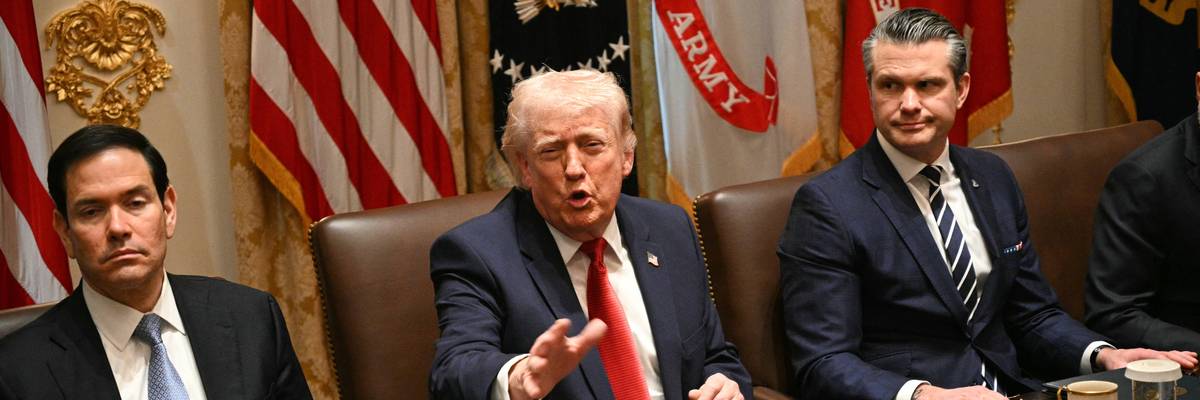
US President Donald Trump, flanked by Secretary of State Marco Rubio and Defense Secretary Pete Hegseth, speaks during a Cabinet meeting at the White House in Washington, DC, on March 26, 2026.
The US president faces pressure to fully retract his "deeply irresponsible threats of acts that would unleash catastrophic harm on millions of civilians."
President Donald Trump on Thursday further delayed any potential US strikes on Iranian power plants to April 6, after nearly a week of critics calling him a "maniacal tyrant" for threatening to commit even more war crimes while attacking Iran with Israel.
"As per Iranian Government request, please let this statement serve to represent that I am pausing the period of Energy Plant destruction by 10 Days to Monday, April 6, 2026, at 8 P.M., Eastern Time. Talks are ongoing and, despite erroneous statements to the contrary by the Fake News Media, and others, they are going very well," Trump wrote on his Truth Social platform.
Trump initially said on the platform last Saturday night that "if Iran doesn't FULLY OPEN, WITHOUT THREAT, the Strait of Hormuz, within 48 HOURS from this exact point in time, the United States of America will hit and obliterate their various POWER PLANTS, STARTING WITH THE BIGGEST ONE FIRST!"
Jan Vande Putte, a senior nuclear and radiation protection expert with Greenpeace International, said in a Monday statement that "bombing civilian electricity infrastructure is illegal under international law. The electricity grid is essential for hospitals, clean water, desalination, and the operation of nuclear facilities. Cutting it off puts millions of lives at risk."
"A blackout could force the Bushehr nuclear facility into depending completely on backup diesel generators, causing a heightened risk of overheating, which can lead to a Fukushima-like disaster," Vande Putte warned, pointing to the 2011 accident in Japan. "If Trump carries through with this reckless threat to knock out critical infrastructure, it could lead to cascading failures, from blackouts to nuclear danger far beyond national borders, with the potential to escalate into a wider regional crisis."
Amid mounting outrage on Monday, Trump instructed the Pentagon to "postpone any and all military strikes against Iranian power plants and energy infrastructure for a five-day period, subject to the success of the ongoing meetings and discussions."
Critics continued to sound the alarm. In a Tuesday statement, Erika Guevara-Rosas, Amnesty International's senior director of research, advocacy, policy, and campaigns, called on Trump to retract his "dangerous" and "deeply irresponsible threats of acts that would unleash catastrophic harm on millions of civilians."
"By threatening such strikes, the USA is effectively indicating its willingness to plunge an entire country into darkness, and to potentially deprive its people of their human rights to life, water, food, healthcare, and adequate standard of living, and to subject them to severe pain and suffering," she warned.
"The decision to not proceed with such attacks must be based on the USA’s obligations under international humanitarian law to avoid civilian harm—not the outcome of political negotiations," the campaigner argued. "Going through with such attacks would cause devastating long-term consequences and severely undermine the international legal framework designed to protect civilians in wartime."
Guevara-Rosas also called on Iran to retract its threats to retaliate by striking power plants used by the US and Israel in Gulf states, as well as end all unlawful attacks on commercial vessels in the Strait of Hormuz and against energy infrastructure and desalination facilities in the region.
"Intentionally attacking civilian infrastructure such as power plants is generally prohibited," she stressed. "Even in the limited cases that they qualify as military targets, a party still cannot attack power plants if this may cause disproportionate harm to civilians. Given that such power plants are essential for meeting the basic needs and livelihoods of tens of millions of civilians, attacking them would be disproportionate and thus unlawful under international humanitarian law, and could amount to a war crime."
As for the Trump administration's negotiations with Iran, the president's special envoy, Steve Witkoff, confirmed Thursday that Pakistani mediators sent the United States' 15-point framework to the Iranian government—which has not fallen over nearly a month of war, despite frequent assassinations.
Citing an Iranian senior political-security official, state-run Press TV reported Wednesday that Iran had rejected Trump's 15-point plan and had a list of five conditions for ending the conflict: a halt to assassinations, concrete mechanisms to ensure that the war is not reimposed, reparations for damages, an end to the war across all fronts and for all resistance groups involved throughout the region, and recognition of Iran sovereignty over the Strait of Hormuz.
As The Associated Press reported Thursday:
Iran's Foreign Minister Abbas Araghchi said in an interview on state TV that his government has not engaged in talks to end the war and does not plan to. He said the US had tried to send messages to Iran through other nations, "but that is not a conversation nor a negotiation."
Egypt is also acting as a go-between, according to Egyptian Foreign Minister Badr Abdelatty, who said Thursday that his country sees a desire from both sides "for calm, for the exploration of negotiations."
Throughout the week, fears of Trump pursuing a ground invasion of Iran have also mounted, intenstifying pressure on congressional Democrats to force another vote on a war powers resolution intended to end the president's unauthorized Operation Epic Fury before the upcoming two-week recess.
"This may be the last opportunity for Congress to slam on the brakes before Trump launches a disastrous ground invasion of Iran," Jamal Abdi, president of the National Iranian American Council, said on social media Thursday evening. "If Democratic leadership fails to force a vote and leaves town for two weeks, they will be complicit in any catastrophic escalation."
Dear Common Dreams reader, It’s been nearly 30 years since I co-founded Common Dreams with my late wife, Lina Newhouser. We had the radical notion that journalism should serve the public good, not corporate profits. It was clear to us from the outset what it would take to build such a project. No paid advertisements. No corporate sponsors. No millionaire publisher telling us what to think or do. Many people said we wouldn't last a year, but we proved those doubters wrong. Together with a tremendous team of journalists and dedicated staff, we built an independent media outlet free from the constraints of profits and corporate control. Our mission has always been simple: To inform. To inspire. To ignite change for the common good. Building Common Dreams was not easy. Our survival was never guaranteed. When you take on the most powerful forces—Wall Street greed, fossil fuel industry destruction, Big Tech lobbyists, and uber-rich oligarchs who have spent billions upon billions rigging the economy and democracy in their favor—the only bulwark you have is supporters who believe in your work. But here’s the urgent message from me today. It's never been this bad out there. And it's never been this hard to keep us going. At the very moment Common Dreams is most needed, the threats we face are intensifying. We need your support now more than ever. We don't accept corporate advertising and never will. We don't have a paywall because we don't think people should be blocked from critical news based on their ability to pay. Everything we do is funded by the donations of readers like you. When everyone does the little they can afford, we are strong. But if that support retreats or dries up, so do we. Will you donate now to make sure Common Dreams not only survives but thrives? —Craig Brown, Co-founder |
President Donald Trump on Thursday further delayed any potential US strikes on Iranian power plants to April 6, after nearly a week of critics calling him a "maniacal tyrant" for threatening to commit even more war crimes while attacking Iran with Israel.
"As per Iranian Government request, please let this statement serve to represent that I am pausing the period of Energy Plant destruction by 10 Days to Monday, April 6, 2026, at 8 P.M., Eastern Time. Talks are ongoing and, despite erroneous statements to the contrary by the Fake News Media, and others, they are going very well," Trump wrote on his Truth Social platform.
Trump initially said on the platform last Saturday night that "if Iran doesn't FULLY OPEN, WITHOUT THREAT, the Strait of Hormuz, within 48 HOURS from this exact point in time, the United States of America will hit and obliterate their various POWER PLANTS, STARTING WITH THE BIGGEST ONE FIRST!"
Jan Vande Putte, a senior nuclear and radiation protection expert with Greenpeace International, said in a Monday statement that "bombing civilian electricity infrastructure is illegal under international law. The electricity grid is essential for hospitals, clean water, desalination, and the operation of nuclear facilities. Cutting it off puts millions of lives at risk."
"A blackout could force the Bushehr nuclear facility into depending completely on backup diesel generators, causing a heightened risk of overheating, which can lead to a Fukushima-like disaster," Vande Putte warned, pointing to the 2011 accident in Japan. "If Trump carries through with this reckless threat to knock out critical infrastructure, it could lead to cascading failures, from blackouts to nuclear danger far beyond national borders, with the potential to escalate into a wider regional crisis."
Amid mounting outrage on Monday, Trump instructed the Pentagon to "postpone any and all military strikes against Iranian power plants and energy infrastructure for a five-day period, subject to the success of the ongoing meetings and discussions."
Critics continued to sound the alarm. In a Tuesday statement, Erika Guevara-Rosas, Amnesty International's senior director of research, advocacy, policy, and campaigns, called on Trump to retract his "dangerous" and "deeply irresponsible threats of acts that would unleash catastrophic harm on millions of civilians."
"By threatening such strikes, the USA is effectively indicating its willingness to plunge an entire country into darkness, and to potentially deprive its people of their human rights to life, water, food, healthcare, and adequate standard of living, and to subject them to severe pain and suffering," she warned.
"The decision to not proceed with such attacks must be based on the USA’s obligations under international humanitarian law to avoid civilian harm—not the outcome of political negotiations," the campaigner argued. "Going through with such attacks would cause devastating long-term consequences and severely undermine the international legal framework designed to protect civilians in wartime."
Guevara-Rosas also called on Iran to retract its threats to retaliate by striking power plants used by the US and Israel in Gulf states, as well as end all unlawful attacks on commercial vessels in the Strait of Hormuz and against energy infrastructure and desalination facilities in the region.
"Intentionally attacking civilian infrastructure such as power plants is generally prohibited," she stressed. "Even in the limited cases that they qualify as military targets, a party still cannot attack power plants if this may cause disproportionate harm to civilians. Given that such power plants are essential for meeting the basic needs and livelihoods of tens of millions of civilians, attacking them would be disproportionate and thus unlawful under international humanitarian law, and could amount to a war crime."
As for the Trump administration's negotiations with Iran, the president's special envoy, Steve Witkoff, confirmed Thursday that Pakistani mediators sent the United States' 15-point framework to the Iranian government—which has not fallen over nearly a month of war, despite frequent assassinations.
Citing an Iranian senior political-security official, state-run Press TV reported Wednesday that Iran had rejected Trump's 15-point plan and had a list of five conditions for ending the conflict: a halt to assassinations, concrete mechanisms to ensure that the war is not reimposed, reparations for damages, an end to the war across all fronts and for all resistance groups involved throughout the region, and recognition of Iran sovereignty over the Strait of Hormuz.
As The Associated Press reported Thursday:
Iran's Foreign Minister Abbas Araghchi said in an interview on state TV that his government has not engaged in talks to end the war and does not plan to. He said the US had tried to send messages to Iran through other nations, "but that is not a conversation nor a negotiation."
Egypt is also acting as a go-between, according to Egyptian Foreign Minister Badr Abdelatty, who said Thursday that his country sees a desire from both sides "for calm, for the exploration of negotiations."
Throughout the week, fears of Trump pursuing a ground invasion of Iran have also mounted, intenstifying pressure on congressional Democrats to force another vote on a war powers resolution intended to end the president's unauthorized Operation Epic Fury before the upcoming two-week recess.
"This may be the last opportunity for Congress to slam on the brakes before Trump launches a disastrous ground invasion of Iran," Jamal Abdi, president of the National Iranian American Council, said on social media Thursday evening. "If Democratic leadership fails to force a vote and leaves town for two weeks, they will be complicit in any catastrophic escalation."
President Donald Trump on Thursday further delayed any potential US strikes on Iranian power plants to April 6, after nearly a week of critics calling him a "maniacal tyrant" for threatening to commit even more war crimes while attacking Iran with Israel.
"As per Iranian Government request, please let this statement serve to represent that I am pausing the period of Energy Plant destruction by 10 Days to Monday, April 6, 2026, at 8 P.M., Eastern Time. Talks are ongoing and, despite erroneous statements to the contrary by the Fake News Media, and others, they are going very well," Trump wrote on his Truth Social platform.
Trump initially said on the platform last Saturday night that "if Iran doesn't FULLY OPEN, WITHOUT THREAT, the Strait of Hormuz, within 48 HOURS from this exact point in time, the United States of America will hit and obliterate their various POWER PLANTS, STARTING WITH THE BIGGEST ONE FIRST!"
Jan Vande Putte, a senior nuclear and radiation protection expert with Greenpeace International, said in a Monday statement that "bombing civilian electricity infrastructure is illegal under international law. The electricity grid is essential for hospitals, clean water, desalination, and the operation of nuclear facilities. Cutting it off puts millions of lives at risk."
"A blackout could force the Bushehr nuclear facility into depending completely on backup diesel generators, causing a heightened risk of overheating, which can lead to a Fukushima-like disaster," Vande Putte warned, pointing to the 2011 accident in Japan. "If Trump carries through with this reckless threat to knock out critical infrastructure, it could lead to cascading failures, from blackouts to nuclear danger far beyond national borders, with the potential to escalate into a wider regional crisis."
Amid mounting outrage on Monday, Trump instructed the Pentagon to "postpone any and all military strikes against Iranian power plants and energy infrastructure for a five-day period, subject to the success of the ongoing meetings and discussions."
Critics continued to sound the alarm. In a Tuesday statement, Erika Guevara-Rosas, Amnesty International's senior director of research, advocacy, policy, and campaigns, called on Trump to retract his "dangerous" and "deeply irresponsible threats of acts that would unleash catastrophic harm on millions of civilians."
"By threatening such strikes, the USA is effectively indicating its willingness to plunge an entire country into darkness, and to potentially deprive its people of their human rights to life, water, food, healthcare, and adequate standard of living, and to subject them to severe pain and suffering," she warned.
"The decision to not proceed with such attacks must be based on the USA’s obligations under international humanitarian law to avoid civilian harm—not the outcome of political negotiations," the campaigner argued. "Going through with such attacks would cause devastating long-term consequences and severely undermine the international legal framework designed to protect civilians in wartime."
Guevara-Rosas also called on Iran to retract its threats to retaliate by striking power plants used by the US and Israel in Gulf states, as well as end all unlawful attacks on commercial vessels in the Strait of Hormuz and against energy infrastructure and desalination facilities in the region.
"Intentionally attacking civilian infrastructure such as power plants is generally prohibited," she stressed. "Even in the limited cases that they qualify as military targets, a party still cannot attack power plants if this may cause disproportionate harm to civilians. Given that such power plants are essential for meeting the basic needs and livelihoods of tens of millions of civilians, attacking them would be disproportionate and thus unlawful under international humanitarian law, and could amount to a war crime."
As for the Trump administration's negotiations with Iran, the president's special envoy, Steve Witkoff, confirmed Thursday that Pakistani mediators sent the United States' 15-point framework to the Iranian government—which has not fallen over nearly a month of war, despite frequent assassinations.
Citing an Iranian senior political-security official, state-run Press TV reported Wednesday that Iran had rejected Trump's 15-point plan and had a list of five conditions for ending the conflict: a halt to assassinations, concrete mechanisms to ensure that the war is not reimposed, reparations for damages, an end to the war across all fronts and for all resistance groups involved throughout the region, and recognition of Iran sovereignty over the Strait of Hormuz.
As The Associated Press reported Thursday:
Iran's Foreign Minister Abbas Araghchi said in an interview on state TV that his government has not engaged in talks to end the war and does not plan to. He said the US had tried to send messages to Iran through other nations, "but that is not a conversation nor a negotiation."
Egypt is also acting as a go-between, according to Egyptian Foreign Minister Badr Abdelatty, who said Thursday that his country sees a desire from both sides "for calm, for the exploration of negotiations."
Throughout the week, fears of Trump pursuing a ground invasion of Iran have also mounted, intenstifying pressure on congressional Democrats to force another vote on a war powers resolution intended to end the president's unauthorized Operation Epic Fury before the upcoming two-week recess.
"This may be the last opportunity for Congress to slam on the brakes before Trump launches a disastrous ground invasion of Iran," Jamal Abdi, president of the National Iranian American Council, said on social media Thursday evening. "If Democratic leadership fails to force a vote and leaves town for two weeks, they will be complicit in any catastrophic escalation."