SUBSCRIBE TO OUR FREE NEWSLETTER
Daily news & progressive opinion—funded by the people, not the corporations—delivered straight to your inbox.
5
#000000
#FFFFFF
To donate by check, phone, or other method, see our More Ways to Give page.

At least 16 US billionaires owe their wealth to one of America’s 20 largest low-wage employers—corporations where a significant share of workers earn so little they have to rely on public assistance.
Of these 16 billionaires, 8 are associated with Walmart. Amazon and Tyson Foods have two members of this elite club, while Home Depot, Best Buy, Starbucks, and Chipotle each have one.
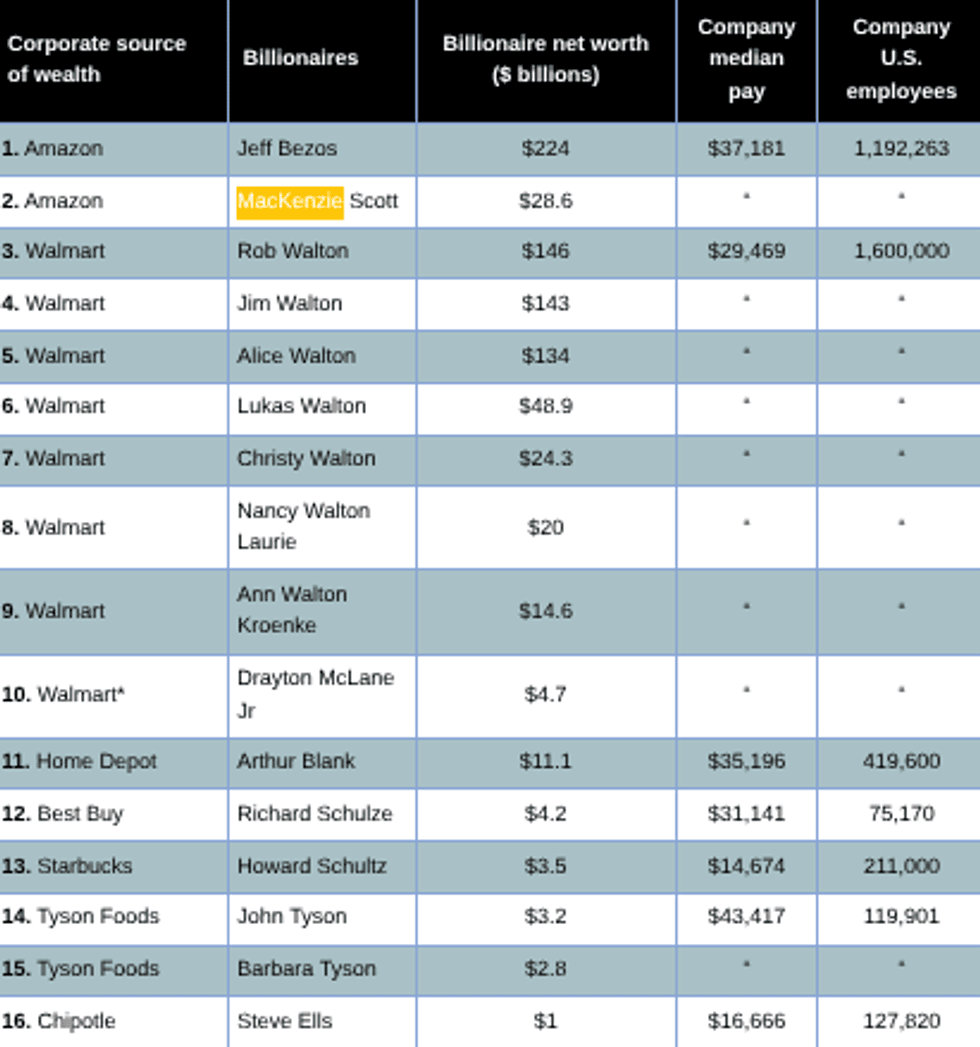
For detailed data on wages and CEO pay at these and other leading low-wage corporations, see the recent Institute for Policy Studies report "America’s 20 Largest Low-Wage Employers and the Affordability Crisis." This article includes updated net worth data from the just-released Forbes 2026 Global Billionaires List.
Seven descendants of Walmart founder Sam Walton have accumulated their multi-billion-dollar fortunes off the backs of the giant retailer’s low-wage workers. His eldest son, Rob Walton, leads the pack, with $146 billion. Another billionaire, Drayton McLane, gained entry to this elite club by selling his grocery distribution business to Walmart for a significant share in the retailer.
When corporate resources are funneled into the pockets of those at the top while ordinary employees have to rely on public assistance, we are all subsidizing the executive mansions and private jets.
Median pay at Walmart, the largest US private sector employer, stood at $29,469 in 2024. That’s below the income limits for a family of three to qualify for Medicaid and Supplemental Nutrition Assistance Program (SNAP) food aid benefits. It’s nowhere near the $59,600 income level needed to afford the US average rent for a two-bedroom apartment.
In addition to median pay figures reported in corporate proxy statements, we gathered data from the small number of state governments that disclose corporations’ use of public assistance programs to subsidize their low wages.
In Nevada, Walmart had 4,574 employees, 29.3% of their employees in that state, enrolled in Medicaid in 2024. In four states (Colorado, Massachusetts, Illinois, and Michigan), Walmart had a total of 10,920 employees enrolled in the SNAP food aid program.
The media organization More Perfect Union points out that Walmart not only relies on SNAP to make up for the low wages they pay their workers, but they also benefit when people use food stamps to buy groceries in their stores. According to a Numerator survey covering the 12 months ending July 31, 2025, Walmart ranked No. 1 for SNAP benefit redemption, receiving nearly 26% of all SNAP dollars.
Since MacKenzie Scott received 4% of Amazon stock in her 2019 divorce settlement, the ecommerce goliath has had not one but two reps on the billionaire ranking. Scott has become a major philanthropist, but is still sitting on an estimated $28.6 billion. Her ex, Amazon founder and current Trump ally Jeff Bezos, came in fourth in the world in the Forbes list this year, with $224 billion.
Amazon’s typical employees are on another economic planet. Their median pay of $37,181 just barely exceeds the family-of-three income limits for Medicaid and SNAP. With half of Amazon employees earning less than that amount, a significant share of the company’s 1.2 million US employees no doubt have to rely on public assistance.
Indeed, the Nevada state government’s Medicaid report reveals that Amazon had 8,951 employees enrolled in that health program in that state in 2024, making up 48.4% of all of the firm’s employees in Nevada. In the four states that report SNAP enrollee data by employer, Amazon came in second after Walmart, with 9,633 employees receiving those benefits.
Home Depot co-founder and Atlanta Falcons owner Arthur Blank holds an estimated $11.1 billion. His fellow co-founder, Bernard Marcus, died on election day in 2024, after donating $9.4 million to the campaigns of President Donald Trump and other Republicans.
While ranking among the country’s lowest-paying companies, Home Depot has had plenty money to blow on stock buybacks. This is a financial maneuver that artificially inflates the value of a company’s shares—and the stock holdings of wealthy executives and stockholders.
The big-box chain spent $37.9 billion on share repurchases between 2019 and 2024. That sum would have been enough to give each of Home Depot’s 419,600 US employees six annual $15,039 bonuses. Home Depot’s median pay in 2024 stood at just $35,196—less than the $35,631 income limit for a family of three to qualify for Medicaid.
State government data show that Home Depot employees had a total of 2,213 employees enrolled in SNAP food aid in Colorado, Massachusetts, Illinois, and Michigan.
Longtime Starbucks CEO Howard Schultz has accumulated $3.5 billion in wealth off a company that paid its median earner just $14,674 in 2024. Employee discontent has sparked pro-union elections at more than 570 stores over the past four years. But the company has used various tactics to prevent workers from securing a first contract, including during a period when Schultz returned to his CEO post.
Schultz recently purchased a $44 million penthouse in Surfside, Florida, a state with zero personal income tax.
Taxing away excessive wealth could also encourage business models that share profits equitably with all employees.
Rounding out the low-wage billionaires list are the founders of Best Buy and Chipotle and two descendants of John Tyson, the founder of Tyson Foods, a meat processor with a sizeable immigrant workforce.
The poverty wage business model that is so prevalent in Corporate America works spectacularly well for a handful of wealthy and politically powerful executives and shareholders. For the rest of us, not so much.
When corporate resources are funneled into the pockets of those at the top while ordinary employees have to rely on public assistance, we are all subsidizing the executive mansions and private jets, the massive political spending, and all the other trappings of excessive wealth.
Lawmakers have introduced several tax proposals to curb the size of billionaire fortunes. Under current law, the ultra rich hold most of their wealth in stock and other financial assets that are not taxable until they are sold. In the meantime, they’re allowed to borrow against these assets to fund their lavish lifestyles and then pass their wealth on to heirs tax-free.
One federal bill to address that loophole, the Billionaires Income Tax Act, would impose an annual tax on billionaires’ gains from tradable assets like stocks, whether or not they sell the asset.
Several other proposals would tax billionaires’ accumulated wealth. For example, Sen. Elizabeth Warren (D-Mass.) and Rep. Pramila Jayapal (D-Wash.) are the lead advocates of the Ultra-Millionaire Tax Act, which would apply a 2% annual tax on the net worth of households and trusts between $50 million and $1 billion and a 3% tax on those with net worth above $1 billion.
Sen. Bernie Sanders (I-Vt.) and Rep. Ro Khanna (D-Calif.) recently introduced a slightly different model that would establish a 5% annual wealth tax on billionaires. This proposal is similar to a California state ballot initiative for a 5% one-time wealth tax on billionaire residents of that state.
Each of these proposals would raise massive revenue for public investments. At the same time, taxing away excessive wealth could also encourage business models that share profits equitably with all employees instead of extracting from those at the bottom to make wealthy executives and shareholders even richer.
At least 16 US billionaires owe their wealth to one of America’s 20 largest low-wage employers—corporations where a significant share of workers earn so little they have to rely on public assistance.
Of these 16 billionaires, 8 are associated with Walmart. Amazon and Tyson Foods have two members of this elite club, while Home Depot, Best Buy, Starbucks, and Chipotle each have one.
For detailed data on wages and CEO pay at these and other leading low-wage corporations, see the recent Institute for Policy Studies report "America’s 20 Largest Low-Wage Employers and the Affordability Crisis." This article includes updated net worth data from the just-released Forbes 2026 Global Billionaires List.
Seven descendants of Walmart founder Sam Walton have accumulated their multi-billion-dollar fortunes off the backs of the giant retailer’s low-wage workers. His eldest son, Rob Walton, leads the pack, with $146 billion. Another billionaire, Drayton McLane, gained entry to this elite club by selling his grocery distribution business to Walmart for a significant share in the retailer.
When corporate resources are funneled into the pockets of those at the top while ordinary employees have to rely on public assistance, we are all subsidizing the executive mansions and private jets.
Median pay at Walmart, the largest US private sector employer, stood at $29,469 in 2024. That’s below the income limits for a family of three to qualify for Medicaid and Supplemental Nutrition Assistance Program (SNAP) food aid benefits. It’s nowhere near the $59,600 income level needed to afford the US average rent for a two-bedroom apartment.
In addition to median pay figures reported in corporate proxy statements, we gathered data from the small number of state governments that disclose corporations’ use of public assistance programs to subsidize their low wages.
In Nevada, Walmart had 4,574 employees, 29.3% of their employees in that state, enrolled in Medicaid in 2024. In four states (Colorado, Massachusetts, Illinois, and Michigan), Walmart had a total of 10,920 employees enrolled in the SNAP food aid program.
The media organization More Perfect Union points out that Walmart not only relies on SNAP to make up for the low wages they pay their workers, but they also benefit when people use food stamps to buy groceries in their stores. According to a Numerator survey covering the 12 months ending July 31, 2025, Walmart ranked No. 1 for SNAP benefit redemption, receiving nearly 26% of all SNAP dollars.
Since MacKenzie Scott received 4% of Amazon stock in her 2019 divorce settlement, the ecommerce goliath has had not one but two reps on the billionaire ranking. Scott has become a major philanthropist, but is still sitting on an estimated $28.6 billion. Her ex, Amazon founder and current Trump ally Jeff Bezos, came in fourth in the world in the Forbes list this year, with $224 billion.
Amazon’s typical employees are on another economic planet. Their median pay of $37,181 just barely exceeds the family-of-three income limits for Medicaid and SNAP. With half of Amazon employees earning less than that amount, a significant share of the company’s 1.2 million US employees no doubt have to rely on public assistance.
Indeed, the Nevada state government’s Medicaid report reveals that Amazon had 8,951 employees enrolled in that health program in that state in 2024, making up 48.4% of all of the firm’s employees in Nevada. In the four states that report SNAP enrollee data by employer, Amazon came in second after Walmart, with 9,633 employees receiving those benefits.
Home Depot co-founder and Atlanta Falcons owner Arthur Blank holds an estimated $11.1 billion. His fellow co-founder, Bernard Marcus, died on election day in 2024, after donating $9.4 million to the campaigns of President Donald Trump and other Republicans.
While ranking among the country’s lowest-paying companies, Home Depot has had plenty money to blow on stock buybacks. This is a financial maneuver that artificially inflates the value of a company’s shares—and the stock holdings of wealthy executives and stockholders.
The big-box chain spent $37.9 billion on share repurchases between 2019 and 2024. That sum would have been enough to give each of Home Depot’s 419,600 US employees six annual $15,039 bonuses. Home Depot’s median pay in 2024 stood at just $35,196—less than the $35,631 income limit for a family of three to qualify for Medicaid.
State government data show that Home Depot employees had a total of 2,213 employees enrolled in SNAP food aid in Colorado, Massachusetts, Illinois, and Michigan.
Longtime Starbucks CEO Howard Schultz has accumulated $3.5 billion in wealth off a company that paid its median earner just $14,674 in 2024. Employee discontent has sparked pro-union elections at more than 570 stores over the past four years. But the company has used various tactics to prevent workers from securing a first contract, including during a period when Schultz returned to his CEO post.
Schultz recently purchased a $44 million penthouse in Surfside, Florida, a state with zero personal income tax.
Taxing away excessive wealth could also encourage business models that share profits equitably with all employees.
Rounding out the low-wage billionaires list are the founders of Best Buy and Chipotle and two descendants of John Tyson, the founder of Tyson Foods, a meat processor with a sizeable immigrant workforce.
The poverty wage business model that is so prevalent in Corporate America works spectacularly well for a handful of wealthy and politically powerful executives and shareholders. For the rest of us, not so much.
When corporate resources are funneled into the pockets of those at the top while ordinary employees have to rely on public assistance, we are all subsidizing the executive mansions and private jets, the massive political spending, and all the other trappings of excessive wealth.
Lawmakers have introduced several tax proposals to curb the size of billionaire fortunes. Under current law, the ultra rich hold most of their wealth in stock and other financial assets that are not taxable until they are sold. In the meantime, they’re allowed to borrow against these assets to fund their lavish lifestyles and then pass their wealth on to heirs tax-free.
One federal bill to address that loophole, the Billionaires Income Tax Act, would impose an annual tax on billionaires’ gains from tradable assets like stocks, whether or not they sell the asset.
Several other proposals would tax billionaires’ accumulated wealth. For example, Sen. Elizabeth Warren (D-Mass.) and Rep. Pramila Jayapal (D-Wash.) are the lead advocates of the Ultra-Millionaire Tax Act, which would apply a 2% annual tax on the net worth of households and trusts between $50 million and $1 billion and a 3% tax on those with net worth above $1 billion.
Sen. Bernie Sanders (I-Vt.) and Rep. Ro Khanna (D-Calif.) recently introduced a slightly different model that would establish a 5% annual wealth tax on billionaires. This proposal is similar to a California state ballot initiative for a 5% one-time wealth tax on billionaire residents of that state.
Each of these proposals would raise massive revenue for public investments. At the same time, taxing away excessive wealth could also encourage business models that share profits equitably with all employees instead of extracting from those at the bottom to make wealthy executives and shareholders even richer.
At least 16 US billionaires owe their wealth to one of America’s 20 largest low-wage employers—corporations where a significant share of workers earn so little they have to rely on public assistance.
Of these 16 billionaires, 8 are associated with Walmart. Amazon and Tyson Foods have two members of this elite club, while Home Depot, Best Buy, Starbucks, and Chipotle each have one.
For detailed data on wages and CEO pay at these and other leading low-wage corporations, see the recent Institute for Policy Studies report "America’s 20 Largest Low-Wage Employers and the Affordability Crisis." This article includes updated net worth data from the just-released Forbes 2026 Global Billionaires List.
Seven descendants of Walmart founder Sam Walton have accumulated their multi-billion-dollar fortunes off the backs of the giant retailer’s low-wage workers. His eldest son, Rob Walton, leads the pack, with $146 billion. Another billionaire, Drayton McLane, gained entry to this elite club by selling his grocery distribution business to Walmart for a significant share in the retailer.
When corporate resources are funneled into the pockets of those at the top while ordinary employees have to rely on public assistance, we are all subsidizing the executive mansions and private jets.
Median pay at Walmart, the largest US private sector employer, stood at $29,469 in 2024. That’s below the income limits for a family of three to qualify for Medicaid and Supplemental Nutrition Assistance Program (SNAP) food aid benefits. It’s nowhere near the $59,600 income level needed to afford the US average rent for a two-bedroom apartment.
In addition to median pay figures reported in corporate proxy statements, we gathered data from the small number of state governments that disclose corporations’ use of public assistance programs to subsidize their low wages.
In Nevada, Walmart had 4,574 employees, 29.3% of their employees in that state, enrolled in Medicaid in 2024. In four states (Colorado, Massachusetts, Illinois, and Michigan), Walmart had a total of 10,920 employees enrolled in the SNAP food aid program.
The media organization More Perfect Union points out that Walmart not only relies on SNAP to make up for the low wages they pay their workers, but they also benefit when people use food stamps to buy groceries in their stores. According to a Numerator survey covering the 12 months ending July 31, 2025, Walmart ranked No. 1 for SNAP benefit redemption, receiving nearly 26% of all SNAP dollars.
Since MacKenzie Scott received 4% of Amazon stock in her 2019 divorce settlement, the ecommerce goliath has had not one but two reps on the billionaire ranking. Scott has become a major philanthropist, but is still sitting on an estimated $28.6 billion. Her ex, Amazon founder and current Trump ally Jeff Bezos, came in fourth in the world in the Forbes list this year, with $224 billion.
Amazon’s typical employees are on another economic planet. Their median pay of $37,181 just barely exceeds the family-of-three income limits for Medicaid and SNAP. With half of Amazon employees earning less than that amount, a significant share of the company’s 1.2 million US employees no doubt have to rely on public assistance.
Indeed, the Nevada state government’s Medicaid report reveals that Amazon had 8,951 employees enrolled in that health program in that state in 2024, making up 48.4% of all of the firm’s employees in Nevada. In the four states that report SNAP enrollee data by employer, Amazon came in second after Walmart, with 9,633 employees receiving those benefits.
Home Depot co-founder and Atlanta Falcons owner Arthur Blank holds an estimated $11.1 billion. His fellow co-founder, Bernard Marcus, died on election day in 2024, after donating $9.4 million to the campaigns of President Donald Trump and other Republicans.
While ranking among the country’s lowest-paying companies, Home Depot has had plenty money to blow on stock buybacks. This is a financial maneuver that artificially inflates the value of a company’s shares—and the stock holdings of wealthy executives and stockholders.
The big-box chain spent $37.9 billion on share repurchases between 2019 and 2024. That sum would have been enough to give each of Home Depot’s 419,600 US employees six annual $15,039 bonuses. Home Depot’s median pay in 2024 stood at just $35,196—less than the $35,631 income limit for a family of three to qualify for Medicaid.
State government data show that Home Depot employees had a total of 2,213 employees enrolled in SNAP food aid in Colorado, Massachusetts, Illinois, and Michigan.
Longtime Starbucks CEO Howard Schultz has accumulated $3.5 billion in wealth off a company that paid its median earner just $14,674 in 2024. Employee discontent has sparked pro-union elections at more than 570 stores over the past four years. But the company has used various tactics to prevent workers from securing a first contract, including during a period when Schultz returned to his CEO post.
Schultz recently purchased a $44 million penthouse in Surfside, Florida, a state with zero personal income tax.
Taxing away excessive wealth could also encourage business models that share profits equitably with all employees.
Rounding out the low-wage billionaires list are the founders of Best Buy and Chipotle and two descendants of John Tyson, the founder of Tyson Foods, a meat processor with a sizeable immigrant workforce.
The poverty wage business model that is so prevalent in Corporate America works spectacularly well for a handful of wealthy and politically powerful executives and shareholders. For the rest of us, not so much.
When corporate resources are funneled into the pockets of those at the top while ordinary employees have to rely on public assistance, we are all subsidizing the executive mansions and private jets, the massive political spending, and all the other trappings of excessive wealth.
Lawmakers have introduced several tax proposals to curb the size of billionaire fortunes. Under current law, the ultra rich hold most of their wealth in stock and other financial assets that are not taxable until they are sold. In the meantime, they’re allowed to borrow against these assets to fund their lavish lifestyles and then pass their wealth on to heirs tax-free.
One federal bill to address that loophole, the Billionaires Income Tax Act, would impose an annual tax on billionaires’ gains from tradable assets like stocks, whether or not they sell the asset.
Several other proposals would tax billionaires’ accumulated wealth. For example, Sen. Elizabeth Warren (D-Mass.) and Rep. Pramila Jayapal (D-Wash.) are the lead advocates of the Ultra-Millionaire Tax Act, which would apply a 2% annual tax on the net worth of households and trusts between $50 million and $1 billion and a 3% tax on those with net worth above $1 billion.
Sen. Bernie Sanders (I-Vt.) and Rep. Ro Khanna (D-Calif.) recently introduced a slightly different model that would establish a 5% annual wealth tax on billionaires. This proposal is similar to a California state ballot initiative for a 5% one-time wealth tax on billionaire residents of that state.
Each of these proposals would raise massive revenue for public investments. At the same time, taxing away excessive wealth could also encourage business models that share profits equitably with all employees instead of extracting from those at the bottom to make wealthy executives and shareholders even richer.