SUBSCRIBE TO OUR FREE NEWSLETTER
Daily news & progressive opinion—funded by the people, not the corporations—delivered straight to your inbox.
5
#000000
#FFFFFF
To donate by check, phone, or other method, see our More Ways to Give page.
Daily news & progressive opinion—funded by the people, not the corporations—delivered straight to your inbox.
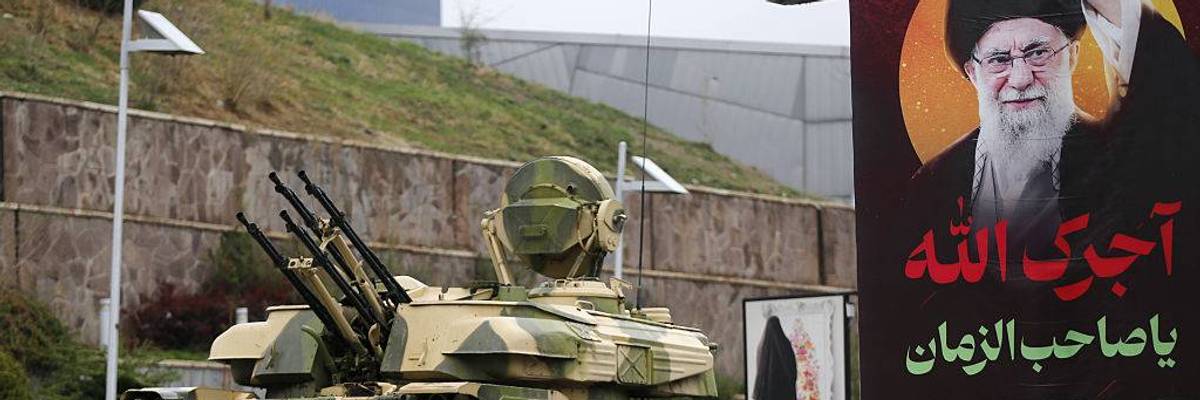
Domestically produced tanks and missiles are put on display in Tehran, Iran on March 25, 2026.
"Every day this war goes on makes both the United States and Iran weaker, poorer, and less secure."
Even as President Donald Trump signaled this week that he'd like to quickly wrap up his unconstitutional war with Iran, some experts are warning that the president has put himself in a situation with no easy way out.
Military historian Bret Devereaux, a teaching assistant professor at North Carolina State University, published a lengthy analysis of the war on Wednesday in which he described it as a failed gamble that Iran's regime would simply crumble in the face of a well-executed series of aerial strikes.
Devereaux said that this was highly unlikely given the nature of the Iranian regime, which is structured to maintain itself up and down the chain of command if one or even several of its leaders are killed.
And now that it's very clear that Trump's gamble of overthrowing the regime hasn't paid off, Devereaux wrote, he will be at the mercy of events beyond his control.
"Once started, a major regional war with Iran was always likely to be something of a 'trap,'" he contended, "not in the sense of an ambush laid by Iran—but in the sense of a situation that, once entered, cannot be easily left or reversed."
While Iran's response to the strikes carried out by the US and Israel in June 2025 was relatively tepid, Devereaux said, once Trump and Israeli Prime Minister Benjamin Netanyahu declared that the goal of their latest operation would be regime change, the Iranian government took the extraordinary step of shutting down the Strait of Hormuz, sending global energy prices skyrocketing.
It has been this threat to shut down the strait, as well as the massive difficulty and cost it would take to occupy a nation of 90 million people, the historian continued, that has kept every US president for the last five decades from launching an invasion of Iran.
At the same time, he continued, Trump cannot now simply walk away while leaving Iran with the ability to take the global economy hostage whenever it pleases.
"The result is a fairly classic escalation trap: Once the conflict starts, it is extremely costly for either side to ever back down, which ensures that the conflict continues long past it being in the interests of either party," he wrote. "Every day this war goes on makes both the United States and Iran weaker, poorer, and less secure but it is very hard for either side to back down because there are huge costs connected to being the party that backs down."
Summing up his argument, Devereaux declared, "This war is dumb as hell."
Devereaux's analysis was echoed by Ilan Goldenberg, senior vice president and chief policy officer at J Street, who wrote in a social media post Wednesday that the US and Iran appear to be caught in an escalation trap, as exemplified by the Trump administration's recent decision to send more military personnel to the Persian Gulf.
"The much more important story right now isn’t diplomacy—it’s the thousands of US troops being mobilized and moving toward the Middle East," he wrote. "That movement strongly suggests preparation for further escalation, with Kharg Island emerging as the most likely target. For any objective observer, the likely Iranian response to a US move on Kharg is obvious: escalation, not capitulation. Tehran would almost certainly respond by expanding attacks on energy infrastructure across the Gulf."
Goldenberg added that "the most plausible off-ramp" will involve Trump simply declaring victory while leaving the regime intact and with vague promises to not produce a nuclear weapon, although he said that likely wouldn't come until after more escalation and destruction.
"Better to accept this likely outcome today rather than six months from now," he advised.
In a Wednesday analysis published at Liberal Currents, University of Illinois political scientist Nicholas Grossman cast doubt on Trump's ability to simply wash his hands of the Iran conflict and walk away.
Part of the issue, said Grossman, is that Iran simply might want to keep inflicting economic damage on Trump to make him think twice before launching a future attack on the regime.
"In hard power dynamics, this is the strongest position the Islamic Republic has ever been in, the most leverage they have over the United States since the 1979-80 hostage crisis," Grossman wrote. "Iran is likely thinking of longer-term security. If they can endure more US-Israeli bombing—and the war so far indicates that they can—then they can increasingly establish their ability to crash the global economy, a deterrent even the United States must respect."
Given that Trump is unlikely to want to be seen as a "loser" for simply accepting Iran's control of the strait, Grossman concluded, "that points to stablemate or escalation, more death and destruction, and a global economic disruption that will be bigger than many currently expect."
Dear Common Dreams reader, It’s been nearly 30 years since I co-founded Common Dreams with my late wife, Lina Newhouser. We had the radical notion that journalism should serve the public good, not corporate profits. It was clear to us from the outset what it would take to build such a project. No paid advertisements. No corporate sponsors. No millionaire publisher telling us what to think or do. Many people said we wouldn't last a year, but we proved those doubters wrong. Together with a tremendous team of journalists and dedicated staff, we built an independent media outlet free from the constraints of profits and corporate control. Our mission has always been simple: To inform. To inspire. To ignite change for the common good. Building Common Dreams was not easy. Our survival was never guaranteed. When you take on the most powerful forces—Wall Street greed, fossil fuel industry destruction, Big Tech lobbyists, and uber-rich oligarchs who have spent billions upon billions rigging the economy and democracy in their favor—the only bulwark you have is supporters who believe in your work. But here’s the urgent message from me today. It's never been this bad out there. And it's never been this hard to keep us going. At the very moment Common Dreams is most needed, the threats we face are intensifying. We need your support now more than ever. We don't accept corporate advertising and never will. We don't have a paywall because we don't think people should be blocked from critical news based on their ability to pay. Everything we do is funded by the donations of readers like you. When everyone does the little they can afford, we are strong. But if that support retreats or dries up, so do we. Will you donate now to make sure Common Dreams not only survives but thrives? —Craig Brown, Co-founder |
Even as President Donald Trump signaled this week that he'd like to quickly wrap up his unconstitutional war with Iran, some experts are warning that the president has put himself in a situation with no easy way out.
Military historian Bret Devereaux, a teaching assistant professor at North Carolina State University, published a lengthy analysis of the war on Wednesday in which he described it as a failed gamble that Iran's regime would simply crumble in the face of a well-executed series of aerial strikes.
Devereaux said that this was highly unlikely given the nature of the Iranian regime, which is structured to maintain itself up and down the chain of command if one or even several of its leaders are killed.
And now that it's very clear that Trump's gamble of overthrowing the regime hasn't paid off, Devereaux wrote, he will be at the mercy of events beyond his control.
"Once started, a major regional war with Iran was always likely to be something of a 'trap,'" he contended, "not in the sense of an ambush laid by Iran—but in the sense of a situation that, once entered, cannot be easily left or reversed."
While Iran's response to the strikes carried out by the US and Israel in June 2025 was relatively tepid, Devereaux said, once Trump and Israeli Prime Minister Benjamin Netanyahu declared that the goal of their latest operation would be regime change, the Iranian government took the extraordinary step of shutting down the Strait of Hormuz, sending global energy prices skyrocketing.
It has been this threat to shut down the strait, as well as the massive difficulty and cost it would take to occupy a nation of 90 million people, the historian continued, that has kept every US president for the last five decades from launching an invasion of Iran.
At the same time, he continued, Trump cannot now simply walk away while leaving Iran with the ability to take the global economy hostage whenever it pleases.
"The result is a fairly classic escalation trap: Once the conflict starts, it is extremely costly for either side to ever back down, which ensures that the conflict continues long past it being in the interests of either party," he wrote. "Every day this war goes on makes both the United States and Iran weaker, poorer, and less secure but it is very hard for either side to back down because there are huge costs connected to being the party that backs down."
Summing up his argument, Devereaux declared, "This war is dumb as hell."
Devereaux's analysis was echoed by Ilan Goldenberg, senior vice president and chief policy officer at J Street, who wrote in a social media post Wednesday that the US and Iran appear to be caught in an escalation trap, as exemplified by the Trump administration's recent decision to send more military personnel to the Persian Gulf.
"The much more important story right now isn’t diplomacy—it’s the thousands of US troops being mobilized and moving toward the Middle East," he wrote. "That movement strongly suggests preparation for further escalation, with Kharg Island emerging as the most likely target. For any objective observer, the likely Iranian response to a US move on Kharg is obvious: escalation, not capitulation. Tehran would almost certainly respond by expanding attacks on energy infrastructure across the Gulf."
Goldenberg added that "the most plausible off-ramp" will involve Trump simply declaring victory while leaving the regime intact and with vague promises to not produce a nuclear weapon, although he said that likely wouldn't come until after more escalation and destruction.
"Better to accept this likely outcome today rather than six months from now," he advised.
In a Wednesday analysis published at Liberal Currents, University of Illinois political scientist Nicholas Grossman cast doubt on Trump's ability to simply wash his hands of the Iran conflict and walk away.
Part of the issue, said Grossman, is that Iran simply might want to keep inflicting economic damage on Trump to make him think twice before launching a future attack on the regime.
"In hard power dynamics, this is the strongest position the Islamic Republic has ever been in, the most leverage they have over the United States since the 1979-80 hostage crisis," Grossman wrote. "Iran is likely thinking of longer-term security. If they can endure more US-Israeli bombing—and the war so far indicates that they can—then they can increasingly establish their ability to crash the global economy, a deterrent even the United States must respect."
Given that Trump is unlikely to want to be seen as a "loser" for simply accepting Iran's control of the strait, Grossman concluded, "that points to stablemate or escalation, more death and destruction, and a global economic disruption that will be bigger than many currently expect."
Even as President Donald Trump signaled this week that he'd like to quickly wrap up his unconstitutional war with Iran, some experts are warning that the president has put himself in a situation with no easy way out.
Military historian Bret Devereaux, a teaching assistant professor at North Carolina State University, published a lengthy analysis of the war on Wednesday in which he described it as a failed gamble that Iran's regime would simply crumble in the face of a well-executed series of aerial strikes.
Devereaux said that this was highly unlikely given the nature of the Iranian regime, which is structured to maintain itself up and down the chain of command if one or even several of its leaders are killed.
And now that it's very clear that Trump's gamble of overthrowing the regime hasn't paid off, Devereaux wrote, he will be at the mercy of events beyond his control.
"Once started, a major regional war with Iran was always likely to be something of a 'trap,'" he contended, "not in the sense of an ambush laid by Iran—but in the sense of a situation that, once entered, cannot be easily left or reversed."
While Iran's response to the strikes carried out by the US and Israel in June 2025 was relatively tepid, Devereaux said, once Trump and Israeli Prime Minister Benjamin Netanyahu declared that the goal of their latest operation would be regime change, the Iranian government took the extraordinary step of shutting down the Strait of Hormuz, sending global energy prices skyrocketing.
It has been this threat to shut down the strait, as well as the massive difficulty and cost it would take to occupy a nation of 90 million people, the historian continued, that has kept every US president for the last five decades from launching an invasion of Iran.
At the same time, he continued, Trump cannot now simply walk away while leaving Iran with the ability to take the global economy hostage whenever it pleases.
"The result is a fairly classic escalation trap: Once the conflict starts, it is extremely costly for either side to ever back down, which ensures that the conflict continues long past it being in the interests of either party," he wrote. "Every day this war goes on makes both the United States and Iran weaker, poorer, and less secure but it is very hard for either side to back down because there are huge costs connected to being the party that backs down."
Summing up his argument, Devereaux declared, "This war is dumb as hell."
Devereaux's analysis was echoed by Ilan Goldenberg, senior vice president and chief policy officer at J Street, who wrote in a social media post Wednesday that the US and Iran appear to be caught in an escalation trap, as exemplified by the Trump administration's recent decision to send more military personnel to the Persian Gulf.
"The much more important story right now isn’t diplomacy—it’s the thousands of US troops being mobilized and moving toward the Middle East," he wrote. "That movement strongly suggests preparation for further escalation, with Kharg Island emerging as the most likely target. For any objective observer, the likely Iranian response to a US move on Kharg is obvious: escalation, not capitulation. Tehran would almost certainly respond by expanding attacks on energy infrastructure across the Gulf."
Goldenberg added that "the most plausible off-ramp" will involve Trump simply declaring victory while leaving the regime intact and with vague promises to not produce a nuclear weapon, although he said that likely wouldn't come until after more escalation and destruction.
"Better to accept this likely outcome today rather than six months from now," he advised.
In a Wednesday analysis published at Liberal Currents, University of Illinois political scientist Nicholas Grossman cast doubt on Trump's ability to simply wash his hands of the Iran conflict and walk away.
Part of the issue, said Grossman, is that Iran simply might want to keep inflicting economic damage on Trump to make him think twice before launching a future attack on the regime.
"In hard power dynamics, this is the strongest position the Islamic Republic has ever been in, the most leverage they have over the United States since the 1979-80 hostage crisis," Grossman wrote. "Iran is likely thinking of longer-term security. If they can endure more US-Israeli bombing—and the war so far indicates that they can—then they can increasingly establish their ability to crash the global economy, a deterrent even the United States must respect."
Given that Trump is unlikely to want to be seen as a "loser" for simply accepting Iran's control of the strait, Grossman concluded, "that points to stablemate or escalation, more death and destruction, and a global economic disruption that will be bigger than many currently expect."