SUBSCRIBE TO OUR FREE NEWSLETTER
Daily news & progressive opinion—funded by the people, not the corporations—delivered straight to your inbox.
5
#000000
#FFFFFF
To donate by check, phone, or other method, see our More Ways to Give page.
Daily news & progressive opinion—funded by the people, not the corporations—delivered straight to your inbox.
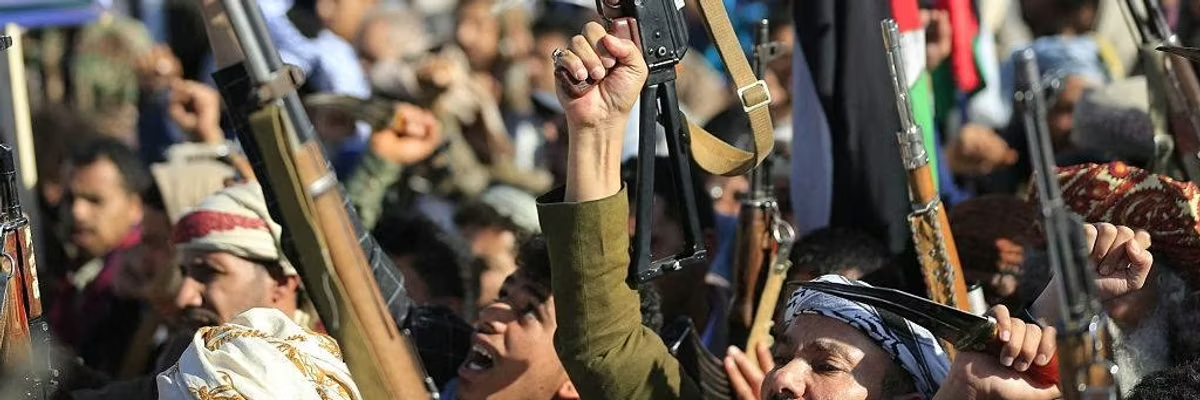
Houthis brandish their weapons as they rally in solidarity with Iran and Lebanon, amid the US-Israeli war with Iran, in the Yemeni capital Sanaa on March 27, 2026.
"You thought it was bad when Iran throttled the Strait of Hormuz?... The Houthis have already proven they can keep the Red Sea closed despite a year of US Navy skirmishing," said one journalist.
The Houthis on Saturday took credit for launching a ballistic missile at Israel, opening a new front in the war US President Donald Trump illegally started with Iran nearly one month ago.
As reported by Axios, the attack by the Houthis signals that the Yemen-based militia is joining the conflict to aide Iran, which has been under aerial assault from the US and Israel for the past four weeks.
Although the Houthi missile was intercepted by Israeli defenses, it is likely just the opening salvo in an expanding conflict throughout the Middle East.
Axios noted that while the Houthis entered the war by launching an attack on Israel, they could inflict the most damage on the US and its allies in the region by shutting down the strait of Bab al-Mandeb in the Red Sea.
"Doing that," Axios explained, "would dramatically increase the global economic crisis that has been created due to the war with Iran" and its closure of the Strait of Hormuz, which has sent global energy prices skyrocketing.
Sky News international correspondent John Sparks reported on Saturday that the Houthis' entrance into the war shows that "this crisis is expanding, it is escalating."
'This crisis is expanding and escalating.'
Houthi rebels in Yemen have confirmed they launched a missile at Israel, marking the Iran-backed group's first involvement in the war.
@sparkomat reports live from Jerusalem
https://t.co/Leuc4SnGfG
📺 Sky 501 and YouTube pic.twitter.com/TmlyFHkCZN
— Sky News (@SkyNews) March 28, 2026
Sparks argued that the Houthis' decision to fire a missile at Israel signals that "the geographical spread of this conflict is expanding," adding that "the Houthis have shown the ability to attack shipping in the Red Sea and the waters around the Arabian Peninsula."
Sparks said that even though Trump and Secretary of State Marco Rubio "have been projecting confidence" about having the war under control, "it's not playing out that way... on the ground."
Danny Citrinowicz, senior researcher at the Institute for National Security Studies, argued that the Houthis' main value to Iran isn't launching strikes on Israel, but their ability to increase economic pressure on the US.
Citrinowicz also outlined ways the Houthis could further drive up the global price of energy.
"This raises a key question: whether the Houthis will escalate further by targeting Saudi infrastructure and shipping lanes more directly, or whether they will preserve this capability as an additional lever of pressure as the conflict evolves," he wrote. "With each passing day of the conflict, particularly in light of its expanding scope against Iran, the likelihood of this scenario materializing continues to grow. It is increasingly not a question of if, but when."
Journalist Spencer Ackerman similarly pointed to the Houthis' ability to cause economic havoc as the biggest concern about their entrance into the conflict.
"You thought it was bad when Iran throttled the Strait of Hormuz?" he asked rhetorically. "The Houthis have already proven they can keep the Red Sea closed despite a year of US Navy skirmishing."
Dear Common Dreams reader, It’s been nearly 30 years since I co-founded Common Dreams with my late wife, Lina Newhouser. We had the radical notion that journalism should serve the public good, not corporate profits. It was clear to us from the outset what it would take to build such a project. No paid advertisements. No corporate sponsors. No millionaire publisher telling us what to think or do. Many people said we wouldn't last a year, but we proved those doubters wrong. Together with a tremendous team of journalists and dedicated staff, we built an independent media outlet free from the constraints of profits and corporate control. Our mission has always been simple: To inform. To inspire. To ignite change for the common good. Building Common Dreams was not easy. Our survival was never guaranteed. When you take on the most powerful forces—Wall Street greed, fossil fuel industry destruction, Big Tech lobbyists, and uber-rich oligarchs who have spent billions upon billions rigging the economy and democracy in their favor—the only bulwark you have is supporters who believe in your work. But here’s the urgent message from me today. It's never been this bad out there. And it's never been this hard to keep us going. At the very moment Common Dreams is most needed, the threats we face are intensifying. We need your support now more than ever. We don't accept corporate advertising and never will. We don't have a paywall because we don't think people should be blocked from critical news based on their ability to pay. Everything we do is funded by the donations of readers like you. When everyone does the little they can afford, we are strong. But if that support retreats or dries up, so do we. Will you donate now to make sure Common Dreams not only survives but thrives? —Craig Brown, Co-founder |
The Houthis on Saturday took credit for launching a ballistic missile at Israel, opening a new front in the war US President Donald Trump illegally started with Iran nearly one month ago.
As reported by Axios, the attack by the Houthis signals that the Yemen-based militia is joining the conflict to aide Iran, which has been under aerial assault from the US and Israel for the past four weeks.
Although the Houthi missile was intercepted by Israeli defenses, it is likely just the opening salvo in an expanding conflict throughout the Middle East.
Axios noted that while the Houthis entered the war by launching an attack on Israel, they could inflict the most damage on the US and its allies in the region by shutting down the strait of Bab al-Mandeb in the Red Sea.
"Doing that," Axios explained, "would dramatically increase the global economic crisis that has been created due to the war with Iran" and its closure of the Strait of Hormuz, which has sent global energy prices skyrocketing.
Sky News international correspondent John Sparks reported on Saturday that the Houthis' entrance into the war shows that "this crisis is expanding, it is escalating."
'This crisis is expanding and escalating.'
Houthi rebels in Yemen have confirmed they launched a missile at Israel, marking the Iran-backed group's first involvement in the war.
@sparkomat reports live from Jerusalem
https://t.co/Leuc4SnGfG
📺 Sky 501 and YouTube pic.twitter.com/TmlyFHkCZN
— Sky News (@SkyNews) March 28, 2026
Sparks argued that the Houthis' decision to fire a missile at Israel signals that "the geographical spread of this conflict is expanding," adding that "the Houthis have shown the ability to attack shipping in the Red Sea and the waters around the Arabian Peninsula."
Sparks said that even though Trump and Secretary of State Marco Rubio "have been projecting confidence" about having the war under control, "it's not playing out that way... on the ground."
Danny Citrinowicz, senior researcher at the Institute for National Security Studies, argued that the Houthis' main value to Iran isn't launching strikes on Israel, but their ability to increase economic pressure on the US.
Citrinowicz also outlined ways the Houthis could further drive up the global price of energy.
"This raises a key question: whether the Houthis will escalate further by targeting Saudi infrastructure and shipping lanes more directly, or whether they will preserve this capability as an additional lever of pressure as the conflict evolves," he wrote. "With each passing day of the conflict, particularly in light of its expanding scope against Iran, the likelihood of this scenario materializing continues to grow. It is increasingly not a question of if, but when."
Journalist Spencer Ackerman similarly pointed to the Houthis' ability to cause economic havoc as the biggest concern about their entrance into the conflict.
"You thought it was bad when Iran throttled the Strait of Hormuz?" he asked rhetorically. "The Houthis have already proven they can keep the Red Sea closed despite a year of US Navy skirmishing."
The Houthis on Saturday took credit for launching a ballistic missile at Israel, opening a new front in the war US President Donald Trump illegally started with Iran nearly one month ago.
As reported by Axios, the attack by the Houthis signals that the Yemen-based militia is joining the conflict to aide Iran, which has been under aerial assault from the US and Israel for the past four weeks.
Although the Houthi missile was intercepted by Israeli defenses, it is likely just the opening salvo in an expanding conflict throughout the Middle East.
Axios noted that while the Houthis entered the war by launching an attack on Israel, they could inflict the most damage on the US and its allies in the region by shutting down the strait of Bab al-Mandeb in the Red Sea.
"Doing that," Axios explained, "would dramatically increase the global economic crisis that has been created due to the war with Iran" and its closure of the Strait of Hormuz, which has sent global energy prices skyrocketing.
Sky News international correspondent John Sparks reported on Saturday that the Houthis' entrance into the war shows that "this crisis is expanding, it is escalating."
'This crisis is expanding and escalating.'
Houthi rebels in Yemen have confirmed they launched a missile at Israel, marking the Iran-backed group's first involvement in the war.
@sparkomat reports live from Jerusalem
https://t.co/Leuc4SnGfG
📺 Sky 501 and YouTube pic.twitter.com/TmlyFHkCZN
— Sky News (@SkyNews) March 28, 2026
Sparks argued that the Houthis' decision to fire a missile at Israel signals that "the geographical spread of this conflict is expanding," adding that "the Houthis have shown the ability to attack shipping in the Red Sea and the waters around the Arabian Peninsula."
Sparks said that even though Trump and Secretary of State Marco Rubio "have been projecting confidence" about having the war under control, "it's not playing out that way... on the ground."
Danny Citrinowicz, senior researcher at the Institute for National Security Studies, argued that the Houthis' main value to Iran isn't launching strikes on Israel, but their ability to increase economic pressure on the US.
Citrinowicz also outlined ways the Houthis could further drive up the global price of energy.
"This raises a key question: whether the Houthis will escalate further by targeting Saudi infrastructure and shipping lanes more directly, or whether they will preserve this capability as an additional lever of pressure as the conflict evolves," he wrote. "With each passing day of the conflict, particularly in light of its expanding scope against Iran, the likelihood of this scenario materializing continues to grow. It is increasingly not a question of if, but when."
Journalist Spencer Ackerman similarly pointed to the Houthis' ability to cause economic havoc as the biggest concern about their entrance into the conflict.
"You thought it was bad when Iran throttled the Strait of Hormuz?" he asked rhetorically. "The Houthis have already proven they can keep the Red Sea closed despite a year of US Navy skirmishing."