SUBSCRIBE TO OUR FREE NEWSLETTER
Daily news & progressive opinion—funded by the people, not the corporations—delivered straight to your inbox.
5
#000000
#FFFFFF
To donate by check, phone, or other method, see our More Ways to Give page.
Daily news & progressive opinion—funded by the people, not the corporations—delivered straight to your inbox.
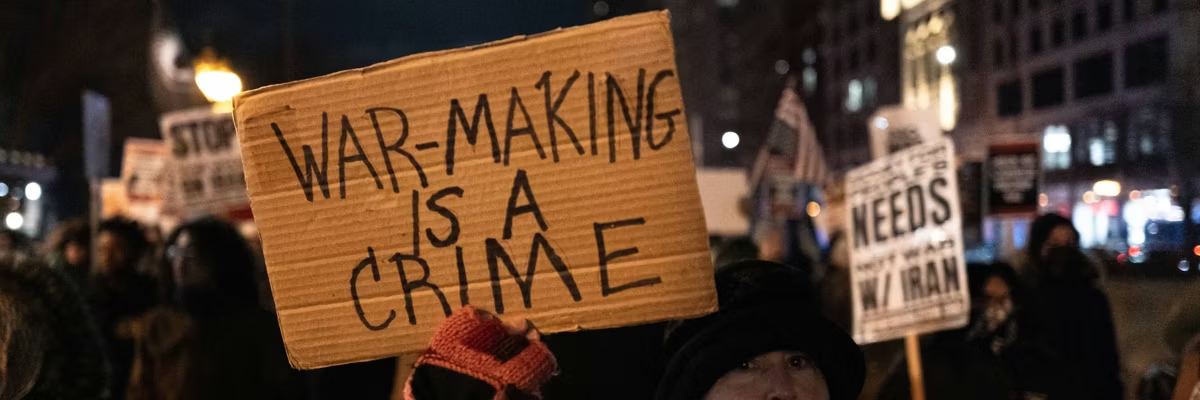
A protester holds placards reading ''war making is a crime'' during a demonstration against the war in Iran, in Chicago, Illinois, on February 28, 2026.
After Trump threatened to "obliterate" Iranian power plants, one Democratic congressman said that "his worsening instability is a clear and growing threat, not only to the American people but to the world."
Democrats in Congress sounded the alarm over President Donald Trump pledging to commit more war crimes in Iran after he traded threats to energy infrastructure with the Iranian government, with the Republican declaring Saturday that he would take out the country's power plants unless it reopened the Strait of Hormuz to all traffic.
Just a day after Trump claimed that "we are getting very close to meeting our objectives as we consider winding down our great Military efforts in the Middle East with respect to the Terrorist Regime of Iran," in a post that remains pinned to the top of his Truth Social profile, the president took to the platform with a clear threat Saturday night.
"If Iran doesn't FULLY OPEN, WITHOUT THREAT, the Strait of Hormuz, within 48 HOURS from this exact point in time, the United States of America will hit and obliterate their various POWER PLANTS, STARTING WITH THE BIGGEST ONE FIRST!" Trump said at 7:44 pm Eastern time.
Trump's post came after Ali Mousavi, the Iranian representative to the International Maritime Organization, told the Chinese news agency Xinhua on Friday that the Strait of Hormuz—the waterway between the Persian Gulf and the Gulf of Oman that is a key shipping route, including for fossil fuels—remains open to all vessels not linked to "Iran's enemies."
It also followed the Israeli military—which is bombing Iran alongside the United States—suggesting that the US was responsible for a Saturday attack on Iran's uranium enrichment complex in Natanz. According to The Associated Press, with his new threat, Trump "may have meant the Bushehr nuclear power plant, Iran's biggest, which was already hit last week, or Damavand, a natural gas plant near Tehran, Iran's capital."
Responding to Trump's Saturday post, US Rep. Don Beyer (D-Va.) said: "It's important not to shy away from candidly discussing the president's increasingly erratic behavior. His worsening instability is a clear and growing threat, not only to the American people but to the world."
Rep. Yassamin Ansari (D-Ariz.) was similarly critical: "From 'help is on the way' for Iranian protestors to threatening war crimes against an entire population. The United States is being run by a maniacal tyrant hell-bent on destroying this country and the world along with it."
Other critics also pointed out that Article 56 of the Geneva Convention states in part that "works or installations containing dangerous forces, namely dams, dykes, and nuclear electrical generating stations, shall not be made the object of attack, even where these objects are military objectives, if such attack may cause the release of dangerous forces and consequent severe losses among the civilian population."
The AP reported that after that strike on the Natanz complex, "Iranian missiles struck two communities in southern Israel late Saturday, leaving buildings shattered and dozens injured in dual attacks not far from Israel's main nuclear research center."
"Israel's military said it was not able to intercept missiles that hit the southern cities of Dimona and Arad, the largest near the center in Israel’s sparsely populated Negev desert," according to the news agency. "It was the first time Iranian missiles penetrated Israel’s air defense systems in the area around the nuclear site."
Mohammad Bagher Ghalibaf, speaker of Iran's Parliament, said on X Saturday that "if the Israeli regime is unable to intercept missiles in the heavily protected Dimona area, it is, operationally, a sign of entering a new phase of the battle... Israel's skies are defenseless."
After Trump's threat, the speaker added Sunday that "immediately after the power plants and infrastructure in our country are targeted, the critical infrastructure, energy infrastructure, and oil facilities throughout the region will be considered legitimate targets and will be irreversibly destroyed, and the price of oil will remain high for a long time."
Dear Common Dreams reader, It’s been nearly 30 years since I co-founded Common Dreams with my late wife, Lina Newhouser. We had the radical notion that journalism should serve the public good, not corporate profits. It was clear to us from the outset what it would take to build such a project. No paid advertisements. No corporate sponsors. No millionaire publisher telling us what to think or do. Many people said we wouldn't last a year, but we proved those doubters wrong. Together with a tremendous team of journalists and dedicated staff, we built an independent media outlet free from the constraints of profits and corporate control. Our mission has always been simple: To inform. To inspire. To ignite change for the common good. Building Common Dreams was not easy. Our survival was never guaranteed. When you take on the most powerful forces—Wall Street greed, fossil fuel industry destruction, Big Tech lobbyists, and uber-rich oligarchs who have spent billions upon billions rigging the economy and democracy in their favor—the only bulwark you have is supporters who believe in your work. But here’s the urgent message from me today. It's never been this bad out there. And it's never been this hard to keep us going. At the very moment Common Dreams is most needed, the threats we face are intensifying. We need your support now more than ever. We don't accept corporate advertising and never will. We don't have a paywall because we don't think people should be blocked from critical news based on their ability to pay. Everything we do is funded by the donations of readers like you. When everyone does the little they can afford, we are strong. But if that support retreats or dries up, so do we. Will you donate now to make sure Common Dreams not only survives but thrives? —Craig Brown, Co-founder |
Democrats in Congress sounded the alarm over President Donald Trump pledging to commit more war crimes in Iran after he traded threats to energy infrastructure with the Iranian government, with the Republican declaring Saturday that he would take out the country's power plants unless it reopened the Strait of Hormuz to all traffic.
Just a day after Trump claimed that "we are getting very close to meeting our objectives as we consider winding down our great Military efforts in the Middle East with respect to the Terrorist Regime of Iran," in a post that remains pinned to the top of his Truth Social profile, the president took to the platform with a clear threat Saturday night.
"If Iran doesn't FULLY OPEN, WITHOUT THREAT, the Strait of Hormuz, within 48 HOURS from this exact point in time, the United States of America will hit and obliterate their various POWER PLANTS, STARTING WITH THE BIGGEST ONE FIRST!" Trump said at 7:44 pm Eastern time.
Trump's post came after Ali Mousavi, the Iranian representative to the International Maritime Organization, told the Chinese news agency Xinhua on Friday that the Strait of Hormuz—the waterway between the Persian Gulf and the Gulf of Oman that is a key shipping route, including for fossil fuels—remains open to all vessels not linked to "Iran's enemies."
It also followed the Israeli military—which is bombing Iran alongside the United States—suggesting that the US was responsible for a Saturday attack on Iran's uranium enrichment complex in Natanz. According to The Associated Press, with his new threat, Trump "may have meant the Bushehr nuclear power plant, Iran's biggest, which was already hit last week, or Damavand, a natural gas plant near Tehran, Iran's capital."
Responding to Trump's Saturday post, US Rep. Don Beyer (D-Va.) said: "It's important not to shy away from candidly discussing the president's increasingly erratic behavior. His worsening instability is a clear and growing threat, not only to the American people but to the world."
Rep. Yassamin Ansari (D-Ariz.) was similarly critical: "From 'help is on the way' for Iranian protestors to threatening war crimes against an entire population. The United States is being run by a maniacal tyrant hell-bent on destroying this country and the world along with it."
Other critics also pointed out that Article 56 of the Geneva Convention states in part that "works or installations containing dangerous forces, namely dams, dykes, and nuclear electrical generating stations, shall not be made the object of attack, even where these objects are military objectives, if such attack may cause the release of dangerous forces and consequent severe losses among the civilian population."
The AP reported that after that strike on the Natanz complex, "Iranian missiles struck two communities in southern Israel late Saturday, leaving buildings shattered and dozens injured in dual attacks not far from Israel's main nuclear research center."
"Israel's military said it was not able to intercept missiles that hit the southern cities of Dimona and Arad, the largest near the center in Israel’s sparsely populated Negev desert," according to the news agency. "It was the first time Iranian missiles penetrated Israel’s air defense systems in the area around the nuclear site."
Mohammad Bagher Ghalibaf, speaker of Iran's Parliament, said on X Saturday that "if the Israeli regime is unable to intercept missiles in the heavily protected Dimona area, it is, operationally, a sign of entering a new phase of the battle... Israel's skies are defenseless."
After Trump's threat, the speaker added Sunday that "immediately after the power plants and infrastructure in our country are targeted, the critical infrastructure, energy infrastructure, and oil facilities throughout the region will be considered legitimate targets and will be irreversibly destroyed, and the price of oil will remain high for a long time."
Democrats in Congress sounded the alarm over President Donald Trump pledging to commit more war crimes in Iran after he traded threats to energy infrastructure with the Iranian government, with the Republican declaring Saturday that he would take out the country's power plants unless it reopened the Strait of Hormuz to all traffic.
Just a day after Trump claimed that "we are getting very close to meeting our objectives as we consider winding down our great Military efforts in the Middle East with respect to the Terrorist Regime of Iran," in a post that remains pinned to the top of his Truth Social profile, the president took to the platform with a clear threat Saturday night.
"If Iran doesn't FULLY OPEN, WITHOUT THREAT, the Strait of Hormuz, within 48 HOURS from this exact point in time, the United States of America will hit and obliterate their various POWER PLANTS, STARTING WITH THE BIGGEST ONE FIRST!" Trump said at 7:44 pm Eastern time.
Trump's post came after Ali Mousavi, the Iranian representative to the International Maritime Organization, told the Chinese news agency Xinhua on Friday that the Strait of Hormuz—the waterway between the Persian Gulf and the Gulf of Oman that is a key shipping route, including for fossil fuels—remains open to all vessels not linked to "Iran's enemies."
It also followed the Israeli military—which is bombing Iran alongside the United States—suggesting that the US was responsible for a Saturday attack on Iran's uranium enrichment complex in Natanz. According to The Associated Press, with his new threat, Trump "may have meant the Bushehr nuclear power plant, Iran's biggest, which was already hit last week, or Damavand, a natural gas plant near Tehran, Iran's capital."
Responding to Trump's Saturday post, US Rep. Don Beyer (D-Va.) said: "It's important not to shy away from candidly discussing the president's increasingly erratic behavior. His worsening instability is a clear and growing threat, not only to the American people but to the world."
Rep. Yassamin Ansari (D-Ariz.) was similarly critical: "From 'help is on the way' for Iranian protestors to threatening war crimes against an entire population. The United States is being run by a maniacal tyrant hell-bent on destroying this country and the world along with it."
Other critics also pointed out that Article 56 of the Geneva Convention states in part that "works or installations containing dangerous forces, namely dams, dykes, and nuclear electrical generating stations, shall not be made the object of attack, even where these objects are military objectives, if such attack may cause the release of dangerous forces and consequent severe losses among the civilian population."
The AP reported that after that strike on the Natanz complex, "Iranian missiles struck two communities in southern Israel late Saturday, leaving buildings shattered and dozens injured in dual attacks not far from Israel's main nuclear research center."
"Israel's military said it was not able to intercept missiles that hit the southern cities of Dimona and Arad, the largest near the center in Israel’s sparsely populated Negev desert," according to the news agency. "It was the first time Iranian missiles penetrated Israel’s air defense systems in the area around the nuclear site."
Mohammad Bagher Ghalibaf, speaker of Iran's Parliament, said on X Saturday that "if the Israeli regime is unable to intercept missiles in the heavily protected Dimona area, it is, operationally, a sign of entering a new phase of the battle... Israel's skies are defenseless."
After Trump's threat, the speaker added Sunday that "immediately after the power plants and infrastructure in our country are targeted, the critical infrastructure, energy infrastructure, and oil facilities throughout the region will be considered legitimate targets and will be irreversibly destroyed, and the price of oil will remain high for a long time."