July, 25 2016, 03:15pm EDT

EPA Admits Airplane Pollution's Climate Danger But Drags Feet on Emissions Rules
Agency releases long-awaited endangerment finding acknowledging that planet-warming pollution from airplanes poses threat to human welfare
WASHINGTON
After nine years of delay, the U.S. Environmental Protection Agency today officially acknowledged in a so-called "endangerment finding" that planet-warming pollution from airplanes disrupts the climate and endangers human welfare. But the agency failed to move forward on rules to actually reduce aircraft emissions.
"EPA officials finally acknowledged airplane pollution's obvious climate threat, but they're still not actually cutting the airline industry's skyrocketing emissions," said Vera Pardee, senior counsel at the Center for Biological Diversity. "After nearly a decade of denial and delay, we need fast, effective EPA action. The Obama administration must quickly devise ambitious aircraft pollution rules that dramatically reduce this high-flying hazard to our climate."
"The endangerment finding documents the magnitude of airplanes' contribution to climate change, but EPA fails to take steps to address these harms," said Sarah Burt, staff attorney at Earthjustice. "We will continue to use the power of law to compel EPA to put in place standards that actually reduce harmful pollution from aircraft."
"People should not have to choose between mobility and a healthy climate," said Marcie Keever, legal director for Friends of the Earth. "The EPA's nine-year delay on regulating aircraft emissions failed the American people. Now it's time for the Obama administration to issue a strong rule, to hold the aviation industry accountable for its significant contributions to climate disruption, and to act immediately to curb air pollution worldwide."
The Center and Friends of the Earth, represented by Earthjustice, first petitioned the EPA in 2007 to regulate carbon emissions from aircraft under the federal Clean Air Act, which requires the government to issue emissions standards for any aircraft pollutant that "may reasonably be anticipated to endanger public health or welfare."
The EPA finally began evaluating the climate risk of airplane pollution in 2014, shortly after environmental organizations filed a notice of intent to sue the agency for failing to reduce aircraft emissions.
Airplane greenhouse gas pollution is growing rapidly. If commercial aviation were considered a country, it would rank seventh after Germany in terms of carbon emissions. Airplanes could generate 43 gigatonnes of planet-warming pollution through 2050, consuming more than 4 percent of the world's remaining carbon budget, according to a recent Center report.
Studies show aircraft emissions could be reduced dramatically. A recent International Council on Clean Transportation report showed that some of the top 20 transatlantic air carriers can drive down greenhouse emissions by as much as 51 percent using existing technology and operational improvements.
The first international standards for carbon pollution from airplanes recommended earlier this year by the International Civil Aviation Organization (ICAO) are years behind the existing technology curve, would not reduce emissions from new planes beyond business as usual and would not even apply to any in-service aircraft.
"Decisive EPA action on airplane pollution is critical to catalyzing change on a global scale," Pardee said. "Aviation's threat to our climate is too big and growing too quickly to be ignored."
Earthjustice is a non-profit public interest law firm dedicated to protecting the magnificent places, natural resources, and wildlife of this earth, and to defending the right of all people to a healthy environment. We bring about far-reaching change by enforcing and strengthening environmental laws on behalf of hundreds of organizations, coalitions and communities.
800-584-6460LATEST NEWS
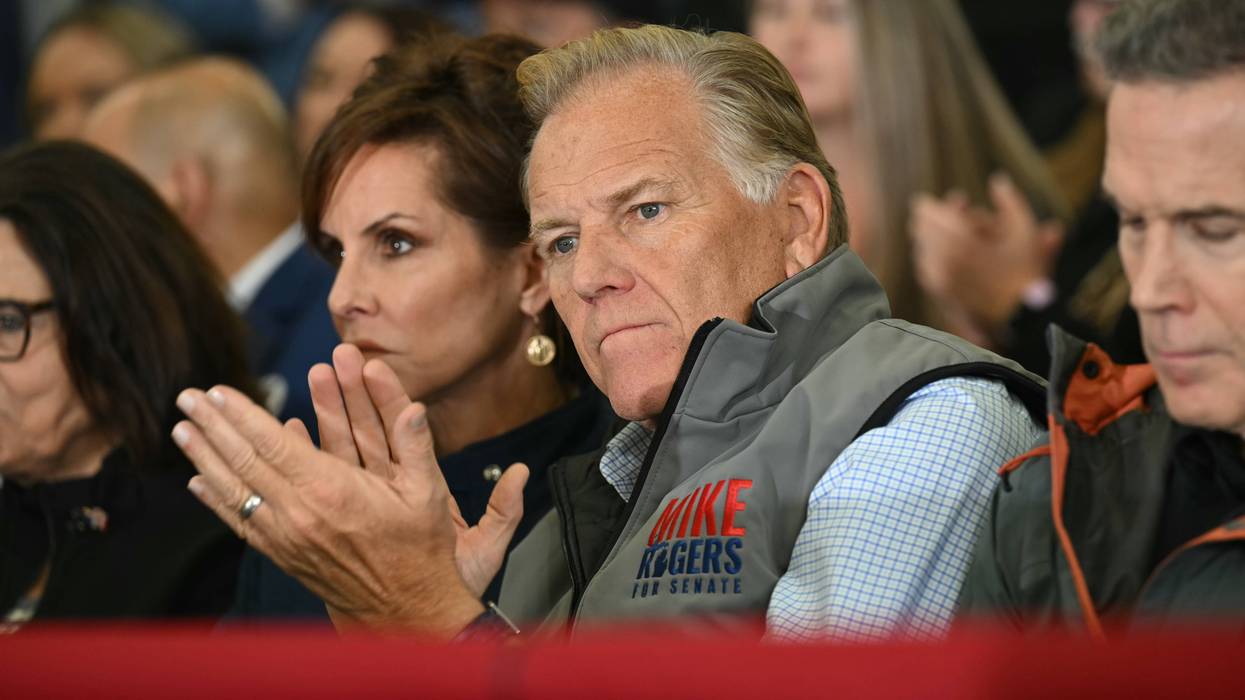
Rogers Cashes Checks From Anti-Abortion Extremists in Final Days of Senate Campaign
"Michigan voters fought hard to protect reproductive freedom, and these extremist groups want a senator who will help them undermine it in Washington."
Oct 27, 2026
Michigan voters were clear in 2022 when they voted by a 13-point margin to codify the right to abortion care in the state constitution, and the state's Republican US Senate candidate, former Rep. Mike Rogers, claimed two years ago that he had no interest in "going back to Washington, DC to undo what the people of Michigan decided to do.”
But a recent campaign contribution from the National Pro-Life Alliance political action committee (PAC) left reproductive rights advocates warning that Rogers has shown throughout his political career that he will fight to stop Michiganders from accessing abortion care—and that extremist groups are counting on him to win the Senate race to ensure abortion is banned nationwide.
Recent filings from the Federal Election Commission show that on October 23, just before Michigan residents began voting early ahead of the November 3 midterms, the National Pro-Life Alliance PAC donated $5,000 to the Rogers for Senate campaign.
The group has lobbied for the passage of the Life at Conception Act, which would ban all abortions with no exceptions for rape, incest, or health risks for the pregnant patient, and previously donated $1,700 to Rogers between 2000-10.
In 2010, when the then-congressman received $1,000 from the group, the National Pro-Life Alliance stipulated that candidates they supported must support the Life at Conception Act.
Shanay Watson-Whittaker, director of Michigan campaigns at Reproductive Freedom for All, told Common Dreams on Tuesday that the "last-minute donation shows how desperate anti-abortion groups are to buy this election—and they’re counting on Mike Rogers to deliver for them."
"His record gives them every reason to believe he will," she added.
"We need someone who will fight for our rights, and Rogers has spent his entire career showing us he won’t.”
Despite Rogers' earlier claims that should he win the Senate seat, he would respect Michiganders' support for the right to abortion care, he spent his 14 years in office backing a constitutional amendment to enshrine "personhood" in the US Constitution, aiming to ban all abortions from the moment of conception, and supporting a national 20-week ban—"still very much a national ban that could carry disparate harm for people experiencing medical emergencies and fetal conditions," wrote Kylie Cheung at Jezebel in 2024.
"I oppose abortion at any time except to save the live [sic] of the mother," Rogers wrote in a candidate questionnaire distributed by the Michigan Catholic Conference, affirming that he supported the Human Life Amendment. He added that he opposed the use of "taxpayer funds for any abortions.”
Rogers was also a sponsor of four fetal "personhood" bills that aimed to ban nearly all abortions nationwide.
Watson-Whittaker urged Michigan voters to keep Rogers' donation from the National Pro-Life Alliance and his record in mind as they go to the polls in the coming week.
"Michigan voters fought hard to protect reproductive freedom, and these extremist groups want a senator who will help them undermine it in Washington," said Watson-Whittaker. "We need someone who will fight for our rights, and Rogers has spent his entire career showing us he won’t.”
Keep ReadingShow Less
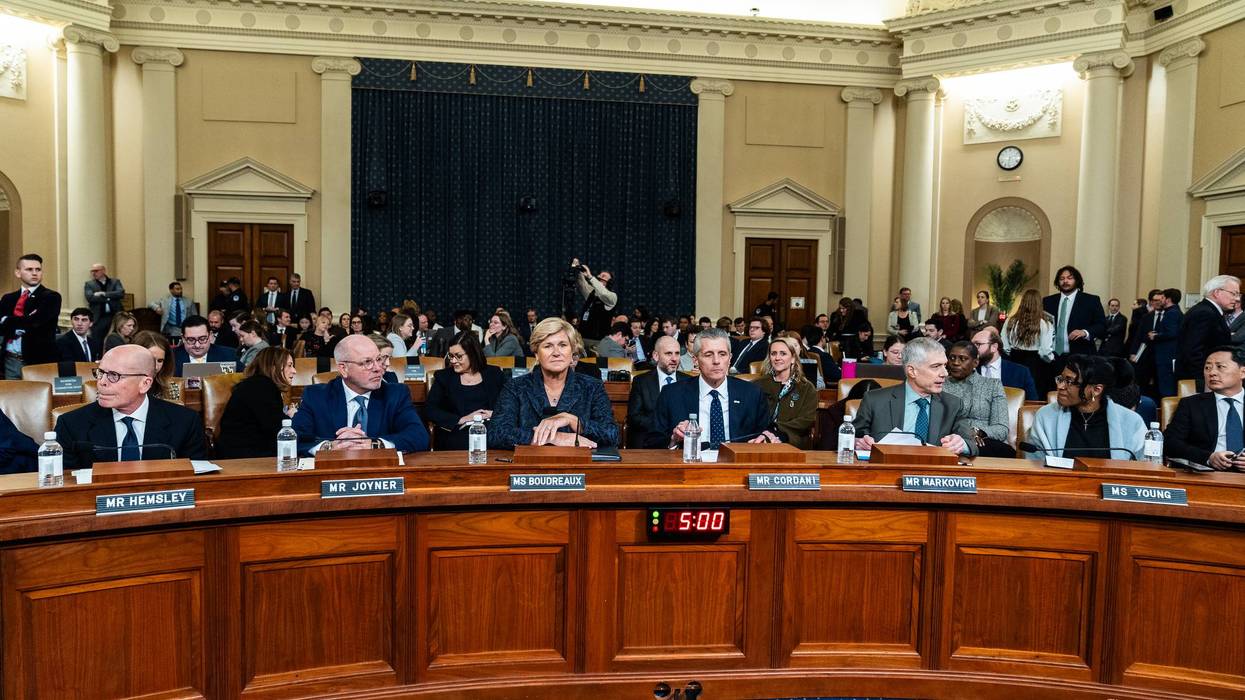
Senators Investigate Insurance Giants for 'Quietly Colluding' With Trump to Kick People Off Healthcare
"Insurance companies chose to participate in a collaborative effort with the Trump administration to inject yet more chaos and damage into the ACA marketplace."
Oct 27, 2026
US Sen. Bernie Sanders and a dozen of his Democratic colleagues are investigating the roles that Cigna, UnitedHealthcare, and other leading private insurance companies are playing in the Trump administration's ongoing efforts to strip health coverage from millions of Americans.
On Monday, the lawmakers sent letters to the chief executives of 10 top insurance companies demanding answers on the firms' cooperation with the Trump administration in its recent removal of around 760,000 Affordable Care Act (ACA) enrollees, citing alleged fraud.
"Aligning with Republicans and their so-called ‘war on fraud,’ insurance companies chose to participate in a collaborative effort with the Trump administration to inject yet more chaos and damage into the ACA marketplace,” the senators wrote. “This year, nearly 3 million people have lost coverage while millions more are paying sky-high premiums and higher deductibles for insurance that covers less."
The lawmakers noted that the 760,000 coverage terminations "would not have been possible without the cooperation of insurance companies that have been quietly colluding with the Trump administration" for months. The senators disclosed in their letters that the ten largest insurance companies in the ACA marketplaces "received, and voluntarily complied with, a Centers for Medicare & Medicaid Services (CMS) data request designed to terminate coverage for hundreds of thousands of enrollees."
The letters characterize the CMS requests as "potentially unlawful" and take insurers to task for readily obeying the administration. The insurance companies that received letters from the senators are Cigna, UnitedHealthcare, AmeriHealth Caritas, Centene, Elevance, Florida Blue, Health Care Service Corporation, Imperial Insurance Companies, Oscar Health, and Molina Healthcare.
"Issuers, including Cigna, took specific steps to assist CMS in their efforts, including sending unsolicited communications to enrollees asking them to verify their Social Security numbers," the senators observed. "Issuers provided CMS with lists of enrollees who did not receive or respond to this unsolicited outreach asking for personally identifiable information. Those enrollees were deemed presumptively fraudulent, so-called 'phantom enrollees' and their coverage was terminated retrospectively, effective August 31, 2026."
The lawmakers added that "enrollees were identified as being subject to coverage termination based on metrics such as whether their projected income made them eligible for tax credits that cover the full premium of their plan, and whether they sought care during the 2026 plan year."
"As you know, there is no credible research or evidence in support of the longstanding Republican conspiracy theory that zero-dollar premium plans and zero-claims enrollment are reliable proxies for fraud," the senators wrote.
Analysts said in response to the administration's September announcement of mass coverage terminations that while fraud certainly exists in the ACA marketplaces, many of the people who lost coverage as part of the purge were likely enrolled legitimately. KFF Health News reported earlier this month that CMS has already "reinstated a small number of people whose coverage should not have been canceled."
"More could follow in the coming weeks if enrollees discover they are uninsured when they go to use their coverage," the outlet noted. "Overall, however, the administration is providing few details about the cancellations, such as how robust the outreach was to those it targeted, how long it takes for people to get reinstated after discovering their coverage was wrongly canceled, and how many such cancellations have been reversed."
The senators demanded answers from the 10 insurance company executives to a series of questions, including when the Trump administration first contacted them about its purported anti-fraud effort in the ACA marketplaces and what steps the firms took to ensure that eligible enrollees were not impacted.
The lawmakers contrasted the companies' voluntary cooperation with the Trump administration with their refusal to act on requests from Democrats last year to increase outreach to ACA enrollees amid relentless Republican attacks on the program.
"Insurance companies almost universally declined to perform any additional direct enrollee outreach, citing the cost and complexity associated with doing so outside the issuer renewal notice process," the senators wrote. "Issuers also expressed concern about being put at a competitive disadvantage should their enrollees choose to shop for more affordable coverage in light of rising premiums."
Keep ReadingShow Less
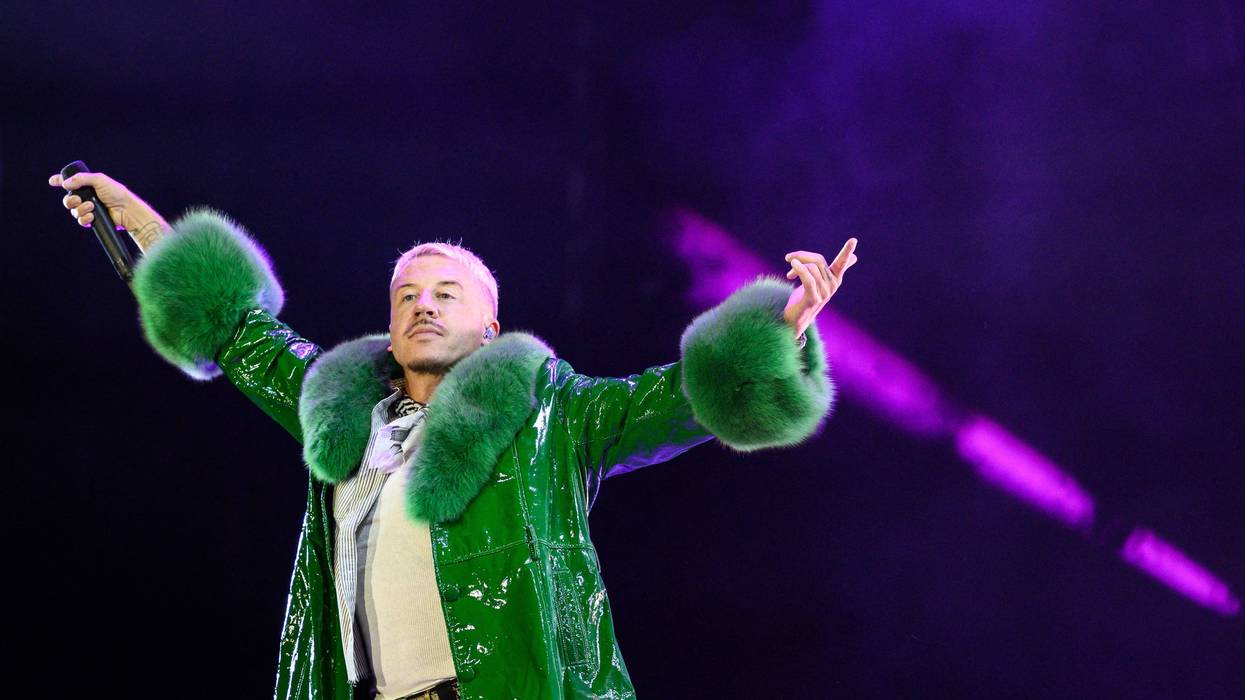
After Silencing by NFL Owner, Macklemore Opens 'Free Palestine' Tour With Sold-Out Dublin Show
The concert garnered rave reviews, with The Guardian calling it a five-star "triumph," and The Irish Times praising the “courage of Macklemore's convictions.”
Oct 27, 2026
In a metaphorical middle finger to billionaire NFL owner Robert Kraft's effort to get Macklemore booted from Ed Sheeran’s US stadium tour over his outspoken support for Palestinian liberation, the rapper opened his "Free Palestine" benefit tour Monday with a critically acclaimed sold-out show in Dublin.
More than 13,000 fans packed Dublin's 3Arena, waving Palestinian flags and wearing keffiyehs as the crowd repeatedly chanted “Free Palestine" throughout the show.
“I am proud to stand here on stage in solidarity with the Palestinian people,” Macklemore told the audience. “We will continue to fight for collective liberation until our last breath."
"Six weeks ago, it was two words. Two words is all that it took. Two words that are rooted in love and liberation. Not against anybody, not divisive, not a call for hatred, but a call to recognize our shared humanity. 'Free Palestine.' I said 'Free Palestine,'" the Seattle native said.
He was referring to his removal from Sheeran's Loop Tour amid pressure from Kraft—who owns the New England Patriots and Gillette Stadium in Foxborough, Massachusetts—after the rapper condemned Israel's genocidal assault on Gaza and illegal occupation and apartheid in the West Bank during a September performance at MetLife Stadium in New Jersey.
"While the world debates those words, we see the videos, we see the footage, we see parents pulling their children out of the rubble, families erased, devastation beyond our imagination," Macklemore, whose real name is Benjamin Hammond Haggerty, continued.
"And somehow," he added, "those words have become more controversial than the suffering that made them necessary."
Kraft's pressure backfired spectacularly as every other opening artist on Sheeran's tour withdrew in solidarity with Macklemore, while the rapper launched his own benefit shows in larger European venues than he had played on his previous tour.
In addition to Macklemore—who rose to prominence in 2012 with his multiplatinum hit "Thrift Shop"—the concert featured performances by Irish artist Hozier, trio Kneecap, and folk band Beoga; Palestinian singer Lina Makoul; Palestinian American DJ Habibeats; and US political hip-hop duo Dead Prez.d
Actors Mark Ruffalo and Cynthia Nixon and Strokes frontman Julian Casablancas also appeared via video messages.
Macklemore has paid more than just lip service to the Palestinian cause, pledging $1 million to aid groups. Children's educator and YouTube star Ms. Rachel subsequently vowed to match the donation, declaring, “We have a moral obligation to use our privilege and platforms to protect children and human rights.”
The proceeds of the "Free Palestine" tour—which also has scheduled shows in London and Paris—will support organizations providing Palestinians with medical care, humanitarian assistance, education, and community services.
The tour's opening show garnered rave reviews, with The Guardian calling it a five-star "triumph," and The Irish Times giving the concert four stars and praising the “courage of Macklemore's convictions.”
Keep ReadingShow Less
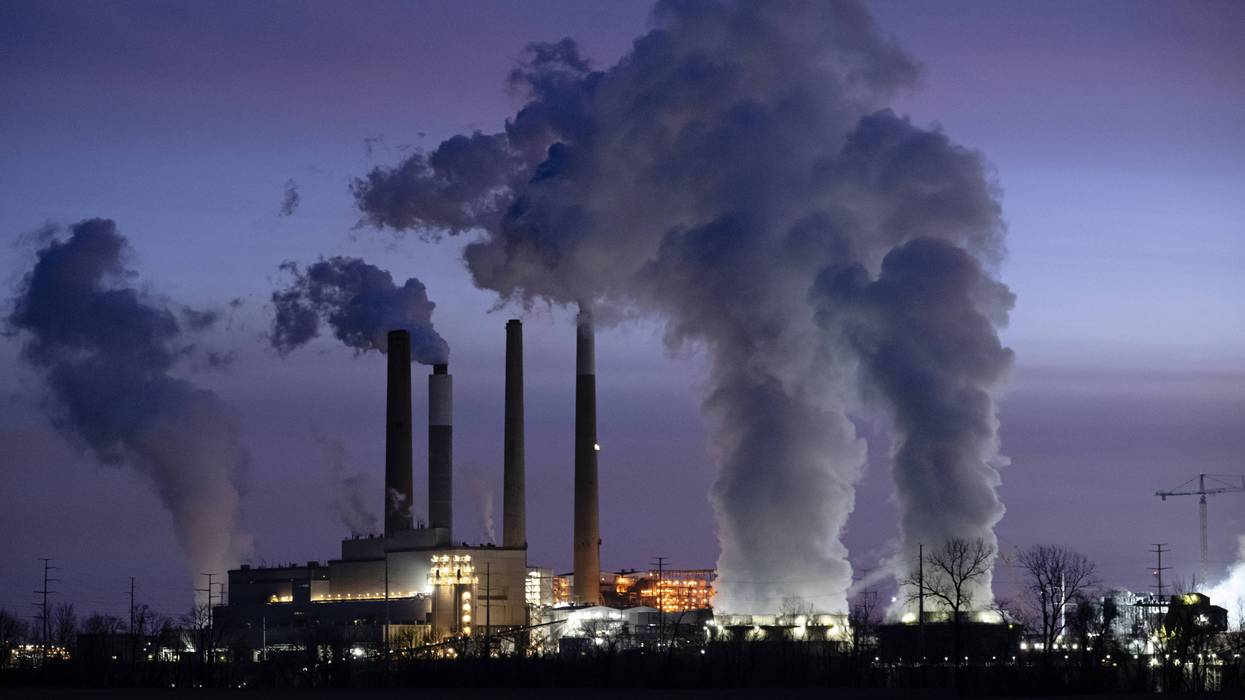
'Another Year, Another New Record': UN Highlights Rising Greenhouse Gas Levels Ahead of COP31
"We are supercharging the ocean and the atmosphere," said one WMO leader. "That means that heatwaves, tropical cyclones, and rainstorms are intensifying faster than our historical baselines prepared us for."
Oct 27, 2026
With the next United Nations Climate Change Conference less than two weeks away, a UN agency confirmed Tuesday that levels of three key greenhouse gases in the atmosphere "reached unprecedented highs in 2025, locking in more long-term temperature increase for the planet."
“Another year, another new record," World Meteorological Organization (WMO) Deputy Secretary-General Ko Barrett said in a statement. "The past 11 years have been the warmest on record, and this trend is set to continue."
"The big three are carbon dioxide, methane, and nitrous oxide. Since the 1960s, growth rates of CO2 have tripled," Barrett told journalists during a press briefing about the "Greenhouse Gas Bulletin of 2025," which is published annually.
Global greenhouse gas concentrations reach record highs in 2025. The unprecedented atmospheric levels of carbon dioxide and methane lock in severe climate impacts and temperature increases for centuries ahead of the upcoming United Nations climate summit in Turkey.www.france24.com/en/live-news...
[image or embed]
— Flingjore (@flingjore.com) October 27, 2026 at 11:12 AM
"When the bulletin was first published in 2004, the annual level of carbon dioxide was 377.5 parts per million. In 2025, it was 426.8 parts per million," Barrett noted. Methane, or CH4, hit 1,948 parts per billion, while nitrous oxide, or N2O, was 339.1 ppb.
"Every additional part per million matters because it traps additional heat," she stressed. "In effect, we are supercharging the ocean and the atmosphere. That means that heatwaves, tropical cyclones, and rainstorms are intensifying faster than our historical baselines prepared us for."
While carbon dioxide is "the most abundant long-lived gas," Barrett also addressed "gases which are present in much lower concentrations but are of potential concern," such as sulfur hexafluoride, or SF6—which "is closely related to electricity production and distribution, and has been rising over the past three decades because of the switch to global electrification."
"Sulfur hexafluoride concentration in 2025 have increased by 249% relative to 1995 levels. They are measured in parts per trillion—not million. So why should we be concerned?" she said. "Because SF6 has an atmospheric lifetime of up to 3,200 years. Its global warming potential is more than 24,000 times that of CO2."
"The energy transition is essential and welcome," Barrett added. "But as with every transition, it has to be done in a smart way and informed by environmental observations."
The WMO bulletin follows a series of recent UN reports showing the Paris Agreement's goal of limiting global temperature rise this century to 1.5°C above preindustrial levels is no longer possible without an overshoot, but getting back to that level is, with ambitious action to phase out fossil fuels.
Additionally, before the ongoing biodiversity summit in Yerevan, Armenia, the UN warned that the world is not on track to meet any of the targets from the Kunming-Montreal Global Biodiversity Framework, or the "Paris Agreement for Nature."
While that event on the global biodiversity crisis—which is linked to the worsening climate emergency—is set to conclude in a few days, world leaders are scheduled to convene again on November 9 in Antalya, Türkiye for the next climate conference, or COP31.
Although the United States is the world's biggest historical climate polluter, and one of the recently released UN reports repeatedly calls out US emissions, Big Oil-backed President Donald Trump has ditched the Paris Agreement, again, and is not expected to send a delegation to Antalya.
"The rest of the world is exhausted when it comes to counting the damage that the US is willingly doing to allies, multilateral structures, economic cooperation, disaster relief," Australian climate scientist Malte Meinshausen told The Associated Press earlier this month. "The rest of the world should probably continue to focus even less on the US."
There is hope in the elections taking place around the world and how they may usher in new leadership in many countries. Even with those changes, we all are in for a warm ride filled with climate shocks until we stabilize the concentrations of greenhouse gases in the atmosphere.
— Dana R. Fisher (aka the Apocalyptic Optimist) (@fisherdanar.bsky.social) October 27, 2026 at 6:37 AM
In the United States, University of Pennsylvania professor Michael Mann said Tuesday that "there is a lot of support among the public for a clean energy transition. The problem is that the fossil fuel industry currently owns our government. But there are reasons for optimism that we might begin to turn the corner, with the midterm elections" on November 3.
"If they return one or both houses of Congress to the Democrats, there will be the possibility of Congress acting as a check on the destructive policies of the Trump administration and in a couple of years, with new leadership at the presidential level, the US could once again reassert leadership on climate," the climatologist told writer Brian McHugh.
"We have to transition rapidly away from fossil fuel burning," Mann emphasized. "There's simply no other way. Without regulating them and imposing an incentive structure that leads them to move toward clean energy, nothing else is really going to matter."
Keep ReadingShow Less
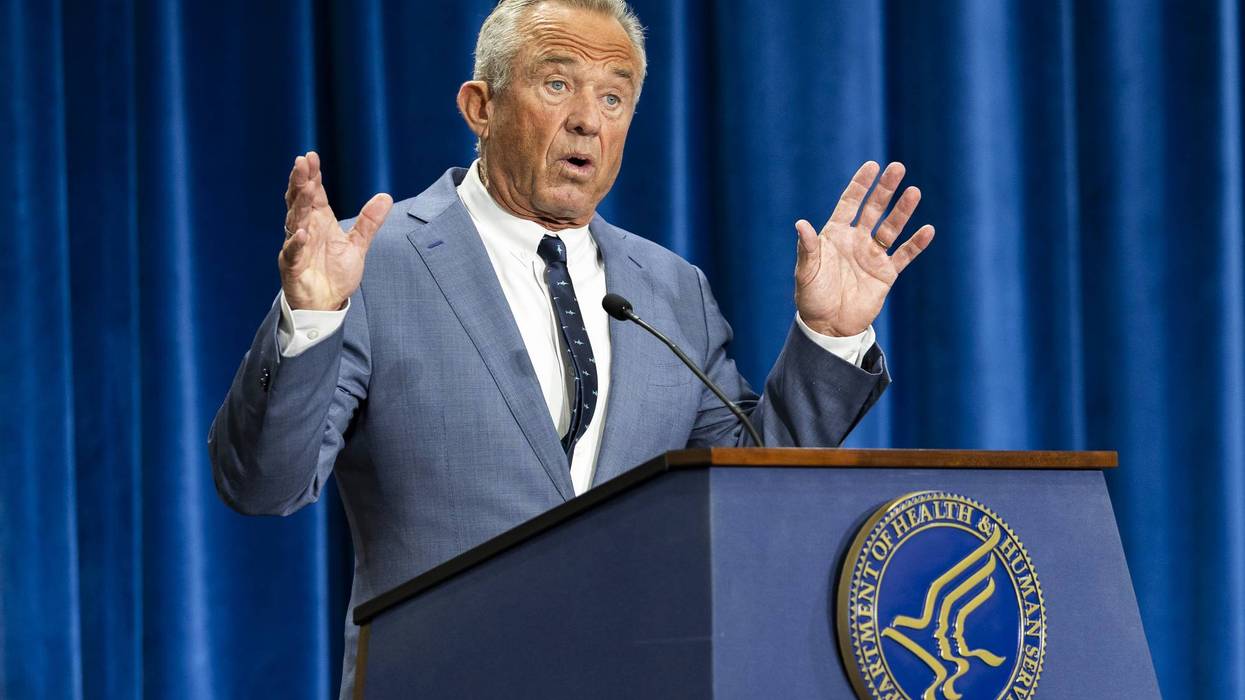
RFK Jr. Condemned Over Baseless and 'Nakedly Racist' Anti-Arab Rant at Rogers Event in Michigan
"Every day, a prominent Republican... says something insanely racist about Muslims or Arabs," said one journalist, while many Democrats are silent about "out-of-control Islamophobia from the GOP."
Oct 27, 2026
Visiting the state with the highest percentage of Arab Americans to campaign for the Republican US Senate candidate, a week before the midterm elections during a campaign in which people from across the political spectrum have recoiled at the GOP's racist, misogynist rhetoric, the Trump administration's top health official opted to share a fact-free non sequitur about hundreds of millions of Arabs across the globe.
Apparently trying to sell voters in Michigan on Republican former Rep. Mike Rogers, who was behind Democratic candidate Abdul El-Sayed by two points in a recent Marist poll—and by six points among independents—Health and Human Services Secretary Robert F. Kennedy Jr. opined on "500 million Arabs in the world," a vast population that he suggested contributes little to the global community.
"They don’t produce science, they don’t win the Nobel Prize, they don’t win the Fields prize, they don’t win the Wolf Prize, they don’t produce literature," declared Kennedy at a campaign event in Grand Rapids.
RFK: "There's five hundred million Arabs in the world. And yet they don't produce science. They don't win the Novel Prize. They don't win the Fields Prize. They don't win the Wolf Prize. They don't produce literature." https://t.co/ikZHqklQjE
— Bulwark Clips (@BulwarkClips) October 26, 2026
The comments provoked horror among numerous Democratic lawmakers, advocacy groups, scientists, and journalists, many of whom were quick to point out that Kennedy's racist rant had no basis in reality.
"Besides being nakedly racist and bigoted, this is just hilariously wrong on all levels," said Justin Baragona of Zeteo News.
Baragona was among the observers who did not have reach far back in history to prove Kennedy, who has been widely condemned for his rejection of scientific evidence as he has questioned the safety of vaccines, entirely wrong about Arab people's contributions to the field.
Just last year, Omar Yaghi won the Nobel Prize in chemistry for the development of metal-organic frameworks. Yaghi was born in Jordan to Palestinian refugee parents. He also won the Wolf Prize, an international award for achievements in sciences and the arts, in 2018, for his contributions to the field of reticular chemistry.
Vaccine scientist Peter Hotez expressed relief that his late colleague and "brilliant co-US Science Envoy," the Egyptian-American chemist Ahmed Zewail, "didn’t have to endure" listening to Kennedy's comments. Zewail won the Nobel Prize in chemistry in 1999.
Entrepreneur Saad Mohseni listed a number of other "Arab science giants" who came to mind.
Baragona also pointed to two winners of the National Book Award just last year—the Lebanese writer and painter Rabih Alameddine and Egyptian-American journalist Omar El Akkad.
But US Sen. Chris Murphy (D-Conn.) suggested that beyond debunking Kennedy's wholly inaccurate claim, "everyone needs to pay attention" to what his comments were part of: a "coordinated campaign to delegitimize Muslim Americans—not just as citizens but as humans."
"These increasingly hysterical attacks are a prelude to Republicans bringing us to a very, very dark place after the election," said Murphy.
The Council on American Islamic Relations demanded that Kennedy be removed from his Cabinet position in light of the remarks, which they called "a textbook display of unvarnished racism and bigotry."
"To stand on a public stage as a sitting US Cabinet official and dehumanize half a billion people—and millions of Muslim and Christian Arab Americans—with fabricated, white supremacist talking points is utterly disqualifying for public office," said the group. "His sweeping erasure of Arab contributions to humanity is not only maliciously false, but it also fans the flames of anti-Arab and anti-Muslim hate at a time when communities are already vulnerable to bigoted attacks from other public officials nationwide. Anyone who holds such blatant contempt for an entire ethnicity has no business leading a federal agency meant to serve all Americans."
Journalist Mehdi Hasan, the founder of Zeteo News, suggested that the Democratic Party and liberal commentators deserve a large share of the blame for a political environment in which a top US official felt comfortable openly degrading hundreds of millions of people of Arab descent, including an estimated 3.7 million Arab Americans, as non-contributing members of society.
"Every day, a prominent Republican—the president, a Cabinet official, a primetime Fox host, the Michigan Senate candidate—says something insanely racist about Muslims or Arabs. Meanwhile, my timeline is full of prominent Democrats and liberals getting mad about a random ad attacking Israel and screaming about antisemitism," he said, referring to an ad recently released by Rebellion political action committee, which criticized US aid to Israel and tied it to Americans' struggles with the rising cost of living.
From many liberal commentators, said Hasan, he has heard "crickets... on the out-of-control Islamophobia from the GOP."
Kennedy's anti-Arab comments were hardly an outlier in the Michigan Senate campaign. Rogers and President Donald Trump have both accused El-Sayed of supporting the Muslim Brotherhood, despite the fact that in 2012, as a congressman, Rogers himself said he was willing to work with the movement. The president has openly called the Michigan-born El-Sayed a "jihadist," and a speaker at one Rogers rally over the weekend said the candidate's birth certificate did not make him an American.
But prominent Democrats have also had a hand in pushing the narrative that El-Sayed is a risky choice for Michiganders. Former state Democratic Party chair Lon Johnson accused El-Sayed of “extremism” last week and said his criticism of Israel threatens Jewish communities, calling on Democrats in the state to “leave the Senate race blank." During the primary, the centrist think tank Third Way spent months attacking El-Sayed for campaigning with popular streamer Hasan Piker, who once said that the US "deserved" the September 11 attacks—a comment he later clarified and apologized for.
At Protect Our Care, an advocacy group that typically focuses on Kennedy's attacks on public health, president Brad Woodhouse said Tuesday that with his remarks in Grand Rapids, the health secretary had "laid bare how small and ignorant he really is."
“Fear and racism are the crutch of pathetic political hacks with absolutely nothing to offer or progress to point to," said Woodhouse. "This is his closing argument for why Republicans need more power, smearing an entire people with gross and instantly disprovable lies? Really?"
"Secretary Kennedy thinks spewing hate will distract people from his multiple corruption scandals and starring role in the historic measles and food-borne illness crises Americans have suffered through this year," he added. "This wasn’t the first time RFK Jr has trafficked in racism, but it may be his ugliest episode yet. It’s an indictment of both Mike Rogers and [Republican US Rep.] John James that they haven’t condemned the remarks. They’d rather clap like seals and hope RFK’s racist ‘hail mary’ pays off for them politically. That makes them just as weak, pathetic, and un-American.”
Keep ReadingShow Less
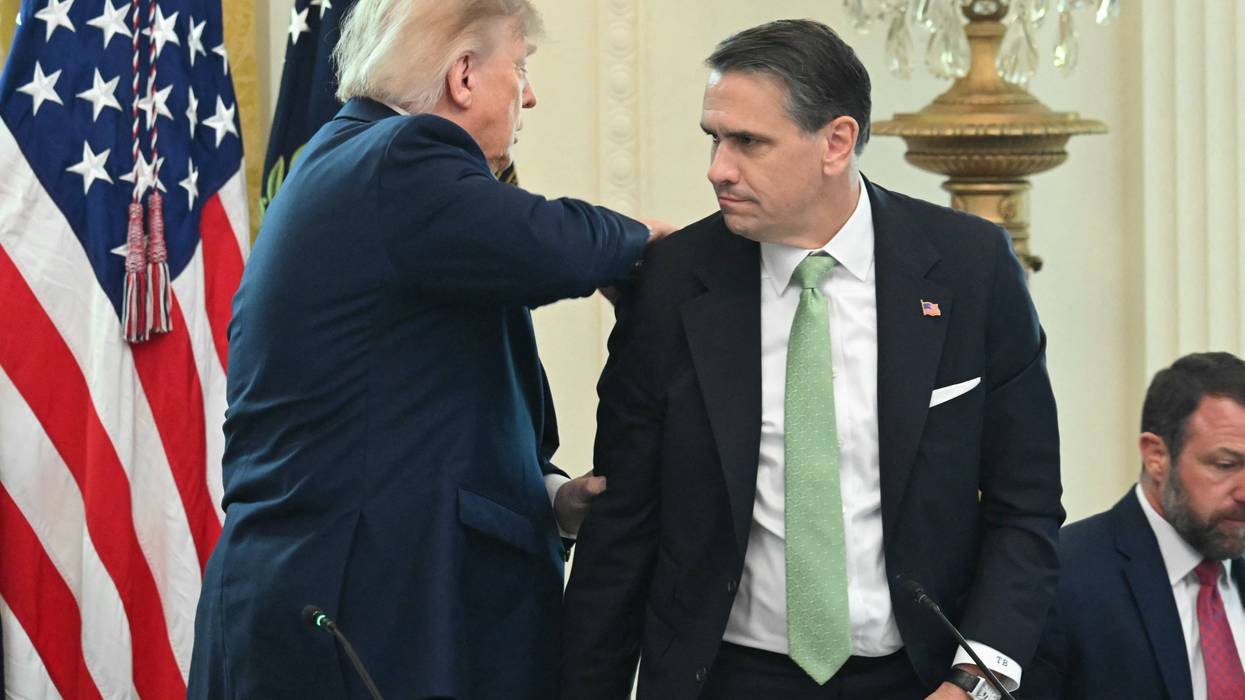
‘Doomsday’ Was No Joke: DOJ Considering Scenarios In Which It Would Intervene in Midterms
"Nobody knows what the president might do if the midterms don’t go his way."
Oct 27, 2026
When US Attorney General Todd Blanche said last week that the Department of Justice may seek to block states from certifying elections if a "doomsday" scenario occurred, he wasn't simply speaking hypothetically.
Three administration officials have told investigative journalist Ken Klippenstein that the DOJ has several "contingency plans" that may result in unprecedented efforts at federal interference, many of which President Donald Trump and other administration officials have hinted at in the press.
The plans include extreme scenarios like a foreign cyberattack, according to a report from Klippenstein on Monday. They also include scenarios that the administration has claimed are already underway, such as “questions about qualified voters” and “voter confusion.”
The DOJ has already acted on such claims in three states.
At Trump's direction, the DOJ has demanded that Alaska suspend the certification of its Senate election if Republican Sen. Dan Sullivan loses, arguing that the presence of another person with the same name on the ballot was part of a ploy to “confuse” voters.
Earlier this month, the department sued California to keep officials from tallying ballots cast by people it flagged as potentially ineligible using an error-prone federal database. Its list contained around 20,000 names.
Two judges expressed concerns that the list could disenfranchise lawful voters. When Los Angeles County officials reviewed a sample of 200 records, they found that the list included US-born people, people with inactive or canceled registrations, and people with no voting history.
On Monday, the DOJ demanded that Washington state set aside ballots from over 400 people on similar grounds.
Officials told Klippenstein that other potential "doomsday" scenarios are being discussed as possible catalysts for federal intervention, including "disruptions at the polls" and "irregularities with the count."
After suggesting the midterms should be outright "canceled," Trump has suggested that Republicans should "nationalize" elections despite the plain language of the US Constitution, which makes them the domain of states, subject to congressional regulation.
During a TV interview in February, he suggested that plans were in the works to "put in federal controls as opposed to state controls" if states could not conduct elections "honestly."
Following that interview, officials said that then-Attorney General Pam Bondi met with Trump and several governors in the White House State Dining Room to discuss potential election doomsday scenarios. Bondi then reportedly spoke with senior department officials about what situations might justify action.
While the president and DOJ cannot unilaterally block states from certifying elections, the department can bring lawsuits and seek emergency court orders under the Voting Rights Act if the attorney general has “reasonable grounds” to conclude that there has been intimidation, threats, or coercion against voters or that someone has knowingly provided false registration information or conspired to encourage false registration.
Trump has still not accepted his 2020 presidential election defeat and continues to sow doubts about it six years later. In 2020, he attempted to overturn the outcome by spreading claims that the election was marred by systemic “irregularities” and fraud, which his own advisers informed him were baseless.
Unlike previous attorneys general who declined to lend legitimacy to Trump’s claims, Blanche has repeatedly said he agrees with Trump’s sentiment that the 2020 election was “rigged.” When asked to provide specific evidence last month that mail-in voting produces large amounts of fraud, he said it was simply “common sense.”
Trump has voted by mail numerous times, and mail-in ballots have been used for elections in several states for years, including the conservative state of Utah.
Asked by CNN anchor Dana Bash on Sunday whether Trump was "laying the groundwork" to try to overturn the election again, as he did in 2020, Blanche was defiant.
"Oh stop it!" he scoffed. "You've got to stop it with that! You're not being a real person... We're not laying any groundwork for the president to do that. So the premise of your question is not true."
Breaking with previous norms of DOJ independence from the White House, Blanche declared last week, “I work for President Trump,” suggesting that he will dutifully assist any attempts by the president to undermine the results.
The question is how far he may be willing to go: “Nobody knows what the president might do if the midterms don’t go his way, what Trump might say or what he might provoke,” one senior intelligence official who served in the first Trump White House told Klippenstein.
One government lawyer told Klippenstein that while there is no law allowing the federal government to suspend elections simply by alleging fraud, that doesn’t mean the administration won’t seek to find a legal justification:
“Could Trump sign a classified emergency order raising the specter of national security to justify intervention?” the intelligence official asks. “Could Doomsday involve some continuity of government argument? You just never know with Donald Trump.”
"If all else fails,” he says, the president could put “pressure on officials, undertake unsupported litigation, or even issue unlawful executive orders." This, he says, could cause enough disruption to provoke a January 6-style riot.
Meanwhile, the government lawyer says the lack of clear legal authority hasn’t stopped the planning.
“Justice Department and White House lawyers are grappling with these very scenarios… [including] what it can do if the law is no guide,” he says.
With the midterms just a week away and Republicans projected to do poorly, Trump has a veritable army of influencers online prepared to sow doubt about the election result.
A Washington Post analysis on Tuesday found nearly 600 high-profile right-wing social media accounts, podcasts, and other media sources that have published content questioning the integrity of the election and telling Trump supporters to expect cheating. Many of their claims echo those made by the administration about the prevalence of noncitizen voting, which is exceedingly rare.
Democrats on the congressional intelligence committees have said they are prepared for Trump to claim that classified intelligence shows that foreign powers tampered with vote totals or otherwise intervened to help his rivals.
"This administration has a record of using weaponized intelligence to make the case for election interference, and now its officials are grasping at straws to satisfy the president's desire to interfere with the elections," Alexandra Chandler, the director of impact programs at Free and Fair Elections, told Common Dreams. "None of this is new."
If Trump makes such a claim, Rep. Jim Himes (D-Conn.), the top Democrat on the House Intelligence Committee, said that Trump’s CIA Director John Ratcliffe and Director of National Intelligence Jay Clayton have agreed to review any of the underlying intelligence with him and Sen. Mark Warner (D-Va.), vice chair of the Senate Intelligence Committee.
Himes told reporters, "We’re making the presumption that the president will not accept the results,” adding that they expect him to "pull out all the stops."
Voting rights groups have also said they are ready for whatever Trump throws their way.
"States and local election officials run our elections, not the federal government," Tianna Mays, legal director at the Democracy Defenders Fund, told Common Dreams. "Trump administration officials cannot claim powers they do not have under the Constitution, and we will fight them in court if they try."
“The pro-democracy coalition is prepared for whatever scenario comes,” Chandler said. “We will defend the integrity of this election.”
Keep ReadingShow Less
Election-Denying Trump Judges Preside Over Nearly Every Battleground Midterm Race: Analysis
"We must vote in numbers so overwhelming that no Trump judge could deny the truth."
Oct 27, 2026
If the Trump administration decides to challenge the outcome of any of the dozens of battleground contests in next week's midterms, there's a significant chance that one of the president's handpicked, election-denying judges will oversee the case.
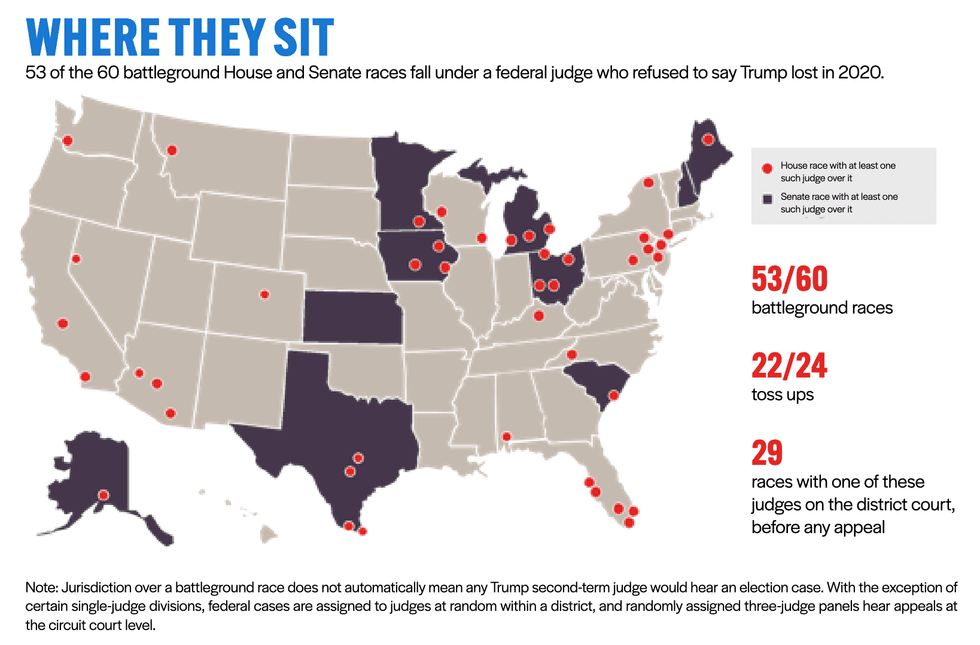
That's according to a report published Tuesday by the advocacy group Demand Justice, which found that 53 of 60 battleground races for US House and Senate that will be held on November 3 "are in districts or states presided over by at least one Trump-appointed federal judge who, under oath, refused to admit that Donald Trump lost the 2020 election."
“If these judges couldn’t tell the truth about 2020, we can’t count on them to do so in 2026," said Josh Orton, president of Demand Justice. "We must vote in numbers so overwhelming that no Trump judge could deny the truth."
The report defines battleground races as Senate and House contests that analysts currently rate as either a toss up, lean Republican, or lean Democratic.
Demand Justice emphasizes that federal courts "look very different" today than they did in 2020, when the judiciary "halted Trump’s attempt to challenge the 2020 election results."
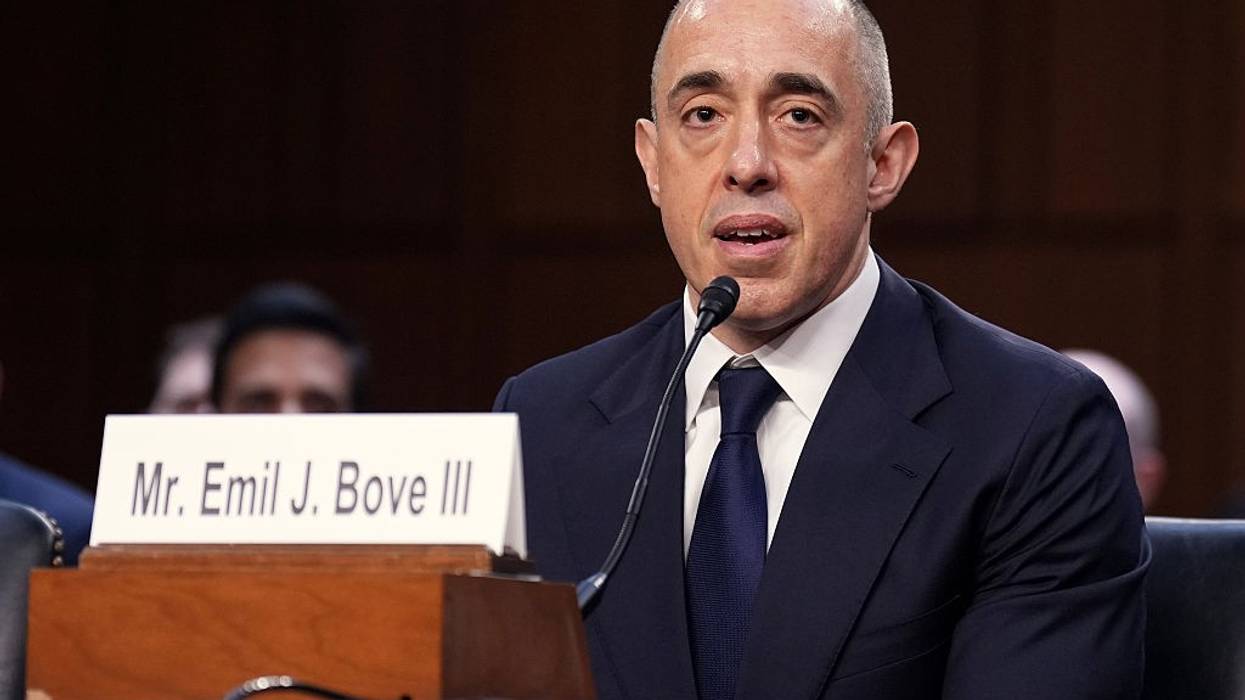
"Since then, Trump appointed Emil Bove and Jennifer Mascott to the Third Circuit, Rebecca Taibleson to the Seventh, Michael Martin to the Eastern District of Michigan, and Eric Tung to the Ninth Circuit, which hears appeals from Arizona," the report notes, pointing to courts that previously weighed 2020-related cases.
During their confirmation hearings, each of those Trump-picked judges—along with dozens of others—refused to explicitly say that Trump lost the 2020 election. As Demand Justice observed in an earlier report, Trump's judicial picks used virtually identical phrasing to evade senators' questions about the 2020 election results, saying that former President Joe Biden "was certified as the winner."
The report comes amid mounting concerns that the Trump administration could try to intervene in the midterms if the outcome is unfavorable to Trump and his Republican Party, which is seeking to maintain control of both chambers of Congress.
Demand Justice cited as an alarming example the Justice Department's lawsuit aiming at blocking certification of Alaska's US Senate election if Republican Sen. Dan Sullivan loses. Trump told reporters late last week that he ordered the DOJ to file the lawsuit, which Democratic nominee Mary Peltola is seeking to dismiss before Election Day.
“Trump's attempt to interfere in Alaska’s Senate race is a wake-up call," said Orton. "His administration will not accept election results unless the Republicans win."
Keep ReadingShow Less
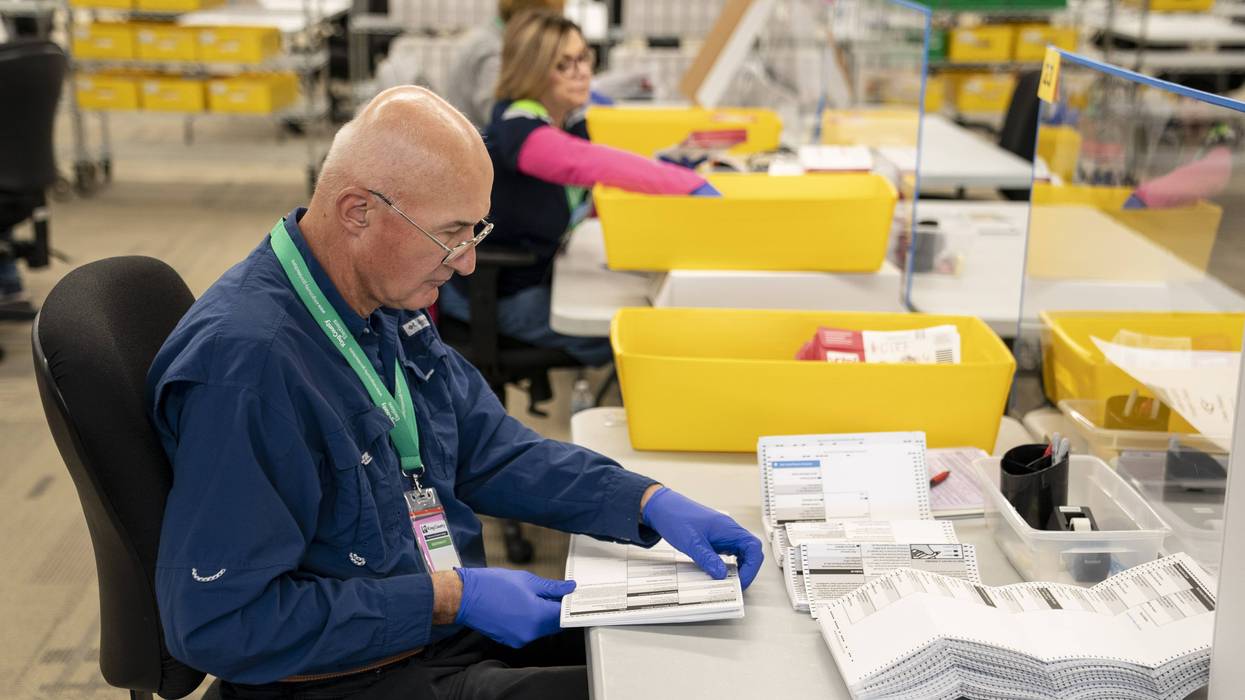
Trump DOJ Brings 'Tired, Desperate' Attempt to Find Noncitizen Voting to Washington State
"The timing of this request—one week before the general election—is no doubt intended to cast unfounded suspicion on the results," said Secretary of State Steve Hobbs.
Oct 27, 2026
As a federal appeals court on Monday refused to order California officials to set aside 20,000 mail-in ballots that the Trump administration claimed were cast by noncitizens, the US Department of Justice was already pushing a similar effort in Washington state—the latest of what one advocate called "tired, desperate attempts by a cornered and losing side" to cast doubt on the validity of the November 3 midterm elections.
Washington Secretary of State Steve Hobbs received a letter Monday from acting US Attorney Charles Neil Floyd, who demanded that the state set aside any ballots cast by 405 people whom the DOJ claims are illegally registered to vote despite not being US citizens.
Floyd said the voters have cast 1,500 ballots in past elections, and complained that the Democratic-led state's refusal to turn over unredacted voter rolls to the DOJ earlier this year made his search for noncitizen voters more time-consuming.
The Trump administration has filed lawsuits against more than 20 states for refusing to hand over voter data on millions of people, and the DOJ has resorted to using commercially available information and comparing it with federal records in an effort to track down people it says have voted illegally despite being noncitizens.
The right-wing Heritage Foundation was able to uncover just 23 instances of noncitizen voting between 2003-22, and election officials in found that in 42 jurisdictions, .0001% of 23.5 million votes were cast by suspected noncitizens in 2016.
Those statistics are in line with the results of the DOJ's efforts thus far. In California, federal officials announced they had identified 28 immigrants who were suspected of voting before they became naturalized citizens. The group represented about .0001% of registered voters in California.
In Nevada in September, Homeland Security Secretary Markwayne Mullin claimed authorities had found 16,000 noncitizens on the state's voter rolls. DHS ultimately sent the state a list of just 185 people who it said were illegally registered to vote, but state officials found that all 185 voters were citizens.
Despite the administration's track record, Floyd insisted that this time would be different, asserting in a news conference that the 405 people identified by the DOJ in Washington were "only the tip of the iceberg."
“Because of limitations the state has placed on our investigation, we’ve only been able to uncover a fraction of the total number,” he said. "We will continue to investigate and identify those who are committing crimes by voting illegally.”
A spokesperson for Hobbs' office told NBC News that the secretary of state is reviewing the list, but Hobbs stressed that he "will only respond to requests that follow due process."
"We take our responsibility to protect voter information seriously," said Hobbs. "We saw what happened in California and don’t want Washingtonians to be harassed. The timing of this request—one week before the general election—is no doubt intended to cast unfounded suspicion on the results.”
The search for illegally registered voters in Washington comes days after the DOJ filed a lawsuit in Alaska seeking to block the certification of the state's US Senate election results if Sen. Dan Sullivan (R) narrowly loses to his Democratic challenger, former Rep. Mary Peltola.
The DOJ argued that voters may be confused by their ballots, on which Sullivan and Peltola are listed along with other candidates—one of whom is a retired teacher named Daniel J. Sullivan, Jr. Critics have noted that the sitting senator is clearly marked as the incumbent.
The latest polling average in the key race, which could determine control of the Senate, shows Peltola leading Sullivan by about two points.
On Sunday in an interview with CNN, Attorney General Todd Blanche defended the DOJ's push to stop the automatic certification of the Alaska election results, saying that President Donald Trump "is not trying to take over a state election in any way, shape, or form" and becoming angry when anchor Dana Bash asked whether the refusal to accept the election results could lay the groundwork for violence, as in the January 6, 2021 attack on the US Capitol.
Last week Blanche told reporters that the DOJ could become involved in the election certification process in a "doomsday" scenario.
"Trump’s DOJ has been trying to figure out how to rob Americans of their votes in the midterms since February," said journalist Pedro L. Gonzalez Tuesday. "I hope states are ready to fight and resist the administration. These freaks aren’t just going to let Americans vote their way out of this if they think they can do something about it."
Keep ReadingShow Less
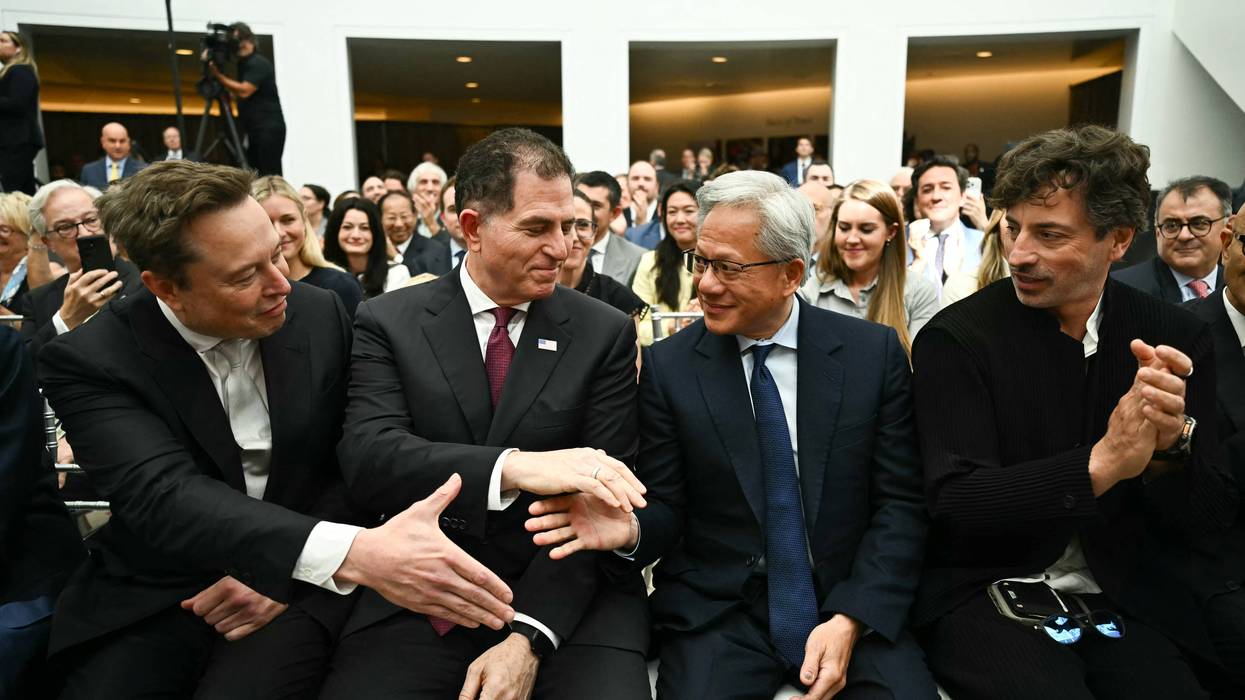
'A Crime of Extreme Inequality': Richest 0.1% Generate More Carbon Pollution Than Half of Humanity
“The ultra-rich are setting the planet on fire and then charging the rest of us for the extinguishers."
Oct 27, 2026
The richest 0.1% of humanity generates more planet-heating carbon pollution than nearly half of the global population combined, according to an Oxfam analysis released late Monday as world leaders prepared to gather in Türkiye next month for the United Nations climate summit.
The new analysis provides an updated look at global elites' outsized contribution to a climate crisis that disproportionately impacts the poorest segments of the global population through increasingly devastating heatwaves, droughts, flooding, and other extreme weather, causing death, destruction, and mass displacement worldwide.
Oxfam estimates that a person in the richest 0.1% "has contributed nearly 400 times more to today’s extreme heatwaves than someone in the poorest 50%." The 8 million richest people in the world combined produce "over three times more carbon pollution than the entire population of Sub-Saharan Africa"—around 1.3 billion people.
"The climate crisis is often described as a shared human challenge. It is not," said Amitabh Behar, Oxfam International's executive director. "Those who have done the least to cause it are losing their homes, their harvests and, increasingly, their lives. Meanwhile, the super-rich can buy their way out of danger—by retreating to high-tech underground survival bunkers, hiring private firefighting crews, and securing private insurance—and are actively profiting from the consequences of their pollution. This is not a tragedy of shared fate; it is a crime of extreme inequality."
Oxfam's report notes that the same investors and firms profiting massively from the fossil fuel companies driving the climate crisis are also benefiting from disaster preparedness and recovery. The analysis places those investors in what it calls a "Destroy and Rebuild" index.
"Six major asset managers (including Vanguard, BlackRock, and State Street) make up more than one-quarter of all the Destroy and Rebuild corporations," the report states. "BlackRock and Vanguard are invested in 92% of the corporations in the index: The pair’s total investments in these corporations are more than $1 trillion."
“The ultra-rich are setting the planet on fire and then charging the rest of us for the extinguishers," said Behar. "They profit from the pollution. They profit from the disaster. And they profit again from the clean-up.”
"While ordinary people are forced to grapple with the consequences of emergencies they bear little responsibility in fueling, billionaires are busy outrunning the reality they and their private jets created."
In the United States—where the country's billionaire president has taken a sledgehammer to domestic and international efforts to combat the climate crisis—a person in the richest 0.1% emits 48 times as much carbon dioxide as the average American.
"The country’s richest 0.1% (333,271 people) emit 108 times more CO2 per person than the poorest half of the population (166.6 million people)," Oxfam's analysis shows. "In just under four months (118.3 days), someone in the richest 0.1% emits more CO2 than someone in the poorest half of the U.S. has emitted over the last 30 years."
Rachel Carle, senior advisor on climate justice at Oxfam America, said in a statement that the global climate emergency is "an inequality crisis at its core."
"While ordinary people are forced to grapple with the consequences of emergencies they bear little responsibility in fueling, billionaires are busy outrunning the reality they and their private jets created," said Carle. "Mark Zuckerberg can hunker down in his Hawaiian bunker at the first sign of chaos, but the rest of us don’t have that luxury. Addressing this glaring inequality is the first step to mitigating climate disaster, and that starts with making ultra-rich polluters pay their fair share."
In view of its findings, Oxfam urged governments to use the upcoming COP31 summit in Türkiye to:
- Make rich polluters pay to significantly and rapidly curb their carbon emissions, including through permanent wealth and income taxes, a permanent tax on fossil fuel corporations, and punitive taxes on high-emitting luxury items like private jets;
- Substantially increase climate finance for the Global South, prioritizing public, grant-based finance rather than loans that deepen debt. The amount for adaptation should be tripled by 2035;
- Radically reduce inequality within and between countries, including through climate-resilient public infrastructure and public services; and
- End profiteering from climate disasters. Governments need to curb corporate power in emergency response, reconstruction, and food systems during disasters.
"Another future remains possible," Oxfam's report concludes. "Creating a more equal world would enable emissions to fall rapidly, food systems to become fairer and more resilient, and the creation of public systems to protect people from crisis and adapt to the effects of climate change. Achieving that future will require bold political choices to curb excessive wealth and corporate power while investing in the resilience, rights, and livelihoods of the majority. Climate justice and equality must now become the foundation of climate action."
Keep ReadingShow Less
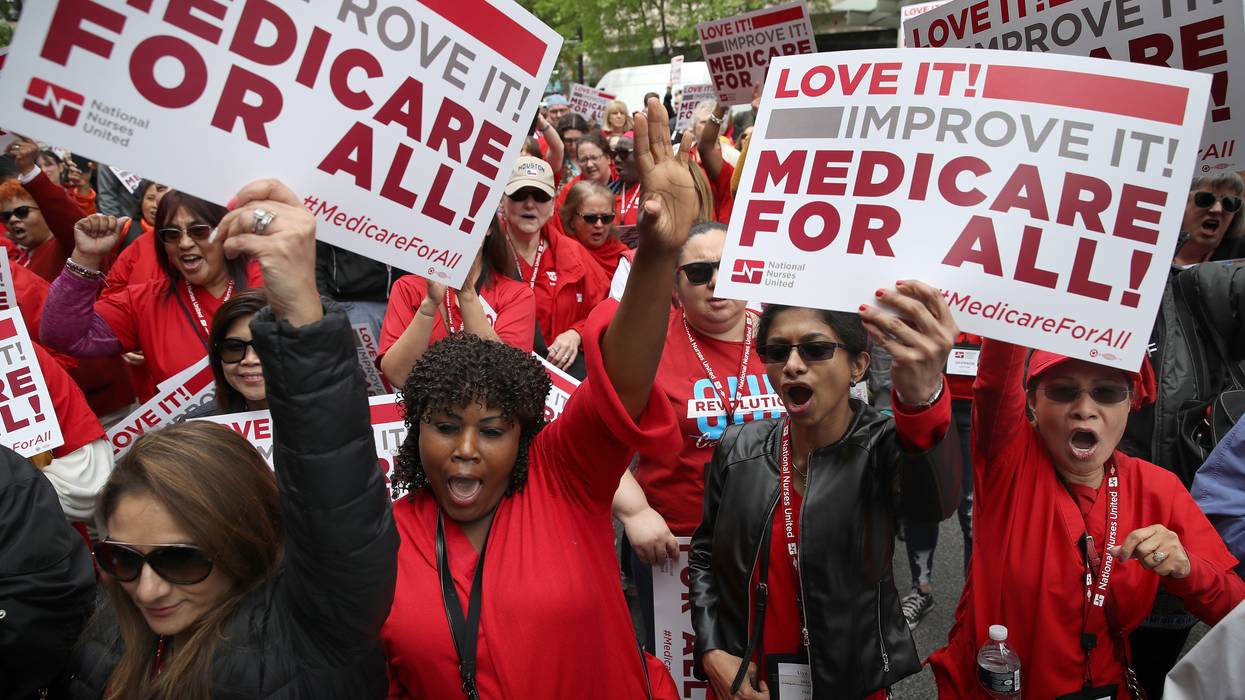
Former Top GOP Strategist Says It's 'Unimaginable' That US Won't Have Medicare for All Within 20 Years
"This is just a matter of how long are we going to delay this?”
Oct 26, 2026
A prominent former Republican political strategist said Monday that he believes it's just a matter of time before the United States adopts a Medicare for All universal healthcare system, citing the popularity of the program for older Americans across the political spectrum.
"Close your eyes and think about what will America be like in 20 years," Stuart Stevens—a senior strategist for Mitt Romney's failed 2012 presidential campaign—said during an MS NOW panel discussion hosted by Katy Tur. "It is unimaginable we will not have a national health plan."
"We're already the only Western country that doesn't," Stevens noted. "And this is just a matter of how long are we going to delay this?"
" Medicare is wildly popular," he said. "So you can see what the appeal of Medicare for All is."
"Why shouldn't everybody have Medicare?" Stevens asked. "I mean, it's the wealthiest country in the history of the world."
Stevens noted that the prospect of universal healthcare is "getting a tremendous response," even "from people who aren't exactly on the far left."
"So I think this is an issue that's changing," he added.
Responding to Stevens comments, Rep. Ro Khanna (D-Calif.) told Common Dreams that Medicare for All will ultimately happen in the United States "because it is not just a moral imperative but makes economic sense," as study after study has shown.
"It's what will truly reduce the cost of our system," Khanna said.
A KFF survey released earlier this month found that 66% of Americans favor Medicare for All, the highest level of support since the organization began tracking the proposal. Support included 84% of Democrats, 72% of independents, and 34% of Republicans—up from just 21% of Republicans in 2020.
A separate Axios-Ipsos poll, also published this month, found that 43% of Americans supported the proposal, compared with just 24% opposed, while 21% of Republicans backed it.
Multiple studies have shown that Medicare for All would save lives—and money. Most recently, researchers at Yale University estimated that implementing such a system would save over 114,000 lives annually while reducing healthcare expenditures by more than $1 billion per year.
Stevens' comments came as Sen. Chris Van Hollen (D-Md.)—a possible 2028 presidential candidate—said his party needs to pursue Medicare for All if it succeeds in winning control of the Senate next week.
Keep ReadingShow Less
See More
Most Popular