SUBSCRIBE TO OUR FREE NEWSLETTER
Daily news & progressive opinion—funded by the people, not the corporations—delivered straight to your inbox.
5
#000000
#FFFFFF
To donate by check, phone, or other method, see our More Ways to Give page.
Daily news & progressive opinion—funded by the people, not the corporations—delivered straight to your inbox.
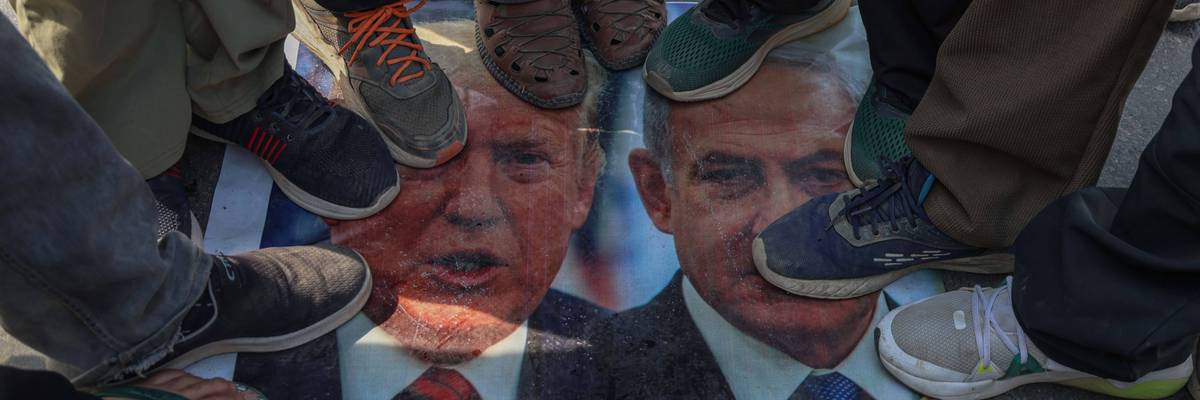
Shiite Muslims step on a banner with images of US President Donald Trump and Israeli Prime Minister Benjamin Netanyahu during a protest against the killing of Iran's Supreme Leader Ayatollah Ali Khamenei in Budgam, northeast of Srinagar, Jammu and Kashmir, on March 6, 2026.
"The American people do not want more war in the Middle East. No boots on the ground. No more war."
A report late Friday that US President Donald Trump is more bullish in private about putting American soldiers on the ground in Iran than he has been publicly stirred immediate condemnation among lawmakers opposed to the illegal military attack, now entering its second week of destructive and deadly operations.
"This is madness," declared Rep. Pramila Jayapal (D-Wash.) in response to NBC News reporting, which cited unnamed sources familiar with the conversations, that stated Trump "has privately expressed serious interest in deploying US troops on the ground inside of Iran."
While the White House pushed back on the contents of the reporting, Trump himself has said that he does not hold reservations about deploying ground troops if he deems it necessary.
“I don’t have the yips with respect to boots on the ground," Trump told the New York Post on Monday. "Like every president says, ‘There will be no boots on the ground.’ I don’t say it. I say, ‘probably don’t need them,’ [or] ‘if they were necessary.’”
Senate Minority Leader Chuck Schumer (D-N.Y.) also reacted to the new reporting.
" Donald Trump is hellbent on escalating his reckless war and is now considering putting US boots on the ground in Iran," said Schumer in an online statement. "The American people do not want more war in the Middle East. No boots on the ground. No more war."
Early morning on Saturday, Trump issued a fresh threat to the people of Iran, declaring in a social media post: "Today Iran will be hit very hard!"
In the same post, the US president falsely claimed that Iran had "surrendered" to neighboring countries in the region following a series of missile attacks over recent days by Islamic Revolutionary Guard Corps units on select targets in Saudi Arabia, Bahrain, the United Arab Emirates, and others.
What Trump was referring to was a video message issued by Iranian President Masoud Pezeshkian earlier in the day in which he apologized for the strikes—carried out by IRGC commanders operating independently in the wake of the killing of Supreme Leader Ayatollah Ali Khamenei in a US-Israeli strike earlier this week—and said that no further such attacks would take place “unless those countries launch an attack on us."
In his remarks, Pezeshkian rejected Trump's insistence on Friday for an "unconditional surrender" by Iran. “That we surrender unconditionally is a dream that they must take with themselves to the grave," he said. "What we adhere to are international laws and humanitarian framework."
Pezeshkian called for diplomacy to bring the war of aggression by the US and Israel to an end. "We aim to work hand‑in‑hand with our dear brothers and neighbors in the region to establish lasting peace and stability, and we hope this goal will be achieved,” he said.
However, if hostilities launched from factions in neighboring countries resumed, Pezeshkian warned, "all military bases and interests of criminal America and the fake Zionist regime on land, at sea, and in the air across the region will be considered primary targets and will come under the powerful and crushing strikes of the mighty armed forces of the Islamic Republic of Iran.”
In remarks on Thursday, after Trump previously refused to rule out boots on the ground, Iranian Foreign Minister Foreign Minister Abbas Araghch told NBC News that the country's armed forces are prepared.
“We are waiting for them,” Araghchi said. “Because we are confident that we can confront them, and that would be a big disaster for them.”
Foreign policy experts warn that Trump has created an untenable situation for himself by demanding the "unconditional surrender" as well as stating that he must personally be involved in the choosing the next leader of Iran—an overt call for regime change in a nation of 90 million people.
"No country surrenders from airpower alone," said Ryan Costello, policy director for the National Iranian American Council, a Washington DC-based think tank, on Friday. "Trump has created a trap for himself: either he backs down on his unattainable goal to dictate Iran, or he climbs up the escalation ladder, considering even more disastrous steps like boots on the ground."
Dear Common Dreams reader, It’s been nearly 30 years since I co-founded Common Dreams with my late wife, Lina Newhouser. We had the radical notion that journalism should serve the public good, not corporate profits. It was clear to us from the outset what it would take to build such a project. No paid advertisements. No corporate sponsors. No millionaire publisher telling us what to think or do. Many people said we wouldn't last a year, but we proved those doubters wrong. Together with a tremendous team of journalists and dedicated staff, we built an independent media outlet free from the constraints of profits and corporate control. Our mission has always been simple: To inform. To inspire. To ignite change for the common good. Building Common Dreams was not easy. Our survival was never guaranteed. When you take on the most powerful forces—Wall Street greed, fossil fuel industry destruction, Big Tech lobbyists, and uber-rich oligarchs who have spent billions upon billions rigging the economy and democracy in their favor—the only bulwark you have is supporters who believe in your work. But here’s the urgent message from me today. It's never been this bad out there. And it's never been this hard to keep us going. At the very moment Common Dreams is most needed, the threats we face are intensifying. We need your support now more than ever. We don't accept corporate advertising and never will. We don't have a paywall because we don't think people should be blocked from critical news based on their ability to pay. Everything we do is funded by the donations of readers like you. When everyone does the little they can afford, we are strong. But if that support retreats or dries up, so do we. Will you donate now to make sure Common Dreams not only survives but thrives? —Craig Brown, Co-founder |
A report late Friday that US President Donald Trump is more bullish in private about putting American soldiers on the ground in Iran than he has been publicly stirred immediate condemnation among lawmakers opposed to the illegal military attack, now entering its second week of destructive and deadly operations.
"This is madness," declared Rep. Pramila Jayapal (D-Wash.) in response to NBC News reporting, which cited unnamed sources familiar with the conversations, that stated Trump "has privately expressed serious interest in deploying US troops on the ground inside of Iran."
While the White House pushed back on the contents of the reporting, Trump himself has said that he does not hold reservations about deploying ground troops if he deems it necessary.
“I don’t have the yips with respect to boots on the ground," Trump told the New York Post on Monday. "Like every president says, ‘There will be no boots on the ground.’ I don’t say it. I say, ‘probably don’t need them,’ [or] ‘if they were necessary.’”
Senate Minority Leader Chuck Schumer (D-N.Y.) also reacted to the new reporting.
" Donald Trump is hellbent on escalating his reckless war and is now considering putting US boots on the ground in Iran," said Schumer in an online statement. "The American people do not want more war in the Middle East. No boots on the ground. No more war."
Early morning on Saturday, Trump issued a fresh threat to the people of Iran, declaring in a social media post: "Today Iran will be hit very hard!"
In the same post, the US president falsely claimed that Iran had "surrendered" to neighboring countries in the region following a series of missile attacks over recent days by Islamic Revolutionary Guard Corps units on select targets in Saudi Arabia, Bahrain, the United Arab Emirates, and others.
What Trump was referring to was a video message issued by Iranian President Masoud Pezeshkian earlier in the day in which he apologized for the strikes—carried out by IRGC commanders operating independently in the wake of the killing of Supreme Leader Ayatollah Ali Khamenei in a US-Israeli strike earlier this week—and said that no further such attacks would take place “unless those countries launch an attack on us."
In his remarks, Pezeshkian rejected Trump's insistence on Friday for an "unconditional surrender" by Iran. “That we surrender unconditionally is a dream that they must take with themselves to the grave," he said. "What we adhere to are international laws and humanitarian framework."
Pezeshkian called for diplomacy to bring the war of aggression by the US and Israel to an end. "We aim to work hand‑in‑hand with our dear brothers and neighbors in the region to establish lasting peace and stability, and we hope this goal will be achieved,” he said.
However, if hostilities launched from factions in neighboring countries resumed, Pezeshkian warned, "all military bases and interests of criminal America and the fake Zionist regime on land, at sea, and in the air across the region will be considered primary targets and will come under the powerful and crushing strikes of the mighty armed forces of the Islamic Republic of Iran.”
In remarks on Thursday, after Trump previously refused to rule out boots on the ground, Iranian Foreign Minister Foreign Minister Abbas Araghch told NBC News that the country's armed forces are prepared.
“We are waiting for them,” Araghchi said. “Because we are confident that we can confront them, and that would be a big disaster for them.”
Foreign policy experts warn that Trump has created an untenable situation for himself by demanding the "unconditional surrender" as well as stating that he must personally be involved in the choosing the next leader of Iran—an overt call for regime change in a nation of 90 million people.
"No country surrenders from airpower alone," said Ryan Costello, policy director for the National Iranian American Council, a Washington DC-based think tank, on Friday. "Trump has created a trap for himself: either he backs down on his unattainable goal to dictate Iran, or he climbs up the escalation ladder, considering even more disastrous steps like boots on the ground."
A report late Friday that US President Donald Trump is more bullish in private about putting American soldiers on the ground in Iran than he has been publicly stirred immediate condemnation among lawmakers opposed to the illegal military attack, now entering its second week of destructive and deadly operations.
"This is madness," declared Rep. Pramila Jayapal (D-Wash.) in response to NBC News reporting, which cited unnamed sources familiar with the conversations, that stated Trump "has privately expressed serious interest in deploying US troops on the ground inside of Iran."
While the White House pushed back on the contents of the reporting, Trump himself has said that he does not hold reservations about deploying ground troops if he deems it necessary.
“I don’t have the yips with respect to boots on the ground," Trump told the New York Post on Monday. "Like every president says, ‘There will be no boots on the ground.’ I don’t say it. I say, ‘probably don’t need them,’ [or] ‘if they were necessary.’”
Senate Minority Leader Chuck Schumer (D-N.Y.) also reacted to the new reporting.
" Donald Trump is hellbent on escalating his reckless war and is now considering putting US boots on the ground in Iran," said Schumer in an online statement. "The American people do not want more war in the Middle East. No boots on the ground. No more war."
Early morning on Saturday, Trump issued a fresh threat to the people of Iran, declaring in a social media post: "Today Iran will be hit very hard!"
In the same post, the US president falsely claimed that Iran had "surrendered" to neighboring countries in the region following a series of missile attacks over recent days by Islamic Revolutionary Guard Corps units on select targets in Saudi Arabia, Bahrain, the United Arab Emirates, and others.
What Trump was referring to was a video message issued by Iranian President Masoud Pezeshkian earlier in the day in which he apologized for the strikes—carried out by IRGC commanders operating independently in the wake of the killing of Supreme Leader Ayatollah Ali Khamenei in a US-Israeli strike earlier this week—and said that no further such attacks would take place “unless those countries launch an attack on us."
In his remarks, Pezeshkian rejected Trump's insistence on Friday for an "unconditional surrender" by Iran. “That we surrender unconditionally is a dream that they must take with themselves to the grave," he said. "What we adhere to are international laws and humanitarian framework."
Pezeshkian called for diplomacy to bring the war of aggression by the US and Israel to an end. "We aim to work hand‑in‑hand with our dear brothers and neighbors in the region to establish lasting peace and stability, and we hope this goal will be achieved,” he said.
However, if hostilities launched from factions in neighboring countries resumed, Pezeshkian warned, "all military bases and interests of criminal America and the fake Zionist regime on land, at sea, and in the air across the region will be considered primary targets and will come under the powerful and crushing strikes of the mighty armed forces of the Islamic Republic of Iran.”
In remarks on Thursday, after Trump previously refused to rule out boots on the ground, Iranian Foreign Minister Foreign Minister Abbas Araghch told NBC News that the country's armed forces are prepared.
“We are waiting for them,” Araghchi said. “Because we are confident that we can confront them, and that would be a big disaster for them.”
Foreign policy experts warn that Trump has created an untenable situation for himself by demanding the "unconditional surrender" as well as stating that he must personally be involved in the choosing the next leader of Iran—an overt call for regime change in a nation of 90 million people.
"No country surrenders from airpower alone," said Ryan Costello, policy director for the National Iranian American Council, a Washington DC-based think tank, on Friday. "Trump has created a trap for himself: either he backs down on his unattainable goal to dictate Iran, or he climbs up the escalation ladder, considering even more disastrous steps like boots on the ground."