SUBSCRIBE TO OUR FREE NEWSLETTER
Daily news & progressive opinion—funded by the people, not the corporations—delivered straight to your inbox.
5
#000000
#FFFFFF
To donate by check, phone, or other method, see our More Ways to Give page.
Daily news & progressive opinion—funded by the people, not the corporations—delivered straight to your inbox.
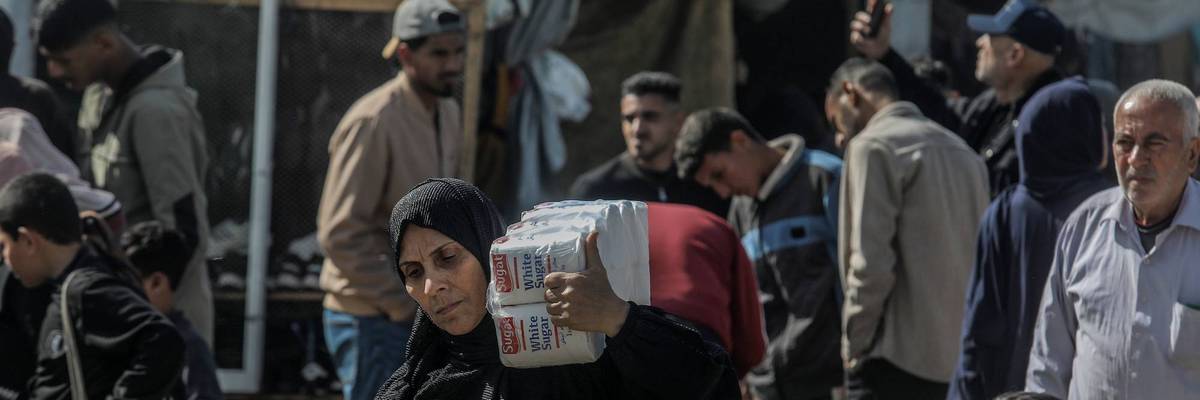
Palestinians gather in the market following the targeting of Iran by the US and Israel and the subsequent retaliatory strikes in Khan Younis, Gaza on February 28, 2026.
"All the NGOs in Gaza need more food, medicine, medical equipment, fuel, tents, personal care every day. We cannot wait," said chef José Andrés, founder of World Central Kitchen.
After Israeli and US forces launched an illegal war aimed at forcing regime change in Iran this past weekend, Israel also announced "the closure of the crossings into the Gaza Strip," which it has bombed and starved for nearly 29 months, killing at least tens of thousands of Palestinians.
Israel's Coordinator of Government Activities in the Territories (COGAT)—which oversees civilian policy in Gaza and the West Bank—announced on social media Saturday that "several necessary security adjustments have been implemented" because of the operation against Iran, including the closure of Gaza crossings "until further notice."
COGAT also claimed that "the closure of the crossings will have no impact on the humanitarian situation" in Gaza, adding that "the substantial quantities of food that have entered since the beginning of the ceasefire amount to four times the nutritional needs of the population," so "the existing stock is expected to suffice for an extended period."
However, reports from human rights groups, journalists, and the United Nations have highlighted how Israel's restrictions have continued to impede evacuations of the sick and severely wounded, and nongovernmental groups' deliveries of humanitarian aid, despite the October ceasefire deal. Palestinians in Gaza also remain at risk of Israeli forces' airstrikes, gunfire, and shelling.
"A new chokehold on Gaza," Philippe Lazzarini, commissioner-general of the United Nations Relief and Works Agency for Palestine Refugees in the Near East, said Monday. "Once again, Israel is renewing its ban on supplies entering Gaza. After more than two years of unspeakable suffering and a spreading man-made famine, people still lack the most basic supplies, despite increases in aid since the ceasefire. UNRWA personnel in Gaza keep providing healthcare, learning, and clean water—but we must be allowed to do much more and certainly not less."
Even before Israel closed the borders on Saturday, the US-Israel attack on Iran led to Palestinians in Gaza "buying whatever food supplies and goods they could manage," Al Jazeera reported Monday. "People everywhere rushed to the market to buy sugar, flour, cooking oil, and yeast. Shelves began to empty, and the price of essential goods increased."
Things got even worse after COGAT's announcement. Asmaa Abu Al-Khair, a 38-year-old mother of eight, told Al Jazeera at a Gaza City market on Sunday that "I feel great anxiety. Everyone is talking about it—about Iran's strike and the closure of the crossings—and I cannot afford to buy what I need, while at the same time, I am afraid of famine returning. I have young children."
Many displaced families living in nearby tents also "do not have the money to buy supplies, nor the space to store them inside the tents," she said. "We endured so much hardship during the war, and it barely ended with the announcement of a ceasefire. So why close the crossing now? What do we have to do with what is happening? Is what we witnessed not enough? Why play with people’s nerves?"
Since Saturday, critics around the world have also warned about the impacts of Israel shutting off the Palestinian exclave indefinitely, again. Arab Center Washington DC fellow Assal Rad declared on social media that "under the cover of its illegal war on Iran, Israel is continuing genocide in Gaza."
Mass shooting survivor and former congressional candidate Cameron Kasky similarly said that "the siege on Gaza returns in its fullest force. Illegal wars to advance Israel's goals are being used for expanding the genocide plans."
Israel faces a South Africa-led genocide case at the International Court of Justice (ICJ) over the US-backed war on Gaza that it launched after Hamas' October 7, 2023 attack. The International Criminal Court (ICC) has also issued related arrest warrants for Israeli Prime Minister Benjamin Netanyahu and former Defense Minister Yoav Gallant.
Chef José Andrés said on social media Sunday that World Central Kitchen—which he founded—is cooking 1 million hot meals every day, and if Gaza's borders stay closed, the group "will run out of food this week."
"We need food deliveries every single day to feed hungry families who are not part of this war," he said. "All the NGOs in Gaza need more food, medicine, medical equipment, fuel, tents, personal care every day. We cannot wait... let the humanitarian trucks go through today!"
Responding to Andrés, US Congressman Mark Pocan (D-Wis.) said that "Israel must reopen access to aid groups. If not, Netanyahu must be arrested immediately. He continues war crimes."
The Hague Group—a coalition of countries that came together last year, led by Colombia and South Africa, with the goal of upholding the ICC and ICJ rulings on Israel and Palestine—responded to COGAT by scheduling an emergency meeting that at least 30 nations are set to attend in the Dutch city for which the organization is named.
The focus of Wednesday's meeting "is simple," Varsha Gandikota-Nellutla, the group's executive secretary, said in a Monday statement. "How do we give international law teeth? Several states have begun enforcing their legal obligations, turning rhetoric into concrete action through The Hague Group's measures: cutting arms flows, closing ports, and pursuing accountability."
Ronald Lamola, South Africa's minister of international relations and cooperation, said that "the application of international law can no longer be selective: punitive for some and totally disregarded by others. The Hague Group exists to translate obligations that arise out of international law into coordinated state action. We invite governments of conscience—those prepared to uphold law in deed as well as word—to join us."
Francesca Albanese, the UN special rapporteur focused on the occupied Palestinian territories and a target of Trump administration sanctions, said that "I am honored to attend the upcoming emergency meeting of the The Hague Group."
"Time has come for decolonized multilateralism, grounded in universal rights and obligations, applied with integrity and free from double standards," Albanese added. "May European and Arab states join this necessary effort."
Dear Common Dreams reader, It’s been nearly 30 years since I co-founded Common Dreams with my late wife, Lina Newhouser. We had the radical notion that journalism should serve the public good, not corporate profits. It was clear to us from the outset what it would take to build such a project. No paid advertisements. No corporate sponsors. No millionaire publisher telling us what to think or do. Many people said we wouldn't last a year, but we proved those doubters wrong. Together with a tremendous team of journalists and dedicated staff, we built an independent media outlet free from the constraints of profits and corporate control. Our mission has always been simple: To inform. To inspire. To ignite change for the common good. Building Common Dreams was not easy. Our survival was never guaranteed. When you take on the most powerful forces—Wall Street greed, fossil fuel industry destruction, Big Tech lobbyists, and uber-rich oligarchs who have spent billions upon billions rigging the economy and democracy in their favor—the only bulwark you have is supporters who believe in your work. But here’s the urgent message from me today. It's never been this bad out there. And it's never been this hard to keep us going. At the very moment Common Dreams is most needed, the threats we face are intensifying. We need your support now more than ever. We don't accept corporate advertising and never will. We don't have a paywall because we don't think people should be blocked from critical news based on their ability to pay. Everything we do is funded by the donations of readers like you. When everyone does the little they can afford, we are strong. But if that support retreats or dries up, so do we. Will you donate now to make sure Common Dreams not only survives but thrives? —Craig Brown, Co-founder |
After Israeli and US forces launched an illegal war aimed at forcing regime change in Iran this past weekend, Israel also announced "the closure of the crossings into the Gaza Strip," which it has bombed and starved for nearly 29 months, killing at least tens of thousands of Palestinians.
Israel's Coordinator of Government Activities in the Territories (COGAT)—which oversees civilian policy in Gaza and the West Bank—announced on social media Saturday that "several necessary security adjustments have been implemented" because of the operation against Iran, including the closure of Gaza crossings "until further notice."
COGAT also claimed that "the closure of the crossings will have no impact on the humanitarian situation" in Gaza, adding that "the substantial quantities of food that have entered since the beginning of the ceasefire amount to four times the nutritional needs of the population," so "the existing stock is expected to suffice for an extended period."
However, reports from human rights groups, journalists, and the United Nations have highlighted how Israel's restrictions have continued to impede evacuations of the sick and severely wounded, and nongovernmental groups' deliveries of humanitarian aid, despite the October ceasefire deal. Palestinians in Gaza also remain at risk of Israeli forces' airstrikes, gunfire, and shelling.
"A new chokehold on Gaza," Philippe Lazzarini, commissioner-general of the United Nations Relief and Works Agency for Palestine Refugees in the Near East, said Monday. "Once again, Israel is renewing its ban on supplies entering Gaza. After more than two years of unspeakable suffering and a spreading man-made famine, people still lack the most basic supplies, despite increases in aid since the ceasefire. UNRWA personnel in Gaza keep providing healthcare, learning, and clean water—but we must be allowed to do much more and certainly not less."
Even before Israel closed the borders on Saturday, the US-Israel attack on Iran led to Palestinians in Gaza "buying whatever food supplies and goods they could manage," Al Jazeera reported Monday. "People everywhere rushed to the market to buy sugar, flour, cooking oil, and yeast. Shelves began to empty, and the price of essential goods increased."
Things got even worse after COGAT's announcement. Asmaa Abu Al-Khair, a 38-year-old mother of eight, told Al Jazeera at a Gaza City market on Sunday that "I feel great anxiety. Everyone is talking about it—about Iran's strike and the closure of the crossings—and I cannot afford to buy what I need, while at the same time, I am afraid of famine returning. I have young children."
Many displaced families living in nearby tents also "do not have the money to buy supplies, nor the space to store them inside the tents," she said. "We endured so much hardship during the war, and it barely ended with the announcement of a ceasefire. So why close the crossing now? What do we have to do with what is happening? Is what we witnessed not enough? Why play with people’s nerves?"
Since Saturday, critics around the world have also warned about the impacts of Israel shutting off the Palestinian exclave indefinitely, again. Arab Center Washington DC fellow Assal Rad declared on social media that "under the cover of its illegal war on Iran, Israel is continuing genocide in Gaza."
Mass shooting survivor and former congressional candidate Cameron Kasky similarly said that "the siege on Gaza returns in its fullest force. Illegal wars to advance Israel's goals are being used for expanding the genocide plans."
Israel faces a South Africa-led genocide case at the International Court of Justice (ICJ) over the US-backed war on Gaza that it launched after Hamas' October 7, 2023 attack. The International Criminal Court (ICC) has also issued related arrest warrants for Israeli Prime Minister Benjamin Netanyahu and former Defense Minister Yoav Gallant.
Chef José Andrés said on social media Sunday that World Central Kitchen—which he founded—is cooking 1 million hot meals every day, and if Gaza's borders stay closed, the group "will run out of food this week."
"We need food deliveries every single day to feed hungry families who are not part of this war," he said. "All the NGOs in Gaza need more food, medicine, medical equipment, fuel, tents, personal care every day. We cannot wait... let the humanitarian trucks go through today!"
Responding to Andrés, US Congressman Mark Pocan (D-Wis.) said that "Israel must reopen access to aid groups. If not, Netanyahu must be arrested immediately. He continues war crimes."
The Hague Group—a coalition of countries that came together last year, led by Colombia and South Africa, with the goal of upholding the ICC and ICJ rulings on Israel and Palestine—responded to COGAT by scheduling an emergency meeting that at least 30 nations are set to attend in the Dutch city for which the organization is named.
The focus of Wednesday's meeting "is simple," Varsha Gandikota-Nellutla, the group's executive secretary, said in a Monday statement. "How do we give international law teeth? Several states have begun enforcing their legal obligations, turning rhetoric into concrete action through The Hague Group's measures: cutting arms flows, closing ports, and pursuing accountability."
Ronald Lamola, South Africa's minister of international relations and cooperation, said that "the application of international law can no longer be selective: punitive for some and totally disregarded by others. The Hague Group exists to translate obligations that arise out of international law into coordinated state action. We invite governments of conscience—those prepared to uphold law in deed as well as word—to join us."
Francesca Albanese, the UN special rapporteur focused on the occupied Palestinian territories and a target of Trump administration sanctions, said that "I am honored to attend the upcoming emergency meeting of the The Hague Group."
"Time has come for decolonized multilateralism, grounded in universal rights and obligations, applied with integrity and free from double standards," Albanese added. "May European and Arab states join this necessary effort."
After Israeli and US forces launched an illegal war aimed at forcing regime change in Iran this past weekend, Israel also announced "the closure of the crossings into the Gaza Strip," which it has bombed and starved for nearly 29 months, killing at least tens of thousands of Palestinians.
Israel's Coordinator of Government Activities in the Territories (COGAT)—which oversees civilian policy in Gaza and the West Bank—announced on social media Saturday that "several necessary security adjustments have been implemented" because of the operation against Iran, including the closure of Gaza crossings "until further notice."
COGAT also claimed that "the closure of the crossings will have no impact on the humanitarian situation" in Gaza, adding that "the substantial quantities of food that have entered since the beginning of the ceasefire amount to four times the nutritional needs of the population," so "the existing stock is expected to suffice for an extended period."
However, reports from human rights groups, journalists, and the United Nations have highlighted how Israel's restrictions have continued to impede evacuations of the sick and severely wounded, and nongovernmental groups' deliveries of humanitarian aid, despite the October ceasefire deal. Palestinians in Gaza also remain at risk of Israeli forces' airstrikes, gunfire, and shelling.
"A new chokehold on Gaza," Philippe Lazzarini, commissioner-general of the United Nations Relief and Works Agency for Palestine Refugees in the Near East, said Monday. "Once again, Israel is renewing its ban on supplies entering Gaza. After more than two years of unspeakable suffering and a spreading man-made famine, people still lack the most basic supplies, despite increases in aid since the ceasefire. UNRWA personnel in Gaza keep providing healthcare, learning, and clean water—but we must be allowed to do much more and certainly not less."
Even before Israel closed the borders on Saturday, the US-Israel attack on Iran led to Palestinians in Gaza "buying whatever food supplies and goods they could manage," Al Jazeera reported Monday. "People everywhere rushed to the market to buy sugar, flour, cooking oil, and yeast. Shelves began to empty, and the price of essential goods increased."
Things got even worse after COGAT's announcement. Asmaa Abu Al-Khair, a 38-year-old mother of eight, told Al Jazeera at a Gaza City market on Sunday that "I feel great anxiety. Everyone is talking about it—about Iran's strike and the closure of the crossings—and I cannot afford to buy what I need, while at the same time, I am afraid of famine returning. I have young children."
Many displaced families living in nearby tents also "do not have the money to buy supplies, nor the space to store them inside the tents," she said. "We endured so much hardship during the war, and it barely ended with the announcement of a ceasefire. So why close the crossing now? What do we have to do with what is happening? Is what we witnessed not enough? Why play with people’s nerves?"
Since Saturday, critics around the world have also warned about the impacts of Israel shutting off the Palestinian exclave indefinitely, again. Arab Center Washington DC fellow Assal Rad declared on social media that "under the cover of its illegal war on Iran, Israel is continuing genocide in Gaza."
Mass shooting survivor and former congressional candidate Cameron Kasky similarly said that "the siege on Gaza returns in its fullest force. Illegal wars to advance Israel's goals are being used for expanding the genocide plans."
Israel faces a South Africa-led genocide case at the International Court of Justice (ICJ) over the US-backed war on Gaza that it launched after Hamas' October 7, 2023 attack. The International Criminal Court (ICC) has also issued related arrest warrants for Israeli Prime Minister Benjamin Netanyahu and former Defense Minister Yoav Gallant.
Chef José Andrés said on social media Sunday that World Central Kitchen—which he founded—is cooking 1 million hot meals every day, and if Gaza's borders stay closed, the group "will run out of food this week."
"We need food deliveries every single day to feed hungry families who are not part of this war," he said. "All the NGOs in Gaza need more food, medicine, medical equipment, fuel, tents, personal care every day. We cannot wait... let the humanitarian trucks go through today!"
Responding to Andrés, US Congressman Mark Pocan (D-Wis.) said that "Israel must reopen access to aid groups. If not, Netanyahu must be arrested immediately. He continues war crimes."
The Hague Group—a coalition of countries that came together last year, led by Colombia and South Africa, with the goal of upholding the ICC and ICJ rulings on Israel and Palestine—responded to COGAT by scheduling an emergency meeting that at least 30 nations are set to attend in the Dutch city for which the organization is named.
The focus of Wednesday's meeting "is simple," Varsha Gandikota-Nellutla, the group's executive secretary, said in a Monday statement. "How do we give international law teeth? Several states have begun enforcing their legal obligations, turning rhetoric into concrete action through The Hague Group's measures: cutting arms flows, closing ports, and pursuing accountability."
Ronald Lamola, South Africa's minister of international relations and cooperation, said that "the application of international law can no longer be selective: punitive for some and totally disregarded by others. The Hague Group exists to translate obligations that arise out of international law into coordinated state action. We invite governments of conscience—those prepared to uphold law in deed as well as word—to join us."
Francesca Albanese, the UN special rapporteur focused on the occupied Palestinian territories and a target of Trump administration sanctions, said that "I am honored to attend the upcoming emergency meeting of the The Hague Group."
"Time has come for decolonized multilateralism, grounded in universal rights and obligations, applied with integrity and free from double standards," Albanese added. "May European and Arab states join this necessary effort."