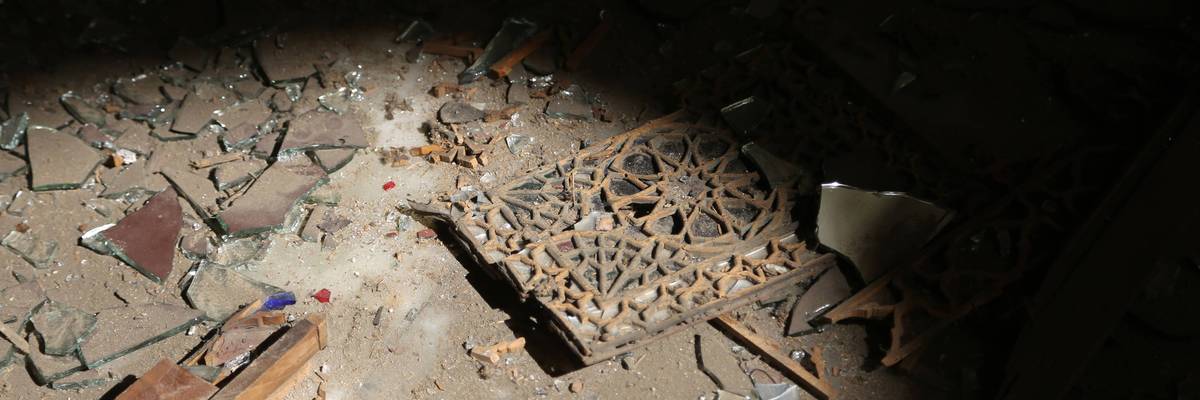
This photo taken on March 3, 2026 shows a view of the damaged Golestan Palace in Tehran, Iran. The Golestan Palace, a UNESCO World Heritage site, was partially damaged in air raids during US and Israeli strikes on Iran.
‘My Memory Is Being Demolished’: US-Israeli Bombings Damage Protected World Heritage Sites in Iran
"War fans say that whatever gets destroyed, someone will build a better one later," said one Iranian scholar. "Fine, go ahead and build a new Golestan Palace, a new Chehel Sotun, and a new Taq-e Bostan too."
In addition to killing and injuring thousands of Iranians, the US-Israeli war in Iran is bringing ruin upon some of the oldest and most cherished historical landmarks in the world.
Several centuries-old locations, designated as World Heritage sites by the United Nations Educational, Scientific and Cultural Organization (UNESCO), have suffered damage from bombings since the US and Israel launched the war on February 28. As UNESCO noted last week, these sites are protected under multiple statutes in international law.
"Iran is home to one of the richest concentrations of historical sites on Earth, representing civilizations that stretch from the Elamites and Achaemenid Persians to Islamic dynasties and modern Iran," wrote Haley Fuller for Military.com on Wednesday.
"Iran contains dozens of sites recognized by the international community as having 'outstanding universal value,'" she said. "The country currently has nearly 30 locations listed as UNESCO World Heritage sites, including ancient cities, monumental architecture, and archaeological landscapes spanning thousands of years."
UNESCO said that it has communicated the coordinates of protected sites to all parties in the conflict, including Israel. Iranian authorities, meanwhile, had already begun marking important historical sites with the internationally recognized Blue Shield symbol, established in the 1954 Hague Convention to designate protected areas. But several have still been attacked.
According to multiple local reports, as well as photos and videos posted to social media, an Israeli airstrike on Monday shattered windows, scattered debris, and broke doors at the Chehel Sotoun Palace and other sites within the 17th-century Naqsh-e-Jahan Square in the city of Isfahan.
The city was the capital of Persia under the Safavid dynasty from 1501-1736, and it boasts some of the country's most significant works of architecture and art. The Israeli military was reportedly targeting the governor’s building, which sits near the square.
"Chehel Sotoun is renowned for its extensive frescoes depicting historical battles, royal receptions, and scenes from Persian mythology, which are among the largest, most unique examples of Persianate painting," wrote Sarvy Geranpayeh in a report for The Art Newspaper.
While most of the site's interior paintings survived the attack, provincial officials said the site's famous mirror-work decorations were damaged, and a 17th-century fresco depicting the Iranian Safavid ruler Shah Tahmasp and the Indian Mughal Humayun sustained a large crack.
Several other buildings in the square also took damage, Geranpayeh reported:
Authorities reported that the 17th-century Ali Qapu Palace had its doors and windows shattered, while the 17th-century Jame Abbasi Mosque, also known as Shah Mosque, sustained damage to sections of its iconic turquoise and calligraphic tiles...
Several other sites within the Safavid-era Dawlatkhaneh complex also reportedly suffered damage. These include the 17th-century Rakeb-Khaneh pavillion (House of the Jockey), originally built to store the equestrian equipment and harnesses of the royal stables, Ashraf Hall, a highly decorative residential structure associated with the Safavid court, and the nearby 15th-century Teymouri Hall, a Timurid-era building later converted into the Natural History Museum.
A previous attack on March 1, the second day of the war, caused damage to the only designated UNESCO World Heritage site in Tehran, the Golestan Palace, which is more than 400 years old.
Geranpayeh reported that the building was left "strewn with debris, its windows blown out and its distinctive mirror and glasswork damaged."
Some of the architecture that has come under attack is even older. On March 8, Israeli strikes on Khorramabad reportedly damaged the structures surrounding the Falak-ol-Aflak Castle, which is more than 1,800 years old, dating back to the Sassanid Empire in the 3rd century.
The US Committee of the Blue Shield, an international organization tasked with protecting heritage sites in times of war and crisis, said it was “disturbed” by the United States' expressions of disregard for the laws of war.
The committee drew attention to comments made by US Defense Secretary Pete Hegseth last week that “America, regardless of what so-called international institutions say, is unleashing the most lethal and precise air power campaign in history... All on our terms with maximum authority. No stupid rules of engagement.”
According to the Iranian Red Crescent Society, more than 19,000 civilian buildings have been damaged since the war began less than two weeks ago, including hospitals, residential buildings, and schools.
One attack, reportedly by the US, on a girls' school in Minab on the first day of the war, resulted in the slaughter of around 175 people, mostly children ages 7-12. According to the World Health Organization more than 1,300 people have been killed and 9,000 injured in total since February 28.
“The failure to observe international humanitarian law, including numerous international conventions to which the US is a state party, as well as customary international law, can lead to the commission of war crimes," the US Blue Shield Committee said. It added that this disregard extends to cultural sites as well.
"The destruction of cultural heritage is irreversible. It erases identity, history, and the shared memory of civilizations," the committee said. "No military or political objective justifies the willful or negligent destruction of humanity’s common inheritance. Such destruction is also one of the actions that can make returning to a state of peace more difficult."
According to a New York Times report on Wednesday, the destruction of culturally important sites has only heightened the anger Iranians feel as their country has fallen under attack.
"War fans say that whatever gets destroyed, someone will build a better one later," Mojtaba Najafi, a prominent Iranian scholar and researcher, said in a post to social media.
"Fine, go ahead and build a new Golestan Palace, a new Chehel Sotun, and a new Taq-e Bostan too," he continued, referring to another site which came under threat from US airstrikes on Iranian nuclear facilities in June 2025.
“For me, ancient monuments are as important as human lives, because they connect me to my past,” Najafi said. “And their destruction means my memory is being demolished."
We are at a crossroads
This country and this world are at a monumental crossroads. In a few short weeks, US voters will have an opportunity to beat back the forces of fascism and confront the billionaires who are rigging the economy, our media system, and our democracy, making it increasingly impossible for ordinary people to get by. We’re not just talking about the election. We’re talking about what must be done once these fascist elements are vanquished from power. We need a bolder set of solutions than what either major party has so far been willing to offer and a working-class movement ready to fight like hell for it. Trump didn't emerge from nowhere. The conditions that fueled MAGA authoritarianism were created by decades of radical neoliberal economic policies and a corrupt political system dominated by corporate interests. They slashed taxes on the super-rich, promising that the benefits would trickle down. They said giveaways to the corporate titans would make life more affordable for the rest of us. It was all bullshit. And when a bitter, betrayed populace searches for someone to blame, right-wing demagogues have little trouble finding scapegoats. People know when they're being lied to, but you won't hear any of this from the corporate media. Only independent journalism—powered and funded by people who believe in building a better world—can deliver truly trustworthy daily news. Our Fall Campaign is underway, and we need your help. To power our newsroom through the rest of the year, we need to raise $125,000 by midnight on October 31. So if you share our vision, please contribute whatever you can to sustain our work. |
In addition to killing and injuring thousands of Iranians, the US-Israeli war in Iran is bringing ruin upon some of the oldest and most cherished historical landmarks in the world.
Several centuries-old locations, designated as World Heritage sites by the United Nations Educational, Scientific and Cultural Organization (UNESCO), have suffered damage from bombings since the US and Israel launched the war on February 28. As UNESCO noted last week, these sites are protected under multiple statutes in international law.
"Iran is home to one of the richest concentrations of historical sites on Earth, representing civilizations that stretch from the Elamites and Achaemenid Persians to Islamic dynasties and modern Iran," wrote Haley Fuller for Military.com on Wednesday.
"Iran contains dozens of sites recognized by the international community as having 'outstanding universal value,'" she said. "The country currently has nearly 30 locations listed as UNESCO World Heritage sites, including ancient cities, monumental architecture, and archaeological landscapes spanning thousands of years."
UNESCO said that it has communicated the coordinates of protected sites to all parties in the conflict, including Israel. Iranian authorities, meanwhile, had already begun marking important historical sites with the internationally recognized Blue Shield symbol, established in the 1954 Hague Convention to designate protected areas. But several have still been attacked.
According to multiple local reports, as well as photos and videos posted to social media, an Israeli airstrike on Monday shattered windows, scattered debris, and broke doors at the Chehel Sotoun Palace and other sites within the 17th-century Naqsh-e-Jahan Square in the city of Isfahan.
The city was the capital of Persia under the Safavid dynasty from 1501-1736, and it boasts some of the country's most significant works of architecture and art. The Israeli military was reportedly targeting the governor’s building, which sits near the square.
"Chehel Sotoun is renowned for its extensive frescoes depicting historical battles, royal receptions, and scenes from Persian mythology, which are among the largest, most unique examples of Persianate painting," wrote Sarvy Geranpayeh in a report for The Art Newspaper.
While most of the site's interior paintings survived the attack, provincial officials said the site's famous mirror-work decorations were damaged, and a 17th-century fresco depicting the Iranian Safavid ruler Shah Tahmasp and the Indian Mughal Humayun sustained a large crack.
Several other buildings in the square also took damage, Geranpayeh reported:
Authorities reported that the 17th-century Ali Qapu Palace had its doors and windows shattered, while the 17th-century Jame Abbasi Mosque, also known as Shah Mosque, sustained damage to sections of its iconic turquoise and calligraphic tiles...
Several other sites within the Safavid-era Dawlatkhaneh complex also reportedly suffered damage. These include the 17th-century Rakeb-Khaneh pavillion (House of the Jockey), originally built to store the equestrian equipment and harnesses of the royal stables, Ashraf Hall, a highly decorative residential structure associated with the Safavid court, and the nearby 15th-century Teymouri Hall, a Timurid-era building later converted into the Natural History Museum.
A previous attack on March 1, the second day of the war, caused damage to the only designated UNESCO World Heritage site in Tehran, the Golestan Palace, which is more than 400 years old.
Geranpayeh reported that the building was left "strewn with debris, its windows blown out and its distinctive mirror and glasswork damaged."
Some of the architecture that has come under attack is even older. On March 8, Israeli strikes on Khorramabad reportedly damaged the structures surrounding the Falak-ol-Aflak Castle, which is more than 1,800 years old, dating back to the Sassanid Empire in the 3rd century.
The US Committee of the Blue Shield, an international organization tasked with protecting heritage sites in times of war and crisis, said it was “disturbed” by the United States' expressions of disregard for the laws of war.
The committee drew attention to comments made by US Defense Secretary Pete Hegseth last week that “America, regardless of what so-called international institutions say, is unleashing the most lethal and precise air power campaign in history... All on our terms with maximum authority. No stupid rules of engagement.”
According to the Iranian Red Crescent Society, more than 19,000 civilian buildings have been damaged since the war began less than two weeks ago, including hospitals, residential buildings, and schools.
One attack, reportedly by the US, on a girls' school in Minab on the first day of the war, resulted in the slaughter of around 175 people, mostly children ages 7-12. According to the World Health Organization more than 1,300 people have been killed and 9,000 injured in total since February 28.
“The failure to observe international humanitarian law, including numerous international conventions to which the US is a state party, as well as customary international law, can lead to the commission of war crimes," the US Blue Shield Committee said. It added that this disregard extends to cultural sites as well.
"The destruction of cultural heritage is irreversible. It erases identity, history, and the shared memory of civilizations," the committee said. "No military or political objective justifies the willful or negligent destruction of humanity’s common inheritance. Such destruction is also one of the actions that can make returning to a state of peace more difficult."
According to a New York Times report on Wednesday, the destruction of culturally important sites has only heightened the anger Iranians feel as their country has fallen under attack.
"War fans say that whatever gets destroyed, someone will build a better one later," Mojtaba Najafi, a prominent Iranian scholar and researcher, said in a post to social media.
"Fine, go ahead and build a new Golestan Palace, a new Chehel Sotun, and a new Taq-e Bostan too," he continued, referring to another site which came under threat from US airstrikes on Iranian nuclear facilities in June 2025.
“For me, ancient monuments are as important as human lives, because they connect me to my past,” Najafi said. “And their destruction means my memory is being demolished."
In addition to killing and injuring thousands of Iranians, the US-Israeli war in Iran is bringing ruin upon some of the oldest and most cherished historical landmarks in the world.
Several centuries-old locations, designated as World Heritage sites by the United Nations Educational, Scientific and Cultural Organization (UNESCO), have suffered damage from bombings since the US and Israel launched the war on February 28. As UNESCO noted last week, these sites are protected under multiple statutes in international law.
"Iran is home to one of the richest concentrations of historical sites on Earth, representing civilizations that stretch from the Elamites and Achaemenid Persians to Islamic dynasties and modern Iran," wrote Haley Fuller for Military.com on Wednesday.
"Iran contains dozens of sites recognized by the international community as having 'outstanding universal value,'" she said. "The country currently has nearly 30 locations listed as UNESCO World Heritage sites, including ancient cities, monumental architecture, and archaeological landscapes spanning thousands of years."
UNESCO said that it has communicated the coordinates of protected sites to all parties in the conflict, including Israel. Iranian authorities, meanwhile, had already begun marking important historical sites with the internationally recognized Blue Shield symbol, established in the 1954 Hague Convention to designate protected areas. But several have still been attacked.
According to multiple local reports, as well as photos and videos posted to social media, an Israeli airstrike on Monday shattered windows, scattered debris, and broke doors at the Chehel Sotoun Palace and other sites within the 17th-century Naqsh-e-Jahan Square in the city of Isfahan.
The city was the capital of Persia under the Safavid dynasty from 1501-1736, and it boasts some of the country's most significant works of architecture and art. The Israeli military was reportedly targeting the governor’s building, which sits near the square.
"Chehel Sotoun is renowned for its extensive frescoes depicting historical battles, royal receptions, and scenes from Persian mythology, which are among the largest, most unique examples of Persianate painting," wrote Sarvy Geranpayeh in a report for The Art Newspaper.
While most of the site's interior paintings survived the attack, provincial officials said the site's famous mirror-work decorations were damaged, and a 17th-century fresco depicting the Iranian Safavid ruler Shah Tahmasp and the Indian Mughal Humayun sustained a large crack.
Several other buildings in the square also took damage, Geranpayeh reported:
Authorities reported that the 17th-century Ali Qapu Palace had its doors and windows shattered, while the 17th-century Jame Abbasi Mosque, also known as Shah Mosque, sustained damage to sections of its iconic turquoise and calligraphic tiles...
Several other sites within the Safavid-era Dawlatkhaneh complex also reportedly suffered damage. These include the 17th-century Rakeb-Khaneh pavillion (House of the Jockey), originally built to store the equestrian equipment and harnesses of the royal stables, Ashraf Hall, a highly decorative residential structure associated with the Safavid court, and the nearby 15th-century Teymouri Hall, a Timurid-era building later converted into the Natural History Museum.
A previous attack on March 1, the second day of the war, caused damage to the only designated UNESCO World Heritage site in Tehran, the Golestan Palace, which is more than 400 years old.
Geranpayeh reported that the building was left "strewn with debris, its windows blown out and its distinctive mirror and glasswork damaged."
Some of the architecture that has come under attack is even older. On March 8, Israeli strikes on Khorramabad reportedly damaged the structures surrounding the Falak-ol-Aflak Castle, which is more than 1,800 years old, dating back to the Sassanid Empire in the 3rd century.
The US Committee of the Blue Shield, an international organization tasked with protecting heritage sites in times of war and crisis, said it was “disturbed” by the United States' expressions of disregard for the laws of war.
The committee drew attention to comments made by US Defense Secretary Pete Hegseth last week that “America, regardless of what so-called international institutions say, is unleashing the most lethal and precise air power campaign in history... All on our terms with maximum authority. No stupid rules of engagement.”
According to the Iranian Red Crescent Society, more than 19,000 civilian buildings have been damaged since the war began less than two weeks ago, including hospitals, residential buildings, and schools.
One attack, reportedly by the US, on a girls' school in Minab on the first day of the war, resulted in the slaughter of around 175 people, mostly children ages 7-12. According to the World Health Organization more than 1,300 people have been killed and 9,000 injured in total since February 28.
“The failure to observe international humanitarian law, including numerous international conventions to which the US is a state party, as well as customary international law, can lead to the commission of war crimes," the US Blue Shield Committee said. It added that this disregard extends to cultural sites as well.
"The destruction of cultural heritage is irreversible. It erases identity, history, and the shared memory of civilizations," the committee said. "No military or political objective justifies the willful or negligent destruction of humanity’s common inheritance. Such destruction is also one of the actions that can make returning to a state of peace more difficult."
According to a New York Times report on Wednesday, the destruction of culturally important sites has only heightened the anger Iranians feel as their country has fallen under attack.
"War fans say that whatever gets destroyed, someone will build a better one later," Mojtaba Najafi, a prominent Iranian scholar and researcher, said in a post to social media.
"Fine, go ahead and build a new Golestan Palace, a new Chehel Sotun, and a new Taq-e Bostan too," he continued, referring to another site which came under threat from US airstrikes on Iranian nuclear facilities in June 2025.
“For me, ancient monuments are as important as human lives, because they connect me to my past,” Najafi said. “And their destruction means my memory is being demolished."