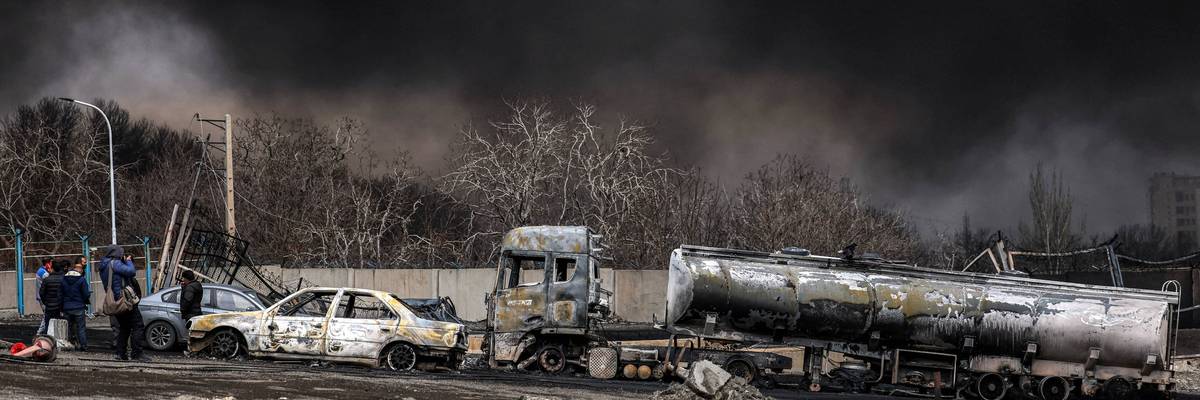
A dark smoke cloud engulfs destroyed vehicles near an ongoing fire following an overnight airstrike on the Shahran oil refinery in northwestern Tehran on March 8, 2026.
'Intentional Chemical Warfare': Toxic Black Rain in Tehran After US-Israel Bomb Oil Facilities
"The consequences of this environmental and humanitarian catastrophe will not be confined within Iran's borders. These strikes constitute war crimes," said a spokesperson for the Iranian Foreign Ministry.
In the wake of infernos unleashed across portions of Tehran the night before, the people of Iran's capital woke up Sunday to the hideous sight of ominous gray clouds above, choking-levels of smoke, and black raindrops full of toxic oil falling across the city.
Critics described "scenes of Armageddon" and characterized the bombings and the destruction they triggered as the latest crimes committed by the US and Israel since they launched their unprovoked and illegal assault on the Middle East nation last week.
Iranian officials urged residents to stay in doors to avoid the health impacts of the air quality following Israel's intentional bombing of several oil storage and processing facilities in the city on Saturday.
"On top of everything else, Israel and the US have unleashed an environmental disaster in Tehran," said Assal Rad, a fellow at the Arab Center in Washington, DC. "How many ways can they show you they have no regard for human life?"
Iran’s Red Crescent Society warned that the toxic rainfall in Tehran, home to approximately 10 million people, could be “highly dangerous and acidic” and issued exposure guidelines for residents.
Esmaeil Baqaei, a spokesperson for the Iranian Foriegn Ministry, condemned the attacks and resulting damage in stark terms.
"The US-Israeli criminal war against the Iranian nation has entered a dangerous new phase with deliberate strikes on Iran's energy infrastructure," said Bagaei in an online statement. "These attacks on fuel storage facilities amount to nothing less than intentional chemical warfare against the Iranian citizens."
"By targeting fuel depots, the aggressors are releasing hazardous materials and toxic substances into the air, poisoning civilians, devastating the environment, and endangering lives on a massive scale," he continued. "The consequences of this environmental and humanitarian catastrophe will not be confined within Iran's borders. These strikes constitute war crimes, crimes against humanity, and genocide—all at once."
In a Sunday morning video, CNN correspondent Frederik Pleitgen showed the view from central Tehran, including the black water gathering on every surface:
It is raining oil in Tehran this morning after major airstrikes on oil facilities in the South and West of the Iranian capital. @CNN @cnni pic.twitter.com/2FBD9EnO9p
— Frederik Pleitgen (@fpleitgenCNN) March 8, 2026
Pleitgen also traveled to the Shahran oil depot, among the facilities bombed Saturday, where dark gray smoke continued to billow into the air and he described the amount of damage as "immense":
Managed to film at the Shahran oil depot in Western Tehran that was targeted by airstrikes last night. The oil still seems to be burning. We saw flames coming from some of the destroyed oil storage tanks. Also destroyed tanker trucks outside the gate. Sorry for audio issues, was… pic.twitter.com/DYrsJbaY3t
— Frederik Pleitgen (@fpleitgenCNN) March 8, 2026
"Though it is day, the sun cannot be seen in Tehran today because of all the smoke following the US and Israel bombing Tehran's oil refineries," said Trita Parsi, executive vice president for the Quincy Institute, a US-based foreign policy think tank. "People on the ground describe it as armageddon."
Though it is day, the sun cannot be seen in Tehran today because of all the smoke following the US and Israel bombing Tehran's oil refineries. People on the ground describe it as armageddon.
History will not forgive Reza Pahlavi, Masih Alinejad, Nazanin Boniadi, and all other… pic.twitter.com/Sy3LhtaDEK
— Trita Parsi (@tparsi) March 8, 2026
Parsi, who is of Iranian descent, also took aim at members of the Iranian diaspora who for weeks and months have pushed for the US and Israeli governments to attack their own country.
"History," he said, "will not forgive Reza Pahlavi, Masih Alinejad, Nazanin Boniadi, and all other 'leaders' who tricked Iranians into thinking this war would set them free."
We are at a crossroads
This country and this world are at a monumental crossroads. In a few short weeks, US voters will have an opportunity to beat back the forces of fascism and confront the billionaires who are rigging the economy, our media system, and our democracy, making it increasingly impossible for ordinary people to get by. We’re not just talking about the election. We’re talking about what must be done once these fascist elements are vanquished from power. We need a bolder set of solutions than what either major party has so far been willing to offer and a working-class movement ready to fight like hell for it. Trump didn't emerge from nowhere. The conditions that fueled MAGA authoritarianism were created by decades of radical neoliberal economic policies and a corrupt political system dominated by corporate interests. They slashed taxes on the super-rich, promising that the benefits would trickle down. They said giveaways to the corporate titans would make life more affordable for the rest of us. It was all bullshit. And when a bitter, betrayed populace searches for someone to blame, right-wing demagogues have little trouble finding scapegoats. People know when they're being lied to, but you won't hear any of this from the corporate media. Only independent journalism—powered and funded by people who believe in building a better world—can deliver truly trustworthy daily news. Our Fall Campaign is underway, and we need your help. To power our newsroom through the rest of the year, we need to raise $125,000 by midnight on October 31. So if you share our vision, please contribute whatever you can to sustain our work. |
In the wake of infernos unleashed across portions of Tehran the night before, the people of Iran's capital woke up Sunday to the hideous sight of ominous gray clouds above, choking-levels of smoke, and black raindrops full of toxic oil falling across the city.
Critics described "scenes of Armageddon" and characterized the bombings and the destruction they triggered as the latest crimes committed by the US and Israel since they launched their unprovoked and illegal assault on the Middle East nation last week.
Iranian officials urged residents to stay in doors to avoid the health impacts of the air quality following Israel's intentional bombing of several oil storage and processing facilities in the city on Saturday.
"On top of everything else, Israel and the US have unleashed an environmental disaster in Tehran," said Assal Rad, a fellow at the Arab Center in Washington, DC. "How many ways can they show you they have no regard for human life?"
Iran’s Red Crescent Society warned that the toxic rainfall in Tehran, home to approximately 10 million people, could be “highly dangerous and acidic” and issued exposure guidelines for residents.
Esmaeil Baqaei, a spokesperson for the Iranian Foriegn Ministry, condemned the attacks and resulting damage in stark terms.
"The US-Israeli criminal war against the Iranian nation has entered a dangerous new phase with deliberate strikes on Iran's energy infrastructure," said Bagaei in an online statement. "These attacks on fuel storage facilities amount to nothing less than intentional chemical warfare against the Iranian citizens."
"By targeting fuel depots, the aggressors are releasing hazardous materials and toxic substances into the air, poisoning civilians, devastating the environment, and endangering lives on a massive scale," he continued. "The consequences of this environmental and humanitarian catastrophe will not be confined within Iran's borders. These strikes constitute war crimes, crimes against humanity, and genocide—all at once."
In a Sunday morning video, CNN correspondent Frederik Pleitgen showed the view from central Tehran, including the black water gathering on every surface:
It is raining oil in Tehran this morning after major airstrikes on oil facilities in the South and West of the Iranian capital. @CNN @cnni pic.twitter.com/2FBD9EnO9p
— Frederik Pleitgen (@fpleitgenCNN) March 8, 2026
Pleitgen also traveled to the Shahran oil depot, among the facilities bombed Saturday, where dark gray smoke continued to billow into the air and he described the amount of damage as "immense":
Managed to film at the Shahran oil depot in Western Tehran that was targeted by airstrikes last night. The oil still seems to be burning. We saw flames coming from some of the destroyed oil storage tanks. Also destroyed tanker trucks outside the gate. Sorry for audio issues, was… pic.twitter.com/DYrsJbaY3t
— Frederik Pleitgen (@fpleitgenCNN) March 8, 2026
"Though it is day, the sun cannot be seen in Tehran today because of all the smoke following the US and Israel bombing Tehran's oil refineries," said Trita Parsi, executive vice president for the Quincy Institute, a US-based foreign policy think tank. "People on the ground describe it as armageddon."
Though it is day, the sun cannot be seen in Tehran today because of all the smoke following the US and Israel bombing Tehran's oil refineries. People on the ground describe it as armageddon.
History will not forgive Reza Pahlavi, Masih Alinejad, Nazanin Boniadi, and all other… pic.twitter.com/Sy3LhtaDEK
— Trita Parsi (@tparsi) March 8, 2026
Parsi, who is of Iranian descent, also took aim at members of the Iranian diaspora who for weeks and months have pushed for the US and Israeli governments to attack their own country.
"History," he said, "will not forgive Reza Pahlavi, Masih Alinejad, Nazanin Boniadi, and all other 'leaders' who tricked Iranians into thinking this war would set them free."
In the wake of infernos unleashed across portions of Tehran the night before, the people of Iran's capital woke up Sunday to the hideous sight of ominous gray clouds above, choking-levels of smoke, and black raindrops full of toxic oil falling across the city.
Critics described "scenes of Armageddon" and characterized the bombings and the destruction they triggered as the latest crimes committed by the US and Israel since they launched their unprovoked and illegal assault on the Middle East nation last week.
Iranian officials urged residents to stay in doors to avoid the health impacts of the air quality following Israel's intentional bombing of several oil storage and processing facilities in the city on Saturday.
"On top of everything else, Israel and the US have unleashed an environmental disaster in Tehran," said Assal Rad, a fellow at the Arab Center in Washington, DC. "How many ways can they show you they have no regard for human life?"
Iran’s Red Crescent Society warned that the toxic rainfall in Tehran, home to approximately 10 million people, could be “highly dangerous and acidic” and issued exposure guidelines for residents.
Esmaeil Baqaei, a spokesperson for the Iranian Foriegn Ministry, condemned the attacks and resulting damage in stark terms.
"The US-Israeli criminal war against the Iranian nation has entered a dangerous new phase with deliberate strikes on Iran's energy infrastructure," said Bagaei in an online statement. "These attacks on fuel storage facilities amount to nothing less than intentional chemical warfare against the Iranian citizens."
"By targeting fuel depots, the aggressors are releasing hazardous materials and toxic substances into the air, poisoning civilians, devastating the environment, and endangering lives on a massive scale," he continued. "The consequences of this environmental and humanitarian catastrophe will not be confined within Iran's borders. These strikes constitute war crimes, crimes against humanity, and genocide—all at once."
In a Sunday morning video, CNN correspondent Frederik Pleitgen showed the view from central Tehran, including the black water gathering on every surface:
It is raining oil in Tehran this morning after major airstrikes on oil facilities in the South and West of the Iranian capital. @CNN @cnni pic.twitter.com/2FBD9EnO9p
— Frederik Pleitgen (@fpleitgenCNN) March 8, 2026
Pleitgen also traveled to the Shahran oil depot, among the facilities bombed Saturday, where dark gray smoke continued to billow into the air and he described the amount of damage as "immense":
Managed to film at the Shahran oil depot in Western Tehran that was targeted by airstrikes last night. The oil still seems to be burning. We saw flames coming from some of the destroyed oil storage tanks. Also destroyed tanker trucks outside the gate. Sorry for audio issues, was… pic.twitter.com/DYrsJbaY3t
— Frederik Pleitgen (@fpleitgenCNN) March 8, 2026
"Though it is day, the sun cannot be seen in Tehran today because of all the smoke following the US and Israel bombing Tehran's oil refineries," said Trita Parsi, executive vice president for the Quincy Institute, a US-based foreign policy think tank. "People on the ground describe it as armageddon."
Though it is day, the sun cannot be seen in Tehran today because of all the smoke following the US and Israel bombing Tehran's oil refineries. People on the ground describe it as armageddon.
History will not forgive Reza Pahlavi, Masih Alinejad, Nazanin Boniadi, and all other… pic.twitter.com/Sy3LhtaDEK
— Trita Parsi (@tparsi) March 8, 2026
Parsi, who is of Iranian descent, also took aim at members of the Iranian diaspora who for weeks and months have pushed for the US and Israeli governments to attack their own country.
"History," he said, "will not forgive Reza Pahlavi, Masih Alinejad, Nazanin Boniadi, and all other 'leaders' who tricked Iranians into thinking this war would set them free."