

SUBSCRIBE TO OUR FREE NEWSLETTER
Daily news & progressive opinion—funded by the people, not the corporations—delivered straight to your inbox.
5
#000000
#FFFFFF
To donate by check, phone, or other method, see our More Ways to Give page.
Daily news & progressive opinion—funded by the people, not the corporations—delivered straight to your inbox.
Jamal Abdi Phone: 206-369-2069 Email: jabdi@niacouncil.org
NIAC commends Rep. Jan Schakowsky (D-IL), Rep. Lloyd Doggett (D-TX), Rep. David Price (D-NC), and all 150 members of the House of Representatives who sent a letter to President Obama today providing the strongest Congressional endorsement of nuclear negotiations with Iran to date.
"This letter reflects the views of the majority of Americans who support a negotiated resolution with Iran and is a last line of defense against those in Congress who are committed to killing a deal," said Jamal Abdi, NIAC Policy Director. "If the President is forced to use his veto to protect an agreement this summer, there are now sufficient lawmakers on the record in support of the envisioned deal to potentially uphold that veto."
The Iran Nuclear Agreement Review Act is expected to be signed into law within weeks, which would give Congress the power to vote on an Iran deal and potentially block its implementation by passing a resolution of disapproval. Such a resolution would face a Presidential veto, which would require 145 Representatives, or 34 Senators, to sustain. If the 145 voting members who signed onto the Schakowsky-Doggett-Price letter vote to protect the veto, a deal would be approved.
"Protecting a deal by veto is not the ideal option because it could convince some in Congress to persist with further efforts to sabotage a deal," said Abdi. "But if it's necessary to prevent Congress from killing a deal and leading us down the war path, the President will have to use his veto and many lawmakers will have his back."
The Schakowsky-Doggett-Price letter conveys support for the framework nuclear agreement secured by the U.S. and UN powers with Iran in April. Its signers warn that a collapse of negotiations would be harmful to U.S. interests and that war would not make the U.S. safer. The letter's signers encourage continued diplomatic efforts by U.S. negotiators to seal a final deal.
"The best option for a strong, sustainable agreement will be for lawmakers to approve a deal by either passing a positive resolution or simply doing nothing," said Abdi. "We are optimistic that, between this letter, the support of the American people, and a good final deal, there will be sufficient support in Congress on both sides of the aisle to protect a final deal."
The National Iranian American Council (NIAC) is a nonpartisan, nonprofit organization founded in 2002 to give voice to the Iranian-American community. From being the trusted voice on U.S.- Iran relations, to pushing forth legislation that protects individuals of Iranian heritage from systematic discrimination, to celebrating our cultural heritage, NIAC creates a lasting impact in the lives of the members of our community.
(202) 386-6325
"How we confront the climate crisis will determine a lot about the next 250 years of American history, including if we make it that long," one climate advocate said. "The revolution we need today is the clean energy revolution."
The US reliance on and promotion of fossil fuels is interfering with its ability to celebrate its 250th birthday, as several July 4 events were canceled due to a dangerous, record-breaking heatwave in the Central and Eastern US that scientists say would have been "virtually impossible" without the climate emergency.
As millions of people sweltered under heat alerts, extreme heat and humidity led to the cancellation of both Washington, DC and Philadelphia's Independence Day parades. Nearly 30 other events in states including Alabama, Delaware, New Jersey, New York, Pennsylvania, Maryland, and Virginia were modified, postponed, or canceled, according to USA Today.
I'm just saying, it seems like a signwww.cbsnews.com/philadelphia...
[image or embed]
— Bill McKibben (@billmckibben.bsky.social) July 3, 2026 at 1:12 PM
"The US having to cancel major 4th of July celebrations because of extreme heat is almost too spot on as a metaphor for the country’s failure to combat global warming," Fossil Free Media director Jamie Henn told Common Dreams. "How we confront the climate crisis will determine a lot about the next 250 years of American history, including if we make it that long. The revolution we need today is the clean energy revolution so we can finally declare our independence from fossil fuels."
Happy Independence Day!🇺🇸🎆
A prolonged, dangerous heat wave will persist through the Independence Day weekend across the Ohio Valley, Midwest, and Mid-Atlantic. Numerous temperature records are expected. 🥵
Clusters of severe thunderstorms will move across parts of the… pic.twitter.com/hz4vSz40Z4
— National Weather Service (@NWS) July 4, 2026
Temperature records were tied or broken in 22 locations on Thursday and 17 on Friday, according to CNN, with DC breaking a 120-year record on both days with temperatures above 102°F.
The heat forced the temporary closure Friday afternoon of the Great American State Fair on the National Mall, and seven attendees required "advanced life support," probably due to heat exposure, according to CNN.
Matt Rein, the Democratic National Committee's influencer and creative partnerships director, reported from the state fair on Saturday that local emergency workers said guests were "dropping like flies" due to the heat.
This is the scene here at one of the cordoned off medical area inside a main tent.
They keep having to make more space as more people are brought in.
There is no AC. https://t.co/eVVpqwHiMJ pic.twitter.com/Rmyg4YW1r2
— Matt Rein (@MatthewARein) July 4, 2026
Meanwhile, one group who tried to draw attention to the climate emergency at a July 4 event was evicted for its efforts by the US Coast Guard, as the Times Union reported. The nonprofit Hudson River Sloop Clearwater had attempted to join Saturday's Sail4th 250 parade of tall ships to New York Harbor when its sailboat was removed by the guard. The Coast Guard later said it was due to banners the boat was displaying reading, "Save the Clean Water Act” and “Indigenous rights, racial justice, climate solutions,” despite the fact that the group had the event organizer's permission to participate.
A sailboat, the Hudson River Sloop Clearwater, was removed from the Sail4th 250 Parade of Ships for displaying banners about climate justice and clean water.
Source: ig/jackiemarieburton, ig/sloopclearwater pic.twitter.com/kJoS4RLgAQ
— Dr. Lucky Tran (@luckytran) July 4, 2026
The heat dome that has settled over the Central and Eastern US over the July 4 weekend is so dangerous in part because it includes high humidity along with high heat, with heat indexes of 105-115°F expected in some places. This corresponds with a Wet Bulb Global Temperature (WBGT)—a measurement that accounts for heat, humidity, and air flow—of 28-30°C, at which point it is dangerous for even healthy people to be physically active outdoors. According to World Weather Attribution, the current heatwave broke regional records for WBGT.
"It is still a relatively rare event even in today’s climate, that has warmed by 1.4°C due to the burning of fossil fuels. In a 1.4°C cooler climate, WBGTs as high as those forecast in early July 2026 would have been so extreme as to be virtually impossible," the group wrote on Friday.
Friederike Otto, a professor of climate science at Imperial College London, told CNN, “When a historic 4th of July celebration is disrupted, and World Cup matches are played in conditions that are unsafe for players and fans, it shouldn’t take another scientific study to wake people up."
Otto continued, "Climate change is here, it’s already impacting the things we enjoy in our everyday lives, and it will continue to get worse the longer we drag out the inevitable transition to net zero emissions.”
Climate scientist and communicator Katharine Hayhoe encouraged people to use this opportunity to talk about the climate emergency to their friends and family:
Heatwaves aren't new. But I'm a climate scientist, and I can tell you heatwaves like this are virtually impossible without fossil fuel pollution. Not only that, but when extreme weather hits, research shows that connecting it to climate change helps people understand why it matters. And you know who the most trusted people to do that are? Not scientists. You! Yes, people we know are the most effective messengers to have these conversations. So if you're worried about what's happening and how extreme heat puts us at risk—talk about it!
While the US is the world's leading historical emitter of greenhouse gas emissions, and its military is the No. 1 institutional climate polluter, the Trump administration in particular has taken steps to accelerate the climate emergency by increasing oil, gas, and coal production while hindering the development of renewable energy.
"Trump’s promotion of coal burning and cancellation of wind turbines make him the Benedict Arnold of America’s current struggle, not its George Washington."
Just two days before the nation's birthday, Energy Secretary and fracking CEO Chris Wright bragged on social media that the Trump administration would end subsidies for new wind and solar on July 4.
Climate scientist Rebekah Jones shot back: "During a record heatwave, no less. Fossil fuel industries have received $549 BILLION in direct subsidies, and $7 TRILLION in tax benefits. They average $30 billion per year in upfront taxpayer money. All of renewable energy recieved $400 million per year from 1994-2009."
Tennessee state Sen. Heidi Campbell (D-20) also called out the move: "Talk about 'slugs for salt’—it's 119 degree heat index in the Eastern US this week—these guys are all in on the rapture."
In a July 4 post, scholar Juan Cole argued that President Donald Trump's climate policies were tantamount to treason.
"Since 2018, some 13,000 Americans have died from heat," he said. "Trump’s promotion of coal burning and cancellation of wind turbines make him the Benedict Arnold of America’s current struggle, not its George Washington."
Cole pointed out that the current heatwave was part of a pattern of hotter summers in the nation's capital due to the climate emergency, noting that the last decade was its hottest on record.
He continued:
The bad news is that this is only the beginning. Summers in the capital are going to be more dangerous every decade unless we halt dangerous carbon emissions.
The average summer temperature in DC could be 97°F in the 2080s if we go on farting out CO2 at our current rate. Humidity will also increase, as the Atlantic heats up and puts more water vapor in the atmosphere. The ability of the atmosphere to hold water vapor increases 7% with every 1°C increase in temperature.
That combined with more frequent storms and sea-level rise opens up the possiblity that DC "will be unlivable in the summers within the lifetime of my younger readers," he wrote.
"Trump is helping climate change accomplish what British military might could not, putting in question the future of America in places like Washington, DC and Baltimore, at least in the summers," Cole said.
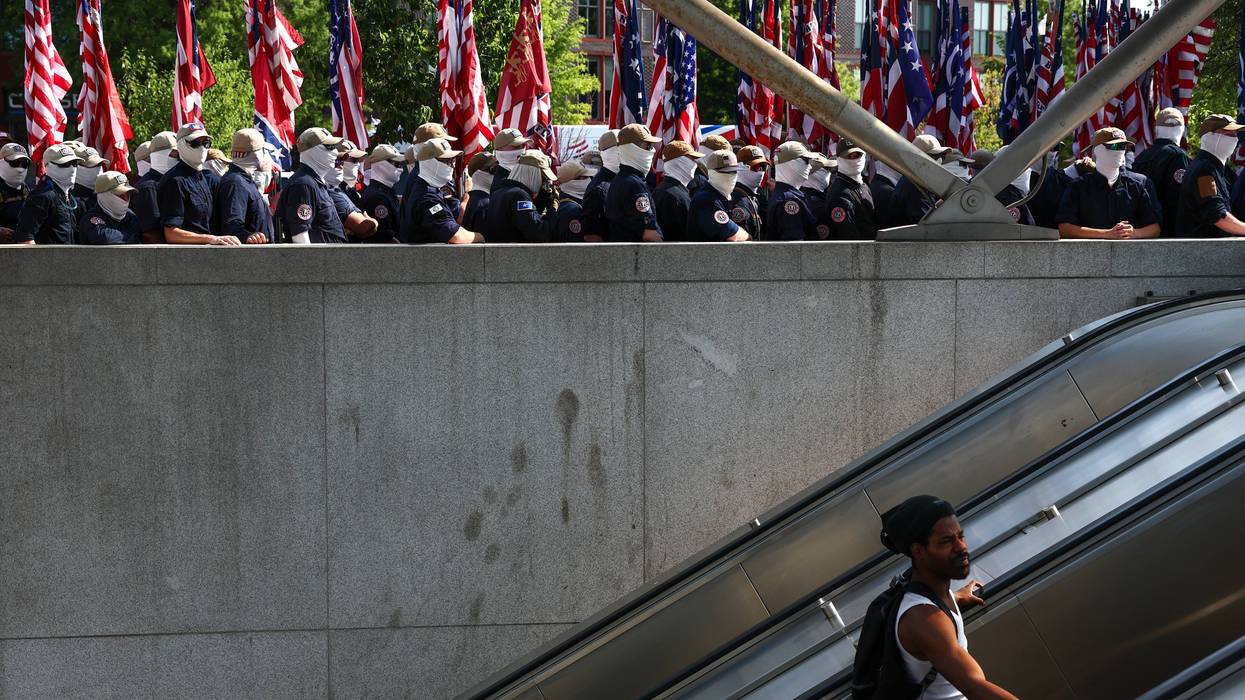
"Absolutely terrifying to have white supremacist hate group Patriot Front march through our streets today in Washington, DC," one human rights lawyer said.
Hundreds of members of the white nationalist hate group Patriot Front descended on Washington DC Saturday morning as the nation's capital prepared to celebrate the 250th anniversary of the Declaration of Independence.
Members of the group, wearing masks and carrying Confederate and US flags, rode the DC metro and marched around parts of Capitol Hill before departing the city by train, as WUSA reported. Beyond the march itself, no other incidents were reported connected to the group.
"What kind of fascist hellscape is [happening] on Pennsylvania Ave at the Eastern Market Metro stop?" Georgetown Law professor Josh Chafetz wrote on Bluesky upon spotting the group.
Chafetz said the group appeared to be all white and all male.
What kind of fascist hellscape is happing on Pennsylvania Ave at the Eastern Market Metro stop? These guys—seemingly all white, all men—have their faces covered, are carrying shields, wearing brown …
[image or embed]
— Josh Chafetz (@joshchafetz.bsky.social) July 4, 2026 at 6:43 AM
"Absolutely terrifying to have white supremacist hate group Patriot Front march through our streets today in Washington, DC," human rights lawyer Mai El-Sadany wrote on social media. "Their manifesto calls for a white ethnostate, excludes people of color from their definition of citizenship, and is deeply antisemitic and xenophobic."
In one video shared by WTOP reporter Mitchell Miller, members of the group stood in a line outside DC's Union Station chanting, "Life, liberty, victory" and "Reclaim America."
A group of masked men gathered at Union Station today and called for reclaiming the country and getting rid of immigrants. Some held Confederate flags. They have been marching across Capitol Hill. pic.twitter.com/xTfaoJDHOO
— Mitchell Miller (@mmillerwtop) July 4, 2026
According to the Southern Poverty Law Center (SPLC), Patriot Front split from Vanguard America after the "Unite the Right" rally in Charlottesville, Virginia in 2017, at which white supremacist James Alex Fields Jr. drove his car into counterprotesters, killing anti-racist activist Heather Heyer and injuring 35 others
"Patriot Front is an image-obsessed organization that rehabilitated the explicitly fascist agenda of Vanguard America with garish patriotism. Patriot Front focuses on theatrical rhetoric and activism that can be easily distributed as propaganda for its chapters across the country," SPLC explains.
The group believes that democracy no longer functions and wants to transform the US into a "pan-European" ethnostate that excludes both citizens of color and new immigrants and refugees.
One image from a Reuters photographer shows the masked Patriot Front marchers standing around a Black woman sitting on the DC Metro.
"This image is from today. A Black woman sits on the DC metro as masked white nationalists prepare to march on our nation's capital. This is America's 250th anniversary," attorney Aaron Parnas posted on social media.
This image is from today. A Black woman sits on the DC metro as masked white nationalists prepare to march on our nation's capital.
This is America's 250th anniversary. REUTERS/Cheney Orr pic.twitter.com/eIO8XJwIuA
— Aaron Parnas (@AaronParnas) July 4, 2026
Melanie D’Arrigo, executive director of the Campaign for New York Health, blasted the group for carrying Confederate flags and embracing fascism while claiming the mantle of US patriotism.
"You have no right to call yourself a '[patriot]' while carrying the flag of one of America's enemies, and claiming victory on behalf of the ideology that fueled another—both of which the US defeated," D'Arrigo wrote on social media.
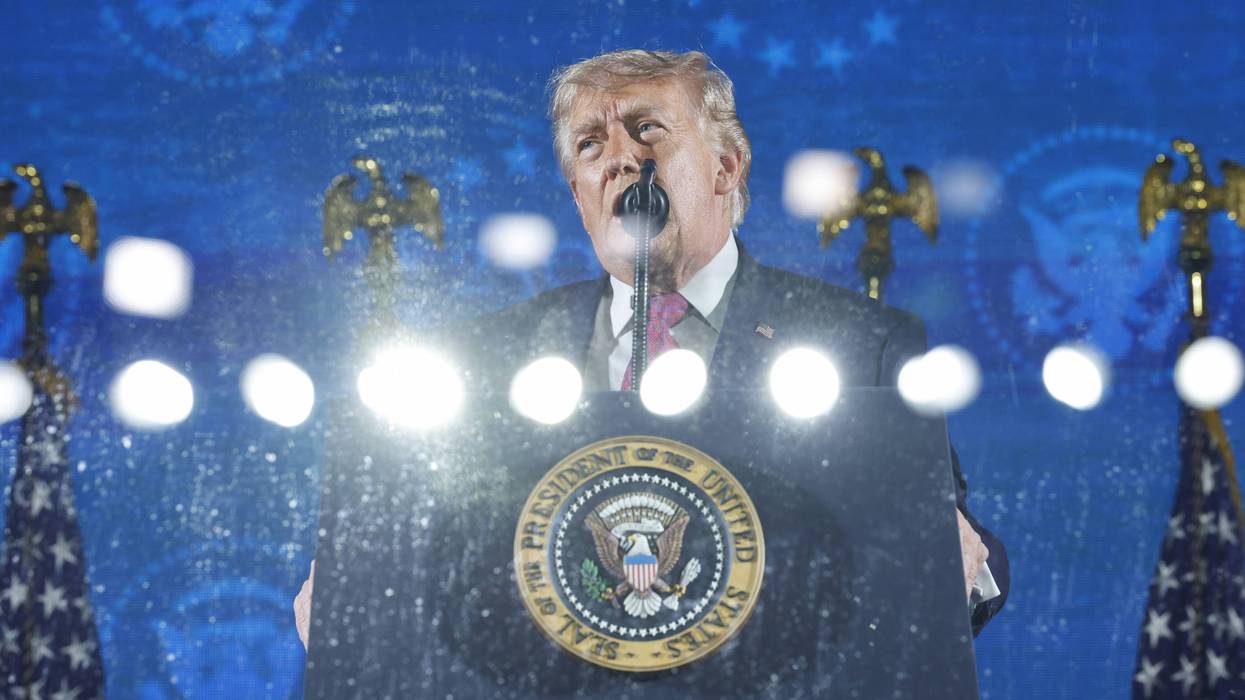
"If we terminate the filibuster as we should do and immediately vote for the SAVE America Act then we will not lose an election for a hundred years," the president said.
President Donald Trump spent his address to the United States the night before its 250th birthday fearmongering about the "communist menace" and suggesting that his Republican Party should govern the nation for a century.
"America will never be a communist country," he said from Mount Rushmore, South Dakota Friday night. "We can only lose the midterms if we allow ourselves to lose the midterms, if we are foolish, stupid, and unwise. But if we terminate the filibuster as we should do and immediately vote for the SAVE America Act then we will not lose an election for a hundred years."
His remarks clearly implied a false link between communism and the Democratic Party and promoted a bill that critics say will make it harder for millions of eligible voters to participate in elections. The SAVE America Act claims to address the documented non-problem of noncitizen voting by requiring voters to show documents such as passports and birth certificates, which can be expensive and difficult to obtain, especially for low-income voters. Such requirements would also impose added burdens on rural voters and married women who have changed their names.
Melanie D’Arrigo, executive director of the Campaign for New York Health, wrote on social media that with his remarks, Trump was "clearly defining the effects of voter suppression bills."
Trump clearly defining the effects of voter suppression bills. https://t.co/vKOytLxdm0
— Melanie D'Arrigo (@DarrigoMelanie) July 4, 2026
"What message could be more unifying on the nation’s 250th birthday weekend than touting one-party rule?" writer Michael Freeman posted on social media.
California state Sen. Scott Wiener (D-11) wrote: "The thing about Trump is he tells us what he wants & what he intends to do. He wants to end democracy. Freeze MAGA in power forever. Have zero accountability to the people. Just seize power & keep it. We are so close to true authoritarianism. We must use every ounce of power & leverage we have to stop them."
Before arguing for 100 years of Republican rule, Trump continued the exaggerated anti-communist rhetoric he has employed in the weeks since progressive and Democratic-Socialist candidates won a series of Democratic primary victories.
"There is now a resurgence of the communist menace in our land, including from newcomers to our country who embrace ideas totally opposed to our way of life and our great success," Trump said on Friday. "These are not mere political disagreements like differences over taxes or regulations. Communism is a mortal threat to American liberty. It is the greatest threat to our country, including World War I, World War II, Pearl Harbor, or even 9/11."
In fact, the Democratic Socialists who won primary elections in New York City last month ran on a platform of affordable housing, Medicare for All, stronger unions, and an end to US military support for Israel's genocide in Gaza, policies backed by large numbers of ordinary Americans.
Trump doubled down on an opposition between communism and US values and also linked his anti-communist to his anti-immigrant stance, threatening to send communists into "exile."
"You can be a communist or you can be a patriot. You cannot be both," Trump said in a quote later posted from the White House X account.
Apparently, you can be a rapist and an alleged pedophile and become President. https://t.co/aYAMCJQOPO
— Wajahat Ali (@WajahatAli) July 4, 2026
"This July 4th, the Trump regime is pushing a new Red Scare. This is an actual White House post. The regime is pretending that communism is a serious threat to America," Tom Joscelyn, who served as a senior professional staffer on the January 6 Committee, responded on social media.
MeidasNews editor in chief Ron Filipkowski argued that Trump was leaning on anti-communism to divert attention from his own disastrous policies.
"Trump fucks up the economy with his tariffs, raises gas prices for every American with his foolish war, piles on to the national debt with his budget & wasteful spending on vanity projects, covers up Epstein, makes billions for himself, then starts yelling about communism to distract," he wrote on social media.
Journalist Mark Chadbourn agreed, writing on social media that the speech reflected Trump's "new strategy."
"Now he’s failed completely abroad, he’s looking to the Enemy Within to create new Hate Figures to unite his wavering followers," Chadbourn said. "Can’t stop Iran’s threat so let’s have a 2026 Red Scare to turn neighbour against neighbour. A new HUAC on the way? Very dangerous."
Trump's July 3 remarks contrasted with those of New York Democratic Socialist Mayor Zohran Mamdani earlier that day, who uplifted the country's immigrant heritage, decried greed and racial supremacy, and argued that “time and again, including 250 years ago, those forces of division have been vanquished by the forces of progress.”