

SUBSCRIBE TO OUR FREE NEWSLETTER
Daily news & progressive opinion—funded by the people, not the corporations—delivered straight to your inbox.
5
#000000
#FFFFFF
To donate by check, phone, or other method, see our More Ways to Give page.
Daily news & progressive opinion—funded by the people, not the corporations—delivered straight to your inbox.

Attacks by forces loyal to Colonel al-Gaddafi on civilian and residential areas of Misratah may amount to war crimes, Amnesty International said today in a new report on the bleak situation in the besieged city.
Misratah: Under Siege and Under Fire accuses al-Gaddafi forces of unlawful killing of civilians due to indiscriminate attacks, including use of heavy artillery, rockets and cluster bombs in civilian areas and sniper fire against residents.
It also documents systematic shooting at peaceful protesters and enforced disappearance of perceived opponents, which can amount to crimes against humanity.
"The scale of the relentless attacks that we have seen by al-Gaddafi forces to intimidate the residents of Misratah for more than two months is truly horrifying," said Donatella Rovera, Amnesty International's senior adviser currently in Libya.
"It shows a total disregard for the lives of ordinary people and is in clear breach of international humanitarian law."
Amnesty International called on the Tripoli authorities to put an immediate end to indiscriminate attacks and direct attacks against civilians or civilian objects.
Since Misratah declared its allegiance to opposition forces in February, al-Gaddafi's forces have used their positions around the city and in the centre to launch relentless indiscriminate attacks into the city's residential neighbourhoods.
Scores of residents not involved in armed confrontations have been killed and hundreds injured, many by indiscriminate 122mm Grad rockets fired from up to tens of kilometres away, and by mortars and 155mm artillery shells.
Rockets, mortars and artillery shells are designed for use against massed infantry or armour. Under international humanitarian law, none of these weapons should ever be used in populated residential areas.
Early in the morning of 14 April, a dozen residents were killed and many more were injured when several salvos of rockets rained down on the Qasr Ahmad neighbourhood of Misratah. Many of the victims were standing in a queue outside a bakery.
On 15 April, Amnesty International found evidence that mortars containing cluster submunitions were being used in residential areas, including in the city centre.
The organization said that cluster munitions, which cannot discriminate between civilians and soldiers, should never be used in any circumstances and that their use in residential areas was a flagrant violation of the international prohibition on indiscriminate attack.
Amnesty International also found that sniper fire was used by al-Gaddafi forces to target residents in areas under the control of opposition fighters, preventing them from moving around freely.
33 year-old father of three Ibrahim Ahmad al-Dernawi was shot and killed in his parents' house, apparently by a sniper. His father told Amnesty International:
"He was holding his six-month-old son in his lap and we were talking. I suddenly heard the sound of the glass breaking but the window did not shatter. Then I saw blood pouring from my son's face. He died instantly."
Many residents remained trapped for weeks in areas near the front line particularly around Tripoli Street, unable to leave for fear of being shot at by snipers.
Amnesty International also found evidence suggesting the use of human shields by al-Gaddafi forces. In the Gheiran neighbourhood, south-west of the city centre, tanks were positioned next to civilian buildings, seemingly in a deliberate attempt to shield them from possible air strikes.
"Shielding" is a violation of international humanitarian law and constitutes a war crime.
Amnesty International also highlighted the plight of thousands of migrants who remain trapped at Misratah's port, now being increasingly targeted by forces loyal to Colonel al-Gaddafi as they attempt to deprive the city's remaining residents of their last lifeline to the outside world.
On 4 May four members of a family from Niger, including two children under two years old and their aunt and uncle, were killed in a rocket attack as they waited for evacuation from Misratah.
Amnesty International called on the international community to support the international investigations into human rights abuses and violations of international humanitarian law in Libya, in particular the International Criminal Court (ICC) and the Commission of Inquiry established by the UN Human Rights Council.
On 4 May, ICC Prosecutor Luis Moreno-Ocampo told the UN Security Council that he will ask ICC judges to issue arrest warrants against three individuals for crimes against humanity committed in Libya.
"The people of Misratah have had nowhere to turn for safety or support in recent months," said Donatella Rovera.
"The international community must give all possible support - financial, legal and practical - to thosee bodies trying to bring to justice those responsible for possible war crimes and crimes against humanity in Misratah and elsewhere in Libya."
Background
The findings of Misratah: Under Siege and Under Fire are based on an Amnesty International delegate's visit to Misratah between 14 and 20 April. The report also draws from an Amnesty International visit to Tunisia between 6 and 20 April, which interviewed injured residents from Misratah and their families who had been evacuated for treatment.
Amnesty International is a worldwide movement of people who campaign for internationally recognized human rights for all. Our supporters are outraged by human rights abuses but inspired by hope for a better world - so we work to improve human rights through campaigning and international solidarity. We have more than 2.2 million members and subscribers in more than 150 countries and regions and we coordinate this support to act for justice on a wide range of issues.
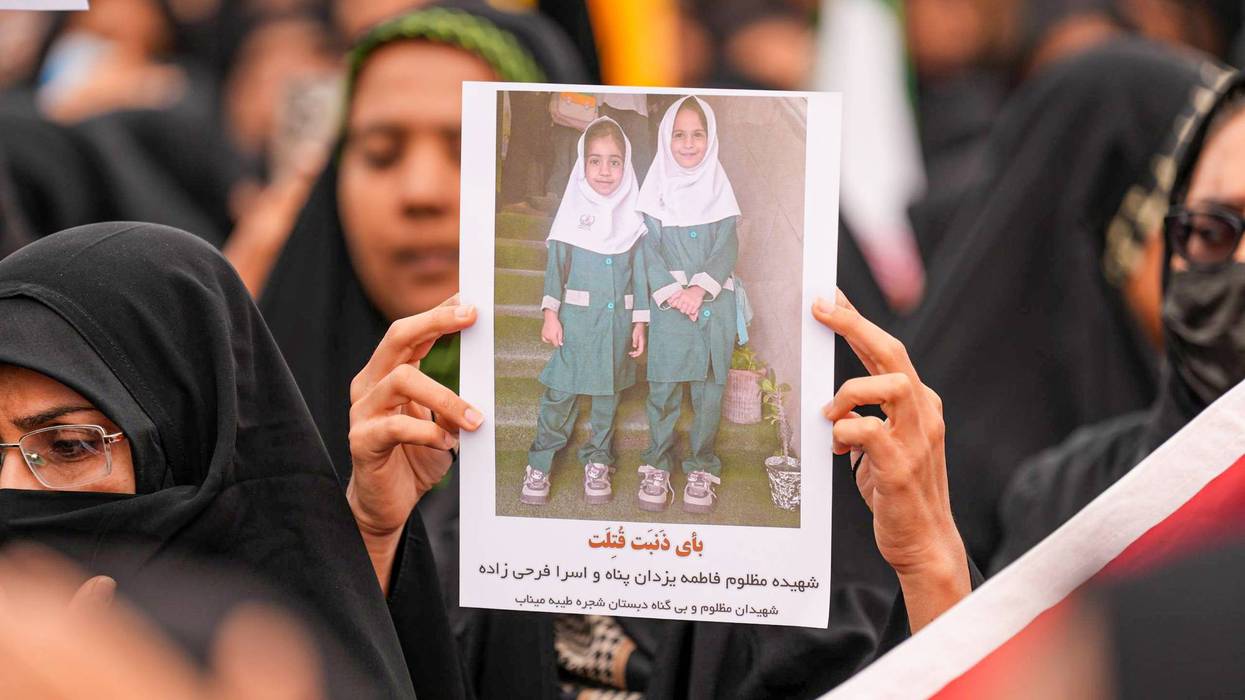
"The second bomb hit," said one paramedic. "Only a small number of those who had taken shelter survived."
As the US and Israel continued to wage war on Iran Wednesday, paramedics and victims’ relatives said last weekend’s bombing of an elementary in southern Iran was a so-called "double-tap" airstrike—a common tactic used by US, Israeli, and Russian forces by which attackers bomb a target and then follow up with a second strike meant to kill survivors and first responders.
Iranian officials said that around 175 people—most of them young girls and boys—were killed when the Shajareh Tayyebeh girls’ elementary school in Minab was hit Saturday by armaments including what Tehran said is a US missile.
“When the first bomb hit the school, one of the teachers and the principal moved a group of students to the prayer hall to protect them,” said one of two Iranian Red Crescent Society (IRCS) paramedics who spoke to Middle East Eye on condition of anonymity.
“The principal called the parents and told them to come and pick up their children," the paramedic added. "But the second bomb hit that area as well. Only a small number of those who had taken shelter survived... Some parents recognized their children only because of the gold bracelets they were wearing."
The father of a girl killed in the second strike on the facility told Middle East Eye that school officials "asked us to come as quickly as possible and take our daughter home.”
However, when he arrived at the school, "My little girl was completely burned."
“There was nothing left of her," he said. "We could only identify her from her school bag, which she was still holding."
"When I saw her smile after coming home from work, all my pain disappeared," the father added. "Now I don’t know what to do with this pain. I don’t know how to live with this.”
The mother of a boy slain in the strike told NBC News that the school also called her and told her to quickly come pick up her child.
“By the time we arrived, the entire school had collapsed on top of the children,” she said. “People were pulling out children’s arms and legs. People were pulling out severed heads.”
On Wednesday, Middle East Eye published a partial list containing the names and ages of 51 children—26 boys and 25 girls—one infant, and eight women killed in the school strike.
Thousands of mourners thronged the streets of Minab on Tuesday as funerals were held for the strike's victims.
Extraordinary crowds as a mass funeral procession begins in Minab, Iran for the 165 school girls & teachers killed in the US/Israeli school strike on Saturday.Many outcomes of this war are uncertain. But a renewed generation of hatred towards the West is now baked in.(🎥 Alireza Akbari)
[image or embed]
— News Eye (@newseye.bsky.social) March 2, 2026 at 11:57 PM
It is not known whether the school, which is located near an Islamic Revolutionary Guard Corps compound, was deliberately targeted.
“All that I know is that we’re investigating that. Of course, we never target civilians," said US Defense Secretary Pete Hegseth, who oversees a military whose 21st century wars have killed more than 400,000 noncombatants, according to the Costs of War Project at Brown University's Watson Institute for International and Public Affairs.
US Secretary of State Marco Rubio said Monday that the Pentagon "would be investigating that, if that was our strike."
"Clearly, the United States would not deliberately target a school," Rubio added.
Since the late 20th century, the US has bombed—either deliberately or through inadequate target vetting and identification—schools in Vietnam, Laos, Cambodia, Iraq, Afghanistan, Pakistan, Yemen, and Syria.
If carried out by the US, Saturday's strike in Minab is likely the deadliest American school bombing since 182 students, staff, and other civilians were massacred in an apparently deliberate secret strike on a school in Laos—the most heavily bombed country ever—during the Vietnam War.
Israel has bombed all levels of schools in Gaza as part of what critics have called a deliberate policy of scholasticide.
North Carolina-based independent journalist Lauren Steiner told Common Dreams Wednesday that the double-tap tactic is "beyond evil."
Other such strikes have been reported during the US-Israeli war on Iran, including the Sunday evening bombing of Niloofar Square in Tehran, where people were celebrating the end of their daily Ramadan fast.
“Suddenly there was the noise and explosion," one survivor, who was enjoying the evening at a café before the bombing, told Drop Site News. "We got up and a few people ran away. We turned around to get our belongings and we saw that blood was spraying everywhere. Someone’s hand had fallen on the floor, a head had fallen on the floor."
“When the second one hit, suddenly everything exploded," he added. "The windows all shattered... One of my friends whom I don’t know that well, he was sitting here... He was severed in half. Half of him was thrown to the side. I put him back together and placed him where he was. A piece of his brain was thrown here on the floor.”
⚡️ Witnesses Describe Horror Scene After “Double-Tap” Bombing Kills Over 20 at Popular Tehran SquareIn Iran, the US & Israel are employing tactics used in Israel’s genocide in Gaza, the “War...Story by Reza Sayah & @mazmhussain.bsky.social for Drop Site Newswww.dropsitenews.com/p/tehran-ira...
[image or embed]
— Drop Site (@dropsitenews.com) March 2, 2026 at 4:20 PM
The IRCS says more than 1,000 Iranians have been killed during four days of US and Israeli bombing, with Iran's retaliatory strikes killing six US service members, 11 Israelis, and a number of people in Gulf states that have come under Iranian bombardment.
"The enemy is exploiting every possible tactic to inflict maximum harm on our people," IRCS spokesperson Mojtaba Khaledi said Tuesday. "We beg the public: Do not rush to bombed areas. The first moments after an explosion are the most dangerous—some munitions are programmed to detonate again, turning rescuers and survivors into additional victims."
The Pennsylvania Democrat "and his GOP colleagues now share ownership of Trump's stupid, unpopular, unjustified, and already tragic war—and the fallout," said Indivisible.
Democratic US Sen. John Fetterman of Pennsylvania voted with nearly every Senate Republican on Wednesday to block a war powers resolution intended to halt President Donald Trump and Israeli Prime Minister Benjamin Netanyahu's war on Iran.
Only Sen. Rand Paul (R-Ky.), who co-sponsored S.J.Res.104 with Sen. Tim Kaine (D-Va.), joined Democrats for the 47-53 vote on the motion to discharge the measure, which would direct the removal of US armed forces from hostilities with Iran.
"This is shameful," declared the anti-war group CodePink, calling out the senators who voted to let the war continue. "The blood is on their hands."
The grassroots group Indivisible similarly said that Fetterman "and his GOP colleagues now share ownership of Trump's stupid, unpopular, unjustified, and already tragic war—and the fallout."
So far, over 1,000 people have been killed in Iran—including around 175 in an attack on a girls' elementary school in Minab—according to the Iranian government, and six US service members are dead.
Cavan Kharrazian, senior policy adviser at the group Demand Progress, said in a statement that "the American people will remember who voted to continue an illegal, unnecessary war. Every senator who voted against the war powers resolution also voted against the wishes of the American people and against the safety of the service members they are sworn to protect."
"The stakes are clear, and there is no more time for political games," Kharrazian continued. "We cannot accept anything except full opposition to Trump's war. This means no votes to authorize it for any period of time and no votes for spending a single penny on it."
The vote came after Senate Democrats left a Tuesday night classified briefing even more concerned that the US-Israeli war on Iran will involve a ground invasion and drag on "forever." The Pentagon is reportedly planning to seek around $50 billion to fund the war, which has not been authorized by Congress and has been widely condemned as illegal under international law.
In the lead-up to the vote, Senate Minority Leader Chuck Schumer (D-NY) had urged Democrats and Republicans alike to "stand with the American people who are tired of war in the Middle East" and "act to stop Trump’s belligerence" by voting "yes."
Pointing to US Defense Secretary Pete Hegseth's Wednesday morning press conference, during which he suggested the war could last at least eight weeks, Schumer said that "one thing is crystal clear: America is at war with no plan, no strategy."
Schumer—who has faced criticism for not leading a strong enough opposition to Trump in general—continued:
In his own words, Hegseth said, "We are just getting started." Hegseth says, "We are accelerating, not decelerating." And in the wake of six brave Americans who died in uniform, Trump simply says: "There will likely be more. That's the way it is." This, my colleagues, is madness. Americans spent the last two decades fighting and dying in the Middle East. Parents watched their kids shipped off to foreign lands.
So many lives lost. So many billions wasted. So much suffering and anguish that scarred an entire generation. Why is Donald Trump hellbent on making history repeat itself? Why is he plunging America headfirst into a war that Americans do not want, and which he cannot even explain? Enough is enough. The American people deserve a say. And that is what our resolution is about.
As the voting got underway, Dylan Williams, vice president for government affairs at the Center for International Policy, a Washington, DC-based think tank, highlighted on social media that "Democrats are at their desks, while the Republican side is empty. The message is unmistakable. For Democrats this is a solemn moment. For Republicans it's just another vote."
The Senate blocked Kaine and Paul's measure from advancing to a final vote as the US House of Representatives on Wednesday debated H.Con.Res.38, a war powers resolution led by Reps. Thomas Massie (R-Ky.) and Ro Khanna (D-Calif.).
"The Constitution entrusts Congress to declare war—not the president," noted Alix Fraser, vice president of advocacy at Issue One. "Today's Senate vote on Sens. Tim Kaine's and Rand Paul's war powers resolution is the first step in setting a precedent to reclaim war powers from the president. We thank Kaine and Paul for bringing this resolution to the floor in a bipartisan manner and Paul for his bravery in standing up and exercising Congress' Article I responsibilities."
"War puts the lives of American military personnel at risk, and the potential economic fallout is massive. The disruption of energy supply chains risks raising the price of everything from fuel to food for everyday Americans. This is why the representatives of we the people must make this decision," he continued. "We hope that tomorrow, the House will follow the Senate's lead and vote on a war powers resolution. Even if the House votes down a war powers resolution like the Senate, this will be an important step in reclaiming our experiment in self-government that our founders intended."
Promoting the We the People Playbook crafted by his and other groups, Fraser stressed that "it is clear that more must be done to ensure that Congress plays its constitutional role. In two months, President Trump has started military conflicts in Iran and Venezuela without congressional approval, and it seems likely he will continue this course unless Congress steps up and reasserts its power."

The survey found Platner with a 33-point lead among independent voters.
The Pan Atlantic Research poll from December was something of an outlier survey in the Maine Senate race, finding that Democratic Gov. Janet Mills was leading progressive combat veteran Graham Platner by 10 points while a number of other polls at the time had Platner, a political newcomer, in the lead.
But on Wednesday, the research firm released its latest survey results after speaking with a random sampling of 1,120 Mainers again between February 13 and March 2. It found that respondents now more closely matched the findings of other polls, with Platner leading Mills by seven points ahead of the June Democratic primary.
Platner had the support of 46% of respondents, up nine points since December, while the governor polled at 39%, down eight points.
Voters ages 18-34 overwhelmingly support Platner, according to the new poll, with 61% backing him compared to 45% supporting Mills. Independent voters also expressed more support for the progressive candidate, by a 33-point margin.
Platner had more support among voters who earn less than $50,000 per year, with 43% supporting him and 41% backing Mills, and significantly more support among voters who make $100,000 per year or more, while Mills was one point ahead among middle-income voters.
The poll also asked respondents who they would support in the general election in potential matchups between the two Democratic candidates and Sen. Susan Collins (R-Maine). Collins and Mills were tied at 44% each, while Platner was ahead of the longtime Republican lawmaker by four points.
The survey also found that Platner—who has been holding packed campaign events across the state, supports Medicare for All and a billionaire minimum tax, and has loudly condemned the Trump administration's attacks on Venezuela and Iran—is the second-most popular politician in the state, after Sen. Angus King (I-Maine).
Pan Atlantic Research released the poll days after a University of New Hampshire survey found Platner ahead of Mills by 38 points in the primary and with an 11-point lead over Collins; Mills was found to be just one point ahead of the Republican.
Platner's support has steadily risen since he announced his candidacy last August. He was endorsed early on by US Sen. Bernie Sanders (I-Vt.) and has spoken out frequently against oligarchy, US support for Israel's assault on Gaza, Republican attacks on transgender rights, and President Donald Trump's deployment of US Immigration and Customs Enforcement agents in Maine and elsewhere.
Controversies that broke soon after Mills entered the race—at the behest of Senate Minority Leader Chuck Schumer (D-NY)—regarding a tattoo Platner had that resembled a Nazi symbol and posts he had written on Reddit years ago, have done little to dent the candidate's lead in polls.
Earlier this week he won his second endorsement from a US senator when Sen. Ruben Gallego (D-Ariz.) announced his support, and as the latest poll was released Wednesday, Democratic Maine gubernatorial candidate Troy Jackson offered his endorsement.
"I'm sick to death of the establishment telling us what we have to do," said Jackson, who has also been endorsed by Sanders. "And until we elect people like Graham Platner up and down this state, up and down this country, we're never going to change it."