SUBSCRIBE TO OUR FREE NEWSLETTER
Daily news & progressive opinion—funded by the people, not the corporations—delivered straight to your inbox.
5
#000000
#FFFFFF
To donate by check, phone, or other method, see our More Ways to Give page.


Daily news & progressive opinion—funded by the people, not the corporations—delivered straight to your inbox.
President Donald Trump and his family have a direct financial stake in the cryptocurrency industry, which pumped tens of millions of dollars into the 2024 election.
The Trump administration on Monday delivered another gift to cryptocurrency giants by directing federal prosecutors to curtail their focus on the industry and disbanding a U.S. Justice Department unit tasked with investigating and pursuing cases against criminal actors in the digital asset space.
The decision to dismantle the National Cryptocurrency Enforcement Team, which the Biden administration established in 2021, was laid out in a memo authored by Deputy Attorney General Todd Blanche, who previously served as President Donald Trump's personal defense attorney.
Fortune first reported the existence of Blanche's memo on Tuesday and noted that other agencies—including the Securities and Exchange Commission (SEC) and the Commodity Futures Trading Commission—have received similar directives from leadership.
The new memo declares that the Justice Department "is not a digital assets regulator" and that the agency, now under the leadership of Attorney General Pam Bondi, will narrow its focus to prosecuting individuals who victimize digital asset investors, or those who use digital assets in furtherance of criminal offenses such as terrorism, narcotics and human trafficking, organized crime, hacking, and cartel and gang financing."
CNBC reported that the memo "explicitly states" that the Justice Department "will not pursue enforcement against crypto exchanges, mixing and tumbling services, or offline wallets for the actions of their users or 'unwitting violations of regulations'—marking a major departure from prior policy."
"Prosecutors are instructed not to charge violations of financial laws, such as unlicensed money transmission and unregistered securities offerings unless they can prove the defendant knew of the rules and willfully broke them," the outlet added.
"There's never been a better time to be a white-collar crook."
Cryptocurrency giants and industry-allied super PACs pumped tens of millions of dollars into the 2024 election—largely on the side of Republicans—and donated to Trump's inaugural committee, spending viewed as an attempt to influence the administration's regulatory posture.
Additionally, Trump and his family have a financial stake in the industry: Reuters noted Tuesday that on top of the president and first lady's meme coins, "the Trump family has a claim on 75% of net revenues from token sales by World Liberty Financial, a crypto venture."
Trump’s family owns and invests in crypto businesses. Trump launched his own meme coins. The crypto industry gave his campaign at least $119M. Crypto CEOs chipped in $30M more. Now, his DOJ shut down the team investigating crypto fraud. This is what corruption looks like.
[image or embed]
— Melanie D’Arrigo (@darrigomelanie.bsky.social) April 8, 2025 at 12:31 PM
Blanche's memo comes weeks after Trump's SEC agreed to drop a lawsuit against the crypto exchange giant Coinbase, a move that one watchdog described as a "massive gift" to the cryptocurrency industry.
The Associated Press characterized the new memo as "part of a larger move by the Justice Department to step back from certain white-collar enforcement."
A tracker run by the consumer advocacy group Public Citizen shows that the Trump administration has "halted, dropped, or withdrawn enforcement actions against more than 100 corporations" so far.
The list includes several cryptocurrency companies, including Crypto.com, which was facing an SEC probe.
"There's never been a better time to be a white-collar crook," Axios' Dan Primack wrote last month after Trump pardoned the three co-founders of the cryptocurrency exchange BitMEX.
"Americans should understand exactly what this is: A giant gift to the corporate class and a Trumpian power grab."
U.S. President Donald Trump on Tuesday signed an executive order aimed at bringing the nation's independent agencies—including the Federal Trade Commission and Securities and Exchange Commission—under his control, a sweeping power grab that's expected to spark a legal fight with enormous stakes for the country.
The new executive order, titled "Ensuring Accountability for All Agencies," laments that previous administrations "have allowed so-called 'independent regulatory agencies' to operate with minimal presidential supervision" and states that, going forward, "the president and the attorney general, subject to the president's supervision and control, shall provide authoritative interpretations of law for the executive branch."
The order goes on to require that "all executive departments and agencies"—including those granted some independence from the presidency by Congress—"shall submit for review all proposed and final significant regulatory actions to the Office of Information and Regulatory Affairs (OIRA) within the Executive Office of the President before publication in the Federal Register."
OIRA is part of the Office of Management and Budget, which is run by Project 2025 architect and far-right extremist Russell Vought.
In a fact sheet released alongside the order, the White House specifically names the FTC, the SEC, and the Federal Communications Commission (FCC) as agencies it claims have "exercised enormous power over the American people without presidential oversight."
The new order exempts from its far-reaching mandates the "monetary policy functions of the Federal Reserve."
"Not incidentally, both the FTC and SEC have ongoing investigations or enforcement actions against companies owned by Elon Musk."
Robert Weissman, co-president of Public Citizen, said in a statement that the executive order marks an "illegal" attempt to "shield corporations from accountability and centralize more power with Trump and his minions."
"This is a profoundly dangerous idea for the nation's health, safety, environment, and economy—and for our democracy," he added. "Congress made independent agencies independent of the White House for good reason."
Weissman noted that the independence of agencies such as the FTC and SEC is "designed to enable them to perform these duties without undue political pressure from giant corporations, the super-rich and the super-connected."
"Trump's EO would dissolve that independence and put the agencies under Trump's thumb, ensuring they turn a blind eye to wrongdoing by favored corporations and leave consumers and investors out to dry," Weissman continued. "Not incidentally, both the FTC and SEC have ongoing investigations or enforcement actions against companies owned by Elon Musk. Americans should understand exactly what this is: A giant gift to the corporate class and a Trumpian power grab."
The Washington Post reported that Trump's order sets the stage for "a potential Supreme Court fight that could give him significantly more power over those agencies' decisions, budgets, and leadership." Trump has already trampled decades of legal precedent by firing protected officials without cause, including the former chair of the National Labor Relations Board (NLRB).
"Courts have blocked or limited the reach of some of Trump's executive actions, but legal observers expect that the conservative-dominated Supreme Court may be open to broadening presidential power in at least some of the cases," the Post observed. "The justices are already considering a case regarding the scope of Trump's power over independent agencies, and Tuesday's executive order seems sure to prompt additional legal challenges."
Deborah Pearlstein, a constitutional scholar at Princeton University, told the newspaper that the White House is "deliberately teeing up a major question of constitutional law that will go to the Supreme Court for review."
The Supreme Court is currently controlled by a right-wing supermajority that includes three Trump-appointed justices.
Prior to Trump's order, the U.S. Justice Department—headed by Attorney General Pam Bondi—indicated that it would no longer defend the independence of the NLRB, FTC, and other agencies and would ask the Supreme Court to reverse precedent that has shielded independent agency leaders from termination without cause.
Reuters reported that "about two dozen companies, including Amazon and Elon Musk's SpaceX, have filed lawsuits since last year claiming the president should have the power to fire NLRB members at will."
"Several companies sued by the FTC have filed similar challenges against that agency," the outlet added. "They include Meta Platforms, Walmart, and Cigna's Express Scripts."
"The Adams case confirms that as long as Bondi is in office, the rule of law will be subordinate to Trump's personal motivations."
U.S. President Donald Trump's Justice Department formally moved Friday night to drop charges against Democratic New York City Mayor Eric Adams after at least seven federal prosecutors resigned, refusing to carry out what's been described as an "openly corrupt legal bailout."
In a new filing signed by veteran prosecutor Edward Sullivan, the Department of Justice requested "dismissal without prejudice of the charges" against Adams, who was indicted last year on multiple counts of wire fraud, bribery, and soliciting illegal foreign campaign donations after an investigation that began in 2021. "Without prejudice" means the charges could be brought again.
It's an open question how Dale Ho, the judge overseeing the case, will respond. Some experts say he could reject the DOJ's request on the grounds that it is politically motivated.
The Justice Department, led by Attorney General Pam Bondi and Acting Deputy Attorney General Emil Bove, has said openly that its push to dismiss the charges against Adams has nothing to do with the "strength of the evidence" against Adams.
Rather, the decision is a remarkably transparent effort to ensure the New York City mayor's full cooperation with Trump's anti-immigrant agenda.
Sullivan reportedly signed the new Justice Department filing under significant duress. According to Reuters, Bove "told the department's career public integrity prosecutors in a meeting on Friday that they had an hour to decide among themselves who would file the motion," signaling they would all be fired if no one capitulated.
"The volunteer was Ed Sullivan, a veteran career prosecutor, who agreed to alleviate pressure on his colleagues in the department's public integrity section," Reuters reported, citing two unnamed sources. "Sullivan's decision came after the attorneys in the meeting contemplated resigning en masse, rather than filing the motion to dismiss... There are approximately 30 attorneys in the Public Integrity Section."
"I expect you will eventually find someone who is enough of a fool, or enough of a coward, to file your motion. But it was never going to be me."
Brewing opposition inside the Justice Department exploded into public view this week as prosecutors opted to step down rather than carry out the DOJ leadership's orders to seek dismissal of the Adams charges.
Danielle Sassoon, former interim U.S. Attorney for the Southern District of New York who announced her departure earlier this week, wrote in a letter to Bondi on February 12 that she was "baffled by the rushed and superficial process" by which the decision to drop the charges against Adams was reached, "in seeming collaboration with Adams' counsel and without my direct input."
In a footnote of the letter, Sassoon described a meeting she and members of her team attended with Bove—who previously served as a member of Trump's personal legal team—and Adams' counsel.
"Adams' attorneys repeatedly urged what amounted to a quid pro quo, indicating that Adams would be in a position to assist with the department's enforcement priorities only if the indictment were dismissed," Sassoon wrote. "Mr. Bove admonished a member of my team who took notes during that meeting and directed the collection of those notes at the meeting's conclusion."
Shortly before the Justice Department submitted its new filing on Friday, Hagan Scotten, a federal prosecutor assigned to the Adams case, announced his resignation in a scathing letter to Bove.
"No system of ordered liberty can allow the government to use the carrot of dismissing charges, or the stick of threatening to bring them again, to induce an elected official to support its policy objectives," Scotten wrote. "Any assistant U.S. attorney would know
that our laws and traditions do not allow using the prosecutorial power to influence other citizens, much less elected officials, in this way."
"If no lawyer within earshot of the president is willing to give him that advice, then I expect you will eventually find someone who is enough of a fool, or enough of a coward, to file your motion," he added. "But it was never going to be me."
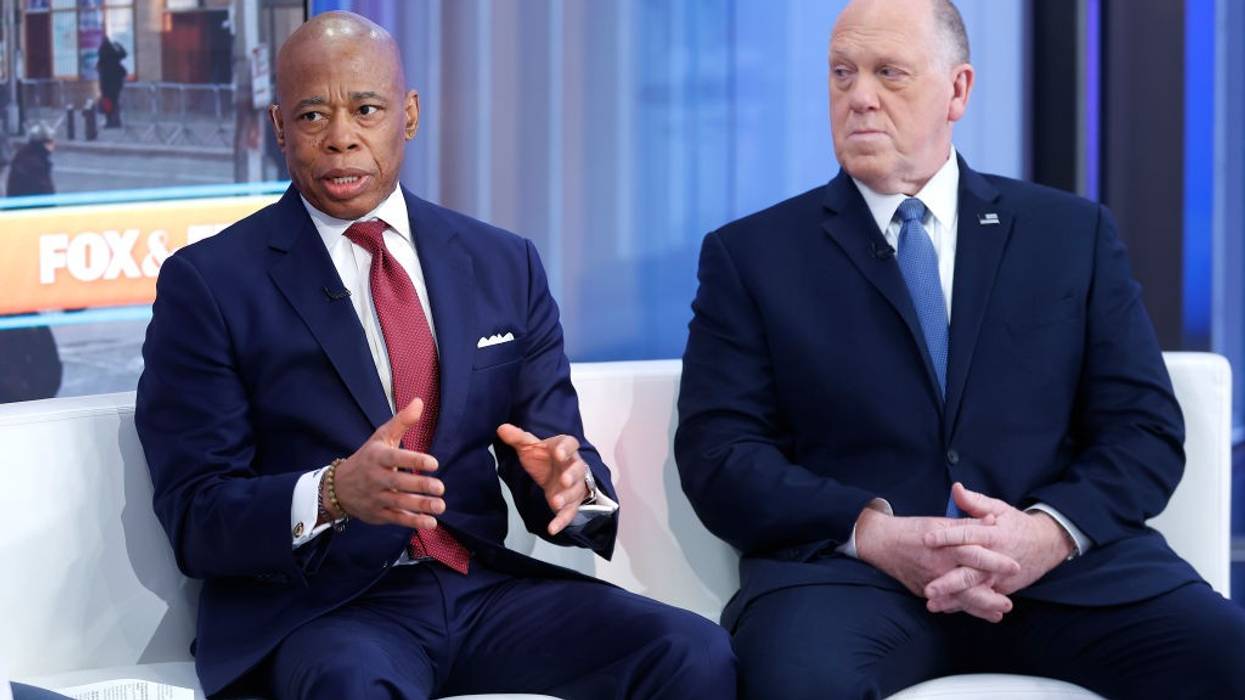
Ahead of the DOJ's filing, Adams appeared on "Fox & Friends" alongside Trump immigration czar Tom Homan in what one observer characterized as a hostage video "broadcast live on national television."
During the segment, Homan smilingly threatened that if Adams "doesn't come through" for the Trump administration, "we won't be sitting on a couch; I'll be in his office, up his butt, saying, 'Where the hell is the agreement we came to?'"
In a separate sitdown with Homan on Thursday, Adams committed to "return federal immigration agents to the Rikers Island jail complex in New York City," Politico reported.
Thinly veiled Homan warning to Adams: “If he doesn’t come through … I’ll be in his office, up his butt, saying, Where the hell is the agreement we came to” pic.twitter.com/Pq0msJXZGb
— Emily Ngo (@emilyngo) February 14, 2025
In a column on Friday, The American Prospect's Ryan Cooper and David Dayen wrote that it is "striking just how awesomely gratuitous this all is."
"Nixon sacked his attorney general because the investigation was closing in on him personally and he wanted to escape. It was corrupt, but it made sense as a desperate last-ditch effort," they wrote. "Trump is letting Adams off the hook because he wants a stooge dependent on his goodwill in the mayor's seat while his deportation goons run riot in New York. That's a modest benefit at best; the mayor has limited tools to prevent ICE operations, though he's already offered up Rikers Island, the notorious prison that was due to close, as a migrant detention center."
"And it shows that the most willing enabler of Trump corruption in the entire government is Attorney General Bondi," Cooper and Dayen added. "This is approximately how she ran the Justice Department in Florida, doing favors for her donors and allies while firing attorneys in the department who got in the way, like the prosecutors looking into foreclosure fraud. The Adams case confirms that as long as Bondi is in office, the rule of law will be subordinate to Trump's personal motivations."
"The U.S. Attorney General should be the American people's lawyer—not a corporate lobbyist with a closet full of conflicted clients," said the head of the watchdog Accountable.US.
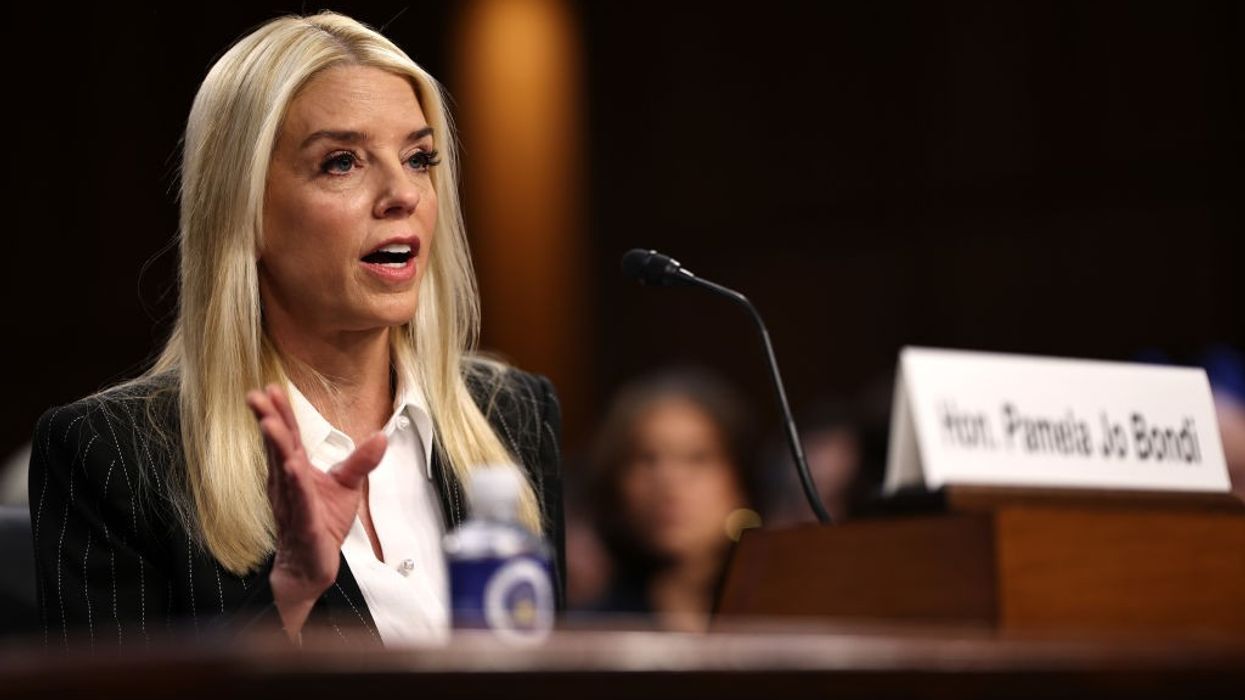
As President-elect Donald Trump's attorney general pick Pam Bondi faced Senate questioning on Wednesday, progressive critics opposed to her nomination cited her record as a lobbyist, her role in amplifying Trump's claims of election fraud in 2020, and her history of catering to corporate interests to argue she is unfit to lead the U.S. Justice Department.
Bondi, for her part, told senators in the first of two scheduled hearings that her Justice Department would not be used to target people based on their politics—though she stopped short of saying that the agency would not investigate foes of Trump. She also spent much of her confirmation answering questions about Kash Patel, Trump's controversial pick for FBI director whom she repeatedly defended, according to Politico.
Jon Golinger, democracy advocate for the watchdog group Public Citizen, was among Bondi's detractors who argued Wednesday that she is deeply unqualified to be the nation's top law enforcement officer.
"The U.S. Attorney General should be the American people's lawyer—not a corporate lobbyist with a closet full of conflicted clients, many of whom seek government contracts or are being investigated by the very Justice Department Bondi now seeks to lead," Golinger said in a statement.
After eight years as Florida's attorney general, Pam Bondi left that post in 2019 and joined Ballard Partners, a corporate lobbying firm that has also employed Trump's pick for White House chief of staff, Susie Wiles. At Ballard Partners, Bondi worked on behalf of numerous corporate clients, including the private prison firm the Geo Group, Uber, and Amazon.
Bondi also served as a lawyer for Trump during his first impeachment trial and pushed Trump's claims of election fraud in 2020.
Tony Carrk, the executive director of the watchdog Accountable.US, went after Bondi's time as Florida Attorney General, writing that she "frequently played favorites with big corporate donors and political insiders at the expense of everyday consumers, patients, and the public good" while she held that office and that "nothing indicates Bondi would change her office-peddling modus operandi as America's top justice official."
Public Citizen co-president Lisa Gilbert, who will testify as an outside witness Thursday at day two of Bondi's hearing, said Wednesday that Bondi's record could lead to a politicization of the agency and called her "unsuitable" for the role given her ties to powerful corporations.
Meanwhile, the civil rights coalition the Leadership Conference on Civil and Human Rights, joined the pile on in a statement submitted Wednesday to the Senate Judiciary Committee. "Ms. Bondi lacks the commitment to defending the core tenets of our democracy and the civil and human rights of all people. Indeed, her active participation in and support of Trump's efforts to overturn the 2020 election ought to be disqualifying in itself," the group wrote.
But Bondi—who "acquitted herself coolly," according to press account—appears on track for likely confirmation.
Raising the specter of the pressure Trump has placed on his Department of Justice in the past, Sen. Chris Coons (D-Del.) asked, "let's imagine Trump issues a directive or order to you or to the FBI director that is outside the boundaries of ethics or law. What will you do?"
"I will never speak on a hypothetical, especially one saying that the president would do something illegal. What I can tell you is my duty, if confirmed as the Attorney General, will be to the Constitution and the United States," said Bondi.
Bondi would not answer directly when asked whether Trump lost the election in 2020 and also would not denounce some of the former president's extreme stances, like calling those arrested for participating in the January 6 insurrection "hostages" or "patriots."
"We will keep fighting for climate justice," said one plaintiff, "but this is another dark day for protecting young people from climate harm imposed by their government."
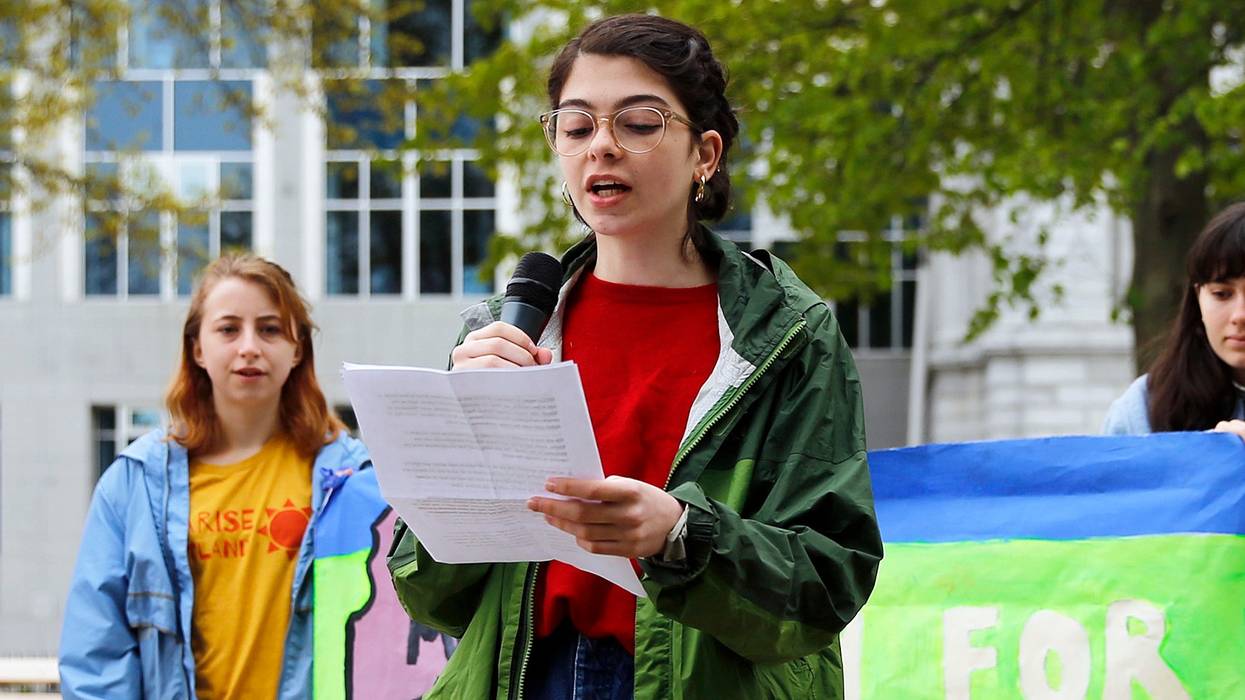
A panel of three Trump-appointed judges on Wednesday granted the Biden Justice Department's request to have a landmark youth climate case dismissed, another setback for a long-running effort to hold the U.S. government accountable for damaging the planet and violating the rights of younger generations.
The order handed down by a 9th Circuit Court of Appeals panel instructs an Oregon district court to toss Juliana v. United States for lack of standing, siding with the Justice Department's emergency petition for a writ of mandamus—which the DOJ itself describes as "an extraordinary remedy" that "should only be used in exceptional circumstances of peculiar emergency or public importance."
Julia Olson, co-executive director of Our Children's Trust, a public interest law firm backing the youth plaintiffs, said in a statement Wednesday that "the Biden administration was wrong to use an emergency measure to stop youth plaintiffs from having their day in court."
"The real emergency is the climate emergency," said Olson. "This emergency was not created by these young people, who have just been stripped of their fundamental constitutional rights by one of the highest courts in our country. Children deserve access to justice."
Calling the 9th Circuit decision "tragic and unjust" and "wrong on the law," Olson said the legal fight is "not over" and stressed that President Joe Biden "can still make this right by coming to the settlement table."
"We will keep fighting for climate justice, but this is another dark day for protecting young people from climate harm imposed by their government."
Juliana v. United States was brought in 2015 by 21 young Americans who argued the federal government has violated their "fundamental constitutional rights to life, liberty, and property" by continuing to allow the extraction of fossil fuels despite knowing their central role in destructive planetary heating.
Three consecutive administrations have worked aggressively to prevent a trial, deploying emergency legal tactics to delay and derail the youth-led case even as climate impacts became increasingly devastating in the U.S. and around the world.
Mat dos Santos, general counsel of Our Children's Trust, warned last month that "it's a mistake" for the Biden administration to "take this position in an election year, especially when young voters continue to be more and more disenchanted with the current administration and the permitting of big fossil fuel projects."
"This is an opportunity for the administration to do right by young people," he added.
Earlier this year, just before parties to the case were set to receive trial dates from a federal judge in Oregon, the Biden Justice Department filed a motion to stay the case and then another to have it tossed, drawing outrage from the youth plaintiffs. Dozens of members of Congress have weighed in on the side of the plaintiffs, arguing they should be allowed a trial to present their arguments and evidence.
Avery McRae, one of the plaintiffs, said in response to the 9th Circuit order on Wednesday that "every time we get a decision as devastating as this one, I lose more and more hope that my country is as democratic as it says it is."
"I have been pleading for my government to hear our case since I was 10 years old, and I am now nearly 19," said McRae. "A functioning democracy would not make a child beg for their rights to be protected in the courts, just to be ignored nearly a decade later. I am fed up with the continuous attempts to squash this case and silence our voices."
Another plaintiff, Nathan Baring, said that "we will keep fighting for climate justice, but this is another dark day for protecting young people from climate harm imposed by their government."
With their dangerous crusade for an anti-encryption bill in Congress all but dead (for now), the FBI and US Justice Department are now engaged in a multi-pronged attack on all sorts of other privacy rights - this time, with much less public scrutiny.
A report from the nonpartisan Government Accountability Office harshly criticized the FBI last week for its little-discussed but frequently used facial recognition database and called on the bureau to implement myriad privacy and safety protections. It turns out the database has far more photos than anyone thought - 411.9m to be exact - and the vast majority are not mugshots of criminals, but driver's license photos from over a dozen states and passport photos of millions of completely innocent people. The feds searched it over 36,000 times from 2011 to 2015 (no court order needed) while also apparently having no idea how accurate it is.
Worse, the FBI wants its hundreds of millions of facial recognition photos and its entire biometric database, including fingerprints and DNA profiles, to be exempt from important Privacy Act protections. As the Intercept reported two weeks ago: "Specifically, the FBI's proposal would exempt the database from the provisions in the Privacy Act that require federal agencies to share with individuals the information they collect about them and that give people the legal right to determine the accuracy and fairness of how their personal information is collected and used."
In Congress, Senate Republicans are pushing for a vote this week on controversial new warrantless surveillance measures that would let the FBI use unconstitutional National Security Letters to get email records and internet browsing history from countless US citizens - without going to a judge or court at all. The Senate leadership is bringing the measure up to vote by invoking the Orlando attack, despite the fact that we know the FBI had no problem surveilling the Orlando killer when he was previously investigated. It is a blatant attempt to exploit the tragedy in order to gain powers the FBI has long asked for (powers, by the way, the FBI is already reportedly using, despite the justice department telling them it's basically illegal).
The justice department, meanwhile, is busy attempting to implement a new rule for the court system that would make it much easier for the FBI to hack into computers worldwide - including those of hacking victims. Using the obscure process for amending the Federal Rules of Criminal Procedure, the department has convinced the courts that they should be able to get one warrant to potentially hack thousands of computers, and shouldn't have to comply with the normal rules involving getting the court order in the jurisdiction where the crime occurred.
As the Electronic Frontier Foundation has noted, "this is a recipe for disaster," and it is being done by circumventing the normal democratic process. Several organizations (including Freedom of the Press Foundation, the organization I work for) have called on Congress to put a stop to it.
Also, in the courts, the Justice Department has continued to argue that the US government doesn't need a warrant to gather Americans' cell phone location information—even though that type of information can give authorities their precise whereabouts 24 hours a day, seven days a week.
The Justice Department convinced the Fourth Circuit Court of Appeals last month to overturn its previous ruling that police need a probable cause warrant to get such information. The court agreed with the justice department that cellphone users don't have a "reasonable expectation of privacy" around their location, even though it is some of the most intimate information that exists, giving law enforcement officials a detailed picture of your life that even your close friends and family may not know.
Last year, the FBI director disingenuously tried to claim that the pendulum "has swung too far" in the way of privacy despite the fact that the agency has virtually unprecedented access to all sorts of information on Americans. If it wasn't clear before, it should be now: they plan on using any means necessary to further erode the rights of hundreds of millions of citizens in their crusade against privacy.
As 2016 U.S. presidential campaigns get underway, candidates are already raking in unprecedented amounts of donations--and being accused of violating campaign finance laws, according to new reports.
But the Federal Election Commission (FEC), the agency in charge of regulating campaign finance, and the U.S. Justice Department are unlikely to do anything to stop it.
According to commissioner statements, the FEC is hampered by internal partisan disputes that have prevented it from making progress on reining in abuse of those laws.
Reuters journalist Michelle Conlin on Thursday pointed to the "charade" campaign of former Florida Governor Jeb Bush, whose yet-undeclared candidacy status allows him to "skirt all sorts of campaign fundraising rules," as an example of the kind of election-season bonanza going unchecked by the government.
"Jeb Bush is seen as the most egregious possible violator of campaign finance law," Conlin said.
Reuters explains:
Campaign finance laws bar declared candidates from maintaining such a close relationship with an independent PAC. But Bush is not subject to such a bar since he has still not officially declared his candidacy - even though he effectively launched his campaign months ago.
...Yet even the most cleancut cases involving election law violations are perilous for federal prosecutors. As it turns out, one of the Justice Department's missions is to avoid getting involved in politics in the first place.
Current estimates put the cost of the 2016 presidential campaign at $10 billion—more than double the price tag of the 2012 season—and the election is expected to bring in record donations but little oversight. FEC chief Ann M. Ravel told the New York Times in May that the agency's internal gridlock made it "worse than dysfunctional."
The Times reported that some of the six commissioners "are barely on speaking terms, cross-aisle negotiations are infrequent, and with no consensus on which rules to enforce, the caseload against violators has plummeted. "
Those conflicts are compounded by the new era of political fundraising ushered in by the U.S. Supreme Court's 2010 ruling on Citizens United v. FEC, which opened the door for unlimited political spending by corporate entities, much of it undisclosed--as long as they donated without coordinating with candidates.
Reuters continues:
All of the people interviewed said the department would be reluctant to do anything during election season out of concern it would appear politically motivated.
They also noted that, even after the election, campaign finance cases would be extremely difficult to bring, especially since the department has been spooked by some high-profile failures in recent years.
...A little-noticed passage of the official manual that guides federal prosecutors specifically warns against interfering in elections. And two Justice Department officials speaking on the condition of anonymity said U.S. prosecutors are instructed to be cautious when contemplating bringing cases against politicians.
That's not to say that campaign insiders couldn't come forward with incriminating evidence of campaign finance law violations from behind the scenes--but whether the FEC would rush to make a case on those grounds remains to be seen.
"It's considered highly political to go after a presidential candidate before an election," Conlin said.