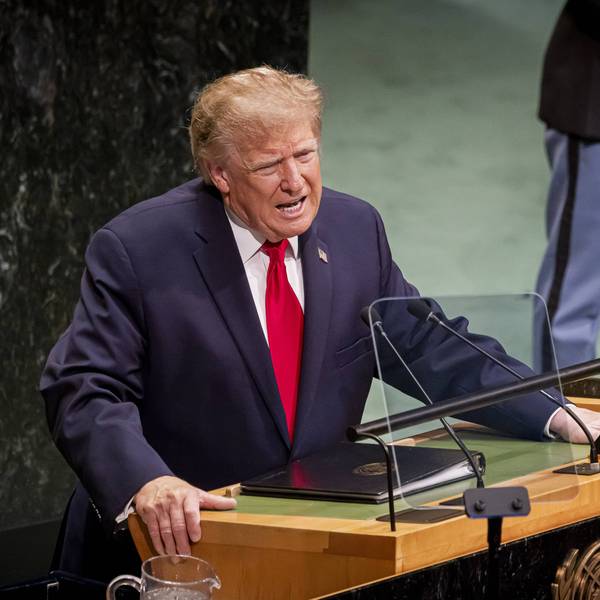

U.S. President Donald Trump, accompanied by White House staff secretary Will Scharf, delivers remarks before signing an executive order on February 18, 2025 in Palm Beach, Florida.
In 'Profoundly Dangerous' Power Grab, Trump Moves to Seize Control of Independent Agencies
"Americans should understand exactly what this is: A giant gift to the corporate class and a Trumpian power grab."
U.S. President Donald Trump on Tuesday signed an executive order aimed at bringing the nation's independent agencies—including the Federal Trade Commission and Securities and Exchange Commission—under his control, a sweeping power grab that's expected to spark a legal fight with enormous stakes for the country.
The new executive order, titled "Ensuring Accountability for All Agencies," laments that previous administrations "have allowed so-called 'independent regulatory agencies' to operate with minimal presidential supervision" and states that, going forward, "the president and the attorney general, subject to the president's supervision and control, shall provide authoritative interpretations of law for the executive branch."
The order goes on to require that "all executive departments and agencies"—including those granted some independence from the presidency by Congress—"shall submit for review all proposed and final significant regulatory actions to the Office of Information and Regulatory Affairs (OIRA) within the Executive Office of the President before publication in the Federal Register."
OIRA is part of the Office of Management and Budget, which is run by Project 2025 architect and far-right extremist Russell Vought.
In a fact sheet released alongside the order, the White House specifically names the FTC, the SEC, and the Federal Communications Commission (FCC) as agencies it claims have "exercised enormous power over the American people without presidential oversight."
The new order exempts from its far-reaching mandates the "monetary policy functions of the Federal Reserve."
"Not incidentally, both the FTC and SEC have ongoing investigations or enforcement actions against companies owned by Elon Musk."
Robert Weissman, co-president of Public Citizen, said in a statement that the executive order marks an "illegal" attempt to "shield corporations from accountability and centralize more power with Trump and his minions."
"This is a profoundly dangerous idea for the nation's health, safety, environment, and economy—and for our democracy," he added. "Congress made independent agencies independent of the White House for good reason."
Weissman noted that the independence of agencies such as the FTC and SEC is "designed to enable them to perform these duties without undue political pressure from giant corporations, the super-rich and the super-connected."
"Trump's EO would dissolve that independence and put the agencies under Trump's thumb, ensuring they turn a blind eye to wrongdoing by favored corporations and leave consumers and investors out to dry," Weissman continued. "Not incidentally, both the FTC and SEC have ongoing investigations or enforcement actions against companies owned by Elon Musk. Americans should understand exactly what this is: A giant gift to the corporate class and a Trumpian power grab."
The Washington Post reported that Trump's order sets the stage for "a potential Supreme Court fight that could give him significantly more power over those agencies' decisions, budgets, and leadership." Trump has already trampled decades of legal precedent by firing protected officials without cause, including the former chair of the National Labor Relations Board (NLRB).
"Courts have blocked or limited the reach of some of Trump's executive actions, but legal observers expect that the conservative-dominated Supreme Court may be open to broadening presidential power in at least some of the cases," the Post observed. "The justices are already considering a case regarding the scope of Trump's power over independent agencies, and Tuesday's executive order seems sure to prompt additional legal challenges."
Deborah Pearlstein, a constitutional scholar at Princeton University, told the newspaper that the White House is "deliberately teeing up a major question of constitutional law that will go to the Supreme Court for review."
The Supreme Court is currently controlled by a right-wing supermajority that includes three Trump-appointed justices.
Prior to Trump's order, the U.S. Justice Department—headed by Attorney General Pam Bondi—indicated that it would no longer defend the independence of the NLRB, FTC, and other agencies and would ask the Supreme Court to reverse precedent that has shielded independent agency leaders from termination without cause.
Reuters reported that "about two dozen companies, including Amazon and Elon Musk's SpaceX, have filed lawsuits since last year claiming the president should have the power to fire NLRB members at will."
"Several companies sued by the FTC have filed similar challenges against that agency," the outlet added. "They include Meta Platforms, Walmart, and Cigna's Express Scripts."
We are at a crossroads
This country and this world are at a monumental crossroads. In a few short weeks, US voters will have an opportunity to beat back the forces of fascism and confront the billionaires who are rigging the economy, our media system, and our democracy, making it increasingly impossible for ordinary people to get by. We’re not just talking about the election. We’re talking about what must be done once these fascist elements are vanquished from power. We need a bolder set of solutions than what either major party has so far been willing to offer and a working-class movement ready to fight like hell for it. Trump didn't emerge from nowhere. The conditions that fueled MAGA authoritarianism were created by decades of radical neoliberal economic policies and a corrupt political system dominated by corporate interests. They slashed taxes on the super-rich, promising that the benefits would trickle down. They said giveaways to the corporate titans would make life more affordable for the rest of us. It was all bullshit. And when a bitter, betrayed populace searches for someone to blame, right-wing demagogues have little trouble finding scapegoats. People know when they're being lied to, but you won't hear any of this from the corporate media. Only independent journalism—powered and funded by people who believe in building a better world—can deliver truly trustworthy daily news. Our Fall Campaign is underway, and we need your help. To power our newsroom through the rest of the year, we need to raise $125,000 by midnight on October 31. So if you share our vision, please contribute whatever you can to sustain our work. |
U.S. President Donald Trump on Tuesday signed an executive order aimed at bringing the nation's independent agencies—including the Federal Trade Commission and Securities and Exchange Commission—under his control, a sweeping power grab that's expected to spark a legal fight with enormous stakes for the country.
The new executive order, titled "Ensuring Accountability for All Agencies," laments that previous administrations "have allowed so-called 'independent regulatory agencies' to operate with minimal presidential supervision" and states that, going forward, "the president and the attorney general, subject to the president's supervision and control, shall provide authoritative interpretations of law for the executive branch."
The order goes on to require that "all executive departments and agencies"—including those granted some independence from the presidency by Congress—"shall submit for review all proposed and final significant regulatory actions to the Office of Information and Regulatory Affairs (OIRA) within the Executive Office of the President before publication in the Federal Register."
OIRA is part of the Office of Management and Budget, which is run by Project 2025 architect and far-right extremist Russell Vought.
In a fact sheet released alongside the order, the White House specifically names the FTC, the SEC, and the Federal Communications Commission (FCC) as agencies it claims have "exercised enormous power over the American people without presidential oversight."
The new order exempts from its far-reaching mandates the "monetary policy functions of the Federal Reserve."
"Not incidentally, both the FTC and SEC have ongoing investigations or enforcement actions against companies owned by Elon Musk."
Robert Weissman, co-president of Public Citizen, said in a statement that the executive order marks an "illegal" attempt to "shield corporations from accountability and centralize more power with Trump and his minions."
"This is a profoundly dangerous idea for the nation's health, safety, environment, and economy—and for our democracy," he added. "Congress made independent agencies independent of the White House for good reason."
Weissman noted that the independence of agencies such as the FTC and SEC is "designed to enable them to perform these duties without undue political pressure from giant corporations, the super-rich and the super-connected."
"Trump's EO would dissolve that independence and put the agencies under Trump's thumb, ensuring they turn a blind eye to wrongdoing by favored corporations and leave consumers and investors out to dry," Weissman continued. "Not incidentally, both the FTC and SEC have ongoing investigations or enforcement actions against companies owned by Elon Musk. Americans should understand exactly what this is: A giant gift to the corporate class and a Trumpian power grab."
The Washington Post reported that Trump's order sets the stage for "a potential Supreme Court fight that could give him significantly more power over those agencies' decisions, budgets, and leadership." Trump has already trampled decades of legal precedent by firing protected officials without cause, including the former chair of the National Labor Relations Board (NLRB).
"Courts have blocked or limited the reach of some of Trump's executive actions, but legal observers expect that the conservative-dominated Supreme Court may be open to broadening presidential power in at least some of the cases," the Post observed. "The justices are already considering a case regarding the scope of Trump's power over independent agencies, and Tuesday's executive order seems sure to prompt additional legal challenges."
Deborah Pearlstein, a constitutional scholar at Princeton University, told the newspaper that the White House is "deliberately teeing up a major question of constitutional law that will go to the Supreme Court for review."
The Supreme Court is currently controlled by a right-wing supermajority that includes three Trump-appointed justices.
Prior to Trump's order, the U.S. Justice Department—headed by Attorney General Pam Bondi—indicated that it would no longer defend the independence of the NLRB, FTC, and other agencies and would ask the Supreme Court to reverse precedent that has shielded independent agency leaders from termination without cause.
Reuters reported that "about two dozen companies, including Amazon and Elon Musk's SpaceX, have filed lawsuits since last year claiming the president should have the power to fire NLRB members at will."
"Several companies sued by the FTC have filed similar challenges against that agency," the outlet added. "They include Meta Platforms, Walmart, and Cigna's Express Scripts."