

SUBSCRIBE TO OUR FREE NEWSLETTER
Daily news & progressive opinion—funded by the people, not the corporations—delivered straight to your inbox.
5
#000000
#FFFFFF
To donate by check, phone, or other method, see our More Ways to Give page.
Daily news & progressive opinion—funded by the people, not the corporations—delivered straight to your inbox.

"Today, we denied the speech of a genocidal company’s CEO," said Stanford Students for Justice in Palestine. "We walked towards our People’s Commencement. We started imagining a better future for our education."
Around 200 graduating students at Stanford University in California walked out of Sunday's commencement speech by Google CEO Sundar Pichai to protest his company's complicity in Israel's genocidal war on Gaza and the Trump administration's deadly anti-immigrant crackdown.
With graduating students across the country booing commencement speakers who mention artificial intelligence, Pichai was careful to avoid discussing the historically disruptive—and potentially apocalyptic—technology during his speech, even joking about the difficulty of doing so given his job and the fact that his name can't be spelled without the "ai" at the end. It was an apparently wise decision, especially given a recent interview in which he opined that humans aren't "evolved" enough to fully understand the profound technology shift AI is driving.
However, protesting students were already walking out and chanting, "Free, Free Palestine!" by the time Pichai started speaking. Students waved Palestinian flags and blew whistles as they marched out of the venue.
BREAKING: Stanford University graduates staged a walkout during Google CEO Sundar Pichai’s keynote address at commencement Sunday.
The walkout was organized by Students for Justice in Palestine and No Tech for Apartheid as a protest against Google’s contracts with the IDF, Dept.… pic.twitter.com/j2SI2dtwLC
— BreakThrough News (@BTnewsroom) June 14, 2026
Protesting students condemned Project Nimbus, a $1.2 billion cloud-computing and AI contract signed in 2021 between the Israeli government and Amazon Web Services and Google Cloud. The deal prohibits Google or Amazon from refusing service to the Israeli government, military, or intelligence agencies.
The Project Nimbus contract sparked the #NoTechForApartheid campaign, in which disaffected tech workers and dozens of advocacy groups rose up against Big Tech’s complicity in Israeli human rights crimes in Palestine and Google's violation of its own AI principles.
"Shout out to all the graduates who walked out today. To all the graduates who chose conscience rather than comfort, we thank you," Stanford Students for Justice in Palestine (SJP)—which organized the protest with No Tech for Apartheid—said in an Instagram post.
"Today, Sundar Pichai was met with the sight of hundreds of students who showed they could not be allured anymore with the talk of a dollar or rapidly expanding AI," SJP continued. "We know about the crimes of Google in collaborating with Israel, [US Immigration and Customs Enforcement], and companies like Palantir."
"Today, we denied the speech of a genocidal company’s CEO," the group added. "We walked towards our People’s Commencement. We started imagining a better future for our education."
Sunday's walkout followed similar demonstrations at Stanford's previous three commencements over the university's crackdown on pro-Palestine protests as Israeli forces killed and wounded hundreds of thousands of Palestinians and forcibly displaced, starved, or sickened around 2 million Gazans, with full US government support.
Earlier this year, a judge declared a mistrial in a case involving five current and former Stanford students who in 2024 occupied the university president's office to protest the Gaza genocide and demanded the school divest from companies supporting Israel's military.
Sunday's protesters also decried Google's contracts with ICE and other Department of Homeland Security agencies.
For the third year in a row, Stanford grads held a "People's Commencement." This year's featured Mahmoud Khalil, a former Columbia University Palestine defender imprisoned for more than 100 days last year by the Trump administration's ICE.
"What good is education if it teaches us how to succeed and not how to care?" Khalil said during his speech. "What good is knowledge if we lack the courage to act from it?"
Correction: This article originally said that it is the second year in a row that a "People's Commencement" was held. It is actually the third.
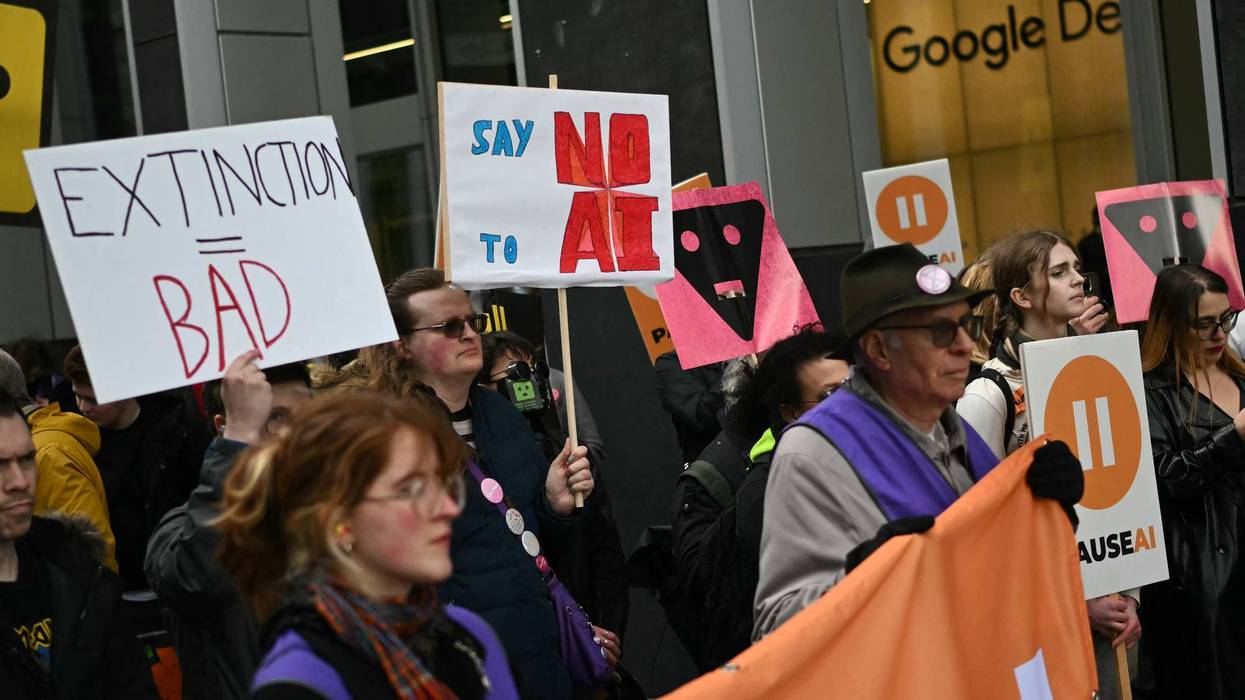
“Human lives are already being lost and civil liberties put at risk at home and abroad from misuses of the technology we’re playing a key role in building."
As Google on Monday became the latest player in the artificial intelligence arms race to sign a classified deal with the US Department of Defense, hundreds of workers at the Silicon Valley giant demanded that its CEO prevent the Pentagon from using the company's AI models for covert work.
Reuters reported that the $200 million agreement includes safety filters and allows the Pentagon to use Google's AI "for any lawful purpose" but not for the development of lethal autonomous weapons systems—commonly known as "killer robots"—or domestic surveillance without human oversight and control.
According to The Information's Erin Woo, the deal does not give Google “any right to control or veto lawful government operational decision-making."
The agreement also reportedly requires Google to adjust its AI safety settings at the government's request.
“We are proud to be part of a broad consortium of leading AI labs and technology and cloud companies providing AI services and infrastructure in support of national security,” a Google spokesperson told The Information.
More than 600 Google employees—many of them from the company's DeepMind AI laboratory—sent a letter Monday to CEO Sundar Pichai demanding that he block the US military from using the firm's artificial intelligence technology for classified projects.
“We want to see AI benefit humanity; not to see it being used in inhumane or extremely harmful ways," the letter says, according to The Washington Post. "This includes lethal autonomous weapons and mass surveillance but extends beyond."
“The only way to guarantee that Google does not become associated with such harms is to reject any classified workloads," the workers stressed. "Otherwise, such uses may occur without our knowledge or the power to stop them."
Thousands of AI experts have called for a pause on the development and deployment of advanced AI technology. However, tech companies and military officials have argued—much as the military-industrial complex did with nuclear weapons during the Cold War—that if the US does not pursue advanced AI, rivals like China will, leaving the US irrecoverably behind.
As US and allied forces from Israel to Ukraine use AI to make life-and-death wartime decisions—including selecting attack targets at a rate unfathomable just a few years ago—use of such technology is expediting Israel's massacres in Gaza and Lebanon and US-Israeli killings in Iran.
“Human lives are already being lost and civil liberties put at risk at home and abroad from misuses of the technology we’re playing a key role in building,” the Google workers' letter states.
The policies and actions of the humans in charge of the US government and military have also stoked fears about their use of AI.
US Defense Secretary Pete Hegseth, for example, has overseen the dismantling of initiatives aimed at reducing wartime harm to civilians—hundreds of thousands of whom have been killed in US-led wars during this century, according to experts. Hegseth has instead promoted "maximum lethality" for US forces while expressing disdain for what he called "stupid rules of engagement" designed to minimize civilian harm.
Critics say their concerns have been validated by actions including the US cruise missile strike on a girls' school in Iran that killed 168 children and staff and Israeli airstrikes, many of them using US-supplied bombs, that have killed tens of thousands of Palestinian civilians in Gaza.
Companies that have run afoul of the Trump administration for refusing military AI use requests also risk getting left behind. Anthropic—maker of the AI assistant Claude—lost a $200 million Pentagon contract and is facing a government blacklist and legal battles after the company refused to loosen safety restrictions on autonomous weapons and surveillance.
Meanwhile, OpenAI, which makes the generative AI platform ChatGPT, rewrote its "no military use" policy to allow "national security" applications of its products, opening the door to lucrative Pentagon contracts.
Not wanting to get left behind as President Donald Trump returned to office last year, Google quietly pulled back its commitment to not use artificial intelligence for harmful purposes, marking a stark departure from the company's long-standing founding motto of "Don't be Evil," which it ditched in 2018.
Pentagon contracts followed, and Google reportedly hopes to add $6 billion in AI deals by next year.
Most AI experts agree that it's not a matter of if, but when, artificial intelligence surpasses human capabilities. Experts are increasingly viewing AI as a new emerging species, and prominent industry voices—including philosopher Nick Bostrom, Machine Intelligence Research Institute co-founder Eliezer Yudkowsky, and "Godfather of AI" Geoffrey Hinton—have noted that when a more intelligent species' goals conflict with those of a less intelligent one, the less intelligent species tends to lose, and usually catastrophically.
Hinton is so concerned that he quit Google in 2023 so he could speak openly about the remote but growing risk of AI one day wiping out humanity.
The perceived probability of existentially catastrophic outcomes from AI—known as p(doom)—was once the stuff of jokes. Now, AI experts' p(doom) predictions are watched like weather or market forecasts. Yudkowski has said there's a greater than 95% chance of AI-driven catastrophe.
Hinton—who was awarded the 2024 Nobel Prize in physics for his work on the neural networks, the foundational technology behind AI—is relatively more optimistic, putting the odds at 10-20%.
"There are very few examples of more intelligent things being controlled by less intelligent things," he said after winning the Nobel Prize.
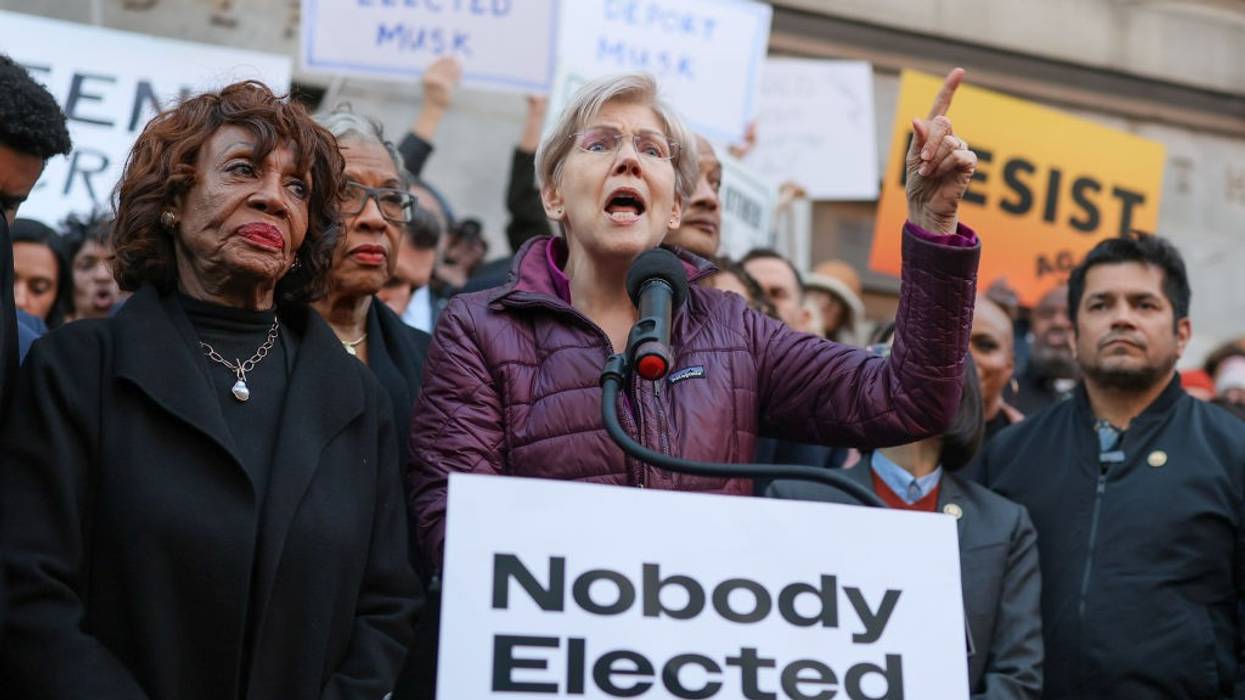
Given that "American taxpayers will shoulder the burden of tax cuts" for major tech companies, she argued, "they deserve answers."
U.S. Sen. Elizabeth Warren this week sent letters to five Big Tech executives—including the world's three richest individuals—to sound the alarm about their "personal and financial ties to the Trump administration" and how they "may be exploiting" those relationships for billions of dollars in corporate tax breaks.
The Massachusetts Democrat's targets include Tesla CEO Elon Musk, the wealthiest person on Earth and head of President Donald Trump's Department of Government Efficiency, which is leading the administration's effort to dismantle the federal bureaucracy.
She also wrote to Mark Zuckerberg, CEO of Meta—which owns Facebook and Instagram—as well as Amazon.com founder and executive chairman Jeff Bezos. As of Thursday, they are respectively the second- and third-wealthiest people on the planet. Warren's final two letters went to Apple CEO Tim Cook and Sundar Pichai, chief executive of Alphabet, Google's parent company.
"This $75 billion windfall is only one slice of the billions of dollars that you stand to gain from Republican efforts to lower your taxes while raising costs for working families."
Warren and other Democrats on Capitol Hill are intensely critical of the Tax Cuts and Jobs Act (TCJA), which congressional Republicans passed and Trump signed in 2017. The law was largely crafted to serve rich individuals and businesses, including by slashing the corporate tax rate from 35% to 21%.
Now that the GOP has regained control of the White House and both chambers of Congress, its members are aiming to extend expiring provisions of the TCJA—funded by gutting programs for the working class.
As Warren's office noted in a Thursday statement, the TCJA ended "a corporate tax break known as research and development (R&D) expensing to help pay for their tax cuts for the ultrawealthy. This tax break allowed companies to deduct the total cost of their R&D expenses immediately, instead of deducting them over time, as is the standard practice in the tax code."
"This change was one of the few parts of the 2017 bill that forced companies to pay higher taxes," her office explained. "Now, corporations want to revert back to the pre-2017 rules—and not only do corporations want to apply immediate R&D expensing to future tax years, but they are also pushing to retroactively apply these deductions to 2022, 2023, and 2024."
Warren's letters cite a recent independent analysis by the Institute on Taxation and Economic Policy, which found that retroactive application of R&D expensing alone would slash each company's tax bill by billions of dollars—specifically, Tesla: $2.5 billion; Meta: $15 billion; Amazon: $22 billion; Apple: $10 billion; and Alphabet: $24 billion.
In other words, Warren wrote, "collectively, Alphabet, Amazon, Apple, Meta, and Tesla are projected to win $75 billion if Congress awards them retroactive R&D tax expensing—nearly double what the federal government spends on child nutrition programs each year and a fantastic return on investment for the millions you have spent lobbying on the tax fight."
"And this $75 billion windfall is only one slice of the billions of dollars that you stand to gain from Republican efforts to lower your taxes while raising costs for working families," she continued, pointing out that GOP lawmakers may "succeed in lowering the corporate tax rate even further, as President Trump has sought, or in handing out other tax giveaways to massive corporations."
Given that "American taxpayers will shoulder the burden of tax cuts" for major tech companies, "they deserve answers," argued Warren, a member of the Senate Finance Committee. She demanded responses to a list of questions by March 19.
Warren's inquiries include how much the companies are spending on lobbying for Republicans' tax legislation, and the R&D provision specifically; which trade associations, lobbying coalitions, or similar entities that they are a part of; and how much they have given, directly or indirectly, to federal elected officials who are advocating for corporate tax giveaways.
The senator also asked "exactly how much" of the retroactive tax breaks that the tech giants would put toward R&D investment and how they expect it will impact the companies' outlook for stock buybacks and executive compensation.
The potential tax law change is just one way Republican control of the federal government could benefit Big Tech. As the watchdog Public Citizen highlighted Tuesday, Amazon, Apple, Google, Meta, and Tesla are among dozens of companies with ties to the Trump administration that could benefit from its efforts to end corporate probes and enforcement actions.

"If it's a trade war Trump wants, consumers in Mexico, Canada, Europe, and beyond should unite to ensure that Musk and his fellow oligarchs feel the cost."
As U.S. President Donald Trump weighed 25% tariffs he plans to impose on Canada and Mexico on Monday, with the White House sending mixed messages in recent days about when the levies will go into effect, a top progressive economist has proposed foreign countries should respond to "the trade war Trump seems determined to stoke" by targeting the "Achilles heel" embedded in the Trump administration.
"Mexico, Canada, and Europe have leverage," wrote Gabriel Zucman, director of the E.U. Tax Observatory, in a column Friday, pointing to the country's "highly internationalized oligarchy: a small group of ultra-wealthy individuals whose fortunes depend on access to global markets."
Commerce Secretary Howard Lutnick indicated Monday morning that Trump has yet to decide whether tariffs on Canadian and Mexican imports—including produce, lumber, vehicles, and electronics—will go forward just after midnight on Tuesday as previously planned; the president has also recently said the tariffs could be delayed until April 2.
But Zucman wrote that whenever the policy does enter force, Canada, Mexico, and any other countries affected "should retaliate by taxing U.S. oligarchs."
Powerful business owners like Tesla CEO Elon Musk—now also spearheading Trump's gutting of federal agencies through the Department of Government Efficiency (DOGE)—Amazon founder Jeff Bezos, and Meta CEO Mark Zuckerberg all rely on markets outside of the U.S. to enrich their companies, which "gives foreign governments influence," Zucman continued.
"If Tesla wants to sell cars in Canada and Mexico, Elon Musk—Tesla's primary shareholder—should be required to pay taxes in those jurisdictions," he wrote. "Of course, this strategy is explicitly extraterritorial, since it applies tax obligations on foreign actors in exchange for access to local markets. But rather than fearing extraterritoriality, countries should embrace it as a tool for enforcing minimum standards, curbing inequality, preventing tax evasion, and promoting sustainability."
Tariffs on oligarchs could fight against Trump's attacks on environmental regulations, push for tax giveaways to billionaires at the cost of crucial public services, and advocacy for re-segregating workplaces, suggested Zucman, while shifting "the economic conflict from a battle between countries—which fuels nationalist tensions and economic retaliation—to one between consumers and oligarchs."
Countries could also "collect taxes that multinationals have dodged elsewhere, gradually eroding the appeal of tax competition" and triggering a "virtuous cycle," added the economist, who focuses on wealth inequality and international tax policy.
With tariffs on oligarchs in place, he said, firms would no longer be incentivized to move to countries that hand out corporate tax breaks because their savings would be offset by the tariffs levied by countries with large markets.
Governments have been accused in taking part in a "race to the bottom" as they try to attract large multinational companies run by some of the richest people in the world, with huge tax breaks that weaken "national safety nets, [kill] jobs by subsidising capital at the expense of labor, [allow] elites to escape the rule of law, and [reduce] productivity and economic growth," as the Tax Justice Network wrote in a 2020 report.
With tariffs for oligarchs, said Zucman "the race to the bottom would soon be replaced by a race to the top."
While the first weeks of Trump's second term in the White House have raised fears over a looming trade war, attacks on immigrants and transgender Americans, mass firings of federal workers, and the United States' withdrawal from international agreements and organizations, Zucman said the Trump presidency "also presents an opportunity."
"This is a moment to rethink international economic relations, calmly but radically," wrote Zucman. "The best response is a new global economic framework that neutralizes tax competition, fights inequality, and protects our planet. Under such a framework, importing countries would enforce tax justice beyond their borders, ensuring that multinational corporations and their billionaire owners pay their fair share."
"If it's a trade war Trump wants," he said, "consumers in Mexico, Canada, Europe, and beyond should unite to ensure that Musk and his fellow oligarchs feel the cost."

"Today marks the beginning of an administration dominated by billionaires and corporate interests."
Donald Trump was sworn in Monday as the 47th president of the United States with some of the richest people on the planet standing close behind him on the inaugural platform—a symbol of what observers described as the nation's slide toward oligarchy.
Tesla CEO Elon Musk, Amazon founder Jeff Bezos, Meta CEO Mark Zuckerberg, and Google CEO Sundar Pichai were granted "prime seats" at the event, positioned in front of many lawmakers and Trump Cabinet nominees. Amazon, Google, and Meta each donated $1 million to the president's inaugural fund, and Musk—the world's richest man—spent over $250 million backing the billionaire president's bid for a second White House term.
Tim Cook, Apple's billionaire CEO and a donor to the inauguration, was also in attendance at Monday's event, which was financed by Wall Street banks, tech giants, the pharmaceutical lobby, fossil fuel companies, crypto firms, and other corporate interests.
"Donald Trump's inauguration today is a coronation of our country's descent into oligarchy: billionaires and corporations spending hundreds of millions of dollars lining the pockets of another billionaire—now president—to usher in a presidency governed for and by the wealthy elite," Justice Democrats, a group that works to elect progressives to Congress, wrote in an email to supporters after Trump was sworn in.
"They're buying influence," the group continued. "And they can expect a massive return on their investment. Crypto is already seeing one with Trump promising an executive order handout to the Wall Street-backed Big Tech corporations on Day 1. Banks and developers are already winning out as Trump and Republicans put conditions on aid to desperate Americans who have lost their homes and need immediate disaster relief in California. This administration will be a boon for the already wealthy few and will be crushing to everyday people struggling to get by."
Nabil Ahmed, economic and racial justice director at Oxfam America, described a photo of Zuckerberg, Bezos, Pichai, and Musk standing together on the inaugural platform as "a defining photo for the new Gilded Age."
Trump's inauguration, Ahmed added, "makes clearer than ever the triumph of oligarchy—one that isn't incidental but intrinsic to the politics and policies that we're seeing set out."
 Tesla and SpaceX CEO Elon Musk cheers as U.S. President Donald Trump speaks after being sworn in on January 20, 2025. (Photo: Saul Loeb/Pool/AFP via Getty Images)
Trump's second administration, which could be staffed by at least 13 billionaires, is expected to bring a fresh push for large-scale deregulation and another round of tax cuts for the rich and large corporations—a giveaway that's expected to be funded in part by cuts to Medicaid, federal nutrition assistance, and other key programs.
"Today marks the beginning of an administration dominated by billionaires and corporate interests," Americans for Tax Fairness (ATF) executive director David Kass said in a statement. "Unsurprisingly, a billionaire president and his top adviser—the wealthiest person on Earth—will prioritize passing $5 trillion in new tax cuts benefiting themselves and their wealthy allies, all at the expense of everyday Americans."
"Let's be clear: The next four years will be a tremendous challenge," said Kass. "We are committed to fighting back against a second Trump Tax Scam because the first one helped to double billionaire wealth and exploded the deficit. ATF and its coalition members will stand on the frontlines pushing back against these deeply harmful measures and fighting for a tax code and economy that works for everyone, not just the wealthy few."
Trump's return to the White House comes days after former President Joe Biden, in his farewell address to the nation, belatedly warned of the threat posed by "an oligarchy... of extreme wealth, power, and influence."
According to an Oxfam report released Monday, the world's billionaires saw their wealth surge by $2 trillion last year as progress against global poverty remained stagnant. The United States has more billionaires than any other country, and its campaign finance laws allow the ultrawealthy to pump unlimited sums into elections.
"With the inauguration of President Donald Trump and the installation of his team of billionaires, we must prepare for an administration that's set to pour fuel on already extraordinary inequality," Abby Maxman, president and CEO of Oxfam America, said Monday. "Our country and the world today are extremely unequal; for too long, big corporations and an ultrawealthy few have rigged the system in their own favor, at the expense of ordinary families."
"The Trump-Musk inequality agenda is not the only threat we are facing around the world, as leaders seek to divide us and conflict and climate change increase the number, severity, and duration of humanitarian crises," Maxman added. "But together, we can and must continue our fight against inequality here in the United States and globally."

"Google cannot allow its online advertising-focused digital infrastructure to be weaponized against women."
That's according to Sen. Ron Wyden (D-Ore.), Rep. Anna Eshoo (D-Calif.), and 40 other progressives in Congress who sent a letter Tuesday to Google CEO Sundar Pichai urging reforms to data collection and retention practices given the anticipated reversal of Roe v. Wade.
While privacy advocates within and beyond Congress have long raised alarm about location data from devices such as cellphones, such concerns have risen in recent weeks since the leak of a draft U.S. Supreme Court opinion signaling the end of Roe, which affirmed the right to abortion.
If the court's decision to overturn Roe is finalized in the weeks ahead, abortion could swiftly become illegal in over half of U.S. states, according to the pro-choice Guttmacher Institute. It is with that knowledge that more than three dozen federal lawmakers are urging changes at Google.
"We believe that abortion is healthcare," states the letter. "We will fight tooth and nail to ensure that it remains recognized as a fundamental right, and that all people in the United States have control over their own bodies."
"That said, we are concerned that, in a world in which abortion could be made illegal, Google's current practice of collecting and retaining extensive records of cellphone location data will allow it to become a tool for far-right extremists looking to crack down on people seeking reproductive healthcare," it continues. "That's because Google stores historical location information about hundreds of millions of smartphone users, which it routinely shares with government agencies."
As the letter details:
While Google collects and retains customer location data for various business purposes, including to target online ads, Google is not the only entity to make use of this data. Law enforcement officials routinely obtain court orders forcing Google to turn over its customers' location information. This includes dragnet "geofence" orders demanding data about everyone who was near a particular location at a given time. In fact, according to data published by Google, one-quarter of the law enforcement orders that your company receives each year are for these dragnet geofence orders; Google received 11,554 geofence warrants in 2020.
Reporting on the lawmakers' demand, Insider noted that "in March, a federal district judge ruled that Virginia police, in serving Google with a geofence warrant to get location data, violated the Fourth Amendment's protections against unreasonable searches."
The outlet added that "Google did not immediately respond to Insider's request for comments."
Highlighting the differences between what data is generally collected from Google's Android devices versus Apple iPhones with Google applications, the letter asserts that "Apple has shown that it is not necessary for smartphone companies to retain invasive tracking databases of their customers' locations."
"While Google deserves credit for being one of the first companies in America to insist on a warrant before disclosing location data to law enforcement, that is not enough," the letter adds. "If abortion is made illegal by the far-right Supreme Court and Republican lawmakers, it is inevitable that right-wing prosecutors will obtain legal warrants to hunt down, prosecute, and jail women for obtaining critical reproductive healthcare."
According to the lawmakers, "The only way to protect your customers' location data from such outrageous government surveillance is to not keep it in the first place."
The digital rights group Fight for the Future echoed that position Tuesday with its own grassroots letter--which is open for signatures--also "calling on the company to stop amassing users' location data, because in a post-Roe world this data will be weaponized against people seeking abortions."
"Google is choosing to amass this data not to improve the experience of users, but to squeeze out a few extra surveillance-driven advertising dollars," Fight for the Future tweeted Tuesday. "And this business model could soon put abortion-seekers in serious danger."