

SUBSCRIBE TO OUR FREE NEWSLETTER
Daily news & progressive opinion—funded by the people, not the corporations—delivered straight to your inbox.
5
#000000
#FFFFFF
To donate by check, phone, or other method, see our More Ways to Give page.
Daily news & progressive opinion—funded by the people, not the corporations—delivered straight to your inbox.
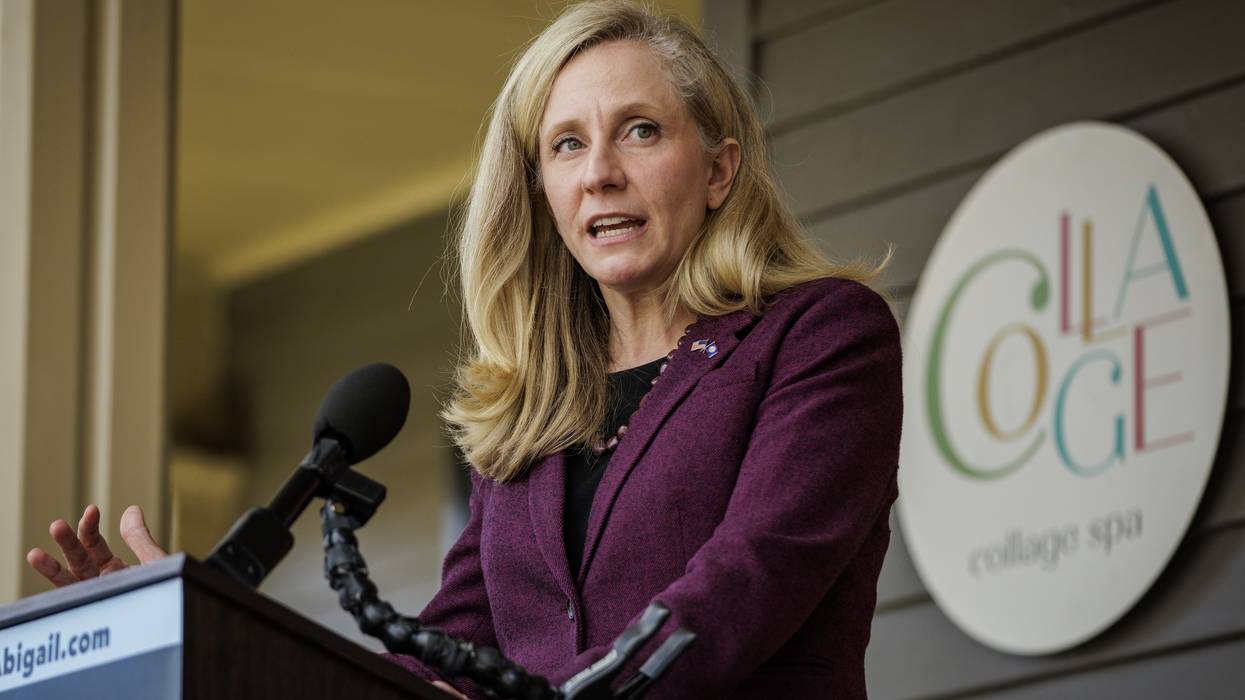
“The governor’s decision leaves the commonwealth exactly where we have been since 2021: with an unchecked illicit market hurting our communities, harming our youth, and putting adults at risk," said one critic.
Criminal justice reform and cannabis legalization advocates led condemnation of Democratic Virginia Gov. Abigail Spanberger's Tuesday veto of legislation that would have established a retail market for the sale of recreational-use marijuana, which has been legal in the state for five years.
In 2021, Virginia became the then-16th state to pass an adult-use marijuana legalization law, with sales set to begin in 2024. However, former Republican Gov. Glenn Youngkin repeatedly vetoed the legislation, which would establish the framework for regulating and taxing the plant's recreational use.
Today, while adults can legally consume cannabis recreationally, cannabis sales in Virginia are still restricted to medical use, and patients must travel to one of the five licensed providers in the commonwealth.
In March, Virginia lawmakers passed a package of bills to legalize recreational cannabis sales to people age 21 and older via a regulated market, place oversight of such sales under the Virginia Cannabis Control Authority, increase the public possession limit from one ounce to 2.5 ounces, allow delivery sales, establish new state and local cannabis taxes, and set January 1, 2027 as the launch date for sales.
Spanberger—who had campaigned on a promise to sign legislation establishing recreational cannabis sales—proposed amendments to the bill that were rejected by the General Assembly.
“I support the intent of many of the bills I am vetoing," she explained in a statement. "However, it is my responsibility as governor to make sure all new laws can be successfully implemented and protect against unintended consequences that harm Virginians."
"I look forward to continuing to work with bill patrons, state and local leaders, and advocates on legislation addressing these issues in the future," the governor said.
Marijuana Moment reported that Spangberger sought to delay the start of sales by six months, increase taxes, and institute new criminal penalties for cannabis consumers.
“Once again, Virginia’s efforts to establish a safe, regulated, and equitable adult-use cannabis marketplace has been halted despite years of work, public input, and broad recognition that the status quo is failing Virginians," state Sen. Lashrecse Aird (D-63), who sponsored one of the bills, said in a statement Tuesday.
“The governor’s decision leaves the commonwealth exactly where we have been since 2021: with an unchecked illicit market hurting our communities, harming our youth, and putting adults at risk," she added.
Del. Paul Krizek (D-16), who sponsored the House of Delegates version of the sales bill, said, “Five years ago, Virginia legalized cannabis in recognition that the War on Drugs has caused disproportionate harm to Black families and communities."
“The question now is whether Virginia will continue allowing an unregulated illegal market to thrive, or finally establish a safe, transparent system that protects consumers, keeps products away from children, and keeps our commitment to ending racially discriminatory marijuana policing in Virginia," he added.
JM Pedini, development director for the advocacy group National Organization for the Reform of Marijuana Laws and executive director for Virginia NORML, told Marijuana Moment that Spanberger's veto is “a profound disappointment to the many Virginia voters who believed her when she said on the campaign trail that she supported establishing a regulated adult-use cannabis market.”
“It is also a slap in the face to the years of serious work undertaken by lawmakers, policy experts, advocates, public health stakeholders, and regulators who spent more than half a decade researching, debating, and carefully crafting this legislation,” Pedini added. “Rather than build upon that work, the governor dismissed it in favor of out-of-touch proposals to recriminalize cannabis consumers that lawmakers rightly rejected.”
It was stupid when Youngkin stood in the way of a regulated market for LEGAL recreational adult-use marijuana--not just for the important safety aspects of taking it off the black market, but also for the $ Virginia misses out on every day without. It is just as stupid now.
— VAPLAN (@vaplan.bsky.social) May 19, 2026 at 2:26 PM
Chelsea Higgs Wise, executive director of the Richmond-based nonprofit Marijuana Justice, said in a statement that "for five years, Virginia has been stuck in a limbo where adults can legally possess, share, and grow cannabis, but there is still no regulated way to purchase it."
"By rejecting the retail bill," Wise added, "the governor has chosen to extend that chaos rather than move us toward a transparent, accountable retail system that centers public health, public safety, and justice."
Twenty-four states have legalized recreational marijuana, while 16 states allow medical use of the plant. Last month, the US Department of Justice began reclassifying cannabis from Schedule I—a category that includes dangerous drugs like heroin, LSD, and MDMA to Schedule III, which includes codeine, ketamine, anabolic steroids, and testosterone.
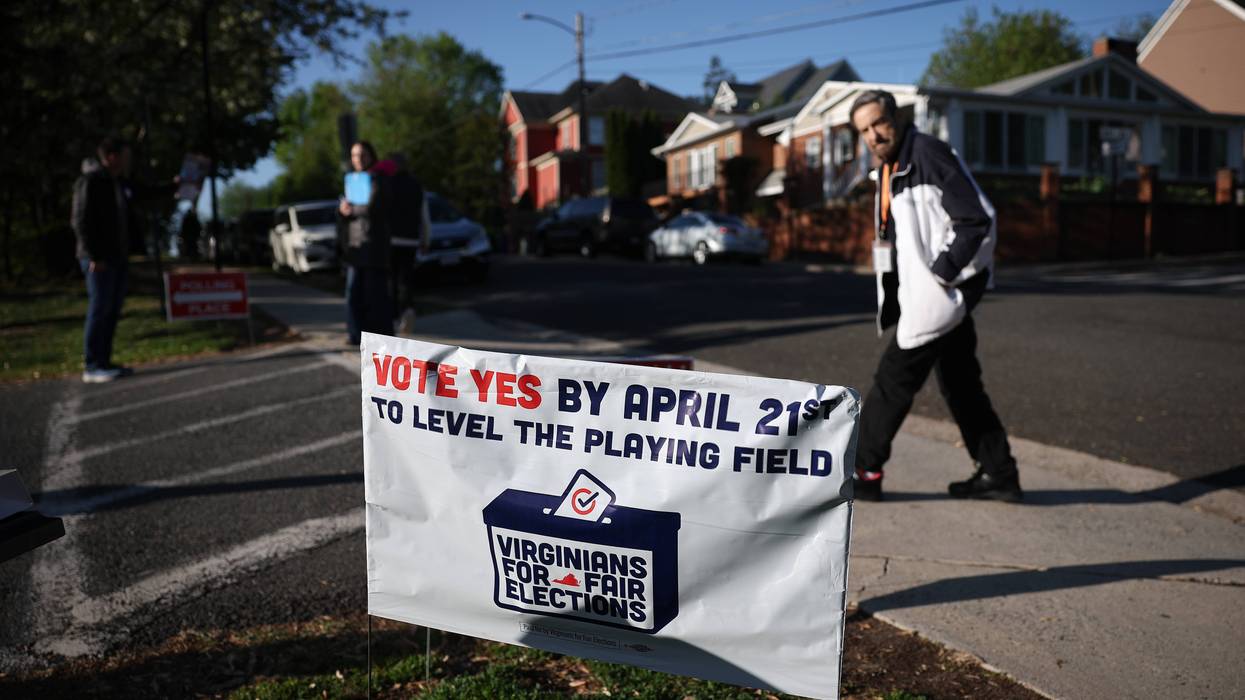
"Donald Trump, Republican state legislatures, and conservative courts are systematically and unabashedly tilting power away from the people for Trump’s political gain," said state Attorney General Jay Jones.
Virginia's Democratic attorney general, Jay Jones, said Friday night that he would redouble efforts to campaign on behalf of Democrats in the upcoming midterm elections following the US Supreme Court's rejection of a request to restore a voter-approved congressional map.
Following the high court's one-sentence denial of Democratic state officials' petition for emergency relief, which they had filed to block the state Supreme Court's ruling against a congressional map that passed via ballot measure last month, Jones said he would be "working tirelessly to support our Democratic candidates so we can win control of the House in spite of Republicans putting their thumbs on the scale."
With no dissents noted, the Supreme Court said Friday evening that it was denying the request to block the Virginia high court's ruling that had tossed out last month's redistricting referendum.
BREAKING: SCOTUS denies Virginia Democrats' request to block the Virginia Supreme Court ruling tossing out the redistricting referendum. There are no noted dissents and no opinion.
[image or embed]
— Chris Geidner (@chrisgeidner.bsky.social) May 15, 2026 at 6:35 PM
The decision "leaves in place the deeply flawed ruling from the Supreme Court of Virginia, which overturned the results of a lawful election and erased the will of millions of Virginia voters," said Jones.
It also served as "yet another profoundly troubling example of the continued national attack on voting rights and the rule of law by [President] Donald Trump, Republican state legislatures, and conservative courts," said the attorney general.
The map that was narrowly approved by voters last month included four new Democratic-leaning US House districts in Virginia, putting the party on equal footing with Republicans nationally or potentially giving it an edge in a mid-decade redistricting battle that was kicked off last year. Trump has urged Republican state legislatures to redraw congressional districts to give the GOP more winnable seats in the US House—as the president's economic policies and his deeply unpopular war on Iran as well as other military actions have pushed his approval rating to a low point for his second term ahead of the November midterms.
The redistricting fight was intensified late last month with the Supreme Court's ruling in Louisiana v. Callais, which held that Louisiana must redraw its 2024 congressional map. The map had created a second majority-minority district in the state, whose population is one-third Black. The ruling effectively gutted Section 2 of the Voting Rights Act, which allowed voters of color to challenge racially discriminatory electoral maps in court.
After the ruling, Louisiana's Republican governor, Jeff Landry, suspended the state's primary elections to allow the Republican-controlled legislature to redraw the congressional map, throwing out roughly 45,000 votes that had already been cast.
In the Virginia case, the US Supreme Court sided with the state's high court, which had found earlier this month that Virginia's Democratic legislature improperly began the process of placing an amendment to the state constitution after early voting in last fall's election was underway. The amendment cleared the way for Democrats to redraw the map, and the General Assembly approved the amendment days before the election.
Virginia voters then approved the redrawn map in April, only to have the state Supreme Court strike it down.
In filing their emergency petition with the US Supreme Court, Virginia Democrats argued the ruling had undermined the will of the residents who had voted for the referendum in April.
On Friday evening, Democratic Gov. Abigail Spanberger said the court had chosen "to nullify an election and the votes of more than three million Virginians."
Jones added in his statement that "Donald Trump, Republican state legislatures, and conservative courts are systematically and unabashedly tilting power away from the people for Trump’s political gain. Just this past month in Louisiana, Tennessee, and South Carolina, they have redrawn their maps and diluted Black political representation because it threatens their hold on power."
"This attack is not subtle," said the attorney general. "It is a coordinated effort to stack the deck in the Republicans' favor before the midterms, lock in political advantage, and make it harder for voters, especially Black voters and communities of color, to hold Trump and his allies accountable. There can be no doubt: Trump and his allies want only their most politically extreme supporters to have their voices heard in Washington. The Supreme Court of Virginia’s previous decision and today’s refusal by the United States Supreme Court to act are only bolstering these extreme MAGA voices."
Addressing Virginia voters, Jones added, "This fight is far from over, and I am committed to fighting alongside you."
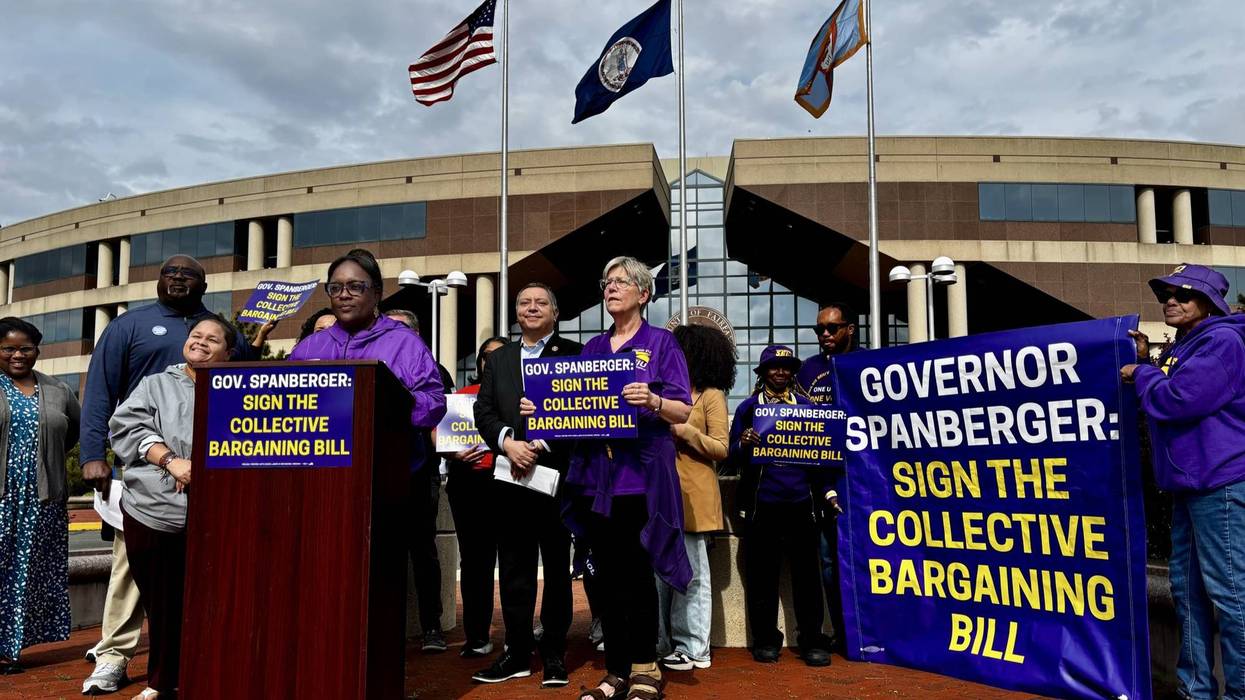
“We believed that she was being authentic and honest with us," said one Virginia labor leader. "She just flat-out flipped."
Labor unions are feeling betrayed after Virginia's Democratic Gov. Abigail Spanberger vetoed a bill on Thursday that would have restored collective bargaining rights for half a million public sector workers.
Virginia is one of the most restrictive states in the country for public sector bargaining, a holdover from the Jim Crow era when the General Assembly and other state legislatures across the South sought to crush the power of a public workforce with many Black employees.
According to the Economic Policy Institute, Virginia has one of the largest public sector pay gaps in the country, with state and local government employees making about 27% less on average than their private-sector peers, and it is similarly stratified in other states with weak collective bargaining rights.
Spanberger, a former US representative who was elected governor this past November, made pro-union messaging central to her affordability-focused platform. She decried President Donald Trump's executive order stripping federal workers of collective bargaining rights last year and said that as governor, she'd "look forward to working with members of our General Assembly to make sure more Virginians can negotiate for the benefits and fair treatment that they earn.”
But since taking office, Spanberger's support for restoring public sector union rights has been more tepid as she's gotten an earful from fiscally conservative Right-to-Work and taxpayer advocacy groups who claimed higher salaries for public employees would drain state funds and raise the cost of services.
When a bill to immediately mandate collective bargaining rights to 500,000 workers was proposed in the Democratic-controlled General Assembly, she introduced amendments aimed at watering down the bill—making it optional for employers to recognize unions, delaying the full implementation until 2030, and introducing what unions called a "kill-switch" that would have allowed future governors to revoke collective bargaining power.
The legislature shot Spanberger's amendments down and passed the bill in its original form. On Thursday, the governor vetoed it altogether.
In her veto message, Spanberger said she wanted the bill's other collective bargaining provisions for state employees, home care workers, and higher education employees to go into effect first "in order to demonstrate the efficacy of this new system" before it was opened up to all public employees.
But the unions that advocated for the bill say Spanberger led workers on with false promises.
"This veto is a devastating betrayal to the hundreds of thousands of public employees who have spent years, and in many cases decades, fighting for a seat at the table," said Doris Crouse-Mays, the president of the Virginia AFL-CIO. "Spanberger campaigned publicly and privately on promises [of] affordability, to support working families and respect workers' rights... Instead, when presented with the opportunity to make history and deliver on those promises, she chose to side with fear, political calculation, business, and the same anti-worker arguments that have been used for generations to deny workers power in Virginia."
LaNoral Thomas, the president of the Service Employees International Union (SEIU) Virginia 512—a union which helped lead the charge to pass the bill—told the Virginia news site Dogwood that her union had "high hopes" for Spanberger when she was elected.
“We believed that she was being authentic and honest with us," Thomas said. "She just flat-out flipped. It is shocking.”
"Public employees are not a special interest. They are our neighbors. They are the educators, bus drivers, social workers, librarians, custodians, and first responders who hold our communities together," said a joint statement from Carol Bauer, president of the Virginia Education Association, and Becky Pringle, president of the National Education Association.
They emphasized that the veto also carried "a deep racial and gender impact," noting that "Virginia’s public sector bargaining ban is rooted in a Jim Crow era effort to silence Black workers at the University of Virginia Hospital who organized for fair pay and dignity." They said, "Preserving that legacy today disproportionately harms women and workers of color, who make up so much of the public-service workforce and who have the most to gain from fair wages, safer workplaces, and a real voice on the job."
Lee Saunders, the president of the American Federation of State, County and Municipal Employees (AFSCME)—the largest national union of public sector workers in the US, with more than 1.4 million members—said that Spanberger had caved to "anti-worker extremists [who] have sidelined working people while starving the public services Virginia families rely on, earning the state a reputation as one of the most anti-worker in the country."
"While the governor has broken her word," Saunders said, "AFSCME members are deeply grateful to the bill’s sponsors and the leadership of both chambers, who kept theirs. Their commitment to working people stands in stark contrast to the governor and will not be forgotten."
"Gov. Spanberger made a choice today," he added. "Working people will remember it."
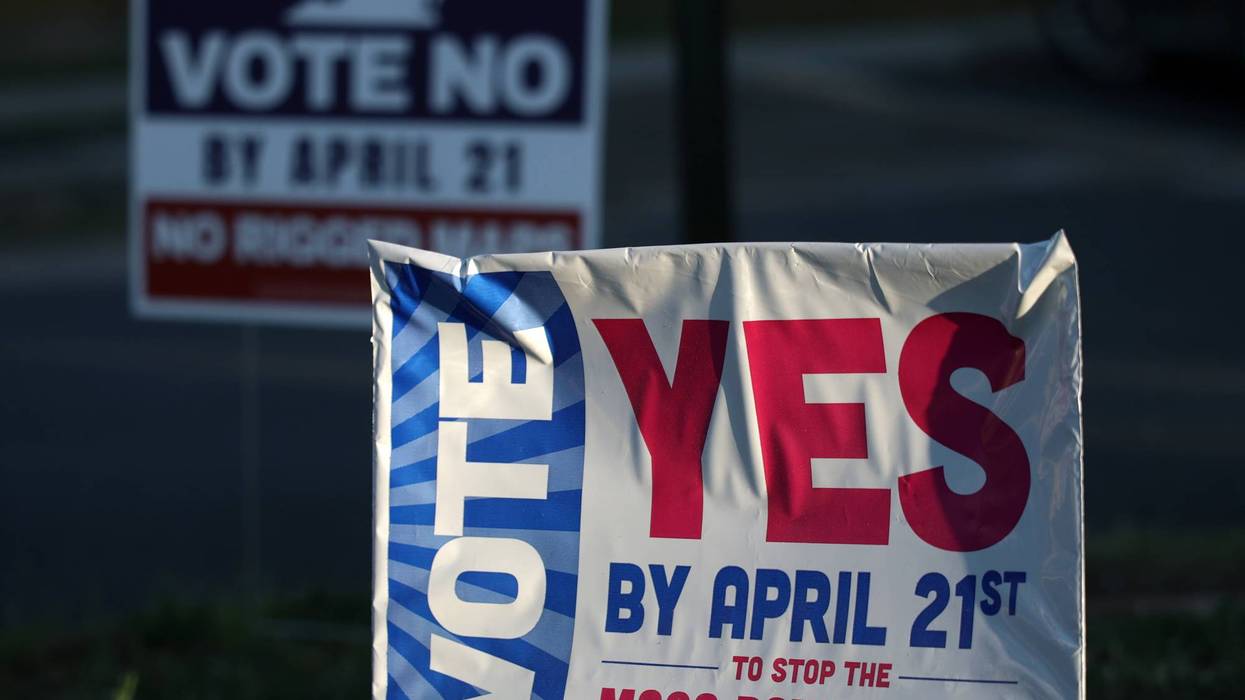
There is an important lesson to be learned here and that is that there is no advantage for Democrats in not being fully anti-Trump.
By roughly three percentage points, voters in Virginia voted for a redistricting plan that will heavily tilt the congressional playing field toward the Democrats. With some votes still to be counted, yes took 51.5% of the vote to 48.5% for the no campaign. The new map will give the Democrats a good chance at winning 10 out of 11 Virginia congressional districts—a big shift from the current 6 Democrats, 5 Republicans in the delegation. The measure still faces legal challenges before it can go into effect.
Turnout for the referendum was roughly 89% of those who voted in the 2025 gubernatorial election. So, the overall turnout rate for the referendum was around 49%. While this is disappointing in that less than half of eligible voters went to the polls, it is a high turnout rate for a special election.
Unfortunately, there are no exit polls for the Virginia referendum, so the best we can do is look at the voting data and see what conclusions we can draw. Among the very Hispanic-Asian election districts in Northern Virginia (Fairfax, Loudoun, and Manassas Park) the pro-referendum forces did about 16 percentage points better than Kamala Harris in 2024. A strong performance among Black voters in Richmond and Hampton Roads helped put the referendum over the top. According to The Washington Post, counties that were at least 25% Black supported the measure by a 14-point margin, after backing Gov. Abigail Spanberger last November by 24 points.
The pro-referendum forces also fared well in high-income parts of the commonwealth. Opposition to the referendum was concentrated in southwestern Virginia. In many of these counties, the no campaign was able to improve on President Donald Trump’s 2024 performance.
Tuesday’s vote in Virginia will mean more Democratic representatives in Congress.
Are there lessons that the Democrats can take away from the Virginia redistricting campaign? First of all, it is important to note that a win is a win. However, there is an important lesson to be learned here and that is that there is no advantage for Democrats in not being fully anti-Trump.
When the referendum campaign began, the yes forces were portraying the vote as part of a broad effort to level the congressional playing field. The New York Times reports that:
In the first six weeks of the campaign, the “Yes” side spent $13.5 million on advertising compared with the “No” campaign’s $640,000, according to data from AdImpact, a media tracking firm. But over that time period, “Yes” did not gain ground in private polling, according to multiple people briefed on the data.
Based on the media that I saw, in the closing days of the campaign, the yes forces retooled their messaging and presented the campaign as a way to stop Trump and the MAGA forces.
Why did the pro-redistricting forces not immediately embrace a full-on anti-Trump message? We can only make educated guesses. The first is newly elected Spanberger, who had run as a middle-of-the-road Democratic centrist. Her role in the redistricting is ambiguous. Unlike Gov. Gavin Newsom in California, Spanberger did not get out in front of the campaign. This is understandable. After all, Virginia, unlike California, is a purple state. Spanberger also needs to get her legislative agenda through in Richmond.
The best symbol of Spanberger’s attitude toward the referendum is the fact that she made an ad in support of a yes vote but the ad never showed. In her statements about the referendum, the governor was uncomfortable.
Democrats also seemed to have been unprepared for the no forces’ very clever use of statements by President Barack Obama opposing gerrymandering, which created confusion in the electorate. In response, the Democrats responded with ads featuring President Obama. In an interesting twist, Obama not Trump was the president most featured in the media outreach on the referendum.
So, in the end the redistricting referendum passed by less than Spanberger won last November. While the Republicans may be able to claim some sort of a moral victory, a win is still a win. Tuesday’s vote in Virginia will mean more Democratic representatives in Congress.
Democrats have reasons to celebrate. However, they should learn the lesson from the referendum: There is nothing to gain politically by soft-pedaling their opposition to Trump.
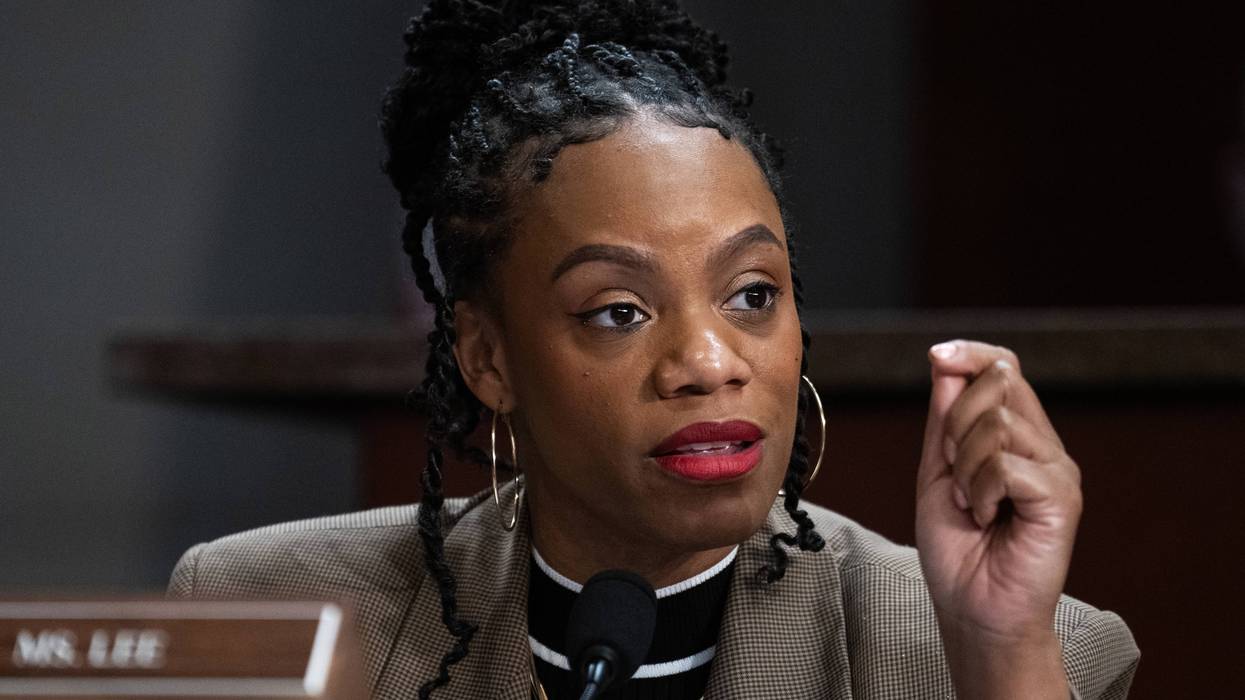
"I’m going to say what too many politicians won’t: The system is rigged, the obscenely wealthy are profiting from it, and working people deserve more than scraps."
As Democrats plan boycotts and counterprogramming to President Donald Trump's State of the Union address next week, progressives are readying their own response to resist not just the historically unpopular commander-in-chief, but the centrist faction of their own party.
For years, the State of the Union has served as a platform for rising stars in the opposition party. The Democrats are rolling out the newly minted Virginia Gov. Abigail Spanberger, a darling of the party establishment whose inaugural committee boasts an army of corporate backers—including Amazon and Capitol One, lobbying groups for the gambling industry and car dealerships, and multiple tobacco companies.
Seeking to push an alternative vision, the left-wing Working Families Party (WFP) has chosen Rep. Summer Lee (D-Pa.), whom national director Maurice Mitchell described as "fearless, rooted in working-class communities, and unafraid to take on both MAGA extremism and corporate power."
Previous WFP speakers have included Reps. Ayanna Pressley (D-Mass.), Rashida Tlaib (D-Mich.), and Delia Ramirez (D-Ill.).
"I’m going to elevate the voices of the people in my district and across the country who are angry, scared, and fed up with an administration that’s done nothing to help and a lot to hurt everyday people,” Lee said. “I’m going to say what too many politicians won’t: The system is rigged, the obscenely wealthy are profiting from it, and working people deserve more than scraps.
"Now more than ever," she continued, "we need a political home for people who are ready to fight back against Trump’s corruption and cruelty, and the corporate politics that made him possible.”
Her address comes at a pivotal moment for the Democratic Party's future. Despite the sinking popularity of Trump and soaring expectations of a blue wave in this November's midterms, polls show that Democratic voters are overwhelmingly dissatisfied with their party's leadership, believing it has failed to forcefully take on corporate power and pursue policy priorities like universal healthcare and increased taxes on the rich.
Contrary to Spanberger, a former congresswoman who consistently voted to hike military spending and called on former President Joe Biden to avoid pursuing an ambitious FDR-style social spending agenda, Lee has championed Medicare for All, a wealth tax on the richest Americans, and Green New Deal legislation while being one of Congress' fiercest critics of the US's unconditional military support for Israel.
"Summer Lee is the kind of leader this moment demands," Mitchell said. “At a time when voters are losing faith in the two-party status quo, the Working Families Party is building a disciplined, independent political force that can defeat Trump and actually deliver on jobs, wages, healthcare, and more.”