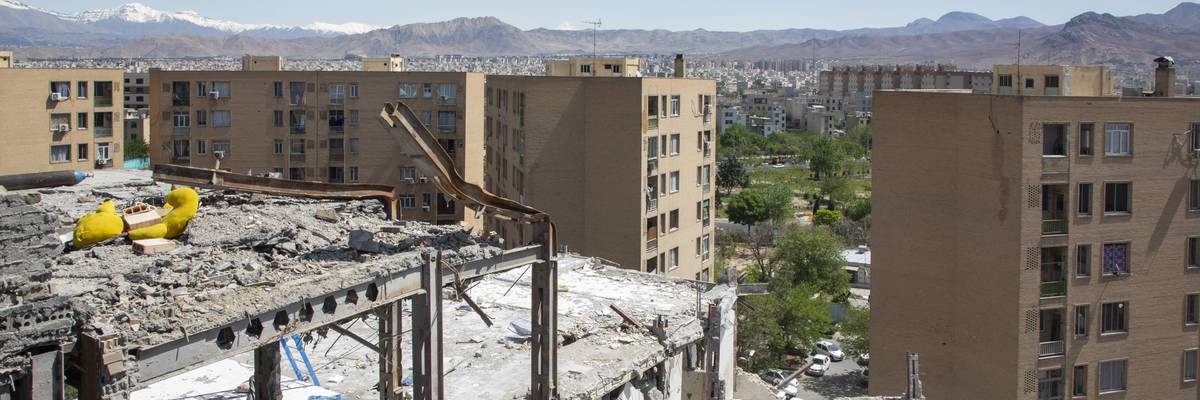
Damage is visible to a residential building that, according to Iranian authorities, was hit by a strike during the US-Israeli military campaign, on April 14, 2026 in southeastern Tehran, Iran.
'War Could Break Out at Any Time': Trump Extends Ceasefire But Continues Blockade of Iran
One expert stressed that "trust between the sides remains at zero."
President Donald Trump on Tuesday afternoon extended a two-week ceasefire for his and Israel's war on Iran, but the US leader also said that a naval blockade of the Mideast nation will continue, and fears of fresh attacks remain high.
Two weeks after threatening to take out the "whole civilization" of Iran just hours before the ceasefire agreement was reached, Trump took to his Truth Social platform again to announce the extension, without a clear timeline.
"Based on the fact that the Government of Iran is seriously fractured, not unexpectedly so and, upon the request of Field Marshal Asim Munir, and Prime Minister Shehbaz Sharif, of Pakistan, we have been asked to hold our Attack on the Country of Iran until such time as their leaders and representatives can come up with a unified proposal," Trump wrote. "I have therefore directed our Military to continue the Blockade and, in all other respects, remain ready and able, and will therefore extend the Ceasefire until such time as their proposal is submitted, and discussions are concluded, one way or the other."
Trump has imposed the blockade in response to Iran's closure of the Strait of Hormuz, a waterway between the Persian Gulf and the Gulf of Oman that's a key trade route, including for fossil fuels. As part of the blockade, the president said Sunday, US forces seized Touska, a nearly 900-foot Iranian-flagged cargo ship.
Trita Parsi, co-founder and executive vice president of the Quincy Institute for Responsible Statecraft, concluded Tuesday that Trump's cave "reflects the outcome I have argued is the most likely: No deal, no sanctions relief, no nuclear compromise, no return to war, while Iran continues to control the strait. Not a stable situation, but one in which Trump pockets the central thing he sought—exiting the war—while Iran is bereft of the main thing it was looking for: sanctions lifting."
While a spokesperson for United Nations Secretary-General António Guterres said that he welcomes Trump's announcement as "an important step toward de-escalation and creating critical space for diplomacy and confidence-building between Iran and the United States," and encouraged all parties "to build on this momentum," comments out of Iran suggested limited progress.
Drop Site News co-founder Jeremy Scahill reported Tuesday that "an Iranian official tells me that, as of this moment, Iran's position remains unchanged: Lifting of the naval blockade is a condition for a second round of talks."
According to Reuters chief national security reporter Phil Stewart, an adviser to Mohammad Bagher Ghalibaf, speaker of Iran's Parliament, said that Tuesday's extension means nothing and could even be a ploy to buy time for a surprise strike, plus the US continuing its blockade is the same as bombardment and must be met with military force.
Noting Stewart's reporting on social media, Center for International Policy senior fellow Sina Toossi warned that "after coming under surprise attack twice, some in Tehran are calling for Iran to take initiative and strike first, including at US vessels or tankers ready to exit Hormuz."
Toossi also stressed that "trust between the sides remains at zero and renewed war could break out at any time."
"Let's be real, Pakistan isn't deciding whether the US goes to war with Iran," he added. "They're a conduit, not a driver. More a convenient excuse and diplomatic cover than having any sort of actual influence over Trump on Iran."
Ahead of the extension, Toossi had published an op-ed in The Guardian arguing that "having fought what they see as an existential war with the US and Israel and held their ground, Iranian officials see little reason to rush into major concessions. The priority is not a sweeping deal, but reducing the risk of war while preserving core sources of power, from Hormuz to its nuclear program."
"In the short term, that may simply mean extending the ceasefire rather than reaching a substantive agreement. Beyond that, the likelier outcome is an interim arrangement, or a broad memorandum-of-understanding-style framework that defers key details, rather than a decisive breakthrough," he continued. "In this view, the conflict is not being resolved but managed—and with time, Iran believes its position will strengthen as the global fallout from energy disruption makes renewed escalation a cost no one is willing to bear."
A Tuesday report from the climate advocacy group 350.org estimates that during the first 50 days of the Iran war, consumers and businesses worldwide have paid an additional $158.6-166.9 billion due to soaring fuel costs.
Additionally, thousands of people have been killed in Iran and across the region, and at least tens of thousands of Iranian civilian infrastructure sites have been damaged since the US and Israel first launched attacks in February.
We are at a crossroads
This country and this world are at a monumental crossroads. In a few short weeks, US voters will have an opportunity to beat back the forces of fascism and confront the billionaires who are rigging the economy, our media system, and our democracy, making it increasingly impossible for ordinary people to get by. We’re not just talking about the election. We’re talking about what must be done once these fascist elements are vanquished from power. We need a bolder set of solutions than what either major party has so far been willing to offer and a working-class movement ready to fight like hell for it. Trump didn't emerge from nowhere. The conditions that fueled MAGA authoritarianism were created by decades of radical neoliberal economic policies and a corrupt political system dominated by corporate interests. They slashed taxes on the super-rich, promising that the benefits would trickle down. They said giveaways to the corporate titans would make life more affordable for the rest of us. It was all bullshit. And when a bitter, betrayed populace searches for someone to blame, right-wing demagogues have little trouble finding scapegoats. People know when they're being lied to, but you won't hear any of this from the corporate media. Only independent journalism—powered and funded by people who believe in building a better world—can deliver truly trustworthy daily news. Our Fall Campaign is underway, and we need your help. To power our newsroom through the rest of the year, we need to raise $125,000 by midnight on October 31. So if you share our vision, please contribute whatever you can to sustain our work. |
President Donald Trump on Tuesday afternoon extended a two-week ceasefire for his and Israel's war on Iran, but the US leader also said that a naval blockade of the Mideast nation will continue, and fears of fresh attacks remain high.
Two weeks after threatening to take out the "whole civilization" of Iran just hours before the ceasefire agreement was reached, Trump took to his Truth Social platform again to announce the extension, without a clear timeline.
"Based on the fact that the Government of Iran is seriously fractured, not unexpectedly so and, upon the request of Field Marshal Asim Munir, and Prime Minister Shehbaz Sharif, of Pakistan, we have been asked to hold our Attack on the Country of Iran until such time as their leaders and representatives can come up with a unified proposal," Trump wrote. "I have therefore directed our Military to continue the Blockade and, in all other respects, remain ready and able, and will therefore extend the Ceasefire until such time as their proposal is submitted, and discussions are concluded, one way or the other."
Trump has imposed the blockade in response to Iran's closure of the Strait of Hormuz, a waterway between the Persian Gulf and the Gulf of Oman that's a key trade route, including for fossil fuels. As part of the blockade, the president said Sunday, US forces seized Touska, a nearly 900-foot Iranian-flagged cargo ship.
Trita Parsi, co-founder and executive vice president of the Quincy Institute for Responsible Statecraft, concluded Tuesday that Trump's cave "reflects the outcome I have argued is the most likely: No deal, no sanctions relief, no nuclear compromise, no return to war, while Iran continues to control the strait. Not a stable situation, but one in which Trump pockets the central thing he sought—exiting the war—while Iran is bereft of the main thing it was looking for: sanctions lifting."
While a spokesperson for United Nations Secretary-General António Guterres said that he welcomes Trump's announcement as "an important step toward de-escalation and creating critical space for diplomacy and confidence-building between Iran and the United States," and encouraged all parties "to build on this momentum," comments out of Iran suggested limited progress.
Drop Site News co-founder Jeremy Scahill reported Tuesday that "an Iranian official tells me that, as of this moment, Iran's position remains unchanged: Lifting of the naval blockade is a condition for a second round of talks."
According to Reuters chief national security reporter Phil Stewart, an adviser to Mohammad Bagher Ghalibaf, speaker of Iran's Parliament, said that Tuesday's extension means nothing and could even be a ploy to buy time for a surprise strike, plus the US continuing its blockade is the same as bombardment and must be met with military force.
Noting Stewart's reporting on social media, Center for International Policy senior fellow Sina Toossi warned that "after coming under surprise attack twice, some in Tehran are calling for Iran to take initiative and strike first, including at US vessels or tankers ready to exit Hormuz."
Toossi also stressed that "trust between the sides remains at zero and renewed war could break out at any time."
"Let's be real, Pakistan isn't deciding whether the US goes to war with Iran," he added. "They're a conduit, not a driver. More a convenient excuse and diplomatic cover than having any sort of actual influence over Trump on Iran."
Ahead of the extension, Toossi had published an op-ed in The Guardian arguing that "having fought what they see as an existential war with the US and Israel and held their ground, Iranian officials see little reason to rush into major concessions. The priority is not a sweeping deal, but reducing the risk of war while preserving core sources of power, from Hormuz to its nuclear program."
"In the short term, that may simply mean extending the ceasefire rather than reaching a substantive agreement. Beyond that, the likelier outcome is an interim arrangement, or a broad memorandum-of-understanding-style framework that defers key details, rather than a decisive breakthrough," he continued. "In this view, the conflict is not being resolved but managed—and with time, Iran believes its position will strengthen as the global fallout from energy disruption makes renewed escalation a cost no one is willing to bear."
A Tuesday report from the climate advocacy group 350.org estimates that during the first 50 days of the Iran war, consumers and businesses worldwide have paid an additional $158.6-166.9 billion due to soaring fuel costs.
Additionally, thousands of people have been killed in Iran and across the region, and at least tens of thousands of Iranian civilian infrastructure sites have been damaged since the US and Israel first launched attacks in February.
- Israel Strikes Lebanon Less Than an Hour After Trump Says It's 'PROHIBITED' From More Attacks ›
- Trump Says Israel and Lebanon Have Agreed to 10-Day Ceasefire - News & Opinion - The Commons ›
- Iran Reopens Strait of Hormuz After Israel-Lebanon Truce as Trump Continues Blockade ›
- US, Israel, and Iran Agree to 2-Week Ceasefire Hours After Trump's Genocidal Threat ›
President Donald Trump on Tuesday afternoon extended a two-week ceasefire for his and Israel's war on Iran, but the US leader also said that a naval blockade of the Mideast nation will continue, and fears of fresh attacks remain high.
Two weeks after threatening to take out the "whole civilization" of Iran just hours before the ceasefire agreement was reached, Trump took to his Truth Social platform again to announce the extension, without a clear timeline.
"Based on the fact that the Government of Iran is seriously fractured, not unexpectedly so and, upon the request of Field Marshal Asim Munir, and Prime Minister Shehbaz Sharif, of Pakistan, we have been asked to hold our Attack on the Country of Iran until such time as their leaders and representatives can come up with a unified proposal," Trump wrote. "I have therefore directed our Military to continue the Blockade and, in all other respects, remain ready and able, and will therefore extend the Ceasefire until such time as their proposal is submitted, and discussions are concluded, one way or the other."
Trump has imposed the blockade in response to Iran's closure of the Strait of Hormuz, a waterway between the Persian Gulf and the Gulf of Oman that's a key trade route, including for fossil fuels. As part of the blockade, the president said Sunday, US forces seized Touska, a nearly 900-foot Iranian-flagged cargo ship.
Trita Parsi, co-founder and executive vice president of the Quincy Institute for Responsible Statecraft, concluded Tuesday that Trump's cave "reflects the outcome I have argued is the most likely: No deal, no sanctions relief, no nuclear compromise, no return to war, while Iran continues to control the strait. Not a stable situation, but one in which Trump pockets the central thing he sought—exiting the war—while Iran is bereft of the main thing it was looking for: sanctions lifting."
While a spokesperson for United Nations Secretary-General António Guterres said that he welcomes Trump's announcement as "an important step toward de-escalation and creating critical space for diplomacy and confidence-building between Iran and the United States," and encouraged all parties "to build on this momentum," comments out of Iran suggested limited progress.
Drop Site News co-founder Jeremy Scahill reported Tuesday that "an Iranian official tells me that, as of this moment, Iran's position remains unchanged: Lifting of the naval blockade is a condition for a second round of talks."
According to Reuters chief national security reporter Phil Stewart, an adviser to Mohammad Bagher Ghalibaf, speaker of Iran's Parliament, said that Tuesday's extension means nothing and could even be a ploy to buy time for a surprise strike, plus the US continuing its blockade is the same as bombardment and must be met with military force.
Noting Stewart's reporting on social media, Center for International Policy senior fellow Sina Toossi warned that "after coming under surprise attack twice, some in Tehran are calling for Iran to take initiative and strike first, including at US vessels or tankers ready to exit Hormuz."
Toossi also stressed that "trust between the sides remains at zero and renewed war could break out at any time."
"Let's be real, Pakistan isn't deciding whether the US goes to war with Iran," he added. "They're a conduit, not a driver. More a convenient excuse and diplomatic cover than having any sort of actual influence over Trump on Iran."
Ahead of the extension, Toossi had published an op-ed in The Guardian arguing that "having fought what they see as an existential war with the US and Israel and held their ground, Iranian officials see little reason to rush into major concessions. The priority is not a sweeping deal, but reducing the risk of war while preserving core sources of power, from Hormuz to its nuclear program."
"In the short term, that may simply mean extending the ceasefire rather than reaching a substantive agreement. Beyond that, the likelier outcome is an interim arrangement, or a broad memorandum-of-understanding-style framework that defers key details, rather than a decisive breakthrough," he continued. "In this view, the conflict is not being resolved but managed—and with time, Iran believes its position will strengthen as the global fallout from energy disruption makes renewed escalation a cost no one is willing to bear."
A Tuesday report from the climate advocacy group 350.org estimates that during the first 50 days of the Iran war, consumers and businesses worldwide have paid an additional $158.6-166.9 billion due to soaring fuel costs.
Additionally, thousands of people have been killed in Iran and across the region, and at least tens of thousands of Iranian civilian infrastructure sites have been damaged since the US and Israel first launched attacks in February.
- Israel Strikes Lebanon Less Than an Hour After Trump Says It's 'PROHIBITED' From More Attacks ›
- Trump Says Israel and Lebanon Have Agreed to 10-Day Ceasefire - News & Opinion - The Commons ›
- Iran Reopens Strait of Hormuz After Israel-Lebanon Truce as Trump Continues Blockade ›
- US, Israel, and Iran Agree to 2-Week Ceasefire Hours After Trump's Genocidal Threat ›