SUBSCRIBE TO OUR FREE NEWSLETTER
Daily news & progressive opinion—funded by the people, not the corporations—delivered straight to your inbox.
5
#000000
#FFFFFF
To donate by check, phone, or other method, see our More Ways to Give page.
Daily news & progressive opinion—funded by the people, not the corporations—delivered straight to your inbox.
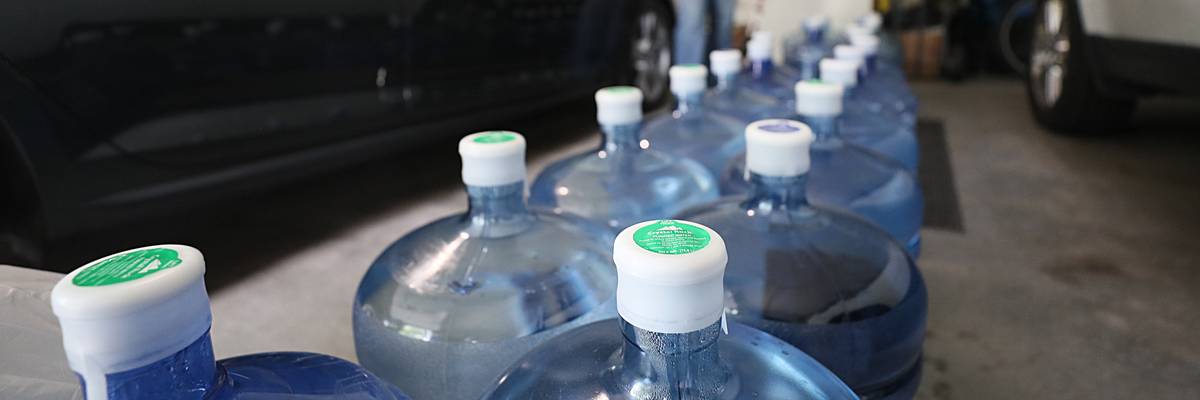
This man's water delivery is shown in Westminster, Massachusetts on June 24, 2022. His household's tap water is contaminated with high levels of "forever chemicals."
President Donald Trump is yet again facing accusations of breaking his campaign promise to "Make America Healthy Again" after the US Environmental Protection Agency on Monday proposed repealing and delaying some landmark limits on "forever chemicals" in drinking water.
Per- and polyfluoroalkyl substances (PFAS) are commonly called forever chemicals because they persist in the environment, humans, and wildlife for long periods. Despite their links to various health issues, including cancer, they have been used in products such as firefighting foam, food packaging, nonstick pans, and water-resistant fabrics for clothing and furniture.
The Biden administration was praised for its historic steps to reduce PFAS contamination of tap water and urged to go even further. However, the Trump EPA is now pushing to delay those limits for two common contaminants, PFOA and PFOS, and abandon the restrictions for four others: PFBS, PFHxS, and PFNA, and HFPO-DA—also known as GenX.
Announcing the proposed rules on Monday, EPA Administrator Lee Zeldin and US Department of Health and Human Services Secretary Robert F. Kennedy Jr. claimed not only that the Biden administration failed to follow federal law in implementing its restrictions, but also that the new proposals are part of the president's Make America Healthy Again pledge. They highlighted "innovative" technologies plus funding for states to address PFAS in tap water.
However, campaigners who have long called for stricter PFAS policies excoriated the Trump administration over its two proposed rules—which are set to be published in the Federal Register with a 60-day public comment period, and the subject of an EPA hearing scheduled for July 7.
"Zeldin and Kennedy are trying to sell potions out of the back of a covered wagon. The millions of Americans demanding safe drinking water are not going to fall for their hocus pocus," said Anna Reade, director of PFAS advocacy at the Natural Resources Defense Council, in a statement. "By repealing and delaying PFAS standards, EPA is abandoning communities in desperate need of drinking water protections, especially those who live near polluting industries."
Food and Water Watch's water program director, Mary Grant, declared that "with today's proposals, the Trump administration is telling the public to drink poison. It has once again shown that it represents the interests of billionaire corporate polluters—not the health of people in this country."
"One thing is absolutely clear, we cannot roll back or delay protections against PFAS," she said. "For decades, communities have been sounding the alarm and demanding action on these toxic forever chemicals. Instead of implementing commonsense regulations, Trump's EPA has doubled down on weakening our drinking water protections. Every person deserves and needs clean, safe water, and today's proposed rules are threats to millions of people."
Grant argued that "EPA must not delay or roll back these hard-won limits on toxic PFAS contaminants in drinking water. It must immediately cease these deregulatory actions, stop approving new PFAS chemicals, ban all nonessential uses, hold polluters accountable for clean up, expand protections to regulate the entire class, and ramp up support to ensure that every community has access to safe, affordable water."
Ken Cook, president and co-founder of the Environmental Working Group (EWG), which has tracked PFAS contamination across the United States and publicly released its findings, was similarly outraged by the EPA proposals.
"You cannot make America healthy again while allowing toxic PFAS to flow freely from our taps," Cook said. "The Trump EPA is caving to chemical industry lobbyists and water utility pressure—and in doing so, it is condemning millions of Americans to drink contaminated water for years to come."
"The price of this decision will be paid by ordinary people, in the form of more PFAS-related diseases," he warned.
While Trump's agency leaders claimed Monday that the Biden administration ran afoul of the Safe Drinking Water Act, EWG accused them of violating that same law, given its requirement that any revision to a tap water standard "maintain, or provide for greater, protection of the health of persons."
Melanie Benesh, vice president of government affairs at EWG, said that "this is a deliberate decision to expose American families to chemicals linked to cancer and other serious health harms. Rolling back limits on four PFAS and then allowing water systems to push compliance deadlines to 2031, when contamination is ongoing, is unconscionable."
"The communities least able to protect themselves will pay the highest price," she added. "That is not regulatory reform. It is an environmental injustice."
Dear Common Dreams reader, It’s been nearly 30 years since I co-founded Common Dreams with my late wife, Lina Newhouser. We had the radical notion that journalism should serve the public good, not corporate profits. It was clear to us from the outset what it would take to build such a project. No paid advertisements. No corporate sponsors. No millionaire publisher telling us what to think or do. Many people said we wouldn't last a year, but we proved those doubters wrong. Together with a tremendous team of journalists and dedicated staff, we built an independent media outlet free from the constraints of profits and corporate control. Our mission has always been simple: To inform. To inspire. To ignite change for the common good. Building Common Dreams was not easy. Our survival was never guaranteed. When you take on the most powerful forces—Wall Street greed, fossil fuel industry destruction, Big Tech lobbyists, and uber-rich oligarchs who have spent billions upon billions rigging the economy and democracy in their favor—the only bulwark you have is supporters who believe in your work. But here’s the urgent message from me today. It's never been this bad out there. And it's never been this hard to keep us going. At the very moment Common Dreams is most needed, the threats we face are intensifying. We need your support now more than ever. We don't accept corporate advertising and never will. We don't have a paywall because we don't think people should be blocked from critical news based on their ability to pay. Everything we do is funded by the donations of readers like you. When everyone does the little they can afford, we are strong. But if that support retreats or dries up, so do we. Will you donate now to make sure Common Dreams not only survives but thrives? —Craig Brown, Co-founder |
President Donald Trump is yet again facing accusations of breaking his campaign promise to "Make America Healthy Again" after the US Environmental Protection Agency on Monday proposed repealing and delaying some landmark limits on "forever chemicals" in drinking water.
Per- and polyfluoroalkyl substances (PFAS) are commonly called forever chemicals because they persist in the environment, humans, and wildlife for long periods. Despite their links to various health issues, including cancer, they have been used in products such as firefighting foam, food packaging, nonstick pans, and water-resistant fabrics for clothing and furniture.
The Biden administration was praised for its historic steps to reduce PFAS contamination of tap water and urged to go even further. However, the Trump EPA is now pushing to delay those limits for two common contaminants, PFOA and PFOS, and abandon the restrictions for four others: PFBS, PFHxS, and PFNA, and HFPO-DA—also known as GenX.
Announcing the proposed rules on Monday, EPA Administrator Lee Zeldin and US Department of Health and Human Services Secretary Robert F. Kennedy Jr. claimed not only that the Biden administration failed to follow federal law in implementing its restrictions, but also that the new proposals are part of the president's Make America Healthy Again pledge. They highlighted "innovative" technologies plus funding for states to address PFAS in tap water.
However, campaigners who have long called for stricter PFAS policies excoriated the Trump administration over its two proposed rules—which are set to be published in the Federal Register with a 60-day public comment period, and the subject of an EPA hearing scheduled for July 7.
"Zeldin and Kennedy are trying to sell potions out of the back of a covered wagon. The millions of Americans demanding safe drinking water are not going to fall for their hocus pocus," said Anna Reade, director of PFAS advocacy at the Natural Resources Defense Council, in a statement. "By repealing and delaying PFAS standards, EPA is abandoning communities in desperate need of drinking water protections, especially those who live near polluting industries."
Food and Water Watch's water program director, Mary Grant, declared that "with today's proposals, the Trump administration is telling the public to drink poison. It has once again shown that it represents the interests of billionaire corporate polluters—not the health of people in this country."
"One thing is absolutely clear, we cannot roll back or delay protections against PFAS," she said. "For decades, communities have been sounding the alarm and demanding action on these toxic forever chemicals. Instead of implementing commonsense regulations, Trump's EPA has doubled down on weakening our drinking water protections. Every person deserves and needs clean, safe water, and today's proposed rules are threats to millions of people."
Grant argued that "EPA must not delay or roll back these hard-won limits on toxic PFAS contaminants in drinking water. It must immediately cease these deregulatory actions, stop approving new PFAS chemicals, ban all nonessential uses, hold polluters accountable for clean up, expand protections to regulate the entire class, and ramp up support to ensure that every community has access to safe, affordable water."
Ken Cook, president and co-founder of the Environmental Working Group (EWG), which has tracked PFAS contamination across the United States and publicly released its findings, was similarly outraged by the EPA proposals.
"You cannot make America healthy again while allowing toxic PFAS to flow freely from our taps," Cook said. "The Trump EPA is caving to chemical industry lobbyists and water utility pressure—and in doing so, it is condemning millions of Americans to drink contaminated water for years to come."
"The price of this decision will be paid by ordinary people, in the form of more PFAS-related diseases," he warned.
While Trump's agency leaders claimed Monday that the Biden administration ran afoul of the Safe Drinking Water Act, EWG accused them of violating that same law, given its requirement that any revision to a tap water standard "maintain, or provide for greater, protection of the health of persons."
Melanie Benesh, vice president of government affairs at EWG, said that "this is a deliberate decision to expose American families to chemicals linked to cancer and other serious health harms. Rolling back limits on four PFAS and then allowing water systems to push compliance deadlines to 2031, when contamination is ongoing, is unconscionable."
"The communities least able to protect themselves will pay the highest price," she added. "That is not regulatory reform. It is an environmental injustice."
President Donald Trump is yet again facing accusations of breaking his campaign promise to "Make America Healthy Again" after the US Environmental Protection Agency on Monday proposed repealing and delaying some landmark limits on "forever chemicals" in drinking water.
Per- and polyfluoroalkyl substances (PFAS) are commonly called forever chemicals because they persist in the environment, humans, and wildlife for long periods. Despite their links to various health issues, including cancer, they have been used in products such as firefighting foam, food packaging, nonstick pans, and water-resistant fabrics for clothing and furniture.
The Biden administration was praised for its historic steps to reduce PFAS contamination of tap water and urged to go even further. However, the Trump EPA is now pushing to delay those limits for two common contaminants, PFOA and PFOS, and abandon the restrictions for four others: PFBS, PFHxS, and PFNA, and HFPO-DA—also known as GenX.
Announcing the proposed rules on Monday, EPA Administrator Lee Zeldin and US Department of Health and Human Services Secretary Robert F. Kennedy Jr. claimed not only that the Biden administration failed to follow federal law in implementing its restrictions, but also that the new proposals are part of the president's Make America Healthy Again pledge. They highlighted "innovative" technologies plus funding for states to address PFAS in tap water.
However, campaigners who have long called for stricter PFAS policies excoriated the Trump administration over its two proposed rules—which are set to be published in the Federal Register with a 60-day public comment period, and the subject of an EPA hearing scheduled for July 7.
"Zeldin and Kennedy are trying to sell potions out of the back of a covered wagon. The millions of Americans demanding safe drinking water are not going to fall for their hocus pocus," said Anna Reade, director of PFAS advocacy at the Natural Resources Defense Council, in a statement. "By repealing and delaying PFAS standards, EPA is abandoning communities in desperate need of drinking water protections, especially those who live near polluting industries."
Food and Water Watch's water program director, Mary Grant, declared that "with today's proposals, the Trump administration is telling the public to drink poison. It has once again shown that it represents the interests of billionaire corporate polluters—not the health of people in this country."
"One thing is absolutely clear, we cannot roll back or delay protections against PFAS," she said. "For decades, communities have been sounding the alarm and demanding action on these toxic forever chemicals. Instead of implementing commonsense regulations, Trump's EPA has doubled down on weakening our drinking water protections. Every person deserves and needs clean, safe water, and today's proposed rules are threats to millions of people."
Grant argued that "EPA must not delay or roll back these hard-won limits on toxic PFAS contaminants in drinking water. It must immediately cease these deregulatory actions, stop approving new PFAS chemicals, ban all nonessential uses, hold polluters accountable for clean up, expand protections to regulate the entire class, and ramp up support to ensure that every community has access to safe, affordable water."
Ken Cook, president and co-founder of the Environmental Working Group (EWG), which has tracked PFAS contamination across the United States and publicly released its findings, was similarly outraged by the EPA proposals.
"You cannot make America healthy again while allowing toxic PFAS to flow freely from our taps," Cook said. "The Trump EPA is caving to chemical industry lobbyists and water utility pressure—and in doing so, it is condemning millions of Americans to drink contaminated water for years to come."
"The price of this decision will be paid by ordinary people, in the form of more PFAS-related diseases," he warned.
While Trump's agency leaders claimed Monday that the Biden administration ran afoul of the Safe Drinking Water Act, EWG accused them of violating that same law, given its requirement that any revision to a tap water standard "maintain, or provide for greater, protection of the health of persons."
Melanie Benesh, vice president of government affairs at EWG, said that "this is a deliberate decision to expose American families to chemicals linked to cancer and other serious health harms. Rolling back limits on four PFAS and then allowing water systems to push compliance deadlines to 2031, when contamination is ongoing, is unconscionable."
"The communities least able to protect themselves will pay the highest price," she added. "That is not regulatory reform. It is an environmental injustice."