SUBSCRIBE TO OUR FREE NEWSLETTER
Daily news & progressive opinion—funded by the people, not the corporations—delivered straight to your inbox.
5
#000000
#FFFFFF
To donate by check, phone, or other method, see our More Ways to Give page.
Daily news & progressive opinion—funded by the people, not the corporations—delivered straight to your inbox.

New York Times columnist Thomas Friedman speaking during an event at the Saban Forum in 2015.
To be fair, Friedman didn’t last this long by not knowing just how stupid you’ve got to talk nowadays if you want to stand out for stupid during the second Trump administration.
Perhaps I haven’t up kept as well as I should, but I can’t recall New York Times columnist Thomas Friedman coming out with such a spectacularly bad idea for some time now. But he’s certainly broken that streak—if ever streak it was‚ with his article, "NATO, Please Help. Trump Has No Strategy for Iran," in which he calls upon NATO to “get all your navies together and proceed to the Persian Gulf immediately to join the American armada.” And just so’s we’re clear here, polling tells us that the attack on Iran is the first war to be rejected—not later on but from its outset–by the American public, since before the Second World War—perhaps the first in 100 years. And Friedman thinks Europe should sail right in.
"This does not come out of nowhere; Friedman does have a serious history of sh*t-talking, the highlight of which might be his appeal to “Give war a chance” during the 1999 NATO bombing of Serbia in the Kosovo War (one of our country’s “little wars” that no one is expected to recall outside of an Advanced Placement History class.) What kind of chance did he propose to give man’s oldest profession at that time? “It should be lights out in Belgrade,” he wrote, “every power grid, water pipe, bridge, road and war-related factory has to be targeted,” Whatever it took, so that no one would be “holding rock concerts in Belgrade, or going out for Sunday merry-go-round rides.”
It was understood, of course, that this advocacy of attacking civilian infrastructure—presumably including merry-go-rounds if need be—was legitimate if was done to “them.” If it were to be done to us it, would be called by its rightful name: terrorism—and you’d be able to read about that in a Friedman column. And, truth be told, this is the unspoken understanding underlying most public debate and discussion of our foreign policy—then and now—even if few choose to be quite so crude as Friedman.
But hey, Friedman didn’t last this long by not knowing just how stupid you’ve got to talk nowadays if you want to stand out for stupid during the second Trump administration. While allowing that “it would be a lot easier if either Trump or the Israeli prime minister, Benjamin Netanyahu, would ever summon the integrity to apologize for launching this war,” he quite reasonably assumes that this will never happen. So, he reasons, if you can’t stop a war, what’s the next best thing to do? Well, join it—of course.
Here we have the nation’s most prominent newspaper proffering this argument as worth an estimated 8 minutes and 11 seconds of your reading time.
Friedman does allow that “Trump sounds more and more unhinged every day,” but he writes as if it hasn’t occurred to him that the surest way to divert people from noticing the hinges coming off would be to legitimize his war. All justification would then be retroactive: Trump and Netanyahu would have played a vanguard role in starting a war that “the West” ultimately realized was a just war—otherwise, why would they come aboard?
Now if this were just someone on the bus or train talking about how the best way to stop stupid stuff from happening was by doing more of it, you’d just move away—if it wasn’t rush hour—and that’d likely be that. But unfortunately here we have the nation’s most prominent newspaper proffering this argument as worth an estimated 8 minutes and 11 seconds of your reading time. And really, the problem goes much deeper than just the New York Times. Three years after assuming the mantle of the anti-John Lennon with his endorsement of destroying Serbian civilian infrastructure, Friedman was awarded the Pulitzer Prize (one of three he’s won) for Commentary, cited "for his clarity of vision, based on extensive reporting, in commenting on the worldwide impact of the terrorist threat." If there were a Pulitzer for Irony, the Committee would have little choice but to award it to itself.
Such are the blinders shared throughout the American journalism profession—and well beyond. Barack Obama is reported to have consulted Friedman during his presidency—this despite Friedman’s ardent support of the Iraq War, during which he wrote, “There is a lot about the Bush team's foreign policy I don't like, but their willingness to... be as crazy as some of our enemies, is one thing they have right.” At the pinnacle of American power, neither “crazy,” nor supporting too many wars is disqualifying... as long as it’s happening to “them.”
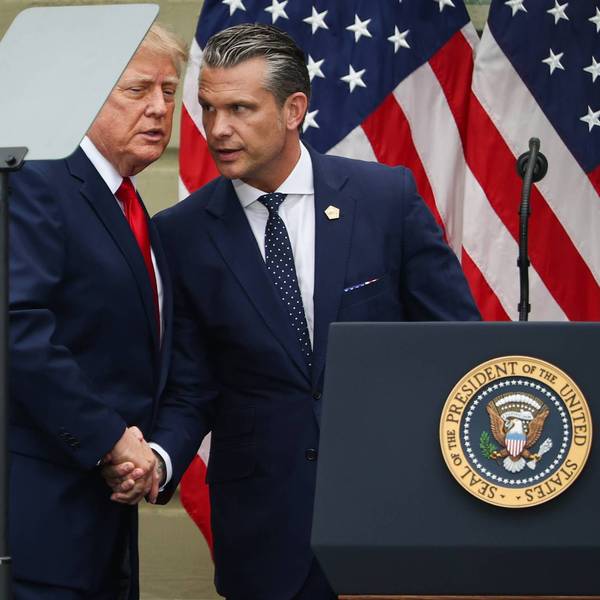
It is only fair to note, however, that even Friedman may have limits. He does not favor the “extreme Christian nationalist beliefs” of Pete Hegseth who prays “for US troops to deliver ‘overwhelming violence of action against those who deserve no mercy … in the mighty and powerful name of Jesus Christ.’” Friedman appears genuinely appalled by the Defense Secretary’s suggestion that “it’s now our religious warriors against Iran’s”—even as his writing continues to water the violent soil from which Hegseth grew.
This country and this world are at a monumental crossroads. US voters have an opportunity to beat back the forces of fascism and confront the billionaires who are rigging the economy, our media system, and our democracy, making it increasingly impossible for ordinary people to get by. We’re not just talking about the election. We’re talking about what must be done once these fascist elements are vanquished from power. We need a bolder set of solutions than what either major party has so far been willing to offer and a working-class movement ready to fight like hell for it. Trump didn't emerge from nowhere. The conditions that fueled MAGA authoritarianism were created by decades of radical neoliberal economic policies and a corrupt political system dominated by corporate interests. They slashed taxes on the super-rich, promising that the benefits would trickle down. They said giveaways to the corporate titans would make life more affordable for the rest of us. It was all bullshit. And when a bitter, betrayed populace searches for someone to blame, right-wing demagogues have little trouble finding scapegoats. People know when they're being lied to, but you won't hear any of this from the corporate media. Only independent journalism—powered and funded by people who believe in building a better world—can deliver truly trustworthy daily news. If you share our vision, please contribute whatever you can to sustain our work. |
Perhaps I haven’t up kept as well as I should, but I can’t recall New York Times columnist Thomas Friedman coming out with such a spectacularly bad idea for some time now. But he’s certainly broken that streak—if ever streak it was‚ with his article, "NATO, Please Help. Trump Has No Strategy for Iran," in which he calls upon NATO to “get all your navies together and proceed to the Persian Gulf immediately to join the American armada.” And just so’s we’re clear here, polling tells us that the attack on Iran is the first war to be rejected—not later on but from its outset–by the American public, since before the Second World War—perhaps the first in 100 years. And Friedman thinks Europe should sail right in.
"This does not come out of nowhere; Friedman does have a serious history of sh*t-talking, the highlight of which might be his appeal to “Give war a chance” during the 1999 NATO bombing of Serbia in the Kosovo War (one of our country’s “little wars” that no one is expected to recall outside of an Advanced Placement History class.) What kind of chance did he propose to give man’s oldest profession at that time? “It should be lights out in Belgrade,” he wrote, “every power grid, water pipe, bridge, road and war-related factory has to be targeted,” Whatever it took, so that no one would be “holding rock concerts in Belgrade, or going out for Sunday merry-go-round rides.”
It was understood, of course, that this advocacy of attacking civilian infrastructure—presumably including merry-go-rounds if need be—was legitimate if was done to “them.” If it were to be done to us it, would be called by its rightful name: terrorism—and you’d be able to read about that in a Friedman column. And, truth be told, this is the unspoken understanding underlying most public debate and discussion of our foreign policy—then and now—even if few choose to be quite so crude as Friedman.
But hey, Friedman didn’t last this long by not knowing just how stupid you’ve got to talk nowadays if you want to stand out for stupid during the second Trump administration. While allowing that “it would be a lot easier if either Trump or the Israeli prime minister, Benjamin Netanyahu, would ever summon the integrity to apologize for launching this war,” he quite reasonably assumes that this will never happen. So, he reasons, if you can’t stop a war, what’s the next best thing to do? Well, join it—of course.
Here we have the nation’s most prominent newspaper proffering this argument as worth an estimated 8 minutes and 11 seconds of your reading time.
Friedman does allow that “Trump sounds more and more unhinged every day,” but he writes as if it hasn’t occurred to him that the surest way to divert people from noticing the hinges coming off would be to legitimize his war. All justification would then be retroactive: Trump and Netanyahu would have played a vanguard role in starting a war that “the West” ultimately realized was a just war—otherwise, why would they come aboard?
Now if this were just someone on the bus or train talking about how the best way to stop stupid stuff from happening was by doing more of it, you’d just move away—if it wasn’t rush hour—and that’d likely be that. But unfortunately here we have the nation’s most prominent newspaper proffering this argument as worth an estimated 8 minutes and 11 seconds of your reading time. And really, the problem goes much deeper than just the New York Times. Three years after assuming the mantle of the anti-John Lennon with his endorsement of destroying Serbian civilian infrastructure, Friedman was awarded the Pulitzer Prize (one of three he’s won) for Commentary, cited "for his clarity of vision, based on extensive reporting, in commenting on the worldwide impact of the terrorist threat." If there were a Pulitzer for Irony, the Committee would have little choice but to award it to itself.
Such are the blinders shared throughout the American journalism profession—and well beyond. Barack Obama is reported to have consulted Friedman during his presidency—this despite Friedman’s ardent support of the Iraq War, during which he wrote, “There is a lot about the Bush team's foreign policy I don't like, but their willingness to... be as crazy as some of our enemies, is one thing they have right.” At the pinnacle of American power, neither “crazy,” nor supporting too many wars is disqualifying... as long as it’s happening to “them.”
It is only fair to note, however, that even Friedman may have limits. He does not favor the “extreme Christian nationalist beliefs” of Pete Hegseth who prays “for US troops to deliver ‘overwhelming violence of action against those who deserve no mercy … in the mighty and powerful name of Jesus Christ.’” Friedman appears genuinely appalled by the Defense Secretary’s suggestion that “it’s now our religious warriors against Iran’s”—even as his writing continues to water the violent soil from which Hegseth grew.