SUBSCRIBE TO OUR FREE NEWSLETTER
Daily news & progressive opinion—funded by the people, not the corporations—delivered straight to your inbox.
5
#000000
#FFFFFF
To donate by check, phone, or other method, see our More Ways to Give page.
Daily news & progressive opinion—funded by the people, not the corporations—delivered straight to your inbox.
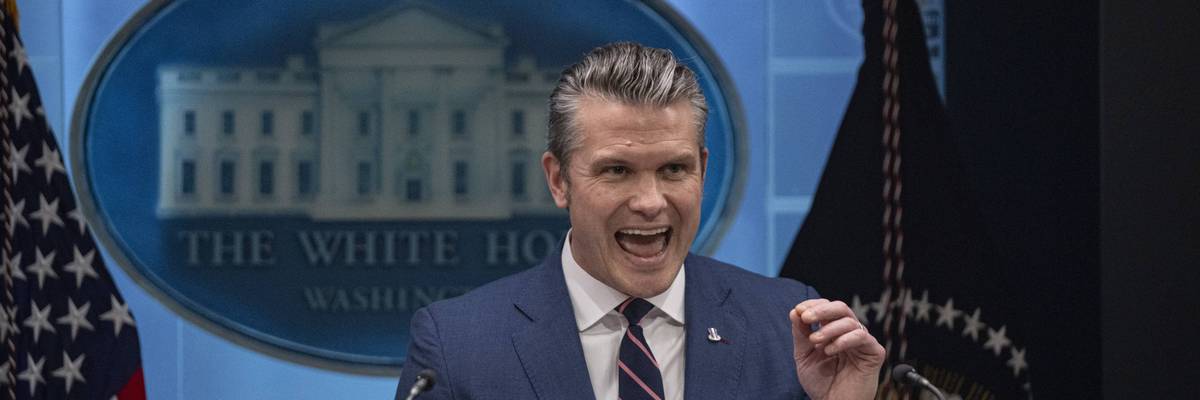
US Secretary of Defense Pete Hegseth speaks during a press conference held by President Donald Trump at the White House in Washington, DC on April 6, 2026.
"Republicans are out of excuses and should join Democrats and stop this war," said one congressional Democrat. "Let's put the pressure on."
Friday marks 60 days since President Donald Trump formally notified Congress of the US and Israel's illegal war on Iran—a key deadline under a relevant federal law. In a new notification obtained by Politico, the White House claimed the conflict has been "terminated," but lawmakers aren't buying that argument.
"That's bullshit," Senate Minority Leader Chuck Schumer (D-NY) said of the latest notification on social media. "This is an illegal war, and every day Republicans remain complicit and allow it to continue is another day lives are endangered, chaos erupts, and prices increase, all while Americans foot the bill."
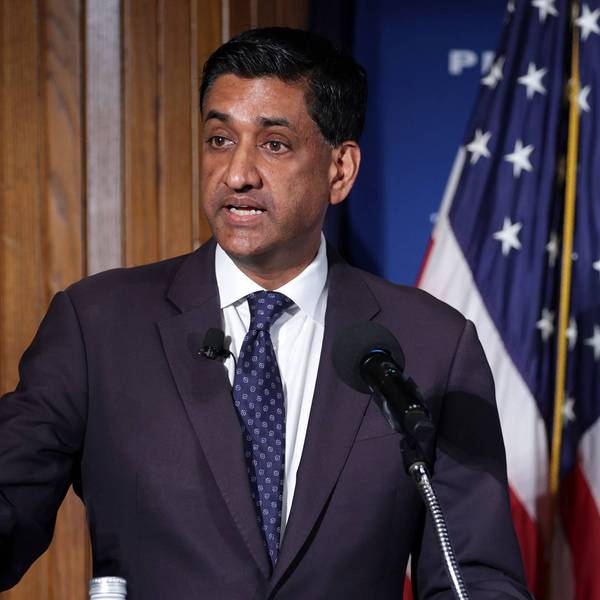
Congressman Ro Khanna (D-Calif.), who has fought to stop Trump's assault on Iran since before it began, told Common Dreams that "Trump knows this war is deeply unpopular with his base. He's trying to say it's over, but the reality is that thousands of US troops are still in the region, and food and gas prices are still going up at home."
The Republican president and some of his key allies had previewed the White House position in various remarks on Thursday.
"Look, the country's doing really well, and that's despite a military operation—I don't call it a war," Trump, a well-documented liar, told reporters in the Oval Office on Thursday. "Iran is dying to make a deal."
Since Trump began bombing Iran on February 28, legal experts and US lawmakers have alleged violations of international law and the Constitution, which empowers only Congress to declare war. However, both chambers are narrowly controlled by Republicans, nearly all of whom have refused to support Democratic war powers resolutions intended to end the conflict, most recently in the Senate on Thursday.
Defenders of Trump's so-called "Operation Epic Fury" argue that he was allowed to strike Iran under the War Powers Act of 1973, which empowers the president to deploy military forces for up to 60 days as long as he notifies Congress within 48 hours. After those two months, he is required to end hostilities or seek permission from federal lawmakers to continue them.
"He seems set against doing so," Tess Bridgeman and Oona A. Hathaway wrote Friday for Just Security. "If he refuses, he will take a war that is already doubly illegal and turn it into a triply illegal war. He will also make it clear, if it was not already, that he regards the law as no constraint on his use of the US military's lethal power."
On Thursday, as the latest Senate resolution was blocked in a 47-50 vote, Trump allies joined the president in suggesting that, as House Speaker Mike Johnson (R-La.) told NBC News in the Capitol, "We are not at war."
"I don't think we have an active, kinetic military bombing, firing, or anything like that. Right now, we are trying to broker a peace," Johnson said. "I would be very reluctant to get in front of the administration in the midst of these very sensitive negotiations, so we'll have to see how that plays out."
The US and Iran agreed to a two-week ceasefire on April 7, just hours after Trump's genocidal threat to wipe out the Middle Eastern country's "whole civilization." That truce has since been extended, but it and another deal for Israel's supposed targeting of Hezbollah in Lebanon are both "fragile, temporary, and in danger of collapse at any moment," as Amnesty International stressed in a Wednesday statement calling on the international community to push for sustainable peace in the region.
Throughout the ceasefire, Trump has maintained his naval blockade on Iran, which has responded to the war by closing the Strait of Hormuz to most ship traffic. Restrictions on the trade route have driven up fuel prices around the world, including across the United States, where new polling shows that over 60% of Americans say the president's war was a "mistake."
US Secretary of Defense Pete Hegseth cited the ceasefire on Thursday when questioned about how the administration plans to address the 60-day deadline by Sen. Tim Kaine (D-Va.)—a leading voice for war powers resolutions on Iran and other military aggression by the administration—during a Senate Armed Services Committee hearing.
Hegseth said that "ultimately, I would defer to the White House and White House counsel on that. However, we are in a ceasefire right now, which, [in] our understanding, means the 60-day clock pauses, or stops, in a ceasefire."
Interjecting, Kaine responded that "I do not believe the statute would support that. I think the 60 days runs maybe tomorrow, and it's gonna pose a really important legal question for the administration. We have serious constitutional concerns and we don't want to layer those with additional statutory concerns."
Before the notification to Congress on Friday, a senior Trump administration official had affirmed that what Hegseth laid out is the White House position, telling Reuters that the US military and Iran have not exchanged fire since April 7 and, for War Powers Act purposes, "the hostilities that began on Saturday, February 28, have terminated."
Highlighting Trump's ongoing blockade of Iran, US Rep. Mike Levin (D-Calif.) called Hegseth "flat wrong," and declared that the Pentagon chief "does not get to rewrite the law because following it is inconvenient."
Another California Democrat, Rep. Sara Jacobs, said on social media Thursday: "Trump's war on Iran was illegal from day one—Congress never authorized it. Tomorrow, the statutory 60-day clock runs out too. Republicans are out of excuses and should join Democrats and stop this war. Let's put the pressure on."
In a video released Friday, Rep. Don Beyer (D-Va.) noted his role in the Obama administration's Iran nuclear deal—which Trump ditched during his first term—and emphasized the president's "legal obligation to withdraw troops after 60 days, or come to Congress for authorization."
Democrats have vowed to keep introducing war powers resolutions. As one went down in the Senate on Thursday, Rep. Becca Balint (D-Vt.) introduced another in the House, following in the footsteps of other Congressional Progressive Caucus members.
"Americans don't even know why we are in this war, and neither does Congress," Balint said in a statement. "This unauthorized war is yet another example of the Trump administration's brazen and illegal attempts to consolidate power. At a time when Americans have told us everything is too expensive, it is shameful that we are wasting upwards of a billion dollars a day on this."
"We need it to end, to bring our service members back to safety, and to get Congress and this administration to focus on lowering the cost of living here at home," she added. "Today, I introduced a war powers resolution which would direct the president to stop the use of US armed forces in Iran unless explicitly authorized by a declaration of war from Congress. It is essential to hold every member of Congress accountable for allowing this war to continue and put them on record for the American people to see."
Nick Penniman, founder and CEO of the political reform group Issue One, took aim at federal lawmakers on Friday, declaring that "the American people should be deeply concerned by Congress' failure today. Since the war in Iran started, our country has spent more than $25 billion bombing military and civilian targets in Iran. Fourteen Americans have been killed, and more than 200 have been wounded. More than 3,000 Iranians have died—half of them civilians, and many of them children. The stakes are profound, which is why Congress should be making such decisions, not just one man in the Oval Office."
"Yet, in defiance of the Constitution, too many in Congress bow to the President. In missing the 60-day deadline to assert constitutional authority, Congress has totally failed in its most fundamental role as the first branch of government," he continued. "The precedent set today is deeply harmful to American democracy. When the president acting alone becomes normalized, it becomes more difficult to have a government of, by, and for the people."
"The founders were very clear that Congress, not the executive, has the final say when it comes to war and peace," he concluded. "This can't go on. Congress must approve all future funding for the war with Iran. Moving forward, Congress has to reassert its power in deciding when and how our country enters war. In order to do that, Congress should update the 1973 War Powers Resolution to reassert constitutional checks and balances to protect future generations of Americans."
This article has been updated to include the White House's new notification to Congress claiming the Iran War has been "terminated" plus comment from Issue One, Senate Minority Leader Chuck Schumer, and Congressman Ro Khanna.
Dear Common Dreams reader, It’s been nearly 30 years since I co-founded Common Dreams with my late wife, Lina Newhouser. We had the radical notion that journalism should serve the public good, not corporate profits. It was clear to us from the outset what it would take to build such a project. No paid advertisements. No corporate sponsors. No millionaire publisher telling us what to think or do. Many people said we wouldn't last a year, but we proved those doubters wrong. Together with a tremendous team of journalists and dedicated staff, we built an independent media outlet free from the constraints of profits and corporate control. Our mission has always been simple: To inform. To inspire. To ignite change for the common good. Building Common Dreams was not easy. Our survival was never guaranteed. When you take on the most powerful forces—Wall Street greed, fossil fuel industry destruction, Big Tech lobbyists, and uber-rich oligarchs who have spent billions upon billions rigging the economy and democracy in their favor—the only bulwark you have is supporters who believe in your work. But here’s the urgent message from me today. It's never been this bad out there. And it's never been this hard to keep us going. At the very moment Common Dreams is most needed, the threats we face are intensifying. We need your support now more than ever. We don't accept corporate advertising and never will. We don't have a paywall because we don't think people should be blocked from critical news based on their ability to pay. Everything we do is funded by the donations of readers like you. When everyone does the little they can afford, we are strong. But if that support retreats or dries up, so do we. Will you donate now to make sure Common Dreams not only survives but thrives? —Craig Brown, Co-founder |
Friday marks 60 days since President Donald Trump formally notified Congress of the US and Israel's illegal war on Iran—a key deadline under a relevant federal law. In a new notification obtained by Politico, the White House claimed the conflict has been "terminated," but lawmakers aren't buying that argument.
"That's bullshit," Senate Minority Leader Chuck Schumer (D-NY) said of the latest notification on social media. "This is an illegal war, and every day Republicans remain complicit and allow it to continue is another day lives are endangered, chaos erupts, and prices increase, all while Americans foot the bill."
Congressman Ro Khanna (D-Calif.), who has fought to stop Trump's assault on Iran since before it began, told Common Dreams that "Trump knows this war is deeply unpopular with his base. He's trying to say it's over, but the reality is that thousands of US troops are still in the region, and food and gas prices are still going up at home."
The Republican president and some of his key allies had previewed the White House position in various remarks on Thursday.
"Look, the country's doing really well, and that's despite a military operation—I don't call it a war," Trump, a well-documented liar, told reporters in the Oval Office on Thursday. "Iran is dying to make a deal."
Since Trump began bombing Iran on February 28, legal experts and US lawmakers have alleged violations of international law and the Constitution, which empowers only Congress to declare war. However, both chambers are narrowly controlled by Republicans, nearly all of whom have refused to support Democratic war powers resolutions intended to end the conflict, most recently in the Senate on Thursday.
Defenders of Trump's so-called "Operation Epic Fury" argue that he was allowed to strike Iran under the War Powers Act of 1973, which empowers the president to deploy military forces for up to 60 days as long as he notifies Congress within 48 hours. After those two months, he is required to end hostilities or seek permission from federal lawmakers to continue them.
"He seems set against doing so," Tess Bridgeman and Oona A. Hathaway wrote Friday for Just Security. "If he refuses, he will take a war that is already doubly illegal and turn it into a triply illegal war. He will also make it clear, if it was not already, that he regards the law as no constraint on his use of the US military's lethal power."
On Thursday, as the latest Senate resolution was blocked in a 47-50 vote, Trump allies joined the president in suggesting that, as House Speaker Mike Johnson (R-La.) told NBC News in the Capitol, "We are not at war."
"I don't think we have an active, kinetic military bombing, firing, or anything like that. Right now, we are trying to broker a peace," Johnson said. "I would be very reluctant to get in front of the administration in the midst of these very sensitive negotiations, so we'll have to see how that plays out."
The US and Iran agreed to a two-week ceasefire on April 7, just hours after Trump's genocidal threat to wipe out the Middle Eastern country's "whole civilization." That truce has since been extended, but it and another deal for Israel's supposed targeting of Hezbollah in Lebanon are both "fragile, temporary, and in danger of collapse at any moment," as Amnesty International stressed in a Wednesday statement calling on the international community to push for sustainable peace in the region.
Throughout the ceasefire, Trump has maintained his naval blockade on Iran, which has responded to the war by closing the Strait of Hormuz to most ship traffic. Restrictions on the trade route have driven up fuel prices around the world, including across the United States, where new polling shows that over 60% of Americans say the president's war was a "mistake."
US Secretary of Defense Pete Hegseth cited the ceasefire on Thursday when questioned about how the administration plans to address the 60-day deadline by Sen. Tim Kaine (D-Va.)—a leading voice for war powers resolutions on Iran and other military aggression by the administration—during a Senate Armed Services Committee hearing.
Hegseth said that "ultimately, I would defer to the White House and White House counsel on that. However, we are in a ceasefire right now, which, [in] our understanding, means the 60-day clock pauses, or stops, in a ceasefire."
Interjecting, Kaine responded that "I do not believe the statute would support that. I think the 60 days runs maybe tomorrow, and it's gonna pose a really important legal question for the administration. We have serious constitutional concerns and we don't want to layer those with additional statutory concerns."
Before the notification to Congress on Friday, a senior Trump administration official had affirmed that what Hegseth laid out is the White House position, telling Reuters that the US military and Iran have not exchanged fire since April 7 and, for War Powers Act purposes, "the hostilities that began on Saturday, February 28, have terminated."
Highlighting Trump's ongoing blockade of Iran, US Rep. Mike Levin (D-Calif.) called Hegseth "flat wrong," and declared that the Pentagon chief "does not get to rewrite the law because following it is inconvenient."
Another California Democrat, Rep. Sara Jacobs, said on social media Thursday: "Trump's war on Iran was illegal from day one—Congress never authorized it. Tomorrow, the statutory 60-day clock runs out too. Republicans are out of excuses and should join Democrats and stop this war. Let's put the pressure on."
In a video released Friday, Rep. Don Beyer (D-Va.) noted his role in the Obama administration's Iran nuclear deal—which Trump ditched during his first term—and emphasized the president's "legal obligation to withdraw troops after 60 days, or come to Congress for authorization."
Democrats have vowed to keep introducing war powers resolutions. As one went down in the Senate on Thursday, Rep. Becca Balint (D-Vt.) introduced another in the House, following in the footsteps of other Congressional Progressive Caucus members.
"Americans don't even know why we are in this war, and neither does Congress," Balint said in a statement. "This unauthorized war is yet another example of the Trump administration's brazen and illegal attempts to consolidate power. At a time when Americans have told us everything is too expensive, it is shameful that we are wasting upwards of a billion dollars a day on this."
"We need it to end, to bring our service members back to safety, and to get Congress and this administration to focus on lowering the cost of living here at home," she added. "Today, I introduced a war powers resolution which would direct the president to stop the use of US armed forces in Iran unless explicitly authorized by a declaration of war from Congress. It is essential to hold every member of Congress accountable for allowing this war to continue and put them on record for the American people to see."
Nick Penniman, founder and CEO of the political reform group Issue One, took aim at federal lawmakers on Friday, declaring that "the American people should be deeply concerned by Congress' failure today. Since the war in Iran started, our country has spent more than $25 billion bombing military and civilian targets in Iran. Fourteen Americans have been killed, and more than 200 have been wounded. More than 3,000 Iranians have died—half of them civilians, and many of them children. The stakes are profound, which is why Congress should be making such decisions, not just one man in the Oval Office."
"Yet, in defiance of the Constitution, too many in Congress bow to the President. In missing the 60-day deadline to assert constitutional authority, Congress has totally failed in its most fundamental role as the first branch of government," he continued. "The precedent set today is deeply harmful to American democracy. When the president acting alone becomes normalized, it becomes more difficult to have a government of, by, and for the people."
"The founders were very clear that Congress, not the executive, has the final say when it comes to war and peace," he concluded. "This can't go on. Congress must approve all future funding for the war with Iran. Moving forward, Congress has to reassert its power in deciding when and how our country enters war. In order to do that, Congress should update the 1973 War Powers Resolution to reassert constitutional checks and balances to protect future generations of Americans."
This article has been updated to include the White House's new notification to Congress claiming the Iran War has been "terminated" plus comment from Issue One, Senate Minority Leader Chuck Schumer, and Congressman Ro Khanna.
Friday marks 60 days since President Donald Trump formally notified Congress of the US and Israel's illegal war on Iran—a key deadline under a relevant federal law. In a new notification obtained by Politico, the White House claimed the conflict has been "terminated," but lawmakers aren't buying that argument.
"That's bullshit," Senate Minority Leader Chuck Schumer (D-NY) said of the latest notification on social media. "This is an illegal war, and every day Republicans remain complicit and allow it to continue is another day lives are endangered, chaos erupts, and prices increase, all while Americans foot the bill."
Congressman Ro Khanna (D-Calif.), who has fought to stop Trump's assault on Iran since before it began, told Common Dreams that "Trump knows this war is deeply unpopular with his base. He's trying to say it's over, but the reality is that thousands of US troops are still in the region, and food and gas prices are still going up at home."
The Republican president and some of his key allies had previewed the White House position in various remarks on Thursday.
"Look, the country's doing really well, and that's despite a military operation—I don't call it a war," Trump, a well-documented liar, told reporters in the Oval Office on Thursday. "Iran is dying to make a deal."
Since Trump began bombing Iran on February 28, legal experts and US lawmakers have alleged violations of international law and the Constitution, which empowers only Congress to declare war. However, both chambers are narrowly controlled by Republicans, nearly all of whom have refused to support Democratic war powers resolutions intended to end the conflict, most recently in the Senate on Thursday.
Defenders of Trump's so-called "Operation Epic Fury" argue that he was allowed to strike Iran under the War Powers Act of 1973, which empowers the president to deploy military forces for up to 60 days as long as he notifies Congress within 48 hours. After those two months, he is required to end hostilities or seek permission from federal lawmakers to continue them.
"He seems set against doing so," Tess Bridgeman and Oona A. Hathaway wrote Friday for Just Security. "If he refuses, he will take a war that is already doubly illegal and turn it into a triply illegal war. He will also make it clear, if it was not already, that he regards the law as no constraint on his use of the US military's lethal power."
On Thursday, as the latest Senate resolution was blocked in a 47-50 vote, Trump allies joined the president in suggesting that, as House Speaker Mike Johnson (R-La.) told NBC News in the Capitol, "We are not at war."
"I don't think we have an active, kinetic military bombing, firing, or anything like that. Right now, we are trying to broker a peace," Johnson said. "I would be very reluctant to get in front of the administration in the midst of these very sensitive negotiations, so we'll have to see how that plays out."
The US and Iran agreed to a two-week ceasefire on April 7, just hours after Trump's genocidal threat to wipe out the Middle Eastern country's "whole civilization." That truce has since been extended, but it and another deal for Israel's supposed targeting of Hezbollah in Lebanon are both "fragile, temporary, and in danger of collapse at any moment," as Amnesty International stressed in a Wednesday statement calling on the international community to push for sustainable peace in the region.
Throughout the ceasefire, Trump has maintained his naval blockade on Iran, which has responded to the war by closing the Strait of Hormuz to most ship traffic. Restrictions on the trade route have driven up fuel prices around the world, including across the United States, where new polling shows that over 60% of Americans say the president's war was a "mistake."
US Secretary of Defense Pete Hegseth cited the ceasefire on Thursday when questioned about how the administration plans to address the 60-day deadline by Sen. Tim Kaine (D-Va.)—a leading voice for war powers resolutions on Iran and other military aggression by the administration—during a Senate Armed Services Committee hearing.
Hegseth said that "ultimately, I would defer to the White House and White House counsel on that. However, we are in a ceasefire right now, which, [in] our understanding, means the 60-day clock pauses, or stops, in a ceasefire."
Interjecting, Kaine responded that "I do not believe the statute would support that. I think the 60 days runs maybe tomorrow, and it's gonna pose a really important legal question for the administration. We have serious constitutional concerns and we don't want to layer those with additional statutory concerns."
Before the notification to Congress on Friday, a senior Trump administration official had affirmed that what Hegseth laid out is the White House position, telling Reuters that the US military and Iran have not exchanged fire since April 7 and, for War Powers Act purposes, "the hostilities that began on Saturday, February 28, have terminated."
Highlighting Trump's ongoing blockade of Iran, US Rep. Mike Levin (D-Calif.) called Hegseth "flat wrong," and declared that the Pentagon chief "does not get to rewrite the law because following it is inconvenient."
Another California Democrat, Rep. Sara Jacobs, said on social media Thursday: "Trump's war on Iran was illegal from day one—Congress never authorized it. Tomorrow, the statutory 60-day clock runs out too. Republicans are out of excuses and should join Democrats and stop this war. Let's put the pressure on."
In a video released Friday, Rep. Don Beyer (D-Va.) noted his role in the Obama administration's Iran nuclear deal—which Trump ditched during his first term—and emphasized the president's "legal obligation to withdraw troops after 60 days, or come to Congress for authorization."
Democrats have vowed to keep introducing war powers resolutions. As one went down in the Senate on Thursday, Rep. Becca Balint (D-Vt.) introduced another in the House, following in the footsteps of other Congressional Progressive Caucus members.
"Americans don't even know why we are in this war, and neither does Congress," Balint said in a statement. "This unauthorized war is yet another example of the Trump administration's brazen and illegal attempts to consolidate power. At a time when Americans have told us everything is too expensive, it is shameful that we are wasting upwards of a billion dollars a day on this."
"We need it to end, to bring our service members back to safety, and to get Congress and this administration to focus on lowering the cost of living here at home," she added. "Today, I introduced a war powers resolution which would direct the president to stop the use of US armed forces in Iran unless explicitly authorized by a declaration of war from Congress. It is essential to hold every member of Congress accountable for allowing this war to continue and put them on record for the American people to see."
Nick Penniman, founder and CEO of the political reform group Issue One, took aim at federal lawmakers on Friday, declaring that "the American people should be deeply concerned by Congress' failure today. Since the war in Iran started, our country has spent more than $25 billion bombing military and civilian targets in Iran. Fourteen Americans have been killed, and more than 200 have been wounded. More than 3,000 Iranians have died—half of them civilians, and many of them children. The stakes are profound, which is why Congress should be making such decisions, not just one man in the Oval Office."
"Yet, in defiance of the Constitution, too many in Congress bow to the President. In missing the 60-day deadline to assert constitutional authority, Congress has totally failed in its most fundamental role as the first branch of government," he continued. "The precedent set today is deeply harmful to American democracy. When the president acting alone becomes normalized, it becomes more difficult to have a government of, by, and for the people."
"The founders were very clear that Congress, not the executive, has the final say when it comes to war and peace," he concluded. "This can't go on. Congress must approve all future funding for the war with Iran. Moving forward, Congress has to reassert its power in deciding when and how our country enters war. In order to do that, Congress should update the 1973 War Powers Resolution to reassert constitutional checks and balances to protect future generations of Americans."
This article has been updated to include the White House's new notification to Congress claiming the Iran War has been "terminated" plus comment from Issue One, Senate Minority Leader Chuck Schumer, and Congressman Ro Khanna.