

SUBSCRIBE TO OUR FREE NEWSLETTER
Daily news & progressive opinion—funded by the people, not the corporations—delivered straight to your inbox.
5
#000000
#FFFFFF
To donate by check, phone, or other method, see our More Ways to Give page.
Daily news & progressive opinion—funded by the people, not the corporations—delivered straight to your inbox.

Greenpeace and 18 Japanese NGOs called on the Japanese government to end its unprofitable whaling operations and refocus on domestic priorities as the factory ship of the country's so-called 'scientific' whaling fleet departed for the Antarctic from Innoshima port on Thursday.
Last year more than 1.8 billon yen was diverted from the recovery fund set up after the tragic March 2011 earthquake and resulting tsunami and used to pay the debts of the whaling industry instead of being used for disaster relief efforts.
Greenpeace and 18 Japanese NGOs called on the Japanese government to end its unprofitable whaling operations and refocus on domestic priorities as the factory ship of the country's so-called 'scientific' whaling fleet departed for the Antarctic from Innoshima port on Thursday.
Last year more than 1.8 billon yen was diverted from the recovery fund set up after the tragic March 2011 earthquake and resulting tsunami and used to pay the debts of the whaling industry instead of being used for disaster relief efforts.
A new Greenpeace International report released today, 'Scientific' Whaling: A Sea Change, details the shameful increased financial support given to the loss-making whaling operations, money that could have been better spent helping the communities devastated by the 2011 disaster.
"Demand has plunged to record lows and the industry has two years worth of frozen whale meat in storage that it is already struggling to sell," said Junichi Sato, Greenpeace Japan Executive Director. "The whalers cannot catch their way out of debt because of the weak market and have been reducing the scale of the hunt for the past few years to stop the stockpiles from getting any bigger." (1)
The Greenpeace briefing sheds light on a financial arrangement through which a body under the Fisheries Agency of Japan (FAJ) will subsidise up to 90% of the whaling fleet's deficit for the next three years.
The so-called Profitable Fisheries Support Project is meant to assist struggling fishing communities, but political deal-making has helped secure a deal for these funds to maintain Japan's Antarctic whaling.
"Sales of whale meat do not even cover a fraction of crew wages, let alone the fuel and other costs of running the programme," said Sato. "The whaling industry is simply dead in the water and only limps on due to it being effectively nationalised and bailed out with misappropriated taxpayer money."
Japan's Institute for Cetacean Research (ICR) has also been granted a government loan to refurbish the whaling fleet's factory processing ship Nisshin Maru to keep her afloat for another 10 years despite the clear decline for industry support at home and abroad.
"Earlier this month the government of South Korea cancelled its plans to begin a whaling programme similar to Japan's - proving once again that commercial whaling is finished," added Sato. "The loans being given to the industry will never be paid back. It is a black hole for taxpayer money. The Japanese government must remove the blinders, save face and begin repairing its international reputation by ending these whaling charades once and for all."
Greenpeace is an independent global campaigning organisation that acts to change attitudes and behaviour, to protect and conserve the environment, and to promote peace. Greenpeace is opposed to commercial whaling in all of the world's oceans.
CONTACT:
Junichi Sato, Greenpeace Japan International Executive Director (in Tokyo) +81 80 3694 2843 (mobile) or junichi.sato@greenpeace.org
John Frizell, Greenpeace International oceans campaigner (in the UK) +44 7801 212 999 (mobile) or john.frizell@greenpeace.org
Steve Smith, Greenpeace International communications (in Amsterdam) +31 643 787 359 (mobile) or steve.smith@greenpeace.org
NOTES:
1) Greenpeace Report: "Scientific" whaling - a sea change: https://www.greenpeace.org/international/whalingfleet2012
Greenpeace is a global, independent campaigning organization that uses peaceful protest and creative communication to expose global environmental problems and promote solutions that are essential to a green and peaceful future.
+31 20 718 2000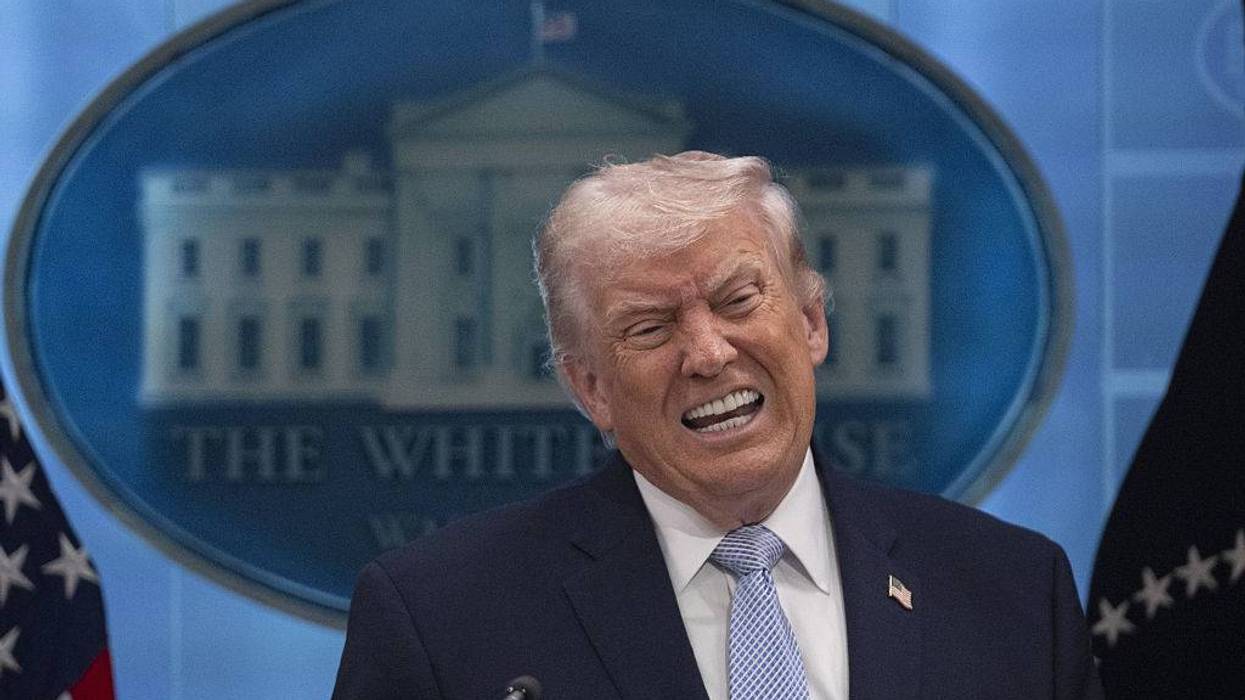
As inflation has wiped out wage growth, 53% of voters said they were worse off financially than when Trump took office, including nearly a quarter of Republicans.
President Donald Trump's approval rating has hit a new low as the majority of Americans—including many of his own voters—now say they are economically worse off under his second administration.
In a Reuters/Ipsos poll released Monday, just 33% of Americans said they approved of Trump's performance in the White House, while 64% disapproved, a drop from 35% approval earlier in the month. They're the worst marks he's received during this term and are tied with his worst ever, which came in December 2017.
Trump's nadir comes as a majority of Americans say their finances have gotten worse since he came to power. In a Financial Times poll released on Sunday, more than 53% of registered voters said they were worse off since January 2025. This includes 57% of independents, but also nearly a quarter of Republicans.
Voters' economic angst aligns with what the metrics show. After hitting a three-year peak of 4.2% in May, inflation was still higher in July than it was when Trump took office, at 3.4%. Real wages declined as hourly pay failed to keep up with inflation, and the economy shed 23,000 jobs last month.
Trump responded to this bleak report by celebrating that the economy was "doing unbelievably from the standpoint of Wall Street," with the stock market continuing to soar.
The pocketbook issues faced by many Americans have been made worse by Trump's war with Iran, which has caused oil prices to spike, triggering a surge in gasoline prices and inflation that has rippled throughout the economy.
The war began unpopular and has only grown more so as the conflict, which Trump said would be over in weeks, approaches its sixth month. In a Reuters poll released in late July, only about a third of Americans said they supported it.
After backing out of a peace agreement earlier this summer, Trump has doubled down on the war in recent weeks. Americans, regardless of party, are now overwhelmingly doubtful that it will end any time soon.
Among all adults, 4 in 5 said they believed the war would "go on for a long time." This includes 80% of independents, but also 71% of Republicans. Across all parties, just 16% said they believed the war would "end in a matter of weeks."
There are increasing signs that even Trump's core base is beginning to sour on him. An Economist/YouGov poll out last week showed that his overall approval among GOP voters had fallen to a second-term low of 79%.
Even more concerning for him is a decline in enthusiasm among supporters: Where 68% said they "strongly approve" of Trump near the start of his term, just 48% now feel that way.
Democratic voters, meanwhile, appear fired up as November approaches. A Washington Post/Ipsos poll from July showed that Democrats have a 10-point advantage over the GOP among those who say they are certain to vote.
"In a diverse public school environment, all students should be treated with equal respect, regardless of their religious beliefs, or lack thereof," said one plaintiff.
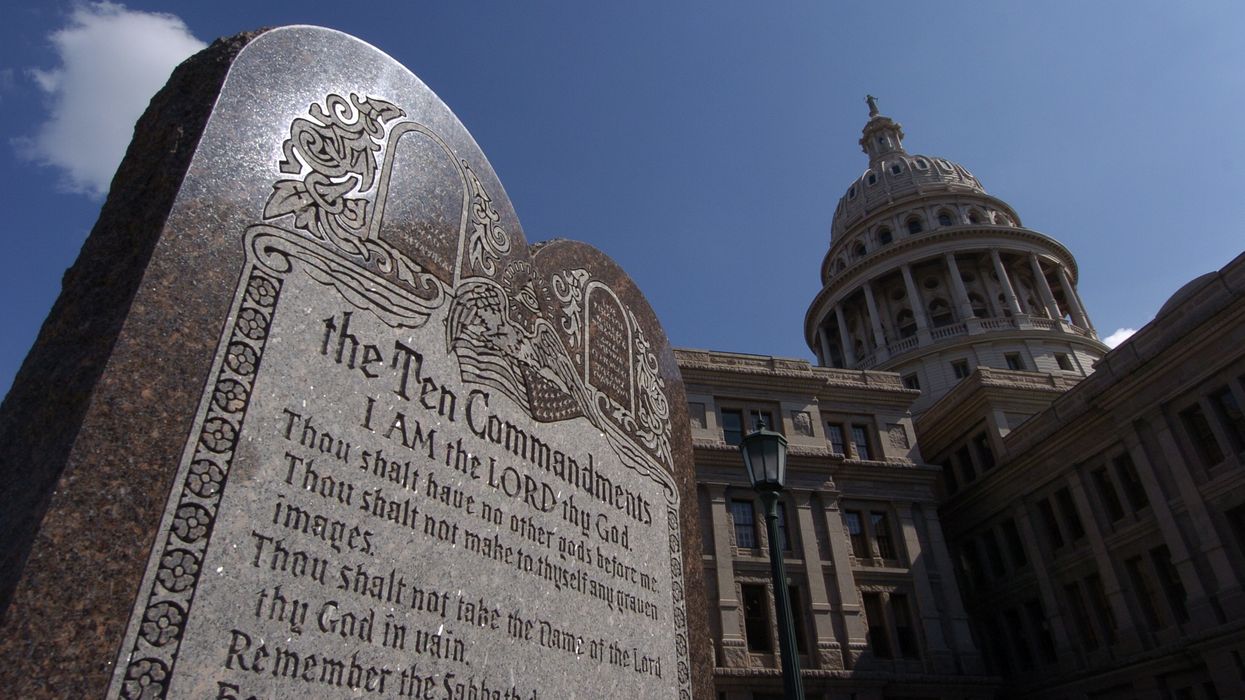
A group of families is asking the US Supreme Court to strike down Texas Senate Bill 10, a state law mandating that a copy of the Ten Commandments be displayed in public school classrooms.
The families, who come from a variety of religious denominations and are being represented by several prominent civil liberties groups, argued in a Monday court filing that SB 10 violates the First Amendment of the US Constitution because it "imposes on public school children, for nearly every hour they are in school, the state's favored scripture."
In making their case, the families argued that a recent appeals court ruling upholding the Texas law ran afoul of multiple past Supreme Court rulings, including the 2022 ruling in Kennedy v. Bremerton School District, which made reference to "problematically coercive" religious messages being "publicly broadcast or recited to a captive audience," and the 1980 ruling in Stone v. Graham, which determined that posting the Ten Commandments in schools violates the Constitution's establishment clause.
Rabbi Joshua Fixler, a plaintiff in the case, said the Texas Ten Commandments law made him "not only worried about my own kids," but "deeply concerned about all the children in my congregation."
"These displays put children in the position of having to defend themselves and their families’ religious beliefs," said Fixler, "against a government mandate that makes them feel different and separate from their classmates."
Fellow plaintiff Nichole Manning, an atheist from Dallas, argued that the Texas law is "interfering with our family’s decisions about how our children engage with religion."
“As a parent, I intentionally choose to have my children attend public school because I prefer an educational environment without any religious affiliation," Manning emphasized. "In a diverse public school environment, all students should be treated with equal respect, regardless of their religious beliefs, or lack thereof."
In an editorial published in the Houston Chronicle on Monday, plaintiff Audrey Nath said that the Texas law was interfering with her right to raise her children to "celebrate the diversity of religious faiths in our families: Hinduism, Jainism, Judaism, and Quakerism."
"My 9-year-old son is proud of his heritage, and he even brought that statue of Shiva to his public school as part of a presentation about his family history," Nath explained. "SB 10 puts a permanent, state-mandated sign above his desk telling him what he carried in is forbidden."
ACLU of Texas staff attorney Chloe Kempf, who is co-representing the families, said that past legal precedents give the current Supreme Court a clear roadmap to overturn the Texas law.
"The US Supreme Court has rejected this kind of government-imposed religion before, and it should do so again,” said Kempf. “Having these posters in Texas classrooms puts students at risk of bullying, stigmatization, and religious coercion. Our nation’s bedrock principle of separating church and state means that families and faith communities—not politicians—get to decide what role religion plays in children’s lives."
Annie Laurie Gaylor, co-president of the Freedom From Religion Foundation, argued that mandating schools display the First Commandment alone is "the antithesis of our First Amendment" because it dictates "which god must be worshipped."
"It is not the government’s role to daily expose young children to a coercive display of one religion’s set of religious edicts in our public schools," Gaylor emphasized. "Our public schools exist to educate, not to proselytize."
Trump campaigned on fixing the affordability crisis but defends high gas prices as the cost of preventing Iran from building nuclear weapons that his own administration said Tehran is not trying to build.
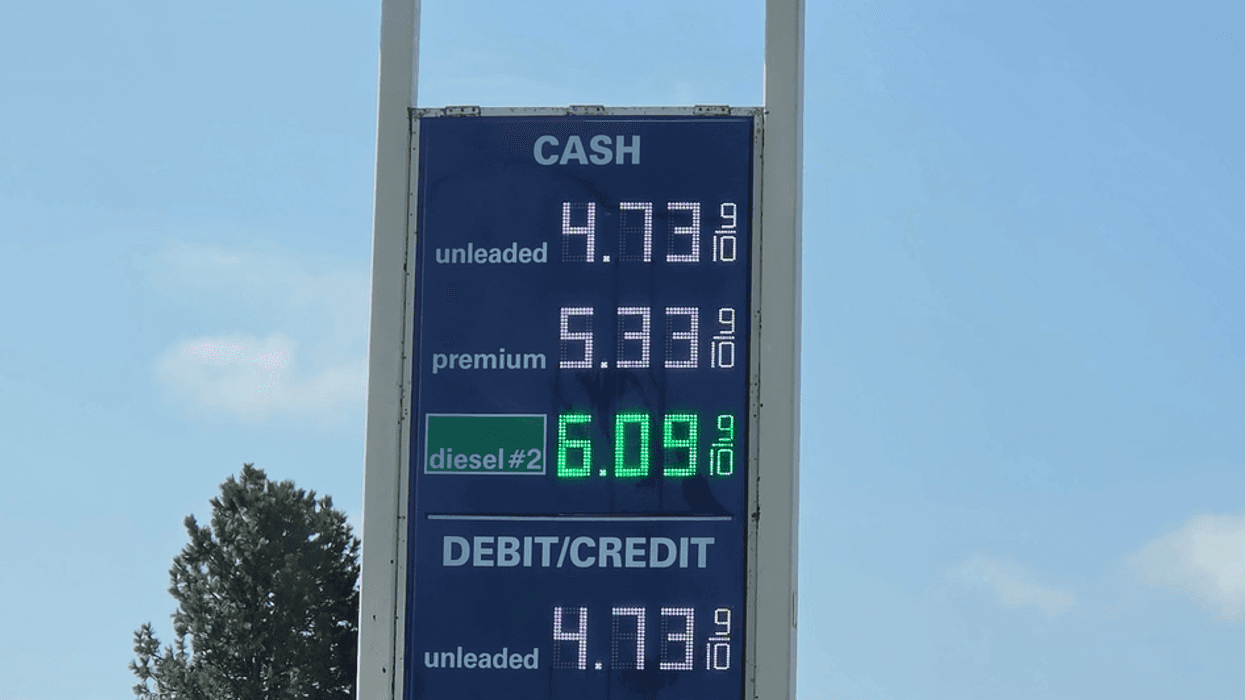
The American Automobile Association reported Monday that drivers are paying more at the pump than ever before for this point in August as President Donald Trump's war on Iran continues to disrupt global energy supplies—and he says he won't apologize for the pain his illegal war of choice is inflicting upon consumers.
AAA said the national average price for a gallon of regular gasoline stood at $4.06 on Monday, more than 92 cents higher than a year ago and double the $1.85 recently promised by Trump. The price is the highest ever recorded for mid-August, according to GasBuddy petroleum analyst Patrick De Haan. In California and Hawaii, average prices are approaching—or exceeding—$5.40 per gallon.
The record gas prices come amid the protracted US-Israeli war on Iran that has killed thousands of people and severely disrupted shipping through the Strait of Hormuz, a crucial global energy artery through which roughly one-fifth of the world’s oil and liquefied natural gas supplies normally pass. According to Reuters, only five vessels traversed the strait Saturday, and none did so Sunday. Brent crude was trading near $89 per barrel on Monday, while West Texas Intermediate was above $82.
While Trump has said the war is "over" or nearly over dozens of times—The Guardian's Robert Tait recently called the recurrent spectacle his "own Groundhog Day"—Iran currently appears to have the upper hand, as shipping has overwhelmingly avoided the US-supported route through the Strait of Hormuz, with most vessels using a course set by Tehran or eschewing the waterway altogether.
The Guardian reported Monday that US households have collectively spent an additional $56.4 billion on gasoline over the past six months—an average of roughly $477 per home. Meanwhile, major oil companies raked in a combined $90 billion in profits during the second quarter.
Trump, who campaigned on promises to tackle the affordability crisis, has repeatedly defended high gas prices as the cost of preventing Iran from developing nuclear weapons that every administration since George W. Bush's—including his own—has said Tehran is not seeking to build.
"For you to pay a tiny little bit more for your gasoline, just remember, you're doing it so that a very evil country cannot have... a nuclear weapon," Trump said Friday during a speech to law enforcement officers in Garden City, New York.
"So remember that when you have to pay a little bit more, you're at $4; it's OK... I'll never apologize, I did the right thing," the president added to raucous applause.
Critics slammed Trump's remarks, with Congresswoman Shontel Brown (D-Ohio) noting on Monday that, while "Trump’s family got rich off of his failed war," the American people—including his own supporters—"got screwed."
"Now he wants to us to smile and accept the higher prices he caused," she added.
The Trump administration has over 10 times as many of these super-rich appointees as the Biden, Obama, and George W. Bush administrations.
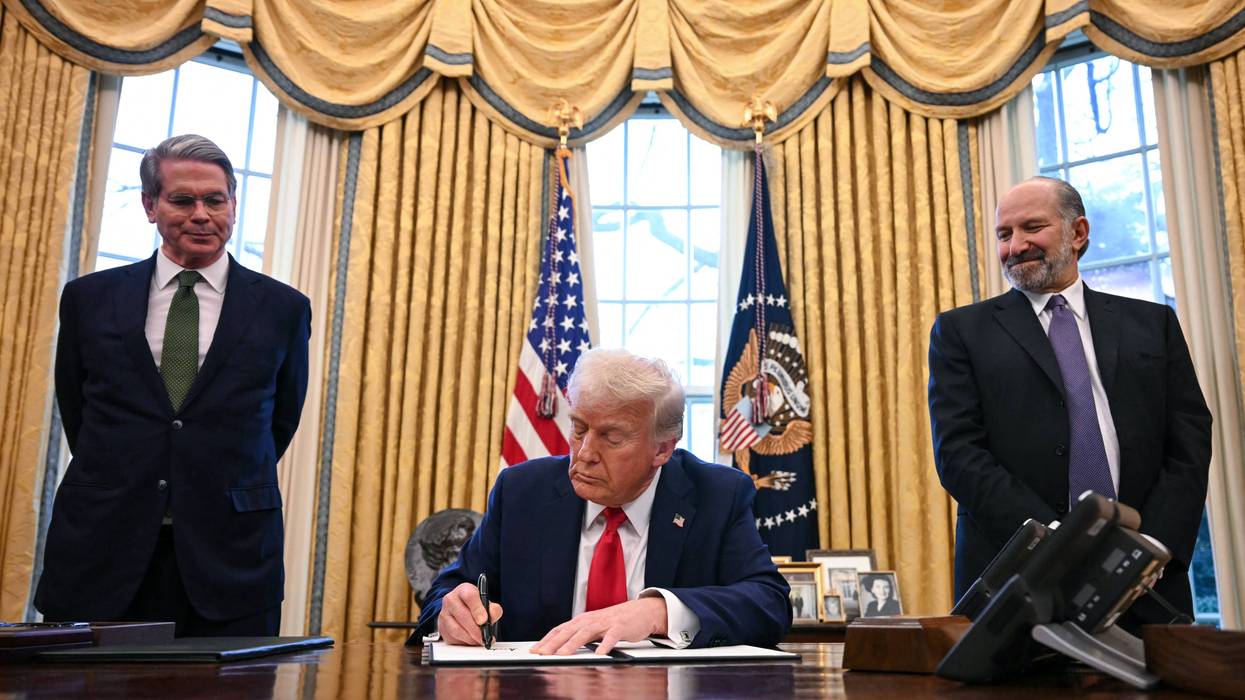
President Donald Trump has created a government "of the rich, by the rich, for the rich."
That's what Sen. Bernie Sanders (I-Vt.) said on Monday following the release of a report demonstrating how the president has handed the reins of power over to the ultra-wealthy on an unprecedented scale.
The analysis by the watchdog group Public Citizen found that 57 officials working for the Trump administration are worth over $100 million, while eight of them are worth a billion or more.
Seventeen of them are ambassadors, while the other 40 occupy senior posts, including over a third of Cabinet positions. More than half of them were donors to Trump’s 2024 presidential campaign, giving a combined $65 million in campaign contributions to him or his associated political committees.
The tally does not include Trump himself, who has seen his family's wealth explode by over $2 billion, mostly from his cryptocurrency venture, since returning to power. His net worth is now estimated by Forbes to be about $6.2 billion.
The ultra-rich officials include Education Secretary Linda McMahon, the wife of former World Wrestling Entertainment (WWE) CEO Vince McMahon, who has little experience working in education but is worth between $413 million and $1.3 billion and has spent over $20 million supporting Trump; Commerce Secretary Howard Lutnick, who is worth at least $723 million and spent over $9 million to back the president; and Treasury Secretary Scott Bessent, who spent about $1.15 million in 2024 supporting Trump.
The Trump administration has more than 10 times as many "ultra-millionaires" as previous administrations, the report found. The Biden administration had just five members with over $100 million; the Obama administration had three, and the George W. Bush administration had five.
"The enormous wealth of Trump administration officials raises questions about whether they are driven by their sweeping personal financial interests or the interests of the American public at large, which they have an obligation to serve," writes its author, Doug Pasternak, the head of Public Citizen's Trump Accountability Project.
Since returning to office in January 2025, Trump has not only employed the super-rich but has also enacted a slate of policies benefiting them.
The administration has facilitated what has been described as the largest upward transfer of wealth in US history, with over $1 trillion in tax cuts for the top 1% paid for by brutal cuts to programs that benefit the poorest Americans, like Medicaid and the Supplemental Nutrition Assistance Program (SNAP).
On top of this, he has gutted the Consumer Financial Protection Bureau, which protected Americans against abuse by powerful financial institutions, and enacted sweeping deregulation of cryptocurrencies. His Labor Department has systematically dismantled worker protections while he’s stripped collective bargaining rights from over 1 million federal employees.
The report also notes that many of Trump's wealthy appointees retain financial ties to companies or industries directly affected by the agencies they now control, creating significant potential conflicts of interest.
Lutnick's Commerce Department, for example, has a role in regulating the financial services firm Cantor Fitzgerald, which is now controlled by his sons and was chosen to handle a $1.5 billion stock offering tied to a mining company receiving federal support from the department. Deputy Defense Secretary Stephen Feinberg’s former firm, Cerberus, meanwhile, owns companies that have received at least $90 million in Pentagon investments and contracts.
"When the people holding the reins of government are drawn overwhelmingly from the ranks of the ultra-rich, it leads to misplaced incentives and corruption, and begs the question whose interests they are truly serving," said Lisa Gilbert, the co-president of Public Citizen.
The report points out the enormous chasm between the extraordinary wealth of the average Trump appointee and that of the Americans they represent, whose average annual salary is about $64,500.
"This disconnect," the report says, "has ripple effects throughout the government and across the entire nation."
In a June poll conducted by the Brennan Center for Justice, 62% of registered voters said corruption in US politics and government was “a very big problem.” More than two-thirds described Trump as corrupt, while over 4 in 5 said the Cabinet was.
"The breadth and depth of the economic divide we quantified in this report," Pasternak said, "should be deeply troubling to anyone concerned about the welfare of our democracy."
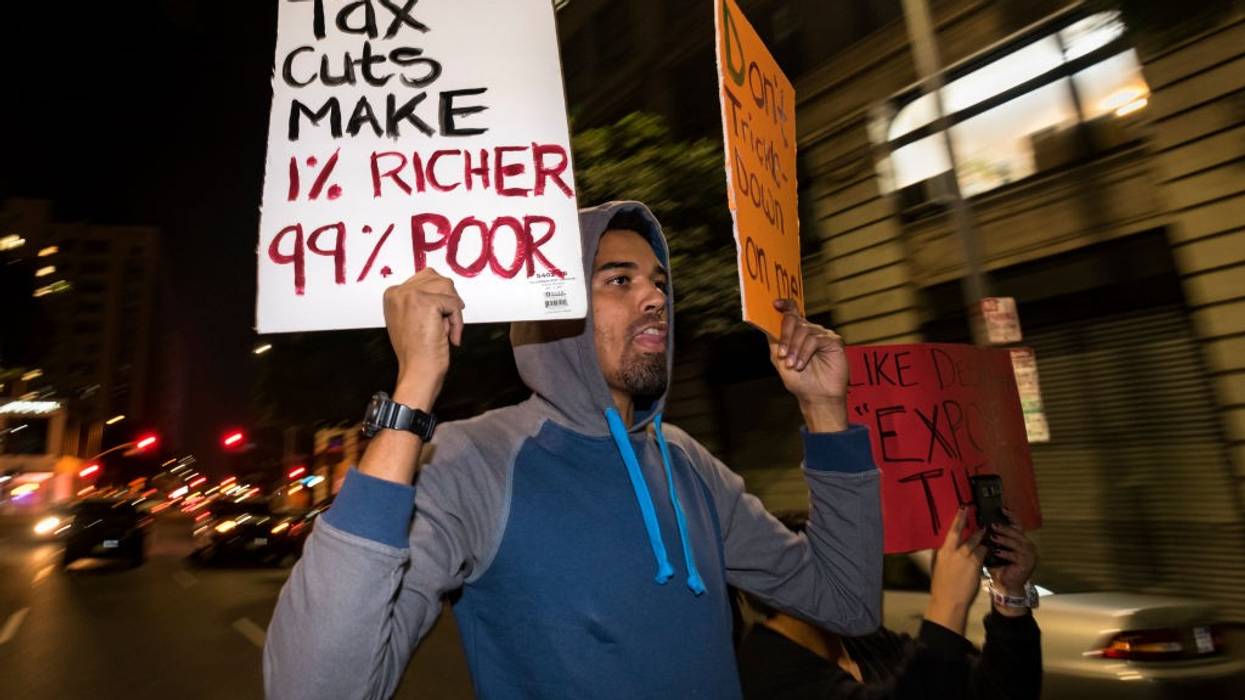
"This is an extraordinary concentration of tax benefits among some of the biggest and most profitable companies in the world," said an ITEP senior fellow.
As with the GOP's 2017 tax legislation, experts warned that big businesses and ultrarich individuals would benefit from President Donald Trump signing the One Big Beautiful Bill Act last year, while everyday Americans would suffer, and a Monday analysis identifies some of the companies now paying billions of dollars less in taxes.
The Institute on Taxation and Economic Policy (ITEP) "has tracked $204 billion in federal tax breaks disclosed by publicly traded US companies so far for 2025," the report says. "But those benefits were not spread evenly across the corporate sector: Six companies alone accounted for $83 billion of them."
The publication points out that "the stunning size of the federal income tax breaks corporations claimed this year dwarfs past corporate tax breaks, themselves sizeable. Microsoft received $18.7 billion in federal income tax breaks, a record high for single-year federal tax breaks for one publicly traded company. Alphabet claimed a staggering $18.4 billion, and Amazon walked away with $17.4 billion in tax breaks. Meta received $13.7 billion, JPMorgan Chase received $8.3 billion, and Nvidia received $6.8 billion."
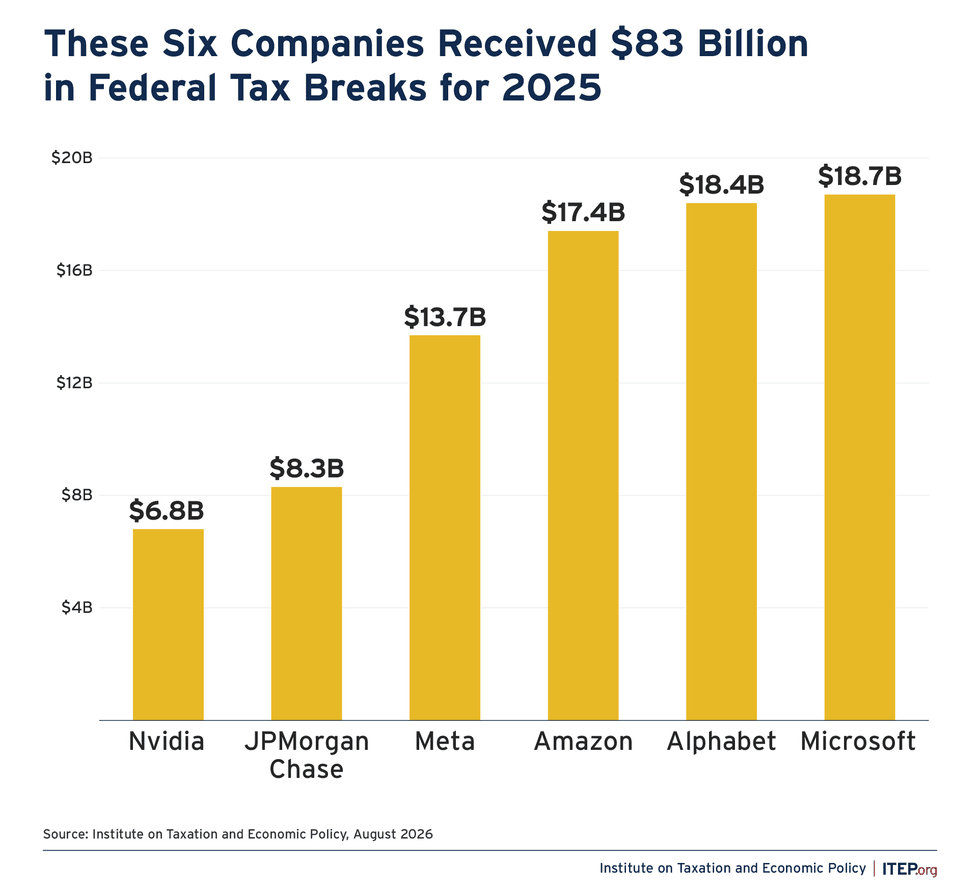
To put that $83 billion into context, the report highlights that it "represents nearly 18%, or almost $1 out of ever $5, of total federal corporation tax collections according to the Congressional Budget Office." It also "exceeds the entire annual discretionary budget of the US Department of Education," which Trump is notably aiming to eliminate as part of a broader mission to gut the federal government in his second term.
"This is an extraordinary concentration of tax benefits among some of the biggest and most profitable companies in the world," report co-author and ITEP senior fellow Matthew Gardner said in a statement. "When six companies can collect tax breaks equal to nearly one-fifth of what the federal government raises from the corporate income tax altogether, policymakers should be asking whether these provisions are serving the public interest or simply rewarding companies that are already enormously profitable and politically influential."
Gardner and his co-author, ITEP intern Sarah Buttikofer, emphasized that the top four firms featured in their analysis are tech giants: "Microsoft, Alphabet, Amazon, and Meta collectively received $68 billion in federal income tax breaks—which represents roughly 33% of the overall total."
"These figures show what Americans intuitively know: Corporate profits and economic power are increasingly concentrated among a relatively small number of extremely large companies," the pair wrote. "The presence of half a dozen tech CEOs at Donald Trump's January 2025 inauguration was a stark reminder that the economic leverage these companies are gaining is being translated into political power as well. That makes the tax treatment of these companies especially important."
Amazon founder Jeff Bezos and Meta CEO Mark Zuckerberg were among the Big Tech executives with prime seating at the inauguration. There was also the world's richest man, Elon Musk, who went on to help Trump rip apart the federal workforce as the de facto leader of the so-called Department of Government Efficiency.
To put these enormous tax breaks in context, the largest single-year tax break we've documented for any corporation before 2025 was J.P. Morgan’s $5.2 billion haul in 2024.itep.org/six-companie...
[image or embed]
— ITEP (@itep.org) August 14, 2026 at 12:18 PM
Musk leads various businesses, including Tesla, which was among 88 companies that paid no federal income tax last year, despite making almost $5.7 billion, according to an April analysis from ITEP. The others range from airlines and banks to energy, entertainment, and tech companies, such as Citigroup, Edison International, Palantir, United, and Walt Disney.
Meanwhile, near the end of last year, as Trump dismissed affordability concerns, an Associated Press-NORC Center for Public Affairs Research poll found that only 31% of voters approved of Trump's handling of the economy, the survey's lowest figure for his two terms.
Then, a January analysis by Democrats on the Joint Economic Committee revealed that the average American family paid $1,625 in higher costs last year as his policies drove up prices.
That was followed by a February warning from the Economic Policy Institute that Trump's economic agenda "will make ordinary families reliably poorer in the future." EPI's chief economist, Josh Bivens, pointed to the president's anti-labor policies, cuts to federal spending and jobs, mass deportation efforts, and tariffs—as well as the OBBBA, which gave tax breaks to the rich while stripping healthcare and food assistance from Americans in need.
With the US now enduring the consequences of Trump's war of choice on Iran, inflation remains high. Americans are struggling with the cost of gasoline, groceries, healthcare, housing, and more. After the latest figures were released last week, Alex Jacquez, a former Obama administration official who is now senior vice president of policy and advocacy at Groundwork Collaborative, said that "prices started climbing again in July, and Trump's catastrophic mismanagement of our economy means more spikes in the months ahead."

Anthropic CEO Dario Amodei said on Sunday that Americans distrust Big Tech because they "always suspect that we are cooking up some new way to screw them over."
Opposition to artificial intelligence data centers has exploded across the US in 2026, as a recent Annenberg Public Policy Center poll showed that more than 60% of Americans say they are against building AI facilities in their areas.
However, a new survey highlighted by Futurism on Sunday shows that the AI industry has bigger problems than just the unpopularity of data centers.
As Futurism noted, the poll by CNBC found widespread distrust of artificial intelligence CEOs among Americans between the ages of 18 and 34.
In fact, more than two-thirds of respondents said they did not trust Palantir CEO Alex Karp, Alphabet CEO Sundar Pichai, Anthropic CEO Dario Amodei, OpenAI CEO Sam Altman, Meta CEO Mark Zuckerberg, Nvidia CEO Jensen Huang, or SpaceX CEO Elon Musk to responsibly expand the use of AI.
"Those are some appalling approval ratings," commented Futurism, "reflecting the massive swing in popularity the tech industry has experienced over the last decade, driven by concerns around data privacy, the purposeful decay of once-useful platforms, and the erosion of democracy."
The survey comes amid signs that the AI industry knows it faces a significant deficit in public opinion.
Anthropic boss Amodei wrote a social media post on Sunday acknowledging that "the public has a negative view of AI," which he said was "fundamentally a crisis of trust."
"I think that ordinary people don't trust companies, governments, or the tech industry and always suspect that we are cooking up some new way to screw them over," wrote Amodei. "The causes of this go back decades and AI is just the latest iteration of it."
The Anthropic CEO added that he didn't think any positive public relations campaign could turn around people's perception of the industry, and he said that one of the few ways it could gain trust was "actually curing cancer."
The rapid expansion of AI data centers, pushed by President Donald Trump, has provoked grassroots campaigns in communities across the country, with people loudly opposing the facilities that have been linked to high household electricity bills, massive water consumption, and few, if any, long-term job opportunities.
Amodei's musings about AI's unpopularity came days after Zuckerberg published a 6,500-word manifesto, in which he pushed back on AI developers who believe the technology will "eliminate most jobs and much of humanity's relevance," while insisting that Meta would develop "personal superintelligence for everyone" that would put "power in people's hands" rather than taking it away.
However, Zuckerberg's promises of a benevolent AI future drew skepticism from TechCrunch AI editor Russell Brandom, who argued in an essay published last week that the Meta chief's manifesto would fall on deaf ears given his own toxic reputation. Meta was recently ordered to pay nearly $1 billion in fines due to its products' harms to children and teens.
"Suffice it to say, Facebook as a product and Zuckerberg as a person are both unpopular with the US public," wrote Brandom. "A recent survey found that 64% of Americans believe social media has been harmful to democracy and a similar percentage believe it should be more heavily regulated, numbers that cut evenly across partisan lines."
People's own past experience with social media, Brandom continued, is a big reason why they are revolting against Big Tech's ambitions to use AI to remake society.
"The public does not trust tech executives to make sure new technologies like this have a positive impact on society," Brandom explained. "Instead of acknowledging that and trying to win back their trust, this essay demonstrates over and over again how the trust was lost in the first place."
Brandom cited Zuckerberg's discussion of human lawyers eventually being replaced by AI as particularly problematic, given that enabling chatbots to engage in litigation could result in a wave of nuisance lawsuits that would clog up the legal system.
"It’s hard to feel calm about any of this stuff," commented Brandom, "and the fact that Zuckerberg isn’t worried makes me more worried."
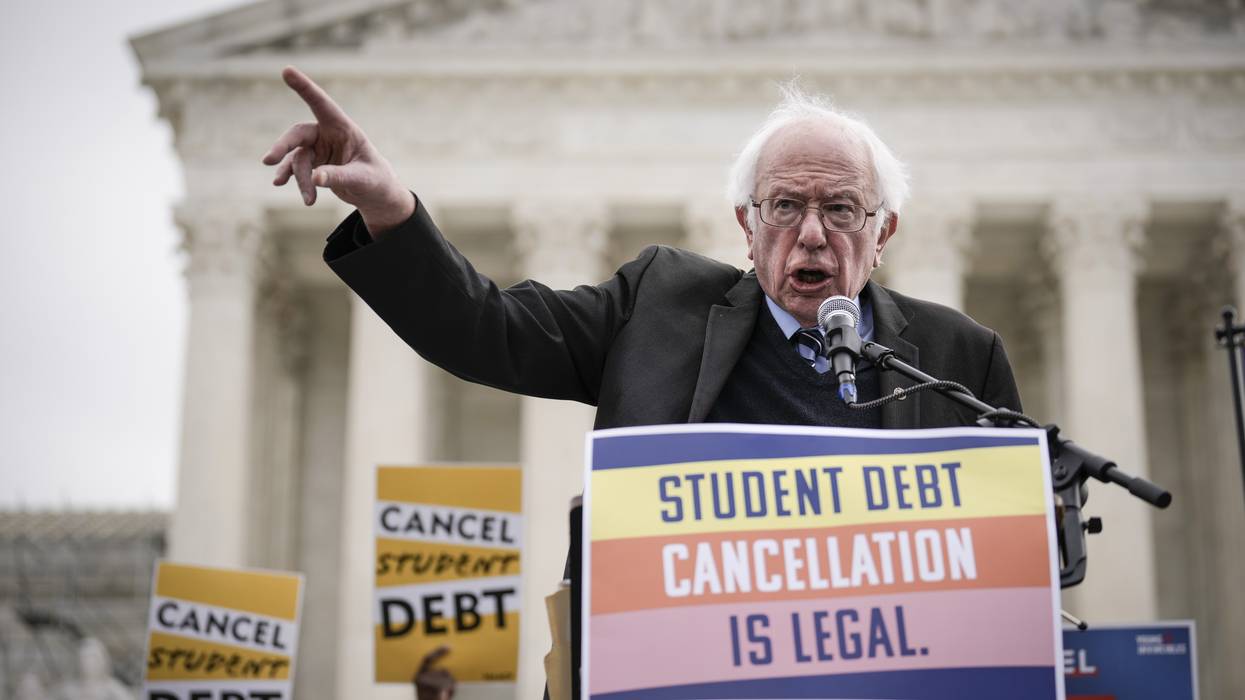
“In the richest country in the history of the world, no senior should have their Social Security payments taken away from them to pay back student debt."
US Sen. Bernie Sanders on Monday introduced legislation that would prohibit the federal government from garnishing Social Security payments from older Americans and people with disabilities who default on their student loans, a move that comes amid a debt crisis made worse by education cuts in President Donald Trump's so-called One Big Beautiful Bill Act.
The Stop Social Security Garnishment Act, co-sponsored by Sens. Elizabeth Warren (D-Mass.) and Ed Markey (D-Mass.), would bar the Treasury Department from seizing Social Security payments, including Social Security Disability Insurance, to collect on defaulted federal student debt.
“As a result of Trump’s disastrous cuts to education, an increasing number of seniors are in danger of having their Social Security checks garnished to pay back student loans they took out decades ago. That is beyond unacceptable,” Sanders (I-Vt.) said in a statement.
“In the richest country in the history of the world, no senior should have their Social Security payments taken away from them to pay back student debt," the senator added. "This is especially true when seniors throughout the country already cannot afford the skyrocketing price of healthcare, prescription drugs, groceries, and housing. Congress must pass this legislation.”
Sanders' bill comes as more than 9 million Americans are in default on their federal student loans, according to the latest Department of Education data. Republicans' One Big Beautiful Bill, which was signed into law by Trump last year, contains the biggest cuts to education in US history while making federal student loans less forgiving for borrowers, in part by attacking repayment protections that could help avert defaults.
Student loan delinquency reached 10.6% in the second quarter of 2026, up from 10.3% in the first quarter, according to the Federal Reserve Bank of New York. Meanwhile, the Trump administration is moving millions of borrowers off the Biden-era SAVE repayment plan, raising concerns among borrowers that higher monthly payments could push more people into delinquency and default.
Under current law, borrowers can generally enter default and be subjected to collection measures after missing payments for 270 days.
All told, student borrowers are collectively on the hook for nearly $2 trillion in loan debt, according to the Federal Reserve Bank of St. Louis. Over $233 billion of that amount is in default.
Sanders aims to "put an end to this absurdity and ensure no Social Security payments are taken away from older adults or individuals with disabilities due to student loan debt."
The Stop Social Security Garnishment Act is endorsed by organizations including the American Federation of Teachers, Protect Borrowers, Student Debt Crisis Center, American Association of University Women, Debt Collective, Social Security Works, and the Alliance for Retired Americans.

After the passage of a law that allows people with Canadian ancestry going back generations to apply for citizenship, archivists are also seeing an increase in requests for genealogical records.
Americans are driving a surge in both citizenship applications in Canada and demand for archivists there to find evidence that they are eligible to become citizens, as people in the US look to leave the country increasingly defined by President Donald Trump's racist, violent, and authoritarian far-right political movement.
As CBC reported Monday, the number of people who have received Canadian citizenship certificates rose nearly 50% between April 1-May 31, months after the country's Parliament passed Bill C-3—the so-called "Lost Canadian" law.
The law allows foreign nationals to gain citizenship if they can prove via official genealogical records that they are descended from a Canadian ancestor. It was passed after courts struck down a previous restriction limiting citizenship eligibility to people whose parents were born in Canada.
In the first five months of 2026, Americans accounted for nearly half of the people who qualified for citizenship.
More than 3,100 Americans obtained citizenship certificates as a result of Bill C-3, and another 8,125 people from the US were granted citizenship due to their parents being Canadian.
The country's federal immigration agency, Immigration, Refugees, and Citizenship Canada (IRCC), reports that the backlog of citizenship certificate applications had exploded to 121,800 people at of August 10—up from 70,400 in May and 56,000 the previous month.
“There’s so many reasons that people, you know, might be looking to leave the States right now or planning for future moves."
In May, the wait time for an application being processed was estimated to be 12 months, but as of August 10, it had jumped to 25 months.
CBC noted that some certificate applicants simply need replacement documents after their citizenship papers have been lost or stolen, but one immigration attorney and policy analyst told CTV News that there is a clear driver of the surge in Americans exploring the possibility of citizenship in their neighboring country.
"Proof of citizenship used to be fast, but the Trump bump has dramatically increased the processing volumes for proof of citizenship, resulting in lengthy processing times,” Richard Kurland told the outlet last week. “What used to take a few months is now going to take well over a year and longer.”
The surge in citizenship applications comes as Trump has overseen a mass deportation campaign in which federal immigration agents have fatally shot at least 11 people on US streets, including at least three US citizens. The president's tariff policy, his unprovoked war of choice in Iran, and the Republican Party's cuts to Medicaid and Affordable Care Act subsidies have all been blamed for worsening the affordability crisis that Trump campaigned on ending.
The White House has also signaled plans to ramp up attacks on the First Amendment as it pushes federal, state, and local law enforcement agencies to carry out Trump's directive from last year, National Security Presidential Memorandum 7, to crack down on groups he called "radical left" extremists.
As Common Dreams reported last week, teachers unions and climate advocates were among those that the Department of Homeland Security surveilled earlier this year in Minnesota in response to widespread protests against its anti-immigration crackdown.
“There’s so many reasons that people, you know, might be looking to leave the States right now or planning for future moves," Mab Coates-Davies, executive director of the Association of Canadian Archivists (ACA), told the CBC Monday.
The association has seen a sharp rise in requests for archivists to find genealogical records that prove Canadian ancestry in recent months, with a majority of the requests coming from the US, according to the outlet.
Some archival institutions are seeing 100-300% jumps in requests, the ACA said.

Some supporters of Israel called for Prime Minister Benjamin Netanyahu to expel Ben-Gvir from his government in response to the comments.
National Security Minister Itamar Ben-Gvir, one of the most powerful figures in the Israeli government, is facing criticism, including from some strong supporters of Israel, after he called for the mass killing of Palestinians in Gaza during an interview that surfaced on Sunday.
The far-right member of Prime Minister Benjamin Netanyahu’s cabinet rarely hides his desire to ethnically cleanse the exclave of Palestinians and replace them with Israeli settlers. But these comments, which he made to a former Israeli captive taken during the Hamas-led October 7, 2023 attacks, were even more explicit and violent than usual.
He said he's pushed for Israeli forces to carry out operations every day that “kill 30 or 40” people in Gaza and go beyond “those who pose a danger… at that particular moment."
"There are people there who are not worthy of life. They shouldn’t live. They’re not even people," Ben-Gvir said, criticizing a recent drawdown of Israeli attacks.
Ben-Gvir, who runs Israel's prisons and police, said killing Palestinians in greater numbers would "encourage" civilians in Gaza to leave so that Israel can fully conquer the strip, allowing it to be colonized by Jewish settlers.
“I see all of Gaza as ours," the minister said. He said that Israel, which has already pushed past last October's ceasefire line to occupy nearly 70% of Gaza, should move "as fast as possible" to take over the rest of the territory.
Ben-Gvir said, "We enter all of Gaza, settle all of Gaza, encourage migration."
The comments were met with condemnation in the West, including from some strong defenders of Israel.
Jacky Rosen (D-Nev.), who has consistently voted to provide weapons to Israel despite growing calls within her party to block some arms sales, said Ben-Gvir’s comments were “horrific and completely indefensible.”
“Anyone advocating for acts of violence against innocent civilians should not be in an official government position,” Rosen said. “I believe Ben-Gvir must resign, and I urge Prime Minister Netanyahu to denounce these remarks and reaffirm to the world that this is not the government’s position.”
Democratic Majority for Israel, a group focused on maintaining support for Israel within the US Democratic Party, stated similarly that Ben-Gvir's comments were "heinous and indefensible" and called for him to be expelled from Netanyahu's government. However, the group also stressed that Ben-Gvir's position "is not Israeli government policy."
Technically, this is true, but only in the sense that the Israeli government's actions toward Gaza have actually been considerably more violent than the kill quota of "30 to 40" per day prescribed by Ben-Gvir. Since the genocidal war began in October 2023, more than 73,000 Palestinians have been killed, according to the Gaza Health Ministry.
Based on the ministry's official tallies, which independent expert analyses have found to be an undercount, around 92 people were killed on average per day between October 2023 and the ceasefire in October 2025.
Data from the Israeli army, analyzed in 2025 by +972 magazine, suggests that more than 80% of those killed were civilians. During the first two years of the conflict, the Government Media Office in Gaza reported that more than 20,000 children had been killed, more than one every hour.
While some called on Netanyahu to stand against Ben-Gvir's especially violent rhetoric, the prime minister himself has also explicitly pushed for genocidal violence against Palestinians in Gaza, at one point invoking the Israelites' ancient foe, the Amalekites, and God's demand in the Hebrew Bible that the Israelites exterminate them.
Along with the similarly extreme finance minister Bezalel Smotrich, Ben-Gvir regularly draws criticism among liberal supporters of Israel for his particularly explicit comments advocating violence against Palestinians and other enemies of Israel and for enacting policies that have accelerated their displacement in the West Bank and allowed violent Israeli settlers to act with impunity.
But as critics pointed out, there is little evidence that Netanyahu will heed the calls from liberal Zionists to boot Ben-Gvir out of his coalition or discipline him in any way.
"And if he doesn’t, which he won’t, of course, does DFMI then support sanctions on Israel and restrictions on US arms sales?" asked commentator Mehdi Hasan in response to the statement from Democratic Majority for Israel. "If not, why not?"
Noting that the group has consistently opposed proposals to cut off weapons aid to Israel, he asked, "Why would you want to sell weapons to ‘heinous’ people?"
Political analyst Omar Baddar suggested that the problem many pro-Israel critics have with Ben-Gvir is not the policy he espouses, but the public relations headaches he creates.
Baddar said, "What’s 'extremist' about Ben Gvir is that he says out loud what Israel’s mainstream political establishment prefers to do quietly under the false pretense of 'fighting terrorism.'"

Trump's warning to Oman over its negotiations with Iran comes as the closure of the Strait of Hormuz is once again putting upward pressure on petroleum prices.
President Donald Trump on Monday threatened to bomb a US ally in the Middle East if it gets in the way of a perpetually elusive deal with Iran to reopen the Strait of Hormuz.
Speaking with Fox News, Trump was asked about talks that Iran and Oman have been conducting about jointly overseeing operations of the strait, which has been shut down ever since Trump started an illegal war in late February.
Trump replied that "if Oman gets in the way" of reopening the strait, "we'll bomb the shit out of them."
.@POTUS on parallel talks between Iran and Oman on the Strait of Hormuz: "If Oman gets in the way, we'll bomb the shit out of them." pic.twitter.com/5dEXDOdAN4
— Rapid Response 47 (@RapidResponse47) August 17, 2026
It is unclear how effective Trump's threats against Oman will be, as the US military still hasn't forced Iran to reopen the strait even after burning through massive stocks of munitions—including what military sources have described to The Military Times as "virtually all" of its Army Tactical Missile Systems (ATACMS) and Precision Strike Missiles (PrSM).
As Trita Parsi of the Quincy Institute for Responsible Statecraft noted, the president previously threatened Oman when the country put forward proposals for a compromise on control of the strait.
Trump's warning to Oman comes as the closure of the strait is once again putting upward pressure on petroleum prices.
According to a Monday report from Reuters, data from maritime vessel tracking firm Kpler shows that "shipping appeared to grind to a near standstill" over the weekend, as only "five commodity vessels transited the strait on Saturday, with none registered for Sunday."
As Reuters noted, an average of 130 ships typically passed through the strait daily prior to the start of Trump's illegal war.
The price of Brent crude jumped over $89 per barrel during Monday trading, while data released by the American Automobile Association shows the average price of gas in the US now stands at $4.06 per gallon, up from $4.01 in the week prior.
The Wall Street Journal on Sunday reported that Iran believes that the war has been going so well that it has concocted a "secret plan" to escalate it, using the June ceasefire with the US to take time “to prepare for a bigger fight.”
"Arab intelligence officials have picked up evidence... of a strategic shift inside the country’s hard-line leadership to get their forces ready to widen the war and raise the costs for the US," the Journal reported. "Their overriding goal is to inflict enough pain to ensure the kind of attacks Iran has endured with the 12-day war last year and the continuing conflict aren’t repeated."