SUBSCRIBE TO OUR FREE NEWSLETTER
Daily news & progressive opinion—funded by the people, not the corporations—delivered straight to your inbox.
5
#000000
#FFFFFF
To donate by check, phone, or other method, see our More Ways to Give page.
Daily news & progressive opinion—funded by the people, not the corporations—delivered straight to your inbox.
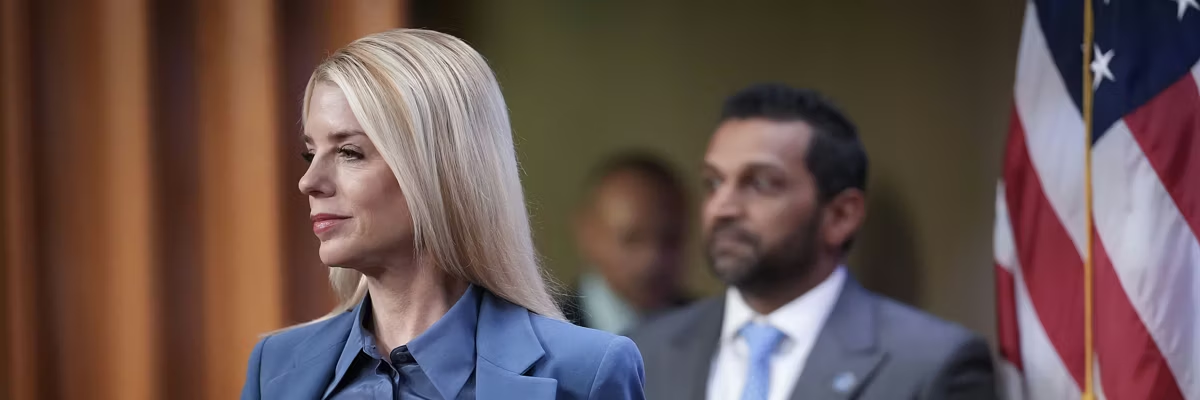
Attorney General Pam Bondi and FBI Director Kash Patel arrive for a news conference at the Department of Justice on December 4, 2025, in Washington, DC.
A former official from Trump’s first term said the FBI will be able to throw the full might of the surveillance state at “Americans whose primary ‘offense’ may be ideological dissent.”
The Trump administration is about to embark on a massive crackdown on what it describes as a scourge of rampant left-wing “terrorism.”
But the US Department of Justice (DOJ) memo ordering the crackdown has critics fearing it will go far beyond punishing those who plan criminal acts and will instead be used to criminalize anyone who expresses opposition to President Donald Trump and his agenda.
Earlier this month, independent journalist Ken Klippenstein reported that Attorney General Pam Bondi had sent out a memo ordering the FBI to “compile a list of groups or entities engaging in acts that may constitute domestic terrorism.”
As part of this effort, Bondi set Thursday as a deadline for all law enforcement agencies to "coordinate delivery" of intelligence files related to “antifa” or “antifa-related activities” to the FBI.
The memo identifies those who express “opposition to law and immigration enforcement; extreme views in favor of mass migration and open borders; adherence to radical gender ideology,” as well as “anti-Americanism,” “anti-capitalism,” and “anti-Christianity," as potential targets for investigation.
This language references National Security Presidential Memorandum-7, or NSPM-7, a memo issued by Trump in September, which identified this slate of left-wing beliefs as potential "indicators" of terrorism following the assassination of right-wing activist Charlie Kirk in September.
In comments made before the alleged shooter's identity was revealed, Trump attributed the murder to "those on the radical left [who] have compared wonderful Americans like Charlie to Nazis," adding that "this kind of rhetoric is directly responsible for the terrorism that we’re seeing in our country and must stop right now."
Weeks after Kirk's shooting, Trump designated "antifa" as a "domestic terrorism organization," a move that alarmed critics because "antifa," short for "anti-fascist," is a loosely defined ideology rather than an organized political group.
Senior Trump adviser Stephen Miller, meanwhile, promised that the Trump administration would use law enforcement to "dismantle" left-wing groups he said were "fomenting violence." He suggested that merely using heated rhetoric—including calling Trump and his supporters "fascist" or "authoritarian"—"incites violence and terrorism."
Klippenstein said that “where NSPM-7 was a declaration of war on just about anyone who isn’t MAGA,” the memo that went into effect Thursday “is the war plan for how the government will wage it on a tactical level.”
In comments to the Washington Post, former FBI agent Michael Feinberg, who is now a senior editor at Lawfare, said it was "a pretty damn dangerous document," in part because "it is directed at a specific ideology, namely the left, without offering much evidence as to why that is necessary."
Studies have repeatedly shown that while all political factions contain violent actors, those who commit acts of political violence are vastly more likely to identify with right-wing causes.
Miles Taylor, who served as chief of staff for the Department of Homeland Security under the first Trump administration, pointed out in a blog post the extraordinary surveillance capability that the FBI will have at its disposal to use against those it targets.
He said it "includes the FBI’s ability to marshal facial recognition, phone-tracking databases, license-plate readers, financial records review, undercover operations, and intelligence-sharing tools against Americans whose primary 'offense' may be ideological dissent."
"Unfortunately, once you are fed into that system, there is no real 'due process' until charges are brought," Taylor said. "It’s not like you get a text-message notification when the FBI begins investigating you for terrorism offenses, and there’s certainly no 'opt-out' feature. For this to happen, you don’t need to commit violence. You don’t even need to plan it. Under the administration’s new guidelines, you merely need to be flagged for association with the anti-fascist movement to become a potential target."
Sen. Ron Wyden (D-Wash.), a member of the Senate Intelligence Committee, told the Post, "It is a throwback to McCarthyism and the worst abuses of [Former FBI Director J. Edgar] Hoover’s FBI to use federal law enforcement against Americans purely because of their political beliefs or because they disagree with the current president’s politics."
Taylor argued: "He’s right, but it’s actually more dangerous than that. Joseph McCarthy had subpoenas and hearings and created his blacklists of 'communist' Americans from Capitol Hill. And while controversial FBI Director J. Edgar Hoover may have had old-school wiretaps and informants, Donald Trump’s team has algorithmic surveillance, bulk data collection, and a post-9/11 security state designed for permanent emergency. It’s like comparing a snowflake with a refrigerator."
Dear Common Dreams reader, It’s been nearly 30 years since I co-founded Common Dreams with my late wife, Lina Newhouser. We had the radical notion that journalism should serve the public good, not corporate profits. It was clear to us from the outset what it would take to build such a project. No paid advertisements. No corporate sponsors. No millionaire publisher telling us what to think or do. Many people said we wouldn't last a year, but we proved those doubters wrong. Together with a tremendous team of journalists and dedicated staff, we built an independent media outlet free from the constraints of profits and corporate control. Our mission has always been simple: To inform. To inspire. To ignite change for the common good. Building Common Dreams was not easy. Our survival was never guaranteed. When you take on the most powerful forces—Wall Street greed, fossil fuel industry destruction, Big Tech lobbyists, and uber-rich oligarchs who have spent billions upon billions rigging the economy and democracy in their favor—the only bulwark you have is supporters who believe in your work. But here’s the urgent message from me today. It's never been this bad out there. And it's never been this hard to keep us going. At the very moment Common Dreams is most needed, the threats we face are intensifying. We need your support now more than ever. We don't accept corporate advertising and never will. We don't have a paywall because we don't think people should be blocked from critical news based on their ability to pay. Everything we do is funded by the donations of readers like you. When everyone does the little they can afford, we are strong. But if that support retreats or dries up, so do we. Will you donate now to make sure Common Dreams not only survives but thrives? —Craig Brown, Co-founder |
The Trump administration is about to embark on a massive crackdown on what it describes as a scourge of rampant left-wing “terrorism.”
But the US Department of Justice (DOJ) memo ordering the crackdown has critics fearing it will go far beyond punishing those who plan criminal acts and will instead be used to criminalize anyone who expresses opposition to President Donald Trump and his agenda.
Earlier this month, independent journalist Ken Klippenstein reported that Attorney General Pam Bondi had sent out a memo ordering the FBI to “compile a list of groups or entities engaging in acts that may constitute domestic terrorism.”
As part of this effort, Bondi set Thursday as a deadline for all law enforcement agencies to "coordinate delivery" of intelligence files related to “antifa” or “antifa-related activities” to the FBI.
The memo identifies those who express “opposition to law and immigration enforcement; extreme views in favor of mass migration and open borders; adherence to radical gender ideology,” as well as “anti-Americanism,” “anti-capitalism,” and “anti-Christianity," as potential targets for investigation.
This language references National Security Presidential Memorandum-7, or NSPM-7, a memo issued by Trump in September, which identified this slate of left-wing beliefs as potential "indicators" of terrorism following the assassination of right-wing activist Charlie Kirk in September.
In comments made before the alleged shooter's identity was revealed, Trump attributed the murder to "those on the radical left [who] have compared wonderful Americans like Charlie to Nazis," adding that "this kind of rhetoric is directly responsible for the terrorism that we’re seeing in our country and must stop right now."
Weeks after Kirk's shooting, Trump designated "antifa" as a "domestic terrorism organization," a move that alarmed critics because "antifa," short for "anti-fascist," is a loosely defined ideology rather than an organized political group.
Senior Trump adviser Stephen Miller, meanwhile, promised that the Trump administration would use law enforcement to "dismantle" left-wing groups he said were "fomenting violence." He suggested that merely using heated rhetoric—including calling Trump and his supporters "fascist" or "authoritarian"—"incites violence and terrorism."
Klippenstein said that “where NSPM-7 was a declaration of war on just about anyone who isn’t MAGA,” the memo that went into effect Thursday “is the war plan for how the government will wage it on a tactical level.”
In comments to the Washington Post, former FBI agent Michael Feinberg, who is now a senior editor at Lawfare, said it was "a pretty damn dangerous document," in part because "it is directed at a specific ideology, namely the left, without offering much evidence as to why that is necessary."
Studies have repeatedly shown that while all political factions contain violent actors, those who commit acts of political violence are vastly more likely to identify with right-wing causes.
Miles Taylor, who served as chief of staff for the Department of Homeland Security under the first Trump administration, pointed out in a blog post the extraordinary surveillance capability that the FBI will have at its disposal to use against those it targets.
He said it "includes the FBI’s ability to marshal facial recognition, phone-tracking databases, license-plate readers, financial records review, undercover operations, and intelligence-sharing tools against Americans whose primary 'offense' may be ideological dissent."
"Unfortunately, once you are fed into that system, there is no real 'due process' until charges are brought," Taylor said. "It’s not like you get a text-message notification when the FBI begins investigating you for terrorism offenses, and there’s certainly no 'opt-out' feature. For this to happen, you don’t need to commit violence. You don’t even need to plan it. Under the administration’s new guidelines, you merely need to be flagged for association with the anti-fascist movement to become a potential target."
Sen. Ron Wyden (D-Wash.), a member of the Senate Intelligence Committee, told the Post, "It is a throwback to McCarthyism and the worst abuses of [Former FBI Director J. Edgar] Hoover’s FBI to use federal law enforcement against Americans purely because of their political beliefs or because they disagree with the current president’s politics."
Taylor argued: "He’s right, but it’s actually more dangerous than that. Joseph McCarthy had subpoenas and hearings and created his blacklists of 'communist' Americans from Capitol Hill. And while controversial FBI Director J. Edgar Hoover may have had old-school wiretaps and informants, Donald Trump’s team has algorithmic surveillance, bulk data collection, and a post-9/11 security state designed for permanent emergency. It’s like comparing a snowflake with a refrigerator."
The Trump administration is about to embark on a massive crackdown on what it describes as a scourge of rampant left-wing “terrorism.”
But the US Department of Justice (DOJ) memo ordering the crackdown has critics fearing it will go far beyond punishing those who plan criminal acts and will instead be used to criminalize anyone who expresses opposition to President Donald Trump and his agenda.
Earlier this month, independent journalist Ken Klippenstein reported that Attorney General Pam Bondi had sent out a memo ordering the FBI to “compile a list of groups or entities engaging in acts that may constitute domestic terrorism.”
As part of this effort, Bondi set Thursday as a deadline for all law enforcement agencies to "coordinate delivery" of intelligence files related to “antifa” or “antifa-related activities” to the FBI.
The memo identifies those who express “opposition to law and immigration enforcement; extreme views in favor of mass migration and open borders; adherence to radical gender ideology,” as well as “anti-Americanism,” “anti-capitalism,” and “anti-Christianity," as potential targets for investigation.
This language references National Security Presidential Memorandum-7, or NSPM-7, a memo issued by Trump in September, which identified this slate of left-wing beliefs as potential "indicators" of terrorism following the assassination of right-wing activist Charlie Kirk in September.
In comments made before the alleged shooter's identity was revealed, Trump attributed the murder to "those on the radical left [who] have compared wonderful Americans like Charlie to Nazis," adding that "this kind of rhetoric is directly responsible for the terrorism that we’re seeing in our country and must stop right now."
Weeks after Kirk's shooting, Trump designated "antifa" as a "domestic terrorism organization," a move that alarmed critics because "antifa," short for "anti-fascist," is a loosely defined ideology rather than an organized political group.
Senior Trump adviser Stephen Miller, meanwhile, promised that the Trump administration would use law enforcement to "dismantle" left-wing groups he said were "fomenting violence." He suggested that merely using heated rhetoric—including calling Trump and his supporters "fascist" or "authoritarian"—"incites violence and terrorism."
Klippenstein said that “where NSPM-7 was a declaration of war on just about anyone who isn’t MAGA,” the memo that went into effect Thursday “is the war plan for how the government will wage it on a tactical level.”
In comments to the Washington Post, former FBI agent Michael Feinberg, who is now a senior editor at Lawfare, said it was "a pretty damn dangerous document," in part because "it is directed at a specific ideology, namely the left, without offering much evidence as to why that is necessary."
Studies have repeatedly shown that while all political factions contain violent actors, those who commit acts of political violence are vastly more likely to identify with right-wing causes.
Miles Taylor, who served as chief of staff for the Department of Homeland Security under the first Trump administration, pointed out in a blog post the extraordinary surveillance capability that the FBI will have at its disposal to use against those it targets.
He said it "includes the FBI’s ability to marshal facial recognition, phone-tracking databases, license-plate readers, financial records review, undercover operations, and intelligence-sharing tools against Americans whose primary 'offense' may be ideological dissent."
"Unfortunately, once you are fed into that system, there is no real 'due process' until charges are brought," Taylor said. "It’s not like you get a text-message notification when the FBI begins investigating you for terrorism offenses, and there’s certainly no 'opt-out' feature. For this to happen, you don’t need to commit violence. You don’t even need to plan it. Under the administration’s new guidelines, you merely need to be flagged for association with the anti-fascist movement to become a potential target."
Sen. Ron Wyden (D-Wash.), a member of the Senate Intelligence Committee, told the Post, "It is a throwback to McCarthyism and the worst abuses of [Former FBI Director J. Edgar] Hoover’s FBI to use federal law enforcement against Americans purely because of their political beliefs or because they disagree with the current president’s politics."
Taylor argued: "He’s right, but it’s actually more dangerous than that. Joseph McCarthy had subpoenas and hearings and created his blacklists of 'communist' Americans from Capitol Hill. And while controversial FBI Director J. Edgar Hoover may have had old-school wiretaps and informants, Donald Trump’s team has algorithmic surveillance, bulk data collection, and a post-9/11 security state designed for permanent emergency. It’s like comparing a snowflake with a refrigerator."