SUBSCRIBE TO OUR FREE NEWSLETTER
Daily news & progressive opinion—funded by the people, not the corporations—delivered straight to your inbox.
5
#000000
#FFFFFF
To donate by check, phone, or other method, see our More Ways to Give page.
Daily news & progressive opinion—funded by the people, not the corporations—delivered straight to your inbox.

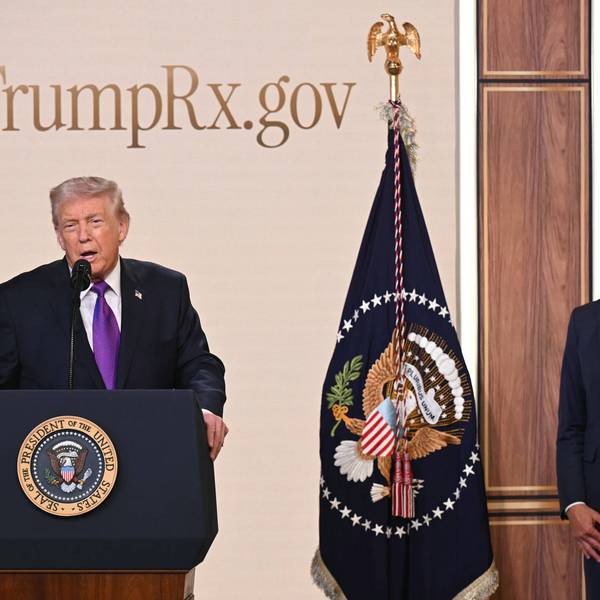
President Donald Trump hosts an event on lowering prescription drug prices in the Roosevelt Room of the White House in Washington, DC on December 19, 2025.
"Patients are overwhelmingly calling on Congress to do more to lower prescription drug prices by holding Big Pharma accountable and addressing the root causes of high drug prices," said one campaigner.
"Starting next year, American drug prices will come down fast and furious and will soon be the lowest in the developed world," President Donald Trump claimed Friday as the White House announced agreements with nine pharmaceutical manufacturers.
The administration struck most favored nation (MFN) pricing deals with Amgen, Bristol Myers Squibb, Boehringer Ingelheim, Genentech, Gilead Sciences, GSK, Merck, Novartis, and Sanofi. The president—who has launched the related TrumpRx.gov—previously reached agreements with AstraZeneca, EMD Serono, Eli Lilly, Novo Nordisk, and Pfizer.
"The White House said it has made MFN deals with 14 of the 17 biggest drug manufacturers in the world," CBS News noted Friday. "The three drugmakers that were not part of the announcement are AbbVie, Johnson & Johnson, and Regeneron, but the president said that deals involving the remaining three could be announced at another time."
However, as Trump and congressional Republicans move to kick millions of Americans off of Medicaid and potentially leave millions more uninsured because they can't afford skyrocketing premiums for Affordable Care Act (ACA) plans, some critics suggested that the new drug deals with Big Pharma are far from enough.
"When 47% of Americans are concerned they won't be able to afford a healthcare cost next year, steps to reduce drug prices for patients are welcomed, especially by patients who rely on one of the overpriced essential medicines named in today's announcement," said Merith Basey, CEO of Patients for Affordable Drugs Now, in a statement.
"But voluntary agreements with drug companies—especially when key details remain undisclosed—are no substitute for durable, system-wide reforms," Basey stressed. "Patients are overwhelmingly calling on Congress to do more to lower prescription drug prices by holding Big Pharma accountable and addressing the root causes of high drug prices, because drugs don't work if people can't afford them."
As the New York Times reported Friday:
Drugs that will be made available in this way include Amgen's Repatha, for lowering cholesterol, at $239 a month; GSK's asthma inhaler, Advair Diskus, at $89 a month; and Merck's diabetes medication Januvia, at $100 a month.
Many of these drugs are nearing the end of their patent protection, meaning that the arrival of low-cost generic competition would soon have prompted manufacturers to lower their prices.
In other cases, the direct-buy offerings are very expensive and out of reach for most Americans.
For example, Gilead will offer Epclusa, a three-month regimen of pills that cures hepatitis C, for $2,492 a month on the site. Most patients pay far less using insurance or with help from patient assistance programs. Gilead says on its website that "typically a person taking Epclusa pays between $0 and $5 per month" with commercial insurance or Medicare.
While medication prices are a concern for Americans who face rising costs for everything from groceries to utility bills, the outcome of the ongoing battle on Capitol Hill over ACA tax credits—which are set to expire at the end of the year—is expected to determine how many people can even afford to buy health insurance for next year.
The ACA subsidies fight—which Republicans in the US House of Representatives ignored in the bill they passed this week before leaving Capitol Hill early—has renewed calls for transitioning the United States from its current for-profit healthcare system to Medicare for All.
"At the heart of our healthcare crisis is one simple truth: Corporations have too much power over our lives," Rep. Pramila Jayapal (D-Wash.), former chair of the Congressional Progressive Caucus, said on social media Friday. "Medicare for All is how we take our power back and build a system that puts people over profits."
Jayapal reintroduced the Medicare for All Act in April with Rep. Debbie Dingell (D-Mich.) and Senate Health, Education, Labor, and Pensions Committee Ranking Member Bernie Sanders (I-Vt.). The senator said Friday that some of his top priorities in 2026 will be campaign finance reform, income and wealth inequality, the rapid deployment of artificial intelligence, and Medicare for All.
Earlier this month, another backer of that bill, US Sen. Chris Van Hollen (D-Md.), said: "We must stop tinkering around the edges of a broken healthcare system. Yes, let's extend the ACA tax credits to prevent a huge spike in healthcare costs for millions. Then, let's finally create a system that puts your health over corporate profits. We need Medicare for All."
It's not just progressives in Congress demanding that kind of transformation. According to Data for Progress polling results released late last month, 65% of likely US voters—including 78% of Democrats, 71% of Independents, and 49% of Republicans—either strongly or somewhat support "creating a national health insurance program, sometimes called 'Medicare for All.'"
This country and this world are at a monumental crossroads. US voters have an opportunity to beat back the forces of fascism and confront the billionaires who are rigging the economy, our media system, and our democracy, making it increasingly impossible for ordinary people to get by. We’re not just talking about the election. We’re talking about what must be done once these fascist elements are vanquished from power. We need a bolder set of solutions than what either major party has so far been willing to offer and a working-class movement ready to fight like hell for it. Trump didn't emerge from nowhere. The conditions that fueled MAGA authoritarianism were created by decades of radical neoliberal economic policies and a corrupt political system dominated by corporate interests. They slashed taxes on the super-rich, promising that the benefits would trickle down. They said giveaways to the corporate titans would make life more affordable for the rest of us. It was all bullshit. And when a bitter, betrayed populace searches for someone to blame, right-wing demagogues have little trouble finding scapegoats. People know when they're being lied to, but you won't hear any of this from the corporate media. Only independent journalism—powered and funded by people who believe in building a better world—can deliver truly trustworthy daily news. If you share our vision, please contribute whatever you can to sustain our work. |
"Starting next year, American drug prices will come down fast and furious and will soon be the lowest in the developed world," President Donald Trump claimed Friday as the White House announced agreements with nine pharmaceutical manufacturers.
The administration struck most favored nation (MFN) pricing deals with Amgen, Bristol Myers Squibb, Boehringer Ingelheim, Genentech, Gilead Sciences, GSK, Merck, Novartis, and Sanofi. The president—who has launched the related TrumpRx.gov—previously reached agreements with AstraZeneca, EMD Serono, Eli Lilly, Novo Nordisk, and Pfizer.
"The White House said it has made MFN deals with 14 of the 17 biggest drug manufacturers in the world," CBS News noted Friday. "The three drugmakers that were not part of the announcement are AbbVie, Johnson & Johnson, and Regeneron, but the president said that deals involving the remaining three could be announced at another time."
However, as Trump and congressional Republicans move to kick millions of Americans off of Medicaid and potentially leave millions more uninsured because they can't afford skyrocketing premiums for Affordable Care Act (ACA) plans, some critics suggested that the new drug deals with Big Pharma are far from enough.
"When 47% of Americans are concerned they won't be able to afford a healthcare cost next year, steps to reduce drug prices for patients are welcomed, especially by patients who rely on one of the overpriced essential medicines named in today's announcement," said Merith Basey, CEO of Patients for Affordable Drugs Now, in a statement.
"But voluntary agreements with drug companies—especially when key details remain undisclosed—are no substitute for durable, system-wide reforms," Basey stressed. "Patients are overwhelmingly calling on Congress to do more to lower prescription drug prices by holding Big Pharma accountable and addressing the root causes of high drug prices, because drugs don't work if people can't afford them."
As the New York Times reported Friday:
Drugs that will be made available in this way include Amgen's Repatha, for lowering cholesterol, at $239 a month; GSK's asthma inhaler, Advair Diskus, at $89 a month; and Merck's diabetes medication Januvia, at $100 a month.
Many of these drugs are nearing the end of their patent protection, meaning that the arrival of low-cost generic competition would soon have prompted manufacturers to lower their prices.
In other cases, the direct-buy offerings are very expensive and out of reach for most Americans.
For example, Gilead will offer Epclusa, a three-month regimen of pills that cures hepatitis C, for $2,492 a month on the site. Most patients pay far less using insurance or with help from patient assistance programs. Gilead says on its website that "typically a person taking Epclusa pays between $0 and $5 per month" with commercial insurance or Medicare.
While medication prices are a concern for Americans who face rising costs for everything from groceries to utility bills, the outcome of the ongoing battle on Capitol Hill over ACA tax credits—which are set to expire at the end of the year—is expected to determine how many people can even afford to buy health insurance for next year.
The ACA subsidies fight—which Republicans in the US House of Representatives ignored in the bill they passed this week before leaving Capitol Hill early—has renewed calls for transitioning the United States from its current for-profit healthcare system to Medicare for All.
"At the heart of our healthcare crisis is one simple truth: Corporations have too much power over our lives," Rep. Pramila Jayapal (D-Wash.), former chair of the Congressional Progressive Caucus, said on social media Friday. "Medicare for All is how we take our power back and build a system that puts people over profits."
Jayapal reintroduced the Medicare for All Act in April with Rep. Debbie Dingell (D-Mich.) and Senate Health, Education, Labor, and Pensions Committee Ranking Member Bernie Sanders (I-Vt.). The senator said Friday that some of his top priorities in 2026 will be campaign finance reform, income and wealth inequality, the rapid deployment of artificial intelligence, and Medicare for All.
Earlier this month, another backer of that bill, US Sen. Chris Van Hollen (D-Md.), said: "We must stop tinkering around the edges of a broken healthcare system. Yes, let's extend the ACA tax credits to prevent a huge spike in healthcare costs for millions. Then, let's finally create a system that puts your health over corporate profits. We need Medicare for All."
It's not just progressives in Congress demanding that kind of transformation. According to Data for Progress polling results released late last month, 65% of likely US voters—including 78% of Democrats, 71% of Independents, and 49% of Republicans—either strongly or somewhat support "creating a national health insurance program, sometimes called 'Medicare for All.'"