

SUBSCRIBE TO OUR FREE NEWSLETTER
Daily news & progressive opinion—funded by the people, not the corporations—delivered straight to your inbox.
5
#000000
#FFFFFF
To donate by check, phone, or other method, see our More Ways to Give page.
Daily news & progressive opinion—funded by the people, not the corporations—delivered straight to your inbox.
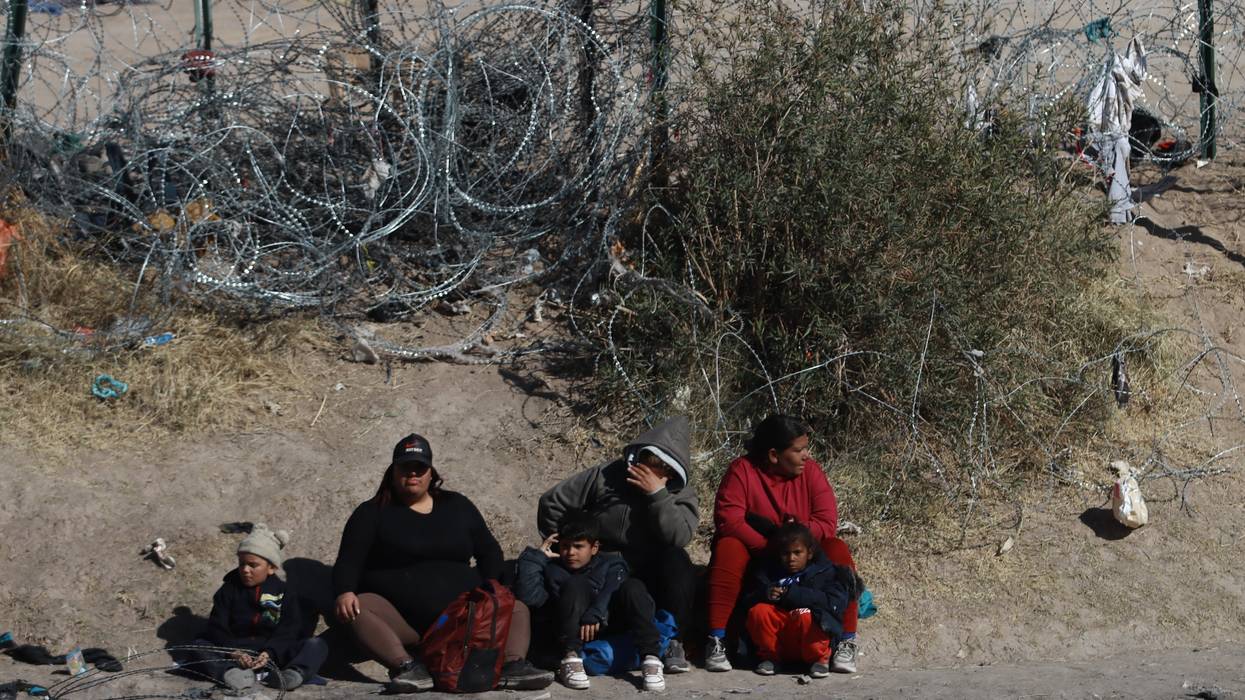
"The idea that 5,000 or even 10,000 people might overwhelm us trivializes both what our government is capable of and our nation's capacity to welcome. Those of us living at the border know this," said one El Paso-based advocate.
Progressives on Saturday urged U.S. President Joe Biden to halt his immigration-related appeals to "a voter who doesn't exist" as he promised voters at a campaign event in South Carolina that he would immediately "shut down the border" between the U.S. and Mexico if Congress passes a bipartisan immigration bill.
Senators are expected to release the legislative text of the bill this week, but Capitol Hill sources have said the bipartisan deal—negotiated chiefly by Sens. Chris Murphy (D-Conn.), Kyrsten Sinema (I-Ariz.), and James Lankford (R-Okla.)—would include a new executive authority to halt asylum screenings on days when border crossings by undocumented immigrants reaches 5,000 over the five-day average.
Under the provision, migrants would be expelled indefinitely until crossings decreased to 3,750 per day. A set amount of asylum claims would be granted at official ports of entry, but the standard for migrants making an asylum claim would be raised, making it harder for people—many of whom have been arriving at the border after fleeing violence and poverty—to get approval to stay in the United States.
"A bipartisan bill would be good for America and help fix our broken immigration system and allow speedy access for those who deserve to be here, and Congress needs to get it done," Biden said in South Carolina, a day after the White House released a written statement on the legislation. "It'll also give me as president the emergency authority to shut down the border until it could get back under control. If that bill were the law today, I'd shut down the border right now and fix it quickly."
Immigrant rights advocates were quick to denounce Biden's promise to eliminate asylum protections for thousands of people, while U.S. House Speaker Mike Johnson (R-La.) said the bill would be "dead on arrival" if it arrives on the House floor and demanded that Biden close the border immediately with his executive authority—something Biden cannot do under federal and international law, said American Immigration Council (AIC) policy director Aaron Reichlin-Melnick.
Although Republicans have insisted on border restrictions in exchange for more military aid for Ukraine and Israel, Oklahoma Republicans passed a resolution condemning Lankford for working with Democrats on the deal.
Johnson complained that the deal would allow "as many as 150,000 illegal crossings each month (1.8 million per year) before any new 'shutdown' authority could be used. At that point, America will have already been surrendered."
"How weak do you have to think the USA is if you're claiming that adding 1.8 million undocumented immigrants a year would "surrender" the nation?" asked Reichlin-Melnick.
Meanwhile, Eleanor Acer, refugee protection director for Human Rights First, warned that former Republican President Donald Trump's anti-migration Title 42 policy already proved to "be a human rights and migration management fiasco."
The U.S. turned away migrants under Title 42 more than 2.8 million times between March 2020—when it was imposed as the coronavirus pandemic began, ostensibly to protect public health—and May 2023. Human Rights First tracked more than 10,000 cases of migrants being kidnapped or physically or sexually assaulted after being expelled under Biden's continuation of Title 42 after he took office. The Kaiser Family Foundation also reported that the policy contributed to the separation of families.
"There are real challenges at the border, and now is the moment that we need our leaders to move forward effective policy solutions that will improve port processing, support communities receiving migrants, and create lawful pathways to citizenship for Dreamers and others," said Deirdre Schifeling, chief political and advocacy officer at the ACLU, on Saturday. "But let's be clear: Cruelty is not a policy solution—and barring people from seeking protection is both callous and unworkable."
"We've already had an expulsion authority before—Title 42—and we know that it did not stop people from coming to the U.S.," added Schifeling. "Instead, we saw record numbers of families and individuals arriving at our border seeking protection, and Title 42 caused tremendous harm to people fleeing danger."
Marisa Limón Garza, executive director of Las Americas Immigrant Advocacy Center in El Paso, Texas, accused Biden of playing "political games" and demanded that he keep his campaign promises to "restore a humane and orderly asylum and immigration system."
"The idea that 5,000 or even 10,000 people might overwhelm us trivializes both what our government is capable of and our nation's capacity to welcome. Those of us living at the border know this," said Limón Garza. "One's commitment to their children is a powerful force that drives parents and children to seek a better life in the U.S... Here in the Borderland we believe in supporting families and keeping them together, not turning our backs on them or tearing them apart.
“We call on Congress and the Biden administration to reverse course and turn away from the political games that drive us toward these reckless immigration proposals," she added.
Author and historian Dan Berger compared Biden's push for new anti-immigration authority to his enthusiasm for a "tough on crime" approach by the Democratic Party three decades ago.
Biden has "won no one over" with his statements on immigration since Friday, said author and podcaster Kate Willett. "It's cruelty for recreation."
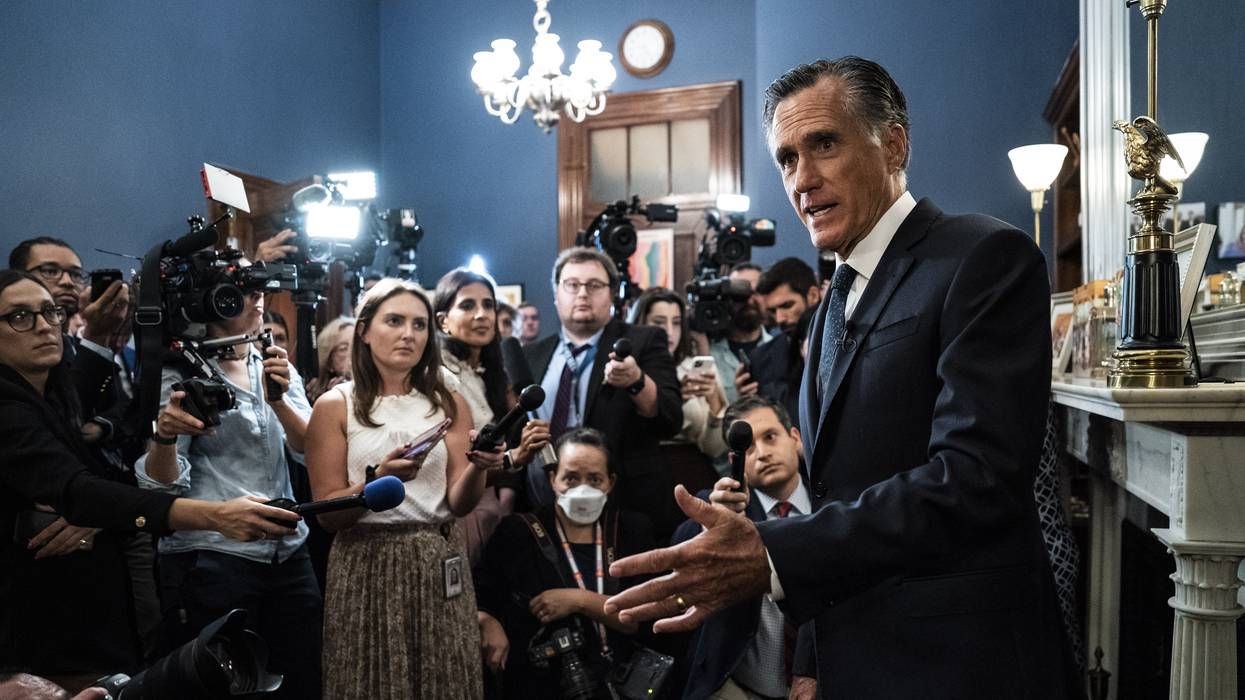
"Speculating that the GOP is blocking border security legislation to help Trump win the election would sound like a crazy conspiracy theory but it's literally what the Republicans are saying is happening."
Critics have long argued that Republicans are interested only in using immigration—and increasingly hysterical claims of a crisis at the U.S.-Mexico border—as a political cudgel, and not in genuine policy reform.
That view appeared to receive some confirmation Thursday when Sen. Mitt Romney (R-Utah) addressed reports that former President Donald Trump—the front-runner for the 2024 GOP presidential nomination—has instructed Republican senators not to strike an immigration deal with Democrats so that he can make the border a central focus of his bid for a second White House term.
"I think the border is a very important issue for Donald Trump," said Romney, who has opted not to run for reelection this year. "And the fact that he would communicate to Republican senators and congresspeople that he doesn't want us to solve the border problem because he wants to blame [President Joe] Biden for it is really appalling."
Romney was responding to a journalist's question about comments that Senate Minority Leader Mitch McConnell (R-Ky.) reportedly made during a closed-door meeting with fellow Republicans on Wednesday. According to Punchbowl News, McConnell told his colleagues that the "politics on this have changed," referring to the GOP's demand that any military aid for Ukraine be paired with draconian changes to U.S. immigration policy.
"We don't want to do anything to undermine him," McConnell said of the former president, who won the Republican primary in New Hampshire on Tuesday after his landslide victory in Iowa last week, further establishing his stranglehold on the party.
Trump, who has pledged to launch the "largest domestic deportation operation in American history" if reelected, has repeatedly tried to insert himself into the ongoing negotiations, writing on social media last week that he'll accept nothing less than a "PERFECT" immigration deal. Proposals on the table reportedly include new asylum restrictions and cuts to the number of people allowed to live and work in the U.S. temporarily.
While some GOP senators pushed back on the notion that Republicans are preparing to drop their border demands to appease Trump's desire to campaign on the issue, The Washington Post's Aaron Blake wrote Thursday that "it's becoming increasingly difficult to dispute that Trump and some Republicans see political value" in preventing an immigration deal that could be seen as beneficial to Biden, who has expressed openness to cutting such a deal—to the dismay of rights groups.
"A comment I keep coming back to on this," wrote Blake, "is one from Rep. Troy E. Nehls (R-Texas), who just came out and said it early this month: 'I'm not willing to do too damn much right now to help a Democrat and to help Joe Biden's approval rating.'"
Other House Republicans—including Speaker Mike Johnson (R-La.)—have also indicated that they're not interested in serious immigration talks.
"I don't think now is the time for comprehensive immigration reform," Johnson said last week.
In response to Romney's comments on Thursday, Rep. Robert Garcia (D-Calif.) asked, "Can we all finally agree that House Republicans and Donald Trump do not want to solve the border challenges?"
"It's all a political game to them," Garcia added. "We've proposed real solutions but the MAGA right isn't interested. Shameful."
Vox's Andrew Prokop wrote Thursday that "if Republicans do kill the deal, it would make all their protestations about how much they supposedly care about this issue look hollow, and the GOP would come off looking tremendously cynical."
"They claim to believe the migrant surge of the past few years is destroying the country," Prokop added, "but they'd be happy to let it continue unaddressed for another year if it means they win an election."
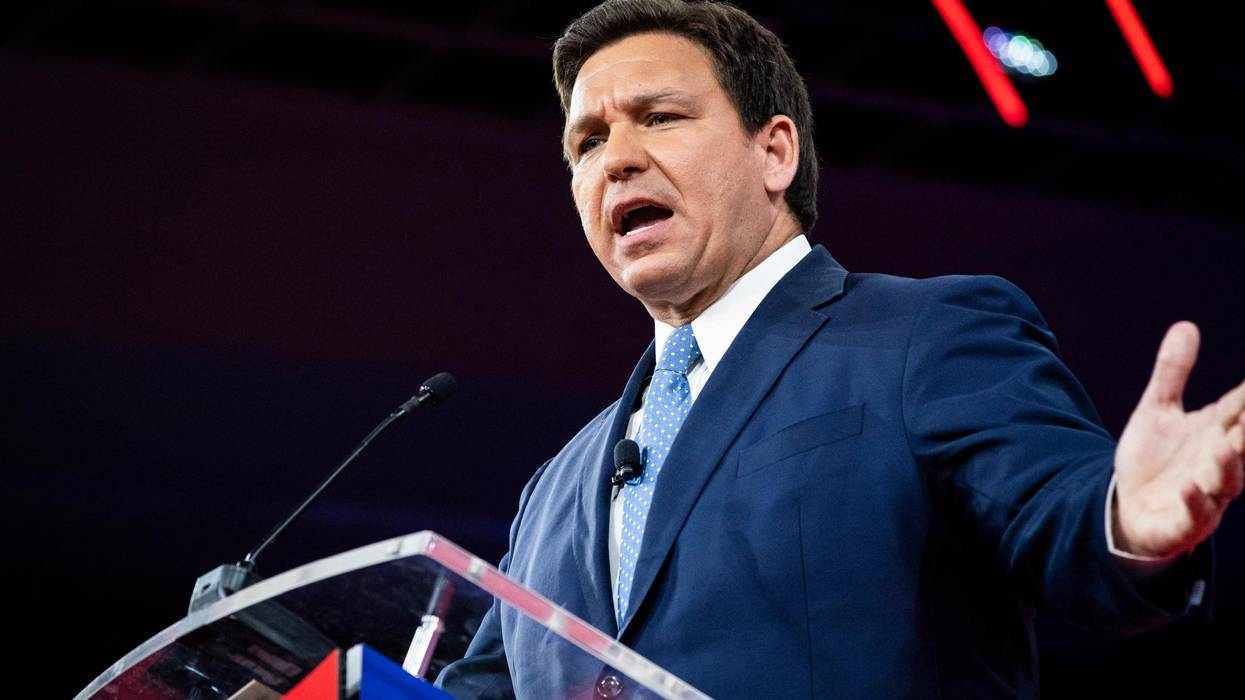
By admitting border agents would have to make their own "judgments" to determine whether to shoot a migrant, said one critic, the Florida governor signaled he would embrace "the large-scale murder of innocent people."
Republican presidential candidate and Florida Gov. Ron DeSantis on Monday night expanded on his proposed border policy, which he has said would include the use of "deadly force" against anyone suspected of drug trafficking—explaining to NBC News that border agents would use the same "rules of engagement" as U.S. forces in Iraq or police officers to determine when they should fire a weapon at someone.
DeSantis first proposed his border policy in June, saying he would "stop the invasion" by deputizing state and local police officers to arrest and deport migrants and detain unaccompanied children who cross the border, ending birthright citizenship, and empowering agents to use deadly force against people suspected of carrying drugs across the border—despite the fact that the vast majority of drug trafficking is carried out with commercial vehicles that travel through official ports of entry rather than people traveling on foot.
On "NBC Nightly News with Lester Holt" on Monday, correspondent Dasha Burns asked DeSantis how agents would determine who was carrying drugs across the border.
Noting that DeSantis worked as an adviser to Navy SEALs, Burns asked the governor, "How do you discern if it's a child, a mother, or a cartel member... A pregnant mom with a baseball cap and a backpack? How do you know you're using deadly force against the right people?"
DeSantis—who in a recent New York Times survey was polling at 17% among GOP voters, far behind former President Donald Trump—all but acknowledged that border agents often would not be able to tell the difference.
"It's the same you would do in any situation," he said. "Same way a police officer would know, same way somebody operating in Iraq would know. These people in Iraq at the time, they all looked the same, you didn't know who had a bomb strapped to them. So those guys have to make judgments."
According to the Costs of War project at the Watson Institute for International and Public Affairs at Brown University, some of the "judgments" made by U.S. military forces on the ground have resulted in 186,694 to 210,038 civilian deaths in Iraq since the war began in 2003.
British non-profit Iraq Body Count has reported that 13% of documented civilian deaths between 2003 and 2011 in Iraq were caused by U.S.-led coalition forces.
John Pfaff, a law professor at Fordham University, said on social media on Monday that DeSantis' proposal that border agents emulate the rules of engagement in Iraq was "terrifying" and "murderous."
The Law Enforcement Epidemiology Project at the University of Illinois Chicago reports that each year, at least 85,000 U.S. civilians suffer non-fatal injuries from the use of force by police officers, while between 600 and 1,000 people are killed by police.
Pfaff wrote that DeSantis made clear he would accept "any sort of false positive rate and the large-scale murder of innocent people" for the sake of carrying out his border policy.
Journalist David Roberts wrote that DeSantis' proposal signaled the governor's "bloodthirsty" embrace of "actual fascism."
"DeSantis," he said, "genuinely wants vulnerable 'out' groups to suffer."
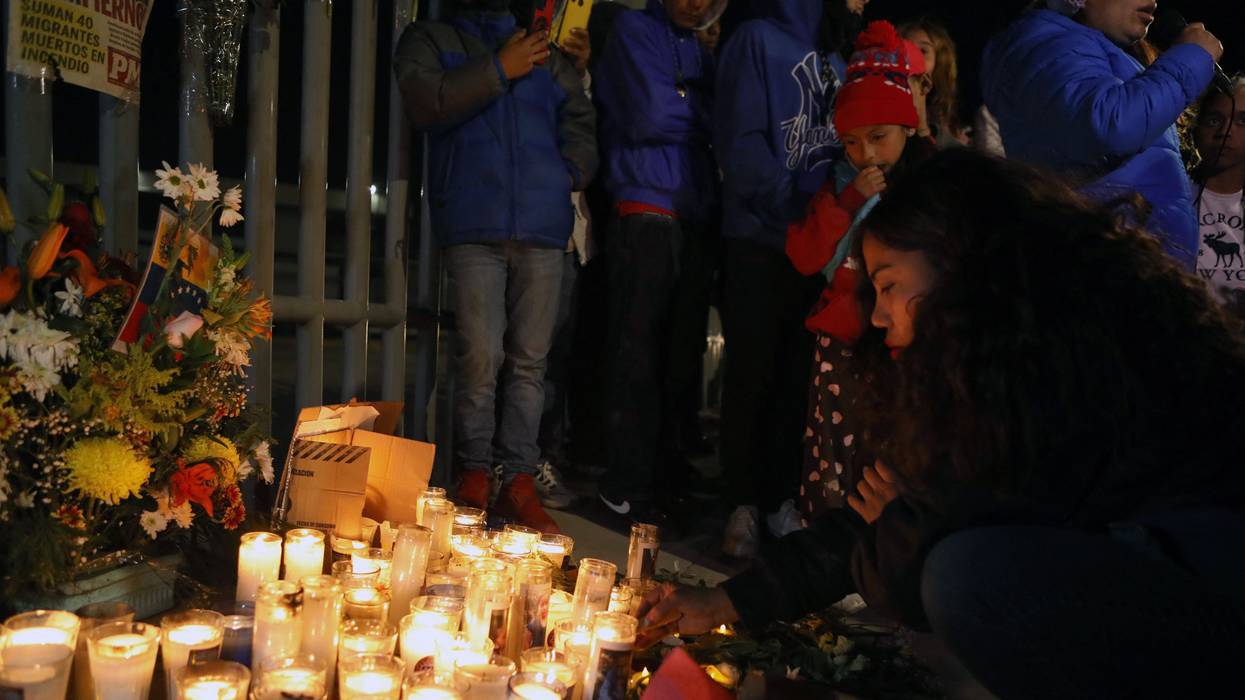
"The U.S. and Mexican governments must work together to ensure that migrants receive access to asylum and to fair and efficient processing at the border and are given humanitarian support when forced to wait in Mexico," said one advocate.
Calling for a full investigation into the fire that killed at least 38 people at a migrant detention center in Ciudad Juarez, Mexico this week, United Nations officials on Tuesday joined human rights groups in calling for an end to the U.S. and Mexican migration policies which led to the detention of dozens of men at the facility.
A spokesperson for the U.N. said all member states must "live up to the commitments they have made as signatories to the U.N.-led Global Compact for Migration," which "intends to reduce the risks and vulnerabilities migrants face at different stages of migration by respecting, protecting, and fulfilling their human rights and providing them with care and assistance."
"We, again, urge all states to adopt alternatives to immigration detention," said the U.N. human rights office.
The 68 men who were being held at the migration facility were mainly from Guatemala, Honduras, Venezuela, and El Salvador originally, and Reuters reported Wednesday that many migrants had been "rounded up off the streets of Ciudad Juarez on Monday" and taken to the center, which is run by Mexico's National Migration Institute (NMI).
A woman named Viangly Infante told the outlet that her husband was among those detained and that the couple had traveled from their home country of Venezuela last fall with their three children, crossing the U.S.-Mexico border in December into Eagle Pass, Texas.
They were then sent back to Mexico by U.S. immigration authorities and bused to Ciudad Juarez.
"We cannot ignore that many of these migrants continue to wait in border cities like Ciudad Juarez without documentation so they can enter the United States to seek protection—a situation created by successive U.S. administrations' undue restrictions on asylum access," said Rachel Schmidtke, senior advocate for Latin America at Refugees International. "The U.S. and Mexican governments must work together to ensure that migrants receive access to asylum and to fair and efficient processing at the border and are given humanitarian support when forced to wait in Mexico."
The U.N. Refugee Agency in January warned the Biden administration that its expansion of former President Donald Trump's Title 42 policy—under which the White House is expelling up to 30,000 migrants per month unless they arrive in the U.S. via a humanitarian parole program—is "not in line with refugee law standards" by which the U.S. is obligated to abide.
Like the U.S. Department of Homeland Security, the NMI in Mexico has long been denounced by migrant rights advocates over its treatment of people in its detention facilities, including overcrowding and lack of medical care. Protests broke out last year in detention centers in Tijuana and the southern city of Tapachula, near the border of Guatemala.
The fire that broke out early Tuesday was reportedly started by migrants who were protesting their confinement in a cell intended for a maximum of 50 people in which 68 people were being detained, and the guards' refusal to provide them with drinking water.
Outrage over the fire, in which at least 29 people have been hospitalized in addition to those who were killed, was compounded Wednesday after newly released surveillance footage footage showed guards quickly walking away from the cell where the men were protesting, while smoke filled the room.
The men were trapped behind padlocked doors as they yelled for help, NBC News reported.
"How could they not get them out?" Katiuska Márquez, a Venezuelan woman who was looking for her half-brother, asked the Associated Press.
The deaths of more than three dozen people in the fire "lay bare a truly inhumane system of immigration enforcement," said Erika Guevara-Rosas, Americas director at Amnesty International. "How is it possible that the Mexican authorities left human beings locked up with no way to escape the fire? These facilities are not 'shelters,' but detention centers, and people are not 'housed' there, but deprived of their freedom."
Amnesty called on Mexican officials to adhere to a recent ruling by the country's Supreme Court of Justice (SCJN), which said on March 15 that people should not be held in migrant detention facilities for more than 36 hours.
"Amnesty International urges the Mexican state to comply with the ruling of the SCJN and to establish protocols to act in fires, as well as evacuation routes in such situations," said the group. "It also calls on the state to investigate the human rights violations, especially the allegations that the migrants were left locked up while the fire occurred, as well as to recognize that the migrants were in its custody and, therefore, it was its obligation both to prevent the fire and to act diligently during the fire to avoid fatal consequences."
The court ruling made clear, said Edith Olivares Ferreto, executive director of Amnesty International Mexico, that the country must "put an end to the practices that have caused untold damage, including torture and cruel, inhuman, and degrading treatment, to thousands of migrants who have passed through these centers."

"The U.S. bears responsibility for pushing these migrants back into Mexico to face unsafe conditions," argued one immigrant rights advocate.
At least 39 migrants were declared dead Tuesday after a fire was started overnight at a detention facility in Ciudad Juárez, close to the U.S.-Mexico border.
Mexico's National Institute of Migration said in a statement that the detention center held 68 men from Central and South America.
"The National Institute of Migration strongly rejects the acts that led to this tragedy," the agency said, without elaborating.
In an address on Tuesday, Mexican President Andrés Manuel López Obrador said the fire was sparked by migrants in protest of their looming deportation.
"They never imagined that this would cause this terrible misfortune," said López Obrador, who noted that most of those killed in the fire were from Central America and some were from Venezuela.
Photos taken at the detention center in the wake of the deadly fire showed emergency workers on the scene and numerous bodies covered by sheets. Dozens who were injured in the fire are reportedly in serious condition.
The disaster is likely to intensify criticism of the immigration policies of the U.S. and Mexico, both of which have been accused of systematically violating the rights of asylum seekers.
The Associated Press noted that "in recent years, as Mexico has stepped up efforts to stem the flow migration to the U.S. border under pressure from the American government, its National Immigration Institute has struggled with overcrowding in its facilities."
Kerri Talbot, deputy director at the Immigration Hub, argued Tuesday that "the U.S. bears responsibility for pushing these migrants back into Mexico to face unsafe conditions"—a reference to the Trump-era "Remain in Mexico" policy.
In December, a Trump-appointed federal judge blocked President Joe Biden's attempt to end the policy, which rights groups say is illegal.
Meanwhile, Biden has been under heavy criticism from advocates for his asylum proposals.
On Monday, the United Nations High Commissioner for Refugees urged the Biden administration to rescind its proposed anti-asylum rule, which critics have compared Trump's "transit ban" that denied asylum to anyone who had traveled to the United States through a third country.
Key portions of the Biden proposal, said the agency, "are incompatible with principles of international refugee law."
This piece has been updated with new information from the Mexican government.