
SUBSCRIBE TO OUR FREE NEWSLETTER
Daily news & progressive opinion—funded by the people, not the corporations—delivered straight to your inbox.
5
#000000
#FFFFFF
To donate by check, phone, or other method, see our More Ways to Give page.


Daily news & progressive opinion—funded by the people, not the corporations—delivered straight to your inbox.
“Unless we fundamentally transform our economic and political systems, the worst is yet to come,” Sen. Bernie Sanders warned.
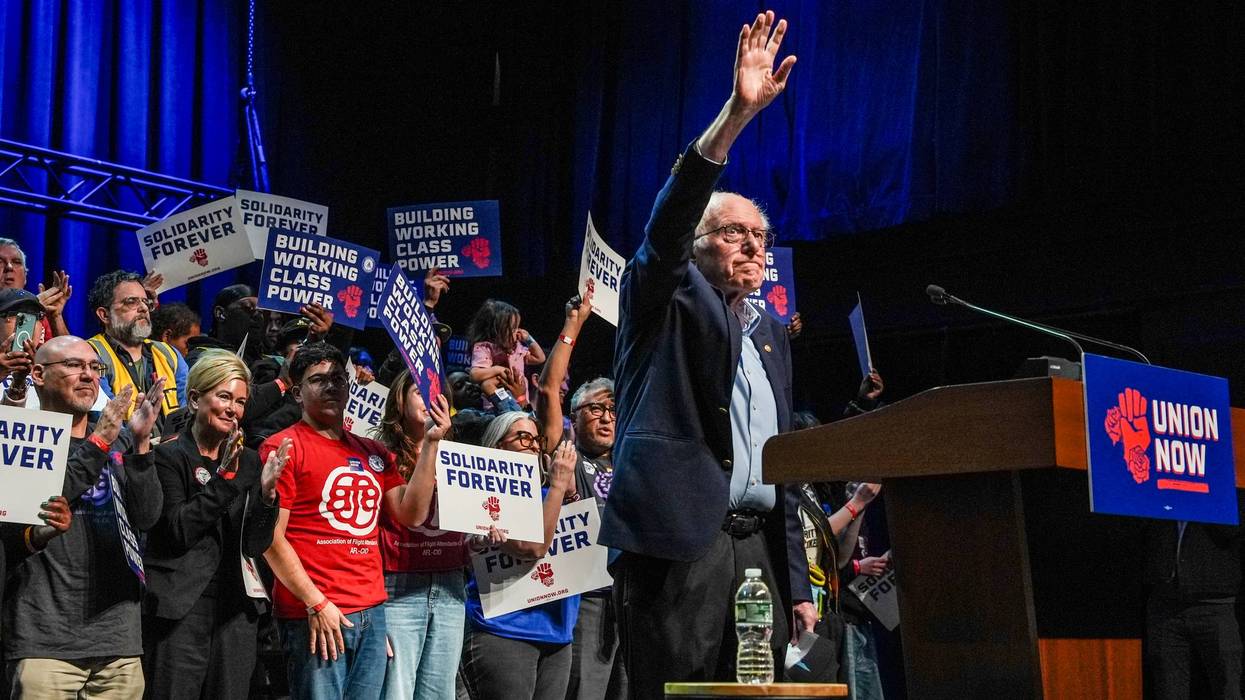
As Republican policies, union-busting corporations, and the imminent threat of artificial intelligence put unprecedented pressure on the US workforce, Sen. Bernie Sanders headlined Sunday's launch of a movement "to strengthen the labor movement and expand worker power across the country."
Sanders (I-VT) spoke at the “Union Now: Building the Labor Movement” rally at Terminal 5 in Hell's Kitchen in Midtown Manhattan alongside New York City Mayor Zohran Mamdani, Association of Flight Attendants-CWA international president Sara Nelson, and other labor and social movement leaders.
“Unless we fundamentally transform our economic and political systems, the worst is yet to come,” Sanders warned. “If the middle class of this country is going to survive, we must understand that status quo politics and status quo economics is no longer good enough."
LIVE Bernie Sanders Zohran Mamdani UNION NOW Rally in NYC https://t.co/uC6atxCK7N
— Status Coup News (@StatusCoup) April 12, 2026
“It’s absolutely important that all of us here and every American understand that in the ruling class of this country today, there is an extraordinary level of arrogance and cruelty,” the senator said.
"The truth is that the 1% the people on top, people running this country have never, ever had it so good,” Sanders told the crowd. “But the sad reality is that for these people, all that they have is not good enough. They want more and more and more, and they don’t care who they step on to get what they want."
“These guys are extremely, extremely greedy people, and they could care less in terms of what happens to our children, what happens to our parents and our grandparents, and what happens to our environment today," the senator argued.
“One of the goals of the oligarchs and the media that they own is to make ordinary people feel that there is nothing that they can do to shape the future,” he added. “And what we are here today to say to [Elon] Musk and his friends: Go to hell.”
Mamdani, who marked 100 days in office, said: "When we talk about the importance of taking on the crisis of income inequality, we know that the most effective tool to do so is increasing union density. Organizing drives and strikes can, frankly, be lonely work. So Union Now is going to support workers and provide them with more resources, and my administration will stand right alongside them. This moment demands nothing less."
“AI and robots are coming for human jobs," the mayor warned. "Worker protections are being eroded. There are companies that think that exploitation is a viable business model. They are wrong.”
Nelson asserted that “growing union membership and bargaining power is crucial for workers' rights and economic justice.”
“Too often, the boss has all the power to starve workers during a fight," she said. "Union Now will work with unions directly to ensure workers have the means to win."
Brittany Norris, a Delta AFA Organizing Committee member and flight attendant, told the crowd that "when it comes to striking, when it comes to public actions, a lot of those things cost money and it’s a lot of time, dedication, and efforts coming from the workers."
“We continuously hear about the profits... that our industry is making, but then we’re begging for a raise that comes up close to what the cost of living increase is every year,” she added.
Sunday's Union Now launch comes amid Sanders' ongoing "Fighting Oligarchy" tour, which has drawn large crowds across the country, including in so-called "red" states. The rally also follows last year's "Workers Over Billionaires" Labor Day rallies and marches in over 1,000 locations.
The Union Now launch also coincides with growing wealth inequality not only in the United States but around a world in which the richest 10% of the global population own three-quarters of planetary wealth and account for nearly half of all consumer spending.
“If [President Donald] Trump and his fellow oligarchs get their way, we will be living in a society where fewer and fewer people have more and more wealth and more and more power, where democracy will be undermined, where workers will be thrown out on the street with no recourse," Sanders said Sunday. “That is not the America we want for ourselves or for our kids."
“The good news is," he added, "if we stand together and we not let Trump and his friends divide us up, when we stand together and fight for a government that works for all of us, there is nothing that we cannot accomplish."
"Europe has always chosen Hungary," said the head of the European Union. "Together, we are stronger."
Far-right Hungarian Prime Minister Viktor Orbán on Sunday conceded defeat to conservative European lawmaker Peter Magyar in parliamentary elections that ended 16 years of increasingly authoritarian Christian nationalist rule amid overt interference from the Trump administration and alleged covert meddling by Russia.
"The election result is not final yet, but it is understandable and clear," Orbán said. "The election result is painful for us, but clear. The responsibility and possibility of governing was not given to us. I have congratulated the winner."
“We will serve our country and the Hungarian nation from the opposition,” he added.
Magyar, who leads the socially conservative but democratic Tisza Party, said on social media that "just now, Prime Minister Viktor Orbán has congratulated me on our victory in a phone call."
Tisza is projected to win 135 seats in the 199-seat Országgyűlés, or Parliament, with nearly half of all votes counted, according to the national election office. Orbán's Fidesz party is projected to control 57 seats, based on results as of Sunday evening.
Magyar had promised that “step by step, brick by brick, we are taking back our homeland and building a new country, a sovereign, modern, European Hungary."
Domestic and international critics have long accused Orbán of systematically eroding Hungary’s democratic institutions, tightening his grip over the country’s political system, and consolidating control over much of the media to strengthen Fidesz's rule.
After serving a single term as prime minister from 1998-2002, Orbán was elected again in 2010 and served four consecutive terms, thanks to passage by Fidesz-led lawmakers of the so-called "Fundamental Law" and other illiberal measures.
Human rights deteriorated markedly during Orbán’s tenure, especially for LGBTQ+ people, migrants, women, and Roma. The European Union has withheld billions of dollars in funding in response.
EU leaders have condemned Orbán’s rule, calling his government a “hybrid regime of electoral autocracy.” Orbán describes it as “illiberal democracy,” while touting its universal appeal to international conservatives, including US President Donald Trump.
European leaders also bristled at Orban’s warm personal relationship with Russian President Vladimir Putin, although the Hungarian leader did condemn Russia’s invasion of Ukraine and voted along with the rest of the 27-nation EU to impose economic sanctions on Moscow.
Russia is accused of trying to influence the outcome of the election in favor of Fidesz via a coordinated online disinformation campaign. At a massive election eve rally and concert in Budapest, thousands of attendees chanted in unison, "Russians go home!"
Anti-Orban concert in Hungary with the audience chanting “Russians, go home”
[image or embed]
— Olga Nesterova (@onestpress.onestnetwork.com) April 10, 2026 at 7:27 PM
Trump and senior members of his administration had openly backed Orbán, with the president promising "to use the full economic might of the United States to strengthen Hungary’s economy" if the prime minister was reelected.
US Vice President JD Vance traveled to Budapest last week to campaign for Orbán. While decrying what he called "disgraceful" interference by the EU—of which Hungary is a member—Vance added that he wanted to “help as much as I can possibly help” to secure Orbán's reelection.
JD Vance is on a historic roll: He campaigns for AfD in Germany - they lose. Invited the Pope to come to US for Trump’s big event - Pope refuses. Leads peace negotiations with Iran - fails miserably. Campaigns in Hungary for Orbán - who gets smoked.
— Ron Filipkowski (@ronfilipkowski.bsky.social) April 12, 2026 at 1:01 PM
Orbán has also accused Ukraine of election interference, although he has provided no evidence supporting his claim.
Responding to alleged foreign meddling, Magyar said on social media that "this is our country."
"Hungarian history is not written in Washington, Moscow, or Brussels—it is written in Hungary's streets and squares," he insisted.
Numerous world leaders congratulated Magyar.
"Europe’s heart is beating stronger in Hungary tonight," European Commission President Ursula von der Leyen said on social media. "Hungary has chosen Europe. Europe has always chosen Hungary. Together, we are stronger. A country reclaims its European path. The Union grows stronger."
German Chancellor Friedrich Merz said: "The Hungarian people have decided. My heartfelt congratulations on your electoral success. I am looking forward to working with you. Let’s join forces for a strong, secure and, above all, united Europe."
French President Emmanuel Macron wrote on X that "France welcomes what has been a victory in terms of people taking part in the democratic process, and a victory which shows the attachment of the Hungarian people to the values of the European Union and for Hungary's role in Europe."
Swedish Prime Minister Ulf Kristersson cheered "Tisza's historic victory in the Hungarian election!"
"I look forward to working closely with you—as allies and EU Members," Kristersson added. "This marks a new chapter in the history of Hungary.”
"Blocking the Strait of Hormuz to unblock the Strait of Hormuz is peak Trump foreign policy," said one observer.
US President Donald Trump on Sunday announced a military blockade of the Strait of Hormuz as Vice President JD Vance's negotiating team failed to gain the trust of their Iranian counterparts, who have been burned by the United States before and are loath to surrender sovereignty over their nuclear program.
Trump announced in an early morning post on his Truth Social network that, "effective immediately," the Strait of Hormuz—which was open before the president launched his illegal war of choice—would be closed to all shipping. Around 20% of the world's oil passed through the waterway before the war.
"At some point, we will reach an 'ALL BEING ALLOWED TO GO IN, ALL BEING ALLOWED TO GO OUT' basis, but Iran has not allowed that to happen by merely saying, 'There may be a mine out there somewhere,' that nobody knows about but them," Trump wrote. "THIS IS WORLD EXTORTION, and Leaders of Countries, especially the United States of America, will never be extorted."
Blocking the Strait of Hormuz to unblock the Strait of Hormuz is peak Trump foreign policy.
[image or embed]
— Eliot Higgins (@eliothiggins.bsky.social) April 12, 2026 at 6:11 AM
"I have also instructed our Navy to seek and interdict every vessel in International Waters that has paid a toll to Iran," the president continued, referring to one of the concessions reportedly in the cease-fire agreement with Iran that he approved last week. "No one who pays an illegal toll will have safe passage on the high seas. We will also begin destroying the mines the Iranians laid in the Straits. Any Iranian who fires at us, or at peaceful vessels, will be BLOWN TO HELL!"
"Iran will not be allowed to profit off this Illegal Act of EXTORTION," Trump added. "They want money and, more importantly, they want Nuclear. Additionally and, at an appropriate moment, we are fully 'LOCKED AND LOADED,' and our Military will finish up the little that is left of Iran!"
Responding to Trump's post, Medea Benjamin, co-founder of the peace group CodePink, said: "So get this. Trump wants to open the Strait of Hormuz by closing the Strait of Hormuz. Blow up the world economy to punish Iran. Make sense?"
Ryan Costello, policy director at the National Iranian American Council, also took to social media, writing that "a blockade is an act of war, so Trump is announcing he will reenter the US into a war has been illegal under domestic and international law and has been disastrous for US interests, regional security, and the people of Iran."
In a social media post, journalist Séamus Malekafzali said: "I have legitimately never heard of a more insane, designed-to-backfire policy under this administration; maybe ever. Not only attempting to blockade Iranian ships, but ANY ship that goes through the Strait of Hormuz by paying the toll."
While Trump and Secretary of State Marco Rubio attended a UFC match in Miami, Vance was left with the task of marathon negotiations with Iranian officials in Islamabad, Pakistan. It was the first direct high-level talks between the two countries since 1979.
“We need to see an affirmative commitment that [Iran] will not seek a nuclear weapon, and they will not seek the tools that would enable them to quickly achieve a nuclear weapon,” Vance told reporters after the talks. “That is the core goal of the president of the United States, and that’s what we’ve tried to achieve through these negotiations.”
Iran’s government was willing to make unprecedented concessions regarding its nuclear program up until the US and Israel began bombing the country on February 28. Every US administration since that of former President George W. Bush—including Trump’s—has concluded that Iran is not seeking to develop nuclear weapons.
Iran gave its assurance that it would not build nukes in the Joint Comprehensive Plan of Action it signed in 2015 during the presidency of Barack Obama. Trump unilaterally scrapped the agreement, which was also called the Iran nuclear deal, during his first term despite—some say because of—Iran's full compliance.
So the Trump administration’s two goals in peace talks with Iran are:1. A commitment by Iran not to develop a nuke (This was part of the Obama deal that Trump canceled)2. Opening the Strait of Hormuz. (Was open before war.)
— Judd Legum (@juddlegum.bsky.social) April 12, 2026 at 4:20 AM
Iranian Parliamentary Speaker Mohammad Baqer Ghalibaf blamed the US for the breakdown in talks.
"My colleagues on the Iranian delegation Minaab168 raised forward-looking initiatives, but the opposing side ultimately failed to gain the trust of the Iranian delegation in this round of negotiations," Ghalibaf said in a social media post. The Iranian delegation was named after the town where 168 children and staff at an elementary school were massacred in a US cruise missile strike on the first day of the war.
"Before the negotiations, I emphasized that we have the necessary good faith and will, but due to the experiences of the two previous wars, we have no trust in the opposing side," Ghalibaf explained.
Just hours before Trump announced his decision to bomb Iran in February, Omani Foreign Minister Badr bin Hamad Al Busaidi, the mediator of talks between the US and Iranian governments, said that a “peace deal is within our reach," prompting Iranian officials and others to accuse the Americans of acting in bad faith. Similar accusations were leveled when the US and Israel launched attacks on Iran in the summer of 2025 amid ongoing nuclear negotiations.
"America has understood our logic and principles," said Ghalibaf, "and now it's time for it to decide whether it can earn our trust or not?"
The US and Israel have been bombing Iran for 43 days. They have bombed more than 13,000 targets, assassinated senior political and military figures—including the late Supreme Leader Ayatollah Ali Khamenei—and, according to Iranian medical officials, killed more than 3,000 people, including hundreds of women and children. Israel's concurrent bombing of Lebanon has also killed hundreds of civilians.
Trump has vowed to bomb Iran "back to the Stone Ages" and destroy Iranian civilization, a genocidal threat that comes amid Israel's killing and maiming of over 250,000 Palestinians in Gaza in a war for which it is facing a genocide case at the International Court of Justice and its prime minister, Benjamin Netanyahu, is wanted by the International Criminal Court for alleged crimes against humanity and war crimes.
Iran, while weakened militarily, appears to be in a position of strategic strength. But to hear Trump say it, Iran is “LOSING, and LOSING BIG!”
"The Iranians don’t seem to realize they have no cards, other than a short term extortion of the World by using International Waterways,” he wrote on Truth Social as Vance headed to Pakistan. “The only reason they are alive today is to negotiate!”
Iranian Foreign Ministry spokesperson Esmaeil Baghaei advised patience, asserting that a diplomatic breakthrough was highly unlikely after just one round of talks.
“Naturally, from the beginning we should not have expected to reach an agreement in a single session," Baghaei said. "No one had such an expectation."
There’s a real risk that the US presidency could advance an economic agenda that prioritizes the interests of the wealthy while sidelining efforts to tackle inequality, strengthen fair taxation, and resolve deepening debt crises worldwide.
In just a year, the wealth of the 10 richest US billionaires increased by $698 billion dollars, while low-wage workers struggled as the Trump administration pushed an inequality-fueling agenda. Now, concerns are growing that the same policy choices—those driving a massive transfer of wealth to the richest—could be projected onto the global stage.
The United States recently assumed the presidency of the G20—a major platform for heads of state and governments to address global economic issues. The presidency is a role that carries significant influence over global economic priorities. There’s a real risk that the US presidency could advance an economic agenda that prioritizes the interests of the wealthy while sidelining efforts to tackle inequality, strengthen fair taxation, and resolve deepening debt crises worldwide.
Instead of focusing the G20 on poverty alleviation, reducing inequality, or dealing with a pending global economic crisis, the US government focus will center on removing regulatory burdens, unlocking energy supply chains, and pioneering new technologies and innovation. This marks a sharp departure from the 2025 theme of “Solidarity, Equality, and Sustainability” and signals a shift toward exporting the Trump administration’s domestic agenda to the global stage.
This all comes at a time when inequality is rising across most countries, and many low- and middle-income nations face mounting debt and stagnant growth.
As the US government so blatantly prioritizes wealthy interests, it is a critical moment for civil society to step forward—organizing and advancing an agenda that breaks decisively from the G20’s all-too-often emphasis on preserving the status quo.
US officials are pitching a “back to the basics” approach—which in reality is a sidelining of issues such as inequality, poverty, labor, climate, and gender. It is also widely anticipated that the Trump administration will restrict avenues for civil society participation.
Current plans suggest a focus on the leaders’ summit and financial track; a reduction in working groups; and formal engagement limited to business stakeholders, excluding civil society organizations, women’s groups, labor unions, and youth representatives. Even acknowledging that past G20 efforts on sustainable development have been uneven, this “back to the basics” approach risks abandoning critical priorities altogether.
Recent G20 presidencies led by Brazil and South Africa demonstrated a different trajectory, placing inequality and debt at the center of global discussions. South Africa’s 2025 presidency elevated the urgency of inequality by commissioning the first-ever G20 report on the issue. Led by professor Joseph Stiglitz, the report described a global “inequality emergency” and proposed the creation of an International Panel on Inequality to guide coordinated action.
Against this backdrop, the Trump administration’s domestic policies, including the 2025 One Big Beautiful Bill Act (OBBBA), represent one of the largest upward transfers of wealth in decades, making it unlikely that current US leadership will champion similar efforts internationally.
Progress on global tax cooperation is also under threat. Brazil’s 2024 presidency achieved a breakthrough agreement to cooperate on taxing high-net-worth individuals. While extreme wealth concentration has increased in recent years, research shows billionaires pay effective tax rates close to 0.3% of their wealth—well below what average workers contribute.
Yet in 2025, the Trump administration has already taken actions that undermine these efforts, including withdrawing from United Nations tax negotiations, pressuring other advanced economies to shield US corporations from global tax agreements, and opposing measures such as digital services and carbon taxes.
Climate action presents another area of concern. G20 countries are responsible for approximately 80% of global greenhouse gas emissions, yet many continue to fall short of their commitments. The US administration’s withdrawal from the Paris Agreement and rollback of domestic climate policies reflect a broader retreat from climate leadership.
The Trump administration’s emphasis on expanding energy supply chains raises the possibility that fossil fuel development could be prioritized over clean energy transitions, particularly if multilateral development banks are encouraged to increase investments in oil and gas projects.
Taken together, these signals suggest that the 2026 US G20 presidency could mark a significant retreat. Rather than building on recent efforts to address inequality, debt, and climate change, it may instead shift the forum toward a narrower agenda that prioritizes elite and corporate interests.
The direction ultimately taken will have far-reaching consequences, not only for the credibility of the G20 but for the future of global economic cooperation. As the US government so blatantly prioritizes wealthy interests, it is a critical moment for civil society to step forward—organizing and advancing an agenda that breaks decisively from the G20’s all-too-often emphasis on preserving the status quo.
Now is the time for people, institutions, and movements to unite and champion bold new forms of multilateral cooperation that serve billions, not billionaires.