SUBSCRIBE TO OUR FREE NEWSLETTER
Daily news & progressive opinion—funded by the people, not the corporations—delivered straight to your inbox.
5
#000000
#FFFFFF
To donate by check, phone, or other method, see our More Ways to Give page.
Daily news & progressive opinion—funded by the people, not the corporations—delivered straight to your inbox.
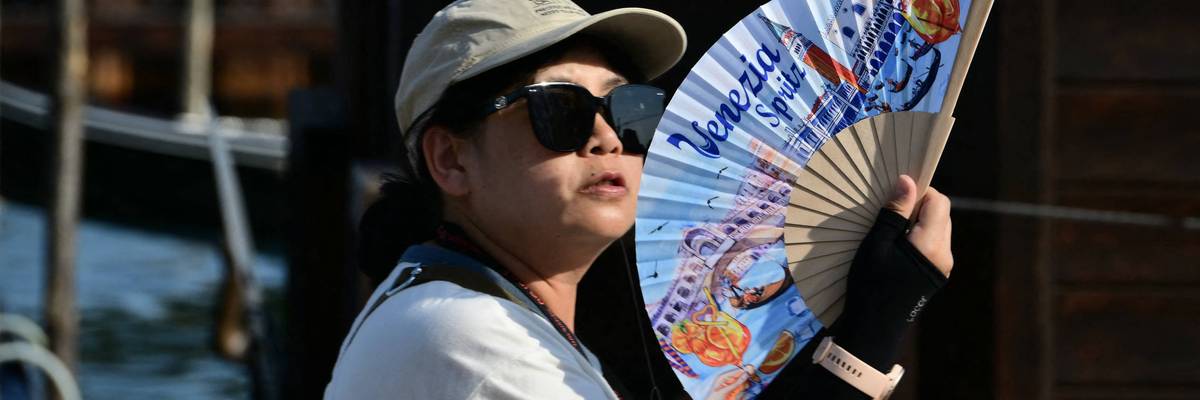
A tourist uses a hand fan to cool herself while visiting St. Mark's Square in Venice, Italy, on June 26, 2026.
"Europe's savage heatwave has the fingerprints of the climate crisis all over it—it's the latest price to pay for fossil fuel pollution baking our planet," said one UN leader.
With at least hundreds of people dead and high temperatures persisting, scientists said Friday that the "record-shattering" heatwave devastating Europe was "virtually impossible just 50 years ago"—and climate change driven by fossil fuel emissions "is unequivocally to blame."
World Weather Attribution (WWA), an international scientific collaboration that analyzes extreme weather events, said daytime highs and overnight temperatures that have been scorching several European countries likely could not have occurred in 1976, and a similar heatwave in that historic climate would be 6.3°F cooler.
The findings followed a Monday analysis from ClimaMeter showing that weather patterns similar to those driving the current European heatwave now produce temperatures roughly 3.6-7.2°F warmer, depending on location, than they did during the second half of the 20th century, because of greenhouse gas emissions.
"The sweltering overnight temperatures keeping many people awake this week are about 100x more likely today than they were just 23 years ago during the infamous 2003 European heatwave," WWA said Friday. "The daytime peaks are about 10x more likely."
WWA found that a "staggering" 45% of 854 cities across 30 European countries have broken, or are expected to break, their records for wet-bulb globe temperatures—which incorporate temperature, humidity, wind speed, and sunlight to measure the risk to humans.
"The science of how climate change is worsening heatwaves is settled. Continued fossil fuel emissions are directly responsible for the disruption people are experiencing this week in their homes, schools, and workplaces," said Theodore Keeping, a co-author of the WWA study who researches extreme weather and wildfire at the United Kingdom's Imperial College London (ICL).
"The speed of change is startling," Keeping continued. "Every few years, we are seeing heat records shattered in Europe. This year, it has been in consecutive months. In the UK, we are used to 'snow days' shutting down schools, but this generation is now growing up with 'heat days' as well."
While the "heat dome" responsible for Europe's second heatwave in two months "was moving east on Friday, bringing marginal relief to some areas in the west and threatening parts of Central and Eastern Europe with a scorching weekend," according to The New York Times, the 97.5°F recorded in southwest England was Britain's highest temperature ever for June, breaking a record set the previous day.
A record-breaking heat wave that’s spreading eastward across Europe has revived interest in a hypothetical temperature forecast for August 2050 in France.But it turns out, it didn’t take 36 years for those imagined temperatures to be reached — and even exceeded.
[image or embed]
— The Washington Post (@washingtonpost.com) June 25, 2026 at 12:30 PM
France also faced more intense heat on Friday, with a 103.3°F reading in Paris. The Washington Post pointed out that two days earlier, as parts of the country endured 112.3°F, soaring temperatures exceeded hypothetical forecasts for August 2050 in 19 of 34 locations across the French mainland.
The current conditions have proven deadly. As Reuters reported:
At least 48 people have died in France from drowning since the start of the heatwave while trying to cool off, authorities said, and three young children are known to have been killed by heat in cars in two separate incidents.
Since the end of last week, more than 20 people across Germany have died in swimming-related accidents, the German Life Saving Association said in a statement to Reuters.
Spain's Mortality Monitoring System estimated that the recent heat has resulted in at least 212 deaths, mostly among people ages 65 and older. Diana Gómez, a scientist at the agency, noted that the figures are preliminary and based on statistical projections.
Acknowledging that "many people still live, work, and study in places that are not designed for the temperatures we are now experiencing," Carolina Pereira Marghidan of the Red Cross Red Crescent Climate Center said to "follow local heat advice, seek cooler spaces where possible, drink plenty of water, and check on family, friends, and neighbors who may be most at risk."
Pereira Marghidan also highlighted the "growing gap between the pace of climate change and the pace of adaptation," and called for "greater investment in heat-resilient homes, cities, and infrastructure to keep people safe."
Right now, record-breaking, dangerous heat waves are rolling across Europe. This isn't just "summer weather". This is exactly what the climate crisis looks like 🥵
— Greenpeace International 🌍 (@greenpeace.org) June 24, 2026 at 7:57 AM
Speaking at London Climate Action Week on Wednesday, United Nations Secretary-General António Guterres similarly said that "climate adaptation is no longer about preparing for a distant future. It's about managing risks in real time—as the searing heat now gripping London and far beyond makes unmistakably clear."
"Our climate is changing faster than our systems, our infrastructure, and our institutions can handle. The World Meteorological Organization confirms that the past 11 years have been the hottest on record. Scientists now expect the world to exceed 1.5°C in the coming years," he continued, citing the Paris Agreement's goal to limit temperature rise this century. "We're entering a new era of climate risk."
The heat has sparked calls to tackle the root cause of the rising temperatures—fossil fuel emissions—from Guterres and others. UN Climate Change Executive Secretary Simon Stiell said Thursday that "Europe's savage heatwave has the fingerprints of the climate crisis all over it—it's the latest price to pay for fossil fuel pollution baking our planet."
"Schools closing, the vulnerable dying, economies sweating: This is what the climate crisis looks like in practice, and it's just getting started," he emphasized. "Until humanity stops burning colossal amounts of coal, oil, and gas, extreme heat will keep getting worse, and other climate impacts—from megadroughts, floods, wildfires, and storms—will keep hammering every economy and population harder each year."
David Ho, a University of Hawaii at Mānoa professor, said on social media: "The heatwave in western Europe is the most severe and widespread ever, with almost half of Europe's largest cities experiencing their worst ever heat stress, a combination of high temperatures and humidity. Unless we stop burning fossil fuels, future heat conditions will become even more extreme."
I spoke with Geeta GuruMurthy of BBC World News Television about the record European heat wave and it's link to human-caused warming:youtu.be/d8vqO2J8WV0
[image or embed]
— Michael E. Mann (@michaelemann.bsky.social) June 25, 2026 at 2:17 PM
Although some natural phenomena can contribute to high temperatures, and the National Oceanic and Atmospheric Administration announced earlier this month that El Niño, the warm phase of a recurring climate pattern in the Pacific Ocean, had formed, WWA found that it "had no role in driving the heat" in Europe.
"Scientists like me are beginning to sound like a broken record. We put out similar quotes year after year, reacting to heat extremes that climb ever higher. Yes this is climate change, yes it's us, no it's not El Niño, yes we have the solutions, no we're not implementing them fast enough," said study co-author and ICL climate science professor Friederike Otto. "It's really now a question of what kind of future we want for ourselves, and whether we're willing to do what it takes to secure it."
On the heels of a French court's ruling against TotalEnergies, Lisa Rose, a campaigner at the global climate group 350.org, argued Friday that "it's time to turn the heat on the fossil fuel giants that caused this heatwave but are doing nothing to cover the costs."
"Both science and the law are clear: Polluters must answer for climate damage. Now it's up to our leaders to make them pay," Rose said. "Forcing fossil fuel companies to cut emissions and pay their fair share is the only effective lasting response. Half-measures won't cool this crisis, only a faster shift to renewables can."
Dear Common Dreams reader, It’s been nearly 30 years since I co-founded Common Dreams with my late wife, Lina Newhouser. We had the radical notion that journalism should serve the public good, not corporate profits. It was clear to us from the outset what it would take to build such a project. No paid advertisements. No corporate sponsors. No millionaire publisher telling us what to think or do. Many people said we wouldn't last a year, but we proved those doubters wrong. Together with a tremendous team of journalists and dedicated staff, we built an independent media outlet free from the constraints of profits and corporate control. Our mission has always been simple: To inform. To inspire. To ignite change for the common good. Building Common Dreams was not easy. Our survival was never guaranteed. When you take on the most powerful forces—Wall Street greed, fossil fuel industry destruction, Big Tech lobbyists, and uber-rich oligarchs who have spent billions upon billions rigging the economy and democracy in their favor—the only bulwark you have is supporters who believe in your work. But here’s the urgent message from me today. It's never been this bad out there. And it's never been this hard to keep us going. At the very moment Common Dreams is most needed, the threats we face are intensifying. We need your support now more than ever. We don't accept corporate advertising and never will. We don't have a paywall because we don't think people should be blocked from critical news based on their ability to pay. Everything we do is funded by the donations of readers like you. When everyone does the little they can afford, we are strong. But if that support retreats or dries up, so do we. Will you donate now to make sure Common Dreams not only survives but thrives? —Craig Brown, Co-founder |
With at least hundreds of people dead and high temperatures persisting, scientists said Friday that the "record-shattering" heatwave devastating Europe was "virtually impossible just 50 years ago"—and climate change driven by fossil fuel emissions "is unequivocally to blame."
World Weather Attribution (WWA), an international scientific collaboration that analyzes extreme weather events, said daytime highs and overnight temperatures that have been scorching several European countries likely could not have occurred in 1976, and a similar heatwave in that historic climate would be 6.3°F cooler.
The findings followed a Monday analysis from ClimaMeter showing that weather patterns similar to those driving the current European heatwave now produce temperatures roughly 3.6-7.2°F warmer, depending on location, than they did during the second half of the 20th century, because of greenhouse gas emissions.
"The sweltering overnight temperatures keeping many people awake this week are about 100x more likely today than they were just 23 years ago during the infamous 2003 European heatwave," WWA said Friday. "The daytime peaks are about 10x more likely."
WWA found that a "staggering" 45% of 854 cities across 30 European countries have broken, or are expected to break, their records for wet-bulb globe temperatures—which incorporate temperature, humidity, wind speed, and sunlight to measure the risk to humans.
"The science of how climate change is worsening heatwaves is settled. Continued fossil fuel emissions are directly responsible for the disruption people are experiencing this week in their homes, schools, and workplaces," said Theodore Keeping, a co-author of the WWA study who researches extreme weather and wildfire at the United Kingdom's Imperial College London (ICL).
"The speed of change is startling," Keeping continued. "Every few years, we are seeing heat records shattered in Europe. This year, it has been in consecutive months. In the UK, we are used to 'snow days' shutting down schools, but this generation is now growing up with 'heat days' as well."
While the "heat dome" responsible for Europe's second heatwave in two months "was moving east on Friday, bringing marginal relief to some areas in the west and threatening parts of Central and Eastern Europe with a scorching weekend," according to The New York Times, the 97.5°F recorded in southwest England was Britain's highest temperature ever for June, breaking a record set the previous day.
A record-breaking heat wave that’s spreading eastward across Europe has revived interest in a hypothetical temperature forecast for August 2050 in France.But it turns out, it didn’t take 36 years for those imagined temperatures to be reached — and even exceeded.
[image or embed]
— The Washington Post (@washingtonpost.com) June 25, 2026 at 12:30 PM
France also faced more intense heat on Friday, with a 103.3°F reading in Paris. The Washington Post pointed out that two days earlier, as parts of the country endured 112.3°F, soaring temperatures exceeded hypothetical forecasts for August 2050 in 19 of 34 locations across the French mainland.
The current conditions have proven deadly. As Reuters reported:
At least 48 people have died in France from drowning since the start of the heatwave while trying to cool off, authorities said, and three young children are known to have been killed by heat in cars in two separate incidents.
Since the end of last week, more than 20 people across Germany have died in swimming-related accidents, the German Life Saving Association said in a statement to Reuters.
Spain's Mortality Monitoring System estimated that the recent heat has resulted in at least 212 deaths, mostly among people ages 65 and older. Diana Gómez, a scientist at the agency, noted that the figures are preliminary and based on statistical projections.
Acknowledging that "many people still live, work, and study in places that are not designed for the temperatures we are now experiencing," Carolina Pereira Marghidan of the Red Cross Red Crescent Climate Center said to "follow local heat advice, seek cooler spaces where possible, drink plenty of water, and check on family, friends, and neighbors who may be most at risk."
Pereira Marghidan also highlighted the "growing gap between the pace of climate change and the pace of adaptation," and called for "greater investment in heat-resilient homes, cities, and infrastructure to keep people safe."
Right now, record-breaking, dangerous heat waves are rolling across Europe. This isn't just "summer weather". This is exactly what the climate crisis looks like 🥵
— Greenpeace International 🌍 (@greenpeace.org) June 24, 2026 at 7:57 AM
Speaking at London Climate Action Week on Wednesday, United Nations Secretary-General António Guterres similarly said that "climate adaptation is no longer about preparing for a distant future. It's about managing risks in real time—as the searing heat now gripping London and far beyond makes unmistakably clear."
"Our climate is changing faster than our systems, our infrastructure, and our institutions can handle. The World Meteorological Organization confirms that the past 11 years have been the hottest on record. Scientists now expect the world to exceed 1.5°C in the coming years," he continued, citing the Paris Agreement's goal to limit temperature rise this century. "We're entering a new era of climate risk."
The heat has sparked calls to tackle the root cause of the rising temperatures—fossil fuel emissions—from Guterres and others. UN Climate Change Executive Secretary Simon Stiell said Thursday that "Europe's savage heatwave has the fingerprints of the climate crisis all over it—it's the latest price to pay for fossil fuel pollution baking our planet."
"Schools closing, the vulnerable dying, economies sweating: This is what the climate crisis looks like in practice, and it's just getting started," he emphasized. "Until humanity stops burning colossal amounts of coal, oil, and gas, extreme heat will keep getting worse, and other climate impacts—from megadroughts, floods, wildfires, and storms—will keep hammering every economy and population harder each year."
David Ho, a University of Hawaii at Mānoa professor, said on social media: "The heatwave in western Europe is the most severe and widespread ever, with almost half of Europe's largest cities experiencing their worst ever heat stress, a combination of high temperatures and humidity. Unless we stop burning fossil fuels, future heat conditions will become even more extreme."
I spoke with Geeta GuruMurthy of BBC World News Television about the record European heat wave and it's link to human-caused warming:youtu.be/d8vqO2J8WV0
[image or embed]
— Michael E. Mann (@michaelemann.bsky.social) June 25, 2026 at 2:17 PM
Although some natural phenomena can contribute to high temperatures, and the National Oceanic and Atmospheric Administration announced earlier this month that El Niño, the warm phase of a recurring climate pattern in the Pacific Ocean, had formed, WWA found that it "had no role in driving the heat" in Europe.
"Scientists like me are beginning to sound like a broken record. We put out similar quotes year after year, reacting to heat extremes that climb ever higher. Yes this is climate change, yes it's us, no it's not El Niño, yes we have the solutions, no we're not implementing them fast enough," said study co-author and ICL climate science professor Friederike Otto. "It's really now a question of what kind of future we want for ourselves, and whether we're willing to do what it takes to secure it."
On the heels of a French court's ruling against TotalEnergies, Lisa Rose, a campaigner at the global climate group 350.org, argued Friday that "it's time to turn the heat on the fossil fuel giants that caused this heatwave but are doing nothing to cover the costs."
"Both science and the law are clear: Polluters must answer for climate damage. Now it's up to our leaders to make them pay," Rose said. "Forcing fossil fuel companies to cut emissions and pay their fair share is the only effective lasting response. Half-measures won't cool this crisis, only a faster shift to renewables can."
With at least hundreds of people dead and high temperatures persisting, scientists said Friday that the "record-shattering" heatwave devastating Europe was "virtually impossible just 50 years ago"—and climate change driven by fossil fuel emissions "is unequivocally to blame."
World Weather Attribution (WWA), an international scientific collaboration that analyzes extreme weather events, said daytime highs and overnight temperatures that have been scorching several European countries likely could not have occurred in 1976, and a similar heatwave in that historic climate would be 6.3°F cooler.
The findings followed a Monday analysis from ClimaMeter showing that weather patterns similar to those driving the current European heatwave now produce temperatures roughly 3.6-7.2°F warmer, depending on location, than they did during the second half of the 20th century, because of greenhouse gas emissions.
"The sweltering overnight temperatures keeping many people awake this week are about 100x more likely today than they were just 23 years ago during the infamous 2003 European heatwave," WWA said Friday. "The daytime peaks are about 10x more likely."
WWA found that a "staggering" 45% of 854 cities across 30 European countries have broken, or are expected to break, their records for wet-bulb globe temperatures—which incorporate temperature, humidity, wind speed, and sunlight to measure the risk to humans.
"The science of how climate change is worsening heatwaves is settled. Continued fossil fuel emissions are directly responsible for the disruption people are experiencing this week in their homes, schools, and workplaces," said Theodore Keeping, a co-author of the WWA study who researches extreme weather and wildfire at the United Kingdom's Imperial College London (ICL).
"The speed of change is startling," Keeping continued. "Every few years, we are seeing heat records shattered in Europe. This year, it has been in consecutive months. In the UK, we are used to 'snow days' shutting down schools, but this generation is now growing up with 'heat days' as well."
While the "heat dome" responsible for Europe's second heatwave in two months "was moving east on Friday, bringing marginal relief to some areas in the west and threatening parts of Central and Eastern Europe with a scorching weekend," according to The New York Times, the 97.5°F recorded in southwest England was Britain's highest temperature ever for June, breaking a record set the previous day.
A record-breaking heat wave that’s spreading eastward across Europe has revived interest in a hypothetical temperature forecast for August 2050 in France.But it turns out, it didn’t take 36 years for those imagined temperatures to be reached — and even exceeded.
[image or embed]
— The Washington Post (@washingtonpost.com) June 25, 2026 at 12:30 PM
France also faced more intense heat on Friday, with a 103.3°F reading in Paris. The Washington Post pointed out that two days earlier, as parts of the country endured 112.3°F, soaring temperatures exceeded hypothetical forecasts for August 2050 in 19 of 34 locations across the French mainland.
The current conditions have proven deadly. As Reuters reported:
At least 48 people have died in France from drowning since the start of the heatwave while trying to cool off, authorities said, and three young children are known to have been killed by heat in cars in two separate incidents.
Since the end of last week, more than 20 people across Germany have died in swimming-related accidents, the German Life Saving Association said in a statement to Reuters.
Spain's Mortality Monitoring System estimated that the recent heat has resulted in at least 212 deaths, mostly among people ages 65 and older. Diana Gómez, a scientist at the agency, noted that the figures are preliminary and based on statistical projections.
Acknowledging that "many people still live, work, and study in places that are not designed for the temperatures we are now experiencing," Carolina Pereira Marghidan of the Red Cross Red Crescent Climate Center said to "follow local heat advice, seek cooler spaces where possible, drink plenty of water, and check on family, friends, and neighbors who may be most at risk."
Pereira Marghidan also highlighted the "growing gap between the pace of climate change and the pace of adaptation," and called for "greater investment in heat-resilient homes, cities, and infrastructure to keep people safe."
Right now, record-breaking, dangerous heat waves are rolling across Europe. This isn't just "summer weather". This is exactly what the climate crisis looks like 🥵
— Greenpeace International 🌍 (@greenpeace.org) June 24, 2026 at 7:57 AM
Speaking at London Climate Action Week on Wednesday, United Nations Secretary-General António Guterres similarly said that "climate adaptation is no longer about preparing for a distant future. It's about managing risks in real time—as the searing heat now gripping London and far beyond makes unmistakably clear."
"Our climate is changing faster than our systems, our infrastructure, and our institutions can handle. The World Meteorological Organization confirms that the past 11 years have been the hottest on record. Scientists now expect the world to exceed 1.5°C in the coming years," he continued, citing the Paris Agreement's goal to limit temperature rise this century. "We're entering a new era of climate risk."
The heat has sparked calls to tackle the root cause of the rising temperatures—fossil fuel emissions—from Guterres and others. UN Climate Change Executive Secretary Simon Stiell said Thursday that "Europe's savage heatwave has the fingerprints of the climate crisis all over it—it's the latest price to pay for fossil fuel pollution baking our planet."
"Schools closing, the vulnerable dying, economies sweating: This is what the climate crisis looks like in practice, and it's just getting started," he emphasized. "Until humanity stops burning colossal amounts of coal, oil, and gas, extreme heat will keep getting worse, and other climate impacts—from megadroughts, floods, wildfires, and storms—will keep hammering every economy and population harder each year."
David Ho, a University of Hawaii at Mānoa professor, said on social media: "The heatwave in western Europe is the most severe and widespread ever, with almost half of Europe's largest cities experiencing their worst ever heat stress, a combination of high temperatures and humidity. Unless we stop burning fossil fuels, future heat conditions will become even more extreme."
I spoke with Geeta GuruMurthy of BBC World News Television about the record European heat wave and it's link to human-caused warming:youtu.be/d8vqO2J8WV0
[image or embed]
— Michael E. Mann (@michaelemann.bsky.social) June 25, 2026 at 2:17 PM
Although some natural phenomena can contribute to high temperatures, and the National Oceanic and Atmospheric Administration announced earlier this month that El Niño, the warm phase of a recurring climate pattern in the Pacific Ocean, had formed, WWA found that it "had no role in driving the heat" in Europe.
"Scientists like me are beginning to sound like a broken record. We put out similar quotes year after year, reacting to heat extremes that climb ever higher. Yes this is climate change, yes it's us, no it's not El Niño, yes we have the solutions, no we're not implementing them fast enough," said study co-author and ICL climate science professor Friederike Otto. "It's really now a question of what kind of future we want for ourselves, and whether we're willing to do what it takes to secure it."
On the heels of a French court's ruling against TotalEnergies, Lisa Rose, a campaigner at the global climate group 350.org, argued Friday that "it's time to turn the heat on the fossil fuel giants that caused this heatwave but are doing nothing to cover the costs."
"Both science and the law are clear: Polluters must answer for climate damage. Now it's up to our leaders to make them pay," Rose said. "Forcing fossil fuel companies to cut emissions and pay their fair share is the only effective lasting response. Half-measures won't cool this crisis, only a faster shift to renewables can."