SUBSCRIBE TO OUR FREE NEWSLETTER
Daily news & progressive opinion—funded by the people, not the corporations—delivered straight to your inbox.
5
#000000
#FFFFFF
To donate by check, phone, or other method, see our More Ways to Give page.
An increasing number of climate lawsuits filed against fossil fuel companies in the last decade could put a dent in the business model of large fossil fuel companies, according to a report released Thursday.
The 16-page report—titled Big Oil in Court and co-created by Oil Change International and Zero Carbon Analytics—documents dozens of cases worldwide, mostly since 2015, when the Paris agreement was signed. Many of the cases center on climate damages, misleading advertising about fossil fuels, or failure to reduce emissions in line with legal agreements. Over half of the cases have been filed in the United States, with a majority of others in Western Europe.
"The growing number of lawsuits against fossil fuel corporations underlines how their historic and continued role in driving and profiting from climate change is catching up to them," David Tong, an industry campaign manager at Oil Change International, an advocacy group, said in a statement.
"The wave of lawsuits against Big Oil could lead to serious impacts on their bottom line, a disincentive for investment in fossil fuel infrastructure, a reduction in corporate value, and a challenge to their social license to continue harming communities around the world," Tong added.
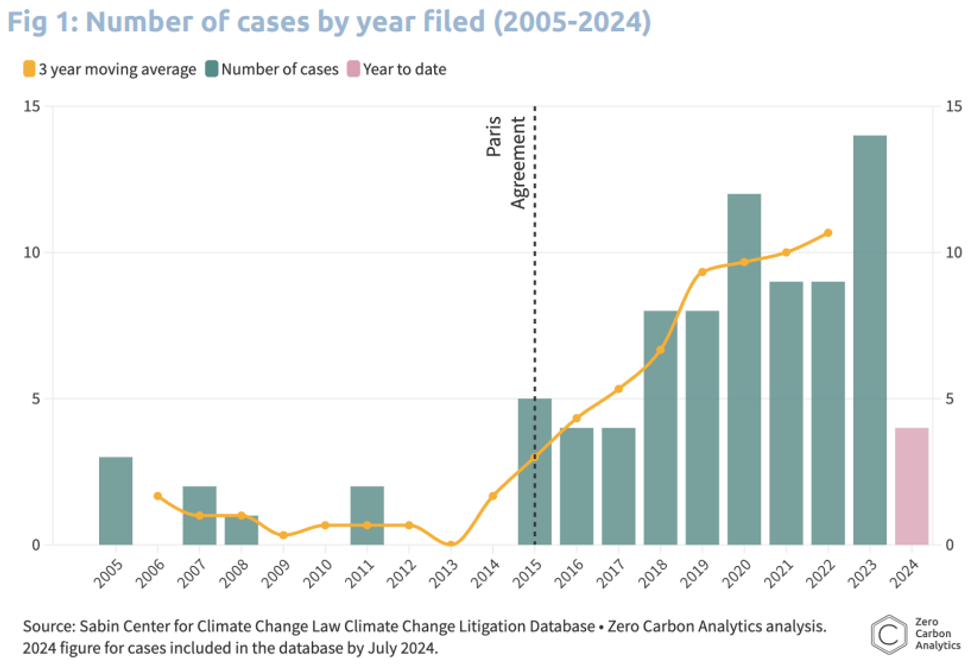
Last year saw 14 climate cases targeted at Big Oil filed worldwide, a record. A database cited in the report that dates to 2005 records 86 total cases, the vast majority having been file since 2015. Forty of the cases are still pending.
The most common type of climate-focused case has been for damages, with 30 filed just since 2017—prior to that year, only three had been filed. Dozens of U.S. states and cities have filed such cases, though none has yet reached a trial. The damages case in the U.S. that's the furthest along, City and County of Honolulu v. Sunoco et al., has faced extraordinary legal and political pushback from the industry, which is seeking to have it dismissed.
One of the most prominent damages cases outside the U.S. features Saúl Luciano Lliuya, a Peruvian farmer who sued energy giant RWE in German court in 2015 for having a partial role in the melting of a glacier in the Andes. He seeks reimbursement for the flood protection infrastructure that he and 50,000 other residents had to erect. Lawyers and judges traveled from Germany to Peru in 2022 to assess Luciano Lliuya's claims. The case is ongoing.
In the statement accompanying Thursday's report, Lliuya said:
Taking on carbon majors in court can be daunting. But the fear of losing your home and everything you’ve worked for due to the reckless actions of fossil fuel companies is even greater. For those of us directly impacted by the climate crisis, the courts offer a glimmer of hope. People like me are in court because our livelihoods are at serious risk and we are asking judges to hold the fossil fuel companies responsible.
The second most common type of climate case against Big Oil has focused on misleading advertising. Of the nine cases of this type that have reached a conclusion, Big Oil won only one case; in each of the others, the companies retracted their claims or were ruled against. The United Kingdom's Advertising Standard Authority found Shell's low-carbon claims to be misleading in separate cases in 2020 and 2023, for example.
There have also been a number of cases seeking to force fossil fuel companies to adhere to legally mandated climate targets. The most prominent outcome from these cases was a landmark ruling against Shell by a Dutch court in 2021, which found that the company must cut emissions by 45% by 2030; the seminal ruling, which was based on emissions limits set in the Paris agreement, pertains to emissions that come from Shell's fossil fuel products, and not just the company's direct business activities.
The report's analysis doesn't include climate lawsuits targeted at governments or at companies involved in other areas of the fossil fuel supply chain.
In response to the report, Michael Gerrard, the faculty director of the Sabin Center for Climate Change Law at Columbia University, told The Guardian that there have been a "formidable number of cases" but "none of them have broken through" except those dealing with advertising.
An increasing number of climate lawsuits filed against fossil fuel companies in the last decade could put a dent in the business model of large fossil fuel companies, according to a report released Thursday.
The 16-page report—titled Big Oil in Court and co-created by Oil Change International and Zero Carbon Analytics—documents dozens of cases worldwide, mostly since 2015, when the Paris agreement was signed. Many of the cases center on climate damages, misleading advertising about fossil fuels, or failure to reduce emissions in line with legal agreements. Over half of the cases have been filed in the United States, with a majority of others in Western Europe.
"The growing number of lawsuits against fossil fuel corporations underlines how their historic and continued role in driving and profiting from climate change is catching up to them," David Tong, an industry campaign manager at Oil Change International, an advocacy group, said in a statement.
"The wave of lawsuits against Big Oil could lead to serious impacts on their bottom line, a disincentive for investment in fossil fuel infrastructure, a reduction in corporate value, and a challenge to their social license to continue harming communities around the world," Tong added.
Last year saw 14 climate cases targeted at Big Oil filed worldwide, a record. A database cited in the report that dates to 2005 records 86 total cases, the vast majority having been file since 2015. Forty of the cases are still pending.
The most common type of climate-focused case has been for damages, with 30 filed just since 2017—prior to that year, only three had been filed. Dozens of U.S. states and cities have filed such cases, though none has yet reached a trial. The damages case in the U.S. that's the furthest along, City and County of Honolulu v. Sunoco et al., has faced extraordinary legal and political pushback from the industry, which is seeking to have it dismissed.
One of the most prominent damages cases outside the U.S. features Saúl Luciano Lliuya, a Peruvian farmer who sued energy giant RWE in German court in 2015 for having a partial role in the melting of a glacier in the Andes. He seeks reimbursement for the flood protection infrastructure that he and 50,000 other residents had to erect. Lawyers and judges traveled from Germany to Peru in 2022 to assess Luciano Lliuya's claims. The case is ongoing.
In the statement accompanying Thursday's report, Lliuya said:
Taking on carbon majors in court can be daunting. But the fear of losing your home and everything you’ve worked for due to the reckless actions of fossil fuel companies is even greater. For those of us directly impacted by the climate crisis, the courts offer a glimmer of hope. People like me are in court because our livelihoods are at serious risk and we are asking judges to hold the fossil fuel companies responsible.
The second most common type of climate case against Big Oil has focused on misleading advertising. Of the nine cases of this type that have reached a conclusion, Big Oil won only one case; in each of the others, the companies retracted their claims or were ruled against. The United Kingdom's Advertising Standard Authority found Shell's low-carbon claims to be misleading in separate cases in 2020 and 2023, for example.
There have also been a number of cases seeking to force fossil fuel companies to adhere to legally mandated climate targets. The most prominent outcome from these cases was a landmark ruling against Shell by a Dutch court in 2021, which found that the company must cut emissions by 45% by 2030; the seminal ruling, which was based on emissions limits set in the Paris agreement, pertains to emissions that come from Shell's fossil fuel products, and not just the company's direct business activities.
The report's analysis doesn't include climate lawsuits targeted at governments or at companies involved in other areas of the fossil fuel supply chain.
In response to the report, Michael Gerrard, the faculty director of the Sabin Center for Climate Change Law at Columbia University, told The Guardian that there have been a "formidable number of cases" but "none of them have broken through" except those dealing with advertising.
An increasing number of climate lawsuits filed against fossil fuel companies in the last decade could put a dent in the business model of large fossil fuel companies, according to a report released Thursday.
The 16-page report—titled Big Oil in Court and co-created by Oil Change International and Zero Carbon Analytics—documents dozens of cases worldwide, mostly since 2015, when the Paris agreement was signed. Many of the cases center on climate damages, misleading advertising about fossil fuels, or failure to reduce emissions in line with legal agreements. Over half of the cases have been filed in the United States, with a majority of others in Western Europe.
"The growing number of lawsuits against fossil fuel corporations underlines how their historic and continued role in driving and profiting from climate change is catching up to them," David Tong, an industry campaign manager at Oil Change International, an advocacy group, said in a statement.
"The wave of lawsuits against Big Oil could lead to serious impacts on their bottom line, a disincentive for investment in fossil fuel infrastructure, a reduction in corporate value, and a challenge to their social license to continue harming communities around the world," Tong added.
Last year saw 14 climate cases targeted at Big Oil filed worldwide, a record. A database cited in the report that dates to 2005 records 86 total cases, the vast majority having been file since 2015. Forty of the cases are still pending.
The most common type of climate-focused case has been for damages, with 30 filed just since 2017—prior to that year, only three had been filed. Dozens of U.S. states and cities have filed such cases, though none has yet reached a trial. The damages case in the U.S. that's the furthest along, City and County of Honolulu v. Sunoco et al., has faced extraordinary legal and political pushback from the industry, which is seeking to have it dismissed.
One of the most prominent damages cases outside the U.S. features Saúl Luciano Lliuya, a Peruvian farmer who sued energy giant RWE in German court in 2015 for having a partial role in the melting of a glacier in the Andes. He seeks reimbursement for the flood protection infrastructure that he and 50,000 other residents had to erect. Lawyers and judges traveled from Germany to Peru in 2022 to assess Luciano Lliuya's claims. The case is ongoing.
In the statement accompanying Thursday's report, Lliuya said:
Taking on carbon majors in court can be daunting. But the fear of losing your home and everything you’ve worked for due to the reckless actions of fossil fuel companies is even greater. For those of us directly impacted by the climate crisis, the courts offer a glimmer of hope. People like me are in court because our livelihoods are at serious risk and we are asking judges to hold the fossil fuel companies responsible.
The second most common type of climate case against Big Oil has focused on misleading advertising. Of the nine cases of this type that have reached a conclusion, Big Oil won only one case; in each of the others, the companies retracted their claims or were ruled against. The United Kingdom's Advertising Standard Authority found Shell's low-carbon claims to be misleading in separate cases in 2020 and 2023, for example.
There have also been a number of cases seeking to force fossil fuel companies to adhere to legally mandated climate targets. The most prominent outcome from these cases was a landmark ruling against Shell by a Dutch court in 2021, which found that the company must cut emissions by 45% by 2030; the seminal ruling, which was based on emissions limits set in the Paris agreement, pertains to emissions that come from Shell's fossil fuel products, and not just the company's direct business activities.
The report's analysis doesn't include climate lawsuits targeted at governments or at companies involved in other areas of the fossil fuel supply chain.
In response to the report, Michael Gerrard, the faculty director of the Sabin Center for Climate Change Law at Columbia University, told The Guardian that there have been a "formidable number of cases" but "none of them have broken through" except those dealing with advertising.