

SUBSCRIBE TO OUR FREE NEWSLETTER
Daily news & progressive opinion—funded by the people, not the corporations—delivered straight to your inbox.
5
#000000
#FFFFFF
To donate by check, phone, or other method, see our More Ways to Give page.
Daily news & progressive opinion—funded by the people, not the corporations—delivered straight to your inbox.
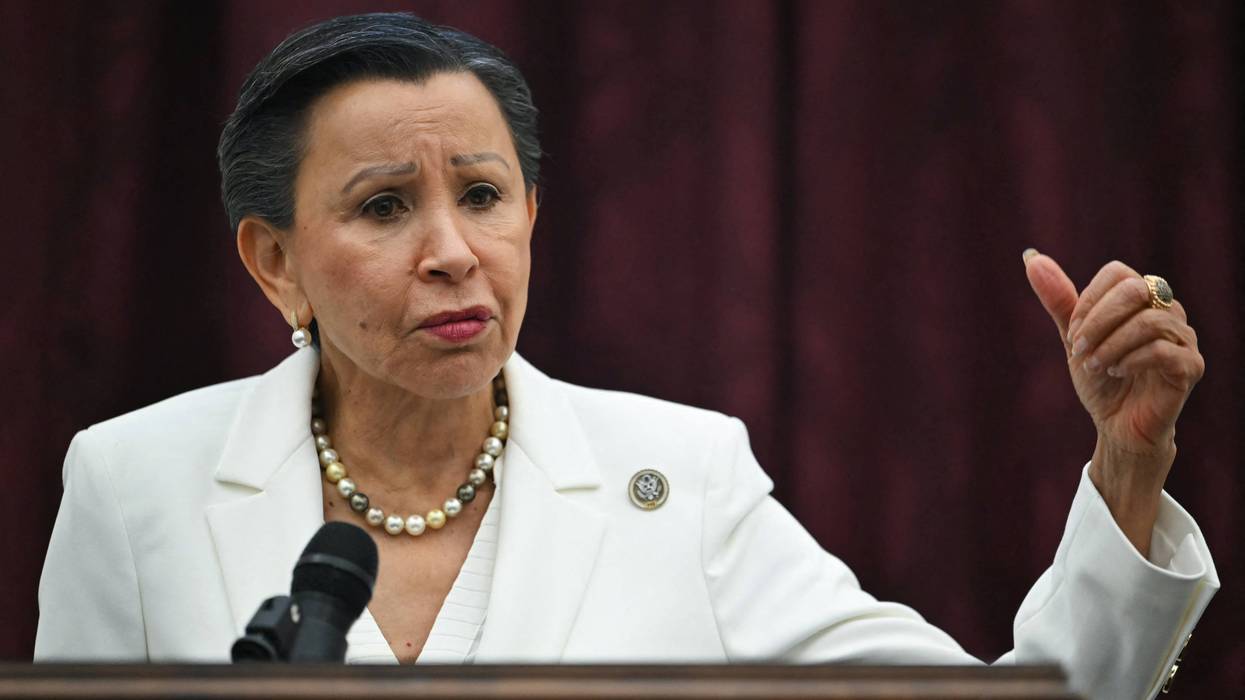
“This administration is rushing toward another disastrous war, putting countless American and foreign lives at risk," said Rep. Nydia Velázquez. "Congress must reassert its constitutional authority."
With US military forces prepared to launch an unprovoked attack on Cuba, a group of congressional Democrats on Wednesday introduced a new war powers resolution in a bid to block President Donald Trump from launching yet another illegal war of choice.
Reps. Nydia Velázquez and Gregory Meeks, both of New York, introduced the resolution, which would bar US forces from hostilities within or against Cuba without congressional authorization, as required under the 1973 War Powers Act. The measure is cosponsored by Reps. Jim McGovern of Massachusetts and Joaquin Castro of Texas.
“Donald Trump's belligerent foreign policy is creating new wars and conflicts across the world. As our country is already embroiled in a new war with Iran, the president has now set his sights on regime change in Cuba,” Velázquez said in a statement. “This administration is rushing toward another disastrous war, putting countless American and foreign lives at risk. Congress must reassert its constitutional authority if the president continues down this illegal path.”
Meeks, the ranking member of the House Foreign Affairs Committee, said that “the Trump administration and Republicans in Congress are hellbent on starting another war, this time with Cuba, to distract from the president’s failure in Iran, weak economy, and mass deportation of 500,000 Cubans legally in the United States."
It is the second Cuba war powers resolution introduced by lawmakers since Trump began threatening to attack and "take" the island earlier this year. Last month, senators voted 51-47—with Democratic Sen. John Fetterman joining all but two of his Republican colleagues, Sens. Susan Collins of Maine and Rand Paul of Kentucky—to block a war powers resolution introduced in March by Sens. Tim Kaine (D-Va.), Adam Schiff (D-Calif.), and Ruben Gallego (D-Ariz.).
The new resolution's introduction follows months of escalating aggression against Cuba by the Trump administration, including preparation and threats to attack, an oil blockade that critics say is causing the deaths of infants and sick people, and last week's Department of Justice (DOJ) indictment of former President Raúl Castro for his alleged role in the 1996 shoot-down of planes operated by a hostile US-based counterrevolutionary group following repeated warnings that they had violated Cuban airspace.
On Wednesday, Secretary of State Marco Rubio—who has falsely claimed that his parents fled communism in Cuba when they actually emigrated during an earlier US-backed dictatorship—said that the island is "in a lot of trouble."
“Having a failed state 90 miles from our shores is a threat to the national security of the United States," Rubio added.
An article published Wednesday by Politico highlighted US military preparations for various war scenarios for Cuba, including bombing, an invasion, or a mission to enforce the DOJ indictmebnt by kidnapping Castro in a manner similar to January's illegal abduction of Venezuelan President Nicolás Maduro.
According to Politico's Paul McLeary:
The armada in the region is slightly smaller than it was in January when the US captured Maduro. But the USS Nimitz aircraft carrier strike group entered the Caribbean in May, along with several guided missile destroyers and cruisers that can launch precision missiles at targets onshore. An array of advanced American drones and surveillance aircraft have also circled Cuba for months, according to flight tracking sites. The USS Kearsarge amphibious ships and escorts, which carry 2,500 Marines, are off the coast of Virginia preparing for a new deployment, and could replace some ships heading home.
The surge provides a variety of military options, although the Pentagon would need additional troops for a massive ground invasion.
The Politico piece drew fierce rebuke from Havana.
"There are politicians in the United States pushing the drumbeat of war against Cuba, trying to fabricate excuses, trying to portray Cuba as a threat, and trying to push the US president to take military action, even with the understanding that military action would lead to bloodshed, mostly of Cubans, but also of Americans," Deputy Foreign Minister Carlos Fernández de Cossío told The Los Angeles Times.
"The question is: How does a government convince American citizens that it is in their interest to cause death, cause destruction and suffering to a neighboring nation simply to satisfy the ambitions of a small cabal of wealthy, influential people who enjoy the ear of politicians and powerful people in Washington?" Fernández added.
Cuba has been shoring up international support amid the growing threat of US attack. On Tuesday, Cuban Foreign Minister Bruno Rodríguez met with United Nations Secretary-General António Guterres, who said earlier this month that “there is no military solution to be sought for Cuba."
On Wednesday, Chinese Foreign Minister Wang Yi said during a meeting with Rodríguez at United Nations headquarters in New York that "China will continue to uphold justice and speak up for Cuba, support the Cuban people’s just cause, and contribute to Cuba’s economic development and people’s livelihood."
Also on Wednesday, the Caribbean Community (CARICOM) Council for Foreign and Community Relations issued a statement affirming "Cuba’s sovereign right to import and receive fuel" and condemning "the obstruction of energy supplies to Cuba, which has precipitated a grave humanitarian crisis."
"Cuba poses no threat to any nation... it stands as a peaceful and cooperative member of the international community... [and] the continued application of these unilateral coercive measures constitutes an unjustifiable violation of human rights, the principles of free trade, and the fundamental norms governing relations among sovereign states," the council stated.
If the US launches military action against Cuba, it will be the 12th country attacked during Trump’s two terms in office. The president—who has repeatedly said that he deserves a Nobel Peace Prize—has ordered attacks on Afghanistan, Ecuador, Iran, Iraq, Libya, Nigeria, Pakistan, Somalia, Syria, Venezuela, and Yemen, and has bombed dozens of boats accused without evidence of transporting drugs in international waters in the Caribbean Sea and Pacific Ocean.
Last week, tens of thousands of Cubans rallied in Havana to denounce the indictment of Castro and US aggression against their homeland, which dates back to the revolution that overthrew Fulgencio Batista, one in a series of dictators backed by the United States after it granted Cuba conditional independence after conquering the island along with Puerto Rico, the Philippines, and Guam during an 1898 war against Spain waged on a dubious pretext.
Since then, the United States has tried to assassinate former Cuban President Fidel Castro, backed the ill-fated Bay of Pigs invasion, served as a base for perpetrators of some of the hemisphere’s worst terror attacks, and even hatched a plan to detonate a nuclear bomb high above the island to convince its people that the return of Jesus Christ was nigh and the only thing standing in the way of the long-awaited “Second Coming” was Castro.
Cuba has endured this aggression and more without retaliating against the United States. Despite this, the Trump administration has responded by inflicting more and more pain upon people it claims it is trying to liberate from oppression.
“If Donald Trump and Marco Rubio are serious about a new relationship with the Cuban people," Meeks said Wednesday, "they would reverse 65 years of failed US policy toward Cuba, end the oil blockade and the humanitarian crisis it caused, and work with Congress to modify the draconian and outdated US sanctions that disproportionately harm the Cuban people.”
"We need to finally leave the Monroe Doctrine behind and pursue a foreign policy grounded in mutual respect and shared prosperity," said Rep. Nydia Velázquez, introducing the New Good Neighbor Act with Rep. Delia Ramirez.
With the death toll from President Donald Trump's boat bombings of alleged drug traffickers now at 130 after a Monday strike, a pair of progressive congresswomen on Tuesday called for ending the Monroe Doctrine and establishing a "New Good Neighbor" policy toward Latin America and the Caribbean.
In 1823, then-President James Monroe "declared the Western Hemisphere off limits to powerful countries in Europe," NPR noted last month. "Fast forward, and President Trump is reviving the Monroe Doctrine to justify intervening in places like Venezuela, and threatening further action in other parts of Latin America and Greenland."
Trump's version of the policy has been dubbed the "Donroe Doctrine." After US forces boarded the Aquila II, a Venezuela-linked oil tanker, in the Indian Ocean, David Adler, co-general coordinator of Progressive International, said Monday that "the Donroe Doctrine is not simply a vision for the hemisphere. It is a doctrine of global domination."
In response to the president's recent actions—from his boat bombings and pardon of convicted drug trafficker and former Honduran President Juan Orlando Hernández, to his oil blockade of Venezuela and raid that overthrew the South American country's president, Nicolás Maduro—US Reps. Nydia Velázquez (D-NY) and Delia Ramirez (D-Ill.) introduced the New Good Neighbor Act.
"This administration's aggressive stance toward Latin America makes this resolution critical," said Velázquez in a statement. "Their 'Donroe Doctrine' is simply a more grotesque version of the interventionist policies that have failed us for two centuries."
"The United States and Latin America face shared challenges in drug trafficking, migration, and climate change," she continued. "We can only solve these through real partnership, not coercion. We need to finally leave the Monroe Doctrine behind and pursue a foreign policy grounded in mutual respect and shared prosperity."
Ramirez similarly said that "for more than 200 years, the United States has used the Monroe Doctrine to justify a paternalistic, damaging approach to relations with Latin America and the Caribbean. As a result, the legacy of our nation's foreign policy in those regions is political instability, deep poverty, extreme migration, and colonialism. It is well past time we change our approach."
"We must recognize our interconnectedness and admit that the Monroe Doctrine undermines the partnership needed to confront the complex challenges of this century," she argued. "We must become better neighbors. That is why I am proud to join Congresswoman Nydia Velázquez to develop an approach to foreign policy that advances our collective interests and builds a stronger coalition throughout the Americas and the rest of the world."
The original Good Neighbor Policy was adopted by former President Franklin D. Roosevelt in the 1930s, in an attempt at reverse US imperialism in Latin America. The aim was to curb military interventions, center respect for national sovereignty, and prioritize diplomacy and trade.
As the sponsors' offices summarized, the new resolution calls for:
The measure isn't likely to advance in a Republican-controlled Congress that has failed to pass various war powers resolutions that would rein in Trump's boat strikes and aggression toward Venezuela, but it offers Democrats an opportunity to make their foreign policy positions clear going into the midterms—in which Velázquez, who is 72, has decided not to seek reelection.
So far, it is backed by Democratic Reps. Greg Casar (Texas), Yvette Clarke (NY), Jesús "Chuy" García (Ill.), Sylvia García (Texas), Adelita Grijalva (Ariz.), Eleanor Holmes Norton (DC), Jonathan Jackson (Ill.), Pramila Jayapal (Wash.), Hank Johnson (Ga.), Summer Lee (Pa.), Alexandria Ocasio-Cortez (D-NY), Ilhan Omar (Minn.), Mark Pocan (Wis.), Jan Schakowsky (Ill.), Lateefah Simon (Calif.), and Rashida Tlaib (Mich.). Like Velázquez, Chuy García and Schakowsky are also retiring after this term.
Leaders from organizations including the Center for Economic and Policy Research (CEPR), the United Methodist Church's board, and We Are CASA also backed the bill and commended the sponsors for, as Cavan Kharrazian of Demand Progress, put it "advancing a new framework for US engagement in the region grounded in mutual respect, sovereignty, and cooperation rather than coercion or threats."
Alex Main, CEPR's director of international policy, stressed that "Trump is waging a new offensive against Latin America and the Caribbean—conducting illegal and unprovoked military attacks and extrajudicial killings and brazenly intervening in other countries' domestic affairs in an undisguised effort to exert control over the region's resources and politics."
"But while Trump’s actions are especially egregious, they are just the latest chapter of a centuries-old story of US military political and economic interference that has subverted democracy and fueled instability and human rights crimes across the hemisphere," Main continued. "It is in the interest of the US to reject this doctrine of unilateral domination and chart a new course for US-Latin American relations—to treat our Latin American siblings as vecinos, not vassals."
Sharing yet another brief black-and-white video on social media, US Southern Command on Monday announced a "lethal kinetic strike on a vessel" allegedly "transiting along known narco-trafficking routes in the Eastern Pacific." SOUTHCOM added that "two narco-terrorists were killed and one survived the strike," which prompted a search for the survivor.
Legal experts and various members of Congress have described the killings as murder on the high seas. Reiterating that position in response to the latest bombing disclosure, Amnesty International USA urged Americans to pressure lawmakers to act.
"US military helpfully publishes evidence of its mass murder of civilians at sea," said Ben Saul, a professor at Australia's University of Sydney and the United Nations special rapporteur on the promotion and protection of human rights and fundamental freedoms while countering terrorism. "Over to you, US Department of Justice, to do your job and bring murder suspects to justice."
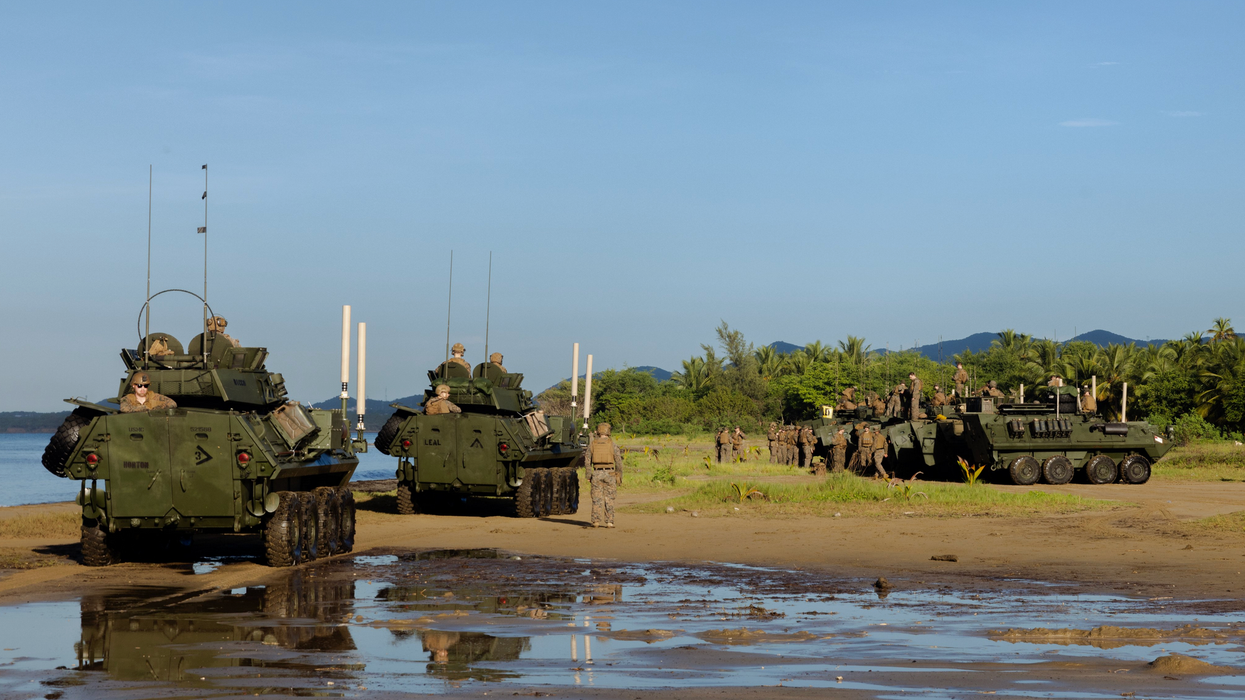
“We are against any type of military intervention in the country of Venezuela, and above all we are against the vile and terrible assassinations of our fishermen brothers," said one protester.
Protests continued Tuesday in Puerto Rico against the US military buildup and attacks on alleged drug-running boats in the Caribbean Sea, as well as the Trump administration's warmongering toward Venezuela.
Since September, Puerto Ricans have been protesting the reactivation of former US bases like Roosevelt Roads in Ceiba, increased operations at Muñiz Air National Guard Base and other sites, airstrikes on alleged drug boats in the Caribbean and Pacific Ocean, and Trump's deployment of warships and thousands of troops to the region for possible attacks on Venezuela. Trump has also authorized covert CIA action against the government of Venezuelan President Nicolás Maduro.
“We are against US imperialism, we are against any type of military intervention in the country of Venezuela, and above all we are against the vile and terrible assassinations of our fishermen brothers that have happened with the pretext that they are boats for drug traffickers," explained protester Enrique Rivera Zambrana, a resident of the southeastern town of Arroyo. "We condemn those killings, and terrible actions. We are in favor of peace.”
En Puerto Rico se siguen llevando a cabo protestas contra los entrenamientos militares que el Gobierno de Trump está realizando en las playas de Arroyo, una localidad situada en el sureste de la isla.
En las últimas semanas, los residentes de Puerto Rico han revelado haber visto… pic.twitter.com/cT2QMiHNxN
— Democracy Now! en español (@DemocracyNowEs) November 12, 2025
Tuesday's protest was also held in honor of Ángel Rodríguez Cristóbal, a Puerto Rican revolutionary who was found dead in a Florida prison—where he was serving a six-month sentence for opposing the US Navy occupation and bombing of Vieques, Puerto Rico—on November 11, 1979. While US authorities said Rodríguez killed himself, many critics believe he was assassinated.
US Marines began large-scale amphibious warfare exercises involving hundreds of troops at the end of August as part of Trump's remilitarization of the region amid his military buildup against Venezuela. There are currently around 10,000 troops on the island—which was conquered from Spain in 1898—as well as weapons including F-35 fighter jets, MQ-9 Reaper drones, surveillance aircraft, and support equipment.
The US buildup has evoked memories of the fight to kick the Navy out of Vieques, a picture-postcard island whose residents lived downwind from a US bombing range for six decades. Tens of thousands of tons of bombs were dropped. Deadly chemical weapons were tested and stored. Toxins polluted the land, air, and sea, including Agent Orange, depleted uranium, and so-called forever chemicals.
There was little that Puerto Ricans—who were denied political representation in Washington, DC—could do about it. When the Navy finally left in 2003, it left behind a legacy of illness including cancer, diabetes, and cardiovascular disease, as well as an infant mortality rate 55% higher than in the rest of the territory.
Vieques octopus fisher José Silva recently told Centro de Periodismo Investigativo (CPI) that the new buildup "is like bringing back the monster of the bombings" of the island.
Another Vieques resident, Yamilette Meléndez, said the renewed US presence brought back childhood memories of hiding under her bed whenever warplanes flew overhead.
“The trauma comes back,” she said. “It comes back because for years we lived with the sound of bombs, planes at all hours, while sleeping, at school."
"I thought of my children, of the anxiety," she added. "It’s something you can’t control, because I grew up with it. And I was just a girl then. Imagine how it feels for the older folks who lived through the real struggle.”
The US military brings other forms of violence to Puerto Rico.
“Some of the soldiers who were recently working at the airport approached local businesses and several people, asking if there were sex workers in Vieques," Judith Conde Pacheco, co-founder of the Vieques Women’s Alliance, told CPI. "It’s one of the most brutal forms of violence… women’s bodies are seen as part of the occupied land."
Some Puerto Ricans dismissed the idea that the buildup on what's often called the US' "unsinkable aircraft carrier" signaled any sort of resurgence in the colonizers' presence.
“The idea that the US military is no longer present in Puerto Rico is a myth," former Puerto Rico Bar Association president Alejandro Torres Rivera told CPI. "They never left, they merely scaled back their presence, or the intensity of it, for a time in their colony."
Condemning the buildup and the acquiescence of the territorial government in a Newsweek opinion piece last month, US Congresswoman Nydia Velázquez (D-NY)—the first Puerto Rican woman to serve in Congress—wrote: "The potential remilitarization of Puerto Rico is not progress; it is regression. It marks a step backwards in the struggle for Puerto Rico’s sovereignty."
"To those who celebrate this militarization, or remain complicit, I say: There is no worse bet than one made against your own people, your own land, your own future," she added. "If only someone would dare to bet on Puerto Ricans, and their right to decide their destiny. After generations of allowing others to exploit Puerto Rico, and abandon it without justice, we have had enough."
"Your current practices leave women vulnerable to life-altering violence," the lawmakers said. "It's past time to act."
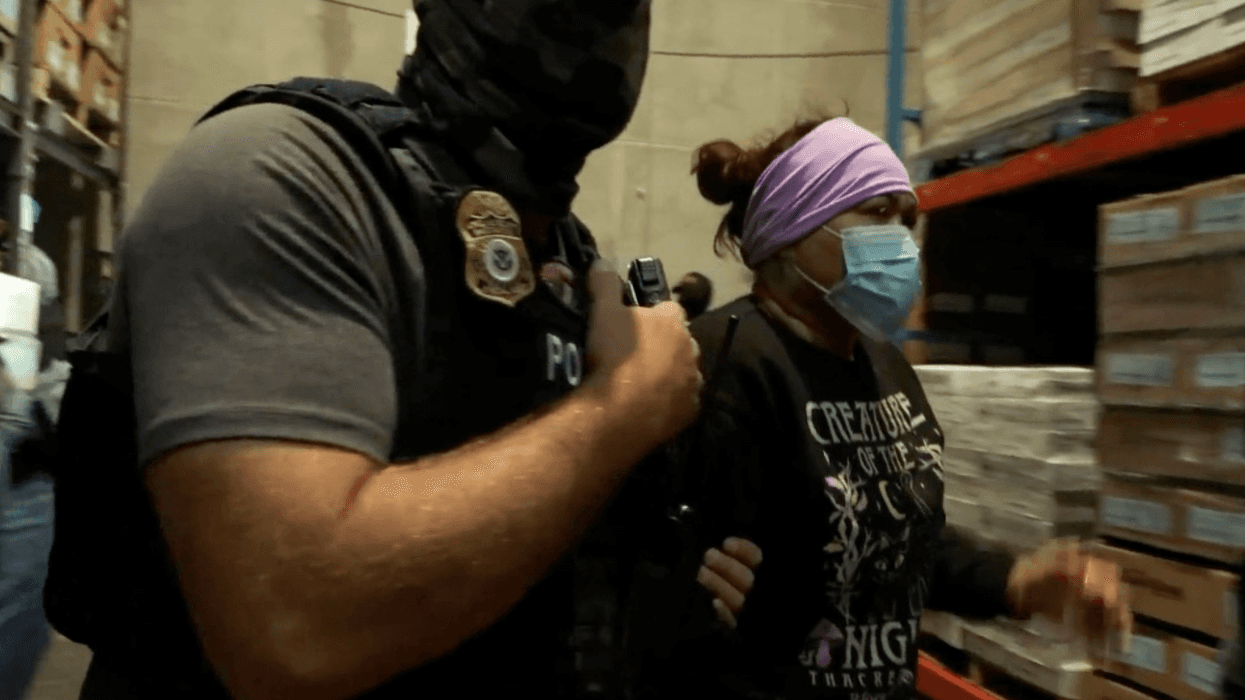
Citing "horrifying" incidents in which masked men impersonating U.S. Immigration and Customs Enforcement agents kidnap and assault women, more than 30 Democratic congresswoman on Monday demanded that ICE officers clearly identify themselves while conducting enforcement activities.
"All our lives, we are taught to fear masked men in unmarked vehicles. We learn we should run from such men to avoid being kidnapped, sexually assaulted, or killed," 33 members of the Democratic Women's Caucus (DWC) wrote in a letter led by Reps. Judy Chu (D-Calif.), Sylvia Garcia (D-Texas), and Nydia Velásquez (D-N.Y.) to Trump administration officials including Homeland Security Secretary Kristi Noem, acting ICE Director Todd Lyons, and "border czar" Tom Homan.
"Yet, ICE is increasingly conducting raids and arrests in masks [and] plain clothes, without visible identification or badges, using unmarked vehicles—tactics that cause confusion, terror, and mistrust among the public," the letter continues. "These tactics invited perpetrators of violence against women to take advantage of the chaos by impersonating masked ICE agents in order to target and sexually assault women."
DWC Members sent a letter calling out recent cases of people impersonating ICE to abuse women. We demand DHS and ICE wear visible identification to stop enabling impersonators.Women deserve to be safe. We’ll keep fighting.
[image or embed]
— Democratic Women’s Caucus (@demwomencaucus.bsky.social) August 11, 2025 at 1:04 PM
Reports of masked men—and in one case, a woman—impersonating federal officers began emerging shortly after President Donald Trump returned to the White House and ordered a mass deportation campaign that senior adviser Stephen Miller said aims to arrest at least 3,000 people per day. Since then, there have been reports of impostors abducting and subsequently sexually assaulting, robbing, or extorting women in states including Maryland, New York, North Carolina, and Pennsylvania.
"This cannot continue and must be addressed immediately," the DWC letter insists. "The Democratic Women's Caucus is committed to defending the rights of all women and girls to live in safety. We call on the department to recognize this pervasive issue and to take immediate action."
"We demand that ICE agents visibly and clearly identify themselves when conducting immigration enforcement activities to stop enabling impersonators who leverage women's uncertainty and fear of immigration consequences to rape, harass, and abuse them," the congresswoman wrote.
"Your current practices leave women vulnerable to life-altering violence," the letter adds. "It's past time to act. Just like local police officers, ICE agents must be required to wear visible and clear identification to ensure their safety, better protect women, and deter impersonators. Finally, impersonators must be held accountable to the fullest extent of the law and this violence must be denounced by this administration."
In a bid to unmask federal agents, Velázquez in June introduced the No Masks for ICE Act, which would ban agents from wearing facial coverings during enforcement actions and require them to wear clothing displaying their name and agency affiliation.
House lawmakers led by Reps. Adriano Espaillat (D-N.Y.) and Dan Goldman (D-N.Y.) in June also introduced the No Secret Police Act, which would require all Department of Homeland Security and other federal law enforcement officers to show their faces and clearly display their badges and identification when detaining or arresting people.
Similar legislation—the Visible Identification Standards for Immigration-Based Law Enforcement (VISIBLE) Act of 2025—was introduced last month in the U.S. Senate by Sens. Patty Murray (D-Wash.), Alex Padilla (D-Calif.), and Cory Booker (D-N.J.).
Also in July, upper chamber lawmakers led by Sens. Mark Warner (D-Va.) and Tim Kain (D-Va.) proposed the similar Immigration Enforcement Identification Act.
States including California, Massachusetts, New York, Pennsylvania, and Tennessee have also introduced or plan to propose legislation banning masked agents and requiring clear identification.
"When agents of the federal government are operating like masked militias, we've crossed a dangerous line by turning immigration enforcement into a paramilitary secret police force that should shock the nation's collective conscience," New York state Sen. Patricia Fahy (D-46), who last month introduced the Mandating End of Lawless Tactics (MELT) Act, said at the time.
"This goes beyond immigration enforcement; it's intimidation and it echoes authoritarian regimes, not the United States of America," Fahy added.
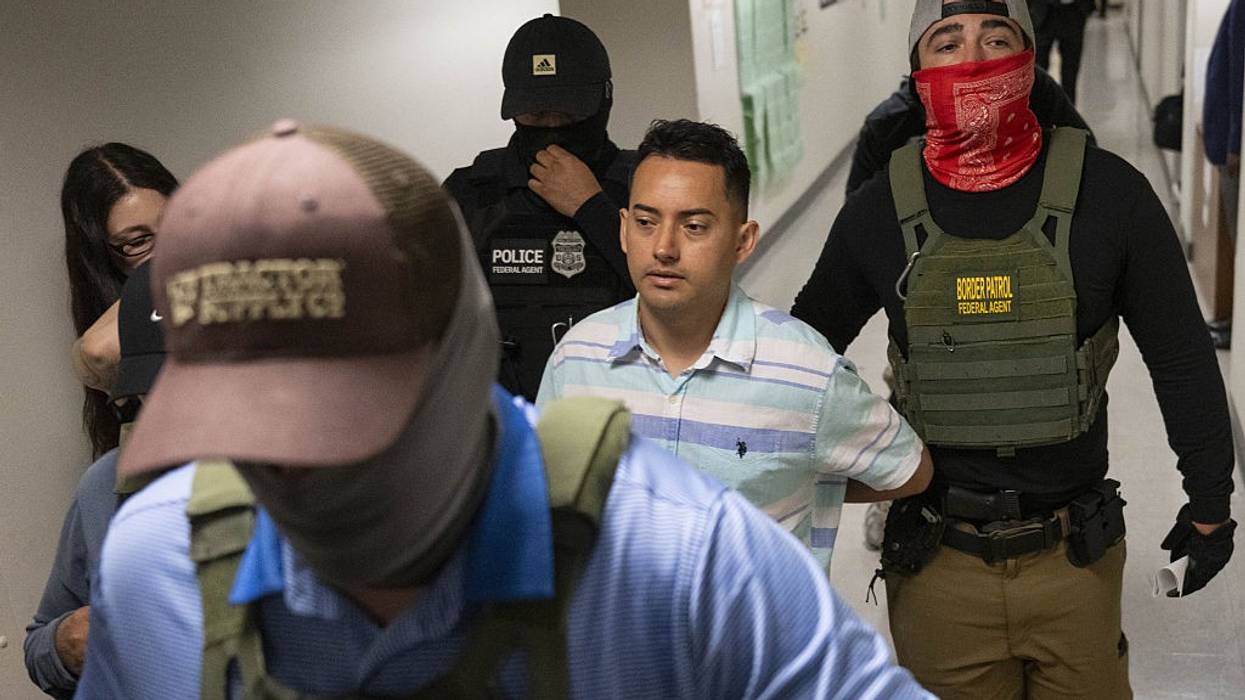
"These guys are popping up, rampant all over the city, just taking people randomly, and we want that particular practice to end," one attorney in the case said of Department of Homeland Security agents.
Immigrant rights defenders in California on Wednesday sued the U.S. Department of Homeland Security, accusing the Trump administration of "abducting and disappearing community members using unlawful stop and arrest practices and confining individuals at a federal building in illegal conditions while denying them access to attorneys" as part of its mass deportation effort.
The lawsuit was brought by five individual workers, three advocacy groups, and a legal services provider: The Los Angeles Worker Center Network, United Farm Workers (UFW), the Coalition for Humane Immigrant Rights (CHIRLA), and Immigrant Defenders Law Center. Their complaint accuses DHS of unconstitutionally arresting and detaining people, according to the ACLU, which is assisting with the legal challenge, "in order to meet arbitrary arrest quotas set by the Trump administration."
According to the complaint:
The raids in this district follow a common, systematic pattern. Individuals with brown skin are approached or pulled aside by unidentified federal agents, suddenly and with a show of force, and made to answer questions about who they are and where they are from. If they hesitate, attempt to leave, or do not answer the questions to the satisfaction of the agents, they are detained, sometimes tackled, handcuffed, and/or taken into custody. In these interactions, agents typically have no prior information about the individual and no warrant of any kind. If agents make an arrest, contrary to federal law, they do not make any determination of whether a person poses a risk of flight before a warrant can be obtained. Also contrary to federal law, the agents do not identify themselves or explain why the individual is being arrested.
"DHS—at explicit direction from the Trump administration—has gone after day laborers, car wash workers, farm workers, street vendors, service workers, nannies, and others who form the lifeblood of communities across Southern California," said ACLU Foundation of Southern California senior staff attorney Mohammad Tajsar, who is representing plaintiffs in the case. "Everyone deserves to feel safe going about their daily lives. DHS must stop disappearing people from our communities."
Tajsar told the Los Angeles Times that "these guys are popping up, rampant all over the city, just taking people randomly, and we want that particular practice to end."
Alvaro M. Huerta, director of litigation and advocacy at Immigrant Defenders Law Center and a plaintiff's attorney in the suit, said in a statement that "the federal government is waging a campaign of terror across Southern California, abducting community members off the streets and warehousing them in deplorable conditions away from their loved ones, all while denying them access to legal counsel."
"It's blatantly unconstitutional, cruelly inhumane, and a violation of any common decency," Huerta added. "If the Trump administration insists on trampling Angelenos' rights, we'll see them in court."
Plaintiffs in the case—who are seeking to represent people subjected to random stops and arrests—are asking the court to certify the case as a class action. They have also requested preliminary and permanent injunctions barring further violations of constitutional protections against unreasonable searches and seizures and self-incrimination, as enshrined in the Fourth and Fifth Amendments, respectively.
As the lawsuit notes, "one of the clearest patterns that have emerged in the raids in Southern California... has been stops and interrogations... on the basis of apparent race and ethnicity."
"These raids have targeted the most vulnerable members of our workforce, essential workers who are the backbone of our local economy," said Los Angeles Worker Center Network executive director Armando Gudino. "We cannot allow racial profiling, warrantless arrests, and denial of due process to become the standard operating procedure in our communities."
DHS has been holding arrested people in the basement of a federal building in downtown Los Angeles commonly referred to as B-18. The lockup has no beds, showers, or medical facilities, according to the ACLU of Southern California. Furthermore, B-18 is meant to hold only a small number of people on a temporary basis while they are processed.
"We have heard from over 100 families of Individuals taken to B-18 and other detention centers that attest to their loved ones being kept in overcrowded, cold, and inhumane conditions," said CHIRLA executive director Angelica Salas. "They are held in small windowless rooms with dozens or more other detainees, in extremely cramped quarters while being verbally humiliated and pressured into signing papers they don't understand."
The ACLU of Southern California said: "The ongoing raids have led to the disappearance of more than 1,500 people. The suit details how federal agents consistently refuse to identify themselves or what agency they are with when asked, using anonymity as a tactic to shield lawlessness."
UFW president Teresa Romero noted in a statement that "the raids in the greater Los Angeles area have not been limited to the urban center; we have also seen horrific instances of Border Patrol agents chasing down farm workers in the fields of Ventura County. The spouse of a UFW member was among those unjustly detained."
"Now the very workers who feed America go to work in fear," she added. "Their American-born children are scared not knowing if their parents will come home. Farm workers deserve better. We've seen these unconstitutional and un-American tactics before, with Border Patrol targeting random farm workers and anyone with brown skin in Kern County during their large sweep in January. We sued then and we are suing now."
While U.S. President Donald Trump, members of his administration, and Republican lawmakers and supporters claim the DHS crackdown is targeting dangerous criminals, critics have noted that people legally seeking asylum, families, relatives of American citizens, and even citizens themselves have been swept up in the mass deportation dragnet.
According to the libertarian Cato Institute, 65% of people taken by ICE had no criminal conviction whatsoever and 93% had no conviction for violent offenses.
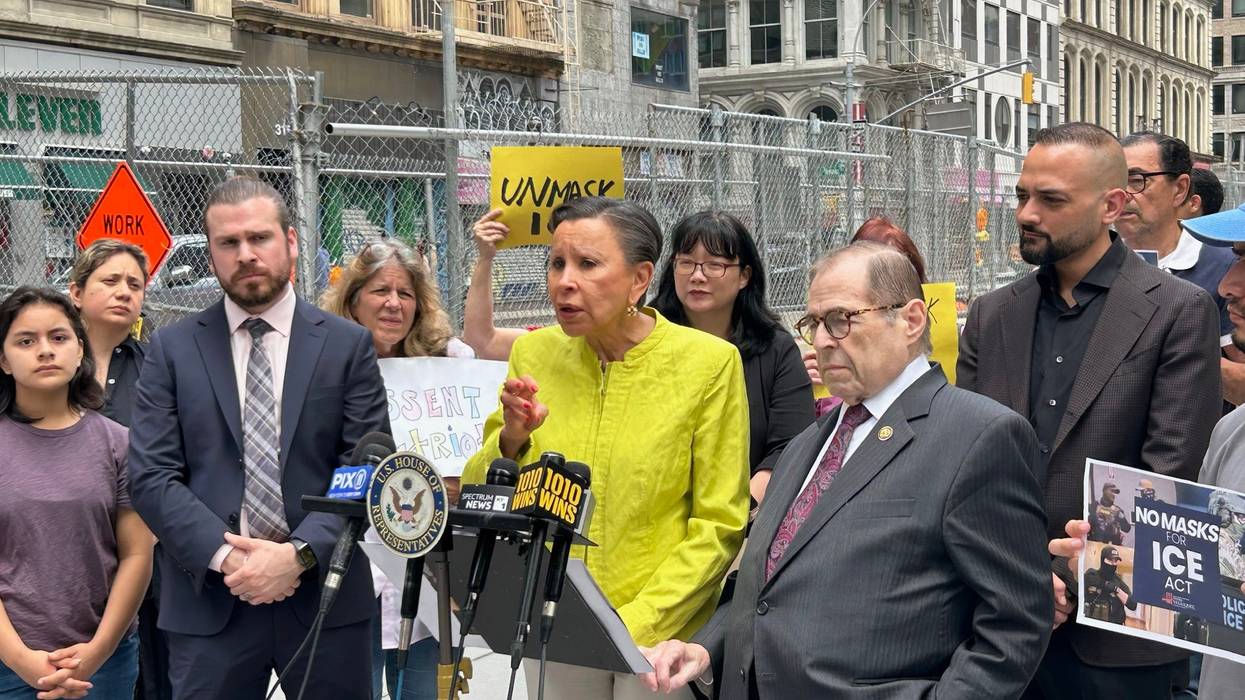
"When agents hide their faces and identities they create chaos, fear, and open the door to abuse. Immigrant communities are left wondering if they're being arrested or kidnapped."
Congresswoman Nydia Velázquez on Saturday held a rally outside a U.S. Immigration and Customs Enforcement field office in New York City to promote her recently introduced No Masks for ICE Act.
"We would never accept it if the NYPD operated in masks without names or badges—and we shouldn't accept it from ICE either," Velázquez (D-N.Y.) said in a statement, referring to the New York Police Department.
"When agents hide their faces and identities they create chaos, fear, and open the door to abuse," she continued. "Immigrant communities are left wondering if they're being arrested or kidnapped. That's not how law enforcement should operate in a democracy. This bill is about restoring basic standards and bringing basic transparency and accountability to immigration enforcement."
"If their operations are legitimate and above-board, why is there a need for anonymity, and why don't they need warrants to come onto private property?"
As the U.S. Department of Homeland Security (DHS) works to deliver on Republican President Donald Trump's promise of mass deportations, federal agents, including those with ICE, have taken immigrants into custody while wearing masks and plain clothes—sparking alarm over abuse by anonymous agents and also copycat criminals.
Velázquez's bill would bar ICE agents from wearing facial coverings during immigration enforcement, unless medically necessary or required for safety. It would also require written justification for any mask use, agents to wear clothing displaying their name and affiliation with ICE, and DHS to report annually to Congress on any related complaints and disciplinary actions.
A spokesperson for Immigration and Customs Enforcement told CBS News on Saturday that masks are optional but that "ICE law enforcement and their families are being targeted and are facing a 500% increase in assaults... due to the demonization of ICE by hostile groups and irresponsible elected officials."
"Politicians and activists must turn the temperature down and tone down their rhetoric," the spokesperson added.
Immigrant rights advocates, legal experts, and Congressman Jerry Nadler (D-N.Y.) also joined the rally. He noted in a statement that "the past few months we've seen a disturbing pattern: masked, plain-clothes agents ambushing immigrants outside courtrooms and on city streets."
"If their operations are legitimate and above-board, why is there a need for anonymity, and why don't they need warrants to come onto private property?" Nadler asked. "This bill will put an end to those intimidation tactics, restore transparency, and ensure the public knows exactly who is wielding federal power in our communities."
Today, outside 26 Federal Plaza, we joined Congress members @velazquez.house.gov + @nadler.house.gov, @thenyic.bsky.social, @legalaidnyc.bsky.social, and allies to spotlight the No Masks for ICE Act to call for immediate federal action to end secretive, unaccountable immigration enforcement.
[image or embed]
— Make the Road NY (@maketheroadny.bsky.social) June 28, 2025 at 12:12 PM
The rally was held at 26 Federal Plaza, a 41-floor building in Lower Manhattan that houses an ICE field office and one of New York City's immigration courts. Earlier this month, NYC Comptroller Brad Lander—then a Democratic mayoral candidate—was arrested by federal agents while escorting a defendant out of immigration court at the building.
On the 10th floor, "there is a holding area where immigration authorities have typically held a few dozen immigrants at a time for a few hours before transferring them to detention centers," The New York Times reported a few days after Lander's arrest. "But as the Trump administration expands its immigration crackdown, the space has become overcrowded and people sleep sprawled on the floor, sometimes for days, according to those who have spent time there."
The Times also noted a letter to DHS Secretary Kristi Noem signed by nine of the state's Democratic members of Congress—Nadler and Velázquez plus Reps. Yvette Clarke, Adriano Espaillat, Dan Goldman, Gregory Meeks, Grace Meng, Alexandria Ocasio-Cortez, and Ritchie Torres—who want to conduct oversight of the field office, which they argue is a detention facility.
"Congressional oversight is essential to bring transparency to the conduct of the Department of Homeland Security," they wrote. "Given the overaggressive and excessive force used to handcuff and detain elected officials in public, DHS's refusal to allow members of Congress to observe the conditions for immigrants behind closed doors begs the obvious question: What are you hiding?"
Following the introduction of Velázquez's bill, two Democratic lawmakers on Thursday introduced the No Secret Police Act, which would require all law enforcement officers and DHS agents to clearly display identification and their official badges when detaining or arresting people.
That legislation is led by Goldman and Espaillat, chair of the Congressional Hispanic Caucus, and backed by dozens of their Democratic colleagues. Espaillat said that "if you uphold the peace of a democratic society, you should not be anonymous. DHS and ICE agents wearing masks and hiding identification echoes the tactics of secret police authoritarian regimes."
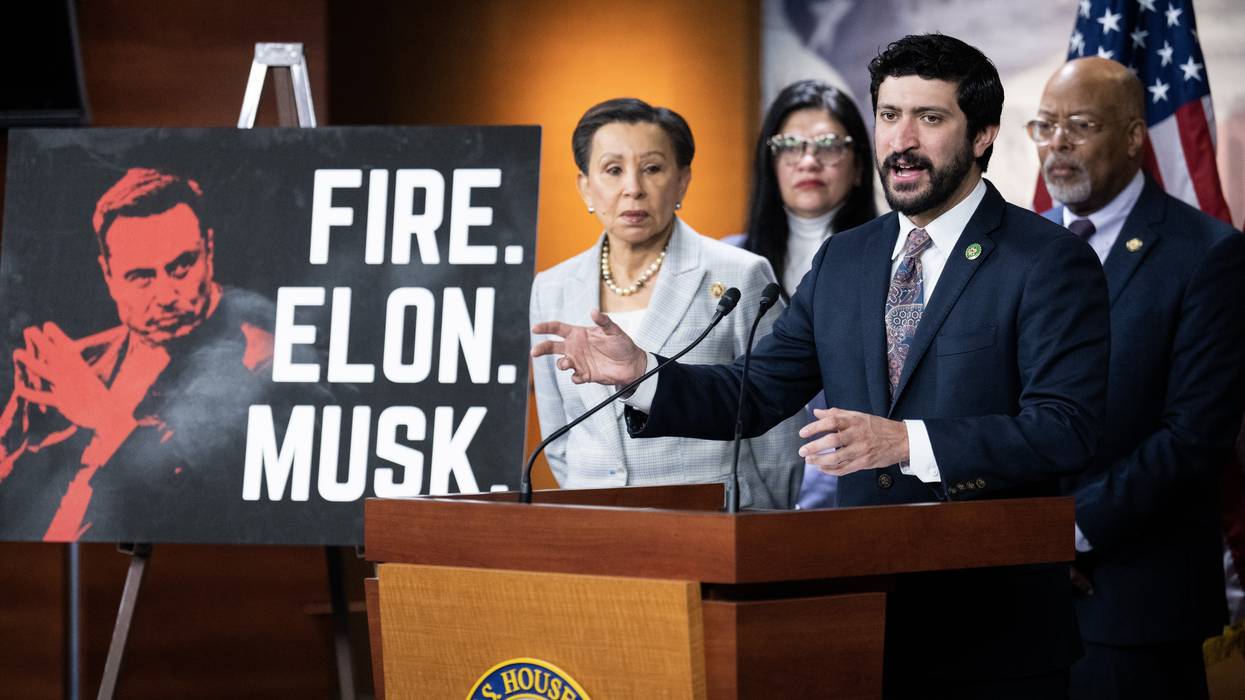
"It's time for all of us to get off the mat and get back in the ring. We're going to fight smarter. We are going to fight harder," the chair of the Congressional Progressive Caucus said.
"We're here to say with one voice: Fire Elon Musk," said Rep. Greg Casar of Texas, kicking off a Congressional Progressive Caucus press conference on Thursday which brought some of the fighting spirit that Democrats have been accused of lacking in recent weeks.
Caucus members gave remarks denouncing billionaire and GOP megadonor Elon Musk, whose so-called Department of Government Efficiency has infiltrated multiple federal agencies with the aim of carrying out cuts to spending and personnel, for engaging in an "illegal power grab." Casar, who is the chair of the caucus, told reporters that they would use "every legislative, judicial, and public pressure tool at [their] disposal as members of Congress" in an effort to get rid of Musk.
"Many Democrats need a time to soul search, to grieve, to think, but that time has ended," Casar said. "It's time for all of us to get off the mat and get back in the ring. We're going to fight smarter. We are going to fight harder."
Musk and his associates at DOGE now have moved to exert influence over agencies such as the U.S. Agency for International Development, the Department of Education, the Office of Personnel Management, and the Treasury Department. The Wall Street Journal reported Wednesday that representatives at DOGE have also secured access to key payment and contracting systems at the Centers for Medicare and Medicaid Services and are "searching agency payment systems for fraud."
Rep. Nydia Velázquez (D-N.Y.) called out House Speaker Mike Johnson (R-La.) for failing to have the "courage to stand up and defend the integrity of the legislative branch" in the face of Musk and Trump's broadsides against federal agencies, which in some cases appear illegal. "This is not only unethical, it is illegal and unconstitutional," she said.
Representatives of the caucus also said that there will be an attempt to pressure Republicans on the House Oversight Committee, which has a Republican majority, to join Democrats in subpoenaing Musk to come testify before the panel. Ranking member of the committee, Rep. Gerry Connolly (D-Va.), brought a motion on Wednesday to subpoena Musk to testify before the committee which failed in a 20-19 vote along party lines, according to Politico.
"We only lost that vote by one vote," said Casar. "We just need to pressure, in that case, just one Republican to have a spine and be willing to hear from Elon Musk."
Meanwhile, the day before the press conference, over 100 civil society groups sent a letter to congressional leaders demanding that Congress immediately act to investigate the full extent of actions taken by Musk and representatives at DOGE.
The groups that signed the letter include the labor union SEIU, the environmental group Greenpeace USA, the watchdog group Citizens for Responsibility and Ethics in Washington, and others.
"Millions of Americans are likely to be harmed if Elon Musk and DOGE are allowed to continue to infiltrate and take over critical government systems," the according to the letter, which says Congress should probe whether Musk and associates at DOGE have violated multiple temporary restraining orders issued by district courts in response to a late January memo from the Office of Management and Budget attempting to freeze funding for federal grants and other programs, among other concerns.
"What we have seen from Elon Musk and DOGE indicates an astounding disregard for the law," the letter concludes.
The Trump administration, Musk, and DOGE are facing resistance in court. Yesterday, the AFL-CIO and four unions filed a lawsuit on Wednesday against DOGE and acting Labor Secretary Vince Micone aimed at keeping DOGE out of the Department of Labor. Two unions and an advocacy group sued Treasury Secretary Scott Bessent and the Treasury Department on Monday for giving DOGE access to a sensitive payment system, citing privacy concerns.
Also Wednesday, thousands turned out for grassroots-organized, anti-Trump rallies around the United States.
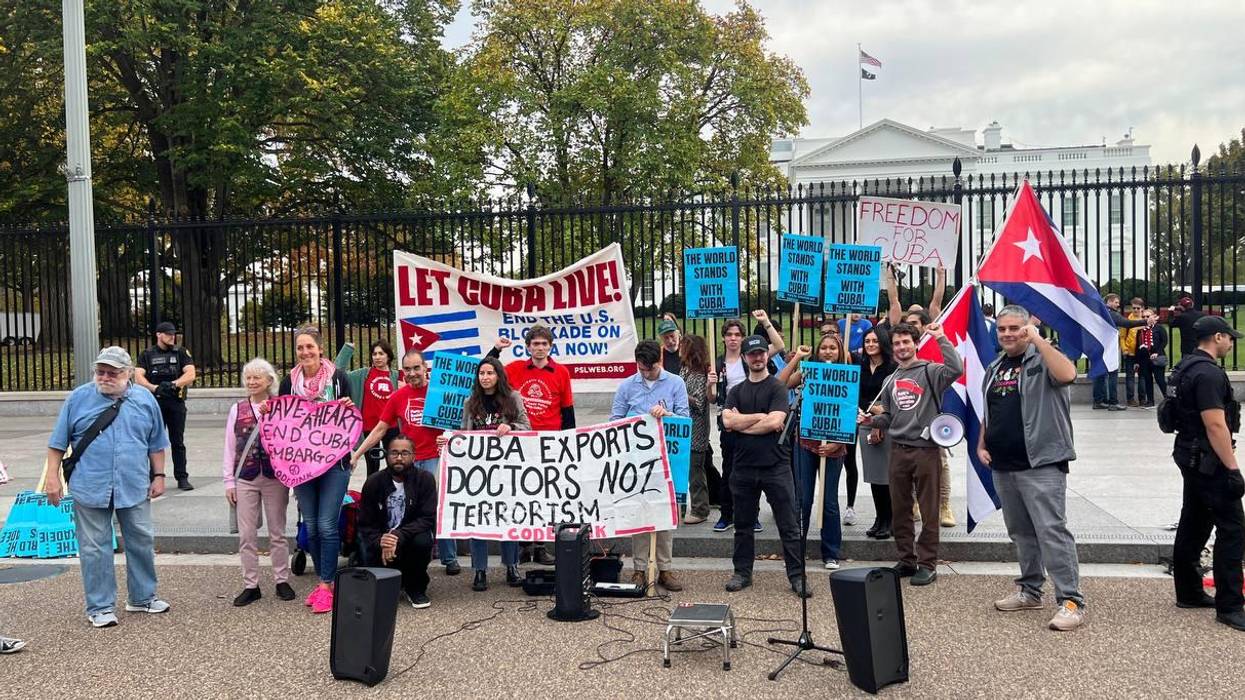
"Seriously? You wait until six days before leaving office to do what you promised to do during your 2020 campaign?" said one observer.
In a move likely to be reversed by the incoming Trump administration, President Joe Biden on Tuesday notified Congress of his intent to remove Cuba from the U.S. State Sponsors of Terrorism list, a designation that critics have long condemned as politically motivated and meritless.
Noting that "the government of Cuba has not provided any support for international terrorism" and has "provided assurances" that it will not do so in the future, the White House said in a memo that the Biden administration is moving to rescind the first Trump administration's January 2021 addition of Cuba to the State Sponsors of Terrorism (SSOT) list and take other measures to ease some sanctions on the long-suffering island of 11 million inhabitants.
Cuba's SSOT designation was based mostly on the socialist nation's harboring of leftist Colombian rebels and several U.S. fugitives from justice for alleged crimes committed decades ago, even though no other country has been placed on the SSOT list for such a reason and despite right-wing Cuban exile terrorists enjoying citizenship—and even heroic status—in the United States.
"Despite its limited nature, it is a decision in the right direction and in line with the sustained and firm demand of the government and people of Cuba, and with the broad, emphatic, and repeated call of many governments, especially Latin America and the Caribbean, of Cubans living abroad, political, religious and social organizations, and numerous political figures from the United States and other countries," the Cuban Ministry of Foreign Affairs said in a statement.
"It is important to note that the economic blockade and much of the dozen coercive measures that have been put into effect since 2017 remain in force to strengthen it, with full extraterritorial effect and in violation of international law and human rights of all Cubans," the ministry added.
For 32 straight years, the United Nations General Assembly has overwhelmingly voted for resolutions condemning the U.S. blockade of Cuba. And for 32 years, the United States, usually along with a small handful of countries, has opposed the measures. Last year's vote was 187-2, with Israel joining the U.S. in voting against the resolution.
Cuba followed Biden's move by announcing it would "gradually" release 553 political prisoners following negotiations with the Catholic Church, The New York Times reported.
Many progressives welcomed Biden's shift. Congresswoman Nydia Velázquez (D-N.Y.) said in a statement that Cuba's SSOT designation "has only worsened life for the Cuban people without advancing U.S. interests" and "has made it harder for Cubans to access humanitarian aid, banking services, and the ability to travel abroad."
"It has also deepened food and medicine shortages and worsened the island's energy crisis, especially after Hurricane Rafael," she added. "These hardships have driven an unprecedented wave of migration, leading to the largest exodus in Cuba's history."
Rep. Ilhan Omar (D-Minn.) called Biden's move "a long overdue action that will help normalize relations with our neighbor."
"This is a step toward ending decades of failed policy that has only hurt Cuban families and strained diplomatic ties," Omar added. "Removing this designation will help the people of Cuba and create new opportunities for trade and cooperation between our nations. I look forward to continuing the work to build bridges between our countries and supporting policies that benefit both the American and Cuban people."
David Adler, the co-general coordinator at Progressive International, called the delisting "far too little, far too late."
"POTUS removing Cuba's SSOT designation in the final days of his presidency only means one thing: He knew—from day one—that the designation was simply an excuse to punish the Cuban people," Adler added. "But he maintained it anyway. Sickening."
The peace group CodePink released a statement welcoming Biden's shift, but adding that "it is unacceptable that it took this administration four years to address these injustices."
"President Biden made the inhumane decision every single day to not alleviate the suffering of millions of Cubans by keeping this designation in place," the group added. "As we mark this overdue progress, we can only hope that the Trump administration does not reverse these crucial steps towards justice and diplomacy."
Trump's nominee for secretary of state, Sen. Marco Rubio (R-Fla.) is the son of Cuban immigrants and a fierce critic of Cuba's socialist government. In 2021, Rubio introduced legislation aimed at blocking Cuba's removal from the SSOT list. Trump has also tapped Mauricio Claver-Carone—a staunch supporter of sanctioning Cuba—as his special envoy for Latin America.
Alex Main, director of international policy at the Center for Economic and Policy Research, said Tuesday that "while this decision, which comes years after 80 members of Congress urged Biden to reverse Trump's 'total pressure' approach should have been made long ago, it is better late than never."
"Sixty years of failed policy should be more than enough, and hopefully the new administration will have the wisdom and the courage to pursue a new course, one that's in the best interest of both the U.S. and the Cuban people," Main added.
Cuba was first placed on the SSOT list by the Reagan administration in 1982 amid an ongoing, decadeslong campaign of U.S.-backed exile terrorism, attempted subversion, failed assassination attempts, economic warfare, and covert operations large and small in a futile effort to overthrow the revolutionary government of longtime leader Fidel Castro. Cuba says U.S.-backed terrorism has killed or wounded more than 5,000 Cubans and cost its economy billions of dollars.
In stark contrast, Cuba has not committed any terrorism against the United States.
Former President Barack Obama removed Cuba from the SSOT in 2015 during a promising but ultimately short-lived rapprochement between the two countries that abruptly ended when Trump took office for the first time in 2017.
"Cuba will continue to confront and denounce this policy of economic war, the interference programs, and the disinformation and discredit operations financed each year with tens of millions of dollars from the United States federal budget," the Cuban Foreign Ministry said Tuesday. "It will also remain ready to develop a relationship of respect with that country, based on dialogue and noninterference in the internal affairs of both, despite differences."
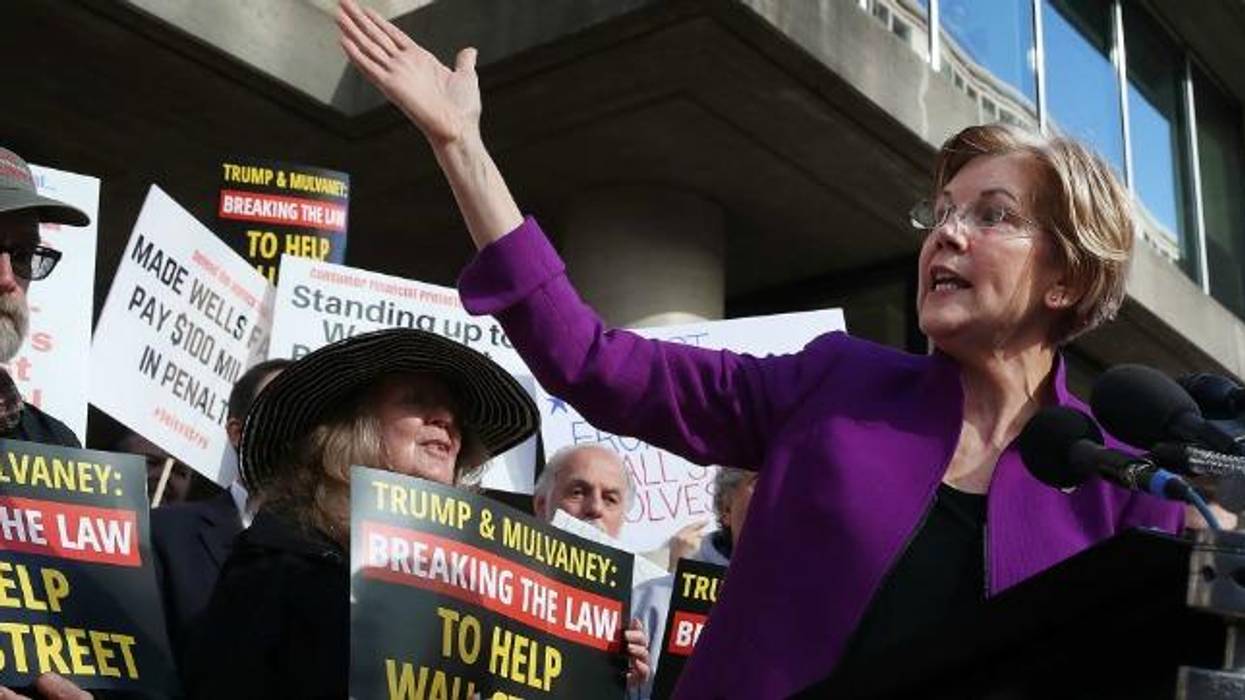
"If the Supreme Court follows suit," said one watchdog, "it will mark a major win for everyday consumers impacted by abusive fees, predatory lenders, and corporate greed."
U.S. Sen. Elizabeth Warren, who established the Consumer Financial Protection Bureau in 2010, was among the consumer advocates celebrating on Thursday as a federal court in New York City ruled that the bureau's funding structure is constitutional—rebuking years of right-wing and corporate attacks on the agency.
The Massachusetts Democrat expressed hope that the U.S. Supreme Court, which is expected to hear arguments in a separate but related case later this year, "follows more than a century of law and historical precedent" and also rules in favor of the CFPB, which has regulated debt collectors, payday lenders, credit card companies, and other financial businesses for more than a decade.
"Yet again, the constitutionality of the CFPB has been upheld, as it has been time and time before," said Warren.
The 2nd U.S. Circuit Court of Appeals ruled in favor of the bureau Thursday in a case stemming from a debt collector's attempt to avoid a subpoena from the CFPB in 2017.
A lower court ruled in the case in August 2020 that the bureau's funding structure is constitutional, but the 5th U.S. Circuit Court of Appeals in New Orleans said last year in the case set to be heard by the Supreme Court that the funding violates the Constitution's appropriations clause and the separation of executive and legislative powers.
The CFPB is funded by the Federal Reserve rather than through appropriations voted on annually by lawmakers.
Writing for the three-judge 2nd Circuit panel that voted unanimously in favor of the bureau, Judge Richard Sullivan noted that the justice system "has consistently interpreted the appropriations clause to mean simply that 'the payment of money from the Treasury must be authorized by a statute,'"—which doesn't apply to the CFPB since it receives no funding from the U.S. Treasury Department.
An upcoming ruling by the Supreme Court that supports the 2nd Circuit's finding would "mark a major win for everyday consumers impacted by abusive fees, predatory lenders, and corporate greed," said government watchdog Accountable.US.
"The CFPB is a vital voice for consumers and protects Americans from unfair and abusive practices," said Rep. Nydia Velázquez (D-N.Y.). "We can't allow these protections to be weakened."
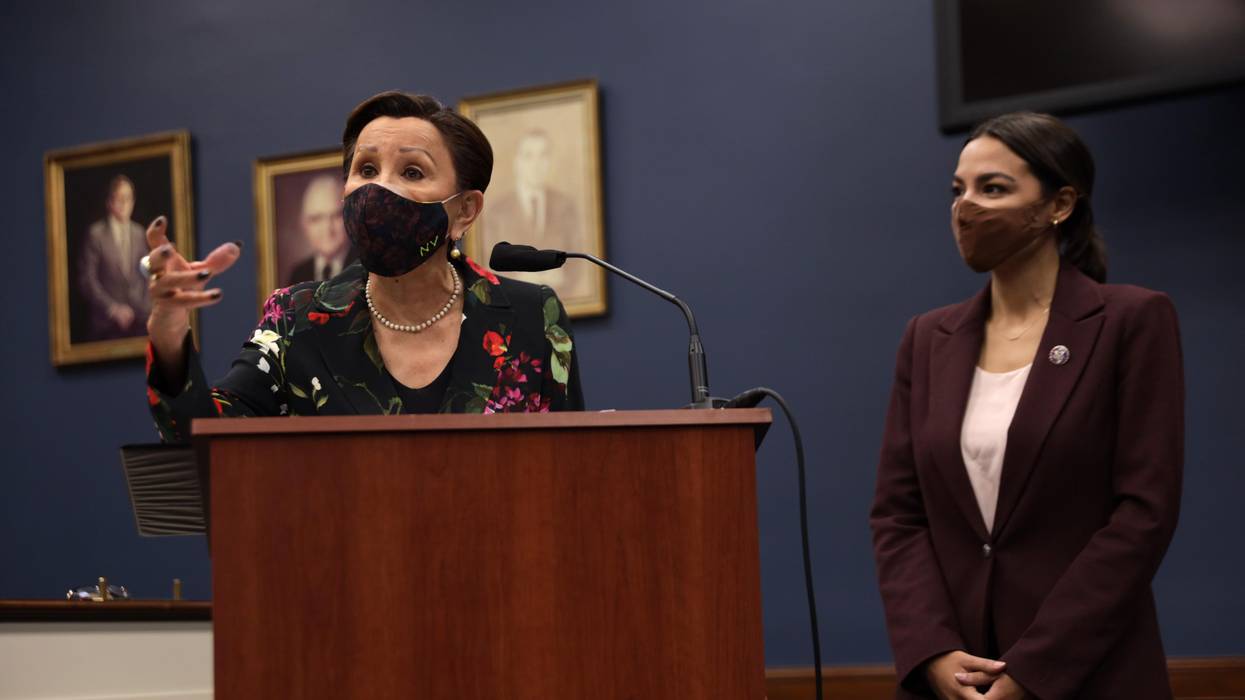
Reps. Nydia Velazquez and Alexandria Ocasio-Cortez, two of the four current Puerto Rican members of the U.S. House, were among those who celebrated the passage of the Puerto Rico Status Act on Thursday as lawmakers made history by approving a binding process for a referendum in the territory regarding potential statehood.
The proposal passed with a vote of 233-191, with 16 Republicans joining the Democratic Party in supporting it.
"We did it!" tweeted Velazquez (D-N.Y.).
The bill was finalized just hours before the vote, with lawmakers coming to a compromise between three different proposals favored by Puerto Rico's three political parties.
"The Puerto Rican Independence Party favors separating from the United States; the New Progressive Party favors statehood, and the Popular Democratic Party favors remaining a U.S. commonwealth," reported The New York Times. "Jenniffer Gonzalez-Colon, the resident commissioner of Puerto Rico and its lone representative in Congress, backed a compromise measure among competing plans."
After the bill passes, Ocasio-Cortez (D-N.Y.) said that "for the first time in our nation's history, the U.S. recognized its role as a colonizing force."
In 2021, Ocasio-Cortez and Velazquez introduced the Puerto Rico Self-Determination Act, which called for the creation of a status convention for residents to propose to Congress the status they want for the territory.
The White House supports the Puerto Rico Status Act, but with the majority of Republican lawmakers opposed, it is not expected to pass in the U.S. Senate.
Ocasio-Cortez told the Times that the bill's passage represents "a way point and a steppingstone for the future of our island."
"The gains that are made here are a watershed moment," she said.