SUBSCRIBE TO OUR FREE NEWSLETTER
Daily news & progressive opinion—funded by the people, not the corporations—delivered straight to your inbox.
5
#000000
#FFFFFF
To donate by check, phone, or other method, see our More Ways to Give page.
Daily news & progressive opinion—funded by the people, not the corporations—delivered straight to your inbox.
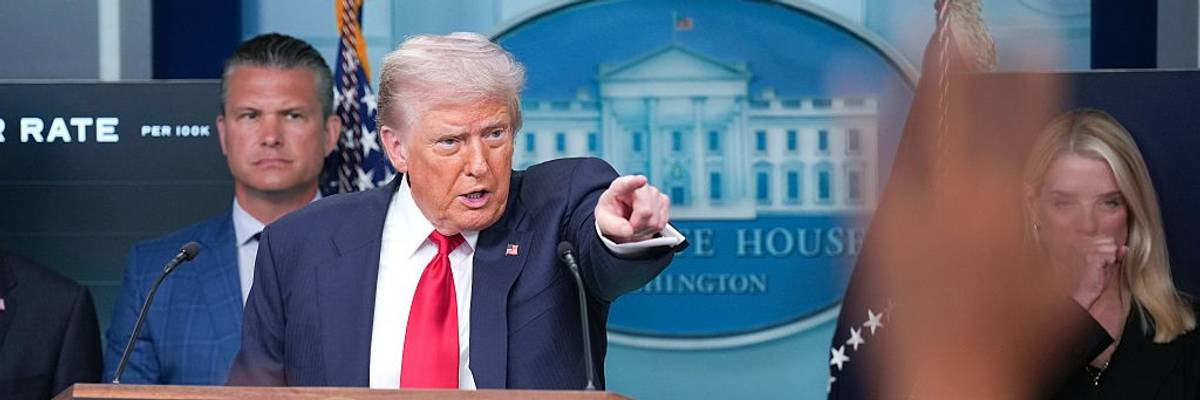
US President Donald Trump answers questions during a press conference in the White House on August 11, 2025 in Washington, DC.
"Trump’s military buildup in the Caribbean isn’t about 'drugs,' it’s about oil, power, and regime change," said on critic of potential strikes in Venezuela.
Two reports claim that the Trump administration is poised to launch strikes against military targets inside Venezuela.
The Wall Street Journal reported on Thursday night that the administration is preparing to attack a variety of targets inside Venezuela, including "ports and airports controlled by the military that are allegedly used to traffic drugs, including naval facilities and airstrips."
Reports from the US government and the United Nations have not identified Venezuela as a significant source of drugs that enter the United States, and the country plays virtually no role in the trafficking of fentanyl, the primary cause of drug overdoses in the US.
While the WSJ report said that the administration had not yet decided to carry out the operations against Venezuela, the Miami Herald reported on Friday morning that the administration "has made the decision to attack military installations inside Venezuela and the strikes could come at any moment."
A source who spoke with the Miami Herald didn't explicitly say that Venezuelan leader Nicolás Maduro would be the target of these actions, but they nonetheless hinted that the goal was to weaken his grip on power.
"Maduro is about to find himself trapped and might soon discover that he cannot flee the country even if he decided to,” the source said. “What’s worse for him, there is now more than one general willing to capture and hand him over, fully aware that one thing is to talk about death, and another to see it coming."
While the Trump administration has accused Maduro of leading an international drug trafficking organization called the Cartel de los Soles, some experts have expressed extreme skepticism of this claim.
Phil Gunson, analyst at the International Crisis Group think tank, said in an interview with Agence Presse-France earlier this year that he doubts that so-called "Cartel de los Soles" even exists, and noted that "direct, incontrovertible evidence has never been presented" to show otherwise.
Earlier this year, the administration attempted to tie Maduro to another gang, Tren de Aragua, despite US intelligence agencies rejecting the notion that the street gang had government connections.
Launching strikes on Venezuelan soil would mark a major escalation in the administration's military campaign targeting purported drug traffickers, which so far has consisted of drone strikes against boats in international waters that many legal experts have described as a campaign of extrajudicial murder.
Dozens of political leaders throughout Latin America earlier this month condemned the administration's attacks on the purported drug boats, and they warned that they could just be the start of a regime change war reminiscent of the coups carried out by the US government in the last century that installed military dictatorships throughout the region.
"We have lived this nightmare before,” they emphasized in a joint letter. “US military interventions of the 20th century brought dictatorships, disappearances, and decades of trauma to our nations. We know the terrible cost of allowing foreign powers to wage war on our continent. We cannot—we will not—allow history to repeat itself.”
Medea Benjamin, cofounder of anti-war group CodePink, accused the Trump administration of using a fight against alleged drug trafficking as a false pretext to seize Venezuela's vast oil reserves.
"Trump’s military buildup in the Caribbean isn’t about 'drugs,' it’s about oil, power, and regime change," she wrote in a post on X. "Venezuela has the largest proven oil reserves in the world, that’s why they’re escalating toward war."
Dear Common Dreams reader, It’s been nearly 30 years since I co-founded Common Dreams with my late wife, Lina Newhouser. We had the radical notion that journalism should serve the public good, not corporate profits. It was clear to us from the outset what it would take to build such a project. No paid advertisements. No corporate sponsors. No millionaire publisher telling us what to think or do. Many people said we wouldn't last a year, but we proved those doubters wrong. Together with a tremendous team of journalists and dedicated staff, we built an independent media outlet free from the constraints of profits and corporate control. Our mission has always been simple: To inform. To inspire. To ignite change for the common good. Building Common Dreams was not easy. Our survival was never guaranteed. When you take on the most powerful forces—Wall Street greed, fossil fuel industry destruction, Big Tech lobbyists, and uber-rich oligarchs who have spent billions upon billions rigging the economy and democracy in their favor—the only bulwark you have is supporters who believe in your work. But here’s the urgent message from me today. It's never been this bad out there. And it's never been this hard to keep us going. At the very moment Common Dreams is most needed, the threats we face are intensifying. We need your support now more than ever. We don't accept corporate advertising and never will. We don't have a paywall because we don't think people should be blocked from critical news based on their ability to pay. Everything we do is funded by the donations of readers like you. When everyone does the little they can afford, we are strong. But if that support retreats or dries up, so do we. Will you donate now to make sure Common Dreams not only survives but thrives? —Craig Brown, Co-founder |
Two reports claim that the Trump administration is poised to launch strikes against military targets inside Venezuela.
The Wall Street Journal reported on Thursday night that the administration is preparing to attack a variety of targets inside Venezuela, including "ports and airports controlled by the military that are allegedly used to traffic drugs, including naval facilities and airstrips."
Reports from the US government and the United Nations have not identified Venezuela as a significant source of drugs that enter the United States, and the country plays virtually no role in the trafficking of fentanyl, the primary cause of drug overdoses in the US.
While the WSJ report said that the administration had not yet decided to carry out the operations against Venezuela, the Miami Herald reported on Friday morning that the administration "has made the decision to attack military installations inside Venezuela and the strikes could come at any moment."
A source who spoke with the Miami Herald didn't explicitly say that Venezuelan leader Nicolás Maduro would be the target of these actions, but they nonetheless hinted that the goal was to weaken his grip on power.
"Maduro is about to find himself trapped and might soon discover that he cannot flee the country even if he decided to,” the source said. “What’s worse for him, there is now more than one general willing to capture and hand him over, fully aware that one thing is to talk about death, and another to see it coming."
While the Trump administration has accused Maduro of leading an international drug trafficking organization called the Cartel de los Soles, some experts have expressed extreme skepticism of this claim.
Phil Gunson, analyst at the International Crisis Group think tank, said in an interview with Agence Presse-France earlier this year that he doubts that so-called "Cartel de los Soles" even exists, and noted that "direct, incontrovertible evidence has never been presented" to show otherwise.
Earlier this year, the administration attempted to tie Maduro to another gang, Tren de Aragua, despite US intelligence agencies rejecting the notion that the street gang had government connections.
Launching strikes on Venezuelan soil would mark a major escalation in the administration's military campaign targeting purported drug traffickers, which so far has consisted of drone strikes against boats in international waters that many legal experts have described as a campaign of extrajudicial murder.
Dozens of political leaders throughout Latin America earlier this month condemned the administration's attacks on the purported drug boats, and they warned that they could just be the start of a regime change war reminiscent of the coups carried out by the US government in the last century that installed military dictatorships throughout the region.
"We have lived this nightmare before,” they emphasized in a joint letter. “US military interventions of the 20th century brought dictatorships, disappearances, and decades of trauma to our nations. We know the terrible cost of allowing foreign powers to wage war on our continent. We cannot—we will not—allow history to repeat itself.”
Medea Benjamin, cofounder of anti-war group CodePink, accused the Trump administration of using a fight against alleged drug trafficking as a false pretext to seize Venezuela's vast oil reserves.
"Trump’s military buildup in the Caribbean isn’t about 'drugs,' it’s about oil, power, and regime change," she wrote in a post on X. "Venezuela has the largest proven oil reserves in the world, that’s why they’re escalating toward war."
Two reports claim that the Trump administration is poised to launch strikes against military targets inside Venezuela.
The Wall Street Journal reported on Thursday night that the administration is preparing to attack a variety of targets inside Venezuela, including "ports and airports controlled by the military that are allegedly used to traffic drugs, including naval facilities and airstrips."
Reports from the US government and the United Nations have not identified Venezuela as a significant source of drugs that enter the United States, and the country plays virtually no role in the trafficking of fentanyl, the primary cause of drug overdoses in the US.
While the WSJ report said that the administration had not yet decided to carry out the operations against Venezuela, the Miami Herald reported on Friday morning that the administration "has made the decision to attack military installations inside Venezuela and the strikes could come at any moment."
A source who spoke with the Miami Herald didn't explicitly say that Venezuelan leader Nicolás Maduro would be the target of these actions, but they nonetheless hinted that the goal was to weaken his grip on power.
"Maduro is about to find himself trapped and might soon discover that he cannot flee the country even if he decided to,” the source said. “What’s worse for him, there is now more than one general willing to capture and hand him over, fully aware that one thing is to talk about death, and another to see it coming."
While the Trump administration has accused Maduro of leading an international drug trafficking organization called the Cartel de los Soles, some experts have expressed extreme skepticism of this claim.
Phil Gunson, analyst at the International Crisis Group think tank, said in an interview with Agence Presse-France earlier this year that he doubts that so-called "Cartel de los Soles" even exists, and noted that "direct, incontrovertible evidence has never been presented" to show otherwise.
Earlier this year, the administration attempted to tie Maduro to another gang, Tren de Aragua, despite US intelligence agencies rejecting the notion that the street gang had government connections.
Launching strikes on Venezuelan soil would mark a major escalation in the administration's military campaign targeting purported drug traffickers, which so far has consisted of drone strikes against boats in international waters that many legal experts have described as a campaign of extrajudicial murder.
Dozens of political leaders throughout Latin America earlier this month condemned the administration's attacks on the purported drug boats, and they warned that they could just be the start of a regime change war reminiscent of the coups carried out by the US government in the last century that installed military dictatorships throughout the region.
"We have lived this nightmare before,” they emphasized in a joint letter. “US military interventions of the 20th century brought dictatorships, disappearances, and decades of trauma to our nations. We know the terrible cost of allowing foreign powers to wage war on our continent. We cannot—we will not—allow history to repeat itself.”
Medea Benjamin, cofounder of anti-war group CodePink, accused the Trump administration of using a fight against alleged drug trafficking as a false pretext to seize Venezuela's vast oil reserves.
"Trump’s military buildup in the Caribbean isn’t about 'drugs,' it’s about oil, power, and regime change," she wrote in a post on X. "Venezuela has the largest proven oil reserves in the world, that’s why they’re escalating toward war."