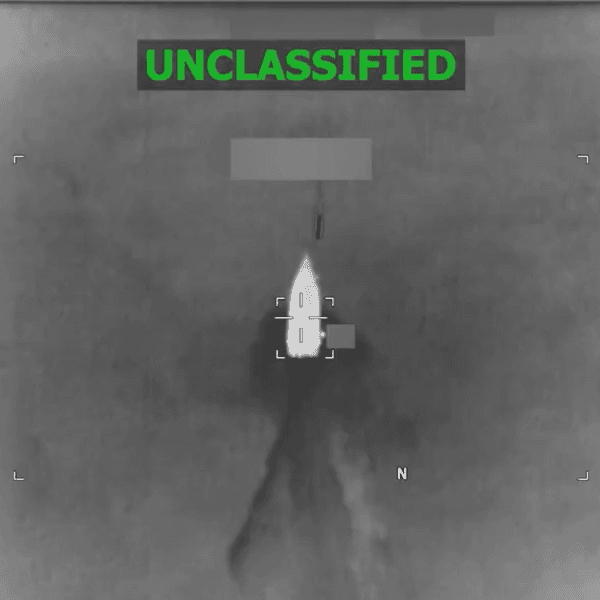
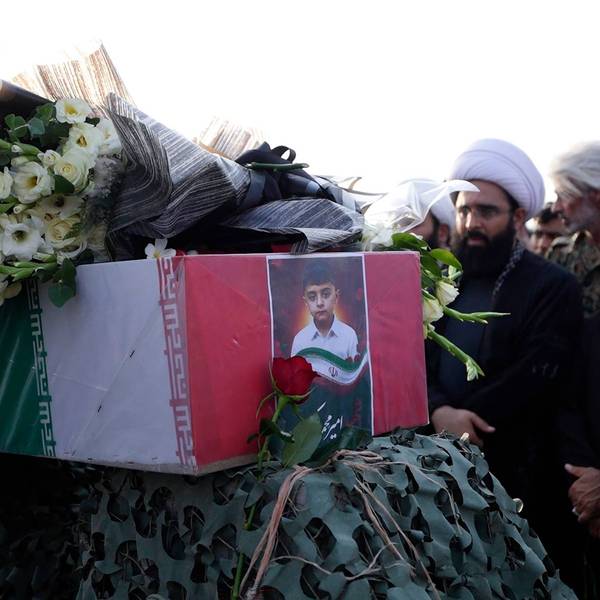
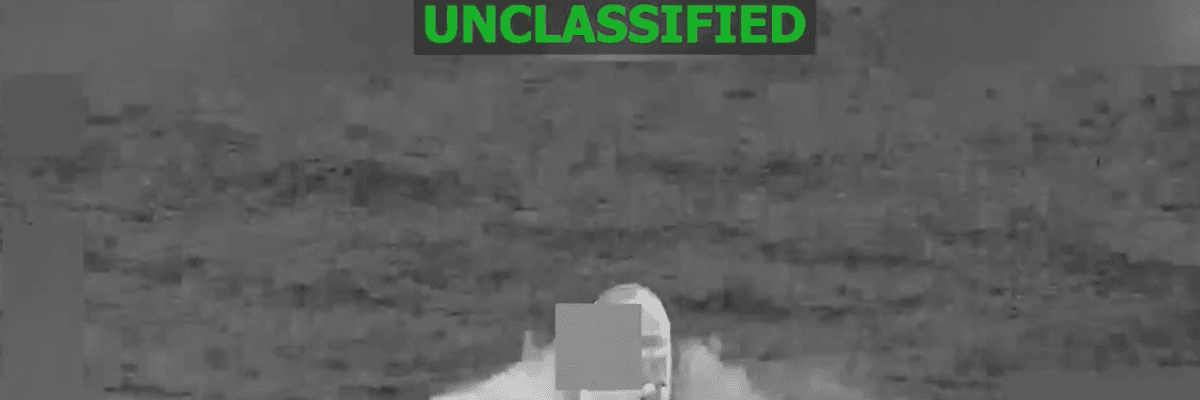
An unclassified surveillance image from US Southern Command shows the boat that was targeted by the US military in the eastern Pacific Ocean on February 5, 2026.
Death Toll Up to 128 People as Trump Pentagon Commits Two More Killings at Sea
"They killed more than 127 people aboard boats, in 33 attacks, in five months," said one analyst. "And the amount of cocaine found at the US land border keeps increasing."
Just over a week after the families of two Trinidadian men sued the Trump administration over the boat bombings that killed their relatives, the US Department of Defense killed two more people in the eastern Pacific Ocean, bringing the total death toll to at least 128 in the White House's operation that it claims is targeting drug traffickers.
The US Southern Command said in a social media post that at the direction of Cmdr. Gen. Francis L. Donovan, "Joint Task Force Southern Spear conducted a lethal kinetic strike on a vessel operated by designated terrorist organizations."
As with the other dozens of strikes the Pentagon has carried out in the Pacific and the Caribbean Sea since September, Southern Command did not provide evidence for its claim that "narco-terrorists" were killed in the attack or that the vessel was traveling "along known narco-trafficking routes in the Eastern Pacific and was engaged in narco-trafficking operations."
The White House has persistently claimed that the boat strikes are aimed at stopping drug cartels based in Venezuela from sending drugs to the US, but international and domestic intelligence agencies have not identified Venezuela as a major player in the trafficking of illicit substances—particularly not of fentanyl, the leading cause of overdoses in the US.
President Donald Trump has claimed the US is in an "armed conflict" with drug cartels. Members of Congress from both sides of the aisle have unsuccessfully sought to pass war powers resolutions to stop the administration from attacking vessels and targets in Venezuela.
Dozens of strikes preceded the Trump administration's invasion of Venezuela and abduction of President Nicolás Maduro, whom the White House has accused of being directly involved with drug trafficking. Since attacking Venezuela, though, administration officials have all but admitted their goal in the South American country is to take control of its oil supply.
The killings of nearly 130 people in the Caribbean and eastern Pacific have been denounced as extrajudicial "murders" by numerous legal experts, and a top military lawyer at the Pentagon warned officials in August, weeks before the operations began, that carrying out the strikes could expose military top brass as well as rank-and-file service members to legal liability.
In the case of at least one bombing in September, the official who oversaw the strike told Congress that the boat was found to have been headed to Suriname, not the United States. One vessel had turned back toward Venezuela, away from the US, when it was struck.
The strike on Thursday was announced soon after Defense Secretary Pete Hegseth claimed that "some top cartel drug-traffickers... have decided to cease all narcotics operations INDEFINITELY due to recent (highly effective) kinetic strikes in the Caribbean.” Hegseth did not provide evidence for the claim.
Adam Isacson of the Washington Office on Latin America emphasized on Thursday that after killing more than 127 people in the Caribbean and eastern Pacific, the administration has nothing to show for the operation but "a collection of gruesome videos" of the bombings.
"The amount of cocaine found at the US land border keeps increasing," he said, citing Customs and Border Protection statistics.
We are at a crossroads
This country and this world are at a monumental crossroads. In a few short weeks, US voters will have an opportunity to beat back the forces of fascism and confront the billionaires who are rigging the economy, our media system, and our democracy, making it increasingly impossible for ordinary people to get by. We’re not just talking about the election. We’re talking about what must be done once these fascist elements are vanquished from power. We need a bolder set of solutions than what either major party has so far been willing to offer and a working-class movement ready to fight like hell for it. Trump didn't emerge from nowhere. The conditions that fueled MAGA authoritarianism were created by decades of radical neoliberal economic policies and a corrupt political system dominated by corporate interests. They slashed taxes on the super-rich, promising that the benefits would trickle down. They said giveaways to the corporate titans would make life more affordable for the rest of us. It was all bullshit. And when a bitter, betrayed populace searches for someone to blame, right-wing demagogues have little trouble finding scapegoats. People know when they're being lied to, but you won't hear any of this from the corporate media. Only independent journalism—powered and funded by people who believe in building a better world—can deliver truly trustworthy daily news. Our Fall Campaign is underway, and we need your help. To power our newsroom through the rest of the year, we need to raise $125,000 by midnight on October 31. So if you share our vision, please contribute whatever you can to sustain our work. |
Just over a week after the families of two Trinidadian men sued the Trump administration over the boat bombings that killed their relatives, the US Department of Defense killed two more people in the eastern Pacific Ocean, bringing the total death toll to at least 128 in the White House's operation that it claims is targeting drug traffickers.
The US Southern Command said in a social media post that at the direction of Cmdr. Gen. Francis L. Donovan, "Joint Task Force Southern Spear conducted a lethal kinetic strike on a vessel operated by designated terrorist organizations."
As with the other dozens of strikes the Pentagon has carried out in the Pacific and the Caribbean Sea since September, Southern Command did not provide evidence for its claim that "narco-terrorists" were killed in the attack or that the vessel was traveling "along known narco-trafficking routes in the Eastern Pacific and was engaged in narco-trafficking operations."
The White House has persistently claimed that the boat strikes are aimed at stopping drug cartels based in Venezuela from sending drugs to the US, but international and domestic intelligence agencies have not identified Venezuela as a major player in the trafficking of illicit substances—particularly not of fentanyl, the leading cause of overdoses in the US.
President Donald Trump has claimed the US is in an "armed conflict" with drug cartels. Members of Congress from both sides of the aisle have unsuccessfully sought to pass war powers resolutions to stop the administration from attacking vessels and targets in Venezuela.
Dozens of strikes preceded the Trump administration's invasion of Venezuela and abduction of President Nicolás Maduro, whom the White House has accused of being directly involved with drug trafficking. Since attacking Venezuela, though, administration officials have all but admitted their goal in the South American country is to take control of its oil supply.
The killings of nearly 130 people in the Caribbean and eastern Pacific have been denounced as extrajudicial "murders" by numerous legal experts, and a top military lawyer at the Pentagon warned officials in August, weeks before the operations began, that carrying out the strikes could expose military top brass as well as rank-and-file service members to legal liability.
In the case of at least one bombing in September, the official who oversaw the strike told Congress that the boat was found to have been headed to Suriname, not the United States. One vessel had turned back toward Venezuela, away from the US, when it was struck.
The strike on Thursday was announced soon after Defense Secretary Pete Hegseth claimed that "some top cartel drug-traffickers... have decided to cease all narcotics operations INDEFINITELY due to recent (highly effective) kinetic strikes in the Caribbean.” Hegseth did not provide evidence for the claim.
Adam Isacson of the Washington Office on Latin America emphasized on Thursday that after killing more than 127 people in the Caribbean and eastern Pacific, the administration has nothing to show for the operation but "a collection of gruesome videos" of the bombings.
"The amount of cocaine found at the US land border keeps increasing," he said, citing Customs and Border Protection statistics.
- Trump Blockade of Venezuela, Murders on High Seas Violate International Law: UN Experts ›
- Legal Experts Accuse Hegseth of 'War Crimes, Murder, or Both' After New Reporting on Boat Strike Order ›
- Princeton Experts Speak Out Against Trump Boat Strikes as 'Illegal' and Destabilizing 'Murders' ›
- US Kills at Least 2 More People in Yet Another Illegal Boat Bombing | Common Dreams ›
- State Department Pushes Human Rights Watchdog to Ignore Deadly, Illegal Boat Strike Campaign | Common Dreams ›
- '3 More Murders at Sea': Trump Boat-Bombing Spree Continues | Common Dreams ›
- 'Each of These Is a Murder': Trump Admin Conducts 3rd Deadly Boat Strike in 5 Days | Common Dreams ›
- 13 of the Nearly 200 People Murdered by Trump and Hegseth Identified for First Time | Common Dreams ›
- After Castro Charges, Critics Ask: When Are Indictments Coming for Trump-Hegseth 'Extrajudicial Murders'? | Common Dreams ›
- 'We Don't Waste Our Time' With Courts, Says Trump, Bragging of Extrajudicial Murders in Pacific and Caribbean | Common Dreams ›
Just over a week after the families of two Trinidadian men sued the Trump administration over the boat bombings that killed their relatives, the US Department of Defense killed two more people in the eastern Pacific Ocean, bringing the total death toll to at least 128 in the White House's operation that it claims is targeting drug traffickers.
The US Southern Command said in a social media post that at the direction of Cmdr. Gen. Francis L. Donovan, "Joint Task Force Southern Spear conducted a lethal kinetic strike on a vessel operated by designated terrorist organizations."
As with the other dozens of strikes the Pentagon has carried out in the Pacific and the Caribbean Sea since September, Southern Command did not provide evidence for its claim that "narco-terrorists" were killed in the attack or that the vessel was traveling "along known narco-trafficking routes in the Eastern Pacific and was engaged in narco-trafficking operations."
The White House has persistently claimed that the boat strikes are aimed at stopping drug cartels based in Venezuela from sending drugs to the US, but international and domestic intelligence agencies have not identified Venezuela as a major player in the trafficking of illicit substances—particularly not of fentanyl, the leading cause of overdoses in the US.
President Donald Trump has claimed the US is in an "armed conflict" with drug cartels. Members of Congress from both sides of the aisle have unsuccessfully sought to pass war powers resolutions to stop the administration from attacking vessels and targets in Venezuela.
Dozens of strikes preceded the Trump administration's invasion of Venezuela and abduction of President Nicolás Maduro, whom the White House has accused of being directly involved with drug trafficking. Since attacking Venezuela, though, administration officials have all but admitted their goal in the South American country is to take control of its oil supply.
The killings of nearly 130 people in the Caribbean and eastern Pacific have been denounced as extrajudicial "murders" by numerous legal experts, and a top military lawyer at the Pentagon warned officials in August, weeks before the operations began, that carrying out the strikes could expose military top brass as well as rank-and-file service members to legal liability.
In the case of at least one bombing in September, the official who oversaw the strike told Congress that the boat was found to have been headed to Suriname, not the United States. One vessel had turned back toward Venezuela, away from the US, when it was struck.
The strike on Thursday was announced soon after Defense Secretary Pete Hegseth claimed that "some top cartel drug-traffickers... have decided to cease all narcotics operations INDEFINITELY due to recent (highly effective) kinetic strikes in the Caribbean.” Hegseth did not provide evidence for the claim.
Adam Isacson of the Washington Office on Latin America emphasized on Thursday that after killing more than 127 people in the Caribbean and eastern Pacific, the administration has nothing to show for the operation but "a collection of gruesome videos" of the bombings.
"The amount of cocaine found at the US land border keeps increasing," he said, citing Customs and Border Protection statistics.
- Trump Blockade of Venezuela, Murders on High Seas Violate International Law: UN Experts ›
- Legal Experts Accuse Hegseth of 'War Crimes, Murder, or Both' After New Reporting on Boat Strike Order ›
- Princeton Experts Speak Out Against Trump Boat Strikes as 'Illegal' and Destabilizing 'Murders' ›
- US Kills at Least 2 More People in Yet Another Illegal Boat Bombing | Common Dreams ›
- State Department Pushes Human Rights Watchdog to Ignore Deadly, Illegal Boat Strike Campaign | Common Dreams ›
- '3 More Murders at Sea': Trump Boat-Bombing Spree Continues | Common Dreams ›
- 'Each of These Is a Murder': Trump Admin Conducts 3rd Deadly Boat Strike in 5 Days | Common Dreams ›
- 13 of the Nearly 200 People Murdered by Trump and Hegseth Identified for First Time | Common Dreams ›
- After Castro Charges, Critics Ask: When Are Indictments Coming for Trump-Hegseth 'Extrajudicial Murders'? | Common Dreams ›
- 'We Don't Waste Our Time' With Courts, Says Trump, Bragging of Extrajudicial Murders in Pacific and Caribbean | Common Dreams ›