

SUBSCRIBE TO OUR FREE NEWSLETTER
Daily news & progressive opinion—funded by the people, not the corporations—delivered straight to your inbox.
5
#000000
#FFFFFF
To donate by check, phone, or other method, see our More Ways to Give page.
Daily news & progressive opinion—funded by the people, not the corporations—delivered straight to your inbox.
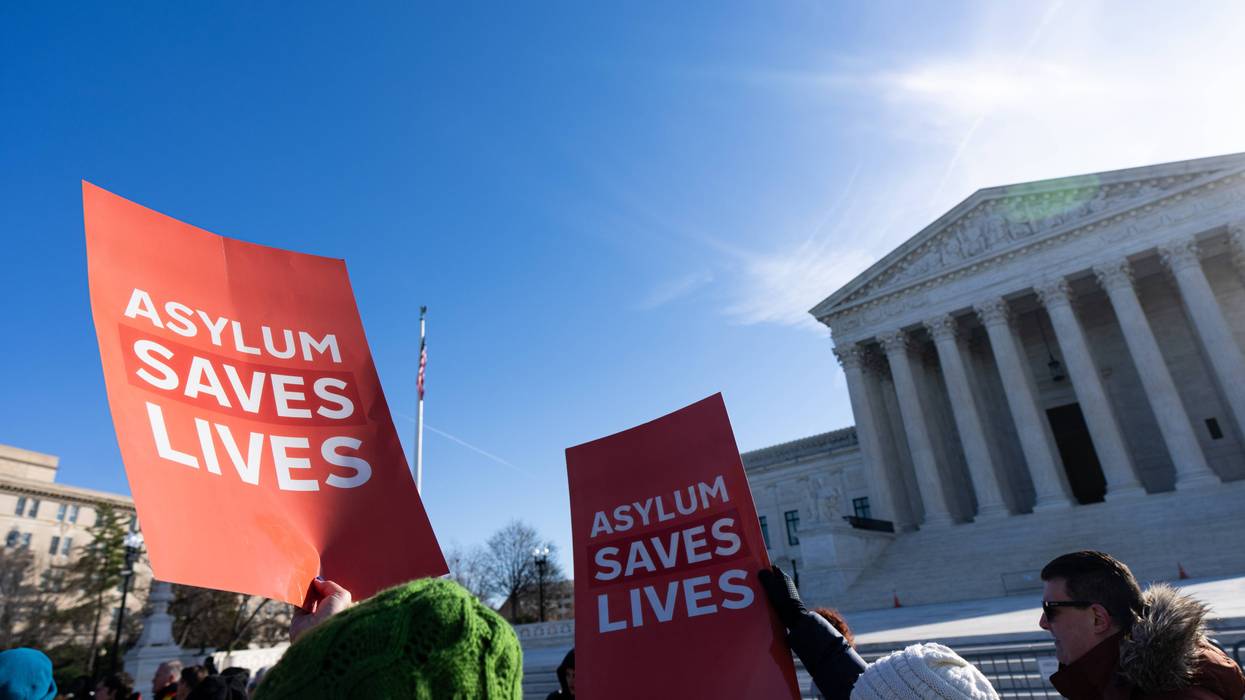
With these decisions, the Supreme Court once again bends the knee to Trump’s vile agenda of violence and death; eliminating humanitarian protections and denying asylum to those who need them most betrays every value that makes this nation great.
On June 25, the Supreme Court drastically expanded the Trump administration’s ability to shape the nation’s immigration system. In two separate 6-3 decisions, the court’s conservative majority ruled that the administration can revoke Temporary Protected Status for hundreds of thousands of Haitian and Syrian migrants, as well as physically block asylum-seekers from entering the country and applying for legal protections.
Both rulings are as cruel as they are nonsensical.
Since the start of President Donald Trump’s second term, the Department of Homeland Security (DHS) has sought to end TPS for over 1 million migrants from 13 countries, including Venezuela, Haiti, Somalia, and Syria. These termination orders have been challenged in court and, to date, seven of them remain paused.
The Supreme Court’s ruling, however, puts all of them in jeopardy. While it allows DHS to remove legal protections for Haitians and Syrians specifically, it paves the way for the department to terminate TPS for any group with little to no oversight.
if Trump’s gross fearmongering about Haitians eating cats and dogs is not “overtly racial,” then it’s hard to imagine this Supreme Court acknowledging any of this administration’s blatant racism and xenophobia.
Writing for the majority, Justice Samuel Alito claims that the courts are prohibited from reviewing whether DHS’ decision to terminate TPS complied with the legally required procedures needed to cancel the status. For example, whether former DHS Secretary Kristi Noem “inadequately consulted the State Department about conditions in Syria” or, more broadly, whether “her decision that country conditions in Syria and Haiti justified termination of their TPS designations” are exempt from any form of judicial review.
Importantly, the Supreme Court did not rule that DHS followed the proper protocols when ending TPS. Nor did it determine that conditions in those countries were safe—and, in fact, the Trump administration knows they are not. The State Department has active travel advisories warning Americans against traveling to Syria and Haiti “for any reason” due to the risk of crime, terrorism, kidnapping, unrest, limited healthcare, hostage taking, and armed conflict. It is also worth noting that the present conditions in those countries are the direct result of America’s actions in Syria through decades of sanctions and military intervention; and in Haiti, through years of colonial occupation and repeatedly undermining their democratic process.
For the conservative justices, none of this matters. These issues are, in their view, beyond the scope of the courts.
This is a ridiculous assessment. The relevant statute (8 U.S.C. 1254a) reads: “There is no judicial review of any determination […] with respect to the designation, or termination or extension of a designation, of a foreign state under this subsection.” The court’s conservatives read the word “determination” here to refer to (i) the final decision, (ii) the entire decision-making process, and (iii) every sub-decision within that process. Based on that definition, they conclude that this statute “squarely bars” the courts from assessing the legality of any aspect of DHS’ decision to end TPS.
As Justice Elena Kagan puts it, this interpretation is not only “very broad,” but “very strange.” In her dissenting opinion, she correctly notes that the statute only applies to the final “determination” with regards to whether TPS is actually granted, terminated, or extended. It “does nothing to stop courts from reviewing […] other things” such as “the procedural steps the Secretary must undertake prior to making any determination about country conditions.”
This is not only more consistent with the relevant text but reflects a basic presumption inherent to our system of checks and balances—namely, that “Congress intends the executive to obey its statutory commands and, accordingly, that it expects the courts to grant relief when an executive agency violates such a command.”
After all, if Congress intended DHS to have broad authority to revoke TPS at its sole discretion, then why would it create a multi-step protocol that the department must follow to lawfully end those protections? That fact alone entails that it always intended how DHS reached its “determination” to be subject to judicial and external review.
The conservative majority ignores such considerations. Instead of proper judicial interpretation, they offer a politically motivated and disingenuous rationale designed to give the Trump administration complete control over the humanitarian program.
To this end, the Supreme Court granted the Trump administration one more gift: sanitizing its racism.
The court rejected the plaintiff’s claim that terminating TPS for Haitians was racially motivated and thus violated the equal protection clause. For the court’s conservatives, none of President Trump’s past remarks—which include that Haitians are “eating the dogs,” “probably have AIDS,” and that Haiti is a “shithole country”—“were overtly racial, and in substance all expressed policy views that could rest on race-neutral justifications.” Whatever these “race-neutral justifications” are, the court conveniently fails to elaborate.
In his concurring opinion, Justice Clarence Thomas goes even further. He posits that the plaintiff’s suit would fail simply because “aliens have no equal protection rights against the Federal Government.” Constitutionally, this is painfully wrong. Morally, this is utterly disgusting.
In one fell swoop, the Supreme Court effectively cleared all legal obstacles against the Trump administration’s efforts to end TPS for anyone at any time for any reason. Their ruling renders non-constitutional challenges regarding policy adherence moot from the outset. And if Trump’s gross fearmongering about Haitians eating cats and dogs is not “overtly racial,” then it’s hard to imagine this Supreme Court acknowledging any of this administration’s blatant racism and xenophobia. Their willful ignorance renders the equal protection clause similarly moot.
To make matters worse, the Supreme Court was not done. In a separate decision, the court’s conservatives upheld the Trump administration’s “turn-back policy” (also known as “metering”) that allows federal agents at the US border to stop migrants from crossing into the US.
Currently, federal law permits any migrant “who is physically present in the United States or who arrives in the United States (whether or not at a designated port of arrival […])” to apply for asylum. In Mulin v. Al Otro Lado, the Trump administration argued that their policy does not violate this law since, insofar as those migrants never step foot onto US soil, they never become entitled to apply for asylum in the first place.
The Supreme Court agreed. Writing again for the court’s majority, Alito claims that this case is “straightforward.” He writes, “In ordinary speech, no one would say that a person ‘arrives in’ a place—for example, a house, a city, or a country—before the person enters the place.”
The Trump administration does not cherish life. The Supreme Court does not value justice. Congress is now the last line of governmental defense against full-on fascism.
Yet, as Justice Sonia Sotomayor writes in her dissenting opinion, the majority’s fixation with the word “in” overlooks the broader context of the statute. Federal law dictates that any migrant “arriving” and “seeking admission” into the country “shall be inspected by immigration officers.” If they are ineligible for admission, they shall be removed unless they indicate “an intention to apply for asylum […] or a fear of persecution.” In that case, “the officer shall refer the alien for an interview.” That clause clearly applies to migrants who haven’t physically entered the US.
This also explains the language Congress uses in that statute. Under the majority’s reading, to “arrive in” the US is synonymous with being “physically present in” the US. But, if this is true, then why would Congress include both phrases if they were so obviously redundant? It’s because, in addition to being physically present, those who have arrived before an immigration official also have the right to apply for asylum even if they are not physically present in the US.
As Sotomayor bleakly remarks, “The consequences of today’s decision are predictable. More people will die. More people will attempt to cross the border illegally, and some will make it while others will not.”
This point not only underlines the cruelty of the policy, but also its sheer stupidity. Asylum-seekers brave horrible conditions, traveling hundreds if not thousands of miles away from their homes in search of a better life. Sotomayor is obviously correct that some will take the extra steps to enter the country by any means necessary. This is especially true if they believe that doing so is their only means of acquiring asylum. Trump’s policy undermines a system that would allow federal officials to screen migrants at the border, review their case, and provide them proper guidance for one that openly encourages the very kinds of “illegal entries” that his administration consistently bemoans as an existential threat to the nation.
With these decisions, the Supreme Court once again bends the knee to Trump’s vile agenda of violence and death. Eliminating humanitarian protections and denying asylum to those who need them most betray every value that makes this nation great.
What’s more, the court further exacerbates a humanitarian crisis that Trump is either intentionally or indifferently manufacturing. In his second term alone, he has either threatened or attacked 15 countries including Greenland, Venezuela, Somalia, and Syria; launched over 60 military strikes in the Caribbean and Eastern Pacific Ocean that have killed over 200 people; eliminated the US Agency for International Development (USAID)—an act that could lead to 9.4 million deaths by 2030; launched an illegal war that has killed more than 7,300 people in Iran and Lebanon; a war that has also wrecked the global economy and caused fuel and food shortages in the world’s poorest and most remote areas; has consistently aided and supported Israel’s genocide in Gaza; imposed a total oil blockade that is economically asphyxiating Cuba; and has made refugee status in the US a privilege nearly-exclusive to white South Africans (who he claims—without evidence—are facing “racially motivated violence”), among many other similarly insidious and corrupted acts.
Our best option is to empower Congress to stand up against both the Trump administration and his Supreme Court by working to elect as many progressive candidates in November.
In short, the Trump administration does not cherish life. The Supreme Court does not value justice. Congress is now the last line of governmental defense against full-on fascism.
Fortunately, even Republicans understand the gravity of this situation. Rep. Mike Lawler (R-NY), for instance, has already called for Congress to extend TPS for Haitians. For all of Trump’s bigotry, migrants remain an indispensable part of the US economy.
Ultimately, we need extensions for every group under threat from the Supreme Court’s reckless decisions as well as new protections for those who have already lost their TPS designations. For now, our best option is to empower Congress to stand up against both the Trump administration and his Supreme Court by working to elect as many progressive candidates in November. Before things get worse, we need fighters in Congress that will serve the people’s interest and stand up to Trump and his cronies.
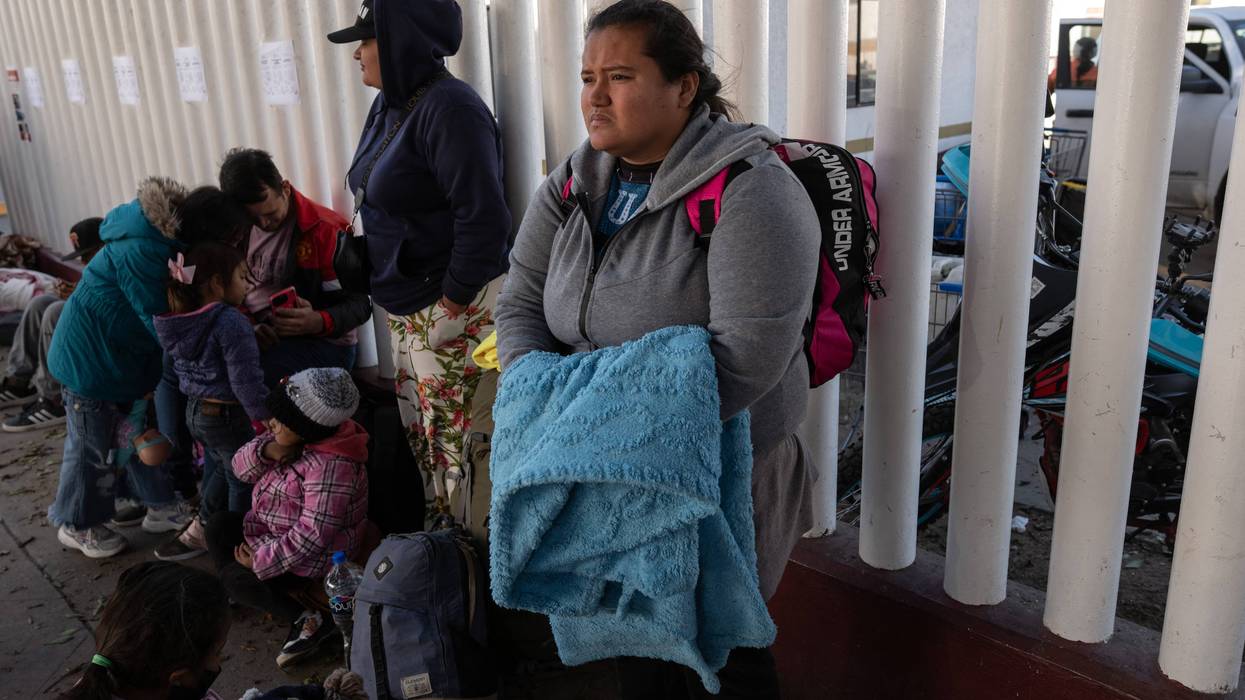
The liberal justice lamented that the majority ruling in Mullin v. Al Otro Lado empowers the Trump administration to slam the door shut on refugees "even if the asylum seeker is certain to be persecuted, or killed."
The US Supreme Court's right-wing majority on Thursday affirmed the Trump administration's deadly policy of blocking people legally seeking asylum from entering the United States in a ruling that prompted liberal Justice Sonia Sotomayor to take the rare step of reading her dissent from the bench.
In Mullin v. Al Otro Lado, the justices reversed lower-court rulings, including a 2024 9th Circuit Court of Appeals panel decision that people approaching authorized border entries are arriving "in" the United States under federal law.
The Trump administration had asked the Supreme Court to rule on the practice of "metering," by which US authorities limit the number of asylum seekers who can present themselves at a port of entry each day to request protection. The policy was first implemented during the Obama administration and expanded during President Donald Trump's first term, with US Solicitor General D. John Sauer calling it “a critical tool for addressing border surges and for preventing overcrowding at ports of entry along the border.”
“In ordinary English, a person ‘arrives in’ a country only when he comes within its borders,” Sauer argued in court filings. “An alien thus does not ‘arrive in’ the United States while he is still in Mexico.”
Justice Samuel Alito, who wrote for the majority—Chief Justice John Roberts, Justice Clarence Thomas, and Trump-appointed Justices Neil Gorsuch, Brett Kavanaugh, and Amy Coney Barrett—agreed.
“In ordinary speech, no one would say that a person ‘arrives in’ a place—for example, a house, a city, or a country—before the person enters that place," Justice Samuel Alito said.
“We hold that an alien who is standing in Mexico does not ‘arrive in the United States’ by attempting, and failing, to set foot in this country," he added. "An alien ‘arrives in the United States’ only when he crosses the border."
Justices Elena Kagan and Ketanji Brown Jackson joined a scathing dissent penned by fellow liberal Sonia Sotomayor. Jackson also dissented separately. In a sign of her vigorous objection to the ruling, Sotomayor took the rare step of reading parts of her 35-page dissent—which is nearly twice as long as the majority opinion—from the bench.
"The Court today holds that the Executive Branch may circumvent all these mandatory procedures by having US immigration officers stand at the border and physically block noncitizens from setting a foot onto US soil," Sotomayor began. "They may do so even if the asylum seeker is at the threshold of a port of entry designated to receive all noncitizens who seek entrance into the country. Even if the port of entry has ample capacity to inspect that person, including an available asylum officer trained to process asylum applications. Even if the asylum seeker is certain to be persecuted, or killed, if she is turned away."
Sotomayor noted that metering "created dire humanitarian conditions at the border."
As US Customs and Border Protection "turned back more and more asylum seekers who had traveled treacherous distances to reach that point, makeshift camps sprung up on the Mexican side of the border, with tens of thousands of those turned away waiting days, then weeks and months, for asylum processing that often never took place," she continued.
Sotomayor noted the dangerous conditions in the border camps, asserting that "those turned away under the metering policy also found themselves subject to the very 'persecution and crime' they were fleeing," and citing cases in which people waiting in Mexico were murdered, raped, kidnapped, and assaulted. She detailed instances in which desperate asylum seekers, including children, drowned while attempting to swim across the Rio Grande into the United States.
"Hundreds of others have met a similar fate, and many more died crossing the desert along the southern border, all making 2020 and 2021 some of the 'deadliest years for migrant crossings' in various regions of the southern border," Sotomayor wrote.
"The words of a statute must be read in their context and with a view to their place in the overall statutory scheme."
"The majority’s conclusion focuses almost exclusively on the word 'in' within the phrase 'arrives in the United States,'" Sotomayor stressed. "If that were all this case were about, the majority might have the better of the argument. Statutory interpretation, however, requires much more."
"The words of a statute must be read in their context and with a view to their place in the overall statutory scheme," she continued, pointing to one of the most frequently cited principles in modern US jurisprudence.
"The majority’s interpretation of 'arrives in the United States' makes no sense," Sotomayor argued. "To start, the majority ignores that 'arrival' and 'arriving' in the immigration context have never focused on the precise location of a noncitizen’s feet."
She continued:
Imagine a movie theater policy that states, “Anyone who arrives in the theater may buy a ticket and all moviegoers must have their tickets scanned before entering.” If a person walks up to a ticket booth located just outside the theater, it would be unreasonable to think they could not buy a ticket under the policy because they are not “in” the theater yet. Perhaps the policy could have been clearer by using the preposition “at,” but everyone understands, from context, what the policy means.
Context leads to the same conclusion here. Requiring an asylum seeker to plant a foot across the border to become an “applicant for admission"... might be plausible looking at the words “arrives in” in a vacuum, but it makes a hash of the statutory scheme overall. Instead, construing text in context, an asylum seeker can be fairly said to “arrive in the United States” for purposes of being an applicant for admission and seeking asylum when she walks up to a port of entry and physically presents herself to an immigration officer who is standing on US soil.
Sotomayor further noted that the modern asylum system "developed in response to the international moral reckoning that followed the Holocaust and World War II," when the United States and other indifferent nations turned back shiploads of desperate Jewish refugees and denied asylum to Jews fleeing almost certain death in Nazi-occupied Europe, including the family of famous diarist Anne Frank.
The dissenting justice highlighted the ill-fated voyage of the M.S. St. Louis, which carried over 900 Jewish refugees fleeing Nazi persecution. After being refused docking in Cuba, the United States, and Canada, the ship returned to Europe, where hundreds of its passengers were killed during the Holocaust.
"Congress passed the Refugee Act in 1980 because it did not want this country to repeat the mistakes of its past," Sotomayor said. "Yet if the refugees on the M.S. St. Louis were to walk up to a port of entry on our southern border today, the majority’s interpretation would allow immigration officers to refuse even to consider their asylum applications by physically blocking them from stepping foot onto US soil."
"The majority’s interpretation permits the government to do that even if the refugees complied with all applicable laws and regulations, even if the port had ample capacity to inspect them, and even if turning them back would result in the very persecution from which they narrowly escaped," she added. "The consequences of today’s decision are predictable. More people will die."
In another extraordinary move, Alito followed Sotomayor's reading by defending the metering policy as necessary for maintaining "orderly and humane" conditions at the border. He then moved on to his next opinion, which upheld the Trump administration's cancellation of temporary deportation protections for hundreds of thousands of Haitians and Syrians.
Responding to the Mullin ruling, Al Otro Lado executive director Erika Pinheiro said, "We believe that today’s ruling violates international law, as well as the express intent of Congress, which enshrined the rights and obligations of the Refugee Convention into US federal law over 40 years ago."
"For decades, the United States has allowed individuals and families who are fleeing persecution, torture, and death to ask for protection at US borders and exercise their legal right to seek asylum,” she continued. "This decision has destroyed the United States’ position as a global leader in promoting the rights of refugees and threatens to serve as a dangerous justification for other countries that unlawfully prevent refugees from crossing borders in search of safety."
"In a world of increasing conflict and climate disaster, this hardening of borders to keep out the most vulnerable is sure to result in many more lives lost," Pinheiro added.
Today, the Supreme Court delivered a devastating blow to asylum rights in the United States.In a 6-3 decision in Mullin v. Al Otro Lado, the Court ruled that the Trump administration may turn back asylum seekers at ports of entry along the U.S.-Mexico border.
[image or embed]
— American Immigration Council (@immcouncil.org) June 25, 2026 at 9:32 AM
Vanessa Cárdenas, executive director of America’s Voice, also issued a statement, contending that the two rulings "will devastate women and children who are fleeing unimaginable danger, vetted workers who have been in the US for decades making significant contributions, senior citizens who depend on their healthcare providers for lifesaving care, and business owners who rely on their workers to sustain their businesses, among many others."
Congresswoman Analilia Mejia (D-NJ) said that "whether denying asylum seekers the chance to be heard or ripping Temporary Protected Status away from families who have spent years building their lives in this country, this corrupt court, beholden to an authoritarian-like president, once again chose politics over the Constitution."
"Asylum seekers deserve the opportunity to have their claims heard before the government decides their fate," she continued. "Above all else, this case is simply cruel and denies humanity to our fellow human beings seeking safety."
"These rulings should alarm every American," Mejia added. "When the government can deny one group a hearing or strip away protections they have relied on for years, it is not just immigrants who lose. It sends a dangerous message that constitutional rights can be discarded whenever those in power find it politically useful."
Congresswoman Pramila Jayapal (D-Wash.) said that by targeting asylum, the justices "are preventing the most vulnerable people from even seeking safety on our shores."
On social media, Rep. Summer Lee (D-Pa.) said, "This extremist Supreme Court just gave Trump the green light to block asylum seekers at the border and end TPS protections for Haitians and Syrians."
"People fleeing danger deserve compassion, not cruelty," Lee added. "We must reform and expand the court immediately."