SUBSCRIBE TO OUR FREE NEWSLETTER
Daily news & progressive opinion—funded by the people, not the corporations—delivered straight to your inbox.
5
#000000
#FFFFFF
To donate by check, phone, or other method, see our More Ways to Give page.
Daily news & progressive opinion—funded by the people, not the corporations—delivered straight to your inbox.
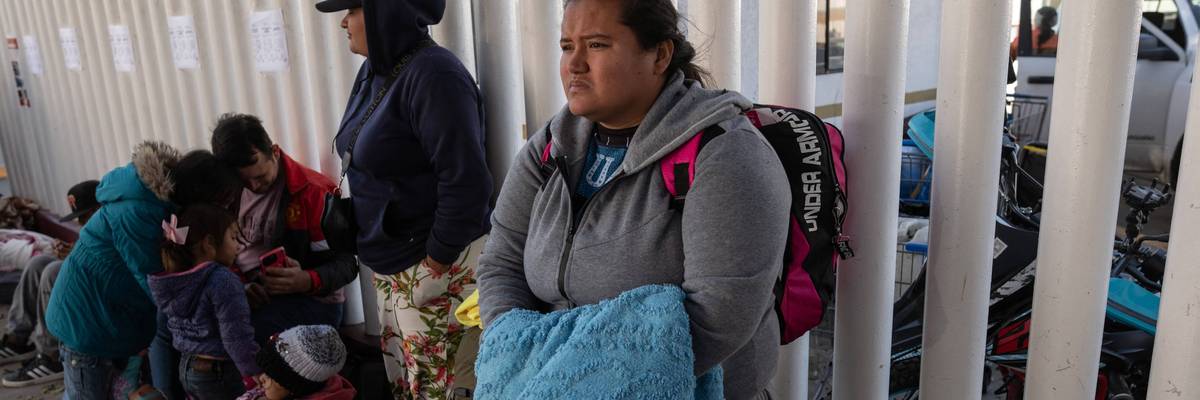
An asylum seeker from Venezuela, Shakira Paola Chaparro waits for news after US President Donald Trump cancelled asylum appointments, at the El Chaparral border crossing in Tijuana, Mexico on January 21, 2026.
The liberal justice lamented that the majority ruling in Mullin v. Al Otro Lado empowers the Trump administration to slam the door shut on refugees "even if the asylum seeker is certain to be persecuted, or killed."
The US Supreme Court's right-wing majority on Thursday affirmed the Trump administration's deadly policy of blocking people legally seeking asylum from entering the United States in a ruling that prompted liberal Justice Sonia Sotomayor to take the rare step of reading her dissent from the bench.
In Mullin v. Al Otro Lado, the justices reversed lower-court rulings, including a 2024 9th Circuit Court of Appeals panel decision that people approaching authorized border entries are arriving "in" the United States under federal law.
The Trump administration had asked the Supreme Court to rule on the practice of "metering," by which US authorities limit the number of asylum seekers who can present themselves at a port of entry each day to request protection. The policy was first implemented during the Obama administration and expanded during President Donald Trump's first term, with US Solicitor General D. John Sauer calling it “a critical tool for addressing border surges and for preventing overcrowding at ports of entry along the border.”
“In ordinary English, a person ‘arrives in’ a country only when he comes within its borders,” Sauer argued in court filings. “An alien thus does not ‘arrive in’ the United States while he is still in Mexico.”
Justice Samuel Alito, who wrote for the majority—Chief Justice John Roberts, Justice Clarence Thomas, and Trump-appointed Justices Neil Gorsuch, Brett Kavanaugh, and Amy Coney Barrett—agreed.
“In ordinary speech, no one would say that a person ‘arrives in’ a place—for example, a house, a city, or a country—before the person enters that place," Justice Samuel Alito said.
“We hold that an alien who is standing in Mexico does not ‘arrive in the United States’ by attempting, and failing, to set foot in this country," he added. "An alien ‘arrives in the United States’ only when he crosses the border."
Justices Elena Kagan and Ketanji Brown Jackson joined a scathing dissent penned by fellow liberal Sonia Sotomayor. Jackson also dissented separately. In a sign of her vigorous objection to the ruling, Sotomayor took the rare step of reading parts of her 35-page dissent—which is nearly twice as long as the majority opinion—from the bench.
"The Court today holds that the Executive Branch may circumvent all these mandatory procedures by having US immigration officers stand at the border and physically block noncitizens from setting a foot onto US soil," Sotomayor began. "They may do so even if the asylum seeker is at the threshold of a port of entry designated to receive all noncitizens who seek entrance into the country. Even if the port of entry has ample capacity to inspect that person, including an available asylum officer trained to process asylum applications. Even if the asylum seeker is certain to be persecuted, or killed, if she is turned away."
Sotomayor noted that metering "created dire humanitarian conditions at the border."
As US Customs and Border Protection "turned back more and more asylum seekers who had traveled treacherous distances to reach that point, makeshift camps sprung up on the Mexican side of the border, with tens of thousands of those turned away waiting days, then weeks and months, for asylum processing that often never took place," she continued.
Sotomayor noted the dangerous conditions in the border camps, asserting that "those turned away under the metering policy also found themselves subject to the very 'persecution and crime' they were fleeing," and citing cases in which people waiting in Mexico were murdered, raped, kidnapped, and assaulted. She detailed instances in which desperate asylum seekers, including children, drowned while attempting to swim across the Rio Grande into the United States.
"Hundreds of others have met a similar fate, and many more died crossing the desert along the southern border, all making 2020 and 2021 some of the 'deadliest years for migrant crossings' in various regions of the southern border," Sotomayor wrote.
"The words of a statute must be read in their context and with a view to their place in the overall statutory scheme."
"The majority’s conclusion focuses almost exclusively on the word 'in' within the phrase 'arrives in the United States,'" Sotomayor stressed. "If that were all this case were about, the majority might have the better of the argument. Statutory interpretation, however, requires much more."
"The words of a statute must be read in their context and with a view to their place in the overall statutory scheme," she continued, pointing to one of the most frequently cited principles in modern US jurisprudence.
"The majority’s interpretation of 'arrives in the United States' makes no sense," Sotomayor argued. "To start, the majority ignores that 'arrival' and 'arriving' in the immigration context have never focused on the precise location of a noncitizen’s feet."
She continued:
Imagine a movie theater policy that states, “Anyone who arrives in the theater may buy a ticket and all moviegoers must have their tickets scanned before entering.” If a person walks up to a ticket booth located just outside the theater, it would be unreasonable to think they could not buy a ticket under the policy because they are not “in” the theater yet. Perhaps the policy could have been clearer by using the preposition “at,” but everyone understands, from context, what the policy means.
Context leads to the same conclusion here. Requiring an asylum seeker to plant a foot across the border to become an “applicant for admission"... might be plausible looking at the words “arrives in” in a vacuum, but it makes a hash of the statutory scheme overall. Instead, construing text in context, an asylum seeker can be fairly said to “arrive in the United States” for purposes of being an applicant for admission and seeking asylum when she walks up to a port of entry and physically presents herself to an immigration officer who is standing on US soil.
Sotomayor further noted that the modern asylum system "developed in response to the international moral reckoning that followed the Holocaust and World War II," when the United States and other indifferent nations turned back shiploads of desperate Jewish refugees and denied asylum to Jews fleeing almost certain death in Nazi-occupied Europe, including the family of famous diarist Anne Frank.
The dissenting justice highlighted the ill-fated voyage of the M.S. St. Louis, which carried over 900 Jewish refugees fleeing Nazi persecution. After being refused docking in Cuba, the United States, and Canada, the ship returned to Europe, where hundreds of its passengers were killed during the Holocaust.
"Congress passed the Refugee Act in 1980 because it did not want this country to repeat the mistakes of its past," Sotomayor said. "Yet if the refugees on the M.S. St. Louis were to walk up to a port of entry on our southern border today, the majority’s interpretation would allow immigration officers to refuse even to consider their asylum applications by physically blocking them from stepping foot onto US soil."
"The majority’s interpretation permits the government to do that even if the refugees complied with all applicable laws and regulations, even if the port had ample capacity to inspect them, and even if turning them back would result in the very persecution from which they narrowly escaped," she added. "The consequences of today’s decision are predictable. More people will die."
In another extraordinary move, Alito followed Sotomayor's reading by defending the metering policy as necessary for maintaining "orderly and humane" conditions at the border. He then moved on to his next opinion, which upheld the Trump administration's cancellation of temporary deportation protections for hundreds of thousands of Haitians and Syrians.
Responding to the Mullin ruling, Al Otro Lado executive director Erika Pinheiro said, "We believe that today’s ruling violates international law, as well as the express intent of Congress, which enshrined the rights and obligations of the Refugee Convention into US federal law over 40 years ago."
"For decades, the United States has allowed individuals and families who are fleeing persecution, torture, and death to ask for protection at US borders and exercise their legal right to seek asylum,” she continued. "This decision has destroyed the United States’ position as a global leader in promoting the rights of refugees and threatens to serve as a dangerous justification for other countries that unlawfully prevent refugees from crossing borders in search of safety."
"In a world of increasing conflict and climate disaster, this hardening of borders to keep out the most vulnerable is sure to result in many more lives lost," Pinheiro added.
Today, the Supreme Court delivered a devastating blow to asylum rights in the United States.In a 6-3 decision in Mullin v. Al Otro Lado, the Court ruled that the Trump administration may turn back asylum seekers at ports of entry along the U.S.-Mexico border.
[image or embed]
— American Immigration Council (@immcouncil.org) June 25, 2026 at 9:32 AM
Vanessa Cárdenas, executive director of America’s Voice, also issued a statement, contending that the two rulings "will devastate women and children who are fleeing unimaginable danger, vetted workers who have been in the US for decades making significant contributions, senior citizens who depend on their healthcare providers for lifesaving care, and business owners who rely on their workers to sustain their businesses, among many others."
Congresswoman Analilia Mejia (D-NJ) said that "whether denying asylum seekers the chance to be heard or ripping Temporary Protected Status away from families who have spent years building their lives in this country, this corrupt court, beholden to an authoritarian-like president, once again chose politics over the Constitution."
"Asylum seekers deserve the opportunity to have their claims heard before the government decides their fate," she continued. "Above all else, this case is simply cruel and denies humanity to our fellow human beings seeking safety."
"These rulings should alarm every American," Mejia added. "When the government can deny one group a hearing or strip away protections they have relied on for years, it is not just immigrants who lose. It sends a dangerous message that constitutional rights can be discarded whenever those in power find it politically useful."
Congresswoman Pramila Jayapal (D-Wash.) said that by targeting asylum, the justices "are preventing the most vulnerable people from even seeking safety on our shores."
On social media, Rep. Summer Lee (D-Pa.) said, "This extremist Supreme Court just gave Trump the green light to block asylum seekers at the border and end TPS protections for Haitians and Syrians."
"People fleeing danger deserve compassion, not cruelty," Lee added. "We must reform and expand the court immediately."
Dear Common Dreams reader, It’s been nearly 30 years since I co-founded Common Dreams with my late wife, Lina Newhouser. We had the radical notion that journalism should serve the public good, not corporate profits. It was clear to us from the outset what it would take to build such a project. No paid advertisements. No corporate sponsors. No millionaire publisher telling us what to think or do. Many people said we wouldn't last a year, but we proved those doubters wrong. Together with a tremendous team of journalists and dedicated staff, we built an independent media outlet free from the constraints of profits and corporate control. Our mission has always been simple: To inform. To inspire. To ignite change for the common good. Building Common Dreams was not easy. Our survival was never guaranteed. When you take on the most powerful forces—Wall Street greed, fossil fuel industry destruction, Big Tech lobbyists, and uber-rich oligarchs who have spent billions upon billions rigging the economy and democracy in their favor—the only bulwark you have is supporters who believe in your work. But here’s the urgent message from me today. It's never been this bad out there. And it's never been this hard to keep us going. At the very moment Common Dreams is most needed, the threats we face are intensifying. We need your support now more than ever. We don't accept corporate advertising and never will. We don't have a paywall because we don't think people should be blocked from critical news based on their ability to pay. Everything we do is funded by the donations of readers like you. When everyone does the little they can afford, we are strong. But if that support retreats or dries up, so do we. Will you donate now to make sure Common Dreams not only survives but thrives? —Craig Brown, Co-founder |
The US Supreme Court's right-wing majority on Thursday affirmed the Trump administration's deadly policy of blocking people legally seeking asylum from entering the United States in a ruling that prompted liberal Justice Sonia Sotomayor to take the rare step of reading her dissent from the bench.
In Mullin v. Al Otro Lado, the justices reversed lower-court rulings, including a 2024 9th Circuit Court of Appeals panel decision that people approaching authorized border entries are arriving "in" the United States under federal law.
The Trump administration had asked the Supreme Court to rule on the practice of "metering," by which US authorities limit the number of asylum seekers who can present themselves at a port of entry each day to request protection. The policy was first implemented during the Obama administration and expanded during President Donald Trump's first term, with US Solicitor General D. John Sauer calling it “a critical tool for addressing border surges and for preventing overcrowding at ports of entry along the border.”
“In ordinary English, a person ‘arrives in’ a country only when he comes within its borders,” Sauer argued in court filings. “An alien thus does not ‘arrive in’ the United States while he is still in Mexico.”
Justice Samuel Alito, who wrote for the majority—Chief Justice John Roberts, Justice Clarence Thomas, and Trump-appointed Justices Neil Gorsuch, Brett Kavanaugh, and Amy Coney Barrett—agreed.
“In ordinary speech, no one would say that a person ‘arrives in’ a place—for example, a house, a city, or a country—before the person enters that place," Justice Samuel Alito said.
“We hold that an alien who is standing in Mexico does not ‘arrive in the United States’ by attempting, and failing, to set foot in this country," he added. "An alien ‘arrives in the United States’ only when he crosses the border."
Justices Elena Kagan and Ketanji Brown Jackson joined a scathing dissent penned by fellow liberal Sonia Sotomayor. Jackson also dissented separately. In a sign of her vigorous objection to the ruling, Sotomayor took the rare step of reading parts of her 35-page dissent—which is nearly twice as long as the majority opinion—from the bench.
"The Court today holds that the Executive Branch may circumvent all these mandatory procedures by having US immigration officers stand at the border and physically block noncitizens from setting a foot onto US soil," Sotomayor began. "They may do so even if the asylum seeker is at the threshold of a port of entry designated to receive all noncitizens who seek entrance into the country. Even if the port of entry has ample capacity to inspect that person, including an available asylum officer trained to process asylum applications. Even if the asylum seeker is certain to be persecuted, or killed, if she is turned away."
Sotomayor noted that metering "created dire humanitarian conditions at the border."
As US Customs and Border Protection "turned back more and more asylum seekers who had traveled treacherous distances to reach that point, makeshift camps sprung up on the Mexican side of the border, with tens of thousands of those turned away waiting days, then weeks and months, for asylum processing that often never took place," she continued.
Sotomayor noted the dangerous conditions in the border camps, asserting that "those turned away under the metering policy also found themselves subject to the very 'persecution and crime' they were fleeing," and citing cases in which people waiting in Mexico were murdered, raped, kidnapped, and assaulted. She detailed instances in which desperate asylum seekers, including children, drowned while attempting to swim across the Rio Grande into the United States.
"Hundreds of others have met a similar fate, and many more died crossing the desert along the southern border, all making 2020 and 2021 some of the 'deadliest years for migrant crossings' in various regions of the southern border," Sotomayor wrote.
"The words of a statute must be read in their context and with a view to their place in the overall statutory scheme."
"The majority’s conclusion focuses almost exclusively on the word 'in' within the phrase 'arrives in the United States,'" Sotomayor stressed. "If that were all this case were about, the majority might have the better of the argument. Statutory interpretation, however, requires much more."
"The words of a statute must be read in their context and with a view to their place in the overall statutory scheme," she continued, pointing to one of the most frequently cited principles in modern US jurisprudence.
"The majority’s interpretation of 'arrives in the United States' makes no sense," Sotomayor argued. "To start, the majority ignores that 'arrival' and 'arriving' in the immigration context have never focused on the precise location of a noncitizen’s feet."
She continued:
Imagine a movie theater policy that states, “Anyone who arrives in the theater may buy a ticket and all moviegoers must have their tickets scanned before entering.” If a person walks up to a ticket booth located just outside the theater, it would be unreasonable to think they could not buy a ticket under the policy because they are not “in” the theater yet. Perhaps the policy could have been clearer by using the preposition “at,” but everyone understands, from context, what the policy means.
Context leads to the same conclusion here. Requiring an asylum seeker to plant a foot across the border to become an “applicant for admission"... might be plausible looking at the words “arrives in” in a vacuum, but it makes a hash of the statutory scheme overall. Instead, construing text in context, an asylum seeker can be fairly said to “arrive in the United States” for purposes of being an applicant for admission and seeking asylum when she walks up to a port of entry and physically presents herself to an immigration officer who is standing on US soil.
Sotomayor further noted that the modern asylum system "developed in response to the international moral reckoning that followed the Holocaust and World War II," when the United States and other indifferent nations turned back shiploads of desperate Jewish refugees and denied asylum to Jews fleeing almost certain death in Nazi-occupied Europe, including the family of famous diarist Anne Frank.
The dissenting justice highlighted the ill-fated voyage of the M.S. St. Louis, which carried over 900 Jewish refugees fleeing Nazi persecution. After being refused docking in Cuba, the United States, and Canada, the ship returned to Europe, where hundreds of its passengers were killed during the Holocaust.
"Congress passed the Refugee Act in 1980 because it did not want this country to repeat the mistakes of its past," Sotomayor said. "Yet if the refugees on the M.S. St. Louis were to walk up to a port of entry on our southern border today, the majority’s interpretation would allow immigration officers to refuse even to consider their asylum applications by physically blocking them from stepping foot onto US soil."
"The majority’s interpretation permits the government to do that even if the refugees complied with all applicable laws and regulations, even if the port had ample capacity to inspect them, and even if turning them back would result in the very persecution from which they narrowly escaped," she added. "The consequences of today’s decision are predictable. More people will die."
In another extraordinary move, Alito followed Sotomayor's reading by defending the metering policy as necessary for maintaining "orderly and humane" conditions at the border. He then moved on to his next opinion, which upheld the Trump administration's cancellation of temporary deportation protections for hundreds of thousands of Haitians and Syrians.
Responding to the Mullin ruling, Al Otro Lado executive director Erika Pinheiro said, "We believe that today’s ruling violates international law, as well as the express intent of Congress, which enshrined the rights and obligations of the Refugee Convention into US federal law over 40 years ago."
"For decades, the United States has allowed individuals and families who are fleeing persecution, torture, and death to ask for protection at US borders and exercise their legal right to seek asylum,” she continued. "This decision has destroyed the United States’ position as a global leader in promoting the rights of refugees and threatens to serve as a dangerous justification for other countries that unlawfully prevent refugees from crossing borders in search of safety."
"In a world of increasing conflict and climate disaster, this hardening of borders to keep out the most vulnerable is sure to result in many more lives lost," Pinheiro added.
Today, the Supreme Court delivered a devastating blow to asylum rights in the United States.In a 6-3 decision in Mullin v. Al Otro Lado, the Court ruled that the Trump administration may turn back asylum seekers at ports of entry along the U.S.-Mexico border.
[image or embed]
— American Immigration Council (@immcouncil.org) June 25, 2026 at 9:32 AM
Vanessa Cárdenas, executive director of America’s Voice, also issued a statement, contending that the two rulings "will devastate women and children who are fleeing unimaginable danger, vetted workers who have been in the US for decades making significant contributions, senior citizens who depend on their healthcare providers for lifesaving care, and business owners who rely on their workers to sustain their businesses, among many others."
Congresswoman Analilia Mejia (D-NJ) said that "whether denying asylum seekers the chance to be heard or ripping Temporary Protected Status away from families who have spent years building their lives in this country, this corrupt court, beholden to an authoritarian-like president, once again chose politics over the Constitution."
"Asylum seekers deserve the opportunity to have their claims heard before the government decides their fate," she continued. "Above all else, this case is simply cruel and denies humanity to our fellow human beings seeking safety."
"These rulings should alarm every American," Mejia added. "When the government can deny one group a hearing or strip away protections they have relied on for years, it is not just immigrants who lose. It sends a dangerous message that constitutional rights can be discarded whenever those in power find it politically useful."
Congresswoman Pramila Jayapal (D-Wash.) said that by targeting asylum, the justices "are preventing the most vulnerable people from even seeking safety on our shores."
On social media, Rep. Summer Lee (D-Pa.) said, "This extremist Supreme Court just gave Trump the green light to block asylum seekers at the border and end TPS protections for Haitians and Syrians."
"People fleeing danger deserve compassion, not cruelty," Lee added. "We must reform and expand the court immediately."
The US Supreme Court's right-wing majority on Thursday affirmed the Trump administration's deadly policy of blocking people legally seeking asylum from entering the United States in a ruling that prompted liberal Justice Sonia Sotomayor to take the rare step of reading her dissent from the bench.
In Mullin v. Al Otro Lado, the justices reversed lower-court rulings, including a 2024 9th Circuit Court of Appeals panel decision that people approaching authorized border entries are arriving "in" the United States under federal law.
The Trump administration had asked the Supreme Court to rule on the practice of "metering," by which US authorities limit the number of asylum seekers who can present themselves at a port of entry each day to request protection. The policy was first implemented during the Obama administration and expanded during President Donald Trump's first term, with US Solicitor General D. John Sauer calling it “a critical tool for addressing border surges and for preventing overcrowding at ports of entry along the border.”
“In ordinary English, a person ‘arrives in’ a country only when he comes within its borders,” Sauer argued in court filings. “An alien thus does not ‘arrive in’ the United States while he is still in Mexico.”
Justice Samuel Alito, who wrote for the majority—Chief Justice John Roberts, Justice Clarence Thomas, and Trump-appointed Justices Neil Gorsuch, Brett Kavanaugh, and Amy Coney Barrett—agreed.
“In ordinary speech, no one would say that a person ‘arrives in’ a place—for example, a house, a city, or a country—before the person enters that place," Justice Samuel Alito said.
“We hold that an alien who is standing in Mexico does not ‘arrive in the United States’ by attempting, and failing, to set foot in this country," he added. "An alien ‘arrives in the United States’ only when he crosses the border."
Justices Elena Kagan and Ketanji Brown Jackson joined a scathing dissent penned by fellow liberal Sonia Sotomayor. Jackson also dissented separately. In a sign of her vigorous objection to the ruling, Sotomayor took the rare step of reading parts of her 35-page dissent—which is nearly twice as long as the majority opinion—from the bench.
"The Court today holds that the Executive Branch may circumvent all these mandatory procedures by having US immigration officers stand at the border and physically block noncitizens from setting a foot onto US soil," Sotomayor began. "They may do so even if the asylum seeker is at the threshold of a port of entry designated to receive all noncitizens who seek entrance into the country. Even if the port of entry has ample capacity to inspect that person, including an available asylum officer trained to process asylum applications. Even if the asylum seeker is certain to be persecuted, or killed, if she is turned away."
Sotomayor noted that metering "created dire humanitarian conditions at the border."
As US Customs and Border Protection "turned back more and more asylum seekers who had traveled treacherous distances to reach that point, makeshift camps sprung up on the Mexican side of the border, with tens of thousands of those turned away waiting days, then weeks and months, for asylum processing that often never took place," she continued.
Sotomayor noted the dangerous conditions in the border camps, asserting that "those turned away under the metering policy also found themselves subject to the very 'persecution and crime' they were fleeing," and citing cases in which people waiting in Mexico were murdered, raped, kidnapped, and assaulted. She detailed instances in which desperate asylum seekers, including children, drowned while attempting to swim across the Rio Grande into the United States.
"Hundreds of others have met a similar fate, and many more died crossing the desert along the southern border, all making 2020 and 2021 some of the 'deadliest years for migrant crossings' in various regions of the southern border," Sotomayor wrote.
"The words of a statute must be read in their context and with a view to their place in the overall statutory scheme."
"The majority’s conclusion focuses almost exclusively on the word 'in' within the phrase 'arrives in the United States,'" Sotomayor stressed. "If that were all this case were about, the majority might have the better of the argument. Statutory interpretation, however, requires much more."
"The words of a statute must be read in their context and with a view to their place in the overall statutory scheme," she continued, pointing to one of the most frequently cited principles in modern US jurisprudence.
"The majority’s interpretation of 'arrives in the United States' makes no sense," Sotomayor argued. "To start, the majority ignores that 'arrival' and 'arriving' in the immigration context have never focused on the precise location of a noncitizen’s feet."
She continued:
Imagine a movie theater policy that states, “Anyone who arrives in the theater may buy a ticket and all moviegoers must have their tickets scanned before entering.” If a person walks up to a ticket booth located just outside the theater, it would be unreasonable to think they could not buy a ticket under the policy because they are not “in” the theater yet. Perhaps the policy could have been clearer by using the preposition “at,” but everyone understands, from context, what the policy means.
Context leads to the same conclusion here. Requiring an asylum seeker to plant a foot across the border to become an “applicant for admission"... might be plausible looking at the words “arrives in” in a vacuum, but it makes a hash of the statutory scheme overall. Instead, construing text in context, an asylum seeker can be fairly said to “arrive in the United States” for purposes of being an applicant for admission and seeking asylum when she walks up to a port of entry and physically presents herself to an immigration officer who is standing on US soil.
Sotomayor further noted that the modern asylum system "developed in response to the international moral reckoning that followed the Holocaust and World War II," when the United States and other indifferent nations turned back shiploads of desperate Jewish refugees and denied asylum to Jews fleeing almost certain death in Nazi-occupied Europe, including the family of famous diarist Anne Frank.
The dissenting justice highlighted the ill-fated voyage of the M.S. St. Louis, which carried over 900 Jewish refugees fleeing Nazi persecution. After being refused docking in Cuba, the United States, and Canada, the ship returned to Europe, where hundreds of its passengers were killed during the Holocaust.
"Congress passed the Refugee Act in 1980 because it did not want this country to repeat the mistakes of its past," Sotomayor said. "Yet if the refugees on the M.S. St. Louis were to walk up to a port of entry on our southern border today, the majority’s interpretation would allow immigration officers to refuse even to consider their asylum applications by physically blocking them from stepping foot onto US soil."
"The majority’s interpretation permits the government to do that even if the refugees complied with all applicable laws and regulations, even if the port had ample capacity to inspect them, and even if turning them back would result in the very persecution from which they narrowly escaped," she added. "The consequences of today’s decision are predictable. More people will die."
In another extraordinary move, Alito followed Sotomayor's reading by defending the metering policy as necessary for maintaining "orderly and humane" conditions at the border. He then moved on to his next opinion, which upheld the Trump administration's cancellation of temporary deportation protections for hundreds of thousands of Haitians and Syrians.
Responding to the Mullin ruling, Al Otro Lado executive director Erika Pinheiro said, "We believe that today’s ruling violates international law, as well as the express intent of Congress, which enshrined the rights and obligations of the Refugee Convention into US federal law over 40 years ago."
"For decades, the United States has allowed individuals and families who are fleeing persecution, torture, and death to ask for protection at US borders and exercise their legal right to seek asylum,” she continued. "This decision has destroyed the United States’ position as a global leader in promoting the rights of refugees and threatens to serve as a dangerous justification for other countries that unlawfully prevent refugees from crossing borders in search of safety."
"In a world of increasing conflict and climate disaster, this hardening of borders to keep out the most vulnerable is sure to result in many more lives lost," Pinheiro added.
Today, the Supreme Court delivered a devastating blow to asylum rights in the United States.In a 6-3 decision in Mullin v. Al Otro Lado, the Court ruled that the Trump administration may turn back asylum seekers at ports of entry along the U.S.-Mexico border.
[image or embed]
— American Immigration Council (@immcouncil.org) June 25, 2026 at 9:32 AM
Vanessa Cárdenas, executive director of America’s Voice, also issued a statement, contending that the two rulings "will devastate women and children who are fleeing unimaginable danger, vetted workers who have been in the US for decades making significant contributions, senior citizens who depend on their healthcare providers for lifesaving care, and business owners who rely on their workers to sustain their businesses, among many others."
Congresswoman Analilia Mejia (D-NJ) said that "whether denying asylum seekers the chance to be heard or ripping Temporary Protected Status away from families who have spent years building their lives in this country, this corrupt court, beholden to an authoritarian-like president, once again chose politics over the Constitution."
"Asylum seekers deserve the opportunity to have their claims heard before the government decides their fate," she continued. "Above all else, this case is simply cruel and denies humanity to our fellow human beings seeking safety."
"These rulings should alarm every American," Mejia added. "When the government can deny one group a hearing or strip away protections they have relied on for years, it is not just immigrants who lose. It sends a dangerous message that constitutional rights can be discarded whenever those in power find it politically useful."
Congresswoman Pramila Jayapal (D-Wash.) said that by targeting asylum, the justices "are preventing the most vulnerable people from even seeking safety on our shores."
On social media, Rep. Summer Lee (D-Pa.) said, "This extremist Supreme Court just gave Trump the green light to block asylum seekers at the border and end TPS protections for Haitians and Syrians."
"People fleeing danger deserve compassion, not cruelty," Lee added. "We must reform and expand the court immediately."