

SUBSCRIBE TO OUR FREE NEWSLETTER
Daily news & progressive opinion—funded by the people, not the corporations—delivered straight to your inbox.
5
#000000
#FFFFFF
To donate by check, phone, or other method, see our More Ways to Give page.
To add insult to injury, the Pentagon announced that it would seek a $200 billion supplemental appropriation to pay for its war on Iran, which has spread across the Middle East. That $200 billion would have been in addition to the $1.5 billion proposed for the Pentagon’s future budget. According to an analysis by Pentagon budget expert Stephen Semler, the Iran war, which started on February 28th with Israeli and U.S. air strikes on that country, cost the United States more than $28 billion just in its first two weeks. And to put that in perspective, $28 billion is more than three times the Trump administration’s proposed annual budgets for the Centers for Disease Control and Prevention and the Environmental Protection Agency (at a time when the climate crisis and the need to head off future pandemics are essential to the health and security of all Americans). Worse yet, it’s all for a completely senseless war that should never have been started.
As President Trump alternates between engaging in negotiations to end the war and threatening to wipe Iran off the map — or even just walking away to bomb another day — there are reports that the supplemental budget request to pay for the war on Iran will shrink from the proposed $200 billion to $98 billion. And that $98 billion will include other things in addition to war costs, including disaster relief and aviation modernization.
The Garrison State and the Reign of the War Profiteers
On the campaign trail in 2024, Donald Trump pledged to drive the “war profiteers” and “war mongers” from Washington, suggesting that they like wars because “missiles cost $2 million each,” while bragging that, in his first term in office, “I had no wars.”
And his rhetoric as the ultimate champion of peace has continued during his second term, even as he has indeed launched reckless wars guaranteed to fill the coffers of the “war profiteers” he railed against on the campaign trail. He has, however, also pledged to help the weapons industry quadruple production of the same sort of “$2 million bombs” he decried during the campaign, plus — even better for the arms makers — missile interceptors that cost up to $12 million each. Worse yet, the demands of the current war on Iran, coupled with support for Israel’s war on Gaza and Ukraine’s efforts to defend itself from Russia, have left the Pentagon and the giant weapons corporations complaining that, if the U.S. doesn’t radically increase its production of artillery shells, bombs, and missiles, the cupboard could soon be bare.
Of course, filling that cupboard again to the tune of staggering sums of money is exactly the wrong solution. The answer to the current munitions shortage is not to further supersize this country’s arms manufacturing base, but to refrain from supplying the weapons used by Israel to commit genocide in Gaza and ethnic cleansing in Lebanon, or to fuel unjustified wars like the current conflict with Iran. The best policy to prevent such stocks of military equipment from running low would, of course, be a more discriminating approach to military aid and a more restrained approach to U.S. foreign policy and war-making (writ large).
 Washington should, in fact, put diplomacy first and only engage in military action if there is a genuine threat to the United States itself. We need a smarter policy toward military procurement and military strategy, not the garrison state with its “military-industrial complex” that President Dwight D. Eisenhower warned us against more than six decades ago.
In addition, of course, the Pentagon needs to shift its procurement strategy toward producing more reliable weapons at a more reasonable cost, while avoiding unnecessary complexity so that they can be made more rapidly and spend more time ready to be used and less time down for maintenance. Such a formula was a watchword of the bipartisan congressional military reform caucus of the 1980s, which at one point included more than 100 members of Congress and helped roll back the extremes of the military buildup launched by President Ronald Reagan.
The Diminishing Economic Returns of Pentagon Spending
In a detailed forthcoming study for the Transition Security Project and in her own writings, investigative journalist Taylor Barnes of Inkstick Media has charted the diminishing returns from Pentagon spending. Despite a soaring Pentagon budget, direct jobs in arms production are now one-third of what they were 30 years ago, down from three million then to 1.1 million now, according to the arms industry’s own trade association. Unionization rates in the arms production sector are also down sharply, with some big weapons firms like Northrop Grumman having unionization rates of less than 10%. In keeping with that trend, Lockheed Martin moved the production of its F-16 fighter — a staple of foreign arms exports — to the anti-union state of South Carolina.
Even worse, many states provide special tax breaks and other subsidies to attract or keep weapons factories — and that’s on top of the hundreds of billions the industry receives in federal tax dollars. In Utah, the state government staunchly refused to reveal how many jobs Northrop Grumman had promised in return for state subsidies, with one official claiming it would “compromise” the interests of the company to do so. Meanwhile, Northrop Grumman’s work on the Sentinel, the newest intercontinental ballistic missile (ICBM), has been a poster child for dysfunctional weapons development, with the estimated cost of the program as a whole growing by 81% in just a few years. Part of the problem was that Northrop Grumman somehow managed to ignore the fact that its new missile would be too large to fit in existing silos, creating the need for further costly new construction efforts.
The spending of scarce tax revenues goes to ICBMs that former Secretary of Defense William Perry once labeled “one of the most dangerous weapons we have.” After all, a president might literally have only minutes to decide whether to launch them on being warned of a potential enemy attack, greatly increasing the risk of an accidental nuclear war prompted by a false alarm. And there have been many false alarms and nuclear accidents in the nuclear age (even if not yet an actual nuclear attack loosed on the world), as meticulously documented in Eric Schlosser’s essential book Command and Control.
Then there’s the Golden Dome missile “defense” system, a fantasy of President Trump’s that, in reality, could never provide the promised “leakproof” protection against weaponry ranging from ICBMs and hypersonic missiles to low-flying drones. By now, more than 40 years after President Ronald Reagan promised a perfect defense against ICBMs in his 1983 “Star Wars” speech, it should be all too obvious that such a leakproof shield is physically impossible, since enemy ICBMs with nuclear warheads would come in at 15,000 — and no, that is not a misprint! — miles per hour and could be surrounded by large numbers of decoy balloons that would be indistinguishable from a warhead when floating in space. There could be hundreds of such incoming warheads in a full-scale nuclear attack. To even have a chance of intercepting all of them, a defensive system would have to devote as many as 1,600 interceptors to take down incoming missiles. An analysis by the conservative American Enterprise Institute estimates that a full-blown effort to build a comprehensive Golden Dome shield could cost $3.6 trillion just to construct.
In fact, the Golden Dome concept is so delusional that it barely merits a detailed critique, though many such analyses are available. A more reasonable way to deal with it would, of course, be ridicule.
Ben Cohen, cofounder of Ben & Jerry’s and the founder of the “Up in Arms” campaign to cut Pentagon spending, has taken just such an approach. On April Fool’s Day, he placed a “Golden Hole-in-Dome” statue on the National Mall that included a Donald Trump, fully clothed, being soaked by water leaking through a faux Golden Dome shield. The Daily Beast‘s headline on its piece about the event captured the spirit of that day: “Ben and Jerry’s Co-Founder Humiliates Trump Outside His House.”
Meanwhile, the dysfunctional weapons systems on the Pentagon’s shopping list only continue to grow. Take Lockheed Martin’s F-35 combat aircraft, which was supposed to do almost anything (and does nothing) well. The plane, which could cost $2 trillion for roughly 2,500 aircraft if the Pentagon’s original plans hold, had taken 23 years to develop and still can’t operate as advertised, spending almost half its time in its hangar for maintenance.
Similarly, as Dan Grazier of the Stimson Center has pointed out, the USS Gerald Ford aircraft carrier, which had to dock in Cyprus recently after multiple mishaps including a clogged toilet system that spewed feces onto the flight deck, is a $13 billion nightmare, chock full of fancy, untested, and expensive technology that all too often fails to work as advertised. As he points out, a more viable, less expensive carrier could have been built if proven technologies had not been replaced with high-tech fantasies. Unfortunately, that’s generally not how Pentagon procurement works these days.
Palmer Luckey Will Not Come to the Rescue
Palmer Luckey, the 32 year-old former game designer who now runs Anduril, one of Silicon Valley’s top military tech firms, made news a few months ago when he told a CNBC interviewer that, if the Pentagon were to stop buying the wrong things, it could provide a robust defense for America at a cost of perhaps $500 billion, half of current levels and one-third of the level President Trump is now seeking. Presumably, the wrong things are piloted aircraft like the F-35 and mammoth ships like the Gerald Ford, and the right things are drones, uncrewed submarines, and complex AI-driven targeting and surveillance systems of the type that Anduril and Peter Thiel’s Palantir produce.
But count on this: replacing piloted combat aircraft with swarms of drones won’t automatically be cheaper, depending on how large the swarms are and how complex their designs may prove to be. Early on, the Ukrainian military decided that U.S.-supplied drones from Silicon Valley were too brittle and expensive, so it launched a do-it-yourself drone program that took cheap commercial drones from China and fitted them with bombs and cameras. U.S. arms companies are now trying to get back in the act by partnering with Ukrainian firms to build more sophisticated drones. Don’t be surprised, though, if their price soars and their reliability sinks.
Another reason AI-driven weapons may not be as cheap as advertised is that Luckey, Thiel, and their merry band of unhinged techno-optimists want to eliminate virtually any oversight of their activities, whether through independent testing of their new systems or measures to prevent price gouging by unscrupulous contractors. At present, the motto of the military tech sector is “trust me.” I don’t know about you, but I’d prefer to have someone minding the store, so that the tech billionaires don’t simply rob us blind.
Of course, what would it mean if Silicon Valley could deliver cheaper, more deadly advanced weaponry? After all, artificial intelligence systems were indeed used in recent times to accelerate targeting during Israel’s genocidal war on the people of Gaza, and they have been used in President Trump’s disastrous assault on Iran. And neither of those situations has yet had a happy ending. But that’s the point. The truth is we really don’t need ever more new weaponry that kills even faster. We need to stop the killing. And that means blunting the political influence of the warmongers and war profiteers that Donald Trump criticized on the campaign trail in 2024 and then so warmly embraced as president.
And to put all of this in grim perspective, he is now presiding over perhaps the most corrupt, incompetent, repressive regime in the history of this republic. And worse yet, some of his most dismal policies — like unstinting support for Israeli aggression — have, sadly enough, had bipartisan backing in Washington. In short, he has taken what were already some of the worst American policies and accelerated them, even as he destroys positive aspects of the government like the U.S. Agency for International Development’s provision of food, clean water, and public health services abroad or any further engagement in constructive international institutions.
Among other things, he is now narrowing America’s foreign policy options by dismantling civilian tools of statecraft, while doubling down on military approaches that haven’t “won” a war in this century (or the second half of the last one either). Meanwhile, the economic damage and humanitarian costs are spreading globally, including to his own supporters.
The challenge now is to build a movement that not only turns back Trump’s policies, but gets at the underlying economic, political, and cultural forces that have kept the United States in a permanent state of war for so long, while robbing us of opportunities to build a better, more peaceful, tolerant, and just future. Given the pace of destruction and chaos being visited upon us, it’s important to act now and continue to do so until we build enough power to rein in the war machine and begin creating actual structures of peace.

I call your attention to Peter Thiel, founder of military tech company Palantir, who just last week visited with Japan’s prime minister last week and was dubbed “America’s shadow president” across Japanese media. I call your attention to Ethan Thornton, founder of Mach Industries, who is attempting to create dangerous hydrogen-powered weapons (and almost killed a coworker in the process). I call your attention to Rob Slaughter, cofounder of Defense Unicorns, whose company has “built the software backbone of the War Department” (and whose surname is rather apt). And I call your attention to Palmer Luckey, self-proclaimed “radical Zionist” and founder of Anduril, a military tech company that supplies the U.S. military with AI and autonomous weapons.
There are many more corporate executives selling weapons and making a killing off of killing. But today we are going to talk about Anduril founder Palmer Luckey, the Tony Stark wannabe who so very badly wants to believe he’s the good guy. Recently, after CODEPINK launched a petition calling him out for his crimes, he claimed that he’s actually saving lives.
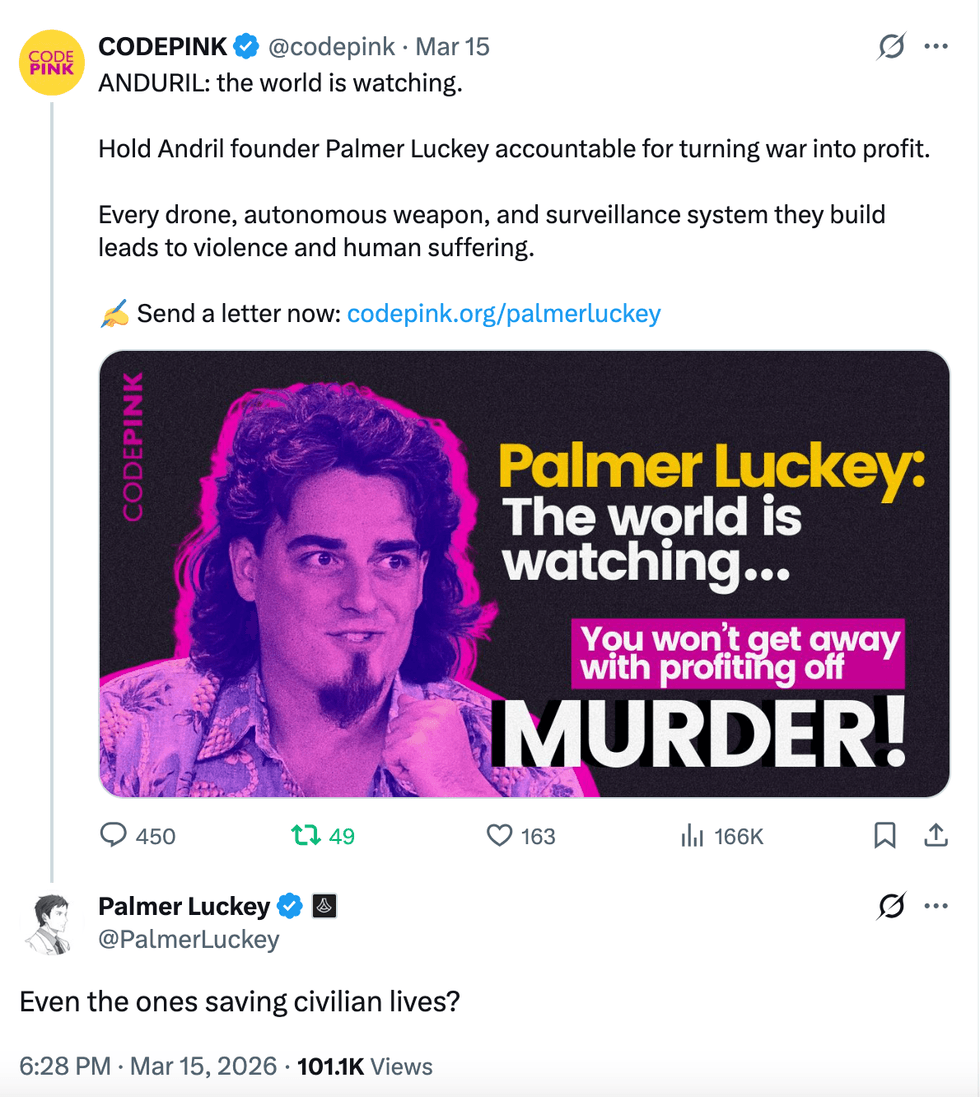
This is how war profiteers have always tried to sell war to people. It’s for the greater good! If we don’t kill them, they will probably try to kill us at some much later date! As much as they want us to believe that their pre-emptive wars of aggression are necessary, the truth is we don’t need to security dilemma ourselves into functioning like soulless robots; we’re actually evolved humans who can participate in dialogue, the great human superpower. It’s not a hard conclusion to draw: murder is not the solution to a disagreement with your neighbor, just as systematic murder is not the solution to a disagreement with another nation.
Besides, we all know war isn’t about saving American lives. Instead, American lives are spent carelessly to accomplish elite agendas, and then veterans are discarded like broken utensils. Tell us, Luckey, whose lives were saved by slaughtering civilians in My Lai in 1968 or in Haditha in 2005? Whose lives were saved by taking out every hospital in Gaza? Whose lives were saved by bombing 160+ school children in Iran?
No, murder is not about saving lives, just as war is not about accomplishing everlasting peace. It’s about men in safe, cushy offices far away from the battlefield amassing as much wealth as possible before they have to join the rest of us as dirt in the ground.
You can tell our petition bothered Luckey, because a few minutes later, he tweeted this:
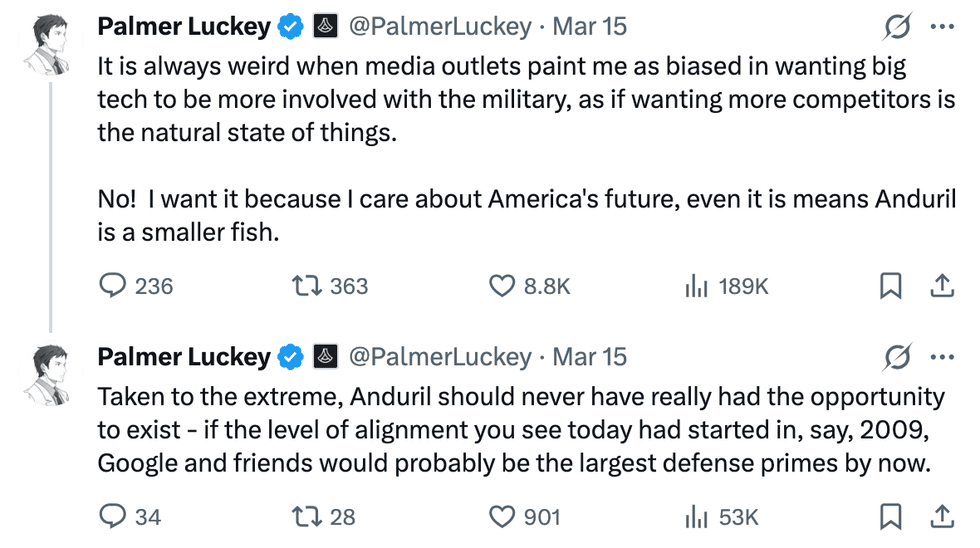
It’s certainly an odd argument to make — that Anduril should never have had the opportunity to exist. It’s almost a direct admission of guilt, if you think about it. A shrugging of responsibility for Anduril’s existence, as if Luckey didn’t build the company himself from the ground up. It’s the world’s fault for needing Anduril, right? He’s just another cog in the machinery of fate. Helpless, unable to withstand his destiny of building murder machines. It’s funny how these war profiteers want all the recognition for what they make until they start getting recognition for the consequences of what they make. Well, we should never have existed anyway!
Luckey also wonders why the media thinks he wants tech to be more involved in the military, as if those words haven’t repeatedly come from his own mouth. He’s been rather urgent about advocating for advanced military tech to counter Russia, China, and Iran, even going so far as to actively prepare for a “simultaneous conflict” by developing advanced, rapid-production military systems. He’s an especially big fan of war on China, and instated a “China 27” strategy, which states that Anduril won’t design and produce any new weapons that won’t be ready by 2027 — the date the War Department set on war with China.
Last year, Anduril secured a $99 million US Air Force contract for autonomous software and a ten-year, $642 million Marine Corps contract for counter-drone systems. Secretary of War Pete Hegseth visited Anduril’s headquarters, where he proclaimed: “We are rebuilding the Arsenal of Freedom.”
Anduril, now valued at nearly $31 billion, was named after the Lord of the Rings sword, “Flame of the West,” a fitting title for a tool of the imperial West’s perpetual exploitation and murder of innocents abroad. The company is also responsible for the “border protection system” of lasers and identification software, inspired by Trump’s dream for a border wall, and has released new wearable headsets that Luckey claims “turn soldiers into superheroes.”
Fact of the matter is, Luckey likes to think of himself as a type of superhero or Lord of the Rings character, bumbling through an adventure, taking down bad guys, and stacking up points. But in doing so, he’s treating reality as a sort of faraway game, entirely detached from human suffering. It’s not all that different from what the White House is doing—just check out this recent White House tweet, which compared the bombing of Iran to a Wii sports game.
War profiteers like Luckey are all the same. They exist in some fantastical bubble, getting high on the idea that they’re helping save-the-world, while the government takes their fresh-baked drones and missiles and sends them to schools, hospitals, and residential buildings to take out unsuspecting families, destroy infrastructure, and wreak widespread destruction. But the truth is — even if it’s deep-deep-down in the dark voids of their souls — Luckey and friends know exactly which part they’re playing and choose not to care.
What does Luckey do with his blood money other than enthusiastically participate in a “B-boys club” group chat (B as in billionaire)... Well, he has amassed quite the collection of vehicles, including a 1969 Ford Mustang, a Tesla Model S, a 2001 Honda Insight, a 1967 Disneyland Autopia car, a UH-60 Black Hawk helicopter, a 1985 ex-Marine Corps Humvee, a Mark V Special Operations Craft, two submarines, and multiple motorcycles, among many others. … I wonder if we converted USD to human lives, how many people had to die for Luckey to afford each vehicle?
It’s a simple equation: more war means more money for war profiteers. So it’s really no surprise Luckey is hellbent on war with China, which would make him billions and could afford him another few submarines for his imaginary underwater adventures. The U.S. has invested trillions of dollars into preparing for war on China ($3.4 trillion to be exact, a number larger than the total amount spent on 20 years of war in Afghanistan). Every incremental increase to the War Department budget is justified with the same reason: we need to counter China, we need to counter China, we need to counter China. China has become the ultimate war budget enhancer, and all the slippery politicians and war profiteers have taken advantage of it.
Unfortunately, war is the main driver of U.S. technological advancement. So instead of developing advanced technology to improve infrastructure, build high-speed railways, and raise the standard of living, the tech industry is creating headsets for soldiers to optimize killing during battle. They are making autonomous robot drones that pick their next targets according to data sets, rather than valuing human life. They are using AI to draft battle strategies and risking escalation to unforeseen, unredeemable heights.
Iran, Venezuela, Cuba, China… These nations are not the enemies of ordinary people in the U.S. Our enemies are internal: the war profiteers, the ruling class, the “B-boys club” members, and the military tech founders. It is the ruling elites who drive war, all for profit. And it is always the people who suffer. Even now, we suffer as all our taxpayer money is funneled into new contracts with companies like Anduril instead of supporting the health and well-being of the American people. And so overseas, children are murdered, so guys like Palmer Luckey can add to their rare car collections.
Instead of pointing at manufactured enemies overseas, we must confront all the war profiteers in the United States, driving us into more war. Their power rests solely on one thing: convincing us that they are the good guys, and that innocent people in Iran, Lebanon, Venezuela, China, and elsewhere are bad and deserving of death. Let’s make sure Palmer Luckey knows that we will never let him get away with profiting off murder.