SUBSCRIBE TO OUR FREE NEWSLETTER
Daily news & progressive opinion—funded by the people, not the corporations—delivered straight to your inbox.
5
#000000
#FFFFFF
To donate by check, phone, or other method, see our More Ways to Give page.
Daily news & progressive opinion—funded by the people, not the corporations—delivered straight to your inbox.
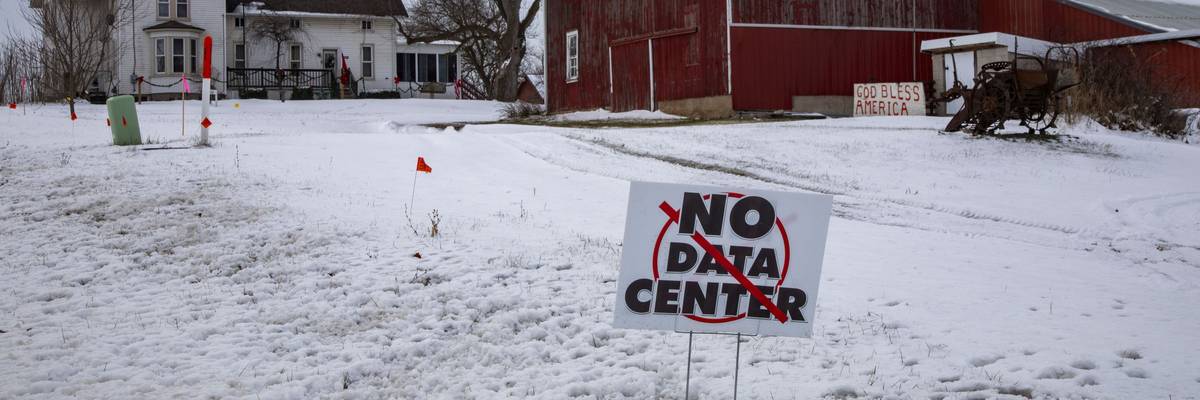
A sign on a rural Michigan road opposes a planned $7 billion data center on southeast Michigan farm land in Saline, Michigan on December 1, 2025.
Data centers are not just toxic installations in communities’ backyards—they are a driving force behind wars and instability, and they keep American workers tied to the endless cycle of wars for fossil fuels.
Across the country, resistance to data centers is rising even as plans are steadily being made to build new ones.
According to the Pew Research Center, a majority of new data centers—67%—are being built in rural areas. And three-quarters of those are in Midwestern and Southern towns.
The negative effects have not gone unnoticed. A new data center in Southaven, Mississippi, for example, is reportedly terrorizing the community with high levels of noise and air pollution, and residents are now regretting its existence.
But it’s not just the pollution, the depletion of water systems, and the increased energy costs to consumers that should lead communities to resist data centers. When you dig a little deeper, you begin to see how data centers are built on exploitation that goes far beyond small-town USA.
In defense of the planet, our communities, and communities around the world, I hope urban and rural communities alike can unite to stop data center projects.
Data centers are both products and producers of wars that kill people and destroy the planet on a global scale. The rapid expansion of these data centers requires raw materials, especially fossil fuels—resources often obtained through violence—and they fuel a technology that is increasingly used to commit war crimes.
Fossil fuels provide almost 60% of the power for data centers, especially for “emergency generators.” AI data centers run almost 24/7, so these “emergency” generators are consistently operating.
Control over fossil fuels, of course, is a driving factor behind the US regime change efforts in Iran, Venezuela, and other resource-rich regions. And the extraction of other needed minerals—like silicon, gallium, lithium, and cobalt—requires both the destabilization of the sovereign regions in which they are found and inhumane mining practices, including the use of child labor.
Then there is the question of the moral and ethical use of generative AI. The expansion of data centers comes at a time when AI and LLMs (large language models) are increasingly being used by the Pentagon for militarism domestically and internationally.
The Pentagon recently agreed to massive deals with both Palantir and OpenAI. The employment of AI in military operations has already resulted in war crimes. For instance, Anthropic’s Claude was used in the bombing of the girls’ school in Minab, Iran, which killed around 170 students and teachers. Do towns that pride themselves on family values want to be behind a killing machine capable of murdering young girls?
It’s easy to understand why the announcement of these data centers can seem like good news for areas facing dire economic conditions. Existing low-wage jobs are difficult to survive on. But the evidence suggests data centers create very few local jobs in the towns where they’re built. Should this small number of jobs come at the expense of people and the future of our planet?
The state officials brokering these deals with tech companies could instead work on bringing jobs that design, install, and maintain renewable energy systems to replace fossil fuel reliance. They could sign contracts with companies that manage and protect the beautiful natural ecosystems, habitats, and biodiversity that often surround rural towns.
We need jobs that sustain the heartbeat of the Midwest and the charm and hospitality of the South—not jobs in an industry that terrorizes communities and kills people.
Data centers are not just toxic installations in communities’ backyards—they are a driving force behind wars and instability, and they keep American workers tied to the endless cycle of wars for fossil fuels.
In defense of the planet, our communities, and communities around the world, I hope urban and rural communities alike can unite to stop data center projects—especially across the Midwest and the South, where they have so much beauty and love to protect.
Rural communities’ future is not AI. We should be investing in what makes us great: the people and the land.
Dear Common Dreams reader, It’s been nearly 30 years since I co-founded Common Dreams with my late wife, Lina Newhouser. We had the radical notion that journalism should serve the public good, not corporate profits. It was clear to us from the outset what it would take to build such a project. No paid advertisements. No corporate sponsors. No millionaire publisher telling us what to think or do. Many people said we wouldn't last a year, but we proved those doubters wrong. Together with a tremendous team of journalists and dedicated staff, we built an independent media outlet free from the constraints of profits and corporate control. Our mission has always been simple: To inform. To inspire. To ignite change for the common good. Building Common Dreams was not easy. Our survival was never guaranteed. When you take on the most powerful forces—Wall Street greed, fossil fuel industry destruction, Big Tech lobbyists, and uber-rich oligarchs who have spent billions upon billions rigging the economy and democracy in their favor—the only bulwark you have is supporters who believe in your work. But here’s the urgent message from me today. It's never been this bad out there. And it's never been this hard to keep us going. At the very moment Common Dreams is most needed, the threats we face are intensifying. We need your support now more than ever. We don't accept corporate advertising and never will. We don't have a paywall because we don't think people should be blocked from critical news based on their ability to pay. Everything we do is funded by the donations of readers like you. When everyone does the little they can afford, we are strong. But if that support retreats or dries up, so do we. Will you donate now to make sure Common Dreams not only survives but thrives? —Craig Brown, Co-founder |
Across the country, resistance to data centers is rising even as plans are steadily being made to build new ones.
According to the Pew Research Center, a majority of new data centers—67%—are being built in rural areas. And three-quarters of those are in Midwestern and Southern towns.
The negative effects have not gone unnoticed. A new data center in Southaven, Mississippi, for example, is reportedly terrorizing the community with high levels of noise and air pollution, and residents are now regretting its existence.
But it’s not just the pollution, the depletion of water systems, and the increased energy costs to consumers that should lead communities to resist data centers. When you dig a little deeper, you begin to see how data centers are built on exploitation that goes far beyond small-town USA.
In defense of the planet, our communities, and communities around the world, I hope urban and rural communities alike can unite to stop data center projects.
Data centers are both products and producers of wars that kill people and destroy the planet on a global scale. The rapid expansion of these data centers requires raw materials, especially fossil fuels—resources often obtained through violence—and they fuel a technology that is increasingly used to commit war crimes.
Fossil fuels provide almost 60% of the power for data centers, especially for “emergency generators.” AI data centers run almost 24/7, so these “emergency” generators are consistently operating.
Control over fossil fuels, of course, is a driving factor behind the US regime change efforts in Iran, Venezuela, and other resource-rich regions. And the extraction of other needed minerals—like silicon, gallium, lithium, and cobalt—requires both the destabilization of the sovereign regions in which they are found and inhumane mining practices, including the use of child labor.
Then there is the question of the moral and ethical use of generative AI. The expansion of data centers comes at a time when AI and LLMs (large language models) are increasingly being used by the Pentagon for militarism domestically and internationally.
The Pentagon recently agreed to massive deals with both Palantir and OpenAI. The employment of AI in military operations has already resulted in war crimes. For instance, Anthropic’s Claude was used in the bombing of the girls’ school in Minab, Iran, which killed around 170 students and teachers. Do towns that pride themselves on family values want to be behind a killing machine capable of murdering young girls?
It’s easy to understand why the announcement of these data centers can seem like good news for areas facing dire economic conditions. Existing low-wage jobs are difficult to survive on. But the evidence suggests data centers create very few local jobs in the towns where they’re built. Should this small number of jobs come at the expense of people and the future of our planet?
The state officials brokering these deals with tech companies could instead work on bringing jobs that design, install, and maintain renewable energy systems to replace fossil fuel reliance. They could sign contracts with companies that manage and protect the beautiful natural ecosystems, habitats, and biodiversity that often surround rural towns.
We need jobs that sustain the heartbeat of the Midwest and the charm and hospitality of the South—not jobs in an industry that terrorizes communities and kills people.
Data centers are not just toxic installations in communities’ backyards—they are a driving force behind wars and instability, and they keep American workers tied to the endless cycle of wars for fossil fuels.
In defense of the planet, our communities, and communities around the world, I hope urban and rural communities alike can unite to stop data center projects—especially across the Midwest and the South, where they have so much beauty and love to protect.
Rural communities’ future is not AI. We should be investing in what makes us great: the people and the land.
Across the country, resistance to data centers is rising even as plans are steadily being made to build new ones.
According to the Pew Research Center, a majority of new data centers—67%—are being built in rural areas. And three-quarters of those are in Midwestern and Southern towns.
The negative effects have not gone unnoticed. A new data center in Southaven, Mississippi, for example, is reportedly terrorizing the community with high levels of noise and air pollution, and residents are now regretting its existence.
But it’s not just the pollution, the depletion of water systems, and the increased energy costs to consumers that should lead communities to resist data centers. When you dig a little deeper, you begin to see how data centers are built on exploitation that goes far beyond small-town USA.
In defense of the planet, our communities, and communities around the world, I hope urban and rural communities alike can unite to stop data center projects.
Data centers are both products and producers of wars that kill people and destroy the planet on a global scale. The rapid expansion of these data centers requires raw materials, especially fossil fuels—resources often obtained through violence—and they fuel a technology that is increasingly used to commit war crimes.
Fossil fuels provide almost 60% of the power for data centers, especially for “emergency generators.” AI data centers run almost 24/7, so these “emergency” generators are consistently operating.
Control over fossil fuels, of course, is a driving factor behind the US regime change efforts in Iran, Venezuela, and other resource-rich regions. And the extraction of other needed minerals—like silicon, gallium, lithium, and cobalt—requires both the destabilization of the sovereign regions in which they are found and inhumane mining practices, including the use of child labor.
Then there is the question of the moral and ethical use of generative AI. The expansion of data centers comes at a time when AI and LLMs (large language models) are increasingly being used by the Pentagon for militarism domestically and internationally.
The Pentagon recently agreed to massive deals with both Palantir and OpenAI. The employment of AI in military operations has already resulted in war crimes. For instance, Anthropic’s Claude was used in the bombing of the girls’ school in Minab, Iran, which killed around 170 students and teachers. Do towns that pride themselves on family values want to be behind a killing machine capable of murdering young girls?
It’s easy to understand why the announcement of these data centers can seem like good news for areas facing dire economic conditions. Existing low-wage jobs are difficult to survive on. But the evidence suggests data centers create very few local jobs in the towns where they’re built. Should this small number of jobs come at the expense of people and the future of our planet?
The state officials brokering these deals with tech companies could instead work on bringing jobs that design, install, and maintain renewable energy systems to replace fossil fuel reliance. They could sign contracts with companies that manage and protect the beautiful natural ecosystems, habitats, and biodiversity that often surround rural towns.
We need jobs that sustain the heartbeat of the Midwest and the charm and hospitality of the South—not jobs in an industry that terrorizes communities and kills people.
Data centers are not just toxic installations in communities’ backyards—they are a driving force behind wars and instability, and they keep American workers tied to the endless cycle of wars for fossil fuels.
In defense of the planet, our communities, and communities around the world, I hope urban and rural communities alike can unite to stop data center projects—especially across the Midwest and the South, where they have so much beauty and love to protect.
Rural communities’ future is not AI. We should be investing in what makes us great: the people and the land.