

SUBSCRIBE TO OUR FREE NEWSLETTER
Daily news & progressive opinion—funded by the people, not the corporations—delivered straight to your inbox.
5
#000000
#FFFFFF
To donate by check, phone, or other method, see our More Ways to Give page.
Daily news & progressive opinion—funded by the people, not the corporations—delivered straight to your inbox.
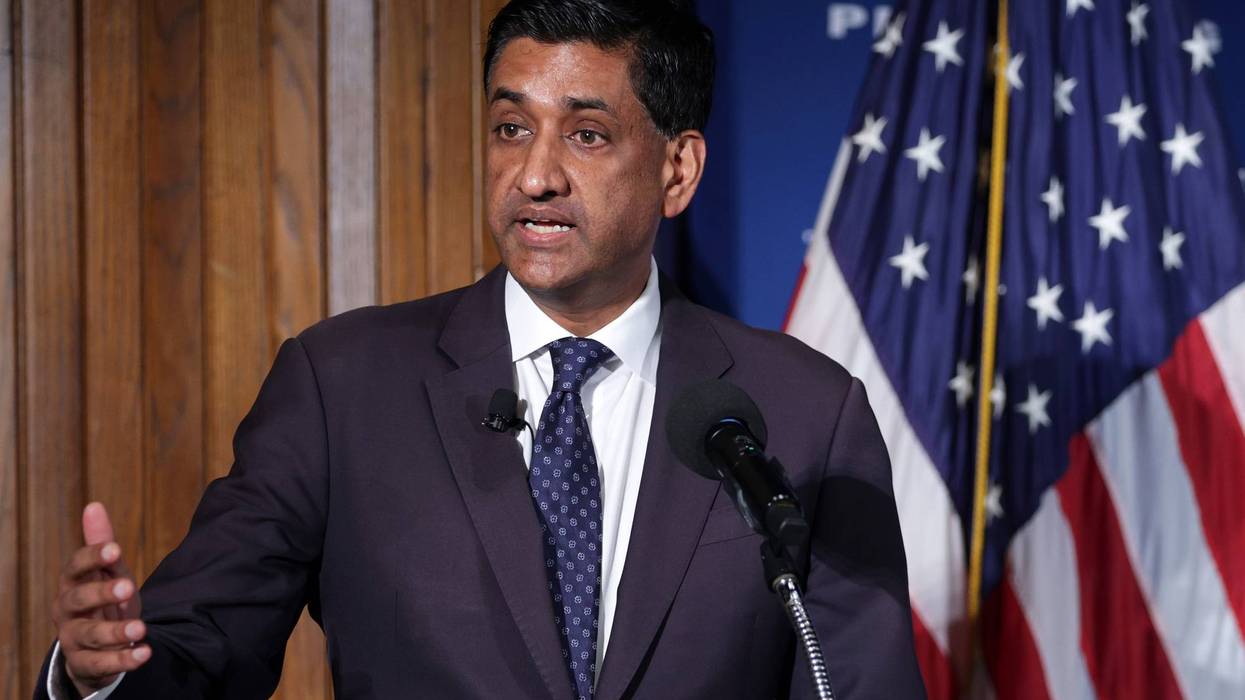
"Right now, all of the political incentives are there to bring this war to an end," Khanna said, warning it could become "endless" if it goes on past November 3.
Rep. Ro Khanna said President Donald Trump's war with Iran must end before the November 3 midterms, or it may become "another endless war."
"Right now, all of the political incentives are there to bring this war to an end," Khanna (D-Calif.) said in a video posted to X on Friday. "Food prices are high, gas prices are high, the American people are demanding that the war end before they cast their votes in November."
A Reuters/Ipsos poll out Friday shows that just 25% of Americans view the war as worthwhile, compared with 54% who do not and 21% who were unsure or did not answer.
Earlier this week, Reuters reported that Trump aides were seeking to stop the war from escalating for now to keep it out of the headlines and prevent Republicans from losing even more support before November. But once the votes are cast, they said Trump—who won't have to deal with concerns about reelection—may ramp up military action.
For this reason, Khanna—a leading advocate in the House of Representatives for restricting Trump's war powers—said the next two months are crucial.
"If we don't end this war now," he said, "then there will not be the same political pressure to bring it to a close."
Khanna said Democrats in Congress need to form an "unconventional coalition" with Republicans to force Trump's hand. He said he'd reached out to Rep. Thomas Massie (R-Ky.), with whom he's co-sponsored multiple war powers resolutions, as well as other Republicans.
"If you believe that we need to be for America First, if you voted for Trump on the promise of no new wars," he urged, "then please let us work together to bring a ceasefire to the war in Iran, to have diplomacy and negotiation, and prevent America from getting into another forever war."
Congress has already passed a war powers resolution directing Trump to end unauthorized hostilities with Iran, but he has so far ignored it, with his administration arguing that it does not have binding force.
In July, Rep. Gregory Meeks (D-NY), ranking member of the House Foreign Affairs Committee, introduced a resolution that would compel House Speaker Mike Johnson (R-La.) to sue Trump and enforce the will of Congress to end the war.
Other Democrats have introduced bills that would forbid funding for military force in Iran without congressional authorization.
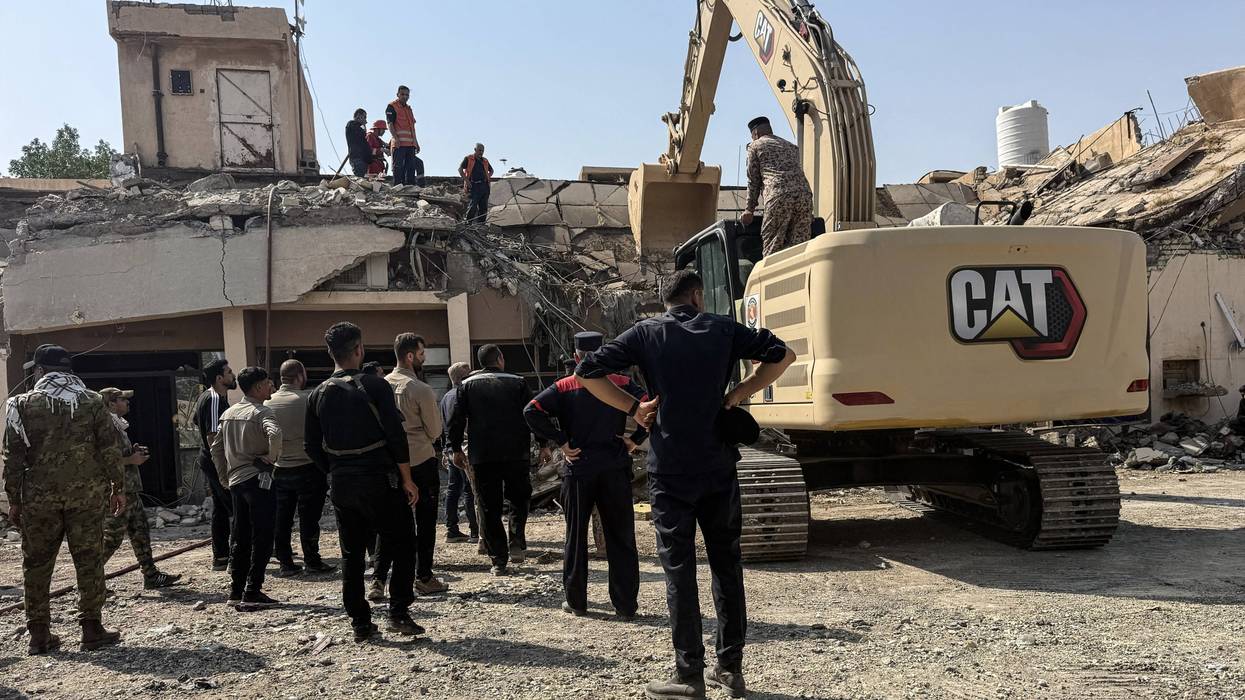
"Without a fundamental shift in US objectives and acceptance of a new regional balance, this conflict could drag on with profound and lasting economic consequences," said one analyst.
US President Donald Trump's illegal war of choice against Iran further spiraled out of control on Wednesday as American forces teamed up with Saudi Arabia to bomb Iraq, strikes that came hours after the US military said it intercepted an Iranian ballistic missile attack on American forces in Jordan.
The US Central Command said its strikes in Iraq targeted "Iran-aligned terrorists that the Islamic Revolutionary Guard Corps (IRGC) directed to attack US forces and Saudi energy infrastructure." The office of Iraqi President Nizar Amidi condemned the US-Saudi airstrikes as "an unacceptable attack and a blatant violation of Iraq's sovereignty." According to Iraq’s Popular Mobilization Forces, at least 20 of its members were killed by the US-Saudi attacks.
The exchange marked the first military escalation since the US and Iran paused strikes over the weekend, briefly hinting at the possibility of a return to diplomatic talks that have thus far not produced a lasting peace agreement.
Trump signaled Wednesday that the US onslaught—which is historically unpopular with the American public—was far from over.
"We're going to beat the fucking shit out of them," Trump told Fox News, according to reporter Trey Yingst. "We'll be hitting them hard."
"We're going to beat the fuc*ing sh*t out of them," President Trump told Fox News after Iran launched a surprise attack against U.S. forces. "We'll be hitting them hard."
The President says U.S. strikes overnight against Iran-backed militias in Iraq were coordinated with the… pic.twitter.com/AeLbEGFCFi
— Trey Yingst (@TreyYingst) July 29, 2026
Iran's Foreign Ministry said in a statement Wednesday that the US-Saudi bombing of Iraq was aimed at expanding "the scope of the war and conflict in the West Asia region."
"The warmongering US regime and its accomplices in the region [are] responsible for the dangerous consequences of these criminal, inhumane, and provocative acts," the foreign ministry added.
Shortly after the flurry of attacks, CNN published a survey showing that 67% of Americans believe that Trump's military actions in Iran have "hurt the US" as oil prices surged once again. Nearly three-quarters of Americans believe Trump does not "have a clear plan for handling the situation in Iran," according to the poll.
"It remains remarkable that Trump won two elections criticizing America’s Middle East wars, attacking the Bush era, and disavowing the regime change business," Sina Toossi, a senior fellow at the Center for International Policy, wrote on social media. "Yet with each passing day, his presidency and legacy are becoming consumed with a Middle East quagmire of his own making."
"Investors should stop assuming this war is nearing its end," Toossi added. "The conditions for a durable settlement do not yet exist. Without a fundamental shift in US objectives and acceptance of a new regional balance, this conflict could drag on with profound and lasting economic consequences."
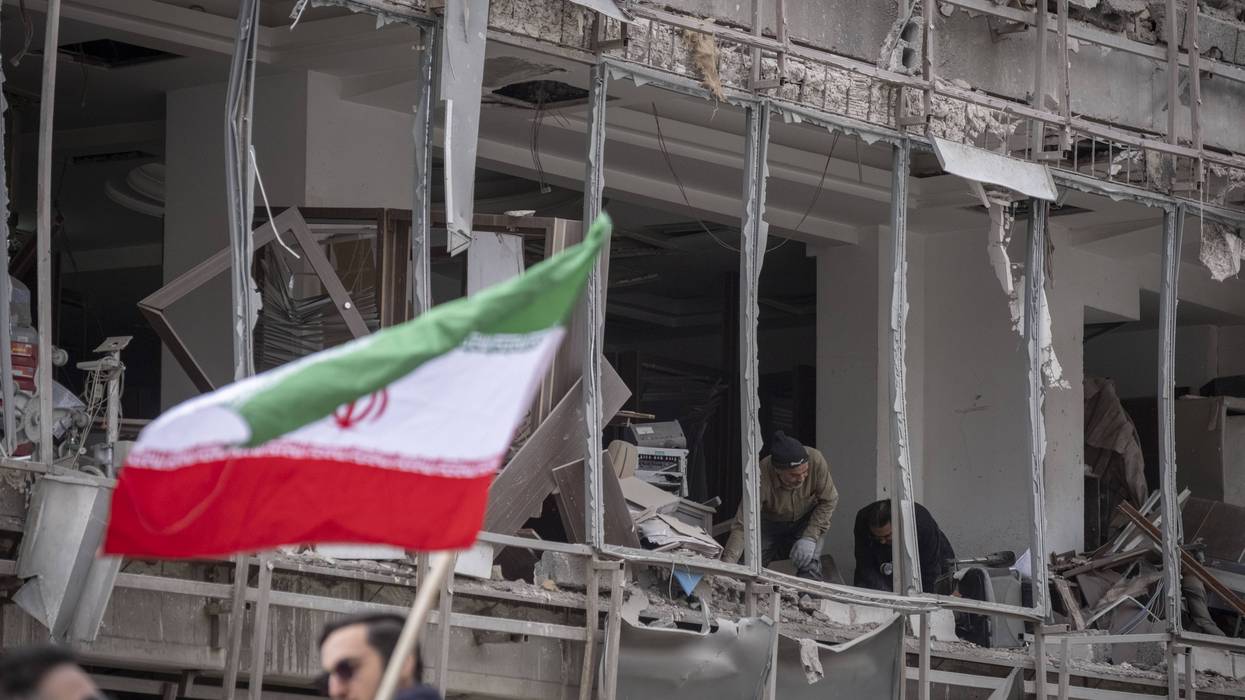
"Trump plunged the region into chaos with his 'delusional fantasies' and now fears more American troop casualties," said the secretary of the Iranian Supreme National Security Council, Ali Larijani.
As US President Donald Trump unleashed a barrage of bombings on Monday in what is rapidly spiraling into a regional conflagration, Iran's security chief said the country is ready for a long war, but questioned whether the US is prepared for the same.
“Trump plunged the region into chaos with his ‘delusional fantasies’ and now fears more American troop casualties,” said Ali Larijani, the secretary of the Iranian Supreme National Security Council, in a post on social media Monday. “With his delusional actions, he turned his self-made 'America First' slogan into 'Israel First' and sacrificed American soldiers for Israel’s power-hungry ambitions.”
"Iran, unlike the United States, has prepared itself for a long war," he said.
Just before US-Israeli strikes began this weekend, Iran reportedly offered Trump a deal that included Iran giving up all of its enriched uranium and full cooperation with international nuclear inspectors—terms even more conciliatory than those in the original Iran nuclear agreement that Trump ripped up during his first presidency.
But now the US and Israel have taken out several senior Iranian officials, including Supreme Leader Ayatollah Ali Khamenei, and included what some observers described as the "carpet bombing" of Tehran, including heavily populated civilian areas, Larijani has declared diplomacy off the table.
"We will not negotiate with the United States," he wrote on social media, disputing reports that he'd restarted talks with Washington.
With diplomatic avenues once again blown up, Iran has shifted toward making a war maximally costly for the US and Israel and deterring its other Arab allies from joining.
At least four US military personnel have already been killed, and four others seriously wounded in attacks at military bases in Kuwait. Trump has acknowledged that more casualties are "likely," which may further heighten the backlash among the American public, which already largely does not support the war, according to a poll released this weekend.
All six of the Gulf nations that host US military bases—including Saudi Arabia, the United Arab Emirates, Qatar, Oman, and Bahrain—have been hit with Iranian missiles and drones, with some attacks spilling into civilian areas—including Dubai's and Kuwait’s international airports, as well as luxury hotels and residential skyscrapers, which resulted in at least three reported civilian deaths.
Israel has also been pummelled with artillery from Iran and its allied militia Hezbollah in Lebanon. Strikes from Iran have reportedly killed at least 11 people and left dozens more injured in Israel, according to local authorities. Israel has retaliated with a massive attack on Lebanon, which the Lebanese health ministry has said killed at least 31 people.
While Iran lacks the military might of the US and Israel, it is likely seeking to deploy its arsenal of cheaper, older drones to deplete the two powerful countries' expensive air defense systems and force them into a war of attrition, according to Amos C. Fox, a professor at Arizona State University’s Future Security Initiative, and Franz-Stefan Gady, an associate fellow for cyber power and future conflict at the International Institute for Strategic Studies.
"The attackers do not want to find themselves trapped in an attritional slugfest, where they burn through hundreds of millions of dollars per day, exhaust their stocks of the most advanced interceptors, and face the prospect of a prolonged war—not by losing on the battlefield but by simply exhausting their anti-air weapons in the coming days and weeks," they wrote in Foreign Policy magazine on Monday.
“The attackers do not want to find themselves trapped in an attritional slugfest, where they burn through hundreds of millions of dollars per day, exhaust their stocks of the most advanced interceptors, and face the prospect of a prolonged war—not by losing on the battlefield but by simply exhausting their anti-air weapons in the coming days and weeks,” they continued. “The United States and its allies may eventually win—but at what price in terms of material and treasure? Iran knows that Israeli and US theories of success are premised on a quick and decisive strike campaign. Iran’s strategy will therefore be to play for time, rather than operate in a way to support the US-Israeli timeline.”
Cranking up the pressure further, Iran has also declared that "no ship is allowed to pass" through the Strait of Hormuz, which handles around 20% of global oil shipments. Prices have already begun to spike, and shipments have been canceled. Financial analysts have predicted that the closure of the strait could drive the price of a barrel to nearly double, potentially triggering global economic instability.
While predicting that the war would be over in “four to five” weeks on Monday, Trump acknowledged the possibility for it to go “far longer than that,” saying, “We’ll do whatever.” He also said he would not rule out a deployment of ground troops.
Defense Secretary Pete Hegseth insisted that this war, which has already claimed the lives of nearly 600 Iranians, would not be “endless” like the war in Iraq, which dragged on for nearly a decade and is estimated to have killed around half a million Iraqis.
However, after killing Khamenei, the Trump administration has provided little clarity on its military objectives. Meanwhile, their rationalizations for the conflict—including claims that an attack on US troops from Iran was imminent, and that it was on the verge of acquiring a nuclear weapon—have proven untrue.
Trump has also admitted to Jonathan Karl, the chief Washington correspondent for ABC News, that many of the leading "candidates" to take over the country "are all dead" from US strikes.
Though Trump has said his goal is to secure the "freedom" of the Iranian people, international experts say decapitating its government is more likely to empower its most authoritarian elements or create a mad, violent scramble for power.
"The two most likely outcomes for Iran are the imposition of an even more ruthless regime controlled by the security apparatus and its new collective leadership or a fragmentation of the country, perhaps precipitated by tension between the military and the Islamic Revolutionary Guard (IRGC)," said Daniel Brumberg, non-resident senior fellow at the Arab Center in Washington DC. "Both could also ensue at once."
Shireen Hunter, an Iranian political scientist at the Prince Alwaleed Bin Talal Center for Muslim-Christian Understanding, said that permanent destabilization may be the goal for the US, and—more importantly—Israel, which views Iran as its primary antagonist in the region.
“Slogans such as ‘freedom for Iranians’ and ‘Make Iran Great Again’ are meaningless. Do they want Iran to remain as a unified country? I have my doubts,“ she said. ”Saddam Hussein once said that five small Irans are better than one big Iran. Netanyahu agrees with that. What neither the US nor Israel wants is a strong nationalist government in Iran.“
"There is no obvious leader with the necessary qualifications to shape the nature of the new regime in Iran... any leader who comes to power by foreign intervention soon loses his or her legitimacy," she continued. "If the conflict continues, the risk of civil or even regional war is high, as is the risk of Iran's disintegration with unforeseeable consequences for regional countries."
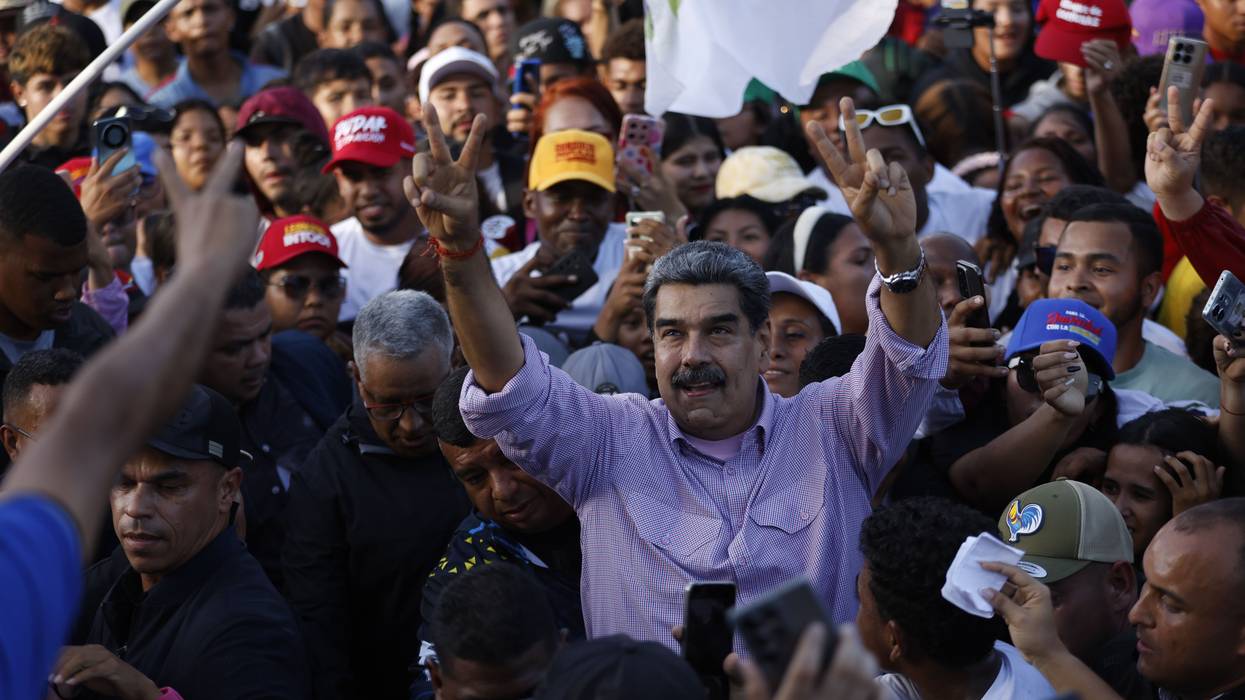
"No more unjust wars. No more Libya. No more Afghanistan. Long live peace," said the president of Venezuela.
Just as Secretary of Defense Pete Hegseth announced new branding for the US military campaign in Latin America, now known as "Operation Souther Spear," the president of Venezuela, Nicolas Maduro, on Thursday offered a message of peace directly to the people of the United States as he warned against further conflict.
In an exchange with a CNN correspondent during a rally for the nation's youth in Caracas, Maduro urged President Donald Trump not to prolong the region's military engagement. Asked if he had a message for the people of the United States, Maduro said in Spanish: “To unite for the peace of the continent. No more endless wars. No more unjust wars. No more Libya. No more Afghanistan.”
Asked if he had anything to say directly to Trump, Maduro replied in English: “Yes peace, yes peace.”
CNN: What is your message to the people of the United States?
Maduro: No more endless wars, no more unjust wars, no more Libya, no more Afghanistan.
CNN: Do you have a message for President Trump?
Maduro: My message is yes, peace. Yes, peace. pic.twitter.com/GpuRU2hqSG
— Acyn (@Acyn) November 14, 2025
Hegseth's rebranding of operations in Latin America, which has included a series of extrajudicial murders against alleged drug runners both in the Caribbean and in the Pacific, also arrived on Thursday.
He said that attacks on boats, which have now claimed the lives of at least 80 people, are part of President Donald Trump's targeting of "narco-terrorists." However, the administration has produced no evidence proving the allegations against these individuals nor shared with the American people the legal basis for the extrajudicial killings that deprive victims of due process.
With a significant military buildup that includes the world's largest aircraft carrier, the USS Gerald R.Ford, fears have grown that Trump is considering a wider military attack on targets inside Venezuelan territory, despite having no congressional authorization for such use of force against a nation with which the US is not at war.
CBS News reports that Trump has been briefed on possible military "options" for an assault on Venezuela, while anti-war voices continue to warn against any such moves.
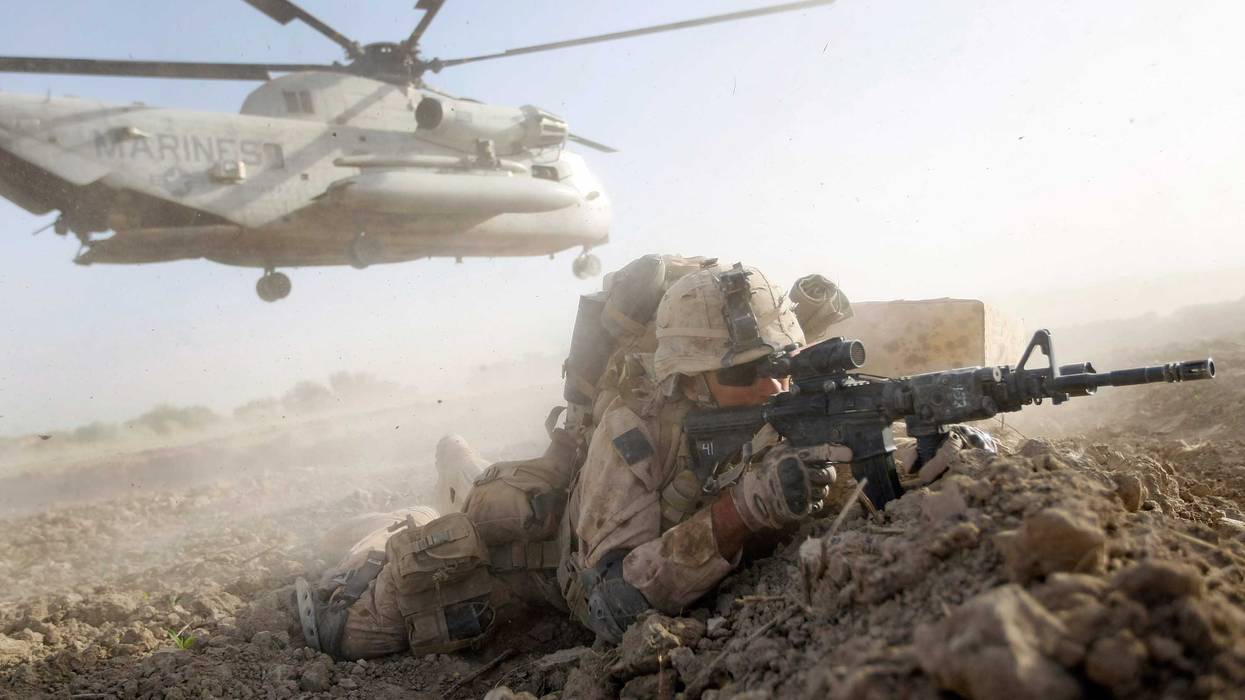
The far-reaching impacts of incessant war on American life in this century have received short shrift.
Donald Trump’s power has thrived on the economics, politics, and culture of war. The runaway militarism of the last quarter-century was a crucial factor in making President Trump possible, even if it goes virtually unmentioned in mainstream media and political discourse. That silence is particularly notable among Democratic leaders, who have routinely joined in bipartisan messaging to boost the warfare state that fueled the rise of Trumpism.
Trump first ran for president nearly a decade and a half after the “Global War on Terror” began in the wake of the 9/11 attacks. The crusade’s allure had worn off. The national mood was markedly different than in the era when President George W. Bush insisted that “our responsibility” was to “rid the world of evil.”
Working-class Americans had more modest goals for their government. Distress festered as income inequality widened and economic hardships worsened, while federal spending on war, the Pentagon budget, and the “national security” state continued to zoom upward. Even though the domestic effects of protracted warfare were proving to be enormous, multilayered, and deeply alienating, elites in Washington scarcely seemed to notice.
Donald Trump, however, did notice.
Pundits were shocked in 2015 when Trump mocked the war record of Republican Senator John McCain. The usual partisan paradigms were further upended during the 2016 presidential campaign when Trump denounced his opponent, Hillary Clinton, as “trigger happy.” He had a point. McCain, Clinton, and their cohort weren’t tired of U.S. warfare — in fact, they kept glorifying it — but many in non-affluent communities had grown sick of its stateside consequences.
Pretending that militarism is not a boon to authoritarian politics only strengthens it.
Repeated deployments of Americans to war zones had taken their toll. The physical and emotional wounds of returning troops were widespread. And while politicians were fond of waxing eloquent about “the fallen,” the continual massive spending for war and preparations for more of it depleted badly needed resources at home.
Status-Quo Militarism
President Barack Obama and Hillary Clinton represented the status quo that Trump ran against and defeated. Like them, he was completely insulated from the harsh boomerang effects of the warfare state. Unlike them, he sensed how to effectively exploit the discontent and anger it was causing.
Obama was not clueless. He acknowledged some downsides to endless war in a much-praised speech during his second term in office. “Our systematic effort to dismantle terrorist organizations must continue,” he affirmed at the National Defense University. “But this war, like all wars, must end. That’s what history advises. That’s what our democracy demands.”
New Yorker journalist Jane Mayer hailed that instance of presidential oratory in a piece touting Obama’s “anguish over the difficult trade-offs that perpetual war poses to a free society.” But such concerns were fleeting at the White House, while sparking little interest from mainstream journalists. Perpetual war had become wallpaper in the media echo chamber.
President Bush’s messianic calls to rid the world of “evil-doers” had fallen out of fashion, but militarism remained firmly embedded in the political economy. Corporate contracts with the Pentagon and kindred agencies only escalated. But when Hillary Clinton ran for president in 2016, being a rigid hawk became a negative with the electorate as pro-Trump forces jumped into the opening she provided.
Six weeks before the election, Forbes published an article under the headline “Hillary Clinton Never Met a War She Didn’t Want Other Americans to Fight.” Written by Doug Bandow, former special assistant to President Ronald Reagan, the piece exemplified how partisan rhetoric about war and peace had abruptly changed. Clinton “almost certainly would lead America into more foolish wars,” Bandow contended, adding: “No one knows what Trump would do in a given situation, which means there is a chance he would do the right thing. In contrast, Clinton’s beliefs, behavior, and promises all suggest that she most likely would do the wrong thing, embracing a militaristic status quo which most Americans recognize has failed disastrously.”
Clinton was following a timeworn formula for Democrats trying to inoculate themselves against charges of being soft on foreign enemies, whether communists or terrorists. Yet Trump, deft at labeling his foes both wimps and warmongers, ran rings around the Democratic nominee. In that close election, Clinton’s resolutely pro-war stance may have cost her the presidency.
“Even controlling in a statistical model for many other alternative explanations, we find that there is a significant and meaningful relationship between a community’s rate of military sacrifice and its support for Trump,” a study by scholars Douglas Kriner and Francis Shen concluded. “Our statistical model suggests that if three states key to Trump’s victory — Pennsylvania, Michigan, and Wisconsin — had suffered even a modestly lower casualty rate, all three could have flipped from red to blue and sent Hillary Clinton to the White House.” Professors Kriner and Shen suggested that Democrats might want to “reexamine their foreign policy posture if they hope to erase Trump’s electoral gains among constituencies exhausted and alienated by 15 years of war.”
But such advice went unheeded. Leading Democrats and Republicans remained on autopilot for the warfare state as the Pentagon budget kept rising.
On the War Train with Donald Trump
In 2018, the top Democrats in Washington, Nancy Pelosi and Chuck Schumer, boasted that they were fully aligned with President Trump in jacking up Pentagon spending. After Trump called for an 11% increase over two years in the already-bloated “defense” budget, Pelosi sent an email to House Democrats declaring, “In our negotiations, congressional Democrats have been fighting for increases in funding for defense.” The office of Senate Democratic leader Chuck Schumer proudly stated: “We fully support President Trump’s Defense Department’s request.”
By then, fraying social safety nets and chronic fears of economic insecurity had become ever more common across the country. The national pattern evoked Martin Luther King’s comment that profligate military spending was like “some demonic destructive suction tube.”
In 2020, recurring rhetoric from Joe Biden in his winning presidential campaign went like this: “If we give Donald Trump eight years in the White House, he will forever alter the character of our nation.” But Biden said nothing about how almost 20 years of nonstop war funding and war making had already altered the character of the nation.
At first glance, President Biden seemed to step away from continuing the “war on terror.” The last U.S. troops left Afghanistan by the end of August 2021. Speaking to the United Nations General Assembly weeks later, he proclaimed: “I stand here today, for the first time in 20 years, with the United States not at war.” But even as he spoke, a new report from the Costs of War Project at Brown University indicated that the “war on terror” persisted on several continents. “The war continues in over 80 countries,” said Catherine Lutz, the project’s co-director. The war’s cost to taxpayers, the project estimated, was already at least $8 trillion.
Biden’s designated successor, Vice President Kamala Harris, displayed a traditional militaristic reflex while campaigning against Trump. In her acceptance speech at the Democratic convention she pledged to maintain “the strongest, most lethal fighting force in the world.” Such rhetoric was problematic for attracting voters from the Democratic base reluctant to cast ballots for a war party. More damaging to her election prospects was her refusal to distance herself from Biden’s insistence on continuing to supply huge quantities of weaponry to Israel for the horrific war in Gaza.
Supplementing the automatic $3.8 billion in annual U.S. military aid to Israel, special new appropriations for weaponry totaling tens of billions of dollars enabled mass killing in Gaza. Poll results at the time showed that Harris would have gained support in swing states if she had called for an arms embargo on Israel as long as the Gaza war continued. She refused to do so.
Post-election polling underscored how Harris’s support for that Israeli war appreciably harmed her chances to defeat Trump. In 2024, as in 2016, Trump notably benefitted from the unwavering militarism of his Democratic opponent.
Overseas, the realities of nonstop war have been unfathomably devastating. Estimates from the Costs of War Project put the number of direct deaths in major war zones from U.S.-led actions under the “war on terror” brand at more than 900,000. With indirect deaths included, the number jumps to “4.5 million and counting.” The researchers explain that “some people were killed in the fighting, but far more, especially children, have been killed by the reverberating effects of war, such as the spread of disease.”
That colossal destruction of faraway human beings and the decimation of distant societies have gotten scant attention in mainstream U.S. media and politics. The far-reaching impacts of incessant war on American life in this century have also gotten short shrift. Midway through the Biden presidency, trying to sum up some of those domestic impacts, I wrote in my book War Made Invisible:
“Overall, the country is gripped by war’s dispersed and often private consequences — the aggravated tendencies toward violence, the physical wartime injuries, the post-traumatic stress, the profusion of men who learned to use guns and were trained to shoot to kill when scarcely out of adolescence, the role modeling from recruitment ads to popular movies to bellicose bombast from high-ranking leaders, and much more. The country is also in the grip of tragic absences: the health care not deemed fundable by those who approve federal budgets larded with military spending, the child care and elder care and family leave not provided by those same budgets, the public schools deprived of adequate funding, the college students and former students saddled with onerous debt, the uncountable other everyday deficits that have continued to lower the bar of the acceptable and the tolerated.”
While the warfare state seems all too natural to most politicians and journalists, its consequences over time have been transformational for the United States in ways that have distinctly skewed the political climate. Along the way, militarism has been integral to the rise of the billionaire tech barons who are now teaming up with an increasingly fascistic Donald Trump.
The Military-Industrial-Tech Complex
While President Trump has granted Elon Musk unprecedented power, many other tech moguls have rushed to ingratiate themselves. The pandering became shameless within hours of his election victory last November.
“Congratulations to President Trump on a decisive victory,” Meta’s CEO Mark Zuckerberg wrote. “We have great opportunities ahead of us as a country. Looking forward to working with you and your administration.” Jeff Bezos, the owner of Amazon, Whole Foods, and the Washington Post, tweeted: “wishing @realDonaldTrump all success in leading and uniting the America we all love.”
Amazon Web Services alone has numerous government contracts, including one with the National Security Agency worth $10 billion and deals with the Pentagon pegged at $9.7 billion. Such commerce is nothing new. For many years, thousands of contracts have tied the tech giants to the military-industrial complex.
Musk, Zuckerberg, Bezos, and smaller rivals are at the helm of corporations eager for government megadeals, tax breaks, and much more. For them, the governmental terrain of the new Trump era is the latest territory to navigate for maximizing their profits. With annual military outlays at 54% of all federal discretionary spending, the incentives are astronomical for all kinds of companies to make nice with the war machine and the man now running it.
While Democrats in Congress have long denounced Trump as an enemy of democracy, they haven’t put any sort of brake on American militarism. Certainly, there are many reasons for Trump’s second triumph, including his exploitation of racism, misogyny, nativism, and other assorted bigotries. Yet his election victories owe much to the Democratic Party’s failure to serve the working class, a failure intermeshed with its insistence on serving the industries of war. Meanwhile, spending more on the military than the next nine countries combined, U.S. government leaders tacitly lay claim to a kind of divine overpowering virtue.
As history attests, militarism can continue for many decades while basic democratic structures, however flawed, remain in place. But as time goes on, militarism is apt to be a major risk factor for developing some modern version of fascism. The more war and preparations for war persist, with all their economic and social impacts, the more core traits of militarism — including reliance on unquestioning obedience to authority and sufficient violence to achieve one’s goals — will permeate the society at large.
During the last 10 years, Donald Trump has become ever more autocratic, striving not just to be the nation’s commander-in-chief but also the commandant of a social movement increasingly fascistic in its approach to laws and civic life. He has succeeded in taking on the role of top general for the MAGA forces. The frenzies that energize Trump’s base and propel his strategists have come to resemble the mentalities of warfare. The enemy is whoever dares to get in his way.
A warfare state is well suited for such developments. Pretending that militarism is not a boon to authoritarian politics only strengthens it. The time has certainly come to stop pretending.
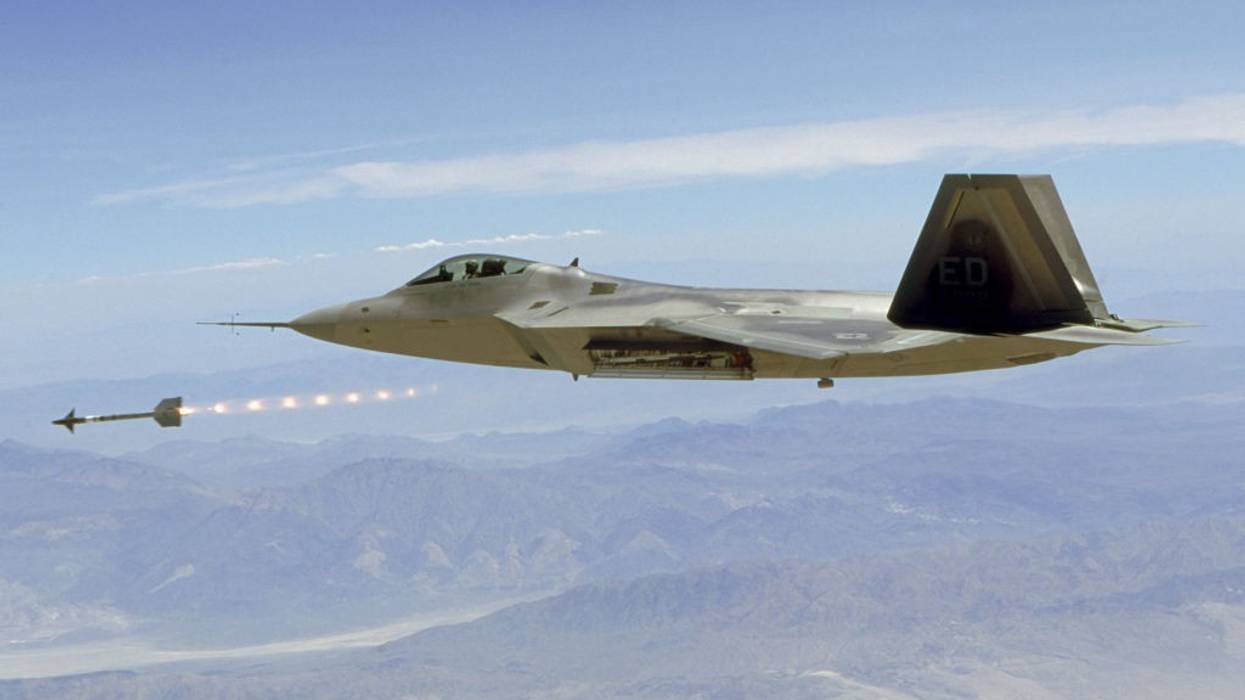
It’s easy for world leaders to point fingers at Azerbaijan for its oil-dependent economy while failing to acknowledge the massive carbon bootprint of their own militaries.
As world leaders are finalizing another round of climate negotiations, they continue to sidestep the single largest institutional source of greenhouse gas emissions: the U.S. military. While frontline communities face devastation from climate disasters, the Pentagon pumps out more emissions than 140 countries combined.
Despite last year's commitment to move away from fossil fuels, current negotiations are hindered by disagreements among nations with some oil-producing countries resisting the reaffirmation of this pledge. The failure to uphold the COP28 agreement could undermine the credibility of international climate efforts and impede progress toward global emission reduction targets.
This year, COP29 met in Azerbaijan under the leadership of Mukhtar Babayev, the country’s Minister of Ecology and Natural Resources. Criticisms of Azerbaijan’s ties to the oil industry quickly surfaced with some Western voices highlighting the influence of the fossil fuel sector on the summit. While this concern is valid, these same critics conveniently ignore their own deep complicity in the climate crisis, most glaringly, the United States’ military emissions.
The U.S. Department of Defense remains the world’s largest institutional consumer of oil, yet its emissions are systematically excluded from climate negotiations. The omission is by design. Since the 1997 Kyoto Protocol, military emissions have been given a free pass, thanks to pressure from U.S. negotiators. The numbers are staggering. The U.S. military consumes more than 100 million barrels of oil annually, producing emissions equivalent to the entire nation of Sweden. Its 800 overseas bases require constant fuel resupply, while Navy carriers, Air Force jets, and Army vehicles guzzle fossil fuels at an astounding rate. During the Iraq War alone, the Pentagon’s daily consumption reached 1.2 million barrels—more than 94% of countries globally.
Yet, instead of tackling this massive source of emissions, Congress continues to expand the military budget, approving $886 billion for FY2024, while climate funding remains a fraction of that amount. The cruel irony is that the communities most vulnerable to climate impacts, poor, Black, and brown communities both domestically and globally, bear the heaviest burden of both military operations and climate devastation. The Pentagon itself acknowledges climate change as a “threat multiplier” that will intensify conflicts and migration. Yet, its massive carbon footprint accelerates the very crises it claims to be preparing for. Military climate emissions create a deadly feedback loop that sacrifices the most vulnerable communities for the sake of military dominance.
Some progressive voices are finally breaking through. Representative Barbara Lee introduced legislation in 2001 requiring the Pentagon to track and reduce its emissions. Organizations like Veterans for Peace have demanded that military emissions be included in climate agreements. But far more pressure is needed from civil society and frontline communities who cannot afford to wait decades for gradual carbon reductions while the Pentagon's emissions continue unabated.
It’s easy for world leaders to point fingers at Azerbaijan for its oil-dependent economy while failing to acknowledge the massive carbon bootprint of their own militaries. True climate leadership requires confronting all major sources of emissions, even those wrapped in national security rhetoric. Excluding military emissions from climate agreements is a moral failure that undermines any serious effort at emissions reduction. The climate crisis demands we finally confront the true cost of endless war and military expansion. Until we do, climate summits will remain elaborate theater while the Pentagon’s carbon bootprint stamps out hope for a livable future. The communities on the frontlines of climate chaos from the Louisiana coast to the Pacific Islands deserve better than empty promises while military emissions remain off the books.
True climate leadership means having the courage to tackle all major emission sources, even those within their own borders. The time has come to end the military's exemption from climate accountability.

The destruction of our world is the warfare that consumes so much of it and the reverberating violence each conflict leaves in its wake.
Count on one thing: armed conflict lasts for decades after battles end and its effects ripple thousands of miles beyond actual battlefields. This has been true of America’s post-9/11 forever wars that, in some minimalist fashion, continue in all too many countries around the world. Yet those wars, which we ignited in Afghanistan, Iraq, and Pakistan in the wake of the 9/11 attacks, are hardly the first to offer such lessons. Prior wars left us plenty to learn from that could have led this country to respond differently after that September day when terrorists crashed planes into the World Trade Center in New York City and the Pentagon in Washington, D.C. Instead, we ignored history and, as a result, among so many other horrific things, left our weaponry — explosives, small arms, you name it — in war zones to kill and maim yet more people there for generations to come.
Case in point: We Americans tend to disregard the possibility (however modest) that weapons of war could even destroy our own lives here at home, despite how many of us own destructive weaponry. A few years ago, my military spouse and I were looking for a house for our family to settle in after over a decade of moving from military post to military post. We very nearly bought an old farmhouse owned by a combat veteran who mentioned his deployments to Afghanistan and Iraq. We felt uncertain about the structure of his house, so we arranged to return with our children to take another look after he had moved out. The moment we entered the garage with our two toddlers in tow, we noticed a semi-automatic rifle leaning against the wall, its barrel pointing up. Had we not grabbed our son by the hand, he might have run over to touch it and, had it been loaded, the unthinkable might have occurred. Anyone who has raised young children knows that a single item in an empty room, especially one as storied as a gun (in today’s age of constant school shootings and lockdowns) could be a temptation too great to resist.
That incident haunts me still. The combat vet, who thought to remove every item from his home but a rifle, left on display for us, was at best careless, at worst provocative, and definitely weird in the most modern meaning of that word. Given the high rates of gun ownership among today’s veterans, it’s not a coincidence that he had one, nor would it have been unknown for a child (in this case mine) to be wounded or die from an accidental gunshot. Many times more kids here die that way, whether accidentally or all too often purposely, than do our police or military in combat. Boys and men especially tend to be tactile learners. Those of them in our former war zones are also the ones still most likely to fall victim to mines and unexploded ordnance left behind, just as they’re more likely to die here from accidental wounds.
Scenes not that different from the one I described have been happening in nearly 70 countries on a regular basis, only with deadlier endings. Hundreds of people each year — many of them kids — happen upon weapons or explosives left over from wars once fought in their countries and are killed, even though they may have been unaware of the risks they faced just seconds before impact. And for that, you can thank the major warmakers on this planet like the U.S. and Russia that have simply refused to learn the lessons of history.
A Deadly Glossary
Many kinds of explosives linger after battles end. Such unexploded ordnance (UXO) includes shells, grenades, mortars, rockets, air-dropped bombs, and cluster munition bomblets that didn’t explode when first used. Among the most destructive of them are those cluster munitions, which can spread over areas several football fields wide, often explode in mid-air, and are designed to set objects on fire on impact. Militaries (ours among them) have been known to leave behind significant stockpiles of such explosive ordnance when conflicts cease. Weapons experts refer to such abandoned ordnance as AXO and it’s not uncommon for militaries to have stored and then abandoned them in places like occupied schools.
Close cousins of UXO are landmines designed to explode and kill indiscriminately upon contact, piercing tanks and other vehicles, as well as what came to be known as Improvised Explosive Devices (IEDs), jerry-rigged homemade bombs often buried in the ground, that kill on impact. IEDs gained notoriety during the American wars in Afghanistan and Iraq, where they accounted for more than half of reported U.S. troop casualties. And both unexploded landmines and IEDs can do terrible damage years later in peacetime.
As many of us are aware, long before this century’s American-led wars on terror started, militaries had already established just such a deadly legacy through their use of unexploded ordnance and mines. In Cambodia, which the U.S. bombed heavily during the Vietnam War in the 1960s and early 1970s, about 650 square kilometers remain contaminated with cluster-munition remnants from American aerial attacks, while a still larger area contains landmines. It’s estimated, in fact, that leftover landmines and other exploding ordnance killed nearly 20,000 Cambodians in what passed for “peacetime” between 1979 and 2022, also giving that country the dubious distinction of having one of the highest number of amputees per capita on the planet. Likewise, half a century after the U.S. littered neighboring Laos with cluster bombs, making it, per capita, the most bombed country in the world, less than 10% of its affected land has been cleared.
Similarly, dud bomblets, which failed to detonate in mid-air, are estimated to have killed or maimed somewhere between 56,000 and 86,000 civilians globally since Hitler’s air force first tested them out on Spanish towns during that country’s civil war in the 1930s. Despite concerted international advocacy by governments and human rights groups beginning in the 2000s, hundreds of new cluster munition casualties are reported yearly. In 2023, the most recent year on record globally, 93% of cluster munition casualties were civilians, with 47% of those killed and injured by such remnant explosives children.
Cluster munitions are known for killing broadly on impact, so it’s not easy to get firsthand accounts of just what it’s like to witness such an attack, but a few such unflinching accounts are available to us. Take for instance, a report by Human Rights Watch researchers who interviewed survivors of a Russian cluster munitions attack in the eastern Ukrainian village of Hlynske in May 2022. As one man reported, after hearing a rocket strike near his home, “Suddenly I heard my father screaming, ‘I’ve been hit! I can’t move,’ he said. I ran back and saw that he had fallen on his knees but couldn’t move from the waist down, and there were many metal pieces in him, including one sticking out of his spine and another in his chest. He had these small metal pellets lodged in his hands and legs.”
According to the report, his father died a month later, despite surgery.
How did a noise outside that survivor’s home so quickly become shrapnel lodged in his father’s body? Maybe someone growing up in America’s poorer neighborhoods, littered with weapons of war, can relate, but I read accounts like his and realize how distant people like me normally remain from war’s violence.
After the international Cluster Munitions Convention took effect in 2010, 124 countries committed to retiring their stockpiles. But neither the U.S., Russia, nor Ukraine, among other countries, signed that document, although our government did promise to try to replace the Pentagon’s cluster munitions with variants that supposedly have lower “dud” rates. (The U.S. military has not explained how they determined that was so.)
Our involvement in the Ukraine war marked a turning point. In mid-2023, the Biden administration ordered the transfer of cluster munitions from its outdated stockpile, sidestepping federal rules limiting such transfers of weapons with high dud rates. As a result, we added to the barrage of Russian cluster-munition attacks on Ukrainian towns. New cluster-munition attacks initiated in Ukraine have created what can only be seen as a deadly kind of time bomb. If it can be said that the U.S. and Russia in any way acted together, it was in placing millions of new time bombs in Ukrainian soil in their quest to take or protect territory there, ensuring a future of mortal danger for so many Ukrainians, no matter who wins the present war.
Afghanistan, Every Step You Take
At the Costs of War Project, which I helped found at Brown University in 2010, a key goal continues to be to show how armed conflict disrupts human lives, undermining so much of what people need to do to work, travel, study, or even go to the doctor. Afghanistan is a case in point: An area roughly 10 times the size of Washington, D.C., is now thoroughly contaminated by mines and unexploded ordnance. Prior to the U.S. attack in 2001, Afghans already had to contend with explosives from the Soviet Union’s disastrous war there in the 1980s. And I’m sure you won’t be surprised to learn that casualties from that war’s unexploded ordnance and mines only rose after the U.S.-led invasion further unsettled the country. It’s estimated that well over half of that country’s 20,000 or so injuries and deaths between 2001 and 2018 were due to unexploded ordnance, landmines, and other explosive remnants of war like IEDs. Contaminated Afghan land includes fields commonly used for growing food and letting livestock graze, schools, roads, tourist sites, and former military bases and training ranges used by the U.S. and its NATO allies.
Worse yet, the damage isn’t only physical. It’s also psychological. As Costs of War researchers Suzanne Fiederlein and SaraJane Rzegocki have written, “The fear of being harmed by these weapons [unexploded ordnance] is magnified by knowing or seeing someone injured or killed.” In her ethnography of Afghan war widows, Anila Daulatzai offered a gripping illustration of how loss, death, and psychological terror ripple outward to a family and community after a young boy dies in a bomb blast on his way to school and his parents turn to heroin to cope.
When I read such accounts, what stands out to me is how long such unexploded ordnance makes the terror of war linger after the wars themselves are in the history books. Think about what life, stressful as it might be in times of peace, would be like if every step you took might be your last because of unseen threats lurking under the ground. That would include threats like certain bomblets, attractive with their bell-like appearance, which your young child might pick up, thinking they’re toys.
The U.S. Arming of Ukraine (“We Start When It All Ends”)
And we still haven’t learned. Today, with 26,000 square kilometers (an area roughly the size of my home state of Maryland) contaminated by mines and unexploded ordnance, Ukraine is the most mined country in the world. I recently spoke with a founding director of the Ukrainian Association for Humanitarian Demining (UAHD), an umbrella organization based in Kyiv and responsible for information-sharing on mines and other unexploded ordnance, as well as future demining, and humanitarian aid based on such an ongoing nightmare.
From our conversation, what stood out to me was how people’s ordinary lives have come to a halt because of this war. For example, much has been written about how interruptions in the Ukrainian grain supply impacted food prices and famine globally, but we pay less attention to how and why. As the UAHD representative told me, “For two years, most Ukrainian farmers in occupied territory have had to halt their work because of mines and unexploded ordnance. This past Thursday, the Ukrainian government issued their first payment so that one day, these farms might be able to keep doing their work.” If the history of Laos is any marker and if the Ukraine war ever ends, just the cleanup will prove a long slog.
When I asked how civilian lives in Ukraine were affected by cluster munitions, the response from the UAHD representative was brief: “I don’t know, because war zones are off-limits to us right now. Once the fighting finally ends, we can survey the land and talk to people living there. We start when it all ends.” My interlocutor’s comments reminded me of a superb recent novel on modern warfare, Andrey Kurkov’s Grey Bees. It focuses on a beekeeper who stays behind in his eastern Ukrainian farming village after his neighbors have evacuated to escape the fighting. The novel conveys the poverty and physical danger war brings with it, as well as how isolated from one another civilians in war zones grow, not least because of the dangers of just moving around along once-quiet fields and roads. For instance, the one gift that a Ukrainian soldier offers the beekeeper in passing is a grenade for his own protection, which he ultimately uses to destroy his bees, nearly hurting himself in the process. His other brush with near-death occurs when a traumatized Ukrainian veteran threatens him with an axe during a flashback to combat. War, in other words, returns home, again and again.
Like the beekeeper, we all need to pay attention to what’s left in the wake of our government’s exploits. We need to ask ourselves what future generations may have to deal with thanks to what our leaders do today in the name of expediency. That’s true when it comes to those horrifying cluster munitions and essentially every other militarized response governments concoct to grapple with complex problems.
In this context, let me suggest that there are two messages readers should take away from this piece: It couldn’t be more important to bear witness to what’s being done to destroy our world and, when the fighting ends, it’s also vital to pay attention to what has been left behind.

Those of my youth are now long gone, lost to time and maturity, as is the illusion that my country pursues freedom and democracy in the Middle East or anywhere else.
Like many American boys of the baby-boomer generation, I played “war” with those old, olive-drab, plastic toy soldiers meant to evoke our great victory over the Nazis and “the Japs” during World War II. At age 10, I also kept a scrapbook of the 1973 Yom Kippur War between Israel and its various Arab enemies in the Middle East. It was, I suppose, an early sign that I would make both the military and the study of history into careers.
I recall rooting for the Israelis, advertised then as crucial American allies, against Egypt, Syria, and other regional enemies at least ostensibly allied with the Soviet Union in that Cold War era. I bought the prevailing narrative of a David-versus-Goliath struggle. I even got a book on the Yom Kippur War that captivated me by displaying all the weaponry the U.S. military had rushed to Israel to turn the tide there, including F-4 Phantom jets and M-60 main battle tanks. (David’s high-tech slingshots, if you will.) Little did I know that, in the next 50 years of my life, I would witness increasingly destructive U.S. military attacks in the Middle East, especially after the oil cartel OPEC (largely Middle Eastern then) hit back hard with an embargo in 1973 that sent our petroleum-based economy into a tailspin.
As one jokester quipped: Who put America’s oil under the sands of all those ungrateful Muslim countries in the Middle East? With declarations like the Carter Doctrine in 1980, the U.S. was obviously ready to show the world just how eagerly it would defend its “vital interests” (meaning fossil fuels, of course) in that region. And even today, as we watch the latest round in this country’s painfully consistent record of attempting to pound various countries and entities there into submission, mainly via repetitive air strikes, we should never forget the importance of oil, and lots of it, to keep the engines of industry and war churning along in a devastating fashion.
No technology may be more all-American than bombs and bombers and no military doctrine more American than the urge to attain “peace” through massive firepower.
Right now, of course, the world is witnessing yet another U.S. bombing campaign, the latest in a series that seems all too predictable (and futile), meant to teach the restless rebels of Iraq, Syria, Yemen, and possibly even Iran a lesson when it comes to messing with the United States of America. As the recently deceased country singer Toby Keith put it: Mess with this country and “We’ll put a boot (think: bomb) in your ass.” You kill three soldiers of ours and we’ll kill scores, if not hundreds, if not thousands of yours (and it doesn’t really matter if they’re soldiers or not), because… well, because we damn well can!
America’s leaders, possessing a peerless Air Force, regularly exhibit a visceral willingness to use it to bomb and missile perceived enemies into submission or, if need be, nothingness. And don’t for a second think that they’re going to be stopped by international law, humanitarian concerns, well-meaning protesters, or indeed any force on this planet. America bombs because it can, because it believes in the efficacy of violence, and because it’s run by appeasers.
Yes, America’s presidents, its bombers-in-chief, are indeed appeasers. Of course, they think they’re being strong when they’re blowing distant people to bits, but their actions invariably showcase a distinctive kind of weakness. They eternally seek to appease the military-industrial-congressional complex, aka the national (in)security state, a complex state-within-a-state with an unappeasable hunger for power, profit, and ever more destruction. They fail and fail and fail again in the Middle East, yet they’re incapable of not ordering more bombing, more droning, more killing there. Think of them as being possessed by a monomania for war akin to my urge to play with toy soldiers. The key difference? When I played at war, I was a wet-behind-the-ears 10 year old.
The Rockets’ Red Glare, the Bombs Bursting in Air
No technology may be more all-American than bombs and bombers and no military doctrine more American than the urge to attain “peace” through massive firepower. In World War II and subsequent wars, the essential U.S. approach could be summarized in five words: mass production enabling mass destruction.
No other country in the world has dedicated such vast resources as mine has to mass destruction through air power. Think of the full-scale bombing of cities in Nazi Germany and Imperial Japan in World War II, ending in the atomic destruction of Hiroshima and Nagasaki. Think of the flattening of North Korea during the Korean War of the early 1950s or the staggering bombing campaigns in Vietnam, Laos, and Cambodia in the 1960s and early 1970s. Or consider the massive use of air power in Desert Shield against Iraq in the early 1990s followed by the air campaigns that accompanied the invasions of Afghanistan and Iraq in 2003 (and never quite seemed to stop thereafter). The butcher’s bill for such bombing has indeed been high, quite literally millions of non-combatants killed by America’s self-styled “arsenal of democracy.”
And indeed, as you read this, another country is now faithfully following America’s example. Israel is systematically destroying Gaza, rendering it essentially uninhabitable for those Palestinians who survive the ongoing rampage. In fact, early in its war of annihilation, Israeli leaders cited the Allied destruction of the German city of Dresden in 1945 in support of their own atrocious air and ground campaign against the Palestinians.
Looking at this dispassionately as a military historian, the Dresden reference makes a certain twisted sense. In World War II, the Americans and their British allies in their “combined bomber offensive” destroyed German cities indiscriminately, seeing all Germans as essentially Nazis, complicit in the crimes of their government, and so legitimate targets. Something similar is true of the right-wing Israeli government today. It sees all Palestinians as essentially members of Hamas and thus complicit in last year’s brutal October 7th attacks on Israel, making them legitimate targets of war, Israeli- (and American-) style. Just like the United States, Israel claims to be “defending democracy” whatever it does. Little wonder, then, that Washington has been so willing to send bombs and bullets to its protégé as it seeks “peace” through massive firepower and genocidal destruction.
Indeed, of late, there has been considerable debate about whether Israel is engaged in acts of genocide, with the International Court of Justice ruling that the present government should strive to prevent just such acts in Gaza. Putting that issue aside, it’s undeniable that Israel has been using indiscriminate bombing attacks and a devastating invasion in a near-total war against Palestinians living on that 25-mile-long strip of land, an approach that calls to mind the harrowing catchphrase “Exterminate all the brutes!” from Joseph Conrad’s novel Heart of Darkness.
In a sense, there’s nothing new under the sun. Certainly, the Old Testament itself provides examples of exterminatory campaigns (cited by Bibi Netanyahu as Israel first moved against the Palestinians in Gaza). He might as well have cited a catchphrase heard during America’s war in Vietnam, but rooted in the medieval crusades: “Kill them all and let God sort them out.”
America’s Unrelenting Crusade in the Middle East
In the immediate aftermath of the 9/11 attacks, President George W. Bush got into trouble almost instantly when he referred to the “war on terror” he had launched as a “crusade.” Yet, as impolitic as that word might have seemed, how better to explain U.S. actions in the Middle East and Afghanistan? Just consider our faith in the goodness and efficacy of “our” military and that all-American urge to bring “democracy” to the world, despite the destruction visited upon Iraq, Libya, Syria, and Yemen over the last several decades. Or go back to 1953 and the role the CIA played in the overthrow of Iran’s legitimate democratic ruler and his replacement by the brutally repressive regime of the Shah.
Try to imagine such events from the perspective of a historian writing in the year 2200. Might that future scribe not refer to repeated U.S. invasions of, incursions into, and bombing campaigns across the Middle East as a bloody crusade, launched under the (false) banner of democracy with righteous vengeance, if not godly purpose, in mind? Might that historian not suggest that such a “crusade” was ultimately more about power and profit, domination and control than (as advertised) “freedom”? And might that historian not be impressed (if not depressed) by the remarkable way the U.S. brought seemingly unending chaos and death to the region over such a broad span of time?
Consider these facts. More than 22 years after the 9/11 attacks, the U.S. still has at least 30,000 troops scattered across the Middle East. At least one Navy carrier strike group, and often two, dominate the regional waters, while striking numbers of military bases (“Little Americas”) are still sprinkled across countries ranging from Kuwait to Bahrain, from Qatar to the United Arab Emirates and beyond. So many years later, about 900 U.S. troops still illegally occupy part of Syria (not coincidentally, where that country produces most of its oil) and 2,500 more remain in Iraq, even though the government there would like them to depart.
Yankee Go Home? Apparently Not in My Lifetime
Meanwhile, American military aid, mostly in the form of deadly weaponry, flows not only to Israel but to other countries in the region like Egypt and Jordan. Direct U.S. military support facilitated Saudi Arabia’s long, destructive, and unsuccessful war against the Houthis in Yemen, a conflict Washington is now conducting on its own with repeated air strikes. And of course, the entire region has, for more than two decades now, been under constant U.S. military pressure in that war on terror, which all too quickly became a war of terror (and of torture).
Recall that the U.S. invasion of Iraq in 2003 led to the death of roughly a million Iraqis and the displacement of millions more as refugees. How could that not be considered part of a “crusade,” even if a fitful and failing one? Yet, here’s the rub: just as those Catholic crusades of the Middle Ages weren’t entirely or even primarily about religion, so today’s American version isn’t motivated primarily by an anti-Muslim animus. Of course, there is indeed an inescapably religious aspect to such never-ending American war-making, but what drives those wars is largely naked greed, vengeance, and an all-American urge both to appease and amplify the military-industrial-congressional complex.
Of course, as was true in the years after 9/11 and is still true today, Americans are generally encouraged to see their country’s imperial and crusading acts as purely defensive in nature, the righteous responses of freedom-bringers. Admittedly, it’s a strange kind of freedom this country brings at the tip of a sword — or on the nosecone of a Hellfire missile. Even so, in such an otherwise thoroughly contentious Congress, it should be striking how few members have challenged the latest bombing version of this country’s enduring war in the Middle East.
Forget the Constitution. No Congressional declaration of war is believed necessary for any of this, nor has it mattered much (so far) that the American public has grown increasingly skeptical of those wars and the acts of destruction that go with them. As it happens, however, the crusade, such as it is, has proven remarkably sustainable without much public crusading zeal. For most Americans, those acts remain distinctly off-stage and largely out of mind, except at moments like the present one where the deaths of three American soldiers give the administration all the excuse it needs for repetitive acts of retaliation.
No, we the people exercise remarkably little control over the war-making that the military-industrial-congressional complex has engaged in for decades or the costs that go with them. Indeed, the dollar costs are largely deferred to future generations as America’s national debt climbs even faster than the Pentagon war budget.
America, so we were told by President George W. Bush, is hated for its freedoms. Yet the “freedoms” we’re allegedly hated for aren’t those delineated in the Constitution and its Bill of Rights. Rather, it’s America’s “freedom” to build military bases across the globe and bomb everywhere, a “freedom” to sell such bellicose activity as lawful and even admirable, a “freedom” to engage in a hyperviolent style of play, treating “our” troops and so many foreigners as toy soldiers and expendable props for Washington’s games.
It’s something I captured unintentionally five decades ago with those toy soldiers of mine from an imagined glorious military past. But after a time (too long, perhaps) I learned to recognize them as the childish things they were and put them away. They’re now long gone, lost to time and maturity, as is the illusion that my country pursues freedom and democracy in the Middle East through ceaseless acts of extreme violence, which just seem to drone on and on and on.
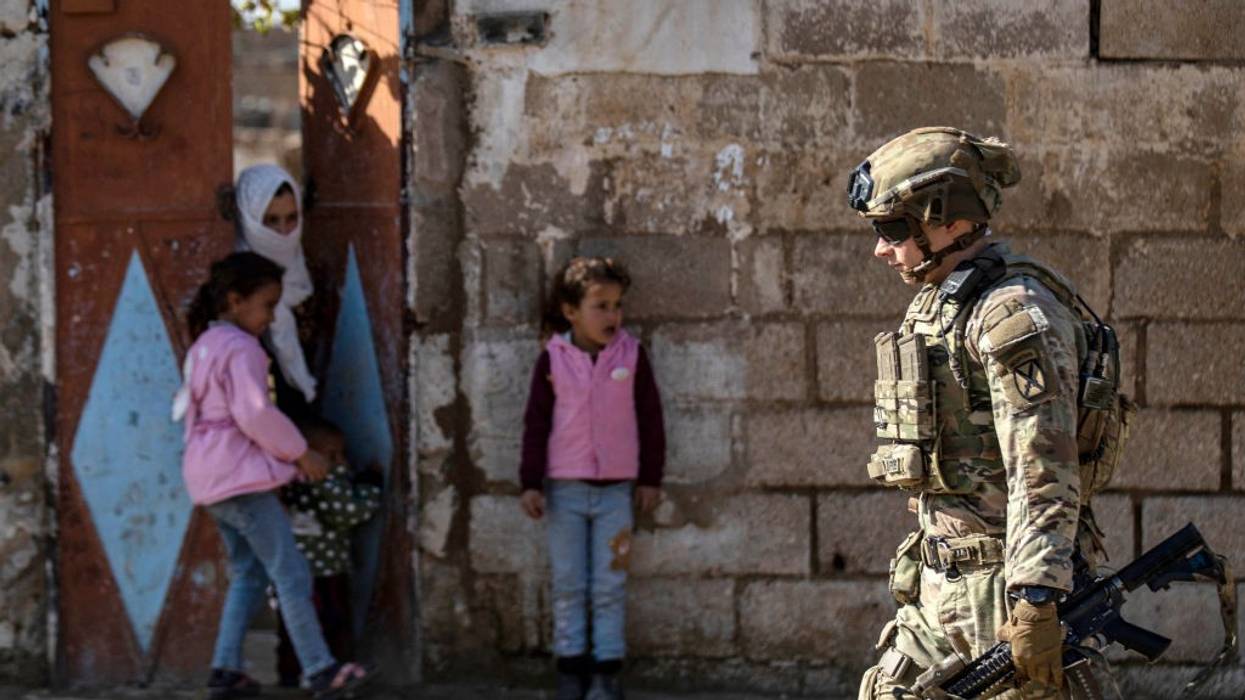
Approximately 2400 American soldiers remain stationed in Syria and Iraq—ostensibly to fight ISIS. But after this weekend's casualties, they may become the reason we fight Iran. That is intolerable.
The drone attack on Sunday that killed three U.S. service members at an outpost in Jordan near the Syria border is more likely to increase rather than decrease U.S. military involvement in the region.
This is unfortunate, and doubly so coming at a time when the Biden administration was showing signs of considering a withdrawal of the 900 U.S. troops in Syria and 2,500 in Iraq. Just last week, Secretary of Defense Lloyd Austin intimated that a joint U.S.-Iraqi review might lead to a drawdown of at least some of the troops in Iraq. Other reporting points to discussions within the administration about possibly removing the troops now in Syria.
It is unclear why the administration chose this time to consider what was already a long-overdue withdrawal of these troops. The answer probably involves the upsurge in regional violence stemming from Israel’s devastating assault on Palestinians in the Gaza Strip and associated anger against the United States for its backing of Israel. Since the Israeli assault began, U.S. military installations in Iraq have been attacked more than 60 times and those in Syria more than 90 times.
The attacks underscore how much these residual U.S. deployments have entailed costs and risks far out of proportion to any positive gains they can achieve. They have been sitting-duck targets within easy reach of militias and other elements wishing to make a violent anti-U.S. statement. Even without deaths, U.S. service members have paid a price, such as in the form of traumatic brain injuries from missile attacks.
The attacks underscore how much these residual U.S. deployments have entailed costs and risks far out of proportion to any positive gains they can achieve.
The now-familiar tit-for-tat sequence in which American airstrikes against militias in Iraq or Syria alternate with more militia attacks on the U.S. installations illustrates a perverse form of mission creep. Whatever was the original mission of the U.S. troop presence gets sidelined as protection of the troop presence itself becomes the main concern. The tit-for-tats also carry the risk of escalation into a larger conflict.
This weekend’s attack just across the border in Jordan is likely to become part of the same risk-laden sequence. A White House statement promised to “hold all those responsible to account at a time and in a manner our choosing.”
This will lead the administration to shelve for the time being any ideas it had about bringing home the troops — out of fear of showing weakness amid the inevitable criticism from domestic political opponents. The better course would be to interpret the attack as one more demonstration of how the troop presence in Syria and Iraq represents a needless vulnerability that ought to be ended sooner rather than later.
The official rationale for the presence on both those countries is to prevent a rise of the group known as Islamic State or ISIS. But the motivations have always involved more than that. The presence in Iraq is in some respects a legacy of the U.S. war begun there in 2003, which has imparted the sense of ownership that often follows a large-scale military intervention. The fixation with Iran and a desire to match Iranian presence and influence in these countries have constituted another motivation.
As for ISIS, although it has shown resilience, it is nowhere near what it was in 2014 when it ruled a de facto mini-state across much of western Iraq and northeastern Syria. If the group ever were to begin approaching that status again, much more than the small U.S. contingents in Syria and Iraq would be needed to counter it. To those who might argue that ISIS already is resurgent, one is entitled to ask exactly what good the presence of those contingents is doing in keeping ISIS down.
With regard to any terrorist group, the foremost U.S. concern ought to be not how the group plays in some local conflict but rather the risk of it striking U.S. interests, either at home or abroad. In that regard, the most relevant fact, repeatedly demonstrated with other terrorist groups in other places, is that anger at a foreign military presence is one of the chief motivations for terrorist attacks.
To the extent that ISIS has been kept down, this is partly due to popular opposition in Iraq and Syria to the group’s brutal methods that it displayed when it had its mini-state. It is partly due to the efforts of security forces in those two countries. And it is partly due to the efforts of the foreign state most extensively involved in those countries — Iran.
Iran is very much an enemy of ISIS. It has been a victim of highly lethal ISIS attacks within Iran, including bombings in the heart of Tehran in 2017 and, earlier this month, an attack on a memorial ceremony in the city of Kerman that killed nearly 100 Iranians. Iran was a major player in the earlier efforts to undo the ISIS mini-state.
Combating ISIS is a shared interest of Iran and the United States, as illustrated by the United States reportedly sharing — quite properly, in conformity with the duty to warn — information about the planned ISIS attack in Kerman. It would be in U.S. interests to have Iran continue to do the heavy lifting in holding down ISIS — and to have Iran, not the United States, risk any resulting terrorist reprisals.
Once powers previously outlawed or at least restrained in the name of fair, just, and responsible laws and norms become codified and implemented, the road back to normalcy is tantamount to impossible.
This week marks the 22nd anniversary of the opening of the Guantánamo Bay detention facility, the infamous prison on the island of Cuba designed to hold detainees from this country’s Global War on Terror. It’s an anniversary that’s likely to go unnoticed, since these days you rarely hear about the war on terror — and for good reason. After all, that response to al-Qaeda’s 9/11 attacks, as defined over the course of three presidential administrations, has officially ended in a cascade of silence. Yes, international terrorism and the threat of such groups persist, but the narrative of American policy as a response to 9/11 seems to have faded away. Two and a half years ago, the Biden administration’s chaotic withdrawal from the 20-year-long Afghan War proved to be a last gasp (followed the next summer by the killing of Ayman al-Zawahiri, successor as al-Qaeda’s leader after Osama bin Laden was killed in 2011).
But Guantánamo, a prison that, from its founding, has violated U.S. codes of due process, fair treatment, and the promise of justice writ large isn’t the only unnerving legacy of the “war” on terror that still persists. If indefinite detention at Guantánamo was a key pillar of that war, defying longstanding American laws and norms, it was just one of the steps beyond those norms that still persist today.
In the days, weeks, and even years following the attacks of September 11th, the U.S. government took action to create new powers in the name of keeping the nation safe. Two of them, more than two decades after those attacks, are now rife with calls for change. Congress created the first just a week after 9/11 (with but a single no vote). It authorized unchecked and unending presidentially driven war powers that could be used without specified geographical limits — and, strangely enough, that power still remains in place, despite recent congressional efforts to curtail its authority. The second, the expansive use of secret surveillance powers on Americans, is currently under heated debate.
War Powers
The very first new authority created in the name of the war on terror was the Authorization for the Use of Military Force, or AUMF, passed by Congress one week after the 9/11 attacks. It gave the president the power “to use all necessary and appropriate force against those nations, organizations, or persons he determines planned, authorized, committed, or aided the terrorist attacks that occurred on September 11, 2001, or harbored such organizations or persons, in order to prevent any future acts of international terrorism against the United States by such nations, organizations, or persons.”
Unlike past declarations of war or authorizations for war in American history, it was staggeringly vague. It named no actual enemy or geographical locations. It made no reference to what conditions would end the hostilities and the power of that authorization. It was in essence “a blank check” for presidential war powers, as Congresswoman Barbara Lee (D-CA), the single member of Congress to vote no on its passage, warned at the time and has reiterated over the years.
It was also a game-changing authorization. Not only did it lack specifics, but it stripped Congress of its constitutionally authorized power to declare war. In the war on terror, Congress would defer to the president who could decide on his own when and where to launch attacks.
Over the course of the last two-plus decades, that 2001 AUMF has been used repeatedly to do exactly what Barbara Lee feared — namely, broaden the president’s power to commit acts of war against not just the terrorist groups who conspired in the 9/11 attacks, but groups in countries far and wide. According to the Costs of War Project at Brown University’s Watson Institute, as of 2021, it had been used in at least 22 countries, including Afghanistan, Djibouti, Eritrea, Ethiopia, Georgia, Iraq, Kenya, Niger, Pakistan, the Philippines, Somalia, and Yemen.
Twenty-two-and-a-half years later, in April 2023, Congressman Gregory Meeks, (D-NY), ranking member of the House Foreign Affairs Committee, acknowledged that the 2001 AUMF had indeed become, in the words of fellow Democrat Annie Kuster (D-NH), “a blank check for presidents from both parties to wage war around the world.”
Over the course of the last two-plus decades, that 2001 AUMF has been used repeatedly to do exactly what Barbara Lee feared — namely, broaden the president’s power to commit acts of war against not just the terrorist groups who conspired in the 9/11 attacks, but groups in countries far and wide.
There have been calls for the repeal of that AUMF over the years, including from — you undoubtedly won’t be surprised to learn — Representative Lee (repeatedly). This past fall, several such bills were introduced in both the House and Senate, including a bipartisan version by Senator Rand Paul (R-KY).
In the spring of 2023, Representative Meeks submitted his bill to replace the 2001 AUMF with a new one. In doing so, he sought to reestablish Congress’s constitutionally granted power to declare war, emphasized the statutory obligation of the president to brief Congress after launching any attack, and added that the president must brief Congress on a regular basis as to the uses of the AUMF.
In addition, he inserted language aimed at curtailing the Act’s expansiveness, including a requirement that the enemies to whom it could be applied be specifically named. He suggested three: the original al-Qaeda; the Islamic State Khorasan, based in Afghanistan and known as IS-K; and the Islamic State in Iraq and Syria, or ISIS. Moreover, his bill called for an annual reconsideration of those enemies and added provisions designed to end the president’s right to authorize the AUMF’s use for new groups by claiming they were just extensions of, or forces associated with, the already named groups. Furthermore, his bill prohibited its use against any unnamed enemy, “whether or not the entity is involved in an armed conflict against a force of a United States ally or partner or is an affiliate, associated force, or successor entity of an entity described in such subsection.”
To further constrain the broadness of that 2001 authorization, Meeks included a sunset clause at the end of four years unless it was reauthorized by Congress.
In a world where wars have broken out in Ukraine and now the Middle East, and where additional hostilities are simmering when it comes to the U.S., Iran, China, and Russia, such language would ensure that a separate congressional declaration of war would have to be approved for any enemy the U.S. decided to attack.
In these many ways, the new version of the AUMF would rein in the aberration of those war powers that came into being in the aftermath of 9/11.
And yet the time to redesign the authority of presidential war powers, as created more than 22 years ago by the war on terror, has still not arrived. Meeks’s bill, like Rand Paul’s, gained remarkably little traction. Likewise, a bill from those relatively few congressional representatives calling for a full repeal of that AUMF rather than a replacement of it failed to make it to a vote.
Surveillance
In addition to indefinite detention at Guantánamo and the authorization of endless, expansive war-making, ever more expansive intelligence collection, at home as well as abroad, has been a foundational pillar of the war on terror — and, like the AUMF, bringing it under some control has been mired in debate and controversy in recent months. In 2023, some members of Congress tried to put limits on part of a controversial law, Section 702 of the Foreign Intelligence Surveillance Amendments Act, passed in the summer of 2008 in the waning months of George W. Bush’s presidency. It authorized the collection and sharing of foreign intelligence for the purpose of deterring national security threats.
The problem was not the stated purpose of Section 702 — to acquire information on foreigners abroad who might pose a threat to the United States — but the domestic uses to which it’s been put. The act allows foreigners abroad to be surveilled without a warrant. But since its inception, it’s also been used for warrantless investigations of Americans whose communications have been caught up in sweeping searches of the communications of foreigners — investigations that have become known as “back-door searches.”
The problem was not the stated purpose of Section 702 — to acquire information on foreigners abroad who might pose a threat to the United States — but the domestic uses to which it’s been put.
Constitutional scholars and civil liberties advocates have fought against Section 702 from its inception, arguing that such searches violate the Fourth Amendment’s guarantee against unreasonable searches and seizures without a warrant based on probable cause of criminal activity. As Elizabeth Gotein of the Brennan Center for Justice explains, “Section 702 lets the government collect the communications of non-Americans located abroad without a warrant. But because Americans talk to people outside the country, the surveillance inevitably sweeps in our private phone calls, emails, and text messages, too — information that the government would normally need a warrant to access.”
In addition, experts note that, over time, the broad authority to collect the communications of Americans has been abused in alarming ways by the authorities. Gotein points out that 702-based warrantless searches have scrutinized the “communications of Black Lives Matter protesters, members of Congress, a local political party, a state court judge, journalists, and in one case, more than 19,000 contributors to a congressional campaign.” For their part, intelligence officials seeking a continuation of Section 702 point out that recent reforms have led to more responsible use of the authority.
Now, for the third time since its passage, Section 702 is up for renewal. December 31, 2023, was the legal deadline for a vote on it. Unlike the two prior times, however, the renewal date came and went without a vote. Instead, substantial opposition by legal experts and others led to several competing bills calling for Section 702’s reform.
One of the proposed bills, the Government Surveillance Reform Act, introduced by Democratic Senator Ron Wyden of Oregon and Republican Senator Mike Lee of Utah, as well as representatives Warren Davidson (R-OH) and Zoe Lofgren (D-CA) in the House, proposed that a warrant requirement be added to the search requirements when looking at the location data of Americans, web browsing and search records, vehicle data, and the like. In Lee’s version, any queries about the communications collected in a 702 search would, in accordance with the Fourth Amendment, require a warrant for material involving Americans. The new bill would amount, in Gotein’s words, to closing “the backdoor search loophole.”
The Biden administration has, however, taken a notably aggressive stance against changes to the law, especially when it comes to the introduction of the warrant requirement. Numerous high-ranking officials have spoken out publicly, insisting that the warrant requirement would imperil their ability to keep the nation safe. In his written testimony before Congress, FBI Director Chris Wray insisted that it was “an essential tool” in the counterterrorism toolbox. In fact, he told Congress, it was potentially “the critical link that allows us to identify the intended target or build out the network of attackers so we can stop them before they strike and kill Americans.” Andrew McCabe, acting director of the FBI after Donald Trump fired Director Jim Comey, put it even more starkly in a podcast devoted to the issue, labeling Section 702 “arguably the most significant national security tool in the intelligence community.” He then insisted that the requirement for a warrant was “completely unworkable.”
So fraught was the congressional loggerhead over Section 702 that the deadline for a decision proved unworkable. Instead, Congress inserted an extension to mid-April 2024 in this year’s defense spending bill, signed into law by President Biden three days before Christmas.
It’s likely that, as with the 2001 AUMF, the attempt to change Section 702 will fail. Powers once given, it seems, only prove ever harder to relinquish and, all too sadly, the overreach engendered by the war on terror has by now become an accepted part of the American (and congressional) way of life.
Guantánamo
And then there’s the most glaring symbol of the never-ending, often extralegal legacy of the war on terror, the continued existence of that grim prison at Guantánamo Bay, Cuba. Twenty-two years ago, the Bush administration set up that offshore detention facility for war-on-terror detainees, placing it beyond the reach of military, federal, or international law. Since then, on numerous occasions, new protections for the rights of prisoners there have been put into place, but none of them have addressed one fundamental wrong — namely, the decision that the federal court system was incapable of prosecuting those accused of engaging in terrorism against the United States, including those who conspired in the 9/11 attacks.
Despite candidate Biden’s assertion that, unlike Donald Trump, he would support the closure of Guantánamo, his appointment of a special representative to oversee the transfer of its prisoners to federal prisons, and the actual transfer of 10 detainees, substantial efforts to finally shut down the prison have been noticeably absent. Once a facility that held 780 men captured in the war on terror, it now holds 30 individuals, 16 of whom have been cleared for transfer elsewhere, pending appropriate security arrangements. Another 10 are scheduled for trial by military commissions but their trials are not expected to begin anytime soon.
Whether it’s an endlessly expansive authorization for eternally conducting war around the world, the redefinition of surveillance powers to include Americans under the guise of a foreign threat, or the seemingly lackadaisical acceptance of Guantánamo as an institution, there is certainly one lasting lesson from the war on terror. Once powers previously outlawed or at least restrained in the name of fair, just, and responsible laws and norms become codified and implemented, the road back to normalcy is tantamount to impossible.
Perhaps the best we can hope for is that wiser heads will prevail in the days to come. It is, however, a terrifyingly fragile approach, given the outlook for the 2024 election.