SUBSCRIBE TO OUR FREE NEWSLETTER
Daily news & progressive opinion—funded by the people, not the corporations—delivered straight to your inbox.
5
#000000
#FFFFFF
To donate by check, phone, or other method, see our More Ways to Give page.
Daily news & progressive opinion—funded by the people, not the corporations—delivered straight to your inbox.
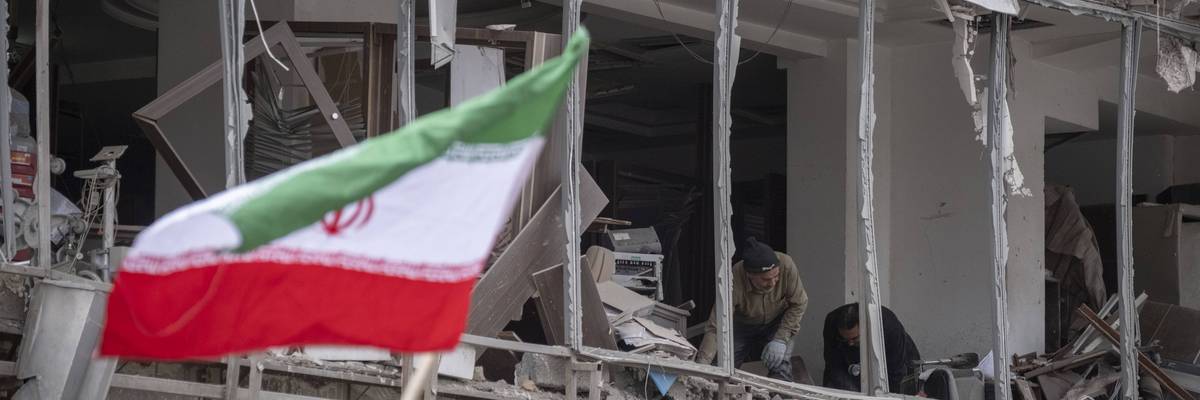
A man holds an Iranian flag outside the Gandhi Hospital, which is damaged after US-Israeli strikes on a state TV telecommunication tower nearby in Tehran on March 2, 2026.
"Trump plunged the region into chaos with his 'delusional fantasies' and now fears more American troop casualties," said the secretary of the Iranian Supreme National Security Council, Ali Larijani.
As US President Donald Trump unleashed a barrage of bombings on Monday in what is rapidly spiraling into a regional conflagration, Iran's security chief said the country is ready for a long war, but questioned whether the US is prepared for the same.
“Trump plunged the region into chaos with his ‘delusional fantasies’ and now fears more American troop casualties,” said Ali Larijani, the secretary of the Iranian Supreme National Security Council, in a post on social media Monday. “With his delusional actions, he turned his self-made 'America First' slogan into 'Israel First' and sacrificed American soldiers for Israel’s power-hungry ambitions.”
"Iran, unlike the United States, has prepared itself for a long war," he said.
Just before US-Israeli strikes began this weekend, Iran reportedly offered Trump a deal that included Iran giving up all of its enriched uranium and full cooperation with international nuclear inspectors—terms even more conciliatory than those in the original Iran nuclear agreement that Trump ripped up during his first presidency.
But now the US and Israel have taken out several senior Iranian officials, including Supreme Leader Ayatollah Ali Khamenei, and included what some observers described as the "carpet bombing" of Tehran, including heavily populated civilian areas, Larijani has declared diplomacy off the table.
"We will not negotiate with the United States," he wrote on social media, disputing reports that he'd restarted talks with Washington.
With diplomatic avenues once again blown up, Iran has shifted toward making a war maximally costly for the US and Israel and deterring its other Arab allies from joining.
At least four US military personnel have already been killed, and four others seriously wounded in attacks at military bases in Kuwait. Trump has acknowledged that more casualties are "likely," which may further heighten the backlash among the American public, which already largely does not support the war, according to a poll released this weekend.
All six of the Gulf nations that host US military bases—including Saudi Arabia, the United Arab Emirates, Qatar, Oman, and Bahrain—have been hit with Iranian missiles and drones, with some attacks spilling into civilian areas—including Dubai's and Kuwait’s international airports, as well as luxury hotels and residential skyscrapers, which resulted in at least three reported civilian deaths.
Israel has also been pummelled with artillery from Iran and its allied militia Hezbollah in Lebanon. Strikes from Iran have reportedly killed at least 11 people and left dozens more injured in Israel, according to local authorities. Israel has retaliated with a massive attack on Lebanon, which the Lebanese health ministry has said killed at least 31 people.
While Iran lacks the military might of the US and Israel, it is likely seeking to deploy its arsenal of cheaper, older drones to deplete the two powerful countries' expensive air defense systems and force them into a war of attrition, according to Amos C. Fox, a professor at Arizona State University’s Future Security Initiative, and Franz-Stefan Gady, an associate fellow for cyber power and future conflict at the International Institute for Strategic Studies.
"The attackers do not want to find themselves trapped in an attritional slugfest, where they burn through hundreds of millions of dollars per day, exhaust their stocks of the most advanced interceptors, and face the prospect of a prolonged war—not by losing on the battlefield but by simply exhausting their anti-air weapons in the coming days and weeks," they wrote in Foreign Policy magazine on Monday.
“The attackers do not want to find themselves trapped in an attritional slugfest, where they burn through hundreds of millions of dollars per day, exhaust their stocks of the most advanced interceptors, and face the prospect of a prolonged war—not by losing on the battlefield but by simply exhausting their anti-air weapons in the coming days and weeks,” they continued. “The United States and its allies may eventually win—but at what price in terms of material and treasure? Iran knows that Israeli and US theories of success are premised on a quick and decisive strike campaign. Iran’s strategy will therefore be to play for time, rather than operate in a way to support the US-Israeli timeline.”
Cranking up the pressure further, Iran has also declared that "no ship is allowed to pass" through the Strait of Hormuz, which handles around 20% of global oil shipments. Prices have already begun to spike, and shipments have been canceled. Financial analysts have predicted that the closure of the strait could drive the price of a barrel to nearly double, potentially triggering global economic instability.
While predicting that the war would be over in “four to five” weeks on Monday, Trump acknowledged the possibility for it to go “far longer than that,” saying, “We’ll do whatever.” He also said he would not rule out a deployment of ground troops.
Defense Secretary Pete Hegseth insisted that this war, which has already claimed the lives of nearly 600 Iranians, would not be “endless” like the war in Iraq, which dragged on for nearly a decade and is estimated to have killed around half a million Iraqis.
However, after killing Khamenei, the Trump administration has provided little clarity on its military objectives. Meanwhile, their rationalizations for the conflict—including claims that an attack on US troops from Iran was imminent, and that it was on the verge of acquiring a nuclear weapon—have proven untrue.
Trump has also admitted to Jonathan Karl, the chief Washington correspondent for ABC News, that many of the leading "candidates" to take over the country "are all dead" from US strikes.
Though Trump has said his goal is to secure the "freedom" of the Iranian people, international experts say decapitating its government is more likely to empower its most authoritarian elements or create a mad, violent scramble for power.
"The two most likely outcomes for Iran are the imposition of an even more ruthless regime controlled by the security apparatus and its new collective leadership or a fragmentation of the country, perhaps precipitated by tension between the military and the Islamic Revolutionary Guard (IRGC)," said Daniel Brumberg, non-resident senior fellow at the Arab Center in Washington DC. "Both could also ensue at once."
Shireen Hunter, an Iranian political scientist at the Prince Alwaleed Bin Talal Center for Muslim-Christian Understanding, said that permanent destabilization may be the goal for the US, and—more importantly—Israel, which views Iran as its primary antagonist in the region.
“Slogans such as ‘freedom for Iranians’ and ‘Make Iran Great Again’ are meaningless. Do they want Iran to remain as a unified country? I have my doubts,“ she said. ”Saddam Hussein once said that five small Irans are better than one big Iran. Netanyahu agrees with that. What neither the US nor Israel wants is a strong nationalist government in Iran.“
"There is no obvious leader with the necessary qualifications to shape the nature of the new regime in Iran... any leader who comes to power by foreign intervention soon loses his or her legitimacy," she continued. "If the conflict continues, the risk of civil or even regional war is high, as is the risk of Iran's disintegration with unforeseeable consequences for regional countries."
Dear Common Dreams reader, It’s been nearly 30 years since I co-founded Common Dreams with my late wife, Lina Newhouser. We had the radical notion that journalism should serve the public good, not corporate profits. It was clear to us from the outset what it would take to build such a project. No paid advertisements. No corporate sponsors. No millionaire publisher telling us what to think or do. Many people said we wouldn't last a year, but we proved those doubters wrong. Together with a tremendous team of journalists and dedicated staff, we built an independent media outlet free from the constraints of profits and corporate control. Our mission has always been simple: To inform. To inspire. To ignite change for the common good. Building Common Dreams was not easy. Our survival was never guaranteed. When you take on the most powerful forces—Wall Street greed, fossil fuel industry destruction, Big Tech lobbyists, and uber-rich oligarchs who have spent billions upon billions rigging the economy and democracy in their favor—the only bulwark you have is supporters who believe in your work. But here’s the urgent message from me today. It's never been this bad out there. And it's never been this hard to keep us going. At the very moment Common Dreams is most needed, the threats we face are intensifying. We need your support now more than ever. We don't accept corporate advertising and never will. We don't have a paywall because we don't think people should be blocked from critical news based on their ability to pay. Everything we do is funded by the donations of readers like you. When everyone does the little they can afford, we are strong. But if that support retreats or dries up, so do we. Will you donate now to make sure Common Dreams not only survives but thrives? —Craig Brown, Co-founder |
As US President Donald Trump unleashed a barrage of bombings on Monday in what is rapidly spiraling into a regional conflagration, Iran's security chief said the country is ready for a long war, but questioned whether the US is prepared for the same.
“Trump plunged the region into chaos with his ‘delusional fantasies’ and now fears more American troop casualties,” said Ali Larijani, the secretary of the Iranian Supreme National Security Council, in a post on social media Monday. “With his delusional actions, he turned his self-made 'America First' slogan into 'Israel First' and sacrificed American soldiers for Israel’s power-hungry ambitions.”
"Iran, unlike the United States, has prepared itself for a long war," he said.
Just before US-Israeli strikes began this weekend, Iran reportedly offered Trump a deal that included Iran giving up all of its enriched uranium and full cooperation with international nuclear inspectors—terms even more conciliatory than those in the original Iran nuclear agreement that Trump ripped up during his first presidency.
But now the US and Israel have taken out several senior Iranian officials, including Supreme Leader Ayatollah Ali Khamenei, and included what some observers described as the "carpet bombing" of Tehran, including heavily populated civilian areas, Larijani has declared diplomacy off the table.
"We will not negotiate with the United States," he wrote on social media, disputing reports that he'd restarted talks with Washington.
With diplomatic avenues once again blown up, Iran has shifted toward making a war maximally costly for the US and Israel and deterring its other Arab allies from joining.
At least four US military personnel have already been killed, and four others seriously wounded in attacks at military bases in Kuwait. Trump has acknowledged that more casualties are "likely," which may further heighten the backlash among the American public, which already largely does not support the war, according to a poll released this weekend.
All six of the Gulf nations that host US military bases—including Saudi Arabia, the United Arab Emirates, Qatar, Oman, and Bahrain—have been hit with Iranian missiles and drones, with some attacks spilling into civilian areas—including Dubai's and Kuwait’s international airports, as well as luxury hotels and residential skyscrapers, which resulted in at least three reported civilian deaths.
Israel has also been pummelled with artillery from Iran and its allied militia Hezbollah in Lebanon. Strikes from Iran have reportedly killed at least 11 people and left dozens more injured in Israel, according to local authorities. Israel has retaliated with a massive attack on Lebanon, which the Lebanese health ministry has said killed at least 31 people.
While Iran lacks the military might of the US and Israel, it is likely seeking to deploy its arsenal of cheaper, older drones to deplete the two powerful countries' expensive air defense systems and force them into a war of attrition, according to Amos C. Fox, a professor at Arizona State University’s Future Security Initiative, and Franz-Stefan Gady, an associate fellow for cyber power and future conflict at the International Institute for Strategic Studies.
"The attackers do not want to find themselves trapped in an attritional slugfest, where they burn through hundreds of millions of dollars per day, exhaust their stocks of the most advanced interceptors, and face the prospect of a prolonged war—not by losing on the battlefield but by simply exhausting their anti-air weapons in the coming days and weeks," they wrote in Foreign Policy magazine on Monday.
“The attackers do not want to find themselves trapped in an attritional slugfest, where they burn through hundreds of millions of dollars per day, exhaust their stocks of the most advanced interceptors, and face the prospect of a prolonged war—not by losing on the battlefield but by simply exhausting their anti-air weapons in the coming days and weeks,” they continued. “The United States and its allies may eventually win—but at what price in terms of material and treasure? Iran knows that Israeli and US theories of success are premised on a quick and decisive strike campaign. Iran’s strategy will therefore be to play for time, rather than operate in a way to support the US-Israeli timeline.”
Cranking up the pressure further, Iran has also declared that "no ship is allowed to pass" through the Strait of Hormuz, which handles around 20% of global oil shipments. Prices have already begun to spike, and shipments have been canceled. Financial analysts have predicted that the closure of the strait could drive the price of a barrel to nearly double, potentially triggering global economic instability.
While predicting that the war would be over in “four to five” weeks on Monday, Trump acknowledged the possibility for it to go “far longer than that,” saying, “We’ll do whatever.” He also said he would not rule out a deployment of ground troops.
Defense Secretary Pete Hegseth insisted that this war, which has already claimed the lives of nearly 600 Iranians, would not be “endless” like the war in Iraq, which dragged on for nearly a decade and is estimated to have killed around half a million Iraqis.
However, after killing Khamenei, the Trump administration has provided little clarity on its military objectives. Meanwhile, their rationalizations for the conflict—including claims that an attack on US troops from Iran was imminent, and that it was on the verge of acquiring a nuclear weapon—have proven untrue.
Trump has also admitted to Jonathan Karl, the chief Washington correspondent for ABC News, that many of the leading "candidates" to take over the country "are all dead" from US strikes.
Though Trump has said his goal is to secure the "freedom" of the Iranian people, international experts say decapitating its government is more likely to empower its most authoritarian elements or create a mad, violent scramble for power.
"The two most likely outcomes for Iran are the imposition of an even more ruthless regime controlled by the security apparatus and its new collective leadership or a fragmentation of the country, perhaps precipitated by tension between the military and the Islamic Revolutionary Guard (IRGC)," said Daniel Brumberg, non-resident senior fellow at the Arab Center in Washington DC. "Both could also ensue at once."
Shireen Hunter, an Iranian political scientist at the Prince Alwaleed Bin Talal Center for Muslim-Christian Understanding, said that permanent destabilization may be the goal for the US, and—more importantly—Israel, which views Iran as its primary antagonist in the region.
“Slogans such as ‘freedom for Iranians’ and ‘Make Iran Great Again’ are meaningless. Do they want Iran to remain as a unified country? I have my doubts,“ she said. ”Saddam Hussein once said that five small Irans are better than one big Iran. Netanyahu agrees with that. What neither the US nor Israel wants is a strong nationalist government in Iran.“
"There is no obvious leader with the necessary qualifications to shape the nature of the new regime in Iran... any leader who comes to power by foreign intervention soon loses his or her legitimacy," she continued. "If the conflict continues, the risk of civil or even regional war is high, as is the risk of Iran's disintegration with unforeseeable consequences for regional countries."
As US President Donald Trump unleashed a barrage of bombings on Monday in what is rapidly spiraling into a regional conflagration, Iran's security chief said the country is ready for a long war, but questioned whether the US is prepared for the same.
“Trump plunged the region into chaos with his ‘delusional fantasies’ and now fears more American troop casualties,” said Ali Larijani, the secretary of the Iranian Supreme National Security Council, in a post on social media Monday. “With his delusional actions, he turned his self-made 'America First' slogan into 'Israel First' and sacrificed American soldiers for Israel’s power-hungry ambitions.”
"Iran, unlike the United States, has prepared itself for a long war," he said.
Just before US-Israeli strikes began this weekend, Iran reportedly offered Trump a deal that included Iran giving up all of its enriched uranium and full cooperation with international nuclear inspectors—terms even more conciliatory than those in the original Iran nuclear agreement that Trump ripped up during his first presidency.
But now the US and Israel have taken out several senior Iranian officials, including Supreme Leader Ayatollah Ali Khamenei, and included what some observers described as the "carpet bombing" of Tehran, including heavily populated civilian areas, Larijani has declared diplomacy off the table.
"We will not negotiate with the United States," he wrote on social media, disputing reports that he'd restarted talks with Washington.
With diplomatic avenues once again blown up, Iran has shifted toward making a war maximally costly for the US and Israel and deterring its other Arab allies from joining.
At least four US military personnel have already been killed, and four others seriously wounded in attacks at military bases in Kuwait. Trump has acknowledged that more casualties are "likely," which may further heighten the backlash among the American public, which already largely does not support the war, according to a poll released this weekend.
All six of the Gulf nations that host US military bases—including Saudi Arabia, the United Arab Emirates, Qatar, Oman, and Bahrain—have been hit with Iranian missiles and drones, with some attacks spilling into civilian areas—including Dubai's and Kuwait’s international airports, as well as luxury hotels and residential skyscrapers, which resulted in at least three reported civilian deaths.
Israel has also been pummelled with artillery from Iran and its allied militia Hezbollah in Lebanon. Strikes from Iran have reportedly killed at least 11 people and left dozens more injured in Israel, according to local authorities. Israel has retaliated with a massive attack on Lebanon, which the Lebanese health ministry has said killed at least 31 people.
While Iran lacks the military might of the US and Israel, it is likely seeking to deploy its arsenal of cheaper, older drones to deplete the two powerful countries' expensive air defense systems and force them into a war of attrition, according to Amos C. Fox, a professor at Arizona State University’s Future Security Initiative, and Franz-Stefan Gady, an associate fellow for cyber power and future conflict at the International Institute for Strategic Studies.
"The attackers do not want to find themselves trapped in an attritional slugfest, where they burn through hundreds of millions of dollars per day, exhaust their stocks of the most advanced interceptors, and face the prospect of a prolonged war—not by losing on the battlefield but by simply exhausting their anti-air weapons in the coming days and weeks," they wrote in Foreign Policy magazine on Monday.
“The attackers do not want to find themselves trapped in an attritional slugfest, where they burn through hundreds of millions of dollars per day, exhaust their stocks of the most advanced interceptors, and face the prospect of a prolonged war—not by losing on the battlefield but by simply exhausting their anti-air weapons in the coming days and weeks,” they continued. “The United States and its allies may eventually win—but at what price in terms of material and treasure? Iran knows that Israeli and US theories of success are premised on a quick and decisive strike campaign. Iran’s strategy will therefore be to play for time, rather than operate in a way to support the US-Israeli timeline.”
Cranking up the pressure further, Iran has also declared that "no ship is allowed to pass" through the Strait of Hormuz, which handles around 20% of global oil shipments. Prices have already begun to spike, and shipments have been canceled. Financial analysts have predicted that the closure of the strait could drive the price of a barrel to nearly double, potentially triggering global economic instability.
While predicting that the war would be over in “four to five” weeks on Monday, Trump acknowledged the possibility for it to go “far longer than that,” saying, “We’ll do whatever.” He also said he would not rule out a deployment of ground troops.
Defense Secretary Pete Hegseth insisted that this war, which has already claimed the lives of nearly 600 Iranians, would not be “endless” like the war in Iraq, which dragged on for nearly a decade and is estimated to have killed around half a million Iraqis.
However, after killing Khamenei, the Trump administration has provided little clarity on its military objectives. Meanwhile, their rationalizations for the conflict—including claims that an attack on US troops from Iran was imminent, and that it was on the verge of acquiring a nuclear weapon—have proven untrue.
Trump has also admitted to Jonathan Karl, the chief Washington correspondent for ABC News, that many of the leading "candidates" to take over the country "are all dead" from US strikes.
Though Trump has said his goal is to secure the "freedom" of the Iranian people, international experts say decapitating its government is more likely to empower its most authoritarian elements or create a mad, violent scramble for power.
"The two most likely outcomes for Iran are the imposition of an even more ruthless regime controlled by the security apparatus and its new collective leadership or a fragmentation of the country, perhaps precipitated by tension between the military and the Islamic Revolutionary Guard (IRGC)," said Daniel Brumberg, non-resident senior fellow at the Arab Center in Washington DC. "Both could also ensue at once."
Shireen Hunter, an Iranian political scientist at the Prince Alwaleed Bin Talal Center for Muslim-Christian Understanding, said that permanent destabilization may be the goal for the US, and—more importantly—Israel, which views Iran as its primary antagonist in the region.
“Slogans such as ‘freedom for Iranians’ and ‘Make Iran Great Again’ are meaningless. Do they want Iran to remain as a unified country? I have my doubts,“ she said. ”Saddam Hussein once said that five small Irans are better than one big Iran. Netanyahu agrees with that. What neither the US nor Israel wants is a strong nationalist government in Iran.“
"There is no obvious leader with the necessary qualifications to shape the nature of the new regime in Iran... any leader who comes to power by foreign intervention soon loses his or her legitimacy," she continued. "If the conflict continues, the risk of civil or even regional war is high, as is the risk of Iran's disintegration with unforeseeable consequences for regional countries."