

SUBSCRIBE TO OUR FREE NEWSLETTER
Daily news & progressive opinion—funded by the people, not the corporations—delivered straight to your inbox.
5
#000000
#FFFFFF
To donate by check, phone, or other method, see our More Ways to Give page.
Daily news & progressive opinion—funded by the people, not the corporations—delivered straight to your inbox.

“Religious readings belong in Sunday school, not in public schools," said one parent opposed to the proposal.
Less than six months after a federal judge enjoined a Texas law mandating display of the "allegedly Protestant version of the Ten Commandments" in public schools, Republican lawmakers in the Lone Star State are pushing legislation to force children to read the Bible in classrooms.
Last week, the Texas State Board of Education (SBOE) voted 13-1 to delay voting on a proposed list of mandatory reading for all K-12 public school students until April in order to provide more time for feedback and thousands of corrections to a Bible-infused elementary school curriculum approved two years ago.
"This would bring the Word of God back into schools in a meaningful way for the first time in decades," SBOE member and Christian pastor Brandon Hall said last week in support of the forced Bible reading proposal.
However, as Texas parent Kevin Jackson—who spoke against the proposed list at a public hearing last week—put it, “Religious readings belong in Sunday school, not in public schools."
The Freedom From Religion Foundation (FFRF), a Wisconsin-based advocacy group, said Tuesday on social media that "mandating Bible readings in public schools isn’t 'education,' it’s state-sponsored religious exercise."
"Public schools are for everyone," FFRF added. "Government has no business promoting or imposing religion on students. Church–state separation protects all Texans."
Carisa Lopez, deputy director of the Texas Freedom Network—a civil liberties and religious freedom group—said Friday that the proposal "enforces a one-size-fits-all approach in one of the largest and most diverse states in the nation."
“This kind of state micromanagement tosses aside local control and makes it harder or even impossible for teachers to tailor instruction in ways that are appropriate for their students," Lopez added. "Even worse is that this list represents another step by the state toward turning public schools into Sunday schools that undermine the right of parents to direct the religious education of their own children.”
Rabbi David Segal, policy counsel for the Baptist Joint Committee for Religious Liberty, noted that “the proposed reading list relies heavily on Protestant Christian translations and leaves out other faith traditions."
“Public schools have a duty to prepare students to participate in civic life, not to advance a particular religious viewpoint," Segal stressed. "Teaching about religion has always been appropriate in public education, but what we are seeing here verges on state-sanctioned religious instruction."
The mandatory reading list also contains texts that conservative SBOE members say represent "foundational" literature that all students should know. However, some Democratic board members object to what they say is the list's lack of racial and gender diversity.
“This list does not represent the students of Texas,” Democratic SBOE member Tiffany Clark told Education Week. “For so many years, students of color have had to endure a European-centered philosophy, history, without representation of their own history being recognized. That is exactly what we see continuing to happen with this list.”
The proposed reading list follows the SBOE's 2024 approval of Bluebonnet Learning, a Bible-infused curriculum for elementary public school students that critics say violates the US Constitution's establishment clause.
Last year, Republican Texas Gov. Greg Abbott—a devout Catholic—signed SB 10, which forces display of the Ten Commandments in all public school classrooms. This, despite an earlier ruling from a federal judge, who found that a similar law in Louisiana was an unconstitutional violation of the separation of church and state.
In an extraordinarily pointed ruling last August, US District Judge for the Western District of Texas Fred Biery issued a preliminary injunction blocking parts of SB 10.
"Imagine the consternation and legal firestorm were the following fictional story to become reality," Biery wrote. "Hamtramck, Michigan: Being a majority Muslim community, the Hamtramck City Council and school board have decreed that, beginning September 1, 2025, the following teachings of the Quran, Surah Al-An’am 6:151 and Surah Al-Isra 17:23, shall be posted in all public buildings and public schools."
"While 'We the people' rule by a majority, the Bill of Rights protects the minority Christians in Hamtramck and those 33% of Texans who do not adhere to any of the Christian denominations," he added.
I don’t know who this man is but protect him at all costs!! He finally broke it down. So much she had no come back! See the God yall worshipping is yourself and your opinions!! I love how he use the word, the one she claims to know in his argument! Sadly they still won’t get it.… pic.twitter.com/KHqrVf5SHC
— Leslie Jones 🦋 (@Lesdoggg) January 23, 2024
If the new reading list mandate is approved in April as anticipated, Texas will become the first state in the nation to force every student in the state to read the Bible. Former Oklahoma State Superintendent of Public Instruction Ryan Walters—a Republican and Christian nationalist—mandated that all public school districts incorporate the Bible—and specifically the Ten Commandments—into their curricula for grades 5-12.
It would start with a mandate to read material including "The Golden Rule” in kindergarten, "The Parable of the Prodigal Son” in first grade, and "The Road to Damascus" in third grade.
As Hemant Mehta wrote for his Friendly Atheist blog :
The readings get more specific as students get older. Seventh graders would have to read "The Shepherd's Psalm (Book of Psalms, Chapter 23)” from the Old Testament along with “The Definition of Love” from 1 Corinthians 13. High schoolers would be reading Genesis 11:1-9 about the Tower of Babel, Lamentations 3, and the story of David and Goliath as told in 1 Samuel 17.
"What makes this proposal so damning is that Christianity is the only religious book included in the required readings, and even the more secular stories are infused with more direct religious messages," Mehta wrote on Saturday. "That’s on top of the state-sanctioned curriculum itself, which is already Bible-heavy."
"The Texas Board of Education is shoving explicitly Christian narratives into a mandatory, state-sanctioned reading list and pretending it’s objective when it comes to religion," Mehta added. "They want to privilege one (and only one) religion at the expense of all others, treating biblical stories as if they’re foundational truths and the default moral framework for everyone, regardless of their families’ beliefs."
There is an alternative proposal by Republican SBOE member Will Hickman that would increase the number of more contemporary works like The Hunger Games and Ender's Game and swap biblical texts with Judeo-Christian mythology such as the story of Adam and Eve and Noah's Ark "without any Bible thumping involved," as Mehta put it.
"That might be fine! But that’s clearly not what most Republicans are aiming for," he wrote. "They don’t care if kids are culturally literate regarding the Bible; they just want those kids to accept the Bible as true."
As if on cue, the Wiley Independent School District on Tuesday issued a statement announcing an investigation into what it called the "unauthorized distribution of religious materials" on the campus of Wylie East High School. While the announcement does not specify the religion in question, Marco Hunter-Lopez, who leads the school's Republican student club, said it was Islam.
🚨 Islamic Outreach Booth Sparks Parent Concerns at Wylie East High School 🚨
Wylie, Texas — Parents and community members are raising concerns after an Islamic outreach organization set up an informational booth on the campus of Wylie East High School during the school day this… pic.twitter.com/cNpq1aPfQf
— Texan Report (@TexanReport) February 3, 2026
At the national level, President Donald Trump and his administration have pledged to "protect" prayer in public schools.
“To have a great nation, you have to have religion," the thrice-married adulterer, serial liar, and purveyor of $1,000 branded Bibles said last year. "I will always defend our glorious heritage, and we will protect the Judeo-Christian principles of our founding.”

"We must not allow ICE to kidnap children and bring them to prisons where they profit off their pain, misery, and suffering," said Rep. Joaquin Castro.
A group of Democratic lawmakers on Tuesday demanded the termination of US Homeland Security Secretary Kristi Noem, as new footage emerged in Minneapolis of federal immigration officers drawing guns on unarmed observers.
More than a dozen Democrats serving in the US House of Representatives stood outside the Washington, DC headquarters of US Immigration and Customs Enforcement (ICE) on Tuesday and demanded that President Donald Trump fire Noem, who has taken heat for making false claims in recent weeks about Minneapolis residents Renee Good and Alex Pretti, both of whom were gunned down by federal agents last month.
Rep. Ilhan Omar (D-Minn.) delivered a brief speech at the event where she described her home city of Minneapolis as being under "occupation" by federal agents sent by Trump and Noem.
"We do not exaggerate when we say we have schools where two-thirds of the students are afraid to go to school," she said. "We do not exaggerate when we say we have people who are afraid to go to the hospital because our hospitals have occupying paramilitary forces. We do not exaggerate when we say our restaurants are shutting down because there are not enough people to drive the employees to work and from work."
Omar went on to reiterate her past calls to abolish ICE, which she described as "not just rogue, but unlawful." She also said that “Democrats are ready and willing to impeach" Noem if Trump doesn't fire her.
Later in the event, Rep. Joaquin Castro (D-Texas) spoke of his meeting last week with Liam Ramos, a 5-year-old boy from Minneapolis who had been detained at a Texas ICE facility before a judge last weekend ordered his release.
"While detained, he became lethargic and sick," Castro said, speaking of Ramos. "His father said that he'd become depressed. He was asking about his mother and his classmates, and most of all, he wanted to go home. But he also said that he was scared of the guards... he had clearly been traumatized."
Castro emphasized that, even though Ramos and his father have been freed from detention, there are still too many children being held at the facility, including at least one as young as two years old
"This is a machinery of cruelty and viciousness that Secretary Noem has overseen, the Trump administration has built, and people like Texas Gov. Greg Abbott have been complicit in upholding," he said. "We must not allow ICE to kidnap children and bring them to prisons where they profit off their pain, misery, and suffering."
As Democrats were making their case for Noem's removal, new footage emerged of federal immigration officers in Minneapolis pulling legal observers out of their cars at gun point.
In a video posted on social media by independent journalist Ford Fischer, agents can be seen swarming a vehicle with their guns drawn and demanding and its passengers exit the car.
Just now: ICE agents pull handguns and arrest observers who had been following them this morning in Minneapolis. pic.twitter.com/s3uIwWS3AA
— Ford Fischer (@FordFischer) February 3, 2026
After the observers were pulled from the vehicle and detained by officers on the scene, one officer in the video claims that the people in question had been threatening them with "hand guns."
An observer then asks the officer if he means that the people being taken into custody were waving firearms at them, and he replies that they were making fake guns with their fingers, not brandishing actual weapons.
As the officers left the scene, they were heckled by protesters.
"Put away your weapons you douchebag, nobody is threatening you!" yelled one.
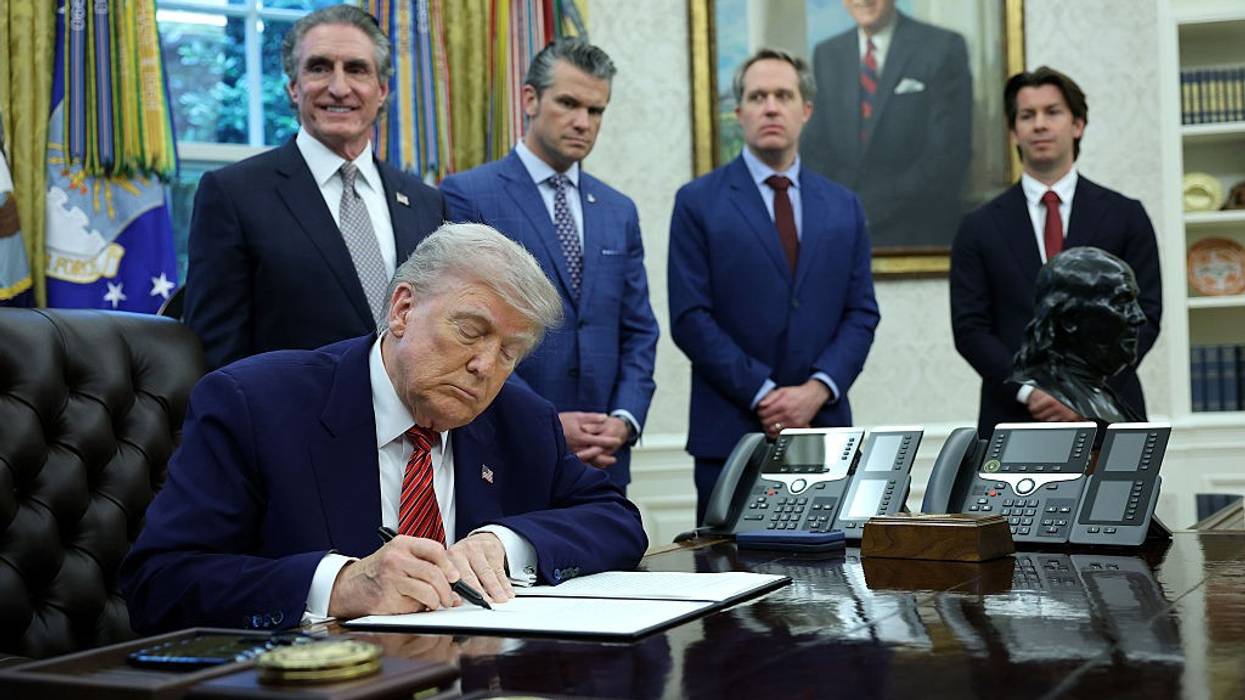
"I think the DOE's attempts to cut corners on safety, security, and environmental protections are posing a grave risk to public health, safety, and our natural environment," said one expert.
Less than a week after NPR revealed that "the Trump administration has overhauled a set of nuclear safety directives and shared them with the companies it is charged with regulating, without making the new rules available to the public," the US Department of Energy announced Monday that it is allowing firms building experimental nuclear reactors to seek exemptions from legally required environmental reviews.
Citing executive orders signed by President Donald Trump in May, a notice published in the Federal Register states that the DOE "is establishing a categorical exclusion for authorization, siting, construction, operation, reauthorization, and decommissioning of advanced nuclear reactors for inclusion in its National Environmental Policy Act (NEPA) implementing procedures."
NEPA has long been a target of energy industries and Republican elected officials, including Trump. The exemption policy has been expected since Trump's May orders—which also launched a DOE pilot program to rapidly build the experimental reactors—and the department said in a statement that even the exempted reactors will face some reviews.
"The US Department of Energy is establishing the potential option to obtain a streamlined approach for advanced nuclear reactors as part of the environmental review performed under NEPA," the DOE said. "The analysis on each reactor being considered will be informed by previously completed environmental reviews for similar advanced nuclear technologies."
"The fact is that any nuclear reactor, no matter how small, no matter how safe it looks on paper, is potentially subject to severe accidents."
However, the DOE announcement alarmed various experts, including Daniel P. Aldrich, director of the Resilience Studies Program at Northeastern University, who wrote on social media: "Making America unsafe again: Trump created an exclusion for new experimental reactors from disclosing how their construction and operation might harm the environment, and from a written, public assessment of the possible consequences of a nuclear accident."
Foreign policy reporter Laura Rozen described the policy as "terrifying," while Paul Dorfman, chair of the Nuclear Consulting Group and a scholar at the University of Sussex's Bennett Institute for Innovation and Policy Acceleration, called it "truly crazy."
As NPR reported Monday:
Until now, the test reactor designs currently under construction have primarily existed on paper, according to Edwin Lyman, director of nuclear power safety at the Union of Concerned Scientists, a nonprofit environmental advocacy group. He believes the lack of real-world experience with the reactors means that they should be subject to more rigorous safety and environmental reviews before they're built.
"The fact is that any nuclear reactor, no matter how small, no matter how safe it looks on paper, is potentially subject to severe accidents," Lyman said.
"I think the DOE's attempts to cut corners on safety, security, and environmental protections are posing a grave risk to public health, safety, and our natural environment here in the United States," he added.
Lyman was also among the experts who criticized changes that NPR exposed last week, after senior editor and correspondent Geoff Brumfiel obtained documents detailing updates to "departmental orders, which dictate requirements for almost every aspect of the reactors' operations—including safety systems, environmental protections, site security, and accident investigations."
While the DOE said that it shared early versions of the rules with companies, "the reduction of unnecessary regulations will increase innovation in the industry without jeopardizing safety," and "the department anticipates publicly posting the directives later this year," Brumfiel noted that the orders he saw weren't labeled as drafts and had the word "approved" on their cover pages.
In a lengthy statement about last week's reporting, Lyman said on the Union of Concerned Scientists website that "this deeply troubling development confirms my worst fears about the dire state of nuclear power safety and security oversight under the Trump administration. Such a brazen rewriting of hundreds of crucial safeguards for the public underscores why preservation of the Nuclear Regulatory Commission (NRC) as an independent, transparent nuclear regulator is so critical."
"The Energy Department has not only taken a sledgehammer to the basic principles that underlie effective nuclear regulation, but it has also done so in the shadows, keeping the public in the dark," he continued. "These long-standing principles were developed over the course of many decades and consider lessons learned from painful events such as the Chernobyl and Fukushima disasters. This is a massive experiment in the deregulation of novel, untested nuclear facilities that could pose grave threats to public health and safety."
"These drastic changes may extend beyond the Reactor Pilot Program, which was created by President Trump last year to circumvent the more rigorous licensing rules employed by the NRC," Lyman warned. "While the DOE created a legally dubious framework to designate these reactors as 'test' reactors to bypass the NRC's statutory authority, these dramatic alterations may further weaken standards used in the broader DOE authorization process and propagate across the entire fleet of commercial nuclear facilities, severely degrading nuclear safety throughout the United States."
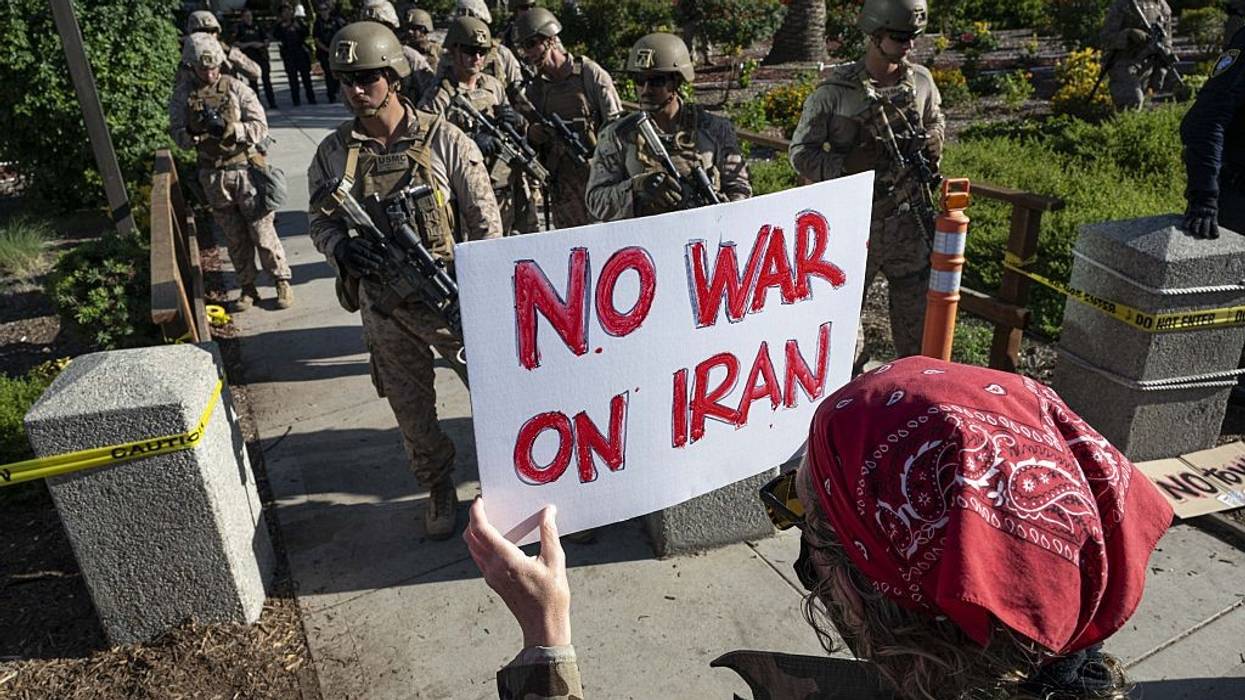
A new US attack on Iran, besides being an act of aggression contrary to the United Nations Charter and international law, would only exacerbate rather than resolve any of the issues that have been raised as possible rationales for war.
Shifting justifications for a war are never a good sign, and they strongly suggest that the war in question was not warranted.
In the Vietnam War, the principal public rationale of saving South Vietnam from communism got replaced in the minds of the war makers—especially after losing hope of winning the contest in Vietnam—by the belief that the United States had to keep fighting to preserve its credibility. In the Iraq War, when President George W. Bush’s prewar argument about weapons of mass destruction fell apart, he shifted to a rationale centered on bringing freedom and democracy to Iraq.
Now, with President Donald Trump threatening a new armed attack on Iran amid a buildup of US forces in the region, the Washington Post’s headline writers aptly describe the rationale for any such attack as being “in flux” and, for the online version of the same article, ask, “What’s the mission?”
A related question about the latest threat to attack Iran is: “Why now?” The initial peg for Trump talking up the subject during the past month was the mass protest in Iran that began in Tehran’s Grand Bazaar in late December and rapidly spread through Iranian cities during the next couple of weeks. Trump urged Iranians to “keep protesting” and promised that “help is on the way.” This rhetoric led to widespread expectations, not least of all inside Iran, that US military action was imminent.
The answer to the question “why now?” is to be found... in domestic politics, including the motivations of diverting attention from political troubles and being able to claim some accomplishment regarding Iran that is bigger or better than what a predecessor achieved.
No such action materialized, and perhaps a valid reason it did not is the difficulty in identifying targets for military attack that would be more likely to help the protesters than to hurt them. If a regime is gunning down innocent citizens in the street, there is no target deck an outside military power can devise that would distinguish the gunners from the innocents on that street.
A brutal crackdown by the Iranian regime that has quelled the protests leaves a couple of implications. One is a sense of betrayal among Iranians whom Trump encouraged to risk their lives by protesting without delivering any help that supposedly was “on the way.”
The other implication is that, without an ongoing protest, the link between any US military action and favorable political change inside Iran is even more tenuous than it would have been a month ago. Iranians—like Americans or any other nationalities—can distinguish between their domestic grievances and external aggression. Another Israeli or US attack out of the blue risks helping the Iranian regime politically by enabling it to appeal to patriotic and nationalist sentiment. Statements from such prominent reformist leaders as former Prime Minister Mir-Hossein Mousavi and former parliament speaker Mehdi Karroubi are simultaneously calling for sweeping constitutional change and explicitly rejecting foreign intervention, including military intervention.
An alternative view is that with the Iranian regime at least as weak as it has been for years, an armed attack from outside might constitute just enough extra pressure to precipitate the regime’s collapse. But the idea that the Islamic Republic is just one nudge away from falling has been voiced many times before, including during previous rounds of protests.
Moreover, the operative word is “collapse,” with all that implies regarding uncertainty about what comes next. Secretary of State Marco Rubio appeared to recognize that uncertainty when asked in a Senate hearing last week about what would happen if the Iranian regime were to fall and he replied, “That’s an open question.” The Iranian opposition lacks a unified leadership and structure ready to take power comparable to the movement led by Ayatollah Ruhollah Khomeini that toppled the shah in 1979.
Regime decapitation to oust current Supreme Leader Ali Khamenei would be even less likely to yield a regime responsive to US wishes than the ouster of President Nicolás Maduro in Venezuela. A more probable successor regime in Iran would be some kind of military dictatorship dominated by the Islamic Revolutionary Guard Corps (IRGC). Regime change in Iran is a classic case of needing to be careful what one wishes for.
Trump has been vague about what Iran would need to accept to avoid being attacked, but there appear to be three issues at play. One is a demand for Iran to end all enrichment of uranium. But Iran is not enriching uranium now and does not appear to have done any enrichment since the Israeli and US attacks last June. If this issue is to make a difference in determining whether the US attacks Iran, it means war or peace would hinge on a demand that makes no practical difference, at least in the short term.
A formal commitment by Iran to forgo enrichment forever conceivably could have value over the long term, but history shows that expecting such a commitment is not realistic. Moreover, to place importance on such a commitment is a tacit admission that Iran is better at adhering to its obligations on such things than the United States is, given Trump’s reneging on an earlier nuclear agreement despite Iran observing its terms.
A second issue involves limiting the range and number of Iran’s ballistic missiles. There is a strong case to be made for a region-wide agreement limiting missiles in the Middle East, but neither the Trump administration nor anyone else has explained why Iran should be singled out for such restrictions while no one else in the region is, or why one should expect Iranian policymakers to accept such disparate treatment. Iran considers its missile capability to be a critical deterrent against the missile and other aerial attack capabilities of adversaries. A deterrent—to be used in response to being attacked—is how Tehran has used its missiles, as in responding to the US killing of prominent IRGC leader Qasem Soleimani in 2020 and to Israel’s unprovoked aerial attack on Iran last June.
The Israeli government would, of course, like to see Iran’s retaliatory capability crippled. This would leave Israel—the Middle Eastern state that has started more wars and attacked more states than any other country in the region—freer to indulge in more offensive operations without having to worry about even the amount of retaliation that Iran mustered last year. Those operations may include attacks that, like the one in June, drag in the United States. This sort of Israeli freedom of action is not in US interests.
The third reported US demand is that Iran cease all support to groups in the region it considers allies, including the Houthis in Yemen, Hezbollah in Lebanon, and Hamas in Palestine. Despite the habitual application of the label “proxy” to such groups, they are separate actors with their own agendas, as illustrated by how the Houthis acted against Iranian advice in capturing the Yemeni capital of Sanaa.
As with uranium enrichment, Iranian support to these groups is a “problem” that is being solved without new Iranian commitments. Iran’s severe economic difficulties, coupled with popular demands within Iran to devote scarce resources to domestic programs rather than foreign endeavors, are already making it difficult for Iran to sustain its support to regional allies.
As with the missile issue, a demand to end such support as part of an agreement disregards how much that support is a response to aggression or predations of other governments. Aid to the Houthis, for example, became of significant interest to Iran only after Saudi Arabia launched a large-scale offensive against Yemen that was the most important factor in turning that country into a humanitarian disaster. The Iranian-supported establishment of Hezbollah and the group’s early rapid growth were a direct response to Israel’s invasion of Lebanon in 1982. The nature and methods of Hamas, like those of many other Palestinian resistance groups, have been responses to Israeli subjugation of Palestinians.
Also like the missile issue, any such demand disregards the outside support that other governments give to parties to some of the same conflicts in the Middle East. This includes, of course, the voluminous US aid to Israel. Iran is being told it cannot have a full regional policy while others do. It is unrealistic to expect any Iranian leader to agree to that.
None of these issues, individually or collectively, constitutes a casus belli. The answer to the question “why now?” is to be found less in those issues than in domestic politics, including the motivations of diverting attention from political troubles and being able to claim some accomplishment regarding Iran that is bigger or better than what a predecessor achieved.
Claimable accomplishments that serve not just such domestic political needs but also the US national interest are possible through diplomacy with Iran. President Trump is correct when he says that Iran wants a deal, given that Iran’s bad economic situation is an incentive to negotiate agreements that would provide at least partial relief from sanctions. Feasible diplomacy would not entail Iranian capitulation to a laundry list of US demands but instead a step-by-step approach that might start with an updated nuclear agreement, which could build confidence on both sides for coming to terms on other issues.
The Trump administration’s saber-rattling is not building such confidence but instead is having the opposite effect. The Iranian regime’s lethal response to the recent popular protests shows that it believes the regime’s survival depends on not showing any weakness in the face of pressures either domestic or foreign. Iranian Foreign Minister Abbas Araghchi said last week that Iran would negotiate directly with the United States only if Trump stops threatening a military attack against Iran. Araghchi also ruled out any unilateral limitations on Iranian missiles, which he described as essential for Iran’s security.
A new US attack on Iran, besides being an act of aggression contrary to the United Nations Charter and international law, would only exacerbate rather than resolve any of the issues that have been raised as possible rationales for war.
A US attack would disadvantage Iranian oppositionists by associating them with an assault against the Iranian nation. It would strengthen the position of those within the regime who argue that Iran should seek a nuclear weapon. It would raise, not lower, the importance Tehran places on its alliances with nonstate groups in the region. And Iran would use its missiles to retaliate in ways that probably would hurt US interests more than its response last June did.