

SUBSCRIBE TO OUR FREE NEWSLETTER
Daily news & progressive opinion—funded by the people, not the corporations—delivered straight to your inbox.
5
#000000
#FFFFFF
To donate by check, phone, or other method, see our More Ways to Give page.
Daily news & progressive opinion—funded by the people, not the corporations—delivered straight to your inbox.
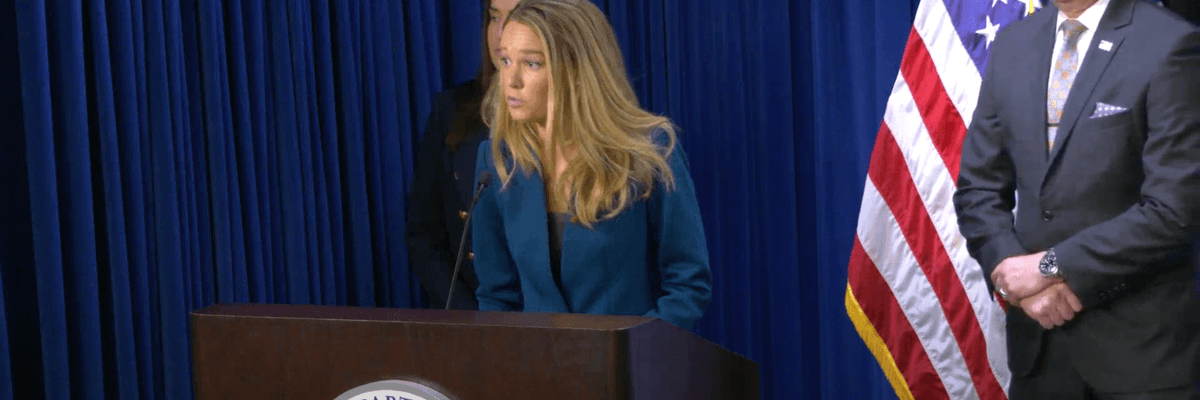
Assistant US Homeland Security Secretary Tricia McLaughlin speaks during a May 21, 2025 press conference at Immigration and Customs Enforcement headquarters in Washington, DC.
"If we don’t explore more why all of these secret lists exist," one US intelligence officer said, there could be "even more of an environment of paranoia on the ground and more tragic killings.”
Despite denials from a senior Trump administration official, secret watchlists of Americans are being used by federal agencies to track and categorize US citizens—especially protesters, activists, and critics of law enforcement—as “domestic terrorists," investigative journalist Ken Klippenstein reported Wednesday.
Klippenstein said that two senior national security officials speaking on condition of anonymity told him that there are over a dozen "secret and obscure" watchlists that the Department of Homeland Security (DHS) and the FBI are using to track anti-Immigration and Customs Enforcement (ICE) and pro-Palestine protesters, antifa-affiliated individuals, and "others who are promiscuously labeled 'domestic terrorists.'"
"I can reveal for the first time," he wrote, "that some of the secret lists and applications go by codenames like Bluekey, Grapevine, Hummingbird, Reaper, Sandcastle, Sienna, Slipstream, and Sparta (including the ominous sounding HEL-A and HEL-C reports generated by Sparta)."
"Some of these, like Hummingbird, were created to vet and track immigrants, in this case Afghans seeking to settle in the United States," Klippenstein explained. "Slipstream is a classified social media repository. Others are tools used to link people on the streets together, including collecting on friends and families who have nothing to do with any purported lawbreaking."
"There’s practically nothing available that further describes what these watchlists do, how large they are, or what they entail," he added.
Klippenstein's revelation seemingly flies in the face of DHS Assistant Secretary for Public Affairs Tricia McLaughlin's recent denial that the administration has a database containing the names of people accused of domestic terrorism.
"There's just one problem: She's lying," wrote Klippenstein.
🚨 I've obtained a list of secret watchlists the Department of Homeland Security uses to keep tabs on American citizenswww.kenklippenstein.com/p/ices-secre...
[image or embed]
— Ken Klippenstein (@kenklippenstein.bsky.social) January 28, 2026 at 1:07 PM
Many observers already thought as much, especially after a masked federal enforcer taunted an anti-ICE protester in Maine by telling her that "we have a nice little database, and now you’re considered a domestic terrorist."
White House "border czar" Tom Homan—who was recently sent to Minnesota to oversee the anti-immigrant blitz following the departure of Border Patrol commander Greg Bovino amid outrage over the killings of Renee Good and Alex Pretti—also said this month that "we’re going to create a database where those people that are arrested for interference, impeding, and assault, we’re going to make them famous."
Reporting Tuesday that Pretti—the nurse who was disarmed and then shot dead by federal enforcers in Minneapolis last week—was known to Trump officials after a previous encounter in which agents broke his rib raised further questions about government watchlists.
"We came out of 9/11 with the notion that we would have a single ‘terrorist’ watch list to eliminate confusion, duplication, and avoid bad communications, but ever since January 6, not only have we expanded exponentially into purely domestic watchlisting, but we have also created a highly secretive and compartmented superstructure that few even understand," a DHS attorney "intimately familiar" with the matter told Klippenstein on condition of anonymity, referring to the deadly January 2021 Capitol insurrection.
According to Klippenstein:
Prior to 9/11, there were nine federal agencies that maintained 12 separate watchlists. Now, officially there are just three: a watch list of 1.1 million international terrorists, a watch list of more than 10,000 domestic terrorists maintained by the FBI, and a new watch list of transnational criminals, built up to more than 85,000 over the past decade...
Among other functions, the new watchlists process tips, situation reports, and collected photographs and video submitted by both the public and from agents in the field; they create a “common operating picture” in places like Minneapolis; they allow task forces to target individuals for surveillance and arrest; and they create the capacity for intelligence people to link individuals together through geographic proximity or what is labeled “call chaining” by processing telephone numbers, emails, and other contact information.
Asked about how the Trump administration might try to legally justify these watchlists, Rachel Levinson-Waldman, the Brennan Center for Justice's Liberty and National Security Program director, cited President Donald Trump's National Security Presidential Memo 7 (NSPM-7), which mandates a “national strategy to investigate and disrupt networks, entities, and organizations that foment political violence so that law enforcement can intervene in criminal conspiracies before they result in violent political acts."
Levinson-Waldman also noted Attorney General Pam Bondi's December 5 memo directing federal agencies to expand the investigation and prosecution of "domestic terrorism," including groups "aligned" with antifa, an anti-fascist ideology that does not exist as an organization.
One senior intelligence official who confirmed the existence of the watchlists warned Klippenstein: "Lists of this and that—this social media post, that video taken of someone videoing ICE, the mere attendance at a protest—gets pulsed by federal cops on the beat to check for criminality but eventually just becomes a list itself of criminality, with the cops thinking that indeed they are dealing with criminals and terrorists. Watchlists, and the whole watchlisting process, should be as transparent as possible, not the other way around."
"If we don’t explore more why all of these secret lists exist," the official added, there could be "even more of an environment of paranoia on the ground and more tragic killings.”
Dear Common Dreams reader, It’s been nearly 30 years since I co-founded Common Dreams with my late wife, Lina Newhouser. We had the radical notion that journalism should serve the public good, not corporate profits. It was clear to us from the outset what it would take to build such a project. No paid advertisements. No corporate sponsors. No millionaire publisher telling us what to think or do. Many people said we wouldn't last a year, but we proved those doubters wrong. Together with a tremendous team of journalists and dedicated staff, we built an independent media outlet free from the constraints of profits and corporate control. Our mission has always been simple: To inform. To inspire. To ignite change for the common good. Building Common Dreams was not easy. Our survival was never guaranteed. When you take on the most powerful forces—Wall Street greed, fossil fuel industry destruction, Big Tech lobbyists, and uber-rich oligarchs who have spent billions upon billions rigging the economy and democracy in their favor—the only bulwark you have is supporters who believe in your work. But here’s the urgent message from me today. It's never been this bad out there. And it's never been this hard to keep us going. At the very moment Common Dreams is most needed, the threats we face are intensifying. We need your support now more than ever. We don't accept corporate advertising and never will. We don't have a paywall because we don't think people should be blocked from critical news based on their ability to pay. Everything we do is funded by the donations of readers like you. When everyone does the little they can afford, we are strong. But if that support retreats or dries up, so do we. Will you donate now to make sure Common Dreams not only survives but thrives? —Craig Brown, Co-founder |
Despite denials from a senior Trump administration official, secret watchlists of Americans are being used by federal agencies to track and categorize US citizens—especially protesters, activists, and critics of law enforcement—as “domestic terrorists," investigative journalist Ken Klippenstein reported Wednesday.
Klippenstein said that two senior national security officials speaking on condition of anonymity told him that there are over a dozen "secret and obscure" watchlists that the Department of Homeland Security (DHS) and the FBI are using to track anti-Immigration and Customs Enforcement (ICE) and pro-Palestine protesters, antifa-affiliated individuals, and "others who are promiscuously labeled 'domestic terrorists.'"
"I can reveal for the first time," he wrote, "that some of the secret lists and applications go by codenames like Bluekey, Grapevine, Hummingbird, Reaper, Sandcastle, Sienna, Slipstream, and Sparta (including the ominous sounding HEL-A and HEL-C reports generated by Sparta)."
"Some of these, like Hummingbird, were created to vet and track immigrants, in this case Afghans seeking to settle in the United States," Klippenstein explained. "Slipstream is a classified social media repository. Others are tools used to link people on the streets together, including collecting on friends and families who have nothing to do with any purported lawbreaking."
"There’s practically nothing available that further describes what these watchlists do, how large they are, or what they entail," he added.
Klippenstein's revelation seemingly flies in the face of DHS Assistant Secretary for Public Affairs Tricia McLaughlin's recent denial that the administration has a database containing the names of people accused of domestic terrorism.
"There's just one problem: She's lying," wrote Klippenstein.
🚨 I've obtained a list of secret watchlists the Department of Homeland Security uses to keep tabs on American citizenswww.kenklippenstein.com/p/ices-secre...
[image or embed]
— Ken Klippenstein (@kenklippenstein.bsky.social) January 28, 2026 at 1:07 PM
Many observers already thought as much, especially after a masked federal enforcer taunted an anti-ICE protester in Maine by telling her that "we have a nice little database, and now you’re considered a domestic terrorist."
White House "border czar" Tom Homan—who was recently sent to Minnesota to oversee the anti-immigrant blitz following the departure of Border Patrol commander Greg Bovino amid outrage over the killings of Renee Good and Alex Pretti—also said this month that "we’re going to create a database where those people that are arrested for interference, impeding, and assault, we’re going to make them famous."
Reporting Tuesday that Pretti—the nurse who was disarmed and then shot dead by federal enforcers in Minneapolis last week—was known to Trump officials after a previous encounter in which agents broke his rib raised further questions about government watchlists.
"We came out of 9/11 with the notion that we would have a single ‘terrorist’ watch list to eliminate confusion, duplication, and avoid bad communications, but ever since January 6, not only have we expanded exponentially into purely domestic watchlisting, but we have also created a highly secretive and compartmented superstructure that few even understand," a DHS attorney "intimately familiar" with the matter told Klippenstein on condition of anonymity, referring to the deadly January 2021 Capitol insurrection.
According to Klippenstein:
Prior to 9/11, there were nine federal agencies that maintained 12 separate watchlists. Now, officially there are just three: a watch list of 1.1 million international terrorists, a watch list of more than 10,000 domestic terrorists maintained by the FBI, and a new watch list of transnational criminals, built up to more than 85,000 over the past decade...
Among other functions, the new watchlists process tips, situation reports, and collected photographs and video submitted by both the public and from agents in the field; they create a “common operating picture” in places like Minneapolis; they allow task forces to target individuals for surveillance and arrest; and they create the capacity for intelligence people to link individuals together through geographic proximity or what is labeled “call chaining” by processing telephone numbers, emails, and other contact information.
Asked about how the Trump administration might try to legally justify these watchlists, Rachel Levinson-Waldman, the Brennan Center for Justice's Liberty and National Security Program director, cited President Donald Trump's National Security Presidential Memo 7 (NSPM-7), which mandates a “national strategy to investigate and disrupt networks, entities, and organizations that foment political violence so that law enforcement can intervene in criminal conspiracies before they result in violent political acts."
Levinson-Waldman also noted Attorney General Pam Bondi's December 5 memo directing federal agencies to expand the investigation and prosecution of "domestic terrorism," including groups "aligned" with antifa, an anti-fascist ideology that does not exist as an organization.
One senior intelligence official who confirmed the existence of the watchlists warned Klippenstein: "Lists of this and that—this social media post, that video taken of someone videoing ICE, the mere attendance at a protest—gets pulsed by federal cops on the beat to check for criminality but eventually just becomes a list itself of criminality, with the cops thinking that indeed they are dealing with criminals and terrorists. Watchlists, and the whole watchlisting process, should be as transparent as possible, not the other way around."
"If we don’t explore more why all of these secret lists exist," the official added, there could be "even more of an environment of paranoia on the ground and more tragic killings.”
Despite denials from a senior Trump administration official, secret watchlists of Americans are being used by federal agencies to track and categorize US citizens—especially protesters, activists, and critics of law enforcement—as “domestic terrorists," investigative journalist Ken Klippenstein reported Wednesday.
Klippenstein said that two senior national security officials speaking on condition of anonymity told him that there are over a dozen "secret and obscure" watchlists that the Department of Homeland Security (DHS) and the FBI are using to track anti-Immigration and Customs Enforcement (ICE) and pro-Palestine protesters, antifa-affiliated individuals, and "others who are promiscuously labeled 'domestic terrorists.'"
"I can reveal for the first time," he wrote, "that some of the secret lists and applications go by codenames like Bluekey, Grapevine, Hummingbird, Reaper, Sandcastle, Sienna, Slipstream, and Sparta (including the ominous sounding HEL-A and HEL-C reports generated by Sparta)."
"Some of these, like Hummingbird, were created to vet and track immigrants, in this case Afghans seeking to settle in the United States," Klippenstein explained. "Slipstream is a classified social media repository. Others are tools used to link people on the streets together, including collecting on friends and families who have nothing to do with any purported lawbreaking."
"There’s practically nothing available that further describes what these watchlists do, how large they are, or what they entail," he added.
Klippenstein's revelation seemingly flies in the face of DHS Assistant Secretary for Public Affairs Tricia McLaughlin's recent denial that the administration has a database containing the names of people accused of domestic terrorism.
"There's just one problem: She's lying," wrote Klippenstein.
🚨 I've obtained a list of secret watchlists the Department of Homeland Security uses to keep tabs on American citizenswww.kenklippenstein.com/p/ices-secre...
[image or embed]
— Ken Klippenstein (@kenklippenstein.bsky.social) January 28, 2026 at 1:07 PM
Many observers already thought as much, especially after a masked federal enforcer taunted an anti-ICE protester in Maine by telling her that "we have a nice little database, and now you’re considered a domestic terrorist."
White House "border czar" Tom Homan—who was recently sent to Minnesota to oversee the anti-immigrant blitz following the departure of Border Patrol commander Greg Bovino amid outrage over the killings of Renee Good and Alex Pretti—also said this month that "we’re going to create a database where those people that are arrested for interference, impeding, and assault, we’re going to make them famous."
Reporting Tuesday that Pretti—the nurse who was disarmed and then shot dead by federal enforcers in Minneapolis last week—was known to Trump officials after a previous encounter in which agents broke his rib raised further questions about government watchlists.
"We came out of 9/11 with the notion that we would have a single ‘terrorist’ watch list to eliminate confusion, duplication, and avoid bad communications, but ever since January 6, not only have we expanded exponentially into purely domestic watchlisting, but we have also created a highly secretive and compartmented superstructure that few even understand," a DHS attorney "intimately familiar" with the matter told Klippenstein on condition of anonymity, referring to the deadly January 2021 Capitol insurrection.
According to Klippenstein:
Prior to 9/11, there were nine federal agencies that maintained 12 separate watchlists. Now, officially there are just three: a watch list of 1.1 million international terrorists, a watch list of more than 10,000 domestic terrorists maintained by the FBI, and a new watch list of transnational criminals, built up to more than 85,000 over the past decade...
Among other functions, the new watchlists process tips, situation reports, and collected photographs and video submitted by both the public and from agents in the field; they create a “common operating picture” in places like Minneapolis; they allow task forces to target individuals for surveillance and arrest; and they create the capacity for intelligence people to link individuals together through geographic proximity or what is labeled “call chaining” by processing telephone numbers, emails, and other contact information.
Asked about how the Trump administration might try to legally justify these watchlists, Rachel Levinson-Waldman, the Brennan Center for Justice's Liberty and National Security Program director, cited President Donald Trump's National Security Presidential Memo 7 (NSPM-7), which mandates a “national strategy to investigate and disrupt networks, entities, and organizations that foment political violence so that law enforcement can intervene in criminal conspiracies before they result in violent political acts."
Levinson-Waldman also noted Attorney General Pam Bondi's December 5 memo directing federal agencies to expand the investigation and prosecution of "domestic terrorism," including groups "aligned" with antifa, an anti-fascist ideology that does not exist as an organization.
One senior intelligence official who confirmed the existence of the watchlists warned Klippenstein: "Lists of this and that—this social media post, that video taken of someone videoing ICE, the mere attendance at a protest—gets pulsed by federal cops on the beat to check for criminality but eventually just becomes a list itself of criminality, with the cops thinking that indeed they are dealing with criminals and terrorists. Watchlists, and the whole watchlisting process, should be as transparent as possible, not the other way around."
"If we don’t explore more why all of these secret lists exist," the official added, there could be "even more of an environment of paranoia on the ground and more tragic killings.”

