SUBSCRIBE TO OUR FREE NEWSLETTER
Daily news & progressive opinion—funded by the people, not the corporations—delivered straight to your inbox.
5
#000000
#FFFFFF
To donate by check, phone, or other method, see our More Ways to Give page.
Daily news & progressive opinion—funded by the people, not the corporations—delivered straight to your inbox.
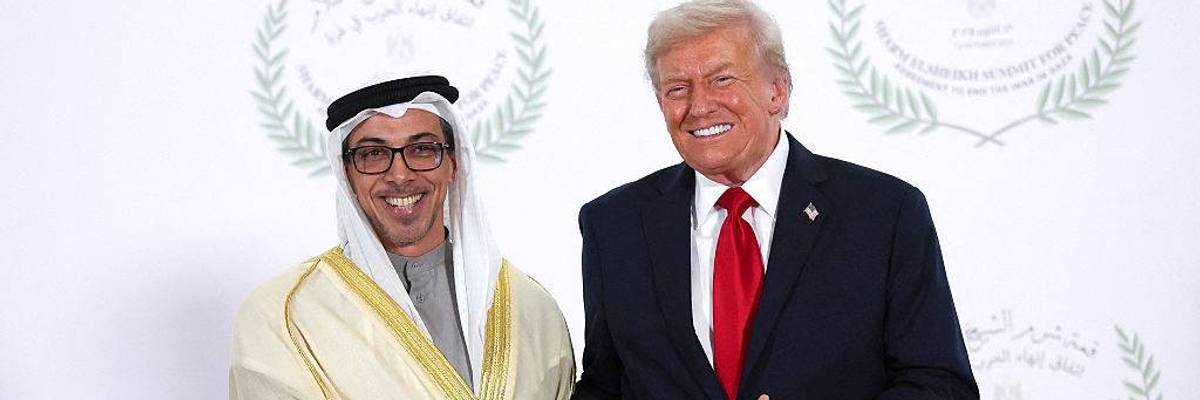
President Donald Trump and Sheikh Mansour bin Zayed Al Nahyan, UAE Vice President and Deputy Prime Minister, shake hands on October 13, 2025 in Sharm El-Sheikh, Egypt.
"This was a bribe," said one critic.
A bombshell Saturday report from the Wall Street Journal revealed that a member of the Abu Dhabi royal family secretly backed a massive $500 million investment into the Trump family's cryptocurrency venture months before the Trump administration gave the United Arab Emirates access to highly sensitive artificial intelligence chip technology.
According to the Journal's sources, lieutenants of Abu Dhabi royal Sheikh Tahnoon bin Zayed Al Nahyan signed a deal in early 2025 to buy a 49% stake in World Liberty Financial, the startup founded by members of the Trump family and the family of Trump Middle East envoy Steve Witkoff.
Documents reviewed by the Journal showed that the buyers in the deal agreed to "pay half up front, steering $187 million to Trump family entities," while "at least $31 million was also slated to flow to entities affiliated with" the Witkoff family.
Weeks after green lighting the investment into the Trump crypto venture, Tahnoon met directly with President Donald Trump and Witkoff in the White House, where he reportedly expressed interest in working with the US on AI-related technology.
Two months after this, the Journal noted, "the administration committed to give the tiny Gulf monarchy access to around 500,000 of the most advanced AI chips a year—enough to build one of the world’s biggest AI data center clusters."
Tahnoon in the past had tried to get US officials to give the UAE access to the chips, but was rebuffed on concerns that the cutting-edge technology could be passed along to top US geopolitical rival China, wrote the Journal.
Many observers expressed shock at the Journal's report, with some critics saying that it showed Trump and his associates were engaging in a criminal bribery scheme.
"This was a bribe," wrote Melanie D’Arrigo, executive director of the Campaign for New York Health, in a social media post. "UAE royals gave the Trump family $500 million, and Trump, in his presidential capacity, gave them access to tightly guarded American AI chips. The most powerful person on the planet, also happens to be the most shamelessly corrupt."
Jesse Eisinger, reporter and editor at ProPublica, argued that the Abu Dhabi investment into the Trump cypto firm "should rank among the greatest US scandals ever."
Democratic strategist David Axelrod also said that the scope of the Trump crypto investment scandal was historic in nature.
"In any other time or presidency, this story... would be an earthquake of a scandal," he wrote. "The size, scope and implications of it are unprecedented and mind-boggling."
Tommy Vietor, co-host of "Pod Save America," struggled to wrap his head around the scale of corruption on display.
"How do you add up the cost of corruption this massive?" he wondered. "It's not just that Trump is selling advanced AI tech to the highest bidder, national security be damned. Its that he's tapped that doofus Steve Witkoff as an international emissary so his son Zach Witkoff can mop up bribes."
Former Rep. Tom Malinkowski (D-NJ) warned the Trump and his associates that they could wind up paying a severe price for their deal with the UAE.
"If a future administration finds that such payments to the Trump family were acts of corruption," he wrote, "these people could be sanctioned under the Global Magnitsky Act, and the assets in the US could potentially be frozen."
Dear Common Dreams reader, It’s been nearly 30 years since I co-founded Common Dreams with my late wife, Lina Newhouser. We had the radical notion that journalism should serve the public good, not corporate profits. It was clear to us from the outset what it would take to build such a project. No paid advertisements. No corporate sponsors. No millionaire publisher telling us what to think or do. Many people said we wouldn't last a year, but we proved those doubters wrong. Together with a tremendous team of journalists and dedicated staff, we built an independent media outlet free from the constraints of profits and corporate control. Our mission has always been simple: To inform. To inspire. To ignite change for the common good. Building Common Dreams was not easy. Our survival was never guaranteed. When you take on the most powerful forces—Wall Street greed, fossil fuel industry destruction, Big Tech lobbyists, and uber-rich oligarchs who have spent billions upon billions rigging the economy and democracy in their favor—the only bulwark you have is supporters who believe in your work. But here’s the urgent message from me today. It's never been this bad out there. And it's never been this hard to keep us going. At the very moment Common Dreams is most needed, the threats we face are intensifying. We need your support now more than ever. We don't accept corporate advertising and never will. We don't have a paywall because we don't think people should be blocked from critical news based on their ability to pay. Everything we do is funded by the donations of readers like you. When everyone does the little they can afford, we are strong. But if that support retreats or dries up, so do we. Will you donate now to make sure Common Dreams not only survives but thrives? —Craig Brown, Co-founder |
A bombshell Saturday report from the Wall Street Journal revealed that a member of the Abu Dhabi royal family secretly backed a massive $500 million investment into the Trump family's cryptocurrency venture months before the Trump administration gave the United Arab Emirates access to highly sensitive artificial intelligence chip technology.
According to the Journal's sources, lieutenants of Abu Dhabi royal Sheikh Tahnoon bin Zayed Al Nahyan signed a deal in early 2025 to buy a 49% stake in World Liberty Financial, the startup founded by members of the Trump family and the family of Trump Middle East envoy Steve Witkoff.
Documents reviewed by the Journal showed that the buyers in the deal agreed to "pay half up front, steering $187 million to Trump family entities," while "at least $31 million was also slated to flow to entities affiliated with" the Witkoff family.
Weeks after green lighting the investment into the Trump crypto venture, Tahnoon met directly with President Donald Trump and Witkoff in the White House, where he reportedly expressed interest in working with the US on AI-related technology.
Two months after this, the Journal noted, "the administration committed to give the tiny Gulf monarchy access to around 500,000 of the most advanced AI chips a year—enough to build one of the world’s biggest AI data center clusters."
Tahnoon in the past had tried to get US officials to give the UAE access to the chips, but was rebuffed on concerns that the cutting-edge technology could be passed along to top US geopolitical rival China, wrote the Journal.
Many observers expressed shock at the Journal's report, with some critics saying that it showed Trump and his associates were engaging in a criminal bribery scheme.
"This was a bribe," wrote Melanie D’Arrigo, executive director of the Campaign for New York Health, in a social media post. "UAE royals gave the Trump family $500 million, and Trump, in his presidential capacity, gave them access to tightly guarded American AI chips. The most powerful person on the planet, also happens to be the most shamelessly corrupt."
Jesse Eisinger, reporter and editor at ProPublica, argued that the Abu Dhabi investment into the Trump cypto firm "should rank among the greatest US scandals ever."
Democratic strategist David Axelrod also said that the scope of the Trump crypto investment scandal was historic in nature.
"In any other time or presidency, this story... would be an earthquake of a scandal," he wrote. "The size, scope and implications of it are unprecedented and mind-boggling."
Tommy Vietor, co-host of "Pod Save America," struggled to wrap his head around the scale of corruption on display.
"How do you add up the cost of corruption this massive?" he wondered. "It's not just that Trump is selling advanced AI tech to the highest bidder, national security be damned. Its that he's tapped that doofus Steve Witkoff as an international emissary so his son Zach Witkoff can mop up bribes."
Former Rep. Tom Malinkowski (D-NJ) warned the Trump and his associates that they could wind up paying a severe price for their deal with the UAE.
"If a future administration finds that such payments to the Trump family were acts of corruption," he wrote, "these people could be sanctioned under the Global Magnitsky Act, and the assets in the US could potentially be frozen."
A bombshell Saturday report from the Wall Street Journal revealed that a member of the Abu Dhabi royal family secretly backed a massive $500 million investment into the Trump family's cryptocurrency venture months before the Trump administration gave the United Arab Emirates access to highly sensitive artificial intelligence chip technology.
According to the Journal's sources, lieutenants of Abu Dhabi royal Sheikh Tahnoon bin Zayed Al Nahyan signed a deal in early 2025 to buy a 49% stake in World Liberty Financial, the startup founded by members of the Trump family and the family of Trump Middle East envoy Steve Witkoff.
Documents reviewed by the Journal showed that the buyers in the deal agreed to "pay half up front, steering $187 million to Trump family entities," while "at least $31 million was also slated to flow to entities affiliated with" the Witkoff family.
Weeks after green lighting the investment into the Trump crypto venture, Tahnoon met directly with President Donald Trump and Witkoff in the White House, where he reportedly expressed interest in working with the US on AI-related technology.
Two months after this, the Journal noted, "the administration committed to give the tiny Gulf monarchy access to around 500,000 of the most advanced AI chips a year—enough to build one of the world’s biggest AI data center clusters."
Tahnoon in the past had tried to get US officials to give the UAE access to the chips, but was rebuffed on concerns that the cutting-edge technology could be passed along to top US geopolitical rival China, wrote the Journal.
Many observers expressed shock at the Journal's report, with some critics saying that it showed Trump and his associates were engaging in a criminal bribery scheme.
"This was a bribe," wrote Melanie D’Arrigo, executive director of the Campaign for New York Health, in a social media post. "UAE royals gave the Trump family $500 million, and Trump, in his presidential capacity, gave them access to tightly guarded American AI chips. The most powerful person on the planet, also happens to be the most shamelessly corrupt."
Jesse Eisinger, reporter and editor at ProPublica, argued that the Abu Dhabi investment into the Trump cypto firm "should rank among the greatest US scandals ever."
Democratic strategist David Axelrod also said that the scope of the Trump crypto investment scandal was historic in nature.
"In any other time or presidency, this story... would be an earthquake of a scandal," he wrote. "The size, scope and implications of it are unprecedented and mind-boggling."
Tommy Vietor, co-host of "Pod Save America," struggled to wrap his head around the scale of corruption on display.
"How do you add up the cost of corruption this massive?" he wondered. "It's not just that Trump is selling advanced AI tech to the highest bidder, national security be damned. Its that he's tapped that doofus Steve Witkoff as an international emissary so his son Zach Witkoff can mop up bribes."
Former Rep. Tom Malinkowski (D-NJ) warned the Trump and his associates that they could wind up paying a severe price for their deal with the UAE.
"If a future administration finds that such payments to the Trump family were acts of corruption," he wrote, "these people could be sanctioned under the Global Magnitsky Act, and the assets in the US could potentially be frozen."