SUBSCRIBE TO OUR FREE NEWSLETTER
Daily news & progressive opinion—funded by the people, not the corporations—delivered straight to your inbox.
5
#000000
#FFFFFF
To donate by check, phone, or other method, see our More Ways to Give page.
Daily news & progressive opinion—funded by the people, not the corporations—delivered straight to your inbox.
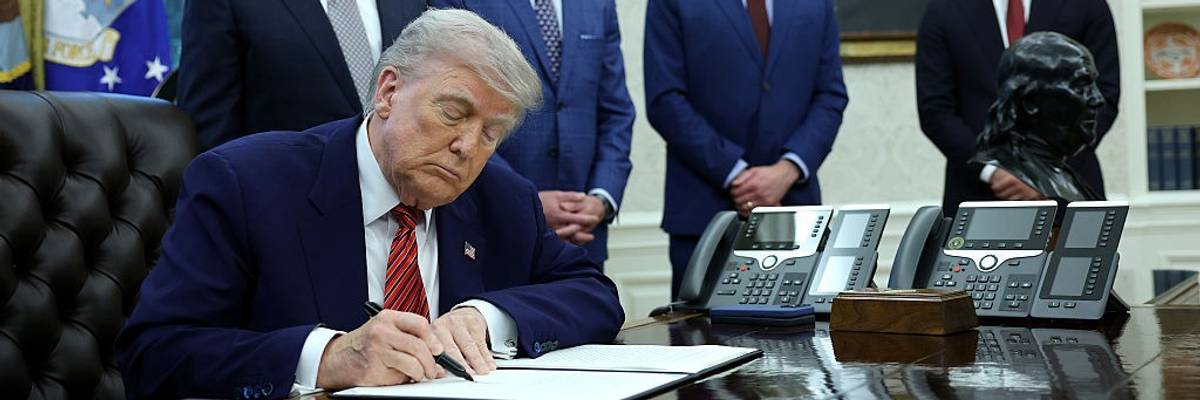
U.S. President Donald Trump signs an executive order related to nuclear power in the Oval Office of the White House in Washington, DC on May 23, 2025.
"I think the DOE's attempts to cut corners on safety, security, and environmental protections are posing a grave risk to public health, safety, and our natural environment," said one expert.
Less than a week after NPR revealed that "the Trump administration has overhauled a set of nuclear safety directives and shared them with the companies it is charged with regulating, without making the new rules available to the public," the US Department of Energy announced Monday that it is allowing firms building experimental nuclear reactors to seek exemptions from legally required environmental reviews.
Citing executive orders signed by President Donald Trump in May, a notice published in the Federal Register states that the DOE "is establishing a categorical exclusion for authorization, siting, construction, operation, reauthorization, and decommissioning of advanced nuclear reactors for inclusion in its National Environmental Policy Act (NEPA) implementing procedures."
NEPA has long been a target of energy industries and Republican elected officials, including Trump. The exemption policy has been expected since Trump's May orders—which also launched a DOE pilot program to rapidly build the experimental reactors—and the department said in a statement that even the exempted reactors will face some reviews.
"The US Department of Energy is establishing the potential option to obtain a streamlined approach for advanced nuclear reactors as part of the environmental review performed under NEPA," the DOE said. "The analysis on each reactor being considered will be informed by previously completed environmental reviews for similar advanced nuclear technologies."
"The fact is that any nuclear reactor, no matter how small, no matter how safe it looks on paper, is potentially subject to severe accidents."
However, the DOE announcement alarmed various experts, including Daniel P. Aldrich, director of the Resilience Studies Program at Northeastern University, who wrote on social media: "Making America unsafe again: Trump created an exclusion for new experimental reactors from disclosing how their construction and operation might harm the environment, and from a written, public assessment of the possible consequences of a nuclear accident."
Foreign policy reporter Laura Rozen described the policy as "terrifying," while Paul Dorfman, chair of the Nuclear Consulting Group and a scholar at the University of Sussex's Bennett Institute for Innovation and Policy Acceleration, called it "truly crazy."
As NPR reported Monday:
Until now, the test reactor designs currently under construction have primarily existed on paper, according to Edwin Lyman, director of nuclear power safety at the Union of Concerned Scientists, a nonprofit environmental advocacy group. He believes the lack of real-world experience with the reactors means that they should be subject to more rigorous safety and environmental reviews before they're built.
"The fact is that any nuclear reactor, no matter how small, no matter how safe it looks on paper, is potentially subject to severe accidents," Lyman said.
"I think the DOE's attempts to cut corners on safety, security, and environmental protections are posing a grave risk to public health, safety, and our natural environment here in the United States," he added.
Lyman was also among the experts who criticized changes that NPR exposed last week, after senior editor and correspondent Geoff Brumfiel obtained documents detailing updates to "departmental orders, which dictate requirements for almost every aspect of the reactors' operations—including safety systems, environmental protections, site security, and accident investigations."
While the DOE said that it shared early versions of the rules with companies, "the reduction of unnecessary regulations will increase innovation in the industry without jeopardizing safety," and "the department anticipates publicly posting the directives later this year," Brumfiel noted that the orders he saw weren't labeled as drafts and had the word "approved" on their cover pages.
In a lengthy statement about last week's reporting, Lyman said on the Union of Concerned Scientists website that "this deeply troubling development confirms my worst fears about the dire state of nuclear power safety and security oversight under the Trump administration. Such a brazen rewriting of hundreds of crucial safeguards for the public underscores why preservation of the Nuclear Regulatory Commission (NRC) as an independent, transparent nuclear regulator is so critical."
"The Energy Department has not only taken a sledgehammer to the basic principles that underlie effective nuclear regulation, but it has also done so in the shadows, keeping the public in the dark," he continued. "These long-standing principles were developed over the course of many decades and consider lessons learned from painful events such as the Chernobyl and Fukushima disasters. This is a massive experiment in the deregulation of novel, untested nuclear facilities that could pose grave threats to public health and safety."
"These drastic changes may extend beyond the Reactor Pilot Program, which was created by President Trump last year to circumvent the more rigorous licensing rules employed by the NRC," Lyman warned. "While the DOE created a legally dubious framework to designate these reactors as 'test' reactors to bypass the NRC's statutory authority, these dramatic alterations may further weaken standards used in the broader DOE authorization process and propagate across the entire fleet of commercial nuclear facilities, severely degrading nuclear safety throughout the United States."
Dear Common Dreams reader, It’s been nearly 30 years since I co-founded Common Dreams with my late wife, Lina Newhouser. We had the radical notion that journalism should serve the public good, not corporate profits. It was clear to us from the outset what it would take to build such a project. No paid advertisements. No corporate sponsors. No millionaire publisher telling us what to think or do. Many people said we wouldn't last a year, but we proved those doubters wrong. Together with a tremendous team of journalists and dedicated staff, we built an independent media outlet free from the constraints of profits and corporate control. Our mission has always been simple: To inform. To inspire. To ignite change for the common good. Building Common Dreams was not easy. Our survival was never guaranteed. When you take on the most powerful forces—Wall Street greed, fossil fuel industry destruction, Big Tech lobbyists, and uber-rich oligarchs who have spent billions upon billions rigging the economy and democracy in their favor—the only bulwark you have is supporters who believe in your work. But here’s the urgent message from me today. It's never been this bad out there. And it's never been this hard to keep us going. At the very moment Common Dreams is most needed, the threats we face are intensifying. We need your support now more than ever. We don't accept corporate advertising and never will. We don't have a paywall because we don't think people should be blocked from critical news based on their ability to pay. Everything we do is funded by the donations of readers like you. When everyone does the little they can afford, we are strong. But if that support retreats or dries up, so do we. Will you donate now to make sure Common Dreams not only survives but thrives? —Craig Brown, Co-founder |
Less than a week after NPR revealed that "the Trump administration has overhauled a set of nuclear safety directives and shared them with the companies it is charged with regulating, without making the new rules available to the public," the US Department of Energy announced Monday that it is allowing firms building experimental nuclear reactors to seek exemptions from legally required environmental reviews.
Citing executive orders signed by President Donald Trump in May, a notice published in the Federal Register states that the DOE "is establishing a categorical exclusion for authorization, siting, construction, operation, reauthorization, and decommissioning of advanced nuclear reactors for inclusion in its National Environmental Policy Act (NEPA) implementing procedures."
NEPA has long been a target of energy industries and Republican elected officials, including Trump. The exemption policy has been expected since Trump's May orders—which also launched a DOE pilot program to rapidly build the experimental reactors—and the department said in a statement that even the exempted reactors will face some reviews.
"The US Department of Energy is establishing the potential option to obtain a streamlined approach for advanced nuclear reactors as part of the environmental review performed under NEPA," the DOE said. "The analysis on each reactor being considered will be informed by previously completed environmental reviews for similar advanced nuclear technologies."
"The fact is that any nuclear reactor, no matter how small, no matter how safe it looks on paper, is potentially subject to severe accidents."
However, the DOE announcement alarmed various experts, including Daniel P. Aldrich, director of the Resilience Studies Program at Northeastern University, who wrote on social media: "Making America unsafe again: Trump created an exclusion for new experimental reactors from disclosing how their construction and operation might harm the environment, and from a written, public assessment of the possible consequences of a nuclear accident."
Foreign policy reporter Laura Rozen described the policy as "terrifying," while Paul Dorfman, chair of the Nuclear Consulting Group and a scholar at the University of Sussex's Bennett Institute for Innovation and Policy Acceleration, called it "truly crazy."
As NPR reported Monday:
Until now, the test reactor designs currently under construction have primarily existed on paper, according to Edwin Lyman, director of nuclear power safety at the Union of Concerned Scientists, a nonprofit environmental advocacy group. He believes the lack of real-world experience with the reactors means that they should be subject to more rigorous safety and environmental reviews before they're built.
"The fact is that any nuclear reactor, no matter how small, no matter how safe it looks on paper, is potentially subject to severe accidents," Lyman said.
"I think the DOE's attempts to cut corners on safety, security, and environmental protections are posing a grave risk to public health, safety, and our natural environment here in the United States," he added.
Lyman was also among the experts who criticized changes that NPR exposed last week, after senior editor and correspondent Geoff Brumfiel obtained documents detailing updates to "departmental orders, which dictate requirements for almost every aspect of the reactors' operations—including safety systems, environmental protections, site security, and accident investigations."
While the DOE said that it shared early versions of the rules with companies, "the reduction of unnecessary regulations will increase innovation in the industry without jeopardizing safety," and "the department anticipates publicly posting the directives later this year," Brumfiel noted that the orders he saw weren't labeled as drafts and had the word "approved" on their cover pages.
In a lengthy statement about last week's reporting, Lyman said on the Union of Concerned Scientists website that "this deeply troubling development confirms my worst fears about the dire state of nuclear power safety and security oversight under the Trump administration. Such a brazen rewriting of hundreds of crucial safeguards for the public underscores why preservation of the Nuclear Regulatory Commission (NRC) as an independent, transparent nuclear regulator is so critical."
"The Energy Department has not only taken a sledgehammer to the basic principles that underlie effective nuclear regulation, but it has also done so in the shadows, keeping the public in the dark," he continued. "These long-standing principles were developed over the course of many decades and consider lessons learned from painful events such as the Chernobyl and Fukushima disasters. This is a massive experiment in the deregulation of novel, untested nuclear facilities that could pose grave threats to public health and safety."
"These drastic changes may extend beyond the Reactor Pilot Program, which was created by President Trump last year to circumvent the more rigorous licensing rules employed by the NRC," Lyman warned. "While the DOE created a legally dubious framework to designate these reactors as 'test' reactors to bypass the NRC's statutory authority, these dramatic alterations may further weaken standards used in the broader DOE authorization process and propagate across the entire fleet of commercial nuclear facilities, severely degrading nuclear safety throughout the United States."
Less than a week after NPR revealed that "the Trump administration has overhauled a set of nuclear safety directives and shared them with the companies it is charged with regulating, without making the new rules available to the public," the US Department of Energy announced Monday that it is allowing firms building experimental nuclear reactors to seek exemptions from legally required environmental reviews.
Citing executive orders signed by President Donald Trump in May, a notice published in the Federal Register states that the DOE "is establishing a categorical exclusion for authorization, siting, construction, operation, reauthorization, and decommissioning of advanced nuclear reactors for inclusion in its National Environmental Policy Act (NEPA) implementing procedures."
NEPA has long been a target of energy industries and Republican elected officials, including Trump. The exemption policy has been expected since Trump's May orders—which also launched a DOE pilot program to rapidly build the experimental reactors—and the department said in a statement that even the exempted reactors will face some reviews.
"The US Department of Energy is establishing the potential option to obtain a streamlined approach for advanced nuclear reactors as part of the environmental review performed under NEPA," the DOE said. "The analysis on each reactor being considered will be informed by previously completed environmental reviews for similar advanced nuclear technologies."
"The fact is that any nuclear reactor, no matter how small, no matter how safe it looks on paper, is potentially subject to severe accidents."
However, the DOE announcement alarmed various experts, including Daniel P. Aldrich, director of the Resilience Studies Program at Northeastern University, who wrote on social media: "Making America unsafe again: Trump created an exclusion for new experimental reactors from disclosing how their construction and operation might harm the environment, and from a written, public assessment of the possible consequences of a nuclear accident."
Foreign policy reporter Laura Rozen described the policy as "terrifying," while Paul Dorfman, chair of the Nuclear Consulting Group and a scholar at the University of Sussex's Bennett Institute for Innovation and Policy Acceleration, called it "truly crazy."
As NPR reported Monday:
Until now, the test reactor designs currently under construction have primarily existed on paper, according to Edwin Lyman, director of nuclear power safety at the Union of Concerned Scientists, a nonprofit environmental advocacy group. He believes the lack of real-world experience with the reactors means that they should be subject to more rigorous safety and environmental reviews before they're built.
"The fact is that any nuclear reactor, no matter how small, no matter how safe it looks on paper, is potentially subject to severe accidents," Lyman said.
"I think the DOE's attempts to cut corners on safety, security, and environmental protections are posing a grave risk to public health, safety, and our natural environment here in the United States," he added.
Lyman was also among the experts who criticized changes that NPR exposed last week, after senior editor and correspondent Geoff Brumfiel obtained documents detailing updates to "departmental orders, which dictate requirements for almost every aspect of the reactors' operations—including safety systems, environmental protections, site security, and accident investigations."
While the DOE said that it shared early versions of the rules with companies, "the reduction of unnecessary regulations will increase innovation in the industry without jeopardizing safety," and "the department anticipates publicly posting the directives later this year," Brumfiel noted that the orders he saw weren't labeled as drafts and had the word "approved" on their cover pages.
In a lengthy statement about last week's reporting, Lyman said on the Union of Concerned Scientists website that "this deeply troubling development confirms my worst fears about the dire state of nuclear power safety and security oversight under the Trump administration. Such a brazen rewriting of hundreds of crucial safeguards for the public underscores why preservation of the Nuclear Regulatory Commission (NRC) as an independent, transparent nuclear regulator is so critical."
"The Energy Department has not only taken a sledgehammer to the basic principles that underlie effective nuclear regulation, but it has also done so in the shadows, keeping the public in the dark," he continued. "These long-standing principles were developed over the course of many decades and consider lessons learned from painful events such as the Chernobyl and Fukushima disasters. This is a massive experiment in the deregulation of novel, untested nuclear facilities that could pose grave threats to public health and safety."
"These drastic changes may extend beyond the Reactor Pilot Program, which was created by President Trump last year to circumvent the more rigorous licensing rules employed by the NRC," Lyman warned. "While the DOE created a legally dubious framework to designate these reactors as 'test' reactors to bypass the NRC's statutory authority, these dramatic alterations may further weaken standards used in the broader DOE authorization process and propagate across the entire fleet of commercial nuclear facilities, severely degrading nuclear safety throughout the United States."