5
#000000
#FFFFFF
To donate by check, phone, or other method, see our More Ways to Give page.
Daily news & progressive opinion—funded by the people, not the corporations—delivered straight to your inbox.
Ultimately, the question is what commitment governments and civil society organizations will demonstrate to counter the “might makes right” mentality with the strength of international law.
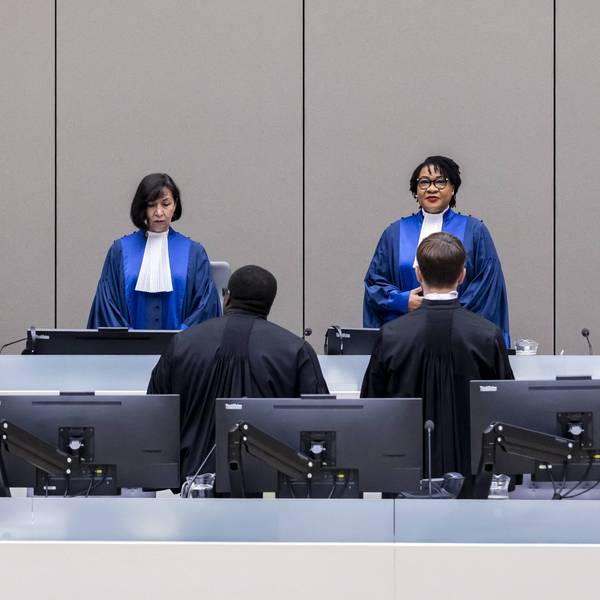
US President Trump is fighting the International Criminal Court, whose mission is to prosecute and convict high-ranking suspected criminals who have violated international law and human rights in The Hague. The US government under Trump is now imposing sanctions against the entire International Criminal Court as an institution. This represents yet another attack on global justice.
The International Criminal Court (ICC) has 125 member states and, since 2002, has been prosecuting war crimes, crimes against humanity, and genocide—including those committed by high-ranking officials. Like China, Israel, and Russia, the US is not a member of the ICC. However, a clear majority of countries worldwide (125 member states) do support it.
The US government is now not only imposing sanctions on the ICC as an institution but has also previously taken action against members of the court. Thirteen judges and the chief prosecutor of the ICC have been placed on the U.S. sanctions list. The sanctions range from travel bans to the US, restricted access to digital services, and the freezing of assets in the US, to the blocking of credit cards, such as Mastercard. This also affected ICC President Tomoko Akane.
The midterm elections have shown how little support the US public has for US foreign policy that violates international law and is aggressive in nature.
The US opposes the ICC’s prosecution of suspected war criminals because this would allow for the prosecution of US citizens if they commit war crimes in ICC member states.
In August 2026—according to STERN—US Secretary of State Marco Rubio justified the sanctions against individual ICC members with the disparaging remarks that the ICC is a “corrupt and fatally politicized” court that has “maliciously abused its powers and exceeded its mandate.”
As of October 9, 2026, the ICC is now also on the US sanctions list as an institution (“Imposing Sanctions on the International Criminal Court”).
These sanctions are already largely in effect and are set to take full effect in early April 2027, although a few individual exemptions still apply.
The sanctions include, for example, a ban on cooperation with the ICC for NGOs, as well as for banks and digital service providers, along with the threat of significant penalties.
One reason for the sanctions could be the arrest warrant issued against Israeli Prime Minister Benjamin Netanyahu, who faces charges of serious war crimes in the Gaza Strip. Palestine is a member state of the ICC, which is why this arrest warrant was possible. The ICC’s arrest warrant against Russian President Vladimir Putin could also be another reason for the action against the ICC. An arrest warrant was issued against Putin in the spring of 2023 in connection with the abduction of 16,000 children from Ukrainian territory. However, US Secretary of State Rubio is also fundamentally opposed to the international prosecution of war criminals by an independent and supranational organization—as reported by the Legal Tribune Online:
Rubio also openly threatened the court with its demise. "Either the ICC stops its threats, or we will put an end to the ICC," declared the US secretary of state (…). At the same time, he called on American allies to exert their influence on the court.
Eight countries protested shortly after the new punitive measures against the ICC were announced in early October 2026 (Joint Statement of the Foreign Ministers of Canada, Denmark, Germany, France, Italy, Japan, the Netherlands, and the United Kingdom) and declared their “unwavering support” for the ICC:
As committed supporters of the ICC, we regret the announcement of sanctions that the United States intends to impose on the Court and firmly reject them… Should these sanctions take effect, however, they will have a significant impact on the Court’s work, its dedicated staff, and their families. They work tirelessly every day to bring those accused of the most serious international crimes to justice and to support the victims.
One human rights organization after another is now halting its cooperation with the International Criminal Court. They fear the sanctions imposed by Trump. For the ICC judges, the NGOs’ reports were a key source of information on which to base their indictments. The editors of the Dutch investigative journalism platform Investico, Michelle Salomons and Allart van der Woude, report on the effects so far of the announced sanctions:
ICC investigators reportedly receive thousands of tips from aid and human rights organizations every year. This important source for investigative work is now at risk of being destroyed. Of the 25 organizations that have spoken out, 14 have already ceased all cooperation with the ICC due to pressure from the US government. Among them is the major human rights organization Human Rights Watch, based in New York, which is also simultaneously filing a lawsuit against the US sanctions. Six other NGOs have already significantly reduced their cooperation. Several European and German organizations have also curtailed their cooperation with ICC investigators. US NGOs are legally compelled to comply with the sanctions.
EU Justice Commissioner Michael McGrath expresses the EU’s solidarity with the ICC and hopes, before the general sanctions take effect:
The six-month grace period before these measures take effect offers an opportunity for dialogue. In the meantime, we are prepared to support the Court and protect EU companies from the effects of these measures.
ICC President Akane stated on November 2, 2026, before the United Nations General Assembly—via video only, as she was already barred from entering the US—that 34 international arrest warrants are currently outstanding and have not yet been executed by the relevant states. However, six states have since withdrawn from the ICC. The ICC, however, is continuing its work undeterred—according to Akane:
Despite all challenges, the International Criminal Court will continue to fulfill its judicial mandate with full independence and impartiality, acting solely on the basis of the law and the evidence.
The work of the ICC is a continuation of the Nuremberg Trials against Nazi war criminals. It is a civilizational achievement of the international community to have created a supranational legal institution that investigates serious war crimes and crimes against humanity.
Philippe Bolopion, executive director of Human Rights Watch, therefore criticizes this move from a human rights perspective: “By attacking the Court, the US government is jeopardizing justice for victims of human rights violations from Palestine to Ukraine and Myanmar to Sudan.”
Political scientist August Pradetto places the actions against the ICC in a current context:
Putin, Trump, Netanyahu—Ukraine, Venezuela, Iran: Everywhere we see attempts to replace the rule of law with the so-called "might makes right." Putin claims such a supposed right against Ukraine, while Trump does so even more indiscriminately against Venezuela, Iran, Cuba, and Greenland… If middle powers and those states interested in an international legal order join together to form "coalitions of the willing" and assert the rule of law both among themselves and against the few but powerful violators of the law, a world of international law and multilateralism—albeit one that will by no means be free of conflict in the future—will be preserved. If they fail to do so, the violators of the law will effectively have free rein (“The Law of the Strongest,” from: Rolf Bader (ed.): Peace Requires Courage and Action 2026, pp. 56 and 64).
The European Union must distance itself from and clearly draw a line against the United States regarding its foreign policy, which violates international law. Furthermore, all diplomatic avenues and measures must be utilized to counter the US government’s actions against the International Criminal Court in The Hague. Cooperation between the United Nations and the European Union would also be essential in this regard.
After all, on November 2, 2026, the UN General Assembly in New York criticized the US government’s actions and attempts at intimidation by a majority vote and continued to call on ICC member states to cooperate. Ninety-three states voted in favor of the resolution critical of the US, 13 against, with 36 abstentions.
On several occasions within the EU—including by the Dutch government—calls have been made in this context to protect institutions, companies, NGOs, and individuals threatened by US sanctions through the EU Blocking Regulation.
The EU Blocking Regulation was created to avert or compensate for damage caused by measures taken by a non-European or extraterritorial state by providing a legal framework that could protect those affected. The EU would not allow them to comply with extraterritorial sanctions that extend into the EU. However, the exact consequences, compensation, and measures in this legal context are not comprehensively defined and are, in some cases, controversial.
Julia Duchrow, secretary general of Amnesty International in Germany, nevertheless calls on the EU:
The US sanctions against the International Criminal Court are an attack on human rights and international law. In doing so, the US government is protecting war criminals and treating judges as perpetrators. The European Union must provide a clear response by shielding European companies and citizens from the consequences of the sanctions. As a first step, the EU must activate and expand its Blocking Regulation. The European Parliament must speak out clearly in favor of this today.
Overall, there is widespread outrage in the European Parliament and the European Commission over the threat to the ICC. EU Foreign Affairs Commissioner Kaja Kallas called for the withdrawal of the threatened US sanctions and reaffirmed that the EU would take all necessary measures to protect the work of the ICC.
The US government is attempting to undermine a transparent legal process—one independent of individual national interests—against individuals who are to be charged with the most serious crimes under international law and crimes against humanity. The ICC serves as a peacekeeping force due to the deterrent effect of the criminal proceedings it threatens to initiate. High-ranking individuals will certainly think twice about whether they want to risk an international arrest warrant from the ICC—even if this will undoubtedly compete with other considerations and interests. The midterm elections have shown how little support the US public has for US foreign policy that violates international law and is aggressive in nature, particularly with regard to an attack on Iran. Whether the actions against the ICC are also part of this rejection remains to be seen.
Even if the midterm results do not yet signal the end of Trump’s US presidency, they are likely to raise hopes for a swift end to this catastrophe for democracy and world peace. The sanctions against the ICC have sparked global outrage.
As early as 2025, a total of 79 states had publicly criticized US sanctions policy and expressed support for the ICC. On October 15 and 16, 2026, the 27 heads of state and government of the EU also declared their support for the ICC and spoke out in favor of “the effective protection of international courts and their officials from any threats or sanctions.”
With the UN General Assembly’s resolution, the number of states condemning the US sanctions had already risen to 93 by November 2026.
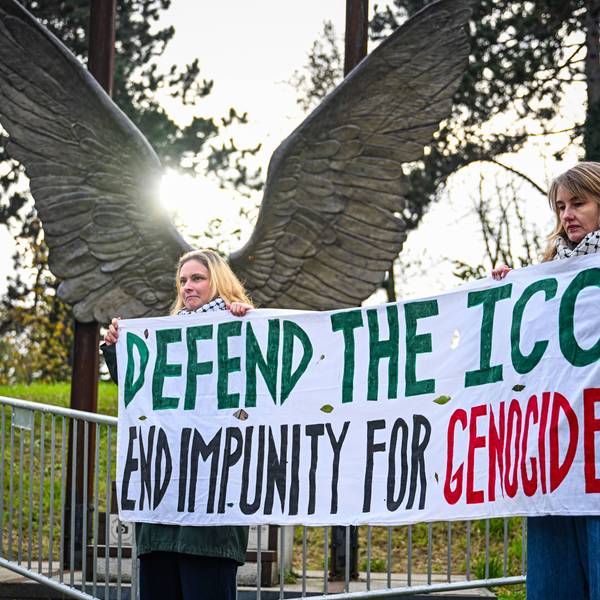
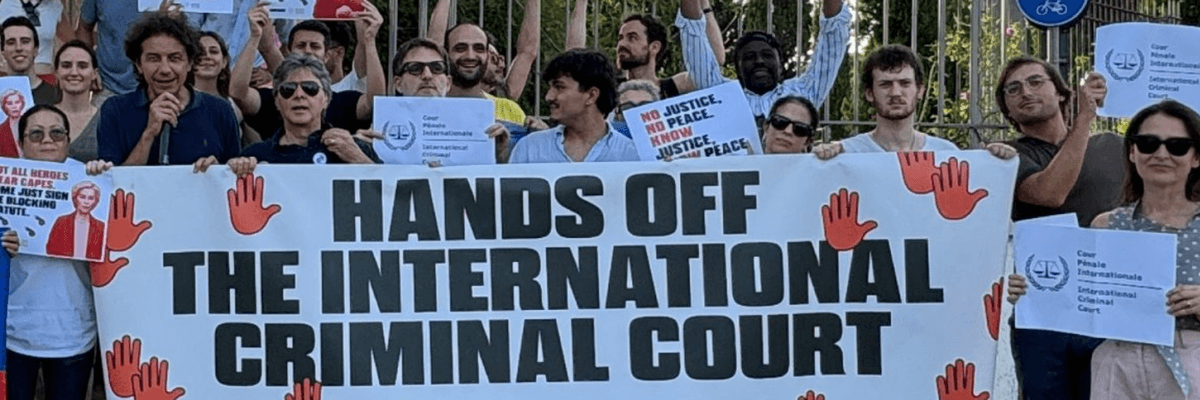
Ultimately, the question is what commitment governments and civil society organizations will demonstrate to counter the “might makes right” mentality with the strength of international law. On the one hand, this involves upholding just normative standards; on the other hand, it also concerns the interest of states and state alliances in not allowing themselves to be dominated by any great power, either now or in the future. The size of the defense budget and the threat posed by the military must not determine whether human rights and international law are upheld. This is what is at stake—and nothing less.
This country and this world are at a monumental crossroads. US voters have an opportunity to beat back the forces of fascism and confront the billionaires who are rigging the economy, our media system, and our democracy, making it increasingly impossible for ordinary people to get by. We’re not just talking about the election. We’re talking about what must be done once these fascist elements are vanquished from power. We need a bolder set of solutions than what either major party has so far been willing to offer and a working-class movement ready to fight like hell for it. Trump didn't emerge from nowhere. The conditions that fueled MAGA authoritarianism were created by decades of radical neoliberal economic policies and a corrupt political system dominated by corporate interests. They slashed taxes on the super-rich, promising that the benefits would trickle down. They said giveaways to the corporate titans would make life more affordable for the rest of us. It was all bullshit. And when a bitter, betrayed populace searches for someone to blame, right-wing demagogues have little trouble finding scapegoats. People know when they're being lied to, but you won't hear any of this from the corporate media. Only independent journalism—powered and funded by people who believe in building a better world—can deliver truly trustworthy daily news. If you share our vision, please contribute whatever you can to sustain our work. |
US President Trump is fighting the International Criminal Court, whose mission is to prosecute and convict high-ranking suspected criminals who have violated international law and human rights in The Hague. The US government under Trump is now imposing sanctions against the entire International Criminal Court as an institution. This represents yet another attack on global justice.
The International Criminal Court (ICC) has 125 member states and, since 2002, has been prosecuting war crimes, crimes against humanity, and genocide—including those committed by high-ranking officials. Like China, Israel, and Russia, the US is not a member of the ICC. However, a clear majority of countries worldwide (125 member states) do support it.
The US government is now not only imposing sanctions on the ICC as an institution but has also previously taken action against members of the court. Thirteen judges and the chief prosecutor of the ICC have been placed on the U.S. sanctions list. The sanctions range from travel bans to the US, restricted access to digital services, and the freezing of assets in the US, to the blocking of credit cards, such as Mastercard. This also affected ICC President Tomoko Akane.
The midterm elections have shown how little support the US public has for US foreign policy that violates international law and is aggressive in nature.
The US opposes the ICC’s prosecution of suspected war criminals because this would allow for the prosecution of US citizens if they commit war crimes in ICC member states.
In August 2026—according to STERN—US Secretary of State Marco Rubio justified the sanctions against individual ICC members with the disparaging remarks that the ICC is a “corrupt and fatally politicized” court that has “maliciously abused its powers and exceeded its mandate.”
As of October 9, 2026, the ICC is now also on the US sanctions list as an institution (“Imposing Sanctions on the International Criminal Court”).
These sanctions are already largely in effect and are set to take full effect in early April 2027, although a few individual exemptions still apply.
The sanctions include, for example, a ban on cooperation with the ICC for NGOs, as well as for banks and digital service providers, along with the threat of significant penalties.
One reason for the sanctions could be the arrest warrant issued against Israeli Prime Minister Benjamin Netanyahu, who faces charges of serious war crimes in the Gaza Strip. Palestine is a member state of the ICC, which is why this arrest warrant was possible. The ICC’s arrest warrant against Russian President Vladimir Putin could also be another reason for the action against the ICC. An arrest warrant was issued against Putin in the spring of 2023 in connection with the abduction of 16,000 children from Ukrainian territory. However, US Secretary of State Rubio is also fundamentally opposed to the international prosecution of war criminals by an independent and supranational organization—as reported by the Legal Tribune Online:
Rubio also openly threatened the court with its demise. "Either the ICC stops its threats, or we will put an end to the ICC," declared the US secretary of state (…). At the same time, he called on American allies to exert their influence on the court.
Eight countries protested shortly after the new punitive measures against the ICC were announced in early October 2026 (Joint Statement of the Foreign Ministers of Canada, Denmark, Germany, France, Italy, Japan, the Netherlands, and the United Kingdom) and declared their “unwavering support” for the ICC:
As committed supporters of the ICC, we regret the announcement of sanctions that the United States intends to impose on the Court and firmly reject them… Should these sanctions take effect, however, they will have a significant impact on the Court’s work, its dedicated staff, and their families. They work tirelessly every day to bring those accused of the most serious international crimes to justice and to support the victims.
One human rights organization after another is now halting its cooperation with the International Criminal Court. They fear the sanctions imposed by Trump. For the ICC judges, the NGOs’ reports were a key source of information on which to base their indictments. The editors of the Dutch investigative journalism platform Investico, Michelle Salomons and Allart van der Woude, report on the effects so far of the announced sanctions:
ICC investigators reportedly receive thousands of tips from aid and human rights organizations every year. This important source for investigative work is now at risk of being destroyed. Of the 25 organizations that have spoken out, 14 have already ceased all cooperation with the ICC due to pressure from the US government. Among them is the major human rights organization Human Rights Watch, based in New York, which is also simultaneously filing a lawsuit against the US sanctions. Six other NGOs have already significantly reduced their cooperation. Several European and German organizations have also curtailed their cooperation with ICC investigators. US NGOs are legally compelled to comply with the sanctions.
EU Justice Commissioner Michael McGrath expresses the EU’s solidarity with the ICC and hopes, before the general sanctions take effect:
The six-month grace period before these measures take effect offers an opportunity for dialogue. In the meantime, we are prepared to support the Court and protect EU companies from the effects of these measures.
ICC President Akane stated on November 2, 2026, before the United Nations General Assembly—via video only, as she was already barred from entering the US—that 34 international arrest warrants are currently outstanding and have not yet been executed by the relevant states. However, six states have since withdrawn from the ICC. The ICC, however, is continuing its work undeterred—according to Akane:
Despite all challenges, the International Criminal Court will continue to fulfill its judicial mandate with full independence and impartiality, acting solely on the basis of the law and the evidence.
The work of the ICC is a continuation of the Nuremberg Trials against Nazi war criminals. It is a civilizational achievement of the international community to have created a supranational legal institution that investigates serious war crimes and crimes against humanity.
Philippe Bolopion, executive director of Human Rights Watch, therefore criticizes this move from a human rights perspective: “By attacking the Court, the US government is jeopardizing justice for victims of human rights violations from Palestine to Ukraine and Myanmar to Sudan.”
Political scientist August Pradetto places the actions against the ICC in a current context:
Putin, Trump, Netanyahu—Ukraine, Venezuela, Iran: Everywhere we see attempts to replace the rule of law with the so-called "might makes right." Putin claims such a supposed right against Ukraine, while Trump does so even more indiscriminately against Venezuela, Iran, Cuba, and Greenland… If middle powers and those states interested in an international legal order join together to form "coalitions of the willing" and assert the rule of law both among themselves and against the few but powerful violators of the law, a world of international law and multilateralism—albeit one that will by no means be free of conflict in the future—will be preserved. If they fail to do so, the violators of the law will effectively have free rein (“The Law of the Strongest,” from: Rolf Bader (ed.): Peace Requires Courage and Action 2026, pp. 56 and 64).
The European Union must distance itself from and clearly draw a line against the United States regarding its foreign policy, which violates international law. Furthermore, all diplomatic avenues and measures must be utilized to counter the US government’s actions against the International Criminal Court in The Hague. Cooperation between the United Nations and the European Union would also be essential in this regard.
After all, on November 2, 2026, the UN General Assembly in New York criticized the US government’s actions and attempts at intimidation by a majority vote and continued to call on ICC member states to cooperate. Ninety-three states voted in favor of the resolution critical of the US, 13 against, with 36 abstentions.
On several occasions within the EU—including by the Dutch government—calls have been made in this context to protect institutions, companies, NGOs, and individuals threatened by US sanctions through the EU Blocking Regulation.
The EU Blocking Regulation was created to avert or compensate for damage caused by measures taken by a non-European or extraterritorial state by providing a legal framework that could protect those affected. The EU would not allow them to comply with extraterritorial sanctions that extend into the EU. However, the exact consequences, compensation, and measures in this legal context are not comprehensively defined and are, in some cases, controversial.
Julia Duchrow, secretary general of Amnesty International in Germany, nevertheless calls on the EU:
The US sanctions against the International Criminal Court are an attack on human rights and international law. In doing so, the US government is protecting war criminals and treating judges as perpetrators. The European Union must provide a clear response by shielding European companies and citizens from the consequences of the sanctions. As a first step, the EU must activate and expand its Blocking Regulation. The European Parliament must speak out clearly in favor of this today.
Overall, there is widespread outrage in the European Parliament and the European Commission over the threat to the ICC. EU Foreign Affairs Commissioner Kaja Kallas called for the withdrawal of the threatened US sanctions and reaffirmed that the EU would take all necessary measures to protect the work of the ICC.
The US government is attempting to undermine a transparent legal process—one independent of individual national interests—against individuals who are to be charged with the most serious crimes under international law and crimes against humanity. The ICC serves as a peacekeeping force due to the deterrent effect of the criminal proceedings it threatens to initiate. High-ranking individuals will certainly think twice about whether they want to risk an international arrest warrant from the ICC—even if this will undoubtedly compete with other considerations and interests. The midterm elections have shown how little support the US public has for US foreign policy that violates international law and is aggressive in nature, particularly with regard to an attack on Iran. Whether the actions against the ICC are also part of this rejection remains to be seen.
Even if the midterm results do not yet signal the end of Trump’s US presidency, they are likely to raise hopes for a swift end to this catastrophe for democracy and world peace. The sanctions against the ICC have sparked global outrage.
As early as 2025, a total of 79 states had publicly criticized US sanctions policy and expressed support for the ICC. On October 15 and 16, 2026, the 27 heads of state and government of the EU also declared their support for the ICC and spoke out in favor of “the effective protection of international courts and their officials from any threats or sanctions.”
With the UN General Assembly’s resolution, the number of states condemning the US sanctions had already risen to 93 by November 2026.
Ultimately, the question is what commitment governments and civil society organizations will demonstrate to counter the “might makes right” mentality with the strength of international law. On the one hand, this involves upholding just normative standards; on the other hand, it also concerns the interest of states and state alliances in not allowing themselves to be dominated by any great power, either now or in the future. The size of the defense budget and the threat posed by the military must not determine whether human rights and international law are upheld. This is what is at stake—and nothing less.