SUBSCRIBE TO OUR FREE NEWSLETTER
Daily news & progressive opinion—funded by the people, not the corporations—delivered straight to your inbox.
5
#000000
#FFFFFF
To donate by check, phone, or other method, see our More Ways to Give page.
Daily news & progressive opinion—funded by the people, not the corporations—delivered straight to your inbox.
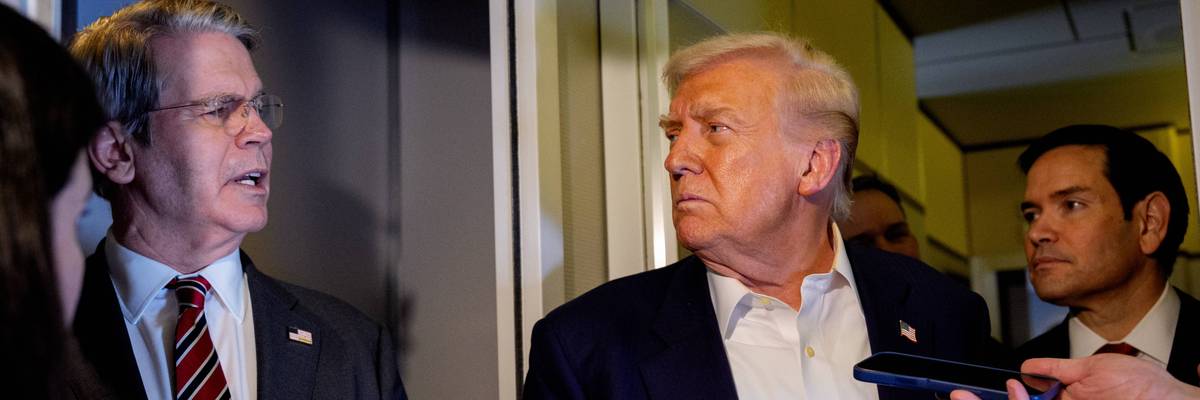
US Treasury Secretary Scott Bessent, accompanied by President Donald Trump and Secretary of State Marco Rubio, speaks to members of the media aboard Air Force One on October 27, 2025.
"These judges are being punished for discharging their judicial duties independently by rendering decisions with which the Trump administration disagrees."
Three judges at the International Criminal Court on Thursday sued the Trump administration over sanctions placed on them by a 2025 executive order.
The three plaintiffs—Judges Kimberly Prost of Canada, Solomy Bossa of Uganda, and Reine Alapini-Gansou of Benin—have served on ICC panels related to alleged crimes committed by either the American or Israeli militaries, and are among the eight ICC judges who have so far been hit with sanctions by the US State Department.
The ICC drew ire of US President Donald Trump for issuing an arrest warrant for Israeli Prime Minister Benjamin Netanyahu and opening a case into alleged war crimes by US troops in Afghanistan.
The judges' lawsuit contends that Trump's executive order establishing the sanctions was manifestly unlawful and in direct violation of the Administrative Procedure Act, which prohibits the government from making arbitrary and capricious policy changes.
The suit also claims that the US sanctions, which were invoked under the International Emergency Economic Powers Act, are illegal because their work at the ICC does not pose an "emergency" to the country's national security.
Andrew Loewenstein, attorney at Foley Hoag and lead counsel in the lawsuit, said the sanctions were designed to intimidate the ICC into dropping investigations related to the US and Israel.
"This sanctions regime is the antithesis of the rule of law,” Loewenstein said. "By targeting their financial and other personal interests, the sanctions are designed to exert extra-judicial pressure on Judges Prost, Bossa, and Alapini-Gansou and their colleagues on the ICC bench, with the objective of punishing them for past judicial decisions and coercing them into prioritizing their private interests over deciding cases on the basis of the law and facts."
Loewenstein also noted that "the sanctions obstruct the ability of victims and witnesses of genocide, war crimes, and crimes against humanity, as well as their lawyers, from being able to present evidence or argument in the judges’ courtrooms or otherwise participate in proceedings before them."
James Goldston, executive director of the Open Society Justice Initiative and a co-counsel representing Judge Prost in the complaint, described the Trump administration's sanctions as "an unprecedented attack on judicial independence and the rule of law."
"These judges are being punished for discharging their judicial duties independently by rendering decisions with which the Trump administration disagrees," Goldston added. "This is an effort to pressure them to render future decisions more to the administration's liking."
Dear Common Dreams reader, It’s been nearly 30 years since I co-founded Common Dreams with my late wife, Lina Newhouser. We had the radical notion that journalism should serve the public good, not corporate profits. It was clear to us from the outset what it would take to build such a project. No paid advertisements. No corporate sponsors. No millionaire publisher telling us what to think or do. Many people said we wouldn't last a year, but we proved those doubters wrong. Together with a tremendous team of journalists and dedicated staff, we built an independent media outlet free from the constraints of profits and corporate control. Our mission has always been simple: To inform. To inspire. To ignite change for the common good. Building Common Dreams was not easy. Our survival was never guaranteed. When you take on the most powerful forces—Wall Street greed, fossil fuel industry destruction, Big Tech lobbyists, and uber-rich oligarchs who have spent billions upon billions rigging the economy and democracy in their favor—the only bulwark you have is supporters who believe in your work. But here’s the urgent message from me today. It's never been this bad out there. And it's never been this hard to keep us going. At the very moment Common Dreams is most needed, the threats we face are intensifying. We need your support now more than ever. We don't accept corporate advertising and never will. We don't have a paywall because we don't think people should be blocked from critical news based on their ability to pay. Everything we do is funded by the donations of readers like you. When everyone does the little they can afford, we are strong. But if that support retreats or dries up, so do we. Will you donate now to make sure Common Dreams not only survives but thrives? —Craig Brown, Co-founder |
Three judges at the International Criminal Court on Thursday sued the Trump administration over sanctions placed on them by a 2025 executive order.
The three plaintiffs—Judges Kimberly Prost of Canada, Solomy Bossa of Uganda, and Reine Alapini-Gansou of Benin—have served on ICC panels related to alleged crimes committed by either the American or Israeli militaries, and are among the eight ICC judges who have so far been hit with sanctions by the US State Department.
The ICC drew ire of US President Donald Trump for issuing an arrest warrant for Israeli Prime Minister Benjamin Netanyahu and opening a case into alleged war crimes by US troops in Afghanistan.
The judges' lawsuit contends that Trump's executive order establishing the sanctions was manifestly unlawful and in direct violation of the Administrative Procedure Act, which prohibits the government from making arbitrary and capricious policy changes.
The suit also claims that the US sanctions, which were invoked under the International Emergency Economic Powers Act, are illegal because their work at the ICC does not pose an "emergency" to the country's national security.
Andrew Loewenstein, attorney at Foley Hoag and lead counsel in the lawsuit, said the sanctions were designed to intimidate the ICC into dropping investigations related to the US and Israel.
"This sanctions regime is the antithesis of the rule of law,” Loewenstein said. "By targeting their financial and other personal interests, the sanctions are designed to exert extra-judicial pressure on Judges Prost, Bossa, and Alapini-Gansou and their colleagues on the ICC bench, with the objective of punishing them for past judicial decisions and coercing them into prioritizing their private interests over deciding cases on the basis of the law and facts."
Loewenstein also noted that "the sanctions obstruct the ability of victims and witnesses of genocide, war crimes, and crimes against humanity, as well as their lawyers, from being able to present evidence or argument in the judges’ courtrooms or otherwise participate in proceedings before them."
James Goldston, executive director of the Open Society Justice Initiative and a co-counsel representing Judge Prost in the complaint, described the Trump administration's sanctions as "an unprecedented attack on judicial independence and the rule of law."
"These judges are being punished for discharging their judicial duties independently by rendering decisions with which the Trump administration disagrees," Goldston added. "This is an effort to pressure them to render future decisions more to the administration's liking."
Three judges at the International Criminal Court on Thursday sued the Trump administration over sanctions placed on them by a 2025 executive order.
The three plaintiffs—Judges Kimberly Prost of Canada, Solomy Bossa of Uganda, and Reine Alapini-Gansou of Benin—have served on ICC panels related to alleged crimes committed by either the American or Israeli militaries, and are among the eight ICC judges who have so far been hit with sanctions by the US State Department.
The ICC drew ire of US President Donald Trump for issuing an arrest warrant for Israeli Prime Minister Benjamin Netanyahu and opening a case into alleged war crimes by US troops in Afghanistan.
The judges' lawsuit contends that Trump's executive order establishing the sanctions was manifestly unlawful and in direct violation of the Administrative Procedure Act, which prohibits the government from making arbitrary and capricious policy changes.
The suit also claims that the US sanctions, which were invoked under the International Emergency Economic Powers Act, are illegal because their work at the ICC does not pose an "emergency" to the country's national security.
Andrew Loewenstein, attorney at Foley Hoag and lead counsel in the lawsuit, said the sanctions were designed to intimidate the ICC into dropping investigations related to the US and Israel.
"This sanctions regime is the antithesis of the rule of law,” Loewenstein said. "By targeting their financial and other personal interests, the sanctions are designed to exert extra-judicial pressure on Judges Prost, Bossa, and Alapini-Gansou and their colleagues on the ICC bench, with the objective of punishing them for past judicial decisions and coercing them into prioritizing their private interests over deciding cases on the basis of the law and facts."
Loewenstein also noted that "the sanctions obstruct the ability of victims and witnesses of genocide, war crimes, and crimes against humanity, as well as their lawyers, from being able to present evidence or argument in the judges’ courtrooms or otherwise participate in proceedings before them."
James Goldston, executive director of the Open Society Justice Initiative and a co-counsel representing Judge Prost in the complaint, described the Trump administration's sanctions as "an unprecedented attack on judicial independence and the rule of law."
"These judges are being punished for discharging their judicial duties independently by rendering decisions with which the Trump administration disagrees," Goldston added. "This is an effort to pressure them to render future decisions more to the administration's liking."