
A protestor holds a placard saying End Israels war crimes during a demonstration.
Trump's Attack on International Law Will Take Us All Down With It
The effort to sideline the International Criminal Court may prove more costly than it looks.
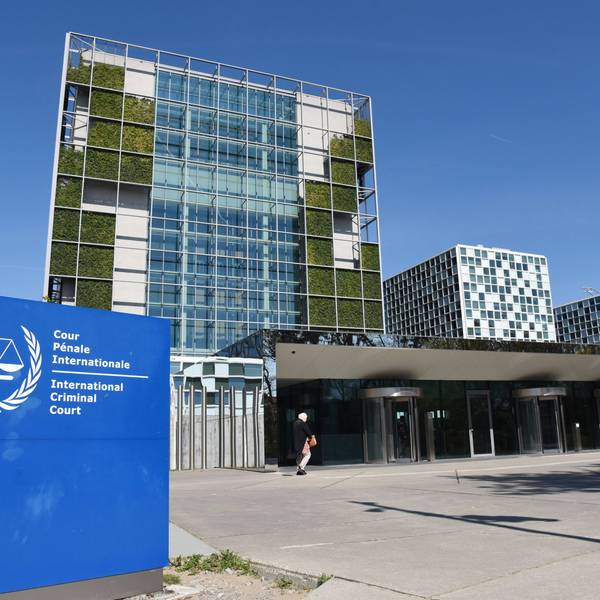
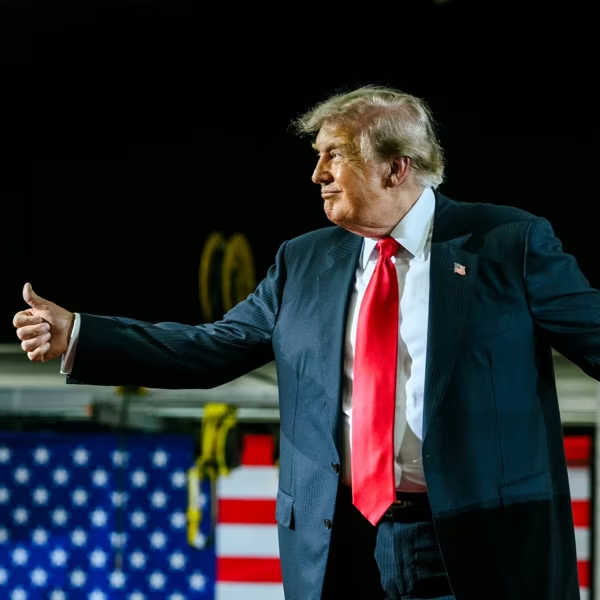
At Camp David on July 31, Donald Trump said plainly what Washington’s fight with the International Criminal Court is now about. The US government's campaign to weaken the court, he said, was meant to defend Israeli Prime Minister Benjamin Netanyahu and “various other people,” not himself. Marco Rubio added that five countries had announced plans to leave the ICC since the administration began its latest push against it. That makes the dispute larger than one court or one case. The real question is what the United States gives up when it treats an institution as useful against an adversary but intolerable when it reaches an ally.
Military strength, economic weight, and alliances matter, of course, but they are not the whole story of great-power influence. For decades, the United States also benefited from helping write the rules and from being able to say that those rules reflected something more than American preference. The postwar legal and institutional order became part of US power itself. It helped Washington isolate rivals, keep allies together, and present its policies as defenses of a wider system. That is why the current approach carries a cost that is easy to miss. In protecting allies from legal pressure today, Washington may be spending some of the credibility it will need tomorrow.
The contrast with Russia is especially hard to explain away. During Joe Biden’s presidency, Washington backed accountability efforts over Russian crimes in Ukraine, and Congress loosened restrictions on U.S. assistance to the ICC for its Ukraine investigation. The tone changed once the court issued arrest warrants for Netanyahu and former Israeli Defense Minister Yoav Gallant in November 2024. Trump’s 2025 executive order authorized sanctions connected to ICC actions against the United States and Israel. Since then, the administration has broadened the pressure to include travel restrictions, more sanctions, and diplomatic pressure on governments that continue to support the court.
There is a serious legal argument on the American side, and the article does not depend on pretending otherwise. The United States never joined the Rome Statute; Israel did not either. US officials have long objected to the prosecution of nationals of non-member states without their governments’ consent. The ICC answers that it has territorial jurisdiction over Gaza and the West Bank, including East Jerusalem. Those are competing legal positions. But there is still a difference between challenging a court’s jurisdiction and punishing its officials while urging other countries to abandon it. One contests a ruling. The other can end up weakening the institution that produced it.
That is where the damage to American credibility begins. A legal order does not have to be perfectly consistent to matter, but it cannot survive for long if its most powerful defenders appear to want one standard for opponents and another for friends. After the Netanyahu and Gallant warrants, Josep Borrell, then the European Union’s foreign policy chief, said the decisions were binding on EU member states. Outside the West, the contradiction is even harder to ignore. Washington asks governments to uphold sovereignty, accountability, and international rules in one crisis, then attacks an institution applying those rules in another. That does not erase U.S. power, but it makes American appeals less persuasive.
A common reply is that international law has always followed power. Courts have no armies, and major states can often avoid consequences that weaker ones cannot. There is plenty of truth in that argument. Still, political protection has a way of expiring. Augusto Pinochet was arrested in London in 1998 on a Spanish extradition request. Former Chadian president Hissène Habré was eventually tried in Senegal and sentenced to life imprisonment. Slobodan Milošević was put on trial after he lost power, though he died before a verdict. The legal routes in those cases were different, but the lesson is similar: power can postpone accountability. It does not always cancel it.
The value of the ICC should therefore not be judged only by how many people it immediately puts behind bars. Warrants can change diplomatic calculations even when an arrest never happens. After the court issued a warrant for Vladimir Putin in 2023, he did not attend the BRICS summit in South Africa in person. Pretoria, as a member of the ICC, would otherwise have faced intense pressure over whether to arrest him. That episode was modest compared with a trial, but it showed that legal exposure can narrow a leader’s room for maneuver.
This matters even more because the international system around the United States is changing. Western governments once had far more influence over the institutions and language used to define international legitimacy. They still have enormous influence, but not the near-exclusive position they once enjoyed. South Africa’s genocide case against Israel at the International Court of Justice is one sign of the shift. Governments in the Global South are increasingly using the same legal institutions that Western states helped build, sometimes in ways Washington and its allies did not expect. The argument is no longer only about whether international law matters. It is also about who gets to interpret it.
That is why the effort to sideline the ICC may prove more costly than it looks. Washington can sanction officials, restrict travel, and encourage governments to leave the court. It may even succeed in making the institution weaker. But weakening a forum also means giving up some ability to shape what that forum becomes. Rules are not written once and then left alone; they are interpreted, challenged, and remade over time. A country that walks away whenever the outcome is inconvenient leaves more room for others to do that work.
America’s problem, then, is not really one arrest warrant. It is the gap between claiming leadership of a rules-based order and accepting the rules only when they produce comfortable results. Shielding an ally from immediate legal pressure may look like a win in Washington. The harder question is what happens when the next crisis requires the United States to persuade other governments that sovereignty, accountability, and legal restraint should apply even when compliance is costly.
The coming international order will not be shaped by aircraft carriers, GDP, and military budgets alone. Legitimacy will matter too, especially as more states compete over how global rules are read and enforced. The United States helped build a system that gave it unusual influence over that process. Its gamble now is that it can weaken parts of that system without weakening its own position inside it. That may turn out to be a much more expensive bet than Washington expects.
An Urgent Message From Our Co-Founder
Dear Common Dreams reader, It’s been nearly 30 years since I co-founded Common Dreams with my late wife, Lina Newhouser. We had the radical notion that journalism should serve the public good, not corporate profits. It was clear to us from the outset what it would take to build such a project. No paid advertisements. No corporate sponsors. No millionaire publisher telling us what to think or do. Many people said we wouldn't last a year, but we proved those doubters wrong. Together with a tremendous team of journalists and dedicated staff, we built an independent media outlet free from the constraints of profits and corporate control. Our mission has always been simple: To inform. To inspire. To ignite change for the common good. Building Common Dreams was not easy. Our survival was never guaranteed. When you take on the most powerful forces—Wall Street greed, fossil fuel industry destruction, Big Tech lobbyists, and uber-rich oligarchs who have spent billions upon billions rigging the economy and democracy in their favor—the only bulwark you have is supporters who believe in your work. But here’s the urgent message from me today. It's never been this bad out there. And it's never been this hard to keep us going. At the very moment Common Dreams is most needed, the threats we face are intensifying. We need your support now more than ever. We don't accept corporate advertising and never will. We don't have a paywall because we don't think people should be blocked from critical news based on their ability to pay. Everything we do is funded by the donations of readers like you. When everyone does the little they can afford, we are strong. But if that support retreats or dries up, so do we. Will you donate now to make sure Common Dreams not only survives but thrives? —Craig Brown, Co-founder |
At Camp David on July 31, Donald Trump said plainly what Washington’s fight with the International Criminal Court is now about. The US government's campaign to weaken the court, he said, was meant to defend Israeli Prime Minister Benjamin Netanyahu and “various other people,” not himself. Marco Rubio added that five countries had announced plans to leave the ICC since the administration began its latest push against it. That makes the dispute larger than one court or one case. The real question is what the United States gives up when it treats an institution as useful against an adversary but intolerable when it reaches an ally.
Military strength, economic weight, and alliances matter, of course, but they are not the whole story of great-power influence. For decades, the United States also benefited from helping write the rules and from being able to say that those rules reflected something more than American preference. The postwar legal and institutional order became part of US power itself. It helped Washington isolate rivals, keep allies together, and present its policies as defenses of a wider system. That is why the current approach carries a cost that is easy to miss. In protecting allies from legal pressure today, Washington may be spending some of the credibility it will need tomorrow.
The contrast with Russia is especially hard to explain away. During Joe Biden’s presidency, Washington backed accountability efforts over Russian crimes in Ukraine, and Congress loosened restrictions on U.S. assistance to the ICC for its Ukraine investigation. The tone changed once the court issued arrest warrants for Netanyahu and former Israeli Defense Minister Yoav Gallant in November 2024. Trump’s 2025 executive order authorized sanctions connected to ICC actions against the United States and Israel. Since then, the administration has broadened the pressure to include travel restrictions, more sanctions, and diplomatic pressure on governments that continue to support the court.
There is a serious legal argument on the American side, and the article does not depend on pretending otherwise. The United States never joined the Rome Statute; Israel did not either. US officials have long objected to the prosecution of nationals of non-member states without their governments’ consent. The ICC answers that it has territorial jurisdiction over Gaza and the West Bank, including East Jerusalem. Those are competing legal positions. But there is still a difference between challenging a court’s jurisdiction and punishing its officials while urging other countries to abandon it. One contests a ruling. The other can end up weakening the institution that produced it.
That is where the damage to American credibility begins. A legal order does not have to be perfectly consistent to matter, but it cannot survive for long if its most powerful defenders appear to want one standard for opponents and another for friends. After the Netanyahu and Gallant warrants, Josep Borrell, then the European Union’s foreign policy chief, said the decisions were binding on EU member states. Outside the West, the contradiction is even harder to ignore. Washington asks governments to uphold sovereignty, accountability, and international rules in one crisis, then attacks an institution applying those rules in another. That does not erase U.S. power, but it makes American appeals less persuasive.
A common reply is that international law has always followed power. Courts have no armies, and major states can often avoid consequences that weaker ones cannot. There is plenty of truth in that argument. Still, political protection has a way of expiring. Augusto Pinochet was arrested in London in 1998 on a Spanish extradition request. Former Chadian president Hissène Habré was eventually tried in Senegal and sentenced to life imprisonment. Slobodan Milošević was put on trial after he lost power, though he died before a verdict. The legal routes in those cases were different, but the lesson is similar: power can postpone accountability. It does not always cancel it.
The value of the ICC should therefore not be judged only by how many people it immediately puts behind bars. Warrants can change diplomatic calculations even when an arrest never happens. After the court issued a warrant for Vladimir Putin in 2023, he did not attend the BRICS summit in South Africa in person. Pretoria, as a member of the ICC, would otherwise have faced intense pressure over whether to arrest him. That episode was modest compared with a trial, but it showed that legal exposure can narrow a leader’s room for maneuver.
This matters even more because the international system around the United States is changing. Western governments once had far more influence over the institutions and language used to define international legitimacy. They still have enormous influence, but not the near-exclusive position they once enjoyed. South Africa’s genocide case against Israel at the International Court of Justice is one sign of the shift. Governments in the Global South are increasingly using the same legal institutions that Western states helped build, sometimes in ways Washington and its allies did not expect. The argument is no longer only about whether international law matters. It is also about who gets to interpret it.
That is why the effort to sideline the ICC may prove more costly than it looks. Washington can sanction officials, restrict travel, and encourage governments to leave the court. It may even succeed in making the institution weaker. But weakening a forum also means giving up some ability to shape what that forum becomes. Rules are not written once and then left alone; they are interpreted, challenged, and remade over time. A country that walks away whenever the outcome is inconvenient leaves more room for others to do that work.
America’s problem, then, is not really one arrest warrant. It is the gap between claiming leadership of a rules-based order and accepting the rules only when they produce comfortable results. Shielding an ally from immediate legal pressure may look like a win in Washington. The harder question is what happens when the next crisis requires the United States to persuade other governments that sovereignty, accountability, and legal restraint should apply even when compliance is costly.
The coming international order will not be shaped by aircraft carriers, GDP, and military budgets alone. Legitimacy will matter too, especially as more states compete over how global rules are read and enforced. The United States helped build a system that gave it unusual influence over that process. Its gamble now is that it can weaken parts of that system without weakening its own position inside it. That may turn out to be a much more expensive bet than Washington expects.
At Camp David on July 31, Donald Trump said plainly what Washington’s fight with the International Criminal Court is now about. The US government's campaign to weaken the court, he said, was meant to defend Israeli Prime Minister Benjamin Netanyahu and “various other people,” not himself. Marco Rubio added that five countries had announced plans to leave the ICC since the administration began its latest push against it. That makes the dispute larger than one court or one case. The real question is what the United States gives up when it treats an institution as useful against an adversary but intolerable when it reaches an ally.
Military strength, economic weight, and alliances matter, of course, but they are not the whole story of great-power influence. For decades, the United States also benefited from helping write the rules and from being able to say that those rules reflected something more than American preference. The postwar legal and institutional order became part of US power itself. It helped Washington isolate rivals, keep allies together, and present its policies as defenses of a wider system. That is why the current approach carries a cost that is easy to miss. In protecting allies from legal pressure today, Washington may be spending some of the credibility it will need tomorrow.
The contrast with Russia is especially hard to explain away. During Joe Biden’s presidency, Washington backed accountability efforts over Russian crimes in Ukraine, and Congress loosened restrictions on U.S. assistance to the ICC for its Ukraine investigation. The tone changed once the court issued arrest warrants for Netanyahu and former Israeli Defense Minister Yoav Gallant in November 2024. Trump’s 2025 executive order authorized sanctions connected to ICC actions against the United States and Israel. Since then, the administration has broadened the pressure to include travel restrictions, more sanctions, and diplomatic pressure on governments that continue to support the court.
There is a serious legal argument on the American side, and the article does not depend on pretending otherwise. The United States never joined the Rome Statute; Israel did not either. US officials have long objected to the prosecution of nationals of non-member states without their governments’ consent. The ICC answers that it has territorial jurisdiction over Gaza and the West Bank, including East Jerusalem. Those are competing legal positions. But there is still a difference between challenging a court’s jurisdiction and punishing its officials while urging other countries to abandon it. One contests a ruling. The other can end up weakening the institution that produced it.
That is where the damage to American credibility begins. A legal order does not have to be perfectly consistent to matter, but it cannot survive for long if its most powerful defenders appear to want one standard for opponents and another for friends. After the Netanyahu and Gallant warrants, Josep Borrell, then the European Union’s foreign policy chief, said the decisions were binding on EU member states. Outside the West, the contradiction is even harder to ignore. Washington asks governments to uphold sovereignty, accountability, and international rules in one crisis, then attacks an institution applying those rules in another. That does not erase U.S. power, but it makes American appeals less persuasive.
A common reply is that international law has always followed power. Courts have no armies, and major states can often avoid consequences that weaker ones cannot. There is plenty of truth in that argument. Still, political protection has a way of expiring. Augusto Pinochet was arrested in London in 1998 on a Spanish extradition request. Former Chadian president Hissène Habré was eventually tried in Senegal and sentenced to life imprisonment. Slobodan Milošević was put on trial after he lost power, though he died before a verdict. The legal routes in those cases were different, but the lesson is similar: power can postpone accountability. It does not always cancel it.
The value of the ICC should therefore not be judged only by how many people it immediately puts behind bars. Warrants can change diplomatic calculations even when an arrest never happens. After the court issued a warrant for Vladimir Putin in 2023, he did not attend the BRICS summit in South Africa in person. Pretoria, as a member of the ICC, would otherwise have faced intense pressure over whether to arrest him. That episode was modest compared with a trial, but it showed that legal exposure can narrow a leader’s room for maneuver.
This matters even more because the international system around the United States is changing. Western governments once had far more influence over the institutions and language used to define international legitimacy. They still have enormous influence, but not the near-exclusive position they once enjoyed. South Africa’s genocide case against Israel at the International Court of Justice is one sign of the shift. Governments in the Global South are increasingly using the same legal institutions that Western states helped build, sometimes in ways Washington and its allies did not expect. The argument is no longer only about whether international law matters. It is also about who gets to interpret it.
That is why the effort to sideline the ICC may prove more costly than it looks. Washington can sanction officials, restrict travel, and encourage governments to leave the court. It may even succeed in making the institution weaker. But weakening a forum also means giving up some ability to shape what that forum becomes. Rules are not written once and then left alone; they are interpreted, challenged, and remade over time. A country that walks away whenever the outcome is inconvenient leaves more room for others to do that work.
America’s problem, then, is not really one arrest warrant. It is the gap between claiming leadership of a rules-based order and accepting the rules only when they produce comfortable results. Shielding an ally from immediate legal pressure may look like a win in Washington. The harder question is what happens when the next crisis requires the United States to persuade other governments that sovereignty, accountability, and legal restraint should apply even when compliance is costly.
The coming international order will not be shaped by aircraft carriers, GDP, and military budgets alone. Legitimacy will matter too, especially as more states compete over how global rules are read and enforced. The United States helped build a system that gave it unusual influence over that process. Its gamble now is that it can weaken parts of that system without weakening its own position inside it. That may turn out to be a much more expensive bet than Washington expects.