SUBSCRIBE TO OUR FREE NEWSLETTER
Daily news & progressive opinion—funded by the people, not the corporations—delivered straight to your inbox.
5
#000000
#FFFFFF
To donate by check, phone, or other method, see our More Ways to Give page.
Daily news & progressive opinion—funded by the people, not the corporations—delivered straight to your inbox.
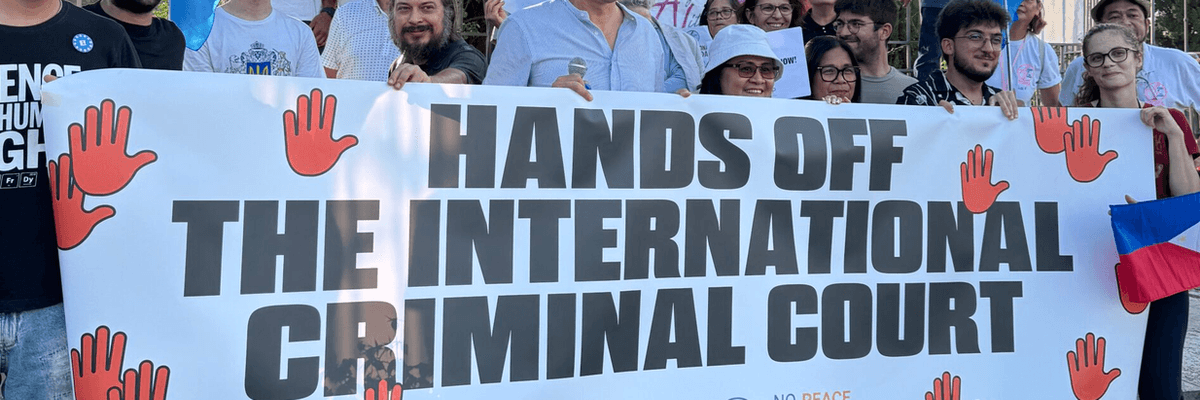
Defenders of the International Criminal Court, led by the pan-European group Eumans, rally in Rome on July 17, 2025.
The head of one affiliated organization called Trump's sanctions "a slap in the face to victims and survivors of grave crimes everywhere who depend on the ICC as a court of last resort.”
A quartet of US human rights groups filed a federal lawsuit on Tuesday challenging the Trump administration’s sanctions targeting members of the International Criminal Court for their roles in seeking to hold Israeli leaders accountable for alleged crimes against humanity in Gaza.
The American Friends Service Committee (AFSC), the Center for Constitutional Rights (CCR), Human Rights Watch (HRW), and the Open Society Institute (OSI) filed suit in the US District Court for the Southern District of New York challenging the Trump administration’s sanctions against ICC prosecutors and judges, a United Nations human rights expert, and three Palestinian human rights groups.
The groups argue that US President Donald Trump's February 2025 executive order that imposed sanctions on the ICC are a “blatantly illegal attack on international justice and should be struck down."
James Goldston, executive director of the Open Society Justice Initiative, called the sanctions "a slap in the face to victims and survivors of grave crimes everywhere who depend on the ICC as a court of last resort.”
Trump's sanctions follow the ICC's November 2024 issuance of arrest warrants for Israeli Prime Minister Benjamin Netanyahu and Yoav Gallant, his former defense minister, for alleged crimes against humanity and war crimes in Gaza, including murder and forced starvation. The tribunal simultaneously issued warrants for the arrest of three Hamas leaders for the same categories of crimes allegedly committed on and after the October 7, 2023 attack on Israel. However, Israel extrajudicially assassinated all three of the men.
The groups' complaint argues that the Trump administration has effectively transformed human rights advocacy into a potential criminal offense. Organizations can face severe civil and criminal penalties for providing what the government may determine are “services” to sanctioned individuals or groups.
That threat, they contend, has already had tangible consequences. The plaintiffs say the sanctions have disrupted their ability to represent victims of war crimes, submit evidence and legal arguments to the ICC, and collaborate with sanctioned Palestinian organizations on research, litigation, advocacy, and humanitarian work.
Targeted groups and individuals have experienced "frozen or closed bank accounts, rejection of financial transactions, denial of access to digital services, and travel bans," CCR notes. "US organizations, including the plaintiffs, can face punishment of up to 20 years of imprisonment and exorbitant fines for providing services to sanctioned persons or entities."
CCR called the sanctions "one of many" actions taken by the Trump administration "against free speech, protest, and advocacy in support of the human rights of Palestinians."
“For many years, I have represented victims in pressing for justice for crimes committed by the powerful, and finally saw much-needed, even if overdue, investigations opened at the ICC," said CCR senior staff attorney Katherine Gallagher. "In response, the Trump administration took the extraordinary step to not only deny Palestinians and victims of US torture equal access to justice, but to criminalize and punish them, their lawyers and advocates, and their partners."
Israeli officials and their supporters argue that the ICC and the International Court of Justice—where Israel is facing a genocide case filed by South Africa and formally supported by nearly 20 nations—have unfairly singled out Israel. However, the ICC has launched 18 investigations involving conflicts in countries including Afghanistan, the Central African Republic, the Democratic Republic of Congo, Libya, the Philippines, Sudan (Darfur), and Ukraine.
Trump’s order asserts that ICC efforts involving US or allied nationals constitute a threat to American national security. But the new complaint argues that there is no genuine “national emergency” that can lawfully justify invoking the International Emergency Economic Powers Act against the court’s routine judicial work.
"The US government’s efforts to dismantle the ICC and punish people seeking justice for grave human rights violations harm far more than the individuals and groups facing sanctions," AFSC general secretary Joyce Ajlouny said in a statement Tuesday. “It is an affront to all victims and survivors of war crimes and genocide."
Ajlouny asserted that the Trump administration "seeks to intimidate human rights defenders and deter people of conscience from advocating for the rights and dignity of others."
"We are joining this lawsuit because we refuse to stay silent when the pursuit of justice is criminalized," she added.
Tuesday's complaint is the latest in a string of lawsuits challenging Trump's sanctions.
Francesca Albanese, the UN special rapporteur on the situation of human rights in the Palestinian territories occupied since 1967, earlier this year sued Trump and three of his senior Cabinet officials over sanctions imposed on her and her family. Although a federal district judge temporarily blocked the move on First Amendment grounds, an appeals court quickly reinstated the sanctions via an administrative stay.
In April 2025, two human rights advocates sued over sanctions against then-ICC Prosecutor Karim Khan, arguing that the restrictions violated their First Amendment rights. A federal judge subsequently found the advocates were likely to succeed on their constitutional claims and issued a preliminary injunction protecting their communications with the court.
In June, three sanctioned ICC judges—Judges Kimberly Prost of Canada, Solomy Bossa of Uganda, and Reine Alapini-Gansou of Benin—filed suit against the Trump administration, arguing that the president's order directly violated the Administrative Procedure Act, which prohibits the government from making arbitrary and capricious policy changes.
Last month, Democracy for the Arab World Now (DAWN) and the Taxpayer Alliance Against Genocide also sued Trump and senior administration officials over the ICC sanctions.
“The Trump administration is using the blunt instrument of economic sanctions not only to punish human rights defenders but to police the political expression of millions of Americans,” DAWN executive director Omar Shakir said at the time. “The government is violating the constitutional rights of American citizens in order to shield officials of a foreign government who have committed a genocide.”
Dear Common Dreams reader, It’s been nearly 30 years since I co-founded Common Dreams with my late wife, Lina Newhouser. We had the radical notion that journalism should serve the public good, not corporate profits. It was clear to us from the outset what it would take to build such a project. No paid advertisements. No corporate sponsors. No millionaire publisher telling us what to think or do. Many people said we wouldn't last a year, but we proved those doubters wrong. Together with a tremendous team of journalists and dedicated staff, we built an independent media outlet free from the constraints of profits and corporate control. Our mission has always been simple: To inform. To inspire. To ignite change for the common good. Building Common Dreams was not easy. Our survival was never guaranteed. When you take on the most powerful forces—Wall Street greed, fossil fuel industry destruction, Big Tech lobbyists, and uber-rich oligarchs who have spent billions upon billions rigging the economy and democracy in their favor—the only bulwark you have is supporters who believe in your work. But here’s the urgent message from me today. It's never been this bad out there. And it's never been this hard to keep us going. At the very moment Common Dreams is most needed, the threats we face are intensifying. We need your support now more than ever. We don't accept corporate advertising and never will. We don't have a paywall because we don't think people should be blocked from critical news based on their ability to pay. Everything we do is funded by the donations of readers like you. When everyone does the little they can afford, we are strong. But if that support retreats or dries up, so do we. Will you donate now to make sure Common Dreams not only survives but thrives? —Craig Brown, Co-founder |
A quartet of US human rights groups filed a federal lawsuit on Tuesday challenging the Trump administration’s sanctions targeting members of the International Criminal Court for their roles in seeking to hold Israeli leaders accountable for alleged crimes against humanity in Gaza.
The American Friends Service Committee (AFSC), the Center for Constitutional Rights (CCR), Human Rights Watch (HRW), and the Open Society Institute (OSI) filed suit in the US District Court for the Southern District of New York challenging the Trump administration’s sanctions against ICC prosecutors and judges, a United Nations human rights expert, and three Palestinian human rights groups.
The groups argue that US President Donald Trump's February 2025 executive order that imposed sanctions on the ICC are a “blatantly illegal attack on international justice and should be struck down."
James Goldston, executive director of the Open Society Justice Initiative, called the sanctions "a slap in the face to victims and survivors of grave crimes everywhere who depend on the ICC as a court of last resort.”
Trump's sanctions follow the ICC's November 2024 issuance of arrest warrants for Israeli Prime Minister Benjamin Netanyahu and Yoav Gallant, his former defense minister, for alleged crimes against humanity and war crimes in Gaza, including murder and forced starvation. The tribunal simultaneously issued warrants for the arrest of three Hamas leaders for the same categories of crimes allegedly committed on and after the October 7, 2023 attack on Israel. However, Israel extrajudicially assassinated all three of the men.
The groups' complaint argues that the Trump administration has effectively transformed human rights advocacy into a potential criminal offense. Organizations can face severe civil and criminal penalties for providing what the government may determine are “services” to sanctioned individuals or groups.
That threat, they contend, has already had tangible consequences. The plaintiffs say the sanctions have disrupted their ability to represent victims of war crimes, submit evidence and legal arguments to the ICC, and collaborate with sanctioned Palestinian organizations on research, litigation, advocacy, and humanitarian work.
Targeted groups and individuals have experienced "frozen or closed bank accounts, rejection of financial transactions, denial of access to digital services, and travel bans," CCR notes. "US organizations, including the plaintiffs, can face punishment of up to 20 years of imprisonment and exorbitant fines for providing services to sanctioned persons or entities."
CCR called the sanctions "one of many" actions taken by the Trump administration "against free speech, protest, and advocacy in support of the human rights of Palestinians."
“For many years, I have represented victims in pressing for justice for crimes committed by the powerful, and finally saw much-needed, even if overdue, investigations opened at the ICC," said CCR senior staff attorney Katherine Gallagher. "In response, the Trump administration took the extraordinary step to not only deny Palestinians and victims of US torture equal access to justice, but to criminalize and punish them, their lawyers and advocates, and their partners."
Israeli officials and their supporters argue that the ICC and the International Court of Justice—where Israel is facing a genocide case filed by South Africa and formally supported by nearly 20 nations—have unfairly singled out Israel. However, the ICC has launched 18 investigations involving conflicts in countries including Afghanistan, the Central African Republic, the Democratic Republic of Congo, Libya, the Philippines, Sudan (Darfur), and Ukraine.
Trump’s order asserts that ICC efforts involving US or allied nationals constitute a threat to American national security. But the new complaint argues that there is no genuine “national emergency” that can lawfully justify invoking the International Emergency Economic Powers Act against the court’s routine judicial work.
"The US government’s efforts to dismantle the ICC and punish people seeking justice for grave human rights violations harm far more than the individuals and groups facing sanctions," AFSC general secretary Joyce Ajlouny said in a statement Tuesday. “It is an affront to all victims and survivors of war crimes and genocide."
Ajlouny asserted that the Trump administration "seeks to intimidate human rights defenders and deter people of conscience from advocating for the rights and dignity of others."
"We are joining this lawsuit because we refuse to stay silent when the pursuit of justice is criminalized," she added.
Tuesday's complaint is the latest in a string of lawsuits challenging Trump's sanctions.
Francesca Albanese, the UN special rapporteur on the situation of human rights in the Palestinian territories occupied since 1967, earlier this year sued Trump and three of his senior Cabinet officials over sanctions imposed on her and her family. Although a federal district judge temporarily blocked the move on First Amendment grounds, an appeals court quickly reinstated the sanctions via an administrative stay.
In April 2025, two human rights advocates sued over sanctions against then-ICC Prosecutor Karim Khan, arguing that the restrictions violated their First Amendment rights. A federal judge subsequently found the advocates were likely to succeed on their constitutional claims and issued a preliminary injunction protecting their communications with the court.
In June, three sanctioned ICC judges—Judges Kimberly Prost of Canada, Solomy Bossa of Uganda, and Reine Alapini-Gansou of Benin—filed suit against the Trump administration, arguing that the president's order directly violated the Administrative Procedure Act, which prohibits the government from making arbitrary and capricious policy changes.
Last month, Democracy for the Arab World Now (DAWN) and the Taxpayer Alliance Against Genocide also sued Trump and senior administration officials over the ICC sanctions.
“The Trump administration is using the blunt instrument of economic sanctions not only to punish human rights defenders but to police the political expression of millions of Americans,” DAWN executive director Omar Shakir said at the time. “The government is violating the constitutional rights of American citizens in order to shield officials of a foreign government who have committed a genocide.”
A quartet of US human rights groups filed a federal lawsuit on Tuesday challenging the Trump administration’s sanctions targeting members of the International Criminal Court for their roles in seeking to hold Israeli leaders accountable for alleged crimes against humanity in Gaza.
The American Friends Service Committee (AFSC), the Center for Constitutional Rights (CCR), Human Rights Watch (HRW), and the Open Society Institute (OSI) filed suit in the US District Court for the Southern District of New York challenging the Trump administration’s sanctions against ICC prosecutors and judges, a United Nations human rights expert, and three Palestinian human rights groups.
The groups argue that US President Donald Trump's February 2025 executive order that imposed sanctions on the ICC are a “blatantly illegal attack on international justice and should be struck down."
James Goldston, executive director of the Open Society Justice Initiative, called the sanctions "a slap in the face to victims and survivors of grave crimes everywhere who depend on the ICC as a court of last resort.”
Trump's sanctions follow the ICC's November 2024 issuance of arrest warrants for Israeli Prime Minister Benjamin Netanyahu and Yoav Gallant, his former defense minister, for alleged crimes against humanity and war crimes in Gaza, including murder and forced starvation. The tribunal simultaneously issued warrants for the arrest of three Hamas leaders for the same categories of crimes allegedly committed on and after the October 7, 2023 attack on Israel. However, Israel extrajudicially assassinated all three of the men.
The groups' complaint argues that the Trump administration has effectively transformed human rights advocacy into a potential criminal offense. Organizations can face severe civil and criminal penalties for providing what the government may determine are “services” to sanctioned individuals or groups.
That threat, they contend, has already had tangible consequences. The plaintiffs say the sanctions have disrupted their ability to represent victims of war crimes, submit evidence and legal arguments to the ICC, and collaborate with sanctioned Palestinian organizations on research, litigation, advocacy, and humanitarian work.
Targeted groups and individuals have experienced "frozen or closed bank accounts, rejection of financial transactions, denial of access to digital services, and travel bans," CCR notes. "US organizations, including the plaintiffs, can face punishment of up to 20 years of imprisonment and exorbitant fines for providing services to sanctioned persons or entities."
CCR called the sanctions "one of many" actions taken by the Trump administration "against free speech, protest, and advocacy in support of the human rights of Palestinians."
“For many years, I have represented victims in pressing for justice for crimes committed by the powerful, and finally saw much-needed, even if overdue, investigations opened at the ICC," said CCR senior staff attorney Katherine Gallagher. "In response, the Trump administration took the extraordinary step to not only deny Palestinians and victims of US torture equal access to justice, but to criminalize and punish them, their lawyers and advocates, and their partners."
Israeli officials and their supporters argue that the ICC and the International Court of Justice—where Israel is facing a genocide case filed by South Africa and formally supported by nearly 20 nations—have unfairly singled out Israel. However, the ICC has launched 18 investigations involving conflicts in countries including Afghanistan, the Central African Republic, the Democratic Republic of Congo, Libya, the Philippines, Sudan (Darfur), and Ukraine.
Trump’s order asserts that ICC efforts involving US or allied nationals constitute a threat to American national security. But the new complaint argues that there is no genuine “national emergency” that can lawfully justify invoking the International Emergency Economic Powers Act against the court’s routine judicial work.
"The US government’s efforts to dismantle the ICC and punish people seeking justice for grave human rights violations harm far more than the individuals and groups facing sanctions," AFSC general secretary Joyce Ajlouny said in a statement Tuesday. “It is an affront to all victims and survivors of war crimes and genocide."
Ajlouny asserted that the Trump administration "seeks to intimidate human rights defenders and deter people of conscience from advocating for the rights and dignity of others."
"We are joining this lawsuit because we refuse to stay silent when the pursuit of justice is criminalized," she added.
Tuesday's complaint is the latest in a string of lawsuits challenging Trump's sanctions.
Francesca Albanese, the UN special rapporteur on the situation of human rights in the Palestinian territories occupied since 1967, earlier this year sued Trump and three of his senior Cabinet officials over sanctions imposed on her and her family. Although a federal district judge temporarily blocked the move on First Amendment grounds, an appeals court quickly reinstated the sanctions via an administrative stay.
In April 2025, two human rights advocates sued over sanctions against then-ICC Prosecutor Karim Khan, arguing that the restrictions violated their First Amendment rights. A federal judge subsequently found the advocates were likely to succeed on their constitutional claims and issued a preliminary injunction protecting their communications with the court.
In June, three sanctioned ICC judges—Judges Kimberly Prost of Canada, Solomy Bossa of Uganda, and Reine Alapini-Gansou of Benin—filed suit against the Trump administration, arguing that the president's order directly violated the Administrative Procedure Act, which prohibits the government from making arbitrary and capricious policy changes.
Last month, Democracy for the Arab World Now (DAWN) and the Taxpayer Alliance Against Genocide also sued Trump and senior administration officials over the ICC sanctions.
“The Trump administration is using the blunt instrument of economic sanctions not only to punish human rights defenders but to police the political expression of millions of Americans,” DAWN executive director Omar Shakir said at the time. “The government is violating the constitutional rights of American citizens in order to shield officials of a foreign government who have committed a genocide.”