SUBSCRIBE TO OUR FREE NEWSLETTER
Daily news & progressive opinion—funded by the people, not the corporations—delivered straight to your inbox.
5
#000000
#FFFFFF
To donate by check, phone, or other method, see our More Ways to Give page.
Daily news & progressive opinion—funded by the people, not the corporations—delivered straight to your inbox.
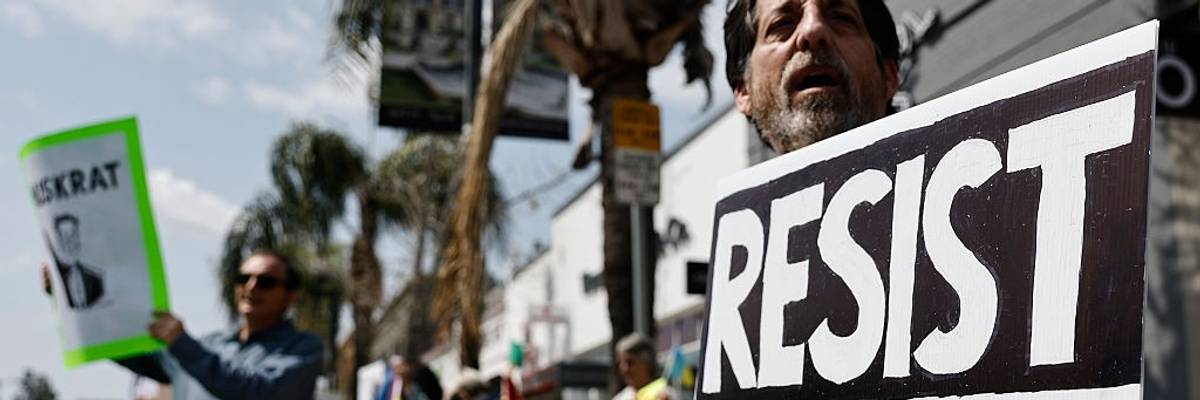
A person holds a 'Resist Billionaires' sign as protesters demonstrate against Tesla CEO Elon Musk’s Department of Government Efficiency (DOGE) initiatives during a nationwide “Tesla Takedown” rally outside a Tesla dealership on March 29, 2025 in Pasadena, California.
In an excerpt from an update of his book, Paul Rogat Loeb write of the importance of being willing to act whether or not we ever see the results. By letting go of the need for immediate victories, we can persist no matter how hard it gets.
This is an excerpt from The Impossible Will Take a Little While: Perseverance and Hope in Troubled Times, whose wholly updated edition has just been released.
Sometimes we achieve the impossible sooner than we expect. Knowing that can stiffen our resolve. But relying on quick victories can also tempt us to place too much emphasis on outcomes; it can cause us to become unduly impatient, brittle, with our will easily broken by defeats. A deeper, more farseeing hope, by contrast, combines realism with resilience, acknowledging setbacks and despair without giving in to them.
The answer may lie in what we could call “hope beyond hope.” It comes from being willing to act whether or not we ever see the results. By letting go of the need for immediate victories, we can persist no matter how hard it gets. Certainly, these victories matter immensely; if we’re facing an important election, for instance, we need to do everything possible to ensure that more humane values prevail, even if the candidates are less than ideal. Lives, and the continuation of democracy, can depend on the outcome. But we still don’t control the results.
The only way to discover what’s achievable is by taking action, trying new approaches, expanding the bounds of the possible.
Whatever we take on, our chances are better if we’re intentional. That means thinking about how we’ll best convey our story, approach crucial allies, expand our reach, and pressure the people or institutions we’re targeting. But since we won’t always win, we need ways to continue regardless of short-term outcomes. The more we accept that we can’t always dictate the results of our actions, the more we free ourselves to keep doing the necessary work.
Ian Bassin, who co-founded the cross-partisan coalition Protect Democracy, explores this paradox in “The Hard-Won Hope of the Long Defeat.” Using a phrase from The Lord of the Rings, Bassin takes lessons from the US Civil Rights movement and from Polish democracy activists who found ways to persist after the Communist dictatorship crushed the Solidarity movement that had embodied their hopes. Bassin explores the kinds of approaches that allow groups and individuals to continue to act even when progress is elusive, or has been reversed.
In “Staying the Course,” Mary-Wynne Ashford echoes Bassin’s perspectives: If we let go of immediate expectations, yet refuse to quit when our plight seems bleakest, she says, we can maintain our own sense of meaning and purpose—and also a deeper and more grounded hope. Ashford, former president of the Nobel Peace Prize-winning International Physicians for the Prevention of Nuclear War, begins by exploring her own temptation to despair. She compares the experience of working for change to that of Sisyphus as he endlessly rolls his rock up the hill, but with one crucial difference: Sisyphus acted alone. “We sustain each other in dark times,” Ashford writes, “sometimes simply by being present together... Whether or not we succeed in pushing the rock up the hill, there is meaning in the journey, not in the hope that one time we’ll be able to shed the rock forever and live in a perfect world.” We can’t predict the future, she says, but for all our doubt and hesitation, we can choose how to live and what to fight for. She therefore urges us to join with others in the pursuit of what may seem impossible, drawing strength from community, as Sisyphus, acting alone, could not.
Taking action together is essential if we’re going to keep on, both to exercise power and for the community that sustains us. We’ve explored this theme before: Nelson Mandela and his fellow prisoners passing news from cell to cell on toilet paper, Norwegian teachers standing strong, John Lewis’ image of children holding hands in a storm, the mothers of the Plaza de Mayo communing in silent witness, people coming out of their homes to challenge masked ICE agents.
There’s no more important lesson if we’re going to learn to persist: Isolation, whether physical or psychological, starves the human spirit; connection feeds and heals it. In her book Small Wonder, Barbara Kingsolver draws on this sense of connection to resist those “who say it’s ridiculous to imagine that the world could be made better than it is. When I come down to this feeling that I am an army of one standing out on the broad plain waving my little flag of hope, I call up a friend or two and offer to make dinner for us. We remind ourselves that we aren’t standing apart from the crowd, we are a crowd. We’re a prairie fire, a church choir, a major note in the American chord... We’re the theater of the street, the accurate joy of children’s hearts, the literature of tomorrow’s wisdom arrived today, just in time... In the long run, the choice of life over death is too good to resist.”
Embracing life also means opening ourselves up to grief. Though we heal best through community, we’re taught to keep our pain to ourselves, especially when it’s the product of powerful political or economic interests. Yet sharing outrage and grief is a critical part of keeping going. In “The Elm Dance,” Buddhist activist Joanna Macy describes the post-Soviet city of Novozybkov. A decade after the nuclear meltdown at Chernobyl, residents were riddled with cancers and birth defects. The superintendent of schools carried a Geiger counter in his car so he could tell children where not to play on a given day. Surrounding forests remain so radioactive that generations to come will never be able to walk safely among the trees.
Yet those affected found they could begin to recover from their losses by grieving together publicly, talking about the spring day when white ash fell from a clear sky. A mother asked what good her tears were if they couldn’t protect her daughters. “It feels like my heart is breaking open,” she said. “Maybe it will keep breaking again and again every day, I don’t know.” The simple act of telling what happened made her feel more connected to others. Through public mourning, she found another kind of community.
But what if we’re torn away from our communities? Under Stalin, prisoners were deliberately isolated in Siberia. Putin continues this tradition. Nadezhda Mandelstam recalls struggling to avoid drowning in despair when she and her husband, the poet Osip Mandelstam, were deported to a Stalinist labor camp. They didn’t know whether they’d ever be released, but Nadezhda refused to resign herself to the fate the dictatorship had assigned to her. Silence, she concluded, “is the real crime against humanity.”
Most of us will never experience conditions remotely as bleak and unforgiving as those endured by the Mandelstams or Alexei Navalny, even as the United States has been sending deportees to nearly equally brutal prisons in El Salvador, Eswatini, Rwanda, and South Sudan. But we still wrestle with powerlessness, particularly when so much is being attacked or destroyed. When this overwhelms us, it’s tempting simply to give up, or to rage at the world, convinced that no matter what we do, nothing will change. One way out of this dilemma is to identify modest actions we can undertake together with others, since we never know where they’ll lead.
History, in short, remains contingent. Nothing is guaranteed. Anything can happen.
While doomscrolling news stories, for example, I’ll often feel helpless before vast political forces. I’ll read about another assault on human dignity or abuse of power and clench my gut in rage. Then I’ll stop, take a breath, and think of some small way to act—a vigil I can join, a phone call I can make, some person or community I can fruitfully approach. Whether or not my efforts achieve their immediate goals, concentrating on these doable tasks helps me shift gears and put whatever strengths I can contribute in service of what I believe. At least, as Howard Zinn would say, I’m back in the game.
The “Tesla Takedown” boycott is an example of small actions mattering at a point when many felt helpless. Elon Musk played a huge role in electing Donald Trump for his second term, giving his campaign $290 million and promoting him endlessly on Twitter/X. In return, Trump made Musk the head of what they called DOGE (the so-called Department of Government Efficiency), which gutted critical federal programs in healthcare, scientific research, the environment, veterans’ services, education, and consumer protection and wholly eliminated the US Agency for International Development (USAID). DOGE also accessed citizens’ private governmental data, including Social Security records. The scale and speed of the cuts was likely intentional—Trump adviser Steve Bannon talked of “flooding the zone” to leave potential challengers dislocated and demoralized. And initially it had that result.
People began to protest in various ways, but aside from court challenges were scrambling to respond to the DOGE cuts and everything else the administration was doing. Then, in February 2025, three days after the first modest national days of protest, Boston University media studies professor Joan Donovan posted on Bluesky: “If Musk thinks he can speed run through DC downloading personal data, we can certainly bang some pots and pans on the sidewalks in front of Tesla dealerships. Bring your friends and make a little noise.” Donovan linked to a list of Tesla locations.
The post drew only 175 likes in the first four months. But actor and activist Alex Winter, who played Bill in Bill & Ted’s Excellent Adventure, reposted to his much larger list and created a website to promote a boycott campaign. Larger groups, including local Indivisible affiliates, spread the idea or took it up as a project. People began protesting in front of Tesla dealerships in hundreds of cities, chanting, carrying signs, wearing the soon-ubiquitous inflatable animal costumes, and presenting the clear message that buying a new Tesla meant supporting all that Trump and Musk were doing. Current Tesla owners joined as well, displaying bumper stickers or magnets saying things like “I Bought This Before Elon Went Crazy” or “Anti-Elon Tesla Club.” The protests engaged people who’d never participated before, renewed the spirits of others, and spread globally.
Through the first three quarters of 2025, the campaign helped decrease Tesla’s net income by 61% from the year before, drove its share of the US electric vehicle market to an eight-year low, and decreased European Tesla sales nearly 40%. As the pressure built, Musk said he was withdrawing from politics (although his donations still dwarf those of all but a few individuals). The ripples of Tesla Takedown seem a high-tech version of my friend Lisa and her handful of friends standing pathetic and bedraggled in the rain, and accidentally inspiring the political involvement of famed baby doctor Benjamin Spock.
When hope does seem elusive, it helps to cultivate what we might call radical stubbornness. As Jane Goodall reflected in The Book of Hope: “Sometimes I think, ‘Well, why on Earth do I feel hopeful?’ Because the problems facing the planet are huge. And if I analyze them carefully, they do sometimes seem absolutely impossible to solve. So why do I feel hopeful? Partly, because I’m obstinate. I just won’t give in. But it’s partly also because we cannot accurately predict what the future might bring... No one can know how it will all turn out.”
I remember one of the weeks when nothing was going right for my student voting project that I’ve mentioned. Anticipated donations fell through. Sympathetic contacts at major foundations unexpectedly left. Health issues hit key staffers. At one point, dealing with yet another personnel crisis and a looming shortage of funds, I was close to tears. But then I thought about the importance of what we were doing. I went out for a run. And then I got back on the phone the next day. Our community of existing supporters began to come through. The following week, we got the largest contribution in the history of the project and were able to hire some amazing new organizers.
In struggles for justice, neither victory nor failure is certain. As K. C. Golden writes in “The Inevitability Trap,” what we often call preordained becomes so only through our resignation. So the only way to discover what’s achievable is by taking action, trying new approaches, expanding the bounds of the possible. Climate Solutions, where Golden was policy director, mixes environmental advocacy with climate-change consulting for Pacific Northwest corporations, small businesses, and local governments. The sponsors of the group’s annual breakfast recently included Boeing and Alaska Airlines, with which Climate Solutions has been working to develop algae-based and other sustainable biofuels—a partnership that would have been nearly unimaginable a short while ago.
Will efforts like these and those Bill McKibben describes be enough to continue shifting the dynamics of this immensely challenging issue? In “Is There Hope on Climate Change?” David Roberts, of the Volts podcast, considers this question in light of the fact that we remain in a race to deploy the more sustainable alternatives despite the progress we’ve made. Echoing Howard Zinn, Roberts takes heart from community, from the intrinsic value of acting, and from the very uncertainty of prediction. Hope isn’t “about the future,” Roberts argues, “as much as it is about the present.” In other words, it’s the choices we make here and now that have the potential to alter a common future. “We don’t know when history might unlock the door,” Roberts concludes, “so we have no choice but to keep pushing on it.”
History, in short, remains contingent. Nothing is guaranteed. Anything can happen. As Barbara Ehrenreich observed, we’re given “no operating manual, no step-by-step instructions.” But what if we assume that our own seemingly small actions could, when joined with those of others, actually change history—and act on that assumption even when the odds seem impossible? That belief unites everyone in this book and is key to their powerful lives and words. It’s also why it’s so critical to refuse to accept the apparent limits of particular historical moments, particularly in hard times.
Wheatley suggests concentrating less on the measurable impact of what we do, and more on the value and appropriateness of our work and on the communities we build in the process.
As my longtime friend Atlanta activist and trainer Sonya Vetra Tinsley reminds us, in “You’ve Got to Pick Your Team”: “We’ll never know who’s really going to prevail.” So I just have to decide which team seems happier, which side I’d rather be on.” For herself, she’s chosen the team that keeps working for change over the team of manipulation, fear, and cynical resignation.
Ta-Nehisi Coates believes in the struggle for justice, but cautions that “if you hope that in your lifetime things will be necessarily improved... you’re setting yourself up for false hope... If you hope that your struggle might in your children’s generation, your grandchildren’s generation, your descendants’ generation, actually lead to a better world... I think that’s a hope based on history and rooted in something very, very real."
Coates remembered being taken as a child to various political events in the African American community. Stressing the struggles and sacrifices of people before him, he said, “There was this whole tradition of saying libations where you poured water into a plant representing the earth and folks who had gone back to the earth. And you would say names, and those names could be anybody from Malcolm X to Toussaint L’Ouverture to your Aunt Grace to whoever it was who you felt had somehow sacrificed for you to be there.” However we believe things will turn out, that connectedness between past, present, and future can help keep us going.
Even in the bleakest situations, we still need to continue acting however we can, if just by standing up for our fellow humans. In “Next Year in Mas’Ha,” Starhawk wrestles with her own fury, bitterness, and despair after an Israeli soldier drove an armored bulldozer over one of her comrades, Rachel Corrie, and Israeli soldiers shot two others. Corrie was killed in the city of Rafah in Gaza while volunteering with the International Solidarity Movement, a nonviolent resistance effort uniting Palestinians and Jews. After the deaths, Starhawk felt in a mood to “smash something.”
Instead, she traveled to the threatened West Bank village of Mas’Ha, on an Israeli settlers’ bus “full of elderly women who could have been my aunts and old men who could have been my uncles,” eventually reaching a Palestinian town where ancient olive groves were about to be uprooted and buried to make way for one of Israel’s ever-advancing “security” walls. Surrounded by anguish, she experienced an unlikely moment of possibility during a Seder that brought together Palestinians and their young Israeli supporters. Watching “people who, faced with utter destruction of everything they need and hold dear, [open] their hearts to the children of the enemy and [ask] for help,” Starhawk felt the remote possibility of hope.
That hope has gotten far more elusive. Since Starhawk wrote her piece, Israeli settlers on the occupied West Bank have continued to destroy homes, cut down olive groves, attack farmers, and do everything they can to eliminate the possibility of a future for those who’ve lived there for generations. In October 2023, Hamas conducted a horrific and unconscionable attack on Israel, killing 1,210 people. Within two years, the Israeli military killed more than 70,000 people in Gaza, comparable to over 10 million deaths in a country the size of the United States. They also systematically destroyed Gaza’s cities and infrastructure, bombing and demolishing apartments, hospitals, schools, and water and sanitation systems. Starhawk grew up collecting pennies to plant trees in Israel. Now, she writes: “Forcing children to starve will not make Israelis safe. It will, in fact, destroy Israel.” She has continued working for peace nonetheless, and a world where we reach beyond our tribes.
Hope endures when we persist despite sorrows and defeats, even the darkest ones. The son of Mexican poet, journalist, and Catholic social justice activist Javier Sicilia was murdered by drug cartels. In response, Sicilia founded the Movement for Peace with Justice and Dignity, which organized silent marches and caravans across Mexico and the United States. The caravans demanded government reform and an end to a “war on drugs” strategy that Sicilia said only fed the cycles of violence. As Sicilia said in those marches, in a phrase adapted from the Greek poet Dinos Christianopoulos: “They buried us thinking we were corpses. They didn’t know we were seeds.”
So even after loss, persistence matters as much as ever. As Rebecca Solnit posted the evening of Trump’s 2024 election, “The fact that we cannot save everything does not mean we cannot save anything and everything we can save is worth saving.”
Sometimes we don’t know our impact until long after we take action. In 1969, Richard Nixon threatened to escalate the Vietnam War with nuclear strikes unless North Vietnam forced the National Liberation Front in the South to surrender. He had military advisers prepare detailed plans. But two weeks before his deadline, millions of Americans joined the nationwide “Moratorium” protests—the largest coordinated day of protest in the United States up to that point. When half a million people marched past the White House the following month, Nixon’s spokesperson announced that the president had watched the Washington Redskins football game instead, claiming the demonstrators hadn’t affected his policies in the slightest.
Nixon’s seeming indifference fed the frustration of far too many in the peace movement and accelerated the descent of a small number of people into violence that tainted the movement for decades to come. Yet, as Nixon’s memoirs revealed much later, he privately decided that the protests had so polarized public opinion that he would have to abandon his threat. Until the memoirs were published, Moratorium participants didn’t know that their demonstrations may have actually helped prevent a nuclear attack.
Similarly, “No Kings” protestors who challenged Trump could never know the precise effects of their protests. Donald Trump dismissed them to the point of posting an AI video of himself defecating from a plane on their marches. Yet their efforts built resistant community, gave courage to others, and impacted the culture in ways we may never precisely know.
Since we can’t predict the future or even always read the impact of our actions in the present, perhaps, as Margaret Wheatley suggests in “From Hope to Hopelessness,” we should let go of expectations altogether. “Anytime we hope for a certain outcome,” she writes, “and work hard to make it happen, then we also introduce fear—fear of failing, fear of loss.” Instead, Wheatley suggests concentrating less on the measurable impact of what we do, and more on the value and appropriateness of our work and on the communities we build in the process. It’s no accident that so many of those who’ve devoted their lives to creating a more humane world share this outlook, and continue doing the necessary work whatever their immediate successes or failures.
Excerpted from the wholly updated new edition of The Impossible Will Take a Little While: Perseverance and Hope in Troubled Times, by Paul Rogat Loeb (Basic Books, Oct 13, 2026), theimpossible.org. © Paul Loeb 2026.
Dear Common Dreams reader, It’s been nearly 30 years since I co-founded Common Dreams with my late wife, Lina Newhouser. We had the radical notion that journalism should serve the public good, not corporate profits. It was clear to us from the outset what it would take to build such a project. No paid advertisements. No corporate sponsors. No millionaire publisher telling us what to think or do. Many people said we wouldn't last a year, but we proved those doubters wrong. Together with a tremendous team of journalists and dedicated staff, we built an independent media outlet free from the constraints of profits and corporate control. Our mission has always been simple: To inform. To inspire. To ignite change for the common good. Building Common Dreams was not easy. Our survival was never guaranteed. When you take on the most powerful forces—Wall Street greed, fossil fuel industry destruction, Big Tech lobbyists, and uber-rich oligarchs who have spent billions upon billions rigging the economy and democracy in their favor—the only bulwark you have is supporters who believe in your work. But here’s the urgent message from me today. It's never been this bad out there. And it's never been this hard to keep us going. At the very moment Common Dreams is most needed, the threats we face are intensifying. We need your support now more than ever. We don't accept corporate advertising and never will. We don't have a paywall because we don't think people should be blocked from critical news based on their ability to pay. Everything we do is funded by the donations of readers like you. When everyone does the little they can afford, we are strong. But if that support retreats or dries up, so do we. Will you donate now to make sure Common Dreams not only survives but thrives? —Craig Brown, Co-founder |
This is an excerpt from The Impossible Will Take a Little While: Perseverance and Hope in Troubled Times, whose wholly updated edition has just been released.
Sometimes we achieve the impossible sooner than we expect. Knowing that can stiffen our resolve. But relying on quick victories can also tempt us to place too much emphasis on outcomes; it can cause us to become unduly impatient, brittle, with our will easily broken by defeats. A deeper, more farseeing hope, by contrast, combines realism with resilience, acknowledging setbacks and despair without giving in to them.
The answer may lie in what we could call “hope beyond hope.” It comes from being willing to act whether or not we ever see the results. By letting go of the need for immediate victories, we can persist no matter how hard it gets. Certainly, these victories matter immensely; if we’re facing an important election, for instance, we need to do everything possible to ensure that more humane values prevail, even if the candidates are less than ideal. Lives, and the continuation of democracy, can depend on the outcome. But we still don’t control the results.
The only way to discover what’s achievable is by taking action, trying new approaches, expanding the bounds of the possible.
Whatever we take on, our chances are better if we’re intentional. That means thinking about how we’ll best convey our story, approach crucial allies, expand our reach, and pressure the people or institutions we’re targeting. But since we won’t always win, we need ways to continue regardless of short-term outcomes. The more we accept that we can’t always dictate the results of our actions, the more we free ourselves to keep doing the necessary work.
Ian Bassin, who co-founded the cross-partisan coalition Protect Democracy, explores this paradox in “The Hard-Won Hope of the Long Defeat.” Using a phrase from The Lord of the Rings, Bassin takes lessons from the US Civil Rights movement and from Polish democracy activists who found ways to persist after the Communist dictatorship crushed the Solidarity movement that had embodied their hopes. Bassin explores the kinds of approaches that allow groups and individuals to continue to act even when progress is elusive, or has been reversed.
In “Staying the Course,” Mary-Wynne Ashford echoes Bassin’s perspectives: If we let go of immediate expectations, yet refuse to quit when our plight seems bleakest, she says, we can maintain our own sense of meaning and purpose—and also a deeper and more grounded hope. Ashford, former president of the Nobel Peace Prize-winning International Physicians for the Prevention of Nuclear War, begins by exploring her own temptation to despair. She compares the experience of working for change to that of Sisyphus as he endlessly rolls his rock up the hill, but with one crucial difference: Sisyphus acted alone. “We sustain each other in dark times,” Ashford writes, “sometimes simply by being present together... Whether or not we succeed in pushing the rock up the hill, there is meaning in the journey, not in the hope that one time we’ll be able to shed the rock forever and live in a perfect world.” We can’t predict the future, she says, but for all our doubt and hesitation, we can choose how to live and what to fight for. She therefore urges us to join with others in the pursuit of what may seem impossible, drawing strength from community, as Sisyphus, acting alone, could not.
Taking action together is essential if we’re going to keep on, both to exercise power and for the community that sustains us. We’ve explored this theme before: Nelson Mandela and his fellow prisoners passing news from cell to cell on toilet paper, Norwegian teachers standing strong, John Lewis’ image of children holding hands in a storm, the mothers of the Plaza de Mayo communing in silent witness, people coming out of their homes to challenge masked ICE agents.
There’s no more important lesson if we’re going to learn to persist: Isolation, whether physical or psychological, starves the human spirit; connection feeds and heals it. In her book Small Wonder, Barbara Kingsolver draws on this sense of connection to resist those “who say it’s ridiculous to imagine that the world could be made better than it is. When I come down to this feeling that I am an army of one standing out on the broad plain waving my little flag of hope, I call up a friend or two and offer to make dinner for us. We remind ourselves that we aren’t standing apart from the crowd, we are a crowd. We’re a prairie fire, a church choir, a major note in the American chord... We’re the theater of the street, the accurate joy of children’s hearts, the literature of tomorrow’s wisdom arrived today, just in time... In the long run, the choice of life over death is too good to resist.”
Embracing life also means opening ourselves up to grief. Though we heal best through community, we’re taught to keep our pain to ourselves, especially when it’s the product of powerful political or economic interests. Yet sharing outrage and grief is a critical part of keeping going. In “The Elm Dance,” Buddhist activist Joanna Macy describes the post-Soviet city of Novozybkov. A decade after the nuclear meltdown at Chernobyl, residents were riddled with cancers and birth defects. The superintendent of schools carried a Geiger counter in his car so he could tell children where not to play on a given day. Surrounding forests remain so radioactive that generations to come will never be able to walk safely among the trees.
Yet those affected found they could begin to recover from their losses by grieving together publicly, talking about the spring day when white ash fell from a clear sky. A mother asked what good her tears were if they couldn’t protect her daughters. “It feels like my heart is breaking open,” she said. “Maybe it will keep breaking again and again every day, I don’t know.” The simple act of telling what happened made her feel more connected to others. Through public mourning, she found another kind of community.
But what if we’re torn away from our communities? Under Stalin, prisoners were deliberately isolated in Siberia. Putin continues this tradition. Nadezhda Mandelstam recalls struggling to avoid drowning in despair when she and her husband, the poet Osip Mandelstam, were deported to a Stalinist labor camp. They didn’t know whether they’d ever be released, but Nadezhda refused to resign herself to the fate the dictatorship had assigned to her. Silence, she concluded, “is the real crime against humanity.”
Most of us will never experience conditions remotely as bleak and unforgiving as those endured by the Mandelstams or Alexei Navalny, even as the United States has been sending deportees to nearly equally brutal prisons in El Salvador, Eswatini, Rwanda, and South Sudan. But we still wrestle with powerlessness, particularly when so much is being attacked or destroyed. When this overwhelms us, it’s tempting simply to give up, or to rage at the world, convinced that no matter what we do, nothing will change. One way out of this dilemma is to identify modest actions we can undertake together with others, since we never know where they’ll lead.
History, in short, remains contingent. Nothing is guaranteed. Anything can happen.
While doomscrolling news stories, for example, I’ll often feel helpless before vast political forces. I’ll read about another assault on human dignity or abuse of power and clench my gut in rage. Then I’ll stop, take a breath, and think of some small way to act—a vigil I can join, a phone call I can make, some person or community I can fruitfully approach. Whether or not my efforts achieve their immediate goals, concentrating on these doable tasks helps me shift gears and put whatever strengths I can contribute in service of what I believe. At least, as Howard Zinn would say, I’m back in the game.
The “Tesla Takedown” boycott is an example of small actions mattering at a point when many felt helpless. Elon Musk played a huge role in electing Donald Trump for his second term, giving his campaign $290 million and promoting him endlessly on Twitter/X. In return, Trump made Musk the head of what they called DOGE (the so-called Department of Government Efficiency), which gutted critical federal programs in healthcare, scientific research, the environment, veterans’ services, education, and consumer protection and wholly eliminated the US Agency for International Development (USAID). DOGE also accessed citizens’ private governmental data, including Social Security records. The scale and speed of the cuts was likely intentional—Trump adviser Steve Bannon talked of “flooding the zone” to leave potential challengers dislocated and demoralized. And initially it had that result.
People began to protest in various ways, but aside from court challenges were scrambling to respond to the DOGE cuts and everything else the administration was doing. Then, in February 2025, three days after the first modest national days of protest, Boston University media studies professor Joan Donovan posted on Bluesky: “If Musk thinks he can speed run through DC downloading personal data, we can certainly bang some pots and pans on the sidewalks in front of Tesla dealerships. Bring your friends and make a little noise.” Donovan linked to a list of Tesla locations.
The post drew only 175 likes in the first four months. But actor and activist Alex Winter, who played Bill in Bill & Ted’s Excellent Adventure, reposted to his much larger list and created a website to promote a boycott campaign. Larger groups, including local Indivisible affiliates, spread the idea or took it up as a project. People began protesting in front of Tesla dealerships in hundreds of cities, chanting, carrying signs, wearing the soon-ubiquitous inflatable animal costumes, and presenting the clear message that buying a new Tesla meant supporting all that Trump and Musk were doing. Current Tesla owners joined as well, displaying bumper stickers or magnets saying things like “I Bought This Before Elon Went Crazy” or “Anti-Elon Tesla Club.” The protests engaged people who’d never participated before, renewed the spirits of others, and spread globally.
Through the first three quarters of 2025, the campaign helped decrease Tesla’s net income by 61% from the year before, drove its share of the US electric vehicle market to an eight-year low, and decreased European Tesla sales nearly 40%. As the pressure built, Musk said he was withdrawing from politics (although his donations still dwarf those of all but a few individuals). The ripples of Tesla Takedown seem a high-tech version of my friend Lisa and her handful of friends standing pathetic and bedraggled in the rain, and accidentally inspiring the political involvement of famed baby doctor Benjamin Spock.
When hope does seem elusive, it helps to cultivate what we might call radical stubbornness. As Jane Goodall reflected in The Book of Hope: “Sometimes I think, ‘Well, why on Earth do I feel hopeful?’ Because the problems facing the planet are huge. And if I analyze them carefully, they do sometimes seem absolutely impossible to solve. So why do I feel hopeful? Partly, because I’m obstinate. I just won’t give in. But it’s partly also because we cannot accurately predict what the future might bring... No one can know how it will all turn out.”
I remember one of the weeks when nothing was going right for my student voting project that I’ve mentioned. Anticipated donations fell through. Sympathetic contacts at major foundations unexpectedly left. Health issues hit key staffers. At one point, dealing with yet another personnel crisis and a looming shortage of funds, I was close to tears. But then I thought about the importance of what we were doing. I went out for a run. And then I got back on the phone the next day. Our community of existing supporters began to come through. The following week, we got the largest contribution in the history of the project and were able to hire some amazing new organizers.
In struggles for justice, neither victory nor failure is certain. As K. C. Golden writes in “The Inevitability Trap,” what we often call preordained becomes so only through our resignation. So the only way to discover what’s achievable is by taking action, trying new approaches, expanding the bounds of the possible. Climate Solutions, where Golden was policy director, mixes environmental advocacy with climate-change consulting for Pacific Northwest corporations, small businesses, and local governments. The sponsors of the group’s annual breakfast recently included Boeing and Alaska Airlines, with which Climate Solutions has been working to develop algae-based and other sustainable biofuels—a partnership that would have been nearly unimaginable a short while ago.
Will efforts like these and those Bill McKibben describes be enough to continue shifting the dynamics of this immensely challenging issue? In “Is There Hope on Climate Change?” David Roberts, of the Volts podcast, considers this question in light of the fact that we remain in a race to deploy the more sustainable alternatives despite the progress we’ve made. Echoing Howard Zinn, Roberts takes heart from community, from the intrinsic value of acting, and from the very uncertainty of prediction. Hope isn’t “about the future,” Roberts argues, “as much as it is about the present.” In other words, it’s the choices we make here and now that have the potential to alter a common future. “We don’t know when history might unlock the door,” Roberts concludes, “so we have no choice but to keep pushing on it.”
History, in short, remains contingent. Nothing is guaranteed. Anything can happen. As Barbara Ehrenreich observed, we’re given “no operating manual, no step-by-step instructions.” But what if we assume that our own seemingly small actions could, when joined with those of others, actually change history—and act on that assumption even when the odds seem impossible? That belief unites everyone in this book and is key to their powerful lives and words. It’s also why it’s so critical to refuse to accept the apparent limits of particular historical moments, particularly in hard times.
Wheatley suggests concentrating less on the measurable impact of what we do, and more on the value and appropriateness of our work and on the communities we build in the process.
As my longtime friend Atlanta activist and trainer Sonya Vetra Tinsley reminds us, in “You’ve Got to Pick Your Team”: “We’ll never know who’s really going to prevail.” So I just have to decide which team seems happier, which side I’d rather be on.” For herself, she’s chosen the team that keeps working for change over the team of manipulation, fear, and cynical resignation.
Ta-Nehisi Coates believes in the struggle for justice, but cautions that “if you hope that in your lifetime things will be necessarily improved... you’re setting yourself up for false hope... If you hope that your struggle might in your children’s generation, your grandchildren’s generation, your descendants’ generation, actually lead to a better world... I think that’s a hope based on history and rooted in something very, very real."
Coates remembered being taken as a child to various political events in the African American community. Stressing the struggles and sacrifices of people before him, he said, “There was this whole tradition of saying libations where you poured water into a plant representing the earth and folks who had gone back to the earth. And you would say names, and those names could be anybody from Malcolm X to Toussaint L’Ouverture to your Aunt Grace to whoever it was who you felt had somehow sacrificed for you to be there.” However we believe things will turn out, that connectedness between past, present, and future can help keep us going.
Even in the bleakest situations, we still need to continue acting however we can, if just by standing up for our fellow humans. In “Next Year in Mas’Ha,” Starhawk wrestles with her own fury, bitterness, and despair after an Israeli soldier drove an armored bulldozer over one of her comrades, Rachel Corrie, and Israeli soldiers shot two others. Corrie was killed in the city of Rafah in Gaza while volunteering with the International Solidarity Movement, a nonviolent resistance effort uniting Palestinians and Jews. After the deaths, Starhawk felt in a mood to “smash something.”
Instead, she traveled to the threatened West Bank village of Mas’Ha, on an Israeli settlers’ bus “full of elderly women who could have been my aunts and old men who could have been my uncles,” eventually reaching a Palestinian town where ancient olive groves were about to be uprooted and buried to make way for one of Israel’s ever-advancing “security” walls. Surrounded by anguish, she experienced an unlikely moment of possibility during a Seder that brought together Palestinians and their young Israeli supporters. Watching “people who, faced with utter destruction of everything they need and hold dear, [open] their hearts to the children of the enemy and [ask] for help,” Starhawk felt the remote possibility of hope.
That hope has gotten far more elusive. Since Starhawk wrote her piece, Israeli settlers on the occupied West Bank have continued to destroy homes, cut down olive groves, attack farmers, and do everything they can to eliminate the possibility of a future for those who’ve lived there for generations. In October 2023, Hamas conducted a horrific and unconscionable attack on Israel, killing 1,210 people. Within two years, the Israeli military killed more than 70,000 people in Gaza, comparable to over 10 million deaths in a country the size of the United States. They also systematically destroyed Gaza’s cities and infrastructure, bombing and demolishing apartments, hospitals, schools, and water and sanitation systems. Starhawk grew up collecting pennies to plant trees in Israel. Now, she writes: “Forcing children to starve will not make Israelis safe. It will, in fact, destroy Israel.” She has continued working for peace nonetheless, and a world where we reach beyond our tribes.
Hope endures when we persist despite sorrows and defeats, even the darkest ones. The son of Mexican poet, journalist, and Catholic social justice activist Javier Sicilia was murdered by drug cartels. In response, Sicilia founded the Movement for Peace with Justice and Dignity, which organized silent marches and caravans across Mexico and the United States. The caravans demanded government reform and an end to a “war on drugs” strategy that Sicilia said only fed the cycles of violence. As Sicilia said in those marches, in a phrase adapted from the Greek poet Dinos Christianopoulos: “They buried us thinking we were corpses. They didn’t know we were seeds.”
So even after loss, persistence matters as much as ever. As Rebecca Solnit posted the evening of Trump’s 2024 election, “The fact that we cannot save everything does not mean we cannot save anything and everything we can save is worth saving.”
Sometimes we don’t know our impact until long after we take action. In 1969, Richard Nixon threatened to escalate the Vietnam War with nuclear strikes unless North Vietnam forced the National Liberation Front in the South to surrender. He had military advisers prepare detailed plans. But two weeks before his deadline, millions of Americans joined the nationwide “Moratorium” protests—the largest coordinated day of protest in the United States up to that point. When half a million people marched past the White House the following month, Nixon’s spokesperson announced that the president had watched the Washington Redskins football game instead, claiming the demonstrators hadn’t affected his policies in the slightest.
Nixon’s seeming indifference fed the frustration of far too many in the peace movement and accelerated the descent of a small number of people into violence that tainted the movement for decades to come. Yet, as Nixon’s memoirs revealed much later, he privately decided that the protests had so polarized public opinion that he would have to abandon his threat. Until the memoirs were published, Moratorium participants didn’t know that their demonstrations may have actually helped prevent a nuclear attack.
Similarly, “No Kings” protestors who challenged Trump could never know the precise effects of their protests. Donald Trump dismissed them to the point of posting an AI video of himself defecating from a plane on their marches. Yet their efforts built resistant community, gave courage to others, and impacted the culture in ways we may never precisely know.
Since we can’t predict the future or even always read the impact of our actions in the present, perhaps, as Margaret Wheatley suggests in “From Hope to Hopelessness,” we should let go of expectations altogether. “Anytime we hope for a certain outcome,” she writes, “and work hard to make it happen, then we also introduce fear—fear of failing, fear of loss.” Instead, Wheatley suggests concentrating less on the measurable impact of what we do, and more on the value and appropriateness of our work and on the communities we build in the process. It’s no accident that so many of those who’ve devoted their lives to creating a more humane world share this outlook, and continue doing the necessary work whatever their immediate successes or failures.
Excerpted from the wholly updated new edition of The Impossible Will Take a Little While: Perseverance and Hope in Troubled Times, by Paul Rogat Loeb (Basic Books, Oct 13, 2026), theimpossible.org. © Paul Loeb 2026.
This is an excerpt from The Impossible Will Take a Little While: Perseverance and Hope in Troubled Times, whose wholly updated edition has just been released.
Sometimes we achieve the impossible sooner than we expect. Knowing that can stiffen our resolve. But relying on quick victories can also tempt us to place too much emphasis on outcomes; it can cause us to become unduly impatient, brittle, with our will easily broken by defeats. A deeper, more farseeing hope, by contrast, combines realism with resilience, acknowledging setbacks and despair without giving in to them.
The answer may lie in what we could call “hope beyond hope.” It comes from being willing to act whether or not we ever see the results. By letting go of the need for immediate victories, we can persist no matter how hard it gets. Certainly, these victories matter immensely; if we’re facing an important election, for instance, we need to do everything possible to ensure that more humane values prevail, even if the candidates are less than ideal. Lives, and the continuation of democracy, can depend on the outcome. But we still don’t control the results.
The only way to discover what’s achievable is by taking action, trying new approaches, expanding the bounds of the possible.
Whatever we take on, our chances are better if we’re intentional. That means thinking about how we’ll best convey our story, approach crucial allies, expand our reach, and pressure the people or institutions we’re targeting. But since we won’t always win, we need ways to continue regardless of short-term outcomes. The more we accept that we can’t always dictate the results of our actions, the more we free ourselves to keep doing the necessary work.
Ian Bassin, who co-founded the cross-partisan coalition Protect Democracy, explores this paradox in “The Hard-Won Hope of the Long Defeat.” Using a phrase from The Lord of the Rings, Bassin takes lessons from the US Civil Rights movement and from Polish democracy activists who found ways to persist after the Communist dictatorship crushed the Solidarity movement that had embodied their hopes. Bassin explores the kinds of approaches that allow groups and individuals to continue to act even when progress is elusive, or has been reversed.
In “Staying the Course,” Mary-Wynne Ashford echoes Bassin’s perspectives: If we let go of immediate expectations, yet refuse to quit when our plight seems bleakest, she says, we can maintain our own sense of meaning and purpose—and also a deeper and more grounded hope. Ashford, former president of the Nobel Peace Prize-winning International Physicians for the Prevention of Nuclear War, begins by exploring her own temptation to despair. She compares the experience of working for change to that of Sisyphus as he endlessly rolls his rock up the hill, but with one crucial difference: Sisyphus acted alone. “We sustain each other in dark times,” Ashford writes, “sometimes simply by being present together... Whether or not we succeed in pushing the rock up the hill, there is meaning in the journey, not in the hope that one time we’ll be able to shed the rock forever and live in a perfect world.” We can’t predict the future, she says, but for all our doubt and hesitation, we can choose how to live and what to fight for. She therefore urges us to join with others in the pursuit of what may seem impossible, drawing strength from community, as Sisyphus, acting alone, could not.
Taking action together is essential if we’re going to keep on, both to exercise power and for the community that sustains us. We’ve explored this theme before: Nelson Mandela and his fellow prisoners passing news from cell to cell on toilet paper, Norwegian teachers standing strong, John Lewis’ image of children holding hands in a storm, the mothers of the Plaza de Mayo communing in silent witness, people coming out of their homes to challenge masked ICE agents.
There’s no more important lesson if we’re going to learn to persist: Isolation, whether physical or psychological, starves the human spirit; connection feeds and heals it. In her book Small Wonder, Barbara Kingsolver draws on this sense of connection to resist those “who say it’s ridiculous to imagine that the world could be made better than it is. When I come down to this feeling that I am an army of one standing out on the broad plain waving my little flag of hope, I call up a friend or two and offer to make dinner for us. We remind ourselves that we aren’t standing apart from the crowd, we are a crowd. We’re a prairie fire, a church choir, a major note in the American chord... We’re the theater of the street, the accurate joy of children’s hearts, the literature of tomorrow’s wisdom arrived today, just in time... In the long run, the choice of life over death is too good to resist.”
Embracing life also means opening ourselves up to grief. Though we heal best through community, we’re taught to keep our pain to ourselves, especially when it’s the product of powerful political or economic interests. Yet sharing outrage and grief is a critical part of keeping going. In “The Elm Dance,” Buddhist activist Joanna Macy describes the post-Soviet city of Novozybkov. A decade after the nuclear meltdown at Chernobyl, residents were riddled with cancers and birth defects. The superintendent of schools carried a Geiger counter in his car so he could tell children where not to play on a given day. Surrounding forests remain so radioactive that generations to come will never be able to walk safely among the trees.
Yet those affected found they could begin to recover from their losses by grieving together publicly, talking about the spring day when white ash fell from a clear sky. A mother asked what good her tears were if they couldn’t protect her daughters. “It feels like my heart is breaking open,” she said. “Maybe it will keep breaking again and again every day, I don’t know.” The simple act of telling what happened made her feel more connected to others. Through public mourning, she found another kind of community.
But what if we’re torn away from our communities? Under Stalin, prisoners were deliberately isolated in Siberia. Putin continues this tradition. Nadezhda Mandelstam recalls struggling to avoid drowning in despair when she and her husband, the poet Osip Mandelstam, were deported to a Stalinist labor camp. They didn’t know whether they’d ever be released, but Nadezhda refused to resign herself to the fate the dictatorship had assigned to her. Silence, she concluded, “is the real crime against humanity.”
Most of us will never experience conditions remotely as bleak and unforgiving as those endured by the Mandelstams or Alexei Navalny, even as the United States has been sending deportees to nearly equally brutal prisons in El Salvador, Eswatini, Rwanda, and South Sudan. But we still wrestle with powerlessness, particularly when so much is being attacked or destroyed. When this overwhelms us, it’s tempting simply to give up, or to rage at the world, convinced that no matter what we do, nothing will change. One way out of this dilemma is to identify modest actions we can undertake together with others, since we never know where they’ll lead.
History, in short, remains contingent. Nothing is guaranteed. Anything can happen.
While doomscrolling news stories, for example, I’ll often feel helpless before vast political forces. I’ll read about another assault on human dignity or abuse of power and clench my gut in rage. Then I’ll stop, take a breath, and think of some small way to act—a vigil I can join, a phone call I can make, some person or community I can fruitfully approach. Whether or not my efforts achieve their immediate goals, concentrating on these doable tasks helps me shift gears and put whatever strengths I can contribute in service of what I believe. At least, as Howard Zinn would say, I’m back in the game.
The “Tesla Takedown” boycott is an example of small actions mattering at a point when many felt helpless. Elon Musk played a huge role in electing Donald Trump for his second term, giving his campaign $290 million and promoting him endlessly on Twitter/X. In return, Trump made Musk the head of what they called DOGE (the so-called Department of Government Efficiency), which gutted critical federal programs in healthcare, scientific research, the environment, veterans’ services, education, and consumer protection and wholly eliminated the US Agency for International Development (USAID). DOGE also accessed citizens’ private governmental data, including Social Security records. The scale and speed of the cuts was likely intentional—Trump adviser Steve Bannon talked of “flooding the zone” to leave potential challengers dislocated and demoralized. And initially it had that result.
People began to protest in various ways, but aside from court challenges were scrambling to respond to the DOGE cuts and everything else the administration was doing. Then, in February 2025, three days after the first modest national days of protest, Boston University media studies professor Joan Donovan posted on Bluesky: “If Musk thinks he can speed run through DC downloading personal data, we can certainly bang some pots and pans on the sidewalks in front of Tesla dealerships. Bring your friends and make a little noise.” Donovan linked to a list of Tesla locations.
The post drew only 175 likes in the first four months. But actor and activist Alex Winter, who played Bill in Bill & Ted’s Excellent Adventure, reposted to his much larger list and created a website to promote a boycott campaign. Larger groups, including local Indivisible affiliates, spread the idea or took it up as a project. People began protesting in front of Tesla dealerships in hundreds of cities, chanting, carrying signs, wearing the soon-ubiquitous inflatable animal costumes, and presenting the clear message that buying a new Tesla meant supporting all that Trump and Musk were doing. Current Tesla owners joined as well, displaying bumper stickers or magnets saying things like “I Bought This Before Elon Went Crazy” or “Anti-Elon Tesla Club.” The protests engaged people who’d never participated before, renewed the spirits of others, and spread globally.
Through the first three quarters of 2025, the campaign helped decrease Tesla’s net income by 61% from the year before, drove its share of the US electric vehicle market to an eight-year low, and decreased European Tesla sales nearly 40%. As the pressure built, Musk said he was withdrawing from politics (although his donations still dwarf those of all but a few individuals). The ripples of Tesla Takedown seem a high-tech version of my friend Lisa and her handful of friends standing pathetic and bedraggled in the rain, and accidentally inspiring the political involvement of famed baby doctor Benjamin Spock.
When hope does seem elusive, it helps to cultivate what we might call radical stubbornness. As Jane Goodall reflected in The Book of Hope: “Sometimes I think, ‘Well, why on Earth do I feel hopeful?’ Because the problems facing the planet are huge. And if I analyze them carefully, they do sometimes seem absolutely impossible to solve. So why do I feel hopeful? Partly, because I’m obstinate. I just won’t give in. But it’s partly also because we cannot accurately predict what the future might bring... No one can know how it will all turn out.”
I remember one of the weeks when nothing was going right for my student voting project that I’ve mentioned. Anticipated donations fell through. Sympathetic contacts at major foundations unexpectedly left. Health issues hit key staffers. At one point, dealing with yet another personnel crisis and a looming shortage of funds, I was close to tears. But then I thought about the importance of what we were doing. I went out for a run. And then I got back on the phone the next day. Our community of existing supporters began to come through. The following week, we got the largest contribution in the history of the project and were able to hire some amazing new organizers.
In struggles for justice, neither victory nor failure is certain. As K. C. Golden writes in “The Inevitability Trap,” what we often call preordained becomes so only through our resignation. So the only way to discover what’s achievable is by taking action, trying new approaches, expanding the bounds of the possible. Climate Solutions, where Golden was policy director, mixes environmental advocacy with climate-change consulting for Pacific Northwest corporations, small businesses, and local governments. The sponsors of the group’s annual breakfast recently included Boeing and Alaska Airlines, with which Climate Solutions has been working to develop algae-based and other sustainable biofuels—a partnership that would have been nearly unimaginable a short while ago.
Will efforts like these and those Bill McKibben describes be enough to continue shifting the dynamics of this immensely challenging issue? In “Is There Hope on Climate Change?” David Roberts, of the Volts podcast, considers this question in light of the fact that we remain in a race to deploy the more sustainable alternatives despite the progress we’ve made. Echoing Howard Zinn, Roberts takes heart from community, from the intrinsic value of acting, and from the very uncertainty of prediction. Hope isn’t “about the future,” Roberts argues, “as much as it is about the present.” In other words, it’s the choices we make here and now that have the potential to alter a common future. “We don’t know when history might unlock the door,” Roberts concludes, “so we have no choice but to keep pushing on it.”
History, in short, remains contingent. Nothing is guaranteed. Anything can happen. As Barbara Ehrenreich observed, we’re given “no operating manual, no step-by-step instructions.” But what if we assume that our own seemingly small actions could, when joined with those of others, actually change history—and act on that assumption even when the odds seem impossible? That belief unites everyone in this book and is key to their powerful lives and words. It’s also why it’s so critical to refuse to accept the apparent limits of particular historical moments, particularly in hard times.
Wheatley suggests concentrating less on the measurable impact of what we do, and more on the value and appropriateness of our work and on the communities we build in the process.
As my longtime friend Atlanta activist and trainer Sonya Vetra Tinsley reminds us, in “You’ve Got to Pick Your Team”: “We’ll never know who’s really going to prevail.” So I just have to decide which team seems happier, which side I’d rather be on.” For herself, she’s chosen the team that keeps working for change over the team of manipulation, fear, and cynical resignation.
Ta-Nehisi Coates believes in the struggle for justice, but cautions that “if you hope that in your lifetime things will be necessarily improved... you’re setting yourself up for false hope... If you hope that your struggle might in your children’s generation, your grandchildren’s generation, your descendants’ generation, actually lead to a better world... I think that’s a hope based on history and rooted in something very, very real."
Coates remembered being taken as a child to various political events in the African American community. Stressing the struggles and sacrifices of people before him, he said, “There was this whole tradition of saying libations where you poured water into a plant representing the earth and folks who had gone back to the earth. And you would say names, and those names could be anybody from Malcolm X to Toussaint L’Ouverture to your Aunt Grace to whoever it was who you felt had somehow sacrificed for you to be there.” However we believe things will turn out, that connectedness between past, present, and future can help keep us going.
Even in the bleakest situations, we still need to continue acting however we can, if just by standing up for our fellow humans. In “Next Year in Mas’Ha,” Starhawk wrestles with her own fury, bitterness, and despair after an Israeli soldier drove an armored bulldozer over one of her comrades, Rachel Corrie, and Israeli soldiers shot two others. Corrie was killed in the city of Rafah in Gaza while volunteering with the International Solidarity Movement, a nonviolent resistance effort uniting Palestinians and Jews. After the deaths, Starhawk felt in a mood to “smash something.”
Instead, she traveled to the threatened West Bank village of Mas’Ha, on an Israeli settlers’ bus “full of elderly women who could have been my aunts and old men who could have been my uncles,” eventually reaching a Palestinian town where ancient olive groves were about to be uprooted and buried to make way for one of Israel’s ever-advancing “security” walls. Surrounded by anguish, she experienced an unlikely moment of possibility during a Seder that brought together Palestinians and their young Israeli supporters. Watching “people who, faced with utter destruction of everything they need and hold dear, [open] their hearts to the children of the enemy and [ask] for help,” Starhawk felt the remote possibility of hope.
That hope has gotten far more elusive. Since Starhawk wrote her piece, Israeli settlers on the occupied West Bank have continued to destroy homes, cut down olive groves, attack farmers, and do everything they can to eliminate the possibility of a future for those who’ve lived there for generations. In October 2023, Hamas conducted a horrific and unconscionable attack on Israel, killing 1,210 people. Within two years, the Israeli military killed more than 70,000 people in Gaza, comparable to over 10 million deaths in a country the size of the United States. They also systematically destroyed Gaza’s cities and infrastructure, bombing and demolishing apartments, hospitals, schools, and water and sanitation systems. Starhawk grew up collecting pennies to plant trees in Israel. Now, she writes: “Forcing children to starve will not make Israelis safe. It will, in fact, destroy Israel.” She has continued working for peace nonetheless, and a world where we reach beyond our tribes.
Hope endures when we persist despite sorrows and defeats, even the darkest ones. The son of Mexican poet, journalist, and Catholic social justice activist Javier Sicilia was murdered by drug cartels. In response, Sicilia founded the Movement for Peace with Justice and Dignity, which organized silent marches and caravans across Mexico and the United States. The caravans demanded government reform and an end to a “war on drugs” strategy that Sicilia said only fed the cycles of violence. As Sicilia said in those marches, in a phrase adapted from the Greek poet Dinos Christianopoulos: “They buried us thinking we were corpses. They didn’t know we were seeds.”
So even after loss, persistence matters as much as ever. As Rebecca Solnit posted the evening of Trump’s 2024 election, “The fact that we cannot save everything does not mean we cannot save anything and everything we can save is worth saving.”
Sometimes we don’t know our impact until long after we take action. In 1969, Richard Nixon threatened to escalate the Vietnam War with nuclear strikes unless North Vietnam forced the National Liberation Front in the South to surrender. He had military advisers prepare detailed plans. But two weeks before his deadline, millions of Americans joined the nationwide “Moratorium” protests—the largest coordinated day of protest in the United States up to that point. When half a million people marched past the White House the following month, Nixon’s spokesperson announced that the president had watched the Washington Redskins football game instead, claiming the demonstrators hadn’t affected his policies in the slightest.
Nixon’s seeming indifference fed the frustration of far too many in the peace movement and accelerated the descent of a small number of people into violence that tainted the movement for decades to come. Yet, as Nixon’s memoirs revealed much later, he privately decided that the protests had so polarized public opinion that he would have to abandon his threat. Until the memoirs were published, Moratorium participants didn’t know that their demonstrations may have actually helped prevent a nuclear attack.
Similarly, “No Kings” protestors who challenged Trump could never know the precise effects of their protests. Donald Trump dismissed them to the point of posting an AI video of himself defecating from a plane on their marches. Yet their efforts built resistant community, gave courage to others, and impacted the culture in ways we may never precisely know.
Since we can’t predict the future or even always read the impact of our actions in the present, perhaps, as Margaret Wheatley suggests in “From Hope to Hopelessness,” we should let go of expectations altogether. “Anytime we hope for a certain outcome,” she writes, “and work hard to make it happen, then we also introduce fear—fear of failing, fear of loss.” Instead, Wheatley suggests concentrating less on the measurable impact of what we do, and more on the value and appropriateness of our work and on the communities we build in the process. It’s no accident that so many of those who’ve devoted their lives to creating a more humane world share this outlook, and continue doing the necessary work whatever their immediate successes or failures.
Excerpted from the wholly updated new edition of The Impossible Will Take a Little While: Perseverance and Hope in Troubled Times, by Paul Rogat Loeb (Basic Books, Oct 13, 2026), theimpossible.org. © Paul Loeb 2026.