5
#000000
#FFFFFF
To donate by check, phone, or other method, see our More Ways to Give page.
Daily news & progressive opinion—funded by the people, not the corporations—delivered straight to your inbox.
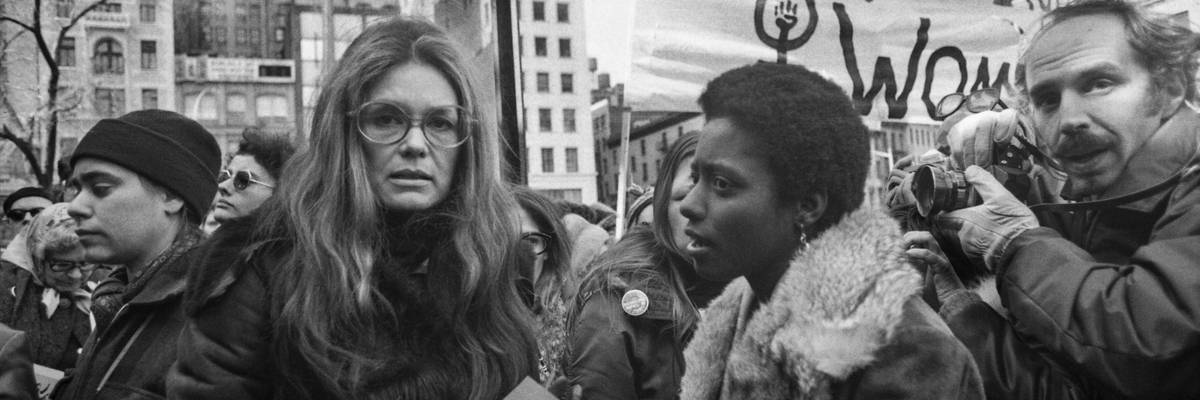
Rep. Bella Abzug, (D-N.Y.), feminist Gloria Steinem and Lt. Gov. Maryann Krupsak of New York (L-R) chat with the marchers and newsmen in midtown Manhattan prior to the start of the International Women's Day March on March 8, 1975. Some 2,000 women from all walks of life joined the solidarity march in which they demanded full economic political, legal, sexual and racial equality and the right to control their own lives and bodies.
Those who don’t know the full history of the feminist icon have little understanding of how far we have come, how we got here, and what still needs to change to make America more livable, humane, democratic, and inclusive.
Gloria Steinem, who died September 2 at ninety-two, was the leading voice and public face of second-wave feminism that began in the 1960s. Thanks to the tireless work of Steinem and others, America is today a more inclusive society for women in both attitude and practice. It is a credit to her generation of activists that later generations now embrace feminism’s goals that were once considered radical, impractical, or even a violation of human nature. Steinem “awakened a vast and often skeptical public to problems like domestic violence, the lack of affordable child care, and unfair hiring practices,” President Barack Obama said in 2013 when he awarded her the Presidential Medal of Freedom. “She also changed how women thought about themselves.”
Today, 75 percent of Americans (including 64 percent of Republicans) think Congress should guarantee twelve weeks of annual paid family and medical leave to all employees. Almost three-quarters support government-funded universal childcare. Also, 57 percent want Congress to pass legislation to codify nationwide rights to abortion, contraception, and in vitro fertilization and 62 percent think it is the responsibility of the federal government to make sure all Americans have health care coverage – a long-time part of feminism’s agenda.
Americans also support equal pay for women and strong protections against and punishment for sexual harassment and rape. They believe that couples should share housework and childcare. They don’t think that gender should limit a person’s ability to enter professions once dominated by men, such as law, engineering, medicine, construction, journalism, and military service.
There are more Americans who embrace these goals than there are self-identified feminists. This might be a good thing. It means that many feminist ideas have become so mainstream that Americans take them for granted. But it could also mean that our society may not appreciate—or even know about—the struggles that previous generations of women endured to change attitudes and practices and win rights.
Born in 1934, Steinem had a peripatetic childhood. Her family dealt with challenging financial circumstances, which may explain why she viewed women’s issues through the lens of class as well as gender. Her father, Leo, was a Jewish itinerant antiques dealer routinely on the precipice of financial ruin. Her mother, Ruth, was a former journalist born to a Presbyterian family. After her parents divorced when she was eleven, she and her mother moved into a condemned farmhouse. Her mother suffered from depression, and Steinem became her caretaker, cook, and housekeeper.
Part of what gave her the resilience to persevere was the example of her paternal grandmother, Pauline Steinem, who was president of the Ohio Suffrage Association from 1908 to 1911, a leader of the National Woman Suffrage Association, and the first woman to be elected to the Toledo Board of Education. In a testimonial to her grandmother, Steinem noted that in her campaign for the school board, “she was elected on a coalition ticket with the socialists and the anarchists.” In the 1930s, Pauline helped rescue many members of her family who lived in Germany from the Nazis. Although Pauline died when Gloria was five, she left her what Gloria later called vivid “sense memories” of her strength, courage, and intelligence.
Gloria was raised without much religious involvement; ironically, it was her Christian mother who taught her to be proud of her Jewish heritage, educating her daughter about the horrors of the Holocaust. “Never in my life have I identified myself as a Christian,” Steinem once said, “but wherever there is antisemitism, I identify as a Jew.”
In 1956, Steinem graduated from Smith College, where she majored in government and graduated magna cum laude and Phi Beta Kappa. After a few years living on a fellowship in India, where she was inspired by the nonviolent movement led by Mahatma Ghandi that overthrew British colonialism, she moved to New York City to pursue a career as a journalist.
No sooner had she died when some social media warriors started attacking her as a one-time CIA agent. The reality is more complicated. Around 1958, she worked for the Independent Research Service (IRS), which was set up to recruit American college students to attend World Youth Festivals sponsored by the Soviet Union and countries in its orbit. It was the height of the Cold War and the goal was to have liberal non-Communist voices at those events. The IRS was covertly funded by the CIA through foundations, as were many liberal nonprofit organizations and publications at the time, including the National Student Association - a connection that Ramparts magazine exposed in 1967. Steinem never denied her work for the IRC and was not ashamed of it, although it is likely that she did not know where the money came from. She was not involved in the CIA’s nefarious activities of overthrowing democratic governments, which came to light long after she spent three years with the IRS in her twenties. These attacks on Steinem’s work for the IRS are a cheap shot, meant to discredit her feminist and progressive credentials.
Steinem came of age in the 1950s, when women were treated like second-class citizens in almost every aspect of society. When she returned to the U.S., she had to overcome many gender barriers to make her way in the world of journalism. (The National Press Club didn’t allow women members until 1971). She worked for a new magazine of political satire, Help!, and contributed short articles to women’s magazines such as Glamour and Ladies’ Home Journal. After writing several pieces for Esquire without being credited, she finally published her first bylined article in the men’s magazine in 1962. The article, published a year before Betty Friedan’s pathbreaking manifesto, The Feminine Mystique, was about the then-new contraceptive pill. She examined the fact that women often had to choose between a career and marriage. “The only trouble with sexually liberating women,” Steinem ended the article, “is that there aren’t enough sexually liberated men to go around.” The following year, Steinem made a big splash with “A Bunny’s Tale” in Show magazine. Steinem got a job working at a Playboy Club for the article, which exposed the decidedly unglamorous working conditions faced by the club’s waitresses, who were required to wear a corset, rabbit ears, cotton tails, and high heels.
Steinem made a living as a freelance writer, profiling celebrities and writing about popular culture for major publications. But she could not persuade editors to assign her serious political subjects. Eventually she began writing a column for New York, which she helped launch in 1968. There she covered a variety of topics: Ho Chi Minh’s years living in New York, wounded veterans returning from Vietnam, neighborhood battles over childcare centers, antiwar demonstrations, migrant workers, the New York City mayoral race, and the 1968 presidential campaign.
Two articles in the magazine established her as a feminist spokesperson. In 1969, she was outraged by what she heard at a “speak out” of women discussing how their illegal abortions made them feel like criminals. Later that year, Steinem, who had an abortion in England in 1957, wrote her first explicitly feminist essay, “After Black Power, Women’s Liberation,” which profiled the burgeoning women’s movement. The second was a 1970 essay in Time called “What It Would Be Like if Women Win.” There Steinem predicted that feminism would liberate men as well as women. If women could have equal power, she argued, if homosexuals had the right to marry and women could refuse to have sex, then men would no longer be “the only ones to support the family, get drafted, bear the strain of power and responsibility.”
Although Steinem wrote hundreds of articles and eleven books and gave thousands of speeches, her most significant accomplishments involve the creation of two influential institutions -- the National Women’s Political Caucus (NWPC) and Ms. magazine.
In 1971 Steinem joined a bipartisan group of women—including Friedan, Congresswoman Bella Abzug, former Congresswoman Shirley Chisholm, and Dorothy Height (president of the National Council of Negro Women)—to launch the NWPC. They believed that by increasing women’s participation in politics, it would be easier to pass legislation to eliminate sex discrimination and to bring about greater legal, economic, and social equality.
“This is no simple reform,” Steinem said at the group’s founding convention. “It really is a revolution. Sex and race because they are easy and visible differences have been the primary ways of organizing human beings into superior and inferior groups and into the cheap labor on which this system still depends. We are talking about a society in which there will be no roles other than those chosen or those earned. We are really talking about humanism.”
Ms. was the first modern feminist periodical with a national readership. From its start in 1972, it challenged conventional wisdom in articles like “How to Write Your Marriage Contract,” “Can Women Love Women?” “The Black Family and Feminism,” “Welfare Is a Women’s Issue,” and “Down with Sexist Upbringing.” In its first year, Ms. made history when it published the names of fifty-three prominent women, including Steinem and tennis star Billie Jean King, who acknowledged having had abortions when it was still illegal in most of the country, before the Supreme Court’s Roe v. Wade decision. Its 1976 cover story on battered women—which featured a photo of a woman with a bruised face—was the first major exposé of the problem of domestic violence.
The magazine pioneered investigative stories about overseas sweatshops, sex trafficking, the wage gap, the glass ceiling, women’s health (and the medical establishment’s sexism), sexual harassment, and date rape. It explained and advocated for the Equal Rights Amendment, rated presidential candidates on women’s issues, reported on feminist protests against pornography, exposed the influence of sexist advertising on women’s self-images, and acknowledged race and class differences within the feminist movement. Ms. injected these issues into the political debate at a time when they were considered too radical for the mainstream media to cover—or at least to cover fairly.
During her first several decades as a public figure, Steinem had to endure media portrayals that called her as the “pin-up girl of the intelligentsia” or a “willowy beauty, 34-24-34.” She also had to deal with some feminist leaders, particularly Friedan, who resented her visibility in the media. But more than any other figure, Steinem was the public face of modern feminism, a constant presence on college campuses at union halls and protest rallies, on TV talk shows and in media profiles.
Steinem often used outrageous ideas to shake up her readers and audiences. In 1971 she stunned parents and alums at the Smith College graduation by quoting her friend Flo Kennedy’s observation that “there are only a few jobs that actually require a penis or vagina.” She once told an audience of CEOs that a fair society would eliminate all inheritance. She compared marriage to prostitution and said that unpaid housework “is the definition of women’s work, which is shit work.” In speeches, she frequently drew on the theme of her 1978 essay “If Men Could Menstruate.”
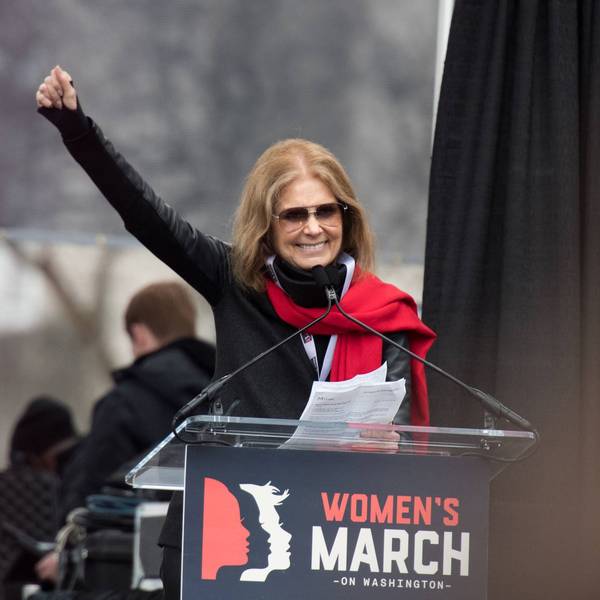
She continued to use her voice for social justice into her eighties. At the 2017 Women’s March in Washington, D.C., she rebuked President Donald Trump for his divisive rhetoric. “The Constitution doesn’t begin with, ‘I, the president’,” she said. “It begins with, ‘We, the people.’ So don’t try to divide us!” Later she blasted Trump’s proposal to force Muslims to register in a government database. “If you force Muslims to register, we will all register as Muslims,” Steinem declared. In 2018, she raised money for Planned Parenthood and joined a successful effort to save the last abortion clinic in her hometown of Toledo.
Steinem’s work was not limited to the United States. She was an outspoken advocate for peace and human rights around the world. In 1984 she and two other activists were arrested at the South African Embassy in Washington, D.C. for protesting the country’s apartheid regime. In 2010, Steinem and Pramila Jayapal (then an immigrant rights activist and since 2017 a congressperson from Seattle) coauthored an article linking women’s and immigrant rights issues. In 2015 Steinem joined a delegation of thirty female peace activists from fifteen countries who made a rare crossing of the dangerous demilitarized zone between North and South Korea.
Despite her many successes, Steinem made some missteps. In 2016, for example, while campaigning for Hillary Clinton during the Democratic primaries, she made a rare political blunder. When asked why so many young women were supporting Bernie Sanders rather than Clinton, she said “When you’re young, you’re thinking, where are the boys?” The backlash to this quip was merciless and she quickly apologized.
Not all of the goals of Steinem’s generation have been achieved, and patriarchy has not disappeared, yet there’s been significant progress. More men take responsibility for housework and childcare, although it is still not shared equally. The U.S. gender pay gap has narrowed: According to the Pew Research Center, women’s pay has increased from roughly 65 percent in 1982 to 85 percent by 2024. Among married female-male couples, women’s financial contributions have grown steadily over the last half century. The share of women who earn as much or more than their husband has roughly tripled from 16 percent to 45 percent since the early 1970s.
Another area of progress is women’s participation in sports. Students in my college courses, including most women, are shocked to see charts showing that in 1971, the year before Congress passed Title IX, only 300,000 girls (less than 4 percent) participated in high school sports. Today, 3.6 million (43 percent) do. The number of women playing college sports has also mushroomed. These trends have laid the groundwork for the growing popularity of women’s professional sports, including soccer, tennis, and basketball. This summer witnessed the inaugural season of the Women’s Professional Baseball League, the first since the All-American Girls Professional Baseball League (the inspiration for the 1992 film A League of Their Own), which lasted from 1943 to 1954.
Feminism has also helped break the professional glass ceiling. Watching the documentary RBG, my students are stunned to learn that when Ruth Bader Ginsburg enrolled at Harvard Law School in 1956, she was one of only nine women in a class of 500. As recently as 1971, women constituted only 3 percent of American lawyers. Today, women represent about 56 percent of all law students. The proportion of women among college students has also increased from 42 percent in 1970 to 57 percent in 2025.
Women have made significant advancements in politics. In 1969, only half of all Americans said they would vote for a woman for president. By 1999, according to a Gallup poll, 92 percent of Americans supported the idea. At the start of the women’s liberation movement, no woman had ever been the presidential nominee of one of the two major political parties. That is no longer the case. The idea of a woman president is no longer a distant dream. In 1969. there were only ten women in the House of Representatives and one in the Senate. In the current Congress, 125 women (29 percent) serve in the House and twenty-six (26 percent) in the Senate, the highest total figure in history. Nor is this only a phenomenon at the federal level: 28 percent of the nation’s governors are women, up from only two in 1980. Roughly 34 percent of state representatives are women. and forty-one of the one hundred largest cities have women mayors.
College students today take for granted that they can take courses in women’s history, literature, and other subjects, but the first women's studies courses didn’t appear until 1969, when Cornell University offered a class in response to student demands. By 1975, that number exploded to over 1,000 courses at hundreds of colleges and universities. Now they are a staple on almost every campus, despite the Trump administration’s efforts to undermine them as part of its assault on diversity, equity, and inclusion programs. Women’s and gender studies departments employ over 2,000 full- and part-time faculty members.
To Steinem’s generation of feminists, these statistics are a sign of progress. Subsequent generations, however, are more likely to see in them a sign of how far we have to go before women achieve equity in many areas of American life. A YouGov poll conducted in July and August found that nearly half of Americans (46 percent)—including 54 percent of women and 36 percent of men—say the country has not gone far enough in promoting gender equality, compared with 17 percent who think it has gone too far. While there is still far to go, Steinem’s life and legacy provide valuable lessons about overcoming obstacles and challenging the status quo.
Steinem’s feminism was rooted in a critique of capitalism and big business, which pitted women against men for jobs, pay, promotion, rights, and respect. She frequently spoke at gatherings of 9 to 5, the working women’s group, and certainly agreed with Dolly Parton’s song, “9 to 5,” that “It’s a rich man’s game no matter what they call it. And you spend your life puttin’ money in his wallet.”
She was also an early advocate of what today’s activists call intersectionality—consistently injecting issues of race and class into the women’s movement. “The truth was (and still is) that in the United States, as in almost every country, categories of work are less likely to be paid by the expertise they require—or even by importance to the community or to the often mythical free market—than by the sex, race and class of most of their workers,” she wrote in a 1994 essay “Revaluing Economics.” She pushed other white middle-class feminists to embrace the concerns of working-class women and women of color. In a 2017 interview with The Grio, she praised Black Lives Matter activists for creating “a more inclusive movement.”
Steinem always viewed working- and middle-class men as potential allies in the struggle for equality. She built bridges between feminism’s radical and liberal wings and between the women’s and labor movements. She believed that unions were a vehicle for promoting gender parity and often join their picket lines. She was not only a cofounder of the Coalition of Labor Union Women, but also an honorary co-chair of the Democratic Socialists of America in the 1980s and 1990s, long before it mushroomed into today’s influential force in American politics.
Steinem believed that the struggle for equality was ongoing and that activists could never give up the fight. There has been backsliding on abortion rights since the U.S. Supreme Court overturned Roe v. Wade in 2022, ending the federal constitutional right to an abortion. Some evangelical ministers in the MAGA orbit want to repeal women’s suffrage. We’ve also seen the rise of a “manosphere” culture epitomized by Joe Rogan, Defense Secretary Pete Hegseth, and others in Trump world. It may be having an influence: A 2018 survey of boys in the eighth and tenth grades found that 84 percent believed that women and men should have the same job opportunities. By 2023, that figure had slipped to 72 percent.
But these gender reactionaries are fighting a rearguard battle. We all stand on the shoulders of earlier generations of reformers, radicals, and idealists, like Steinem, who challenged the status quo of their day and transformed radical ideas into common sense. Those who don’t know this history have little understanding of how far we have come, how we got here, and what still needs to change to make America more livable, humane, democratic, and inclusive. Steinem’s 1970 prediction “If Women’s Lib wins, perhaps we all do” is not yet a reality. But many Americans, including a majority of those under fifty, now embrace the once-radical tenets of modern feminism. And that, like Steinem’s life, is a victory worth celebrating.
Dear Common Dreams reader, It’s been nearly 30 years since I co-founded Common Dreams with my late wife, Lina Newhouser. We had the radical notion that journalism should serve the public good, not corporate profits. It was clear to us from the outset what it would take to build such a project. No paid advertisements. No corporate sponsors. No millionaire publisher telling us what to think or do. Many people said we wouldn't last a year, but we proved those doubters wrong. Together with a tremendous team of journalists and dedicated staff, we built an independent media outlet free from the constraints of profits and corporate control. Our mission has always been simple: To inform. To inspire. To ignite change for the common good. Building Common Dreams was not easy. Our survival was never guaranteed. When you take on the most powerful forces—Wall Street greed, fossil fuel industry destruction, Big Tech lobbyists, and uber-rich oligarchs who have spent billions upon billions rigging the economy and democracy in their favor—the only bulwark you have is supporters who believe in your work. But here’s the urgent message from me today. It's never been this bad out there. And it's never been this hard to keep us going. At the very moment Common Dreams is most needed, the threats we face are intensifying. We need your support now more than ever. We don't accept corporate advertising and never will. We don't have a paywall because we don't think people should be blocked from critical news based on their ability to pay. Everything we do is funded by the donations of readers like you. When everyone does the little they can afford, we are strong. But if that support retreats or dries up, so do we. Will you donate now to make sure Common Dreams not only survives but thrives? —Craig Brown, Co-founder |
Gloria Steinem, who died September 2 at ninety-two, was the leading voice and public face of second-wave feminism that began in the 1960s. Thanks to the tireless work of Steinem and others, America is today a more inclusive society for women in both attitude and practice. It is a credit to her generation of activists that later generations now embrace feminism’s goals that were once considered radical, impractical, or even a violation of human nature. Steinem “awakened a vast and often skeptical public to problems like domestic violence, the lack of affordable child care, and unfair hiring practices,” President Barack Obama said in 2013 when he awarded her the Presidential Medal of Freedom. “She also changed how women thought about themselves.”
Today, 75 percent of Americans (including 64 percent of Republicans) think Congress should guarantee twelve weeks of annual paid family and medical leave to all employees. Almost three-quarters support government-funded universal childcare. Also, 57 percent want Congress to pass legislation to codify nationwide rights to abortion, contraception, and in vitro fertilization and 62 percent think it is the responsibility of the federal government to make sure all Americans have health care coverage – a long-time part of feminism’s agenda.
Americans also support equal pay for women and strong protections against and punishment for sexual harassment and rape. They believe that couples should share housework and childcare. They don’t think that gender should limit a person’s ability to enter professions once dominated by men, such as law, engineering, medicine, construction, journalism, and military service.
There are more Americans who embrace these goals than there are self-identified feminists. This might be a good thing. It means that many feminist ideas have become so mainstream that Americans take them for granted. But it could also mean that our society may not appreciate—or even know about—the struggles that previous generations of women endured to change attitudes and practices and win rights.
Born in 1934, Steinem had a peripatetic childhood. Her family dealt with challenging financial circumstances, which may explain why she viewed women’s issues through the lens of class as well as gender. Her father, Leo, was a Jewish itinerant antiques dealer routinely on the precipice of financial ruin. Her mother, Ruth, was a former journalist born to a Presbyterian family. After her parents divorced when she was eleven, she and her mother moved into a condemned farmhouse. Her mother suffered from depression, and Steinem became her caretaker, cook, and housekeeper.
Part of what gave her the resilience to persevere was the example of her paternal grandmother, Pauline Steinem, who was president of the Ohio Suffrage Association from 1908 to 1911, a leader of the National Woman Suffrage Association, and the first woman to be elected to the Toledo Board of Education. In a testimonial to her grandmother, Steinem noted that in her campaign for the school board, “she was elected on a coalition ticket with the socialists and the anarchists.” In the 1930s, Pauline helped rescue many members of her family who lived in Germany from the Nazis. Although Pauline died when Gloria was five, she left her what Gloria later called vivid “sense memories” of her strength, courage, and intelligence.
Gloria was raised without much religious involvement; ironically, it was her Christian mother who taught her to be proud of her Jewish heritage, educating her daughter about the horrors of the Holocaust. “Never in my life have I identified myself as a Christian,” Steinem once said, “but wherever there is antisemitism, I identify as a Jew.”
In 1956, Steinem graduated from Smith College, where she majored in government and graduated magna cum laude and Phi Beta Kappa. After a few years living on a fellowship in India, where she was inspired by the nonviolent movement led by Mahatma Ghandi that overthrew British colonialism, she moved to New York City to pursue a career as a journalist.
No sooner had she died when some social media warriors started attacking her as a one-time CIA agent. The reality is more complicated. Around 1958, she worked for the Independent Research Service (IRS), which was set up to recruit American college students to attend World Youth Festivals sponsored by the Soviet Union and countries in its orbit. It was the height of the Cold War and the goal was to have liberal non-Communist voices at those events. The IRS was covertly funded by the CIA through foundations, as were many liberal nonprofit organizations and publications at the time, including the National Student Association - a connection that Ramparts magazine exposed in 1967. Steinem never denied her work for the IRC and was not ashamed of it, although it is likely that she did not know where the money came from. She was not involved in the CIA’s nefarious activities of overthrowing democratic governments, which came to light long after she spent three years with the IRS in her twenties. These attacks on Steinem’s work for the IRS are a cheap shot, meant to discredit her feminist and progressive credentials.
Steinem came of age in the 1950s, when women were treated like second-class citizens in almost every aspect of society. When she returned to the U.S., she had to overcome many gender barriers to make her way in the world of journalism. (The National Press Club didn’t allow women members until 1971). She worked for a new magazine of political satire, Help!, and contributed short articles to women’s magazines such as Glamour and Ladies’ Home Journal. After writing several pieces for Esquire without being credited, she finally published her first bylined article in the men’s magazine in 1962. The article, published a year before Betty Friedan’s pathbreaking manifesto, The Feminine Mystique, was about the then-new contraceptive pill. She examined the fact that women often had to choose between a career and marriage. “The only trouble with sexually liberating women,” Steinem ended the article, “is that there aren’t enough sexually liberated men to go around.” The following year, Steinem made a big splash with “A Bunny’s Tale” in Show magazine. Steinem got a job working at a Playboy Club for the article, which exposed the decidedly unglamorous working conditions faced by the club’s waitresses, who were required to wear a corset, rabbit ears, cotton tails, and high heels.
Steinem made a living as a freelance writer, profiling celebrities and writing about popular culture for major publications. But she could not persuade editors to assign her serious political subjects. Eventually she began writing a column for New York, which she helped launch in 1968. There she covered a variety of topics: Ho Chi Minh’s years living in New York, wounded veterans returning from Vietnam, neighborhood battles over childcare centers, antiwar demonstrations, migrant workers, the New York City mayoral race, and the 1968 presidential campaign.
Two articles in the magazine established her as a feminist spokesperson. In 1969, she was outraged by what she heard at a “speak out” of women discussing how their illegal abortions made them feel like criminals. Later that year, Steinem, who had an abortion in England in 1957, wrote her first explicitly feminist essay, “After Black Power, Women’s Liberation,” which profiled the burgeoning women’s movement. The second was a 1970 essay in Time called “What It Would Be Like if Women Win.” There Steinem predicted that feminism would liberate men as well as women. If women could have equal power, she argued, if homosexuals had the right to marry and women could refuse to have sex, then men would no longer be “the only ones to support the family, get drafted, bear the strain of power and responsibility.”
Although Steinem wrote hundreds of articles and eleven books and gave thousands of speeches, her most significant accomplishments involve the creation of two influential institutions -- the National Women’s Political Caucus (NWPC) and Ms. magazine.
In 1971 Steinem joined a bipartisan group of women—including Friedan, Congresswoman Bella Abzug, former Congresswoman Shirley Chisholm, and Dorothy Height (president of the National Council of Negro Women)—to launch the NWPC. They believed that by increasing women’s participation in politics, it would be easier to pass legislation to eliminate sex discrimination and to bring about greater legal, economic, and social equality.
“This is no simple reform,” Steinem said at the group’s founding convention. “It really is a revolution. Sex and race because they are easy and visible differences have been the primary ways of organizing human beings into superior and inferior groups and into the cheap labor on which this system still depends. We are talking about a society in which there will be no roles other than those chosen or those earned. We are really talking about humanism.”
Ms. was the first modern feminist periodical with a national readership. From its start in 1972, it challenged conventional wisdom in articles like “How to Write Your Marriage Contract,” “Can Women Love Women?” “The Black Family and Feminism,” “Welfare Is a Women’s Issue,” and “Down with Sexist Upbringing.” In its first year, Ms. made history when it published the names of fifty-three prominent women, including Steinem and tennis star Billie Jean King, who acknowledged having had abortions when it was still illegal in most of the country, before the Supreme Court’s Roe v. Wade decision. Its 1976 cover story on battered women—which featured a photo of a woman with a bruised face—was the first major exposé of the problem of domestic violence.
The magazine pioneered investigative stories about overseas sweatshops, sex trafficking, the wage gap, the glass ceiling, women’s health (and the medical establishment’s sexism), sexual harassment, and date rape. It explained and advocated for the Equal Rights Amendment, rated presidential candidates on women’s issues, reported on feminist protests against pornography, exposed the influence of sexist advertising on women’s self-images, and acknowledged race and class differences within the feminist movement. Ms. injected these issues into the political debate at a time when they were considered too radical for the mainstream media to cover—or at least to cover fairly.
During her first several decades as a public figure, Steinem had to endure media portrayals that called her as the “pin-up girl of the intelligentsia” or a “willowy beauty, 34-24-34.” She also had to deal with some feminist leaders, particularly Friedan, who resented her visibility in the media. But more than any other figure, Steinem was the public face of modern feminism, a constant presence on college campuses at union halls and protest rallies, on TV talk shows and in media profiles.
Steinem often used outrageous ideas to shake up her readers and audiences. In 1971 she stunned parents and alums at the Smith College graduation by quoting her friend Flo Kennedy’s observation that “there are only a few jobs that actually require a penis or vagina.” She once told an audience of CEOs that a fair society would eliminate all inheritance. She compared marriage to prostitution and said that unpaid housework “is the definition of women’s work, which is shit work.” In speeches, she frequently drew on the theme of her 1978 essay “If Men Could Menstruate.”
She continued to use her voice for social justice into her eighties. At the 2017 Women’s March in Washington, D.C., she rebuked President Donald Trump for his divisive rhetoric. “The Constitution doesn’t begin with, ‘I, the president’,” she said. “It begins with, ‘We, the people.’ So don’t try to divide us!” Later she blasted Trump’s proposal to force Muslims to register in a government database. “If you force Muslims to register, we will all register as Muslims,” Steinem declared. In 2018, she raised money for Planned Parenthood and joined a successful effort to save the last abortion clinic in her hometown of Toledo.
Steinem’s work was not limited to the United States. She was an outspoken advocate for peace and human rights around the world. In 1984 she and two other activists were arrested at the South African Embassy in Washington, D.C. for protesting the country’s apartheid regime. In 2010, Steinem and Pramila Jayapal (then an immigrant rights activist and since 2017 a congressperson from Seattle) coauthored an article linking women’s and immigrant rights issues. In 2015 Steinem joined a delegation of thirty female peace activists from fifteen countries who made a rare crossing of the dangerous demilitarized zone between North and South Korea.
Despite her many successes, Steinem made some missteps. In 2016, for example, while campaigning for Hillary Clinton during the Democratic primaries, she made a rare political blunder. When asked why so many young women were supporting Bernie Sanders rather than Clinton, she said “When you’re young, you’re thinking, where are the boys?” The backlash to this quip was merciless and she quickly apologized.
Not all of the goals of Steinem’s generation have been achieved, and patriarchy has not disappeared, yet there’s been significant progress. More men take responsibility for housework and childcare, although it is still not shared equally. The U.S. gender pay gap has narrowed: According to the Pew Research Center, women’s pay has increased from roughly 65 percent in 1982 to 85 percent by 2024. Among married female-male couples, women’s financial contributions have grown steadily over the last half century. The share of women who earn as much or more than their husband has roughly tripled from 16 percent to 45 percent since the early 1970s.
Another area of progress is women’s participation in sports. Students in my college courses, including most women, are shocked to see charts showing that in 1971, the year before Congress passed Title IX, only 300,000 girls (less than 4 percent) participated in high school sports. Today, 3.6 million (43 percent) do. The number of women playing college sports has also mushroomed. These trends have laid the groundwork for the growing popularity of women’s professional sports, including soccer, tennis, and basketball. This summer witnessed the inaugural season of the Women’s Professional Baseball League, the first since the All-American Girls Professional Baseball League (the inspiration for the 1992 film A League of Their Own), which lasted from 1943 to 1954.
Feminism has also helped break the professional glass ceiling. Watching the documentary RBG, my students are stunned to learn that when Ruth Bader Ginsburg enrolled at Harvard Law School in 1956, she was one of only nine women in a class of 500. As recently as 1971, women constituted only 3 percent of American lawyers. Today, women represent about 56 percent of all law students. The proportion of women among college students has also increased from 42 percent in 1970 to 57 percent in 2025.
Women have made significant advancements in politics. In 1969, only half of all Americans said they would vote for a woman for president. By 1999, according to a Gallup poll, 92 percent of Americans supported the idea. At the start of the women’s liberation movement, no woman had ever been the presidential nominee of one of the two major political parties. That is no longer the case. The idea of a woman president is no longer a distant dream. In 1969. there were only ten women in the House of Representatives and one in the Senate. In the current Congress, 125 women (29 percent) serve in the House and twenty-six (26 percent) in the Senate, the highest total figure in history. Nor is this only a phenomenon at the federal level: 28 percent of the nation’s governors are women, up from only two in 1980. Roughly 34 percent of state representatives are women. and forty-one of the one hundred largest cities have women mayors.
College students today take for granted that they can take courses in women’s history, literature, and other subjects, but the first women's studies courses didn’t appear until 1969, when Cornell University offered a class in response to student demands. By 1975, that number exploded to over 1,000 courses at hundreds of colleges and universities. Now they are a staple on almost every campus, despite the Trump administration’s efforts to undermine them as part of its assault on diversity, equity, and inclusion programs. Women’s and gender studies departments employ over 2,000 full- and part-time faculty members.
To Steinem’s generation of feminists, these statistics are a sign of progress. Subsequent generations, however, are more likely to see in them a sign of how far we have to go before women achieve equity in many areas of American life. A YouGov poll conducted in July and August found that nearly half of Americans (46 percent)—including 54 percent of women and 36 percent of men—say the country has not gone far enough in promoting gender equality, compared with 17 percent who think it has gone too far. While there is still far to go, Steinem’s life and legacy provide valuable lessons about overcoming obstacles and challenging the status quo.
Steinem’s feminism was rooted in a critique of capitalism and big business, which pitted women against men for jobs, pay, promotion, rights, and respect. She frequently spoke at gatherings of 9 to 5, the working women’s group, and certainly agreed with Dolly Parton’s song, “9 to 5,” that “It’s a rich man’s game no matter what they call it. And you spend your life puttin’ money in his wallet.”
She was also an early advocate of what today’s activists call intersectionality—consistently injecting issues of race and class into the women’s movement. “The truth was (and still is) that in the United States, as in almost every country, categories of work are less likely to be paid by the expertise they require—or even by importance to the community or to the often mythical free market—than by the sex, race and class of most of their workers,” she wrote in a 1994 essay “Revaluing Economics.” She pushed other white middle-class feminists to embrace the concerns of working-class women and women of color. In a 2017 interview with The Grio, she praised Black Lives Matter activists for creating “a more inclusive movement.”
Steinem always viewed working- and middle-class men as potential allies in the struggle for equality. She built bridges between feminism’s radical and liberal wings and between the women’s and labor movements. She believed that unions were a vehicle for promoting gender parity and often join their picket lines. She was not only a cofounder of the Coalition of Labor Union Women, but also an honorary co-chair of the Democratic Socialists of America in the 1980s and 1990s, long before it mushroomed into today’s influential force in American politics.
Steinem believed that the struggle for equality was ongoing and that activists could never give up the fight. There has been backsliding on abortion rights since the U.S. Supreme Court overturned Roe v. Wade in 2022, ending the federal constitutional right to an abortion. Some evangelical ministers in the MAGA orbit want to repeal women’s suffrage. We’ve also seen the rise of a “manosphere” culture epitomized by Joe Rogan, Defense Secretary Pete Hegseth, and others in Trump world. It may be having an influence: A 2018 survey of boys in the eighth and tenth grades found that 84 percent believed that women and men should have the same job opportunities. By 2023, that figure had slipped to 72 percent.
But these gender reactionaries are fighting a rearguard battle. We all stand on the shoulders of earlier generations of reformers, radicals, and idealists, like Steinem, who challenged the status quo of their day and transformed radical ideas into common sense. Those who don’t know this history have little understanding of how far we have come, how we got here, and what still needs to change to make America more livable, humane, democratic, and inclusive. Steinem’s 1970 prediction “If Women’s Lib wins, perhaps we all do” is not yet a reality. But many Americans, including a majority of those under fifty, now embrace the once-radical tenets of modern feminism. And that, like Steinem’s life, is a victory worth celebrating.
Gloria Steinem, who died September 2 at ninety-two, was the leading voice and public face of second-wave feminism that began in the 1960s. Thanks to the tireless work of Steinem and others, America is today a more inclusive society for women in both attitude and practice. It is a credit to her generation of activists that later generations now embrace feminism’s goals that were once considered radical, impractical, or even a violation of human nature. Steinem “awakened a vast and often skeptical public to problems like domestic violence, the lack of affordable child care, and unfair hiring practices,” President Barack Obama said in 2013 when he awarded her the Presidential Medal of Freedom. “She also changed how women thought about themselves.”
Today, 75 percent of Americans (including 64 percent of Republicans) think Congress should guarantee twelve weeks of annual paid family and medical leave to all employees. Almost three-quarters support government-funded universal childcare. Also, 57 percent want Congress to pass legislation to codify nationwide rights to abortion, contraception, and in vitro fertilization and 62 percent think it is the responsibility of the federal government to make sure all Americans have health care coverage – a long-time part of feminism’s agenda.
Americans also support equal pay for women and strong protections against and punishment for sexual harassment and rape. They believe that couples should share housework and childcare. They don’t think that gender should limit a person’s ability to enter professions once dominated by men, such as law, engineering, medicine, construction, journalism, and military service.
There are more Americans who embrace these goals than there are self-identified feminists. This might be a good thing. It means that many feminist ideas have become so mainstream that Americans take them for granted. But it could also mean that our society may not appreciate—or even know about—the struggles that previous generations of women endured to change attitudes and practices and win rights.
Born in 1934, Steinem had a peripatetic childhood. Her family dealt with challenging financial circumstances, which may explain why she viewed women’s issues through the lens of class as well as gender. Her father, Leo, was a Jewish itinerant antiques dealer routinely on the precipice of financial ruin. Her mother, Ruth, was a former journalist born to a Presbyterian family. After her parents divorced when she was eleven, she and her mother moved into a condemned farmhouse. Her mother suffered from depression, and Steinem became her caretaker, cook, and housekeeper.
Part of what gave her the resilience to persevere was the example of her paternal grandmother, Pauline Steinem, who was president of the Ohio Suffrage Association from 1908 to 1911, a leader of the National Woman Suffrage Association, and the first woman to be elected to the Toledo Board of Education. In a testimonial to her grandmother, Steinem noted that in her campaign for the school board, “she was elected on a coalition ticket with the socialists and the anarchists.” In the 1930s, Pauline helped rescue many members of her family who lived in Germany from the Nazis. Although Pauline died when Gloria was five, she left her what Gloria later called vivid “sense memories” of her strength, courage, and intelligence.
Gloria was raised without much religious involvement; ironically, it was her Christian mother who taught her to be proud of her Jewish heritage, educating her daughter about the horrors of the Holocaust. “Never in my life have I identified myself as a Christian,” Steinem once said, “but wherever there is antisemitism, I identify as a Jew.”
In 1956, Steinem graduated from Smith College, where she majored in government and graduated magna cum laude and Phi Beta Kappa. After a few years living on a fellowship in India, where she was inspired by the nonviolent movement led by Mahatma Ghandi that overthrew British colonialism, she moved to New York City to pursue a career as a journalist.
No sooner had she died when some social media warriors started attacking her as a one-time CIA agent. The reality is more complicated. Around 1958, she worked for the Independent Research Service (IRS), which was set up to recruit American college students to attend World Youth Festivals sponsored by the Soviet Union and countries in its orbit. It was the height of the Cold War and the goal was to have liberal non-Communist voices at those events. The IRS was covertly funded by the CIA through foundations, as were many liberal nonprofit organizations and publications at the time, including the National Student Association - a connection that Ramparts magazine exposed in 1967. Steinem never denied her work for the IRC and was not ashamed of it, although it is likely that she did not know where the money came from. She was not involved in the CIA’s nefarious activities of overthrowing democratic governments, which came to light long after she spent three years with the IRS in her twenties. These attacks on Steinem’s work for the IRS are a cheap shot, meant to discredit her feminist and progressive credentials.
Steinem came of age in the 1950s, when women were treated like second-class citizens in almost every aspect of society. When she returned to the U.S., she had to overcome many gender barriers to make her way in the world of journalism. (The National Press Club didn’t allow women members until 1971). She worked for a new magazine of political satire, Help!, and contributed short articles to women’s magazines such as Glamour and Ladies’ Home Journal. After writing several pieces for Esquire without being credited, she finally published her first bylined article in the men’s magazine in 1962. The article, published a year before Betty Friedan’s pathbreaking manifesto, The Feminine Mystique, was about the then-new contraceptive pill. She examined the fact that women often had to choose between a career and marriage. “The only trouble with sexually liberating women,” Steinem ended the article, “is that there aren’t enough sexually liberated men to go around.” The following year, Steinem made a big splash with “A Bunny’s Tale” in Show magazine. Steinem got a job working at a Playboy Club for the article, which exposed the decidedly unglamorous working conditions faced by the club’s waitresses, who were required to wear a corset, rabbit ears, cotton tails, and high heels.
Steinem made a living as a freelance writer, profiling celebrities and writing about popular culture for major publications. But she could not persuade editors to assign her serious political subjects. Eventually she began writing a column for New York, which she helped launch in 1968. There she covered a variety of topics: Ho Chi Minh’s years living in New York, wounded veterans returning from Vietnam, neighborhood battles over childcare centers, antiwar demonstrations, migrant workers, the New York City mayoral race, and the 1968 presidential campaign.
Two articles in the magazine established her as a feminist spokesperson. In 1969, she was outraged by what she heard at a “speak out” of women discussing how their illegal abortions made them feel like criminals. Later that year, Steinem, who had an abortion in England in 1957, wrote her first explicitly feminist essay, “After Black Power, Women’s Liberation,” which profiled the burgeoning women’s movement. The second was a 1970 essay in Time called “What It Would Be Like if Women Win.” There Steinem predicted that feminism would liberate men as well as women. If women could have equal power, she argued, if homosexuals had the right to marry and women could refuse to have sex, then men would no longer be “the only ones to support the family, get drafted, bear the strain of power and responsibility.”
Although Steinem wrote hundreds of articles and eleven books and gave thousands of speeches, her most significant accomplishments involve the creation of two influential institutions -- the National Women’s Political Caucus (NWPC) and Ms. magazine.
In 1971 Steinem joined a bipartisan group of women—including Friedan, Congresswoman Bella Abzug, former Congresswoman Shirley Chisholm, and Dorothy Height (president of the National Council of Negro Women)—to launch the NWPC. They believed that by increasing women’s participation in politics, it would be easier to pass legislation to eliminate sex discrimination and to bring about greater legal, economic, and social equality.
“This is no simple reform,” Steinem said at the group’s founding convention. “It really is a revolution. Sex and race because they are easy and visible differences have been the primary ways of organizing human beings into superior and inferior groups and into the cheap labor on which this system still depends. We are talking about a society in which there will be no roles other than those chosen or those earned. We are really talking about humanism.”
Ms. was the first modern feminist periodical with a national readership. From its start in 1972, it challenged conventional wisdom in articles like “How to Write Your Marriage Contract,” “Can Women Love Women?” “The Black Family and Feminism,” “Welfare Is a Women’s Issue,” and “Down with Sexist Upbringing.” In its first year, Ms. made history when it published the names of fifty-three prominent women, including Steinem and tennis star Billie Jean King, who acknowledged having had abortions when it was still illegal in most of the country, before the Supreme Court’s Roe v. Wade decision. Its 1976 cover story on battered women—which featured a photo of a woman with a bruised face—was the first major exposé of the problem of domestic violence.
The magazine pioneered investigative stories about overseas sweatshops, sex trafficking, the wage gap, the glass ceiling, women’s health (and the medical establishment’s sexism), sexual harassment, and date rape. It explained and advocated for the Equal Rights Amendment, rated presidential candidates on women’s issues, reported on feminist protests against pornography, exposed the influence of sexist advertising on women’s self-images, and acknowledged race and class differences within the feminist movement. Ms. injected these issues into the political debate at a time when they were considered too radical for the mainstream media to cover—or at least to cover fairly.
During her first several decades as a public figure, Steinem had to endure media portrayals that called her as the “pin-up girl of the intelligentsia” or a “willowy beauty, 34-24-34.” She also had to deal with some feminist leaders, particularly Friedan, who resented her visibility in the media. But more than any other figure, Steinem was the public face of modern feminism, a constant presence on college campuses at union halls and protest rallies, on TV talk shows and in media profiles.
Steinem often used outrageous ideas to shake up her readers and audiences. In 1971 she stunned parents and alums at the Smith College graduation by quoting her friend Flo Kennedy’s observation that “there are only a few jobs that actually require a penis or vagina.” She once told an audience of CEOs that a fair society would eliminate all inheritance. She compared marriage to prostitution and said that unpaid housework “is the definition of women’s work, which is shit work.” In speeches, she frequently drew on the theme of her 1978 essay “If Men Could Menstruate.”
She continued to use her voice for social justice into her eighties. At the 2017 Women’s March in Washington, D.C., she rebuked President Donald Trump for his divisive rhetoric. “The Constitution doesn’t begin with, ‘I, the president’,” she said. “It begins with, ‘We, the people.’ So don’t try to divide us!” Later she blasted Trump’s proposal to force Muslims to register in a government database. “If you force Muslims to register, we will all register as Muslims,” Steinem declared. In 2018, she raised money for Planned Parenthood and joined a successful effort to save the last abortion clinic in her hometown of Toledo.
Steinem’s work was not limited to the United States. She was an outspoken advocate for peace and human rights around the world. In 1984 she and two other activists were arrested at the South African Embassy in Washington, D.C. for protesting the country’s apartheid regime. In 2010, Steinem and Pramila Jayapal (then an immigrant rights activist and since 2017 a congressperson from Seattle) coauthored an article linking women’s and immigrant rights issues. In 2015 Steinem joined a delegation of thirty female peace activists from fifteen countries who made a rare crossing of the dangerous demilitarized zone between North and South Korea.
Despite her many successes, Steinem made some missteps. In 2016, for example, while campaigning for Hillary Clinton during the Democratic primaries, she made a rare political blunder. When asked why so many young women were supporting Bernie Sanders rather than Clinton, she said “When you’re young, you’re thinking, where are the boys?” The backlash to this quip was merciless and she quickly apologized.
Not all of the goals of Steinem’s generation have been achieved, and patriarchy has not disappeared, yet there’s been significant progress. More men take responsibility for housework and childcare, although it is still not shared equally. The U.S. gender pay gap has narrowed: According to the Pew Research Center, women’s pay has increased from roughly 65 percent in 1982 to 85 percent by 2024. Among married female-male couples, women’s financial contributions have grown steadily over the last half century. The share of women who earn as much or more than their husband has roughly tripled from 16 percent to 45 percent since the early 1970s.
Another area of progress is women’s participation in sports. Students in my college courses, including most women, are shocked to see charts showing that in 1971, the year before Congress passed Title IX, only 300,000 girls (less than 4 percent) participated in high school sports. Today, 3.6 million (43 percent) do. The number of women playing college sports has also mushroomed. These trends have laid the groundwork for the growing popularity of women’s professional sports, including soccer, tennis, and basketball. This summer witnessed the inaugural season of the Women’s Professional Baseball League, the first since the All-American Girls Professional Baseball League (the inspiration for the 1992 film A League of Their Own), which lasted from 1943 to 1954.
Feminism has also helped break the professional glass ceiling. Watching the documentary RBG, my students are stunned to learn that when Ruth Bader Ginsburg enrolled at Harvard Law School in 1956, she was one of only nine women in a class of 500. As recently as 1971, women constituted only 3 percent of American lawyers. Today, women represent about 56 percent of all law students. The proportion of women among college students has also increased from 42 percent in 1970 to 57 percent in 2025.
Women have made significant advancements in politics. In 1969, only half of all Americans said they would vote for a woman for president. By 1999, according to a Gallup poll, 92 percent of Americans supported the idea. At the start of the women’s liberation movement, no woman had ever been the presidential nominee of one of the two major political parties. That is no longer the case. The idea of a woman president is no longer a distant dream. In 1969. there were only ten women in the House of Representatives and one in the Senate. In the current Congress, 125 women (29 percent) serve in the House and twenty-six (26 percent) in the Senate, the highest total figure in history. Nor is this only a phenomenon at the federal level: 28 percent of the nation’s governors are women, up from only two in 1980. Roughly 34 percent of state representatives are women. and forty-one of the one hundred largest cities have women mayors.
College students today take for granted that they can take courses in women’s history, literature, and other subjects, but the first women's studies courses didn’t appear until 1969, when Cornell University offered a class in response to student demands. By 1975, that number exploded to over 1,000 courses at hundreds of colleges and universities. Now they are a staple on almost every campus, despite the Trump administration’s efforts to undermine them as part of its assault on diversity, equity, and inclusion programs. Women’s and gender studies departments employ over 2,000 full- and part-time faculty members.
To Steinem’s generation of feminists, these statistics are a sign of progress. Subsequent generations, however, are more likely to see in them a sign of how far we have to go before women achieve equity in many areas of American life. A YouGov poll conducted in July and August found that nearly half of Americans (46 percent)—including 54 percent of women and 36 percent of men—say the country has not gone far enough in promoting gender equality, compared with 17 percent who think it has gone too far. While there is still far to go, Steinem’s life and legacy provide valuable lessons about overcoming obstacles and challenging the status quo.
Steinem’s feminism was rooted in a critique of capitalism and big business, which pitted women against men for jobs, pay, promotion, rights, and respect. She frequently spoke at gatherings of 9 to 5, the working women’s group, and certainly agreed with Dolly Parton’s song, “9 to 5,” that “It’s a rich man’s game no matter what they call it. And you spend your life puttin’ money in his wallet.”
She was also an early advocate of what today’s activists call intersectionality—consistently injecting issues of race and class into the women’s movement. “The truth was (and still is) that in the United States, as in almost every country, categories of work are less likely to be paid by the expertise they require—or even by importance to the community or to the often mythical free market—than by the sex, race and class of most of their workers,” she wrote in a 1994 essay “Revaluing Economics.” She pushed other white middle-class feminists to embrace the concerns of working-class women and women of color. In a 2017 interview with The Grio, she praised Black Lives Matter activists for creating “a more inclusive movement.”
Steinem always viewed working- and middle-class men as potential allies in the struggle for equality. She built bridges between feminism’s radical and liberal wings and between the women’s and labor movements. She believed that unions were a vehicle for promoting gender parity and often join their picket lines. She was not only a cofounder of the Coalition of Labor Union Women, but also an honorary co-chair of the Democratic Socialists of America in the 1980s and 1990s, long before it mushroomed into today’s influential force in American politics.
Steinem believed that the struggle for equality was ongoing and that activists could never give up the fight. There has been backsliding on abortion rights since the U.S. Supreme Court overturned Roe v. Wade in 2022, ending the federal constitutional right to an abortion. Some evangelical ministers in the MAGA orbit want to repeal women’s suffrage. We’ve also seen the rise of a “manosphere” culture epitomized by Joe Rogan, Defense Secretary Pete Hegseth, and others in Trump world. It may be having an influence: A 2018 survey of boys in the eighth and tenth grades found that 84 percent believed that women and men should have the same job opportunities. By 2023, that figure had slipped to 72 percent.
But these gender reactionaries are fighting a rearguard battle. We all stand on the shoulders of earlier generations of reformers, radicals, and idealists, like Steinem, who challenged the status quo of their day and transformed radical ideas into common sense. Those who don’t know this history have little understanding of how far we have come, how we got here, and what still needs to change to make America more livable, humane, democratic, and inclusive. Steinem’s 1970 prediction “If Women’s Lib wins, perhaps we all do” is not yet a reality. But many Americans, including a majority of those under fifty, now embrace the once-radical tenets of modern feminism. And that, like Steinem’s life, is a victory worth celebrating.