

SUBSCRIBE TO OUR FREE NEWSLETTER
Daily news & progressive opinion—funded by the people, not the corporations—delivered straight to your inbox.
5
#000000
#FFFFFF
To donate by check, phone, or other method, see our More Ways to Give page.
Daily news & progressive opinion—funded by the people, not the corporations—delivered straight to your inbox.

The AFL-CIO, the Service Employees International Union (SEIU), the Sindicato Nacional Independiente de Trabajadores de Industrias y de Servicios Movimiento 20/32 (SNITIS) and Public Citizen announced today that they have filed the first complaint under the Rapid Response Mechanism of the United States-Mexico-Canada Agreement (USMCA) against Tridonex, an auto parts factory located in Matamoros in the state of Tamaulipas, Mexico.
The AFL-CIO, the Service Employees International Union (SEIU), the Sindicato Nacional Independiente de Trabajadores de Industrias y de Servicios Movimiento 20/32 (SNITIS) and Public Citizen announced today that they have filed the first complaint under the Rapid Response Mechanism of the United States-Mexico-Canada Agreement (USMCA) against Tridonex, an auto parts factory located in Matamoros in the state of Tamaulipas, Mexico.
The case will test whether Mexico's labor reforms and USMCA's Rapid Response Mechanism can deliver for Mexican workers denied their fundamental right to organize and bargain for better wages and working conditions. For two years, workers at Tridonex have been harassed and fired for trying to organize with SNITIS, an independent Mexican union of their choice, to replace a corrupt "protection" union. Their lawyer, Susana Prieto Terrazas, gained international media notice after the Tamaulipas governor, who is opposed to labor reform, had her jailed for a month in a state penitentiary that was ridden with COVID-19 on trumped-up charges. Prieto was only released after agreeing to internal exile in another Mexican state and a ban on appearing in labor court.
"USMCA requires Mexico to end the reign of protection unions and their corrupt deals with employers," said AFL-CIO President Richard Trumka. "The ongoing harassment of Susana Prieto and SNITIS members is a textbook violation of the labor laws Mexico has pledged to uphold."
Workers at Tridonex, a subsidiary of Philadelphia-based Cardone Industries Inc., make auto parts, a substantial portion of which are for the U.S. market. Tridonex has refused workers' legal demand to stop withholding their dues and transferring them to the protection union. The company has fired more than 600 supporters of the independent union, SNITIS, which formed after worker protests in 2019 forced the maquiladoras in Matamoros to raise wages.
"Tridonex workers are suffering from the abuses of a corrupt and criminal union leader, who is protected by the company so that it can continue providing precarious wages and working conditions," said Prieto. "All of this through oppressors who harass, intimidate and beat the workers with the consent and protection of Tamaulipas Gov. Francisco Garcia Cabeza de Vaca. We are fighting so that no one ever is afraid of freely electing the union they wish to represent them and to make history, ending several generations of modern slavery."
Corporations' denial of workers' basic rights undermines the livelihoods and lives of workers across North America.
"Tridonex's suppression of workers' rights has cost our members in Philadelphia hundreds of good manufacturing jobs, and now they're doing the same to workers in Matamoros," said SEIU International President Mary Kay Henry. "USMCA requires Mexico to enforce its labor laws and the Rapid Response Mechanism was designed to ensure facility-specific enforcement opportunities to help workers here at home and in Mexico who want to join together in unions, have safe workplaces, and raise their families with dignity."
The Tamaulipas state government has acted on the company's behalf, blocking the workers' demand for an election and arresting Prieto, who has led worker protest movements in both Tamaulipas and the border state of Chihuahua. Shortly after Prieto was released from jail in Tamaulipas and exiled to Chihuahua, the government there also brought bogus criminal charges against her and, even with the repeated COVID-19-related delays, seem intent on imprisoning her again.
"The glaring violations of the USMCA and of Mexico's new labor law became evident as we worked with allies in Mexico and Texas to free Susana Prieto after she was jailed for protecting workers' rights; and we learned more about the mass firings, the fake union's abuses against the workers she represents at Tridonex and how the state government was entirely ignoring the obligations of the revised NAFTA," said Daniel Rangel, an attorney with Public Citizen's Global Trade Watch. "We are honored to join with SNITIS, the AFL-CIO and SEIU on this first USMCA [Rapid Response Mechanism] case."
Organized labor and civil society groups working with congressional Democrats demanded and won improvements in the renegotiation of the North American Free Trade Agreement initiated by President Trump, including the Rapid Response Mechanism.
"We stand with Susana and the brave SNITIS members who are demanding respect for their right to dignity and fair wages. We are calling on Mexican authorities to hold Tridonex accountable for its illegal union-busting and to protect Susana from further harassment, intimidation and threats. Her fight for the rights of the workers at Tridonex is our fight as well, and we will work with our allies in Congress and the Biden administration to insist that Mexico fully implements its obligations under the USMCA," said President Trumka.
The American Federation of Labor and Congress of Industrial Organizations (AFL-CIO) works tirelessly to improve the lives of working people. We are the democratic, voluntary federation of 56 national and international labor unions that represent 12.5 million working men and women.
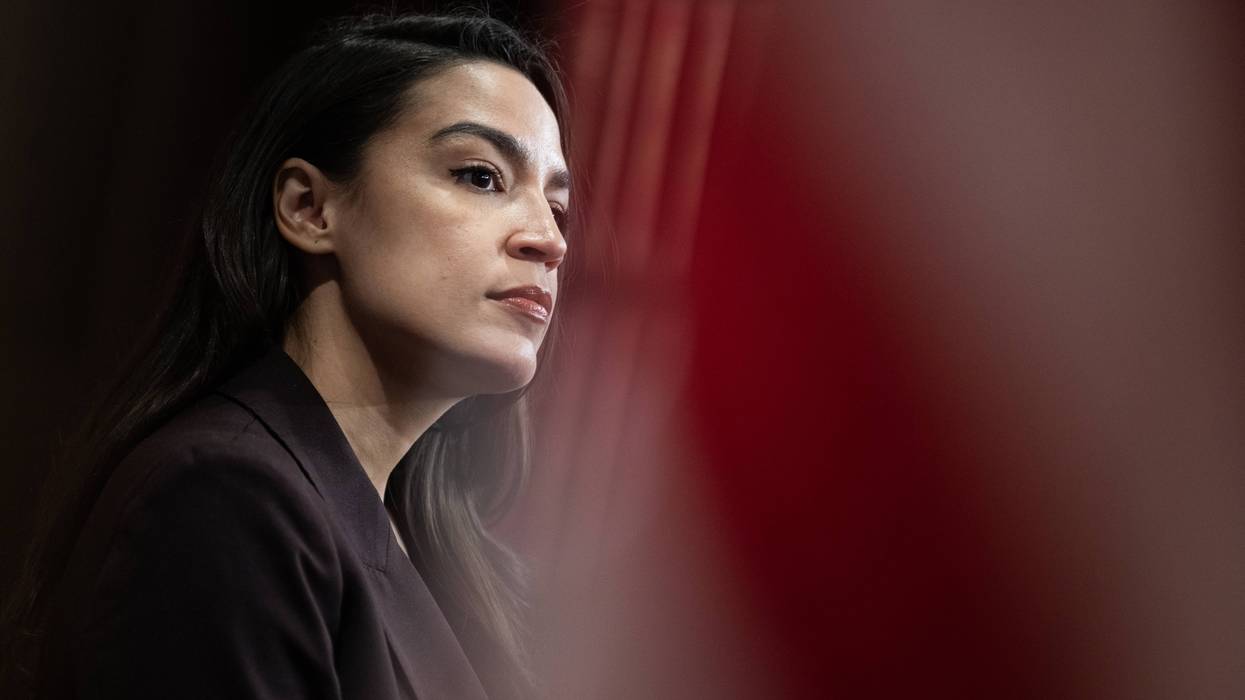
"Life doesn’t wait for you to be ready for things," the Democratic congresswoman said amid nationwide progressive political momentum. "Sometimes life just makes things ready for you."
As Rep. Alexandria Ocasio-Cortez weighs whether to run for president in 2028, there are numerous factors that complicate her decision: her identity as a Latina woman, her role as a leader in a progressive movement on the verge of unprecedented power, and her considerations about raising a family in the future.
Whatever decision the 36-year-old Democratic congresswoman makes, however, it will be “all or nothing,” she said in an interview published Tuesday by The New York Times, in which she spoke candidly about the stakes of what would be a historic and potentially transformative bid for the nation’s highest office.
Ocasio-Cortez (D-NY) became the youngest woman ever elected to Congress in 2018 in a victory over the Democratic Party establishment that became a model for the wave of progressive momentum that has defined this year’s cycle.
Amid what she described as the “ascendance” of her movement—marked by the insurgent victories of New York City Mayor Zohran Mamdani and Michigan Democratic Senate nominee Abdul El-Sayed over opponents with establishment support and big money behind them—Ocasio-Cortez is now wondering aloud whether her own moment has arrived.
“There’s an argument that some make that this is a very unique political window and, oftentimes in politics, you do only get one shot,” she said. “And you don’t—and just in life in general—life doesn’t wait for you to be ready for things. Sometimes life just makes things ready for you.”
But she is well aware of the obstacles and sacrifices, both personal and political. Having recently opened up publicly about receiving fertility treatments, she wondered aloud what a potential candidacy might mean for her life, including a possible future pregnancy.
She is also well aware that she would be up against the weight of very recent history. Two of the last three Democratic candidates for president, former Secretary of State Hillary Clinton and former Vice President Kamala Harris, were women, and they both lost to President Donald Trump after campaigns in which sexism—and, in Harris’ case, racism—featured prominently in attacks against them.
“Pretty candidly, I think about my identity," Ocasio-Cortez said. "I’m not naïve to the fact that we are living under a very regressive administration, and I happen to be a woman, and I, you know, happen to be Latina. And I think that there’s a lot of conversation about electability, and I don’t kind of shy away from those realities.”
Those realities are indeed hard to ignore, especially in contrast to her mentor, Sen. Bernie Sanders (I-Vt.), who ran two formidable Democratic primary campaigns for president in 2016 and 2020 and with whom Ocasio-Cortez embarked on a wildly successful "Fight Oligarchy" rally tour last year, speaking to large crowds in both red and blue districts.
Though they have long campaigned together and advance a platform centered on the same signature policies of Medicare for All, a Green New Deal, and a tax on billionaire wealth, Sanders consistently ranks among the most well-liked politicians in office, while a New York Times/Siena poll this month showed AOC with just 30% favorability, compared with 41% unfavorability among likely voters.
There are other paths in front of AOC that could put her on a more traditional long-term trajectory to the White House, which has never in modern history been occupied by a president who ascended straight from the US House.
She also said she was considering a primary bid against the Democratic Party's current Senate leader, Chuck Schumer (D-NY), whom many Democratic voters have come to see as the embodiment of all that is sclerotic and unchanging about their party's entrenched elite.
At a time when backing from corporations and other powerful special interests plays an unprecedented role in achieving political power, Ocasio-Cortez emphasized her near-exclusive backing from small donors, which she said makes her one of "very few people who are financially independent from special interests that are able to advocate directly for the needs of working people.”
Regardless of the decision she makes, she recognizes the enormous stakes.
“It’s very all or nothing,” she said. “If I were to run in this cycle, and not win, I would be done.”
“And I am not opposed to that,” she added. “That, in and of itself, does not exclude the decision... But it has to make it worth it.”
Ocasio-Cortez has previously emphasized that her "ambitions" have less to do with achieving the highest possible seat for herself than with helping her movement succeed.
“My ambition is to change this country,” she said during a forum in May. “Presidents come and go, Senate, House seats, elected officials come and go, but single-payer healthcare is forever, a living wage is forever, workers’ rights are forever, women’s rights, all of that.”
She told the Times that the question that will ultimately determine her path forward is: "Where can I do the most good?”
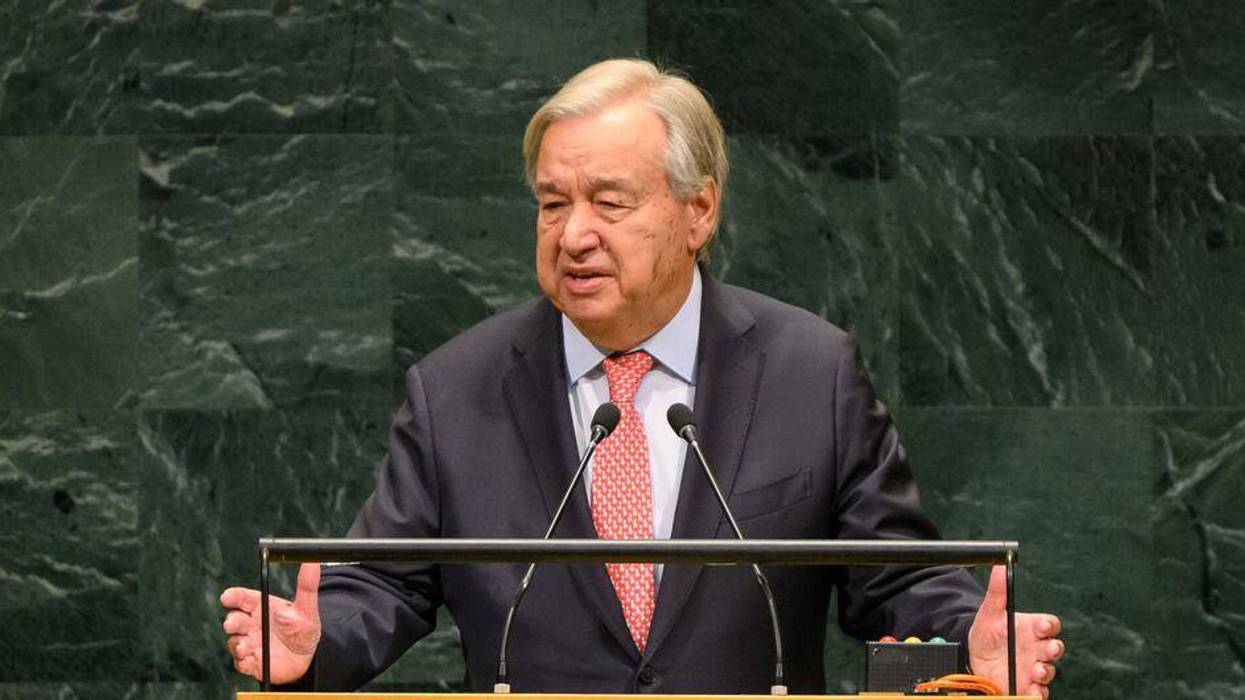
"We know that fossil fuel interests won't step aside on their own," said the UN chief. "When the harms of Big Tobacco became undeniable—governments acted. The climate crisis demands the same determination."
With United Nations Secretary-General António Guterres set to leave his post at the end of this year, he used his final address to the UN General Assembly on Monday to share a familiar call: "Polluters must pay" for fueling the global climate emergency.
Since the Portuguese politician began his first five-year term leading the world body nearly a decade ago, he has repeatedly called for international action to rapidly phase out the coal, gas, and oil that are heating up the planet. In late 2023, he emphasized that "the science is clear. The 1.5°C limit is only possible if we ultimately stop burning all fossil fuels. Not reduce. Not abate."
The UN chief announced at the end of 2024 that "the top 10 hottest years on record have happened in the last 10 years," and declared: "This is climate breakdown in real time. We must exit this road to ruin." Last year, he argued that fossil fuels represent "the greatest threat to energy security today," and countries clinging to them are "sabotaging" their own economies and futures.
Earlier this month, after a UN report found that at least temporarily surpassing the Paris Agreement's goal of limiting temperature rise this century to 1.5°C above preindustrial levels is now inevitable, Guterres stressed that "this summer’s scorching heat, raging wildfires, and deadly floods are a warning of what lies ahead," and called for making the overshoot "as small and short as possible."
Speaking to the General Assembly on Tuesday, he cited that recent finding: "Now we face a near-certain breach of the 1.5-degree limit, with a supersized El Niño speeding straight for humanity. The dangers are real. But so is the hope."
"The sun belongs to no one. The wind cannot be embargoed. Innovation can come from everywhere," he said. "Renewables are now the cheapest source of new electricity in most of the world. And the most viable path to energy security, independence, and sustainable growth... A future beyond fossil fuels is in sight. The question is how."
"Will it be a just and orderly transition built on international cooperation—or chaotic and costly, leaving people and countries behind?" he asked, urging every government to adopt a Paris Agreement-aligned national plan to transition away from fossil fuels.
"We know that fossil fuel interests won't step aside on their own. For decades, Big Oil has treated the atmosphere as an open sewer—and cashed in on the consequences," he acknowledged. "We have seen this kind of abuse of power before. When the harms of Big Tobacco became undeniable—governments acted. The climate crisis demands the same determination."
According to the UN chief: "Those who polluted the most—and profited the most—must do far more to repair the damage they caused. Polluters must pay. And to the leaders, cities, civil society and citizens working to hold them accountable: I say, you are on the right side of history. Keep going."
"And governments must keep going on all fronts: To end deforestation. Invest in grids and storage. Cut methane emissions," he continued. "But these actions are not enough: We need climate justice with a focus on adaptation and finance. Developed countries must respect their commitments. They must triple adaptation finance.And make the Loss and Damage Fund work at scale."
"We must also ensure that the mining of critical minerals does not dig deeper into the inequities of the past," he added. "Producing countries and affected communities must retain a far greater share of the value created from their resources. No more plundering. No more exploitation."
While Guterres' speech didn't just focus on "the power fueling climate chaos and the war on nature"—it also addressed peace and security, inequality, and artificial intelligence in detail—climate campaigners welcomed the time he devoted to the crisis.
"When the UN secretary-general calls for fossil fuel companies to pay, you know this demand has become impossible to ignore," said Louise Hutchins, co-convenor of the Make Polluters Pay International Coalition, in a statement. "Millions of people around the world are calling for it, and governments are starting to listen."
His address came just a day after campaigners from groups around the world delivered over 2 million petition signatures calling on governments to make polluters pay to Selwin Hart, the UN's assistant secretary-general for climate action, in New York City.
"For years, campaigners and communities on the frontlines have been saying the same thing: The companies that profited from fossil fuels must pay their fair share of the costs of the crisis they helped create. Today, that demand is moving into the mainstream," 350.org executive director Anne Jellema noted after Guterres' remarks. "The voices of more than 2 million people are now being brought to the UN. Governments have the power to make polluters pay, and they must use it."
Enough is enough: over 2 million petition signatures at UNGA to Make Polluters Pay www.greenpeace.org/internationa...
[image or embed]
— Nick Young (@nickofnz.bsky.social) September 21, 2026 at 5:56 PM
Amitabh Behar, executive director of Oxfam International, highlighted that "the people who have contributed least to the climate crisis are paying the highest price. They are losing homes, livelihoods, and access to food and facing an increasingly uncertain future, while fossil fuel corporations and their billionaire backers continue to profit. The call to make rich polluters pay is about justice. It is about ensuring that those who have benefited most from the fossil fuel economy pay for the damage it has caused."
Greenpeace International executive director Mads Christensen pointed out that "Guterres has spent years warning leaders where fossil fuel dependence leads, and this year proved him right. From deadly heat to devastating fires and floods, the very dependence driving these disasters is shaking entire economies and leaving families exposed to volatile energy and food prices, while the companies behind it keep raking in the profits."
"New rules forcing governments to align their taxes and spending with global climate goals would raise hundreds of billions of dollars to support the countries and communities least responsible, while incentivizing money out of fossil fuels and into secure, renewable energy that actually protects people," he argued. "As long as destruction stays profitable, the transition to a safer, fairer future will keep being held back. Guterres has named the solution, governments must now act on it."

"We deserve answers about every contract and every conversation that Collins and her team facilitated on the backs of taxpayers. The jig is up."
Maine Democratic US Senate candidate Troy Jackson pounced on Tuesday after ProPublica published a damning story putting incumbent Republican Sen. Susan Collins at the center of what the publication described as a "sprawling pay-to-play operation."
In a statement released shortly after the ProPublica story dropped, Jackson accused Collins of engaging in "corruption of the highest order."
"Susan Collins delivered millions in taxpayer dollars for a corrupt donor bankrolling her campaign," said Jackson, "and then [President] Donald Trump helped her cover it up."
The ProPublica report unearthed internal records revealing an FBI investigation into defense contractor Navatek, now known as Martin Defense Group, for making campaign contributions to politicians in exchange for federal contracts.
According to ProPublica, former Navatek CEO Martin Kao told a group of FBI agents and federal prosecutors in 2022 about a 2019 meeting he'd had with the head of a pro-Collins super political action committee where he committed to cut a big check to the Maine Republican's campaign if she steered federal cash to his company.
After the meeting, ProPublica wrote, Kao "sent an initial $150,000 to the Collins super PAC using the shell company" and then told Navatek executives in an internal email two months later that "Collins committed to getting the company $32 million in naval contracts."
The alleged corruption outlined in the report went far beyond Collins, as Kao also provided FBI agents with a 50-page document that named "dozens of lobbyists, congressional staffers, and members of Congress who he said helped him trade cash for contracts."
However, the probe into Kao's alleged efforts to bribe politicians was shut down shortly after Trump returned to the White House in 2025, which Jackson said may explain why Collins "voted with him 96% of the time and has rubber-stamped his agenda to hurt Maine."
"Susan Collins doesn’t care," Jackson added, "that we’re losing our healthcare that ICE is killing people on the streets, and that we’ve been dragged into a pointless war—as long as her donors get their contracts and her coffers get filled. We deserve answers about every contract and every conversation that Collins and her team facilitated on the backs of taxpayers. The jig is up."
Annie Clark, Collins' deputy chief of staff, disputed the allegations made in the ProPublica story, and accused the publication of wrongly lending credibility to Kao, whom she said "began making outlandish charges about the Collins office, deflecting blame from himself" for his own criminal behavior.
"The seven-year-old allegations made against Sen. Collins and her staff in this piece are categorically false," said Clark. "There have never been any allegations of wrongdoing by the Collins for Senator campaign, and the campaign was never the target of the FBI investigation."
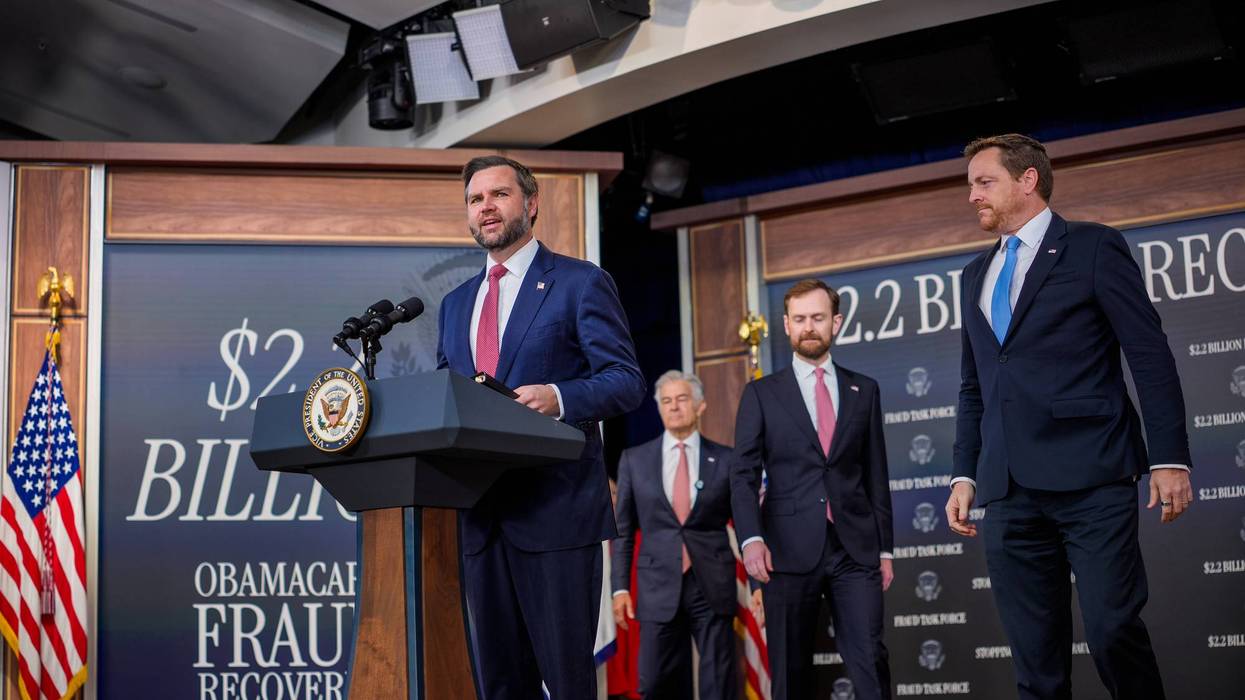
"This so-called task force is nothing more than a bullshit distraction."
The Trump administration is planning to boot more than 700,000 people from their Affordable Care Act coverage as part of a purported initiative to root out fraud in the program—an effort that campaigners said is nothing more than a pretext to kick more people off healthcare.
Vice President JD Vance, who is leading the White House's "Task Force to Eliminate Fraud," announced the planned ACA purge during a press conference on Tuesday alongside Centers for Medicare and Medicaid Services Administrator Mehmet Oz, whose agency has touted a right-wing think tank's dubious claim that millions of ACA enrollees are on the program improperly.
Vance insisted during Tuesday's press conference that the administration is putting itself "under an extraordinary burden of proof" to ensure its mass removal doesn't impact people who are eligible for ACA coverage, but advocates were not convinced.
"Vance's task force is a smokescreen for kicking people off coverage," declared the advocacy group Protect Our Care. The organization's president, Brad Woodhouse, said in a statement that Vance's task force "is nothing more than a bullshit distraction—a political stunt designed to throw even more people off their coverage while pretending to save taxpayers’ money."
"At a time when millions of Americans are already losing coverage and facing skyrocketing costs, Vance and this administration are making the crisis exponentially worse," said Woodhouse. "They are piling on more red tape, more confusion, and more opportunities for people to lose the coverage they rely on. Families need coverage they can afford and count on when they get sick. Vance’s task force won’t accomplish that. It’s a smokescreen for an administration whose sole mission is to make it harder to get and stay covered but to shower billionaires with tax breaks instead."
Millions of people have lost ACA and Medicaid coverage since the start of President Donald Trump's second White House term, due in large part to a Republican budget law that cut Medicaid by more than $800 billion and did nothing to extend enhanced ACA subsidies, sending premiums soaring.
Trump administration officials have baselessly claimed that their anti-fraud efforts were the key driver of ACA enrollment declines this year.
The word ‘fraud’ here obscures a lot.
Many of them may have been accidentally committing ‘fraud’ bc they live in a state that didn’t expand Medicaid and earn too little to qualify for ACA subsidies. There have been cases of brokers signing those folks up for the commission. pic.twitter.com/ek8gaVzJ7g
— Jordan Weissmann (@JHWeissmann) September 22, 2026
The mass disenrollment push comes less than two weeks after the Trump administration said it would send $500 rebate checks to some Americans who were allegedly "overcharged" under the ACA. Critics noted that the checks would only go to a small sliver of ACA enrollees and would do virtually nothing to offset premium hikes that are hitting millions of Americans.
Vance indicated Tuesday that the roughly 750,000 individuals who will soon be removed from the ACA due to alleged fraud are just the start of a broader purge. Around 19 million people are currently enrolled in ACA marketplace coverage.
"We're gonna do some additional verification," said Vance, who suggested the administration is using artificial intelligence tools to identify purported fraud. "We expect that most of these people are fraudulently enrolled, but we're gonna do some additional verification on about 419,000 people."
Democrats on the House Energy and Commerce Committee, which has jurisdiction over the ACA, wrote Tuesday that "people losing healthcare isn't a bug, it's [Trump and the GOP's] plan."
"First Republicans stripped Medicaid from millions," the Democrats wrote on social media. "Then they let premiums spike for millions more. Now JD Vance is using claims of 'fraud' to take coverage from hundreds of thousands more."

"As long as we continue to burn fossil fuels," said one scientist, El Niño "occurs on an increasingly hotter baseline, making it much more difficult for communities to deal with the consequences.”
Although “El Niño comes and goes," as one climate scientist said of the naturally occurring warm-weather phenomenon on Monday, experts are in agreement that this year is different—with meteorologists already recording a temperature rise of 3.07°C in the Pacific Ocean, putting it at a statistical tie with November 2015, when El Niño caused the ocean to warm by 3.08°C.
The temperature rise is not expected to peak until November and December, when an average of 14 models examined by Zeke Hausfather of Carbon Brief and Berkeley Earth found that a temperature rise of 4.1°C is forecast.
The event has been underway since June, Hausfather wrote, and has been gathering strength "faster than any previous event on record."
Scientists typically track the strength of El Niño—which leads to heavy rainfall, higher global temperatures, and other extreme weather as warmer Pacific waters are pushed to the south—using the Niño 3.4 anomaly, or ONI, which determines how much hotter the central Pacific is compared with a 30-year rolling average.
A temperature rise above 2.0°C is considered a "very strong" El Niño, and scientists and policymakers are already calling this year's event a "super El Niño," with some experts using the terms "Godzilla-level" and "jaw-dropping" to describe the weather conditions that can be expected in the coming months due to the warmer climate.
As Common Dreams reported late last month, planetary heating driven by fossil fuel emissions is intensifying El Niño, while the naturally occurring phenomenon can in turn worsen the impacts of the climate emergency.
In the last 40 years scientists have recorded a 16% increase in the strength of El Niño events, according to a study published in Science last month. They've also gotten 36% stronger than they were before industrialization began.
The "double whammy," as The Guardian called it, could make 2027 the hottest year ever recorded, blowing through heat records that have just been set this year—and that have been linked to the deaths of people around the world from extreme heat and flooding.
“This event is a huge redistribution of energy in the climate system and is dangerous because it is unfolding on top of a much warmer, human-influenced climate system," climate scientist Friederike Otto of Imperial College London told The Guardian. “So, in many places around the world we will see never-before-experienced heat extremes, with all their consequences on health, food security, and water stress."
Despite the fact that El Niño predates the human-caused climate emergency, Otto said, "as long as we continue to burn fossil fuels, it occurs on an increasingly hotter baseline, making it much more difficult for communities to deal with the consequences.”
This year's event is likely to be the most intense El Niño in 1,000 years, reported to The Guardian, with hotter and drier conditions already linked to deadly wildfires in Indonesia and crop losses in Central America and the Caribbean region due to drought conditions. Rice production this season is expected to fail in Indonesia, according to the Salata Institute for Climate and Sustainability at Harvard University.
As the Southern Hemisphere's summer months approach, southern Africa and Australia are at heightened risk of wildfires and droughts as well. Meanwhile, cocoa production could be damaged by extreme rainfall in parts of South America.
"All strong El Niño events on record have continued to strengthen well into the winter—and the models are in near-unanimous agreement that this one will, too," wrote Hausfather at Carbon Brief. "If the forecast holds, the current event will peak between November and January at a level far beyond any event previously observed in the instrumental record."
In California on Monday, Democratic Gov. Gavin Newsom declared a state of emergency in an effort to prepare communities for El Niño's impacts in the coming months, which could include coastal flooding and heavy snow in mountain regions.
Hausfather noted that strong El Niño events like those that occurred in 1997 and 2015 were also "associated with hundreds of billions of dollars in damages globally."
"This event," he told The Guardian, "is leaving those past ones in the dust."

"Standing up to Elon Musk should be an easy layup for any Democrat."
SpaceX CEO Elon Musk reportedly plans to spend at least $100 million to help Republicans in the 2026 midterms, and some critics are questioning why Democrats aren't doing more to highlight the efforts of the far-right billionaire—so central to President Donald Trump's destructive second term—to buy elections and further corrupt the nation's political process.
A Monday report from NBC News highlighted how Musk has taken a quieter approach to campaigning for the GOP than he did in 2024, when he personally appeared at campaign rallies and promised $1 million checks to voters.
Republican operatives who spoke with NBC said they worried that Musk getting more publicly involved in the campaign could backfire, with one consultant saying it could be a "mistake" if the South African-born billionaire became "the story" in the closing weeks of the election.
While Republicans might want to keep Musk's campaign contributions quiet, critics pointed out that Democratic candidates are under no obligation to do the same.
In a Tuesday social media post, Princeton historian Kevin Kruse expressed bewilderment that Musk was not a central issue for many Democratic campaigns, despite the fact that he's spending tens of millions of dollars trying to defeat them.
"Many Democrats just refuse to take the open shot at Musk," wrote Kruse. "He's a ripe, rich target, and an obvious way to dramatize key issues and mobilize key voters, but some of them are still sitting on their hands. Not sure if they're cowards who don't want to take him on or if they're complicit in taking money from him and people like him, but it's staggering."
"Standing up to Elon Musk," Kruse emphasized, "should be an easy layup for any Democrat."
Journalist Julian Sanchez endorsed Kruse's analysis, describing Democrats' reluctance to go all in against Musk as "a weird unforced error," while pointing to polling showing that the SpaceX CEO is "almost as unpopular" as Trump.
Sanchez also offered up a mock response for any Democratic candidate targeted by Musk's money cannon.
"You’ve probably seen some ads lying about my position on trans issues," Sanchez wrote, imagining a Democratic ad. "Maybe you’re wondering why the campaign is about a tiny fraction of the population when a failed illegal war is skyrocketing gas prices. It’s because a weird billionaire hates his trans daughter and can't shut up about it."
As reported by journalist Judd Legum on Tuesday, Musk's super political action committee has been obsessively attacking transgender rights by "blanketing the internet with digital ads falsely accusing Democratic Senate candidates of supporting 'taxpayer-funded sex changes for kids.'"
Daily Kos reporter Oliver Willis argued that Democrats' reluctance to put Musk front and center raises red flags about how they'll govern should they re-take Congress
"The refusal to go after Musk is a serious validator of the notion democrats have no real interest in winning," Willis wrote. "No serious party would let someone like him emerge as a major funder of the opposition and just… not say anything about it."
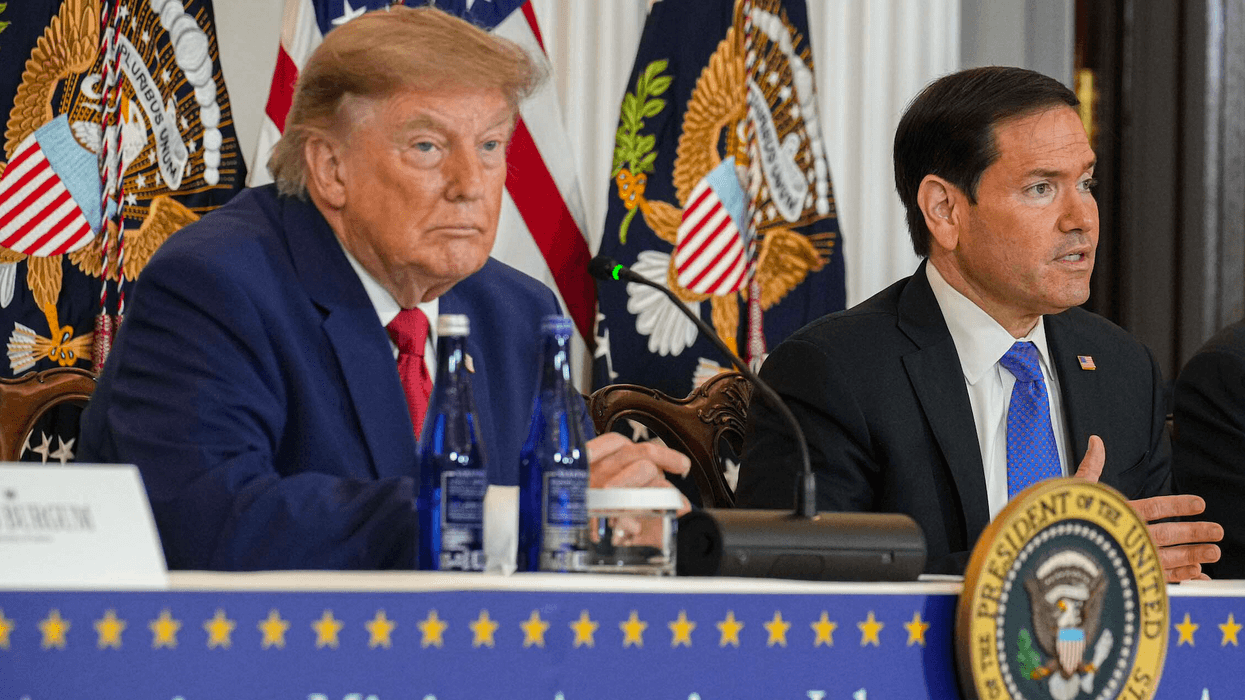
In what the Democratic senator called an effort at “obstructing investigations of Netanyahu’s war crimes,” the Trump administration is planning a dramatic escalation of its sanctions against the court.
As the United Nations General Assembly prepared to meet, a US senator said President Donald Trump and Secretary of State Marco Rubio should face sanctions for their role in trying to destroy the International Criminal Court in order to protect Israeli Prime Minister Benjamin Netanyahu.
"If European countries and other signatories to the International Criminal Court (ICC) have any self-respect, they'd sanction Rubio and Trump for obstructing investigations of Netanyahu's war crimes," wrote Sen. Chris Van Hollen (D-Md.) Monday on social media.
He was responding to a report from the Wall Street Journal detailing "a sharp escalation" in the Trump administration's efforts to, in Rubio's words, "dismantle" the ICC, which issued an arrest warrant for Netanyahu in 2024. The body accused the prime minister and then-Defense Minister Yoav Gallant of war crimes and crimes against humanity in Gaza, including the deliberate use of starvation as a weapon of war.
The ICC has also reportedly launched investigations into two other far-right ministers in Netanyahu's cabinet, Finance Minister Bezalel Smotrich and National Security Minister Itamar Ben-Gvir, for their roles in aggressively expanding Israeli settlements in the occupied West Bank, which are considered illegal under international law.
The Trump administration had already aggressively sanctioned ICC officials involved in efforts to prosecute Americans or Israelis, including then-chief prosecutor Karim Khan and several judges and prosecutors. It had also sanctioned UN special rapporteur on Palestine Francesca Albanese and several Palestinian human rights organizations that had brought evidence of alleged Israeli crimes before the tribunal.
Now, The Journal reports that:
The Trump administration is preparing to impose sweeping sanctions on the [ICC]...
The sanctions would forbid most transactions with the ICC after a grace period of six to seven months... That could potentially cripple the court by prohibiting it from conducting transactions in US dollars, cutting it off from much of the global financial system.
It is unclear when a final decision and announcement might come, though some US officials said the move could be finalized as soon as this week during the United Nations General Assembly meeting or in the following days.
Several world leaders have been vocally critical of the US attack on the ICC, though they've stopped short of calling for sanctions against US officials.
Responding to Rubio's sanctions in August, European Commission President Ursula von der Leyen and European Council President António Costa said that the ICC's "judges and officials must be able to act independently and without external pressure."
Dutch Foreign Minister Tom Berendsen, whose nation is home to the ICC, said the Netherlands disapproves of efforts to sanction the court, adding that Dutch officials were actively working with the EU to protect the court from institution-wide US sanctions. Possible protective measures reportedly include alternative banking and payment arrangements outside the US dollar system.
There have also been calls within the European Parliament, including from Spanish socialist politician Iratxe García Pérez and others, to activate the EU's so-called "blocking statute," which would prohibit European companies from complying with the US sanctions.
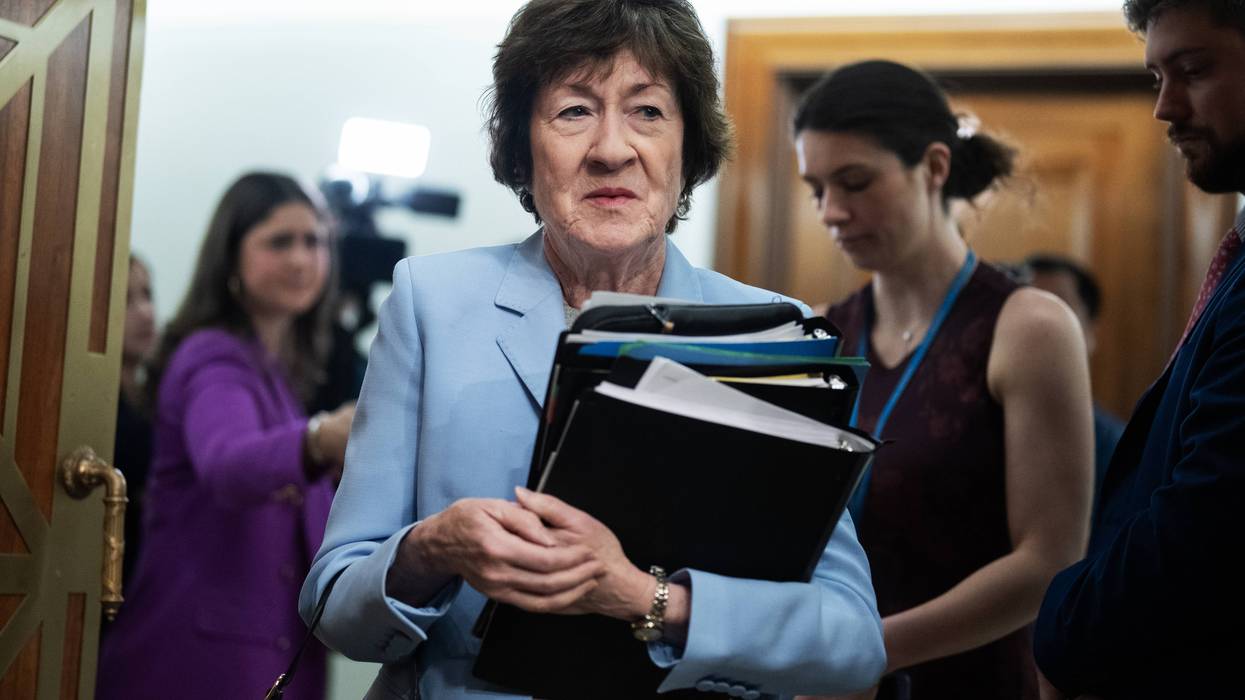
ProPublica reported that the US senator from Maine, now running for a sixth term, was the "most important patron" of a defense company accused of bribing members of Congress for federal contracts.
Explosive reporting published Tuesday by the investigative outlet ProPublica details how US Sen. Susan Collins was at the center of a "sprawling pay-to-play operation" under which the chief executive of a Hawaii-based defense contractor allegedly funneled campaign cash to lawmakers in exchange for lucrative federal contracts.
ProPublica's story—based on internal emails, thousands of pages of legal records, interviews, and other evidence—reveals for the first time the existence of an FBI investigation into possible bribery of members of Congress, including Collins, by the defense contractor Navatek, a probe that was shuttered after President Donald Trump took office for his second term.
In late 2019, according to ProPublica, the head of a pro-Collins super PAC, Scott Reed, met with then-Navatek CEO Martin Kao and other executives at a Washington, DC bakery and asked them for a $500,000 donation to the longtime Maine senator's 2020 reelection bid.
"If they cut a big check, the CEO told Reed, Navatek wanted Collins to guarantee tens of millions of dollars in additional federal funding," ProPublica reported. "After the Corner Bakery meeting, [Kao] sent an initial $150,000 to the Collins super PAC using the shell company. Two months later, he told Navatek executives that Collins committed to getting the company $32 million in naval contracts, according to an internal company email."
In 2022, Kao pleaded guilty to making illegal campaign contributions. The $150,000 check to the pro-Collins group, the 1820 PAC, was funneled through an entity titled "the Society of Young Women Scientist [sic] and Engineers." The money flowed from Navatek's account, violating the ban on federal government contractors making campaign donations.
This is an incredible story of corruption.
I kinda love that the fake shell company the weapons maker used to bribe Susan Collins was called “Society of Young Women Scientist and Engineers LLC.” https://t.co/I06XpPHIO9
— Ryan Grim (@ryangrim) September 22, 2026
ProPubulica revealed that Kao, facing years in federal prison, handed FBI agents "a 50-page document naming dozens of lobbyists, congressional staffers, and members of Congress who he said helped him trade cash for contracts." Kao also told federal agents that Navatek’s federally funded research "was of no real value," according to ProPublica.
"Of all the politicians Navatek courted under Kao’s leadership, Collins was its most important patron," the investigative outlet reported. "The senator’s office steered government contracts worth millions toward the company while her campaign was pumping Kao and his network for donations, according to emails seen by ProPublica. Sometimes they cut checks within 24 hours of the annual defense spending bill, which funds military contracts, clearing a key Senate hurdle."
Collins, who is currently running for a sixth Senate term, denied allegations of bribery through a spokesperson, who dismissed Kao's claims as "outlandish" and said the Collins campaign "disgorged the illegal contributions that Martin Kao had made without our knowledge."
But ProPublica's reporting details, with documentary evidence, Collins' yearslong relationship with Kao, who first met the Maine senator face-to-face in 2018.
"In that first meeting with Collins and her staff, Kao pitched an $8 million boat hull research project for Navatek and [the University of Maine]. Collins seemed supportive," the outlet noted. Kao funneled donations to Collins' campaign, and the senator later included funding for Navatek's project in the annual US military budget.
"Emails showed her staff made it clear to the Navy that it should send the money to Navatek," ProPublica reported.
The outlet also revealed the details of a 2019 meeting between Kao, Collins, and Amy Abbott, who was then serving as the campaign finance director for the senator's 2020 reelection campaign. The meeting took place before an event at Navatek's Maine headquarters, where Collins posed for pictures with Kao.
"Before the event, Kao said, Collins, Abbott, and another staffer met with him in private," ProPublica reported. "One of the staffers told Kao the campaign expected more donations. It was in this meeting that Collins said, 'You’ve seen me deliver,' he told the FBI."
 Martin Kao, second from left, was pictured with Sen. Susan Collins during an event in August 2019. (Photo: Sen. Susan Collins/Facebook)
Avi Asher-Schapiro, one of four ProPublica reporters who bylined the bombshell story, lamented that "we may never know the full story" of the large-scale bribery scheme alleged by Kao because the Trump administration "took a wrecking ball to the FBI teams and DOJ lawyers specializing in these cases—everyone who worked it is gone."
"And as far as we know," Asher-Schapiro added, "the FBI abandoned a witness who might have been able to expose a generational corruption scandal."
The report was published just weeks before the November midterms, when Collins will attempt to retain her seat against former Maine Senate candidate Troy Jackson, who has said that billionaires and corporate-funded super PACs "have her in their pockets."

"This isn't law enforcement," said US Senate candidate James Talarico. "It's lawlessness."
Democrats in Congress on Monday evening were demanding a full, independent investigation into US Immigration and Customs Enforcement's shooting on Sunday of Wilber Rafael Garces Perez, as it was reported that he had been held in an ICE detention center with a bullet still lodged in his back—close to his spine—and that he was finally being taken to a hospital only after he lost feeling in the left side of his body.
In a video posted on social media, US Rep. Joaquin Castro (D-Texas) recounted how Perez was initially hospitalized after ICE agents in an unmarked SUV sideswiped his car as he was making DoorDash deliveries in Austin, Texas, and then shot him through his windshield as he was trying to pull over.
But "only a few hours after being shot, he was forced out of the hospital," said Castro, "and sent over to what is known as STIPC, in Pearsall, Texas, along I-35, the South Texas ICE Processing Center."
Castro and Rep. Greg Casar (D-Texas) spent Monday attempting to gain permission to visit with Perez and raising alarm over the fact that ICE's bullet had not been removed from his back before he was taken to STIPC, where he was reportedly forced to sleep on a floor.
"He reported that he's in incredible pain, that he'd not been given any medication," said Castro. "It's basically abuse that you would take somebody who has been shot and move them from a hospital to a prison, that kind of prison, within a matter of hours, and then also, it looks like, start the process to deport them immediately."
Update on the condition of Wilber Rafael Garcés Pérez at the South Texas Ice Processing Center. He’s being taken to the hospital. He is in tremendous pain and tells us that the bullet is still inside his left side. He can’t move the left side of his body. pic.twitter.com/SWquC2AOrj
— Joaquin Castro (@JoaquinCastrotx) September 21, 2026
Perez entered the country two years agoafter using the CBP One application to set up an appointment with immigration agents. The app was introduced by the Biden administration, but President Donald Trump abruptly terminated it immediately after he took office last year. Perez was permitted to enter the country, applied for asylum, and received a work permit.
As Common Dreams reported Monday, Perez's lawyer, Kate Goldfinch-Lincoln, and his wife were unable to make contact with him when he was first taken from the hospital on Sunday.
After Perez briefly called in from the detention center to a press conference held by Goldfinch-Lincoln on Monday, she said she received a call from another detainee who told her "that officers came in and handled Wilber roughly."
"According to this detainee, Wilber then lost feeling on the left side of his body, including his arm and leg," she said. "Wilber has a bullet lodged near his spine. I was told that he was handcuffed, shackled at the feet, placed in a waist chain, and taken to a hospital. I am waiting to find out how he is doing and what his current condition is. We need answers. We need to know that Wilber is safe and receiving appropriate medical care. So far, he has not."
In response to the update on Perez's condition, Democratic US Senate candidate James Talarico said: "This isn't law enforcement. It's lawlessness."
Casar called Perez's transfer back to the hospital "a positive first step," and credited immigrant rights advocates and community members for "speaking up."
"Now, we have to make sure he fully recovers, is reunited with his family, and gets to tell law enforcement the full story of how he was shot in the back by ICE," said Casar.
Reps. Rashida Tlaib (D-Mich.), Ro Khanna (D-Calif.), and Maxwell Frost (D-Fla.) were among the lawmakers calling for a full investigation into the shooting and ICE's treatment of Perez.
"This is absolutely horrific," said Frost. "ICE must be stopped. Their regime of cruelty will continue until they are held accountable."

"If there was ever a time in human history, in our country and throughout the world, that we have got to come together and create a world not based on greed but based on justice, based on decency, now is the time."
US Sen. Bernie Sanders warned in a speech late Monday that the world is hurtling toward "an extremely dangerous global oligarchy" whose unprecedented concentration of wealth and political power endangers democratic institutions, the environment, and humanity's collective future as artificial intelligence rapidly advances.
"The oligarchs of today, worth hundreds and hundreds of billions of dollars, having investments all over the world, fervently believe that they are the masters of the universe, and that they, through their enormous wealth and power, have been ordained to rule the world," Sanders (I-Vt.) said in an address at the historic Riverside Church in Manhattan, where Martin Luther King Jr. delivered a famous speech condemning the Vietnam War. "Today we say to those oligarchs: This country, this world, belongs to all of us, not just you."
Sanders used his remarks, delivered as world leaders arrived in New York City for the United Nations General Assembly, to decry a massively unequal status quo under which political leaders cater to the needs of billionaire donors and corporate interests rather than the broader population, whose wages are being swallowed by rising costs and whose communities are increasingly devastated by pollution and war.
Sanders also warned about the rise of "right-wing demagogues" who are exploiting real material struggles and government failures to advance nefarious agendas that pit "working people against each other based on the color of their skin, where they were born, or their religion."
"Instead of producing more bombs and weapons and seeing the military-industrial complex enjoy huge profits, governments throughout the world need to come together to feed the children, take care of the vulnerable, and protect our planet from the ravages of climate change," said Sanders, calling for an end to US military assistance to Israel, which is using American-made weaponry to carry out its genocidal assault on the Gaza Strip.
"Never before in human history have so few people held so much wealth and so much power, never before in human history have we had such enormous concentration of ownership," the senator said, warning that advancements in AI technology could dramatically intensify the crises facing humanity if control isn't wrested from "a handful of Big Tech oligarchs."
Watch Sanders' full speech:
Sanders called on US President Donald Trump, a billionaire who has dismissed warnings about the threats posed by AI, and Chinese President Xi Jinping to "begin the process of negotiating a comprehensive treaty to establish a pause on advanced AI and a ban on AI superintelligence" when the leaders meet this week.
The progressive senator also cautioned against "despair and depression" in the face of pressing global challenges, saying, "We got to stand up, we got to fight back, we've got to create the kind of nation and world that you and I know we can create."
"If there was ever a time in human history, in our country and throughout the world, that we have got to come together and create a world not based on greed but based on justice, based on decency, now is the time," said Sanders.