SUBSCRIBE TO OUR FREE NEWSLETTER
Daily news & progressive opinion—funded by the people, not the corporations—delivered straight to your inbox.
5
#000000
#FFFFFF
To donate by check, phone, or other method, see our More Ways to Give page.
Daily news & progressive opinion—funded by the people, not the corporations—delivered straight to your inbox.
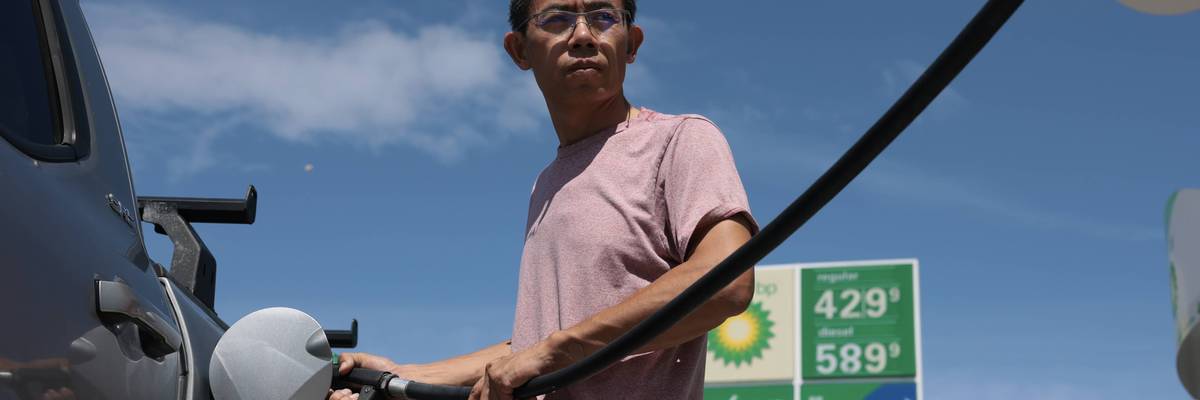
William Mao puts fuel in his vehicle in Miami, Florida on April 6, 2026, as diesel and gasoline prices remain elevated due to President Donald Trump's war on Iran.
"Even if the Strait of Hormuz reopens and the ceasefire holds, oil and gas prices will stay above pre-war levels, and consumers will pay."
Although oil prices dropped after President Donald Trump backed off his genocidal threat against Iran and announced a two-week ceasefire, the international climate group 350.org warned Wednesday that "'fossilflation'—or inflation caused by volatile and rising prices of oil and gas—is still likely to continue," due to the fragility of the deal and extensively damaged infrastructure.
Since the US and Israel started bombing Iran on February 28, the country has closed the Strait of Hormuz—a key shipping route, including for fossil fuels—to most traffic. Oil prices have soared, and Americans have paid more at the pump, with the national average price for a gallon of gasoline topping $4 for the first time in years. As of Wednesday, it was $4.16, despite Trump's Tuesday night announcement.
"In addition to the horrific loss of human life," 350.org said last week, rising oil and gas prices around the world as a result of the war "have already cost consumers and businesses an additional $104.2-$111.6 billion," an estimate that "does not yet include wider knock-on effects, such as rising fertilizer and food costs, declines in economic output and employment, or broader inflation driven by fossil fuel price volatility."
In the United States alone, during the first month of Trump's war, Americans spent an extra $8.4 billion on gasoline, according to a report released last week by Democratic members of the congressional Joint Economic Committee.
Andreas Sieber, 350.org's head of political strategy, explained Wednesday that "even if the Strait of Hormuz reopens and the ceasefire holds, oil and gas prices will stay above pre-war levels, and consumers will pay. Volatility remains high, and supply will stay tight due to infrastructure damage and inventory rebuilding."
Liquefied natural gas (LNG) "markets are still exposed, with few alternatives to Hormuz," he continued. "This will deepen energy poverty, hunger, and inequality. Protecting people means prioritizing resilience and affordability now. The ceasefire must become permanent and extend across the whole region."
There are already concerns that the truce could soon fall apart. The US and Israel halted their bombing of Iran, but Israeli forces unleashed their "heaviest strikes yet" on Lebanon, leaving dozens dead and wounded. According to Reuters, "Iran's Tasnim news agency cited an unnamed source warning that Iran will withdraw from the ceasefire if attacks on Lebanon continue."
Iran hit Bahrain, Kuwait, and the United Arab Emirates with missile and drone strikes, "several of which targeted vital oil, power, and desalination infrastructure," Reuters reported. "Iran also attacked Saudi Arabia's huge East-West Pipeline to the Red Sea."
Even if the ceasefire holds or is extended, there's also the issue of the Strait of Hormuz. As Emory University associate law professor Mark P. Nevitt noted at Just Security on Wednesday, "Tehran continues to exercise de facto control" of the crucial waterway connecting the Persian Gulf to the Gulf of Oman.
As Nevitt wrote:
Iran's Foreign Minister has declared that vessels seeking to transit the strait must coordinate directly with Iranian armed forces, subject to unspecified "technical limitations"—a posture that amounts to a unilateral assertion of sovereign authority over one of the world's most critical maritime chokepoints. Meanwhile, President Trump has pledged that the United States "will be helping with traffic buildup in the strait," but that commitment remains undefined, and it is far from certain whether US naval forces will play any role. Since the conflict started, Iran has rerouted commercial shipping through Iranian territorial waters and imposed a $2 million transit fee—an illegal "Tehran toll booth." The fragile ceasefire does not appear to dismantle that arrangement...
Oil analysts and executives warn that the strait must reopen by mid-April or supply disruptions will grow significantly worse. This mid-April timing reflects the normal journey time for tankers transiting from the Persian Gulf to Australia and Asian markets. Yet the window for a military solution is narrowing at exactly the moment the military option looks least promising.
Over the past five weeks, green groups have used the conflict to highlight one of the dangers of fossil fuels, other than their significant contributions to the climate emergency. As Sieber of 350.org put it on Wednesday: "This is not a temporary shock but a structural crisis. The only lasting answer is to replace volatile fossil fuels with homegrown, affordable renewable energy."
Sieber's organization has also called for imposing a windfall profits tax on fossil fuel giants that helped Trump return to power and are now benefiting from his unconstitutional war. Greenpeace USA has similarly advocated for a war-related tax on oil and gas companies, as well as a "bold renewable energy policy that finally ends our dependence on volatile fossil fuels"—including on Tuesday, when the president threatened to wipe out Iran's "whole civilization" before announcing the ceasefire deal.
"This is a moment where the vice president and presidential Cabinet must intervene to invoke the 25th Amendment and declare Trump unfit for office," Greenpeace USA program director John Hocevar said of Trump's genocidal threat. "All of us have a responsibility to ensure our members of Congress understand that their constituents expect them to back this action and prevent millions of deaths from happening in our name."
As Common Dreams reported earlier Wednesday, while Trump's Republican Party narrowly controls both chambers of Congress, some Democratic lawmakers are arguing that even with the current ceasefire, the "unstable, unhinged, and unfit" US president must still be removed from office after threatening genocide. There are also mounting calls for another round of votes on a war powers resolution that would permanently halt his unauthorized assault.
Hocevar said that "the American people understand that this war is about the financial interests of the dozen or so billionaires that seem to run this administration, and will not make anyone safer. When US companies are set to pocket upwards of $60 billion in windfall profits from this greed-driven disaster, Trump cannot look the truth in the face and lie to the American people who see it clearly written through the impact at the gas pump, in our travel plans, and the supplies of goods and merchandise millions rely on."
Dear Common Dreams reader, It’s been nearly 30 years since I co-founded Common Dreams with my late wife, Lina Newhouser. We had the radical notion that journalism should serve the public good, not corporate profits. It was clear to us from the outset what it would take to build such a project. No paid advertisements. No corporate sponsors. No millionaire publisher telling us what to think or do. Many people said we wouldn't last a year, but we proved those doubters wrong. Together with a tremendous team of journalists and dedicated staff, we built an independent media outlet free from the constraints of profits and corporate control. Our mission has always been simple: To inform. To inspire. To ignite change for the common good. Building Common Dreams was not easy. Our survival was never guaranteed. When you take on the most powerful forces—Wall Street greed, fossil fuel industry destruction, Big Tech lobbyists, and uber-rich oligarchs who have spent billions upon billions rigging the economy and democracy in their favor—the only bulwark you have is supporters who believe in your work. But here’s the urgent message from me today. It's never been this bad out there. And it's never been this hard to keep us going. At the very moment Common Dreams is most needed, the threats we face are intensifying. We need your support now more than ever. We don't accept corporate advertising and never will. We don't have a paywall because we don't think people should be blocked from critical news based on their ability to pay. Everything we do is funded by the donations of readers like you. When everyone does the little they can afford, we are strong. But if that support retreats or dries up, so do we. Will you donate now to make sure Common Dreams not only survives but thrives? —Craig Brown, Co-founder |
Although oil prices dropped after President Donald Trump backed off his genocidal threat against Iran and announced a two-week ceasefire, the international climate group 350.org warned Wednesday that "'fossilflation'—or inflation caused by volatile and rising prices of oil and gas—is still likely to continue," due to the fragility of the deal and extensively damaged infrastructure.
Since the US and Israel started bombing Iran on February 28, the country has closed the Strait of Hormuz—a key shipping route, including for fossil fuels—to most traffic. Oil prices have soared, and Americans have paid more at the pump, with the national average price for a gallon of gasoline topping $4 for the first time in years. As of Wednesday, it was $4.16, despite Trump's Tuesday night announcement.
"In addition to the horrific loss of human life," 350.org said last week, rising oil and gas prices around the world as a result of the war "have already cost consumers and businesses an additional $104.2-$111.6 billion," an estimate that "does not yet include wider knock-on effects, such as rising fertilizer and food costs, declines in economic output and employment, or broader inflation driven by fossil fuel price volatility."
In the United States alone, during the first month of Trump's war, Americans spent an extra $8.4 billion on gasoline, according to a report released last week by Democratic members of the congressional Joint Economic Committee.
Andreas Sieber, 350.org's head of political strategy, explained Wednesday that "even if the Strait of Hormuz reopens and the ceasefire holds, oil and gas prices will stay above pre-war levels, and consumers will pay. Volatility remains high, and supply will stay tight due to infrastructure damage and inventory rebuilding."
Liquefied natural gas (LNG) "markets are still exposed, with few alternatives to Hormuz," he continued. "This will deepen energy poverty, hunger, and inequality. Protecting people means prioritizing resilience and affordability now. The ceasefire must become permanent and extend across the whole region."
There are already concerns that the truce could soon fall apart. The US and Israel halted their bombing of Iran, but Israeli forces unleashed their "heaviest strikes yet" on Lebanon, leaving dozens dead and wounded. According to Reuters, "Iran's Tasnim news agency cited an unnamed source warning that Iran will withdraw from the ceasefire if attacks on Lebanon continue."
Iran hit Bahrain, Kuwait, and the United Arab Emirates with missile and drone strikes, "several of which targeted vital oil, power, and desalination infrastructure," Reuters reported. "Iran also attacked Saudi Arabia's huge East-West Pipeline to the Red Sea."
Even if the ceasefire holds or is extended, there's also the issue of the Strait of Hormuz. As Emory University associate law professor Mark P. Nevitt noted at Just Security on Wednesday, "Tehran continues to exercise de facto control" of the crucial waterway connecting the Persian Gulf to the Gulf of Oman.
As Nevitt wrote:
Iran's Foreign Minister has declared that vessels seeking to transit the strait must coordinate directly with Iranian armed forces, subject to unspecified "technical limitations"—a posture that amounts to a unilateral assertion of sovereign authority over one of the world's most critical maritime chokepoints. Meanwhile, President Trump has pledged that the United States "will be helping with traffic buildup in the strait," but that commitment remains undefined, and it is far from certain whether US naval forces will play any role. Since the conflict started, Iran has rerouted commercial shipping through Iranian territorial waters and imposed a $2 million transit fee—an illegal "Tehran toll booth." The fragile ceasefire does not appear to dismantle that arrangement...
Oil analysts and executives warn that the strait must reopen by mid-April or supply disruptions will grow significantly worse. This mid-April timing reflects the normal journey time for tankers transiting from the Persian Gulf to Australia and Asian markets. Yet the window for a military solution is narrowing at exactly the moment the military option looks least promising.
Over the past five weeks, green groups have used the conflict to highlight one of the dangers of fossil fuels, other than their significant contributions to the climate emergency. As Sieber of 350.org put it on Wednesday: "This is not a temporary shock but a structural crisis. The only lasting answer is to replace volatile fossil fuels with homegrown, affordable renewable energy."
Sieber's organization has also called for imposing a windfall profits tax on fossil fuel giants that helped Trump return to power and are now benefiting from his unconstitutional war. Greenpeace USA has similarly advocated for a war-related tax on oil and gas companies, as well as a "bold renewable energy policy that finally ends our dependence on volatile fossil fuels"—including on Tuesday, when the president threatened to wipe out Iran's "whole civilization" before announcing the ceasefire deal.
"This is a moment where the vice president and presidential Cabinet must intervene to invoke the 25th Amendment and declare Trump unfit for office," Greenpeace USA program director John Hocevar said of Trump's genocidal threat. "All of us have a responsibility to ensure our members of Congress understand that their constituents expect them to back this action and prevent millions of deaths from happening in our name."
As Common Dreams reported earlier Wednesday, while Trump's Republican Party narrowly controls both chambers of Congress, some Democratic lawmakers are arguing that even with the current ceasefire, the "unstable, unhinged, and unfit" US president must still be removed from office after threatening genocide. There are also mounting calls for another round of votes on a war powers resolution that would permanently halt his unauthorized assault.
Hocevar said that "the American people understand that this war is about the financial interests of the dozen or so billionaires that seem to run this administration, and will not make anyone safer. When US companies are set to pocket upwards of $60 billion in windfall profits from this greed-driven disaster, Trump cannot look the truth in the face and lie to the American people who see it clearly written through the impact at the gas pump, in our travel plans, and the supplies of goods and merchandise millions rely on."
Although oil prices dropped after President Donald Trump backed off his genocidal threat against Iran and announced a two-week ceasefire, the international climate group 350.org warned Wednesday that "'fossilflation'—or inflation caused by volatile and rising prices of oil and gas—is still likely to continue," due to the fragility of the deal and extensively damaged infrastructure.
Since the US and Israel started bombing Iran on February 28, the country has closed the Strait of Hormuz—a key shipping route, including for fossil fuels—to most traffic. Oil prices have soared, and Americans have paid more at the pump, with the national average price for a gallon of gasoline topping $4 for the first time in years. As of Wednesday, it was $4.16, despite Trump's Tuesday night announcement.
"In addition to the horrific loss of human life," 350.org said last week, rising oil and gas prices around the world as a result of the war "have already cost consumers and businesses an additional $104.2-$111.6 billion," an estimate that "does not yet include wider knock-on effects, such as rising fertilizer and food costs, declines in economic output and employment, or broader inflation driven by fossil fuel price volatility."
In the United States alone, during the first month of Trump's war, Americans spent an extra $8.4 billion on gasoline, according to a report released last week by Democratic members of the congressional Joint Economic Committee.
Andreas Sieber, 350.org's head of political strategy, explained Wednesday that "even if the Strait of Hormuz reopens and the ceasefire holds, oil and gas prices will stay above pre-war levels, and consumers will pay. Volatility remains high, and supply will stay tight due to infrastructure damage and inventory rebuilding."
Liquefied natural gas (LNG) "markets are still exposed, with few alternatives to Hormuz," he continued. "This will deepen energy poverty, hunger, and inequality. Protecting people means prioritizing resilience and affordability now. The ceasefire must become permanent and extend across the whole region."
There are already concerns that the truce could soon fall apart. The US and Israel halted their bombing of Iran, but Israeli forces unleashed their "heaviest strikes yet" on Lebanon, leaving dozens dead and wounded. According to Reuters, "Iran's Tasnim news agency cited an unnamed source warning that Iran will withdraw from the ceasefire if attacks on Lebanon continue."
Iran hit Bahrain, Kuwait, and the United Arab Emirates with missile and drone strikes, "several of which targeted vital oil, power, and desalination infrastructure," Reuters reported. "Iran also attacked Saudi Arabia's huge East-West Pipeline to the Red Sea."
Even if the ceasefire holds or is extended, there's also the issue of the Strait of Hormuz. As Emory University associate law professor Mark P. Nevitt noted at Just Security on Wednesday, "Tehran continues to exercise de facto control" of the crucial waterway connecting the Persian Gulf to the Gulf of Oman.
As Nevitt wrote:
Iran's Foreign Minister has declared that vessels seeking to transit the strait must coordinate directly with Iranian armed forces, subject to unspecified "technical limitations"—a posture that amounts to a unilateral assertion of sovereign authority over one of the world's most critical maritime chokepoints. Meanwhile, President Trump has pledged that the United States "will be helping with traffic buildup in the strait," but that commitment remains undefined, and it is far from certain whether US naval forces will play any role. Since the conflict started, Iran has rerouted commercial shipping through Iranian territorial waters and imposed a $2 million transit fee—an illegal "Tehran toll booth." The fragile ceasefire does not appear to dismantle that arrangement...
Oil analysts and executives warn that the strait must reopen by mid-April or supply disruptions will grow significantly worse. This mid-April timing reflects the normal journey time for tankers transiting from the Persian Gulf to Australia and Asian markets. Yet the window for a military solution is narrowing at exactly the moment the military option looks least promising.
Over the past five weeks, green groups have used the conflict to highlight one of the dangers of fossil fuels, other than their significant contributions to the climate emergency. As Sieber of 350.org put it on Wednesday: "This is not a temporary shock but a structural crisis. The only lasting answer is to replace volatile fossil fuels with homegrown, affordable renewable energy."
Sieber's organization has also called for imposing a windfall profits tax on fossil fuel giants that helped Trump return to power and are now benefiting from his unconstitutional war. Greenpeace USA has similarly advocated for a war-related tax on oil and gas companies, as well as a "bold renewable energy policy that finally ends our dependence on volatile fossil fuels"—including on Tuesday, when the president threatened to wipe out Iran's "whole civilization" before announcing the ceasefire deal.
"This is a moment where the vice president and presidential Cabinet must intervene to invoke the 25th Amendment and declare Trump unfit for office," Greenpeace USA program director John Hocevar said of Trump's genocidal threat. "All of us have a responsibility to ensure our members of Congress understand that their constituents expect them to back this action and prevent millions of deaths from happening in our name."
As Common Dreams reported earlier Wednesday, while Trump's Republican Party narrowly controls both chambers of Congress, some Democratic lawmakers are arguing that even with the current ceasefire, the "unstable, unhinged, and unfit" US president must still be removed from office after threatening genocide. There are also mounting calls for another round of votes on a war powers resolution that would permanently halt his unauthorized assault.
Hocevar said that "the American people understand that this war is about the financial interests of the dozen or so billionaires that seem to run this administration, and will not make anyone safer. When US companies are set to pocket upwards of $60 billion in windfall profits from this greed-driven disaster, Trump cannot look the truth in the face and lie to the American people who see it clearly written through the impact at the gas pump, in our travel plans, and the supplies of goods and merchandise millions rely on."