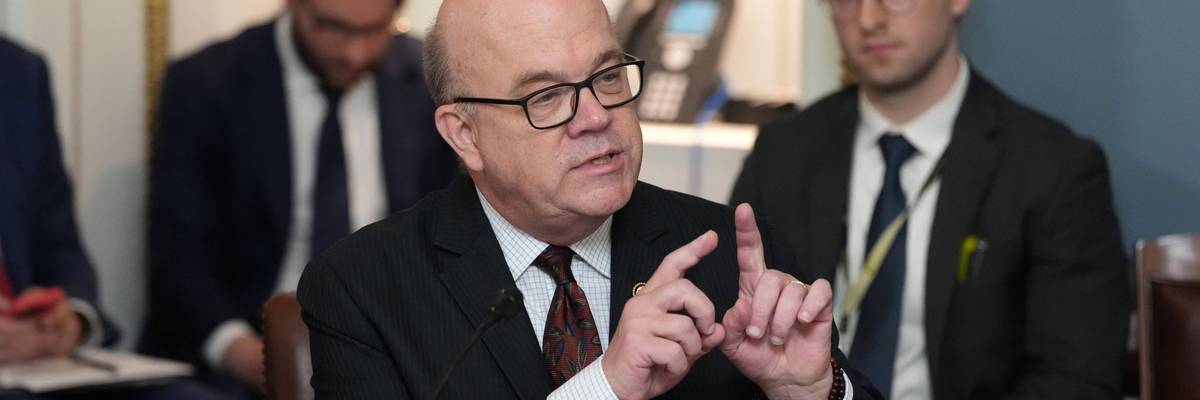
Rep. James McGovern (D-Mass.) speaks during a hearing at the US Capitol on May 21, 2025.
House Republicans Defeat Another Venezuela War Powers Resolution by 'Tightest Margin'
"The maniac in the White House does not have the authority to bomb and invade anywhere he wants across the globe," said Rep. Rashida Tlaib. "Congress must put an end to this."
The latest in a series of congressional efforts to rein in President Donald Trump's military aggression against Venezuela failed Thursday as Republican lawmakers again defeated a war powers resolution by the tightest possible margin.
House lawmakers voted 215-215 on H.Con.Res.68—introduced last month by Rep. James McGovern (D-Mass.)—which "directs the president to remove US armed forces from Venezuela unless a declaration of war or authorization to use military force for such purpose has been enacted."
Unlike in the Senate, where the vice president casts tie-breaking votes, a deadlock in the House means the legislation does not pass.
Every House Democrat and two Republicans—Reps. Don Bacon of Nebraska and Thomas Massie of Kentucky—voted in favor of the measure. Every other Republican voted against it. Rep. Tom McClintock (R-Calif.) did not vote.
The House vote came a week after Vice President JD Vance’s tie-breaking vote was needed to overcome a 50-50 deadlock on a similar resolution introduced last month by Sens. Tim Kaine (D-Va.), Rand Paul (R-Ky.), Adam Schiff (D-Calif.), and Senate Minority Leader Chuck Schumer (D-NY).
The War Powers Resolution of 1973—also known as the War Powers Act—was enacted during the Nixon administration toward the end of the US war on Vietnam, Cambodia, and Laos. The law empowers Congress to check the president’s war-making authority by requiring the president to report any military action to Congress within 48 hours. It also mandates that lawmakers approve any troop deployments lasting longer than 60 days.
Thursday's vote followed this month's US bombing and invasion of Venezuela and kidnapping of its president, Nicolás Maduro, and his wife on dubious "narco-terrorism" and drug trafficking allegations. Trump has also imposed an oil blockade on the South American nation, seizing seven tankers. Since September, the US has also been bombing boats accused of transporting drugs in the Caribbean Sea and Pacific Ocean.
"If the president is contemplating further military action, then he has a moral and constitutional obligation to come here and get our approval," McGovern said following the vote.
House Foreign Affairs Committee Ranking Member Gregory Meeks (D-NY) lamented the resolution's failure, saying, "The American people want us to lower their cost of living, not enable war."
Rep. Mark Pocan (D-Wis.) said on Bluesky: "Only Congress has the authority to declare war. Today, I voted for a war powers resolution to ensure Trump cannot send OUR armed forces to Venezuela without explicit authorization from Congress."
Cavan Kharrazian, senior policy adviser at the advocacy group Demand Progress, also decried the resolution's failure.
“We are deeply disappointed that the House did not pass this war powers resolution, though it's notable that it failed only due to a tie," he said.
"As with the recent Senate vote, the administration expended extraordinary energy pressuring Republicans to block this resolution," Kharrazian added. "That effort speaks for itself: With the American people tired of endless war, the administration knows that a Congress willing to enforce the law can meaningfully curtail illegal and escalatory military action. We urge members of Congress to continue fully exercising their constitutional authority over matters of war.”
We are at a crossroads
This country and this world are at a monumental crossroads. In a few short weeks, US voters will have an opportunity to beat back the forces of fascism and confront the billionaires who are rigging the economy, our media system, and our democracy, making it increasingly impossible for ordinary people to get by. We’re not just talking about the election. We’re talking about what must be done once these fascist elements are vanquished from power. We need a bolder set of solutions than what either major party has so far been willing to offer and a working-class movement ready to fight like hell for it. Trump didn't emerge from nowhere. The conditions that fueled MAGA authoritarianism were created by decades of radical neoliberal economic policies and a corrupt political system dominated by corporate interests. They slashed taxes on the super-rich, promising that the benefits would trickle down. They said giveaways to the corporate titans would make life more affordable for the rest of us. It was all bullshit. And when a bitter, betrayed populace searches for someone to blame, right-wing demagogues have little trouble finding scapegoats. People know when they're being lied to, but you won't hear any of this from the corporate media. Only independent journalism—powered and funded by people who believe in building a better world—can deliver truly trustworthy daily news. Our Fall Campaign is underway, and we need your help. To power our newsroom through the rest of the year, we need to raise $125,000 by midnight on October 31. So if you share our vision, please contribute whatever you can to sustain our work. |
The latest in a series of congressional efforts to rein in President Donald Trump's military aggression against Venezuela failed Thursday as Republican lawmakers again defeated a war powers resolution by the tightest possible margin.
House lawmakers voted 215-215 on H.Con.Res.68—introduced last month by Rep. James McGovern (D-Mass.)—which "directs the president to remove US armed forces from Venezuela unless a declaration of war or authorization to use military force for such purpose has been enacted."
Unlike in the Senate, where the vice president casts tie-breaking votes, a deadlock in the House means the legislation does not pass.
Every House Democrat and two Republicans—Reps. Don Bacon of Nebraska and Thomas Massie of Kentucky—voted in favor of the measure. Every other Republican voted against it. Rep. Tom McClintock (R-Calif.) did not vote.
The House vote came a week after Vice President JD Vance’s tie-breaking vote was needed to overcome a 50-50 deadlock on a similar resolution introduced last month by Sens. Tim Kaine (D-Va.), Rand Paul (R-Ky.), Adam Schiff (D-Calif.), and Senate Minority Leader Chuck Schumer (D-NY).
The War Powers Resolution of 1973—also known as the War Powers Act—was enacted during the Nixon administration toward the end of the US war on Vietnam, Cambodia, and Laos. The law empowers Congress to check the president’s war-making authority by requiring the president to report any military action to Congress within 48 hours. It also mandates that lawmakers approve any troop deployments lasting longer than 60 days.
Thursday's vote followed this month's US bombing and invasion of Venezuela and kidnapping of its president, Nicolás Maduro, and his wife on dubious "narco-terrorism" and drug trafficking allegations. Trump has also imposed an oil blockade on the South American nation, seizing seven tankers. Since September, the US has also been bombing boats accused of transporting drugs in the Caribbean Sea and Pacific Ocean.
"If the president is contemplating further military action, then he has a moral and constitutional obligation to come here and get our approval," McGovern said following the vote.
House Foreign Affairs Committee Ranking Member Gregory Meeks (D-NY) lamented the resolution's failure, saying, "The American people want us to lower their cost of living, not enable war."
Rep. Mark Pocan (D-Wis.) said on Bluesky: "Only Congress has the authority to declare war. Today, I voted for a war powers resolution to ensure Trump cannot send OUR armed forces to Venezuela without explicit authorization from Congress."
Cavan Kharrazian, senior policy adviser at the advocacy group Demand Progress, also decried the resolution's failure.
“We are deeply disappointed that the House did not pass this war powers resolution, though it's notable that it failed only due to a tie," he said.
"As with the recent Senate vote, the administration expended extraordinary energy pressuring Republicans to block this resolution," Kharrazian added. "That effort speaks for itself: With the American people tired of endless war, the administration knows that a Congress willing to enforce the law can meaningfully curtail illegal and escalatory military action. We urge members of Congress to continue fully exercising their constitutional authority over matters of war.”
- Senators Launch Bipartisan Bid to Block Trump War on Venezuela ›
- Omar Brings War Powers Resolution After Trump Bombed Boat in Caribbean With 'No Legal Justification' ›
- 'Absolute Dereliction of Duty': House Republicans Kill Venezuela War Powers Resolutions ›
- Fetterman Joins GOP to Kill War Powers Resolution Against Trump's Extrajudicial Venezuela Bombings ›
The latest in a series of congressional efforts to rein in President Donald Trump's military aggression against Venezuela failed Thursday as Republican lawmakers again defeated a war powers resolution by the tightest possible margin.
House lawmakers voted 215-215 on H.Con.Res.68—introduced last month by Rep. James McGovern (D-Mass.)—which "directs the president to remove US armed forces from Venezuela unless a declaration of war or authorization to use military force for such purpose has been enacted."
Unlike in the Senate, where the vice president casts tie-breaking votes, a deadlock in the House means the legislation does not pass.
Every House Democrat and two Republicans—Reps. Don Bacon of Nebraska and Thomas Massie of Kentucky—voted in favor of the measure. Every other Republican voted against it. Rep. Tom McClintock (R-Calif.) did not vote.
The House vote came a week after Vice President JD Vance’s tie-breaking vote was needed to overcome a 50-50 deadlock on a similar resolution introduced last month by Sens. Tim Kaine (D-Va.), Rand Paul (R-Ky.), Adam Schiff (D-Calif.), and Senate Minority Leader Chuck Schumer (D-NY).
The War Powers Resolution of 1973—also known as the War Powers Act—was enacted during the Nixon administration toward the end of the US war on Vietnam, Cambodia, and Laos. The law empowers Congress to check the president’s war-making authority by requiring the president to report any military action to Congress within 48 hours. It also mandates that lawmakers approve any troop deployments lasting longer than 60 days.
Thursday's vote followed this month's US bombing and invasion of Venezuela and kidnapping of its president, Nicolás Maduro, and his wife on dubious "narco-terrorism" and drug trafficking allegations. Trump has also imposed an oil blockade on the South American nation, seizing seven tankers. Since September, the US has also been bombing boats accused of transporting drugs in the Caribbean Sea and Pacific Ocean.
"If the president is contemplating further military action, then he has a moral and constitutional obligation to come here and get our approval," McGovern said following the vote.
House Foreign Affairs Committee Ranking Member Gregory Meeks (D-NY) lamented the resolution's failure, saying, "The American people want us to lower their cost of living, not enable war."
Rep. Mark Pocan (D-Wis.) said on Bluesky: "Only Congress has the authority to declare war. Today, I voted for a war powers resolution to ensure Trump cannot send OUR armed forces to Venezuela without explicit authorization from Congress."
Cavan Kharrazian, senior policy adviser at the advocacy group Demand Progress, also decried the resolution's failure.
“We are deeply disappointed that the House did not pass this war powers resolution, though it's notable that it failed only due to a tie," he said.
"As with the recent Senate vote, the administration expended extraordinary energy pressuring Republicans to block this resolution," Kharrazian added. "That effort speaks for itself: With the American people tired of endless war, the administration knows that a Congress willing to enforce the law can meaningfully curtail illegal and escalatory military action. We urge members of Congress to continue fully exercising their constitutional authority over matters of war.”
- Senators Launch Bipartisan Bid to Block Trump War on Venezuela ›
- Omar Brings War Powers Resolution After Trump Bombed Boat in Caribbean With 'No Legal Justification' ›
- 'Absolute Dereliction of Duty': House Republicans Kill Venezuela War Powers Resolutions ›
- Fetterman Joins GOP to Kill War Powers Resolution Against Trump's Extrajudicial Venezuela Bombings ›