

SUBSCRIBE TO OUR FREE NEWSLETTER
Daily news & progressive opinion—funded by the people, not the corporations—delivered straight to your inbox.
5
#000000
#FFFFFF
To donate by check, phone, or other method, see our More Ways to Give page.
Daily news & progressive opinion—funded by the people, not the corporations—delivered straight to your inbox.
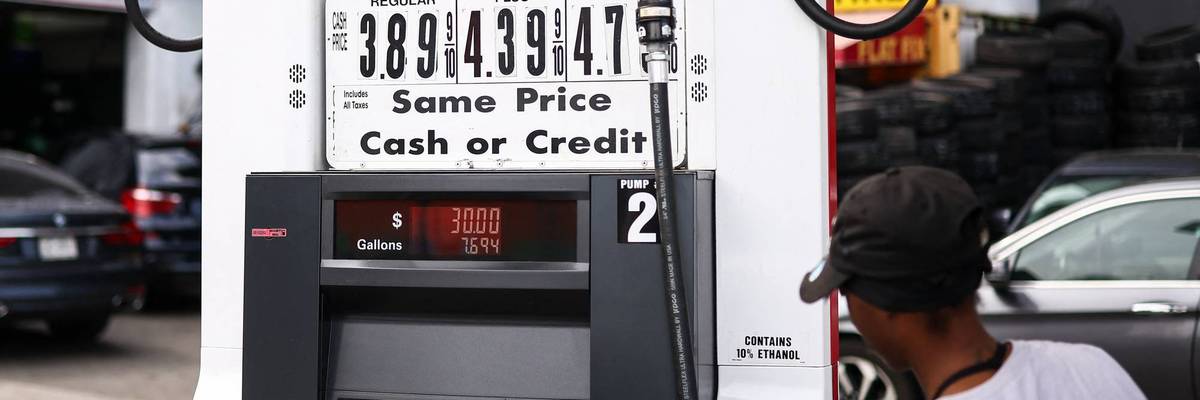
Prices are displayed at the pump as a woman fills up her vehicle's tank at a gas station in New York City on March 31, 2026.
“From the grocery store to the doctor’s office to the gas pump, congressional Republicans are financially crushing working Americans at every turn," said one economic justice campaigner.
As President Donald Trump's Pentagon pushed Congress to approve $1.5 trillion in new military funding, including $200 billion for the US-Israeli war on Iran, congressional Democrats found that the working Americans whose taxes would fund those appropriations have spent $8.4 billion that otherwise could have gone to groceries, childcare, and other essentials—all at the gas pump.
Democratic members of the Joint Economic Committee released a report Thursday—two days after average gas prices in the US reached $4 per gallon, the highest in nearly four years—showing that those higher prices have forced Americans to pay 35% more on gas than they did a month ago, before Trump joined Israeli Prime Minister Benjamin Netanyahu in attacking Iran.
A month after Iran closed the Strait of Hormuz in retaliation for the war that's killed more than 2,000 Iranians and well over 1,000 people across the Middle East as the conflict has widened, it now costs $145 to fill up just one gas tank for a Ford F-150 pickup truck—$37 more than it did in February.
An SUV costs an average of $58 to fill up, an increase of $15, while a sedan costs $52 on average—$13 more than it did before the war.
The analysis was released a day after Trump unequivocally stated that, despite his campaign pledge to make life more affordable for Americans, his administration's priority is "fighting wars," not ensuring the government provides childcare and healthcare that families can afford.
"We can’t take care of daycare," said Trump. “It’s not possible for us to take care of daycare, Medicaid, Medicare, all these individual things.”
“Families are paying more at the pump because Republicans in Congress would rather spend billions of dollars on a war that raises costs than find ways to actually make life more affordable."
The advocacy group Unrig Our Economy noted Friday that the war in Iran, which is supported by nearly every Republican in Congress—is just the latest way in which the GOP under the Trump administration has "raised costs and squeezed families." The Joint Economic Committee found in February that Americans had gotten stuck with the bill due to Trump's aggressive tariffs on imports, which he had claimed would generate massive revenue—but which actually cost the average family more than $1,700 in one year as companies passed off the higher cost of goods and materials to consumers.
“From the grocery store to the doctor’s office to the gas pump, congressional Republicans are financially crushing working Americans at every turn," said Unrig Our Economy campaign director Leor Tal.
The committee Democrats also found last month that the average US electric bill rose by $110, or 6.4%, in 2025, driven by Trump's cancellations of renewable energy projects, his push for liquefied natural gas exports, and his demand for an expansion of artificial intelligence data centers.
"Meanwhile, [Republican] attacks on Americans’ healthcare have sent premiums skyrocketing and put over 15 million Americans at risk of losing health insurance. Now, they want to cut healthcare even more to bankroll their costly and unnecessary war," said Unrig Our Economy, referring to Republicans' call to further cut federal health spending to pay for the Iran war.
As Americans have spent more at the gas pump and the White House has offered shifting explanations for why the US continues to wage war on Iran, public approval for the conflict has remained low. Nearly 60% of Americans said late last month that the war has already gone "too far" as the president threatened to escalate further, and 56% of respondents to a poll by Data for Progress said they believe the conflict will benefit Israel, not the US.
This week, two-thirds of people who responded to a CNN poll said they disapproved of the war and did not believe Trump has a clear plan. More than three-quarters said they would not support the Pentagon's request for $200 billion to fund further military action.
But Trump, who White House Chief of Staff Susie Wiles admitted this week has been getting a "rose-colored view" of the war in Iran during official briefings, told reporters Thursday that Americans are so relieved that the US and Israel are attacking Iran and killed Ayatollah Ali Khamenei on the first day of the war that they are not concerned about the financial toll the war is taking on their families.
"We have a country that's not going to be throwing a nuclear weapon at us in six months," said Trump. "They're feeling a lot safer."
US intelligence has determined Iran did not pose an imminent threat to the United States.
“Families are paying more at the pump," said Tal, "because Republicans in Congress would rather spend billions of dollars on a war that raises costs than find ways to actually make life more affordable."
Dear Common Dreams reader, It’s been nearly 30 years since I co-founded Common Dreams with my late wife, Lina Newhouser. We had the radical notion that journalism should serve the public good, not corporate profits. It was clear to us from the outset what it would take to build such a project. No paid advertisements. No corporate sponsors. No millionaire publisher telling us what to think or do. Many people said we wouldn't last a year, but we proved those doubters wrong. Together with a tremendous team of journalists and dedicated staff, we built an independent media outlet free from the constraints of profits and corporate control. Our mission has always been simple: To inform. To inspire. To ignite change for the common good. Building Common Dreams was not easy. Our survival was never guaranteed. When you take on the most powerful forces—Wall Street greed, fossil fuel industry destruction, Big Tech lobbyists, and uber-rich oligarchs who have spent billions upon billions rigging the economy and democracy in their favor—the only bulwark you have is supporters who believe in your work. But here’s the urgent message from me today. It's never been this bad out there. And it's never been this hard to keep us going. At the very moment Common Dreams is most needed, the threats we face are intensifying. We need your support now more than ever. We don't accept corporate advertising and never will. We don't have a paywall because we don't think people should be blocked from critical news based on their ability to pay. Everything we do is funded by the donations of readers like you. When everyone does the little they can afford, we are strong. But if that support retreats or dries up, so do we. Will you donate now to make sure Common Dreams not only survives but thrives? —Craig Brown, Co-founder |
As President Donald Trump's Pentagon pushed Congress to approve $1.5 trillion in new military funding, including $200 billion for the US-Israeli war on Iran, congressional Democrats found that the working Americans whose taxes would fund those appropriations have spent $8.4 billion that otherwise could have gone to groceries, childcare, and other essentials—all at the gas pump.
Democratic members of the Joint Economic Committee released a report Thursday—two days after average gas prices in the US reached $4 per gallon, the highest in nearly four years—showing that those higher prices have forced Americans to pay 35% more on gas than they did a month ago, before Trump joined Israeli Prime Minister Benjamin Netanyahu in attacking Iran.
A month after Iran closed the Strait of Hormuz in retaliation for the war that's killed more than 2,000 Iranians and well over 1,000 people across the Middle East as the conflict has widened, it now costs $145 to fill up just one gas tank for a Ford F-150 pickup truck—$37 more than it did in February.
An SUV costs an average of $58 to fill up, an increase of $15, while a sedan costs $52 on average—$13 more than it did before the war.
The analysis was released a day after Trump unequivocally stated that, despite his campaign pledge to make life more affordable for Americans, his administration's priority is "fighting wars," not ensuring the government provides childcare and healthcare that families can afford.
"We can’t take care of daycare," said Trump. “It’s not possible for us to take care of daycare, Medicaid, Medicare, all these individual things.”
“Families are paying more at the pump because Republicans in Congress would rather spend billions of dollars on a war that raises costs than find ways to actually make life more affordable."
The advocacy group Unrig Our Economy noted Friday that the war in Iran, which is supported by nearly every Republican in Congress—is just the latest way in which the GOP under the Trump administration has "raised costs and squeezed families." The Joint Economic Committee found in February that Americans had gotten stuck with the bill due to Trump's aggressive tariffs on imports, which he had claimed would generate massive revenue—but which actually cost the average family more than $1,700 in one year as companies passed off the higher cost of goods and materials to consumers.
“From the grocery store to the doctor’s office to the gas pump, congressional Republicans are financially crushing working Americans at every turn," said Unrig Our Economy campaign director Leor Tal.
The committee Democrats also found last month that the average US electric bill rose by $110, or 6.4%, in 2025, driven by Trump's cancellations of renewable energy projects, his push for liquefied natural gas exports, and his demand for an expansion of artificial intelligence data centers.
"Meanwhile, [Republican] attacks on Americans’ healthcare have sent premiums skyrocketing and put over 15 million Americans at risk of losing health insurance. Now, they want to cut healthcare even more to bankroll their costly and unnecessary war," said Unrig Our Economy, referring to Republicans' call to further cut federal health spending to pay for the Iran war.
As Americans have spent more at the gas pump and the White House has offered shifting explanations for why the US continues to wage war on Iran, public approval for the conflict has remained low. Nearly 60% of Americans said late last month that the war has already gone "too far" as the president threatened to escalate further, and 56% of respondents to a poll by Data for Progress said they believe the conflict will benefit Israel, not the US.
This week, two-thirds of people who responded to a CNN poll said they disapproved of the war and did not believe Trump has a clear plan. More than three-quarters said they would not support the Pentagon's request for $200 billion to fund further military action.
But Trump, who White House Chief of Staff Susie Wiles admitted this week has been getting a "rose-colored view" of the war in Iran during official briefings, told reporters Thursday that Americans are so relieved that the US and Israel are attacking Iran and killed Ayatollah Ali Khamenei on the first day of the war that they are not concerned about the financial toll the war is taking on their families.
"We have a country that's not going to be throwing a nuclear weapon at us in six months," said Trump. "They're feeling a lot safer."
US intelligence has determined Iran did not pose an imminent threat to the United States.
“Families are paying more at the pump," said Tal, "because Republicans in Congress would rather spend billions of dollars on a war that raises costs than find ways to actually make life more affordable."
As President Donald Trump's Pentagon pushed Congress to approve $1.5 trillion in new military funding, including $200 billion for the US-Israeli war on Iran, congressional Democrats found that the working Americans whose taxes would fund those appropriations have spent $8.4 billion that otherwise could have gone to groceries, childcare, and other essentials—all at the gas pump.
Democratic members of the Joint Economic Committee released a report Thursday—two days after average gas prices in the US reached $4 per gallon, the highest in nearly four years—showing that those higher prices have forced Americans to pay 35% more on gas than they did a month ago, before Trump joined Israeli Prime Minister Benjamin Netanyahu in attacking Iran.
A month after Iran closed the Strait of Hormuz in retaliation for the war that's killed more than 2,000 Iranians and well over 1,000 people across the Middle East as the conflict has widened, it now costs $145 to fill up just one gas tank for a Ford F-150 pickup truck—$37 more than it did in February.
An SUV costs an average of $58 to fill up, an increase of $15, while a sedan costs $52 on average—$13 more than it did before the war.
The analysis was released a day after Trump unequivocally stated that, despite his campaign pledge to make life more affordable for Americans, his administration's priority is "fighting wars," not ensuring the government provides childcare and healthcare that families can afford.
"We can’t take care of daycare," said Trump. “It’s not possible for us to take care of daycare, Medicaid, Medicare, all these individual things.”
“Families are paying more at the pump because Republicans in Congress would rather spend billions of dollars on a war that raises costs than find ways to actually make life more affordable."
The advocacy group Unrig Our Economy noted Friday that the war in Iran, which is supported by nearly every Republican in Congress—is just the latest way in which the GOP under the Trump administration has "raised costs and squeezed families." The Joint Economic Committee found in February that Americans had gotten stuck with the bill due to Trump's aggressive tariffs on imports, which he had claimed would generate massive revenue—but which actually cost the average family more than $1,700 in one year as companies passed off the higher cost of goods and materials to consumers.
“From the grocery store to the doctor’s office to the gas pump, congressional Republicans are financially crushing working Americans at every turn," said Unrig Our Economy campaign director Leor Tal.
The committee Democrats also found last month that the average US electric bill rose by $110, or 6.4%, in 2025, driven by Trump's cancellations of renewable energy projects, his push for liquefied natural gas exports, and his demand for an expansion of artificial intelligence data centers.
"Meanwhile, [Republican] attacks on Americans’ healthcare have sent premiums skyrocketing and put over 15 million Americans at risk of losing health insurance. Now, they want to cut healthcare even more to bankroll their costly and unnecessary war," said Unrig Our Economy, referring to Republicans' call to further cut federal health spending to pay for the Iran war.
As Americans have spent more at the gas pump and the White House has offered shifting explanations for why the US continues to wage war on Iran, public approval for the conflict has remained low. Nearly 60% of Americans said late last month that the war has already gone "too far" as the president threatened to escalate further, and 56% of respondents to a poll by Data for Progress said they believe the conflict will benefit Israel, not the US.
This week, two-thirds of people who responded to a CNN poll said they disapproved of the war and did not believe Trump has a clear plan. More than three-quarters said they would not support the Pentagon's request for $200 billion to fund further military action.
But Trump, who White House Chief of Staff Susie Wiles admitted this week has been getting a "rose-colored view" of the war in Iran during official briefings, told reporters Thursday that Americans are so relieved that the US and Israel are attacking Iran and killed Ayatollah Ali Khamenei on the first day of the war that they are not concerned about the financial toll the war is taking on their families.
"We have a country that's not going to be throwing a nuclear weapon at us in six months," said Trump. "They're feeling a lot safer."
US intelligence has determined Iran did not pose an imminent threat to the United States.
“Families are paying more at the pump," said Tal, "because Republicans in Congress would rather spend billions of dollars on a war that raises costs than find ways to actually make life more affordable."

